
Versteeg H., Malalasekra W. An Introduction to Computational Fluid Dynamics: The Finite Volume Method
Подождите немного. Документ загружается.


8.5 DISCRETISATION OF TRANSIENT C---D EQUATION 257
Discretisation
of transient
convection---
diffusion equation
In the fully implicit discretisation approach outlined above for multi-
dimensional diffusion problems, the term arising from temporal discretisation
appears as (i) the contribution of a
o
P
to the central coefficient a
P
and (ii) the
contribution of a
o
P
φ
o
P
as an additional source term on the right hand side. The
other coefficients are unaltered and are the same as in the discretised equa-
tions for steady state problems. Using this as a basis the discretised equations
for transient convection–diffusion equations are also simple to obtain. The
unsteady transport of a property
φ
is given by
(
ρφ
) + div(
ρ
u
φ
) = div(Γ grad
φ
) + S
φ
(8.29)
The hybrid differencing scheme was recommended in Chapter 5 on the
grounds of its stability as the preferred method for treatment of convection
terms, so here we quote the implicit/hybrid difference form of the transient
convection–diffusion equations.
Transient three-dimensional convection–diffusion of a general property
φ
in a velocity field u is governed by
+++
=Γ +Γ +Γ +S (8.30)
The fully implicit discretisation equation is
a
P
φ
P
= a
W
φ
W
+ a
E
φ
E
+ a
S
φ
S
+ a
N
φ
N
+ a
B
φ
B
+ a
T
φ
T
+ a
o
P
φ
o
P
+ S
u
(8.31)
where
a
P
= a
W
+ a
E
+ a
S
+ a
N
+ a
B
+ a
T
+ a
o
P
+∆F − S
P
with
a
o
P
=
and
D∆V = S
u
+ S
p
φ
P
The neighbour coefficients of this equation for the hybrid differencing
scheme are as follows:
ρ
o
P
∆V
∆t
D
E
F
∂φ
∂
z
A
B
C
∂
∂
z
D
E
F
∂φ
∂
y
A
B
C
∂
∂
y
D
E
F
∂φ
∂
x
A
B
C
∂
∂
x
∂
(
ρ
w
φ
)
∂
z
∂
(
ρ
v
φ
)
∂
y
∂
(
ρ
u
φ
)
∂
x
∂
(
ρφ
)
∂
t
∂
∂
t
8.5
ANIN_C08.qxd 29/12/2006 04:38PM Page 257

258 CHAPTER 8 THE FINITE VOLUME METHOD FOR UNSTEADY FLOWS
1D flow 2D flow 3D flow
a
W
max F
w
, D
w
+ , 0 max F
w
, D
w
+ , 0 max F
w
, D
w
+ , 0
a
E
max −F
e
, D
e
− , 0 max −F
e
, D
e
− , 0 max −F
e
, D
e
− , 0
a
S
– max F
s
, D
s
+ , 0 max F
s
, D
s
+ , 0
a
N
– max −F
n
, D
n
− , 0 max −F
n
, D
n
− , 0
a
B
– – max F
b
, D
b
+ , 0
a
T
– – max −F
t
, D
t
− , 0
∆FF
e
− F
w
F
e
− F
w
+ F
n
− F
s
F
e
− F
w
+ F
n
− F
s
+ F
t
− F
b
In the above expressions the values of F and D are calculated with the fol-
lowing formulae:
Face w e s n b t
F (
ρ
u)
w
A
w
(
ρ
u)
e
A
e
(
ρ
v)
s
A
s
(
ρ
v)
n
A
n
(
ρ
w)
b
A
b
(
ρ
w)
t
A
t
DA
w
A
e
A
s
A
n
A
b
A
t
The volumes and cell face areas given in section 8.4 apply here as well.
Other schemes such as linear upwind, QUICK or TVD may be incorpor-
ated into these equations by substituting the appropriate expressions for the
coefficients, as will be demonstrated in the following example.
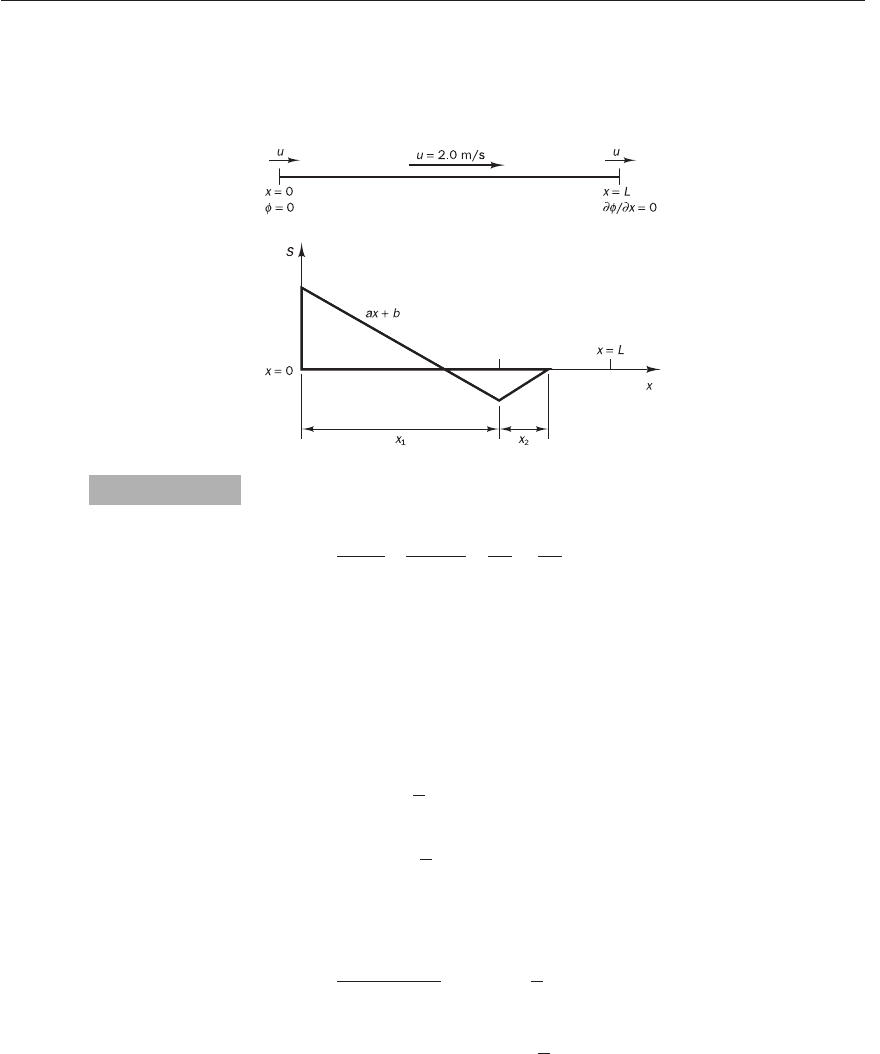
Consider convection and diffusion in the one-dimensional domain sketched
in Figure 8.7. Calculate the transient temperature field if the initial temper-
ature is zero everywhere and the boundary conditions are
φ
= 0 at x = 0 and
∂φ
/
∂
x = 0 at x = L. The data are L = 1.5 m, u = 2 m/s,
ρ
= 1.0 kg/m
3
and
Γ=0.03 kg/m.s. The source distribution defined by Figure 8.8 applies at
times t > 0 with a =−200, b = 100, x
1
= 0.6 m, x
2
= 0.2 m. Write a computer
Γ
t
δ
z
PT
Γ
b
δ
z
BP
Γ
n
δ
y
PN
Γ
s
δ
y
SP
Γ
e
δ
x
PE
Γ
w
δ
x
WP
J
K
L
D
E
F
F
t
2
A
B
C
G
H
I
J
K
L
D
E
F
F
b
2
A
B
C
G
H
I
J
K
L
D
E
F
F
n
2
A
B
C
G
H
I
J
K
L
D
E
F
F
n
2
A
B
C
G
H
I
J
K
L
D
E
F
F
s
2
A
B
C
G
H
I
J
K
L
D
E
F
F
s
2
A
B
C
G
H
I
J
K
L
D
E
F
F
e
2
A
B
C
G
H
I
J
K
L
D
E
F
F
e
2
A
B
C
G
H
I
J
K
L
D
E
F
F
e
2
A
B
C
G
H
I
J
K
L
D
E
F
F
w
2
A
B
C
G
H
I
J
K
L
D
E
F
F
w
2
A
B
C
G
H
I
J
K
L
D
E
F
F
w
2
A
B
C
G
H
I
Worked example of transient convection---diffusion using QUICK differencing8.6
Example 8.3
ANIN_C08.qxd 29/12/2006 04:38PM Page 258
8.6 WORKED EXAMPLE USING QUICK DIFFERENCING 259
program to calculate the transient temperature distribution until it reaches a
steady state using the implicit method for time integration and the Hayase
et al. variant of the QUICK scheme for the convective and diffusive terms,
and compare this result with the analytical steady state solution.
Figure 8.7
Figure 8.8 Geometry and
the source distribution for
Example 8.3
Solution
Transient convection–diffusion of a property
φ
subjected to a distributed
source term is governed by
+=Γ+S (8.32)
We use a 45-point grid to sub-divide the domain and perform all calculations
with a computer program. It is convenient to use the Hayase et al. formula-
tion of QUICK (see section 5.9.3) since it gives a tri-diagonal system of
equations which can be solved iteratively with the TDMA (see section 7.2).
The velocity is u = 2.0 m/s and the cell width is ∆x = 0.0333 so F =
ρ
u =
2.0 and D =Γ/∆x = 0.9 everywhere. The Hayase et al. formulation gives
φ
at cell faces by means of the following formulae:
φ
e
=
φ
P
+ (3
φ
E
− 2
φ
P
−
φ
W
) (8.33)
φ
w
=
φ
W
+ (3
φ
P
− 2
φ
W
−
φ
WW
) (8.34)
The implicit discretisation equation at a general node with Hayase et al.’s
QUICK scheme is given by
+ F
e
φ
P
+ (3
φ
E
− 2
φ
P
−
φ
W
)
− F
w
φ
W
+ (3
φ
P
− 2
φ
W
−
φ
WW
)
= D
e
(
φ
E
−
φ
P
) − D
w
(
φ
P
−
φ
W
) (8.35)
The first and last nodes need to be treated separately. At control volume 1
the mirror node approach, introduced in section 5.9.1, can be used to create
J
K
L
1
8
G
H
I
J
K
L
1
8
G
H
I
ρ
(
φ
P
−
φ
o
P
)∆x
∆t
1
8
1
8
D
E
F
∂φ
∂
x
A
B
C
∂
∂
x
∂
(
ρ
u
φ
)
∂
x
∂
(
ρφ
)
∂
t
ANIN_C08.qxd 29/12/2006 04:38PM Page 259

260 CHAPTER 8 THE FINITE VOLUME METHOD FOR UNSTEADY FLOWS
a west (W) node beyond the boundary at x = 0. Since
φ
A
= 0 at this bound-
ary (A) the linearly extrapolated value at the mirror node is given by
φ
0
=−
φ
P
(8.36)
and the diffusive flux at the boundary by
Γ
A
= (9
φ
P
− 8
φ
A
−
φ
E
) (8.37)
where D *
A
=Γ/∆x
The discretisation equation at node 1 may be written as
+ F
e
φ
P
+ (3
φ
E
−
φ
P
) − F
A
φ
A
= D
e
(
φ
E
−
φ
P
) − (9
φ
P
− 8
φ
A
−
φ
E
) (8.38)
At the last control volume, the zero gradient boundary condition applies so
the diffusive flux through the boundary B equals zero and the value
φ
at the
boundary is equal to the upstream nodal value, i.e.
φ
B
=
φ
P
. The discretisa-
tion equation for control volume 45 becomes
+ F
B
φ
P
− F
w
φ
W
+ (3
φ
P
− 2
φ
W
−
φ
WW
)
= 0 − D
w
(
φ
P
−
φ
W
) (8.39)
These discretisation equations (8.35), (8.37) and (8.40) are now cast in
standard form:
a
P
φ
P
= a
W
φ
W
+ a
E
φ
E
+ a
o
P
φ
o
P
+ S
u
(8.40)
with
a
P
= a
W
+ a
E
+ a
o
P
+ (F
e
− F
w
) − S
P
a
o
P
=
and
Node a
W
a
E
S
P
S
u
10 D
e
+−D*
A
+ F
A
D*
A
+ F
A
φ
A
+ F
e
(
φ
P
− 3
φ
E
)
2 D
w
+ F
w
D
e
0 F
w
(3
φ
P
−
φ
W
) + F
e
(
φ
W
+ 2
φ
P
− 3
φ
E
)
3–44 D
w
+ F
w
D
e
0 F
w
(3
φ
P
− 2
φ
W
−
φ
WW
) + F
e
(
φ
W
+ 2
φ
P
− 3
φ
E
)
45 D
w
+ F
w
00 F
w
(3
φ
P
− 2
φ
W
−
φ
WW
)
1
8
1
8
1
8
1
8
1
8
1
8
D
E
F
8
3
A
B
C
D
E
F
8
3
A
B
C
D*
A
3
ρ
∆x
∆t
J
K
L
1
8
G
H
I
ρ
(
φ
P
−
φ
o
P
)∆x
∆t
D*
A
3
J
K
L
1
8
G
H
I
ρ
(
φ
P
−
φ
o
P
)∆x
∆t
D*
A
3
∂φ
∂
x
ANIN_C08.qxd 29/12/2006 04:38PM Page 260

8.6 WORKED EXAMPLE USING QUICK DIFFERENCING 261
The discretisation equation for control volume 2 has been adjusted to take
into account the special expression that was used to evaluate the convective
flux through the cell face it has in common with control volume 1.
A time step ∆t = 0.01 s is selected, which is well within the stability limit
for explicit schemes, so we can look forward to reasonably accurate and
stable results with the implicit method. At any given time level substitution
of numerical values gives the coefficients summarised in Table 8.5.
Table 8.5
Node a
W
a
E
a
o
P
Total source S
P
a
P
1 0 1.2 3.33 4.4
φ
A
+ 0.25(
φ
P
− 3
φ
E
) + 3.33
φ
o
P
−4.4 8.93
2 2.9 0.9 3.33 0.25(5
φ
P
− 3
φ
E
) + 3.33
φ
o
P
0 7.13
3–44 2.9 0.9 3.33 0.25(5
φ
P
−
φ
W
−
φ
WW
− 3
φ
E
) + 3.33
φ
o
P
0 7.13
45 2.9 0 3.33 0.25(3
φ
P
− 2
φ
W
−
φ
WW
) + 3.33
φ
o
P
0 6.23
Starting with an initial field of
φ
o
P
= 0 at all nodes, the set of equations
defined by the coefficients and source contributions in Table 8.5 is solved
iteratively until a converged solution
φ
P
is obtained. Subsequently, the
φ
P
-
values at the current time level are assigned to
φ
o
P
and the solution proceeds
to the next time level. To monitor whether the steady state has been reached
we track the difference between old and new
φ
P
-values. When this attains a
magnitude less than a prescribed small tolerance (say 10
−9
) the solution is
regarded as having reached the steady state.
The analytical solution
To find the exact steady state solution of (8.32) its time derivative is set to
zero and the resulting ordinary differential equation is integrated twice with
respect to x. The even periodic extension of the source distribution on an
interval (−L, L) is represented by means of a Fourier cosine series, which
gives the forcing function in the differential equation. Under the given
boundary conditions the solution to the problem is as follows:
φ
(x) = C
1
+ C
2
e
Px
− (Px + 1) − a
n
P sin
+ cos
P
2
+
2
(8.41)
with
P = C
2
=+ cos(n
π
)
P
2
+
2
and
C
1
=−C
2
++a
n
P
2
+
2
J
K
L
D
E
F
n
π
L
A
B
C
G
H
I
∞
∑
n =1
a
0
P
2
J
K
L
D
E
F
n
π
L
A
B
C
G
H
I
a
n
e
PL
∞
∑
n=1
a
0
P
2
e
PL
ρ
u
Γ
J
K
L
D
E
F
n
π
L
A
B
C
G
H
I
J
K
L
D
E
F
n
π
x
L
A
B
C
D
E
F
n
π
L
A
B
C
D
E
F
n
π
x
L
A
B
C
G
H
I
D
E
F
L
n
π
A
B
C
∞
∑
n =1
a
0
P
2
ANIN_C08.qxd 29/12/2006 04:38PM Page 261
and
a
0
=
a
n
= cos
− a + cos
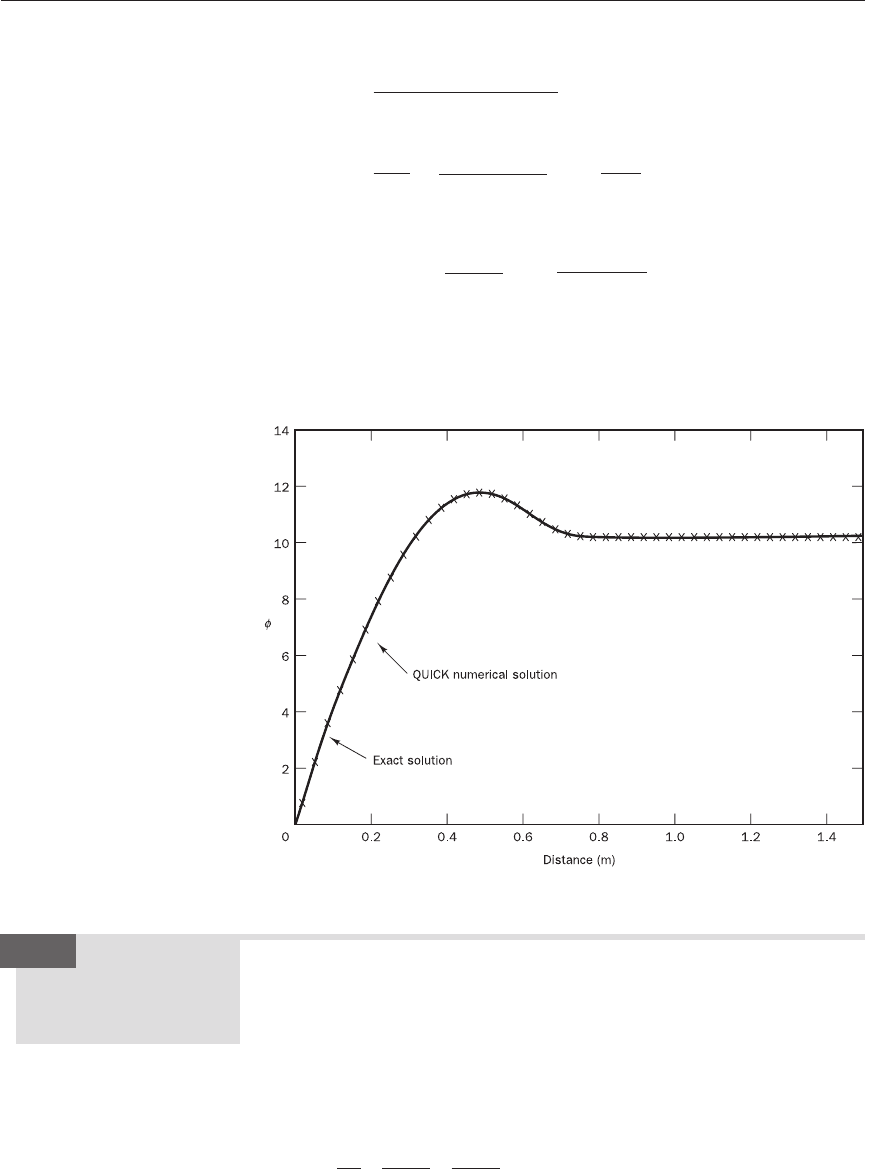
The analytical and numerical steady state solutions are compared in
Figure 8.9. As can be seen, the use of the QUICK scheme and a fine grid for
spatial discretisation ensures near-perfect agreement.
5
4
6
4
7
J
K
K
L
D
E
F
n
π
(x
1
+ x
2
)
L
A
B
C
D
E
F
ax
1
+ b
x
2
A
B
C
G
H
H
I
D
E
F
n
π
x
1
L
A
B
C
D
E
F
a(x
1
+ x
2
) + b
x
2
A
B
C
1
4
2
4
3
2L
n
2
π
2
(x
1
+ x
2
)(ax
1
+ b) + bx
1
2L
262 CHAPTER 8 THE FINITE VOLUME METHOD FOR UNSTEADY FLOWS
Figure 8.9 Comparison of the
numerical results with the
analytical solution
8.7.1 Transient SIMPLE
Algorithms such as SIMPLE, described in Chapter 6 for the calculation of
steady flows, may be extended to transient calculations. The discretised
momentum equations will now include transient terms formulated with the
procedure described in section 8.5. An additional term is also required in the
pressure correction equation. The continuity equation in a transient two-
dimensional flow is given by
++=0 (8.42)
∂
(
ρ
v)
∂
y
∂
(
ρ
u)
∂
x
∂ρ
∂
t
Solution
procedures for
unsteady flow
calculations
8.7
ANIN_C08.qxd 29/12/2006 04:38PM Page 262

8.7 PROCEDURES FOR UNSTEADY FLOW CALCULATIONS 263
The integrated form of this equation over a two-dimensional scalar control
volume becomes
∆V + [(
ρ
uA)
e
− (
ρ
uA)
w
] + [(
ρ
uA)
n
− (
ρ
uA)
s
] = 0 (8.43)
The pressure correction equation is derived from the continuity equation
and should therefore contain terms representing its transient behaviour. For
example, the equivalent of pressure correction equation (6.32) for a two-
dimensional transient flow will take the form
a
I, J
p′
I , J
= a
I+1, J
p′
I +1, J
+ a
I −1, J
p′
I −1, J
+ a
I, J+1
p′
I , J+1
+ a
I, J −1
p′
I , J−1
+ b′
I, J
(8.44)
where
a
I, J
= a
I+1, J
+ a
I−1, J
+ a
I, J+1
+ a
I, J −1
and
b′
I, J
= (
ρ
u*A)
i , J
− (
ρ
u*A)
i+1, J
+ (
ρ
v*A)
I, j
− (
ρ
v*A)
I, j+1
+
with neighbour coefficients
a
I−1, J
a
I+1, J
a
I, J −1
a
I, J+1
(
ρ
dA)
i , J
(
ρ
dA)
i +1, J
(
ρ
dA)
I , j
(
ρ
dA)
I, j+1
The extension to three-dimensional flows includes the same extra term in the
source.
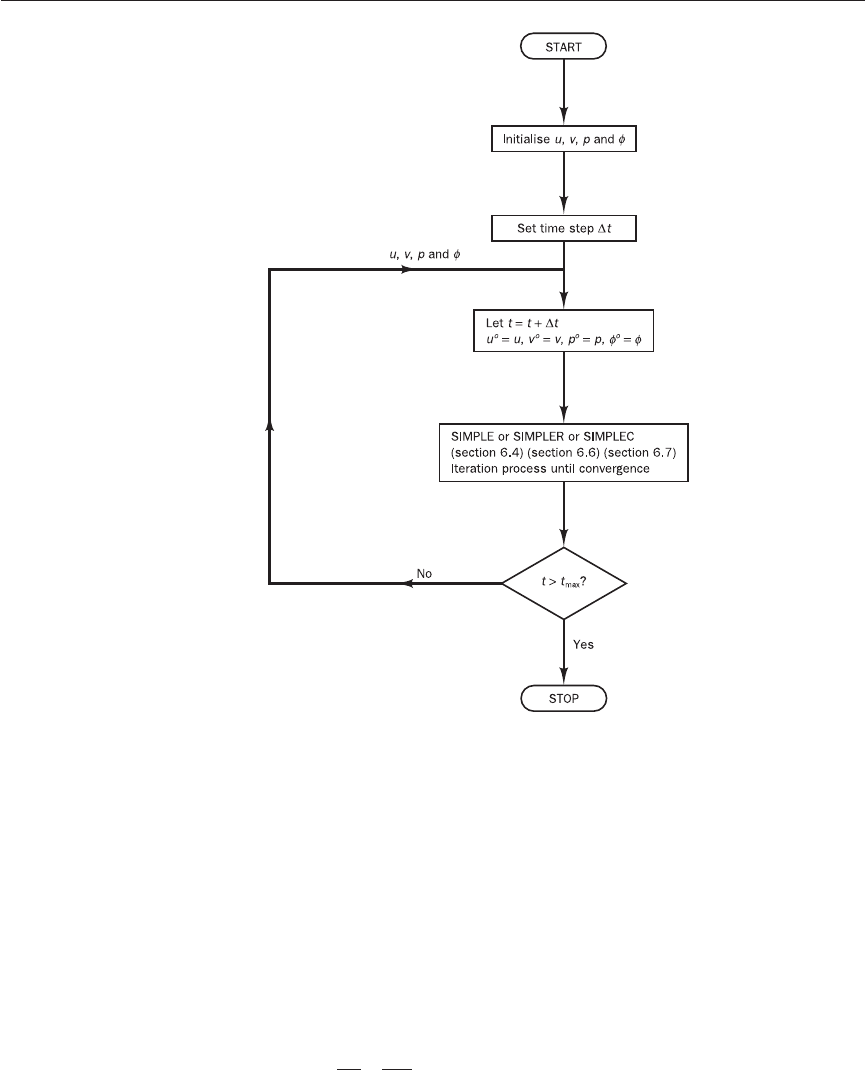
In transient flow calculations with the implicit formulation, the iterative
procedures described for steady state calculations employing SIMPLE,
SIMPLER or SIMPLEC are applied at each time level until convergence is
achieved. Figure 8.10 shows the algorithm structure.
8.7.2 The transient PISO algorithm
The PISO algorithm is a non-iterative transient calculation procedure. It
relies on the temporal accuracy gained by the discretisation practice, in
particular the operator splitting technique (Issa, 1986). In the transient
algorithm all time-dependent terms are retained in the momentum and con-
tinuity equations. This gives the following additional contributions to the
momentum and pressure correction equations in the transient form of PISO:
• add a
o
P
=
ρ
o
P
∆V/∆t to the central coefficients of the discretised u- and
v-momentum equations (6.12)–(6.13) and (6.52)–(6.53) respectively
• add a
o
P
u
o
P
and a
o
P
v
o
P
to the source terms of the u- and v-momentum equations
• add (
ρ
o
P
−
ρ
P
)∆V/∆t to the source term of both the first and second
discretised pressure correction equations
Otherwise the basic equations and steps involved in the transient version of
the PISO algorithm are the same as those set out in section 6.8. The PISO
procedure explained there is carried out at each time level to calculate the
velocity and pressure fields. Issa (1986) shows that the temporal accuracy
(
ρ
o
P
−
ρ
P
)∆V
∆t
(
ρ
P
−
ρ
o
P
)
∆t
ANIN_C08.qxd 29/12/2006 04:38PM Page 263
achieved by the predictor–corrector process for pressure and momentum is
third-order (∆t
3
) and fourth-order (∆t
4
) respectively. Therefore, the pressure
and velocity fields obtained at the end of the PISO process with a suitably
small time step are considered to be accurate enough to proceed to the next
time step immediately and the algorithm is non-iterative.
Since the algorithm relies on the higher-order temporal accuracy gained
by the splitting technique, small time steps are recommended to ensure accur-
ate results. If necessary, a higher-order temporal differencing scheme may be
incorporated in the algorithm for improved performance, such as a second-
order implicit scheme that uses three time levels n + 1, n, n − 1 at intervals
of ∆t. We may use the gradient at time level n of the quadratic profile passing
through T
n+1
, T
n
and T
n −1
to evaluate
∂
T/
∂
t. The resulting time discretisa-
tion with second-order accuracy is
= (3T
n +1
− 4T
n
+ T
n −1
) (8.45)
Incorporation of the scheme to formulate discretised equations is relatively
straightforward. The values at time level n and n − 1 known from previous
time steps are treated as source terms and are placed on the right hand side
of the equation.
1
2∆t
∂
T
∂
t
264 CHAPTER 8 THE FINITE VOLUME METHOD FOR UNSTEADY FLOWS
Figure 8.10 Transient flow
SIMPLE algorithm and its
variants
ANIN_C08.qxd 29/12/2006 04:38PM Page 264

8.9 A BRIEF NOTE ON OTHER TRANSIENT SCHEMES 265
The PISO method has yielded accurate results with sufficiently small
time steps (see e.g. Issa et al, 1986; Kim and Benson, 1992). Since the PISO
method does not require iterations within a time level it is less expensive than
the implicit SIMPLE algorithm. CFD simulation of flow and heat transfer
in internal combustion engines requires transient calculations that are
inevitably time consuming and expensive, especially with three-dimensional
geometries. Ahmadi-Befrui et al (1990) have presented a version of PISO
known as EPISO suitable for predicting engine flows.
It was mentioned in Chapter 6 that under-relaxation is necessary to stabilise
the iterative process of obtaining steady state solutions. The under-relaxed
form of the two-dimensional u-momentum equation, for example, takes the
form
u
i, J
=∑a
nb
u
nb
+ (p
I−1, J
− p
I, J
)A
i, J
+ b
i, J
+ (1 −
α
u
) u
(n−1)
i , J
(8.46)
Compare this with the transient (implicit) u-momentum equation
a
i, J
+ u
i , J
=∑a
nb
u
nb
+ (p
I−1, J
− p
I , J
)A
i , J
+ b
i, J
+ u
o
i , J
(8.47)
In equation (8.46) the superscript (n − 1) indicates the previous iteration
and in equation (8.47) superscript o represents the previous time level. We
immediately note a clear analogy between transient calculations and under-
relaxation in steady state calculations. It can be easily deduced that
(1 −
α
u
) = (8.48)
This formula shows that it is possible to achieve the effects of under-relaxed
iterative steady state calculations from a given initial field by means of a
pseudo-transient computation starting from the same initial field by taking
a step size that satisfies (8.48). Alternatively steady state calculations may be
interpreted as pseudo-transient solutions with spatially varying time steps.
The pseudo-transient approach is useful for situations in which governing
equations give rise to stability problems, e.g. buoyant flows, highly swirling
flows and compressible flows with shocks.
Other transient flow calculation procedures such as MAC (Harlow and Welch,
1965), SMAC (Amsden and Harlow, 1970), ICE (Harlow and Amsden, 1971)
and ICED-ALE (Hirt et al., 1974) are available to the user. The calculation
methodology of this class of schemes includes the direct solution of a Poisson
equation for the pressure as a central feature of the algorithm. The overall
calculation process is different from the techniques explained here and the
interested reader is referred to cited references for more details. The well-
known engine prediction code KIVA uses the ICED-ALE method as the
core solution procedure. The method has been shown to be reliable for pre-
dicting practical internal combustion engine flows and is widely used for
internal combustion engine research (see Amsden et al., 1985, 1989; Zellat
ρ
o
i , J
∆V
∆t
a
i , J
α
u
ρ
o
i , J
∆V
∆t
D
E
F
ρ
o
i , J
∆V
∆t
A
B
C
J
K
L
a
i , J
α
u
G
H
I
a
i, J
α
u
Steady
state calculations
using the pseudo-
transient approach
8.8
A brief
note on other
transient schemes
8.9
ANIN_C08.qxd 29/12/2006 04:38PM Page 265

et al., 1990; Blunsdon et al., 1992, 1993). Kim and Benson (1992) compared
the PISO method with the SMAC algorithms for the prediction of unsteady
flows and reported that SMAC was more efficient, faster and more accurate
than PISO. The MAC/ICE class of methods are, however, mathem-
atically complex and not widely used in general-purpose CFD procedures.
Techniques for the solution of transient flow problems were developed
by considering the unsteady diffusion and convection–diffusion equations.
We distinguish between the following time-stepping algorithms for the
computation of a variable
φ
at a new time level:
• explicit – uses only
φ
from the previous time level
• Crank–Nicolson – uses a mixture of
φ
from the previous time level and
φ
at a new time level
• implicit – uses mainly surrounding
φ
-values at the new time level
The stability and accuracy properties of each of the schemes are given in
Table 8.6 and described below.
266 CHAPTER 8 THE FINITE VOLUME METHOD FOR UNSTEADY FLOWS
Summary8.10
Table 8.6
Scheme Stability Accuracy Positive coefficient criterion
Explicit Conditionally stable First-order ∆t <
Crank–Nicolson Unconditionally stable Second-order ∆t <
Implicit Unconditionally stable First-order Always positive
ρ
(∆x)
2
Γ
ρ
(∆x)
2
2Γ
• For robust general-purpose transient CFD calculations the implicit
scheme is recommended. The unconditional stability of this and the
Crank–Nicolson scheme is, however, bought at the price of having to
solve a system of equations at each time level. In two- and three-
dimensional calculations this requires intermediate iterative stages.
• The (fully implicit) transient discretisation equations for diffusion
and convection–diffusion are practically the same as those of steady
problems apart from minor changes to the central coefficient a
P
and
the source term b
P
:
a
(t)
P
= a
(s)
P
+ a
o
P
and b
(t)
P
= b
(s)
P
+ a
o
P
φ
o
P
with a
o
P
=
ρ
o
P
∆V/∆t
The superscript (t) refers to the transient form and (s) to the steady form.
• In addition to the above modifications to the momentum equations in
SIMPLE its pressure correction equation also requires an addition of
(
ρ
o
P
−
ρ
P
)∆V/∆t to the source term b
P
. The time-stepping procedure
creates an extra loop outside the main iteration cycles of SIMPLE.
• The time accuracy of the second corrector step of PISO makes it very
attractive for non-iterative transient calculations.
• The similarity between the under-relaxed iterative solution and the
pseudo-transient solution was highlighted. The pseudo-transient
strategy has been widely used to combat stability problems in flows
with complex physics.
ANIN_C08.qxd 29/12/2006 04:38PM Page 266