
Versteeg H., Malalasekra W. An Introduction to Computational Fluid Dynamics: The Finite Volume Method
Подождите немного. Документ загружается.


All CFD problems are defined in terms of initial and boundary conditions.
It is important that the user specifies these correctly and understands their
role in the numerical algorithm. In transient problems the initial values of all
the flow variables need to be specified at all solution points in the flow domain.
Since this involves no special measures other than initialising the appropriate
data arrays in the CFD code, we do not need to discuss this topic further.
The present chapter describes the implementation in the discretised equations
of the finite volume method of the most common boundary conditions:
• inlet
• outlet
• wall
• prescribed pressure
• symmetry
• periodicity (or cyclic boundary condition)
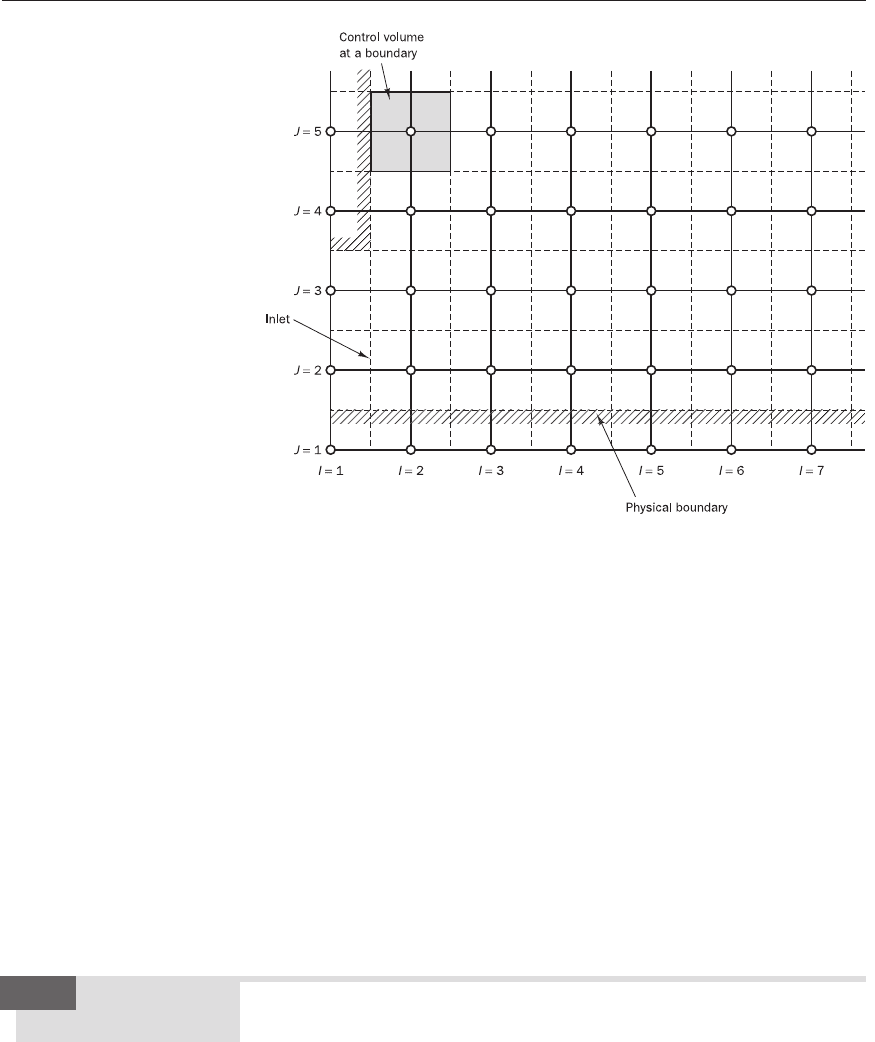
In constructing a staggered grid arrangement we set up additional nodes
surrounding the physical boundary, as illustrated in Figure 9.1. The calcu-
lations are performed at internal nodes only (I = 2 and J = 2 onwards). Two
notable features of the arrangement are (i) the physical boundaries coincide
with scalar control volume boundaries and (ii) the nodes just outside the inlet
of the domain (along I = 1 in Figure 9.1) are available to store the inlet con-
ditions. This enables the introduction of boundary conditions to be achieved
with small modifications to the discretised equations for near-boundary
internal nodes.
In Chapters 4 and 5 we saw that boundary conditions enter the discretised
equations by suppression of the link to the boundary side and modification
of the source terms. The appropriate coefficient of the discretised equation
is set to zero and the boundary side flux – exact or linearly approximated –
is introduced through source terms S
u
and S
p
. We will frequently make use
of this device to fix the flux of a variable at a cell face, but we also need a tech-
nique to cope with situations where we need to set the value of a variable at
a node. This can be done by introducing two overwhelmingly large source
terms into the relevant discretised equation. For example, to set the variable
φ
at node P to a value
φ
fix
the following source term modification is used in
its discretised equation:
S
p
=−10
30
and S
u
= 10
30
φ
fix
(9.1)
With these sources added to the discretised equation we have
(a
P
+ 10
30
)
φ
P
=∑ a
nb
φ
nb
+ 10
30
φ
fix
(9.2)
Chapter nine Implementation of boundary
conditions
Introduction9.1
ANIN_C09.qxd 29/12/2006 10:01 AM Page 267
The actual magnitude of the number 10
30
is arbitrary as long as it is very
large compared with all coefficients in the original discretised equation.
Thus if a
P
and a
nb
are all negligible the discretised equation effectively
states that
φ
P
=
φ
fix
(9.3)
which fixes the value of
φ
at P.
In addition to setting the value of a variable at internal nodes this
treatment is also useful for dealing with solid obstacles within a domain by
taking
φ
fix
= 0 (or any other desired value) at nodes within a solid region. The
system of discretised flow equations can be solved as normal without having
to deal with the obstacles separately.
Details of the modifications needed to implement the listed boundary
conditions will be further explained in the text to follow. We make the
following assumptions: (i) the flow is always subsonic (M < 1), (ii) k–
ε
turbulence modelling is used, (iii) the hybrid differencing method is used
for discretisation and (iv) the SIMPLE solution algorithm is applied.
The distribution of all flow variables needs to be specified at inlet bound-
aries. Here we discuss the case of an inlet perpendicular to the x-direction.
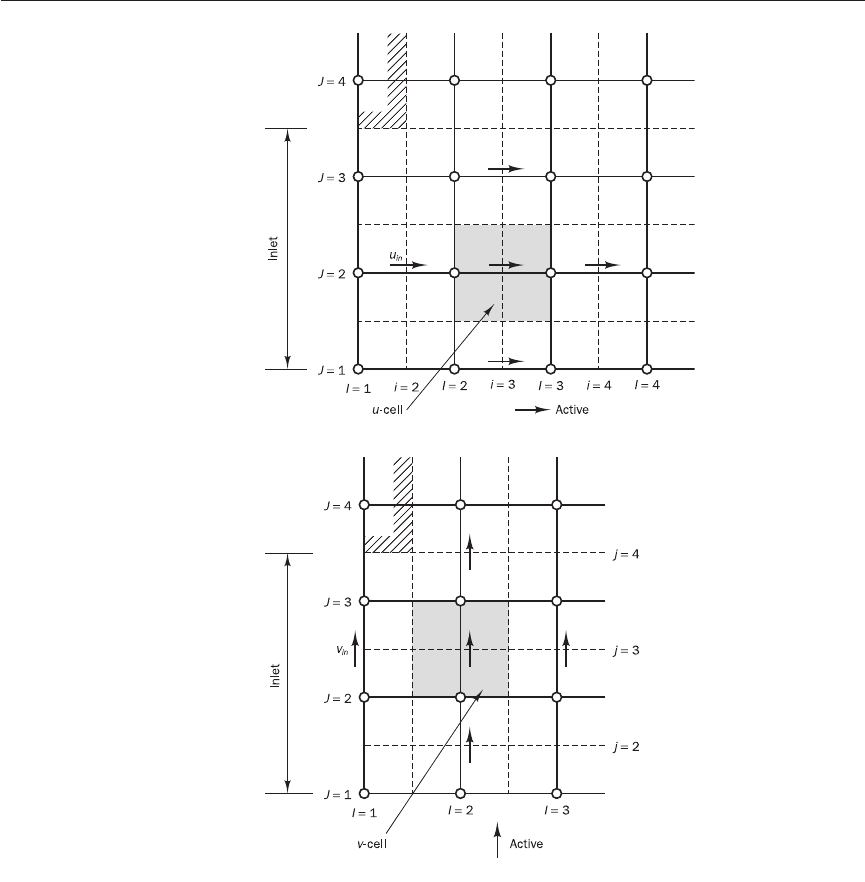
Figures 9.2 to 9.5 show the grid arrangement in the immediate vicinity of an
inlet for u- and v-momentum, scalar and pressure correction equation cells.
The flow direction is assumed to be broadly from the left to the right in the
diagrams. As mentioned, the grid extends outside the physical boundary and
the nodes along the line I = 1 (or i = 2 for u-velocity) are used to store the inlet
values of flow variables (indicated by u
in
, v
in
,
φ
in
and p′
in
). Just downstream of
268 CHAPTER 9 IMPLEMENTATION OF BOUNDARY CONDITIONS
Figure 9.1 The grid
arrangement at boundaries
Inlet boundary
conditions
9.2
ANIN_C09.qxd 29/12/2006 10:01 AM Page 268
9.2 INLET BOUNDARY CONDITIONS 269
this extra node we start to solve the discretised equation for the first internal
cell, which is shaded.
The diagrams also show the ‘active’ neighbours and cell faces which are
represented in the discretised equation for the shaded cell assuming that
hybrid differencing is used. For instance, in Figure 9.2 the active neighbour
velocities are given by means of arrows and the active face pressures by open
circles. The figures indicate that all links to neighbouring nodes remain
active for the first u-, v- and
φ
-cell, so to accommodate the inlet boundary
condition for these variables it is unnecessary to make any modifications to
their discretised equations. Figure 9.4 shows that the link with the boundary
side is cut in the discretised pressure correction equation by setting the
boundary side (west) coefficient a
W
equal to zero. Since the velocity is known
Figure 9.2 u-velocity cell at the
inlet boundary
Figure 9.3 v-velocity cell at the
inlet boundary
ANIN_C09.qxd 29/12/2006 10:01 AM Page 269
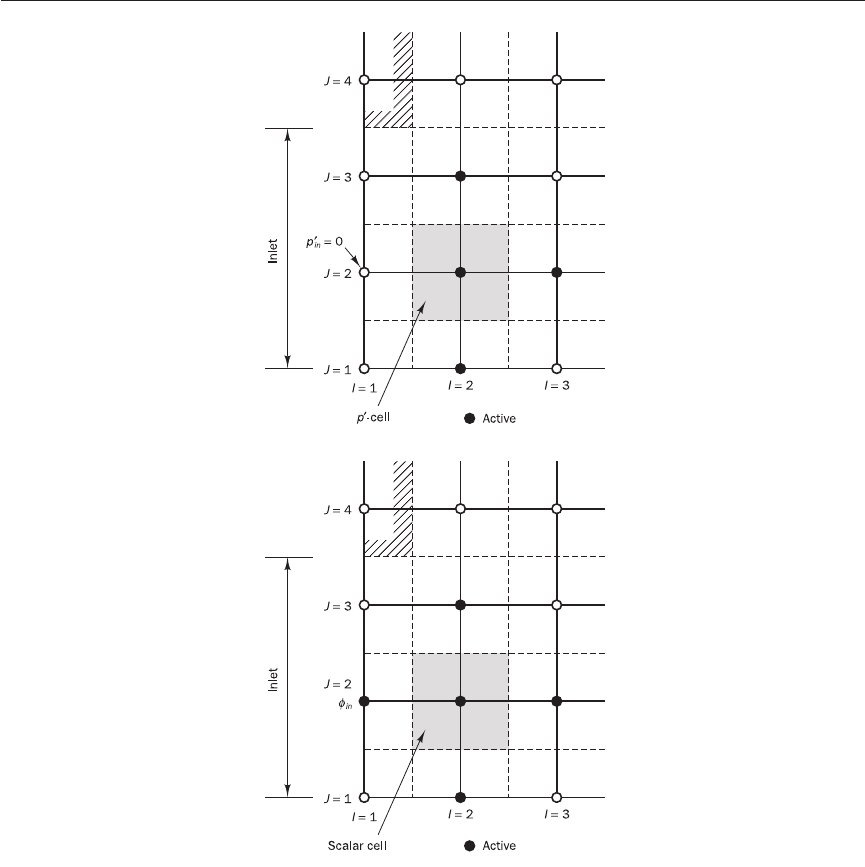
at inlet, it is also not necessary to make a velocity correction here and hence
we have
u*
W
= u
W
(9.4)
in the source associated with discretised pressure correction (6.32).
Reference pressure
The pressure field obtained by solving the pressure correction equation does
not give absolute pressures (Patankar, 1980). It is common practice to fix the
absolute pressure at one inlet node and set the pressure correction to zero at
that node. Having specified a reference value, the absolute pressure field
inside the domain can now be obtained.
270 CHAPTER 9 IMPLEMENTATION OF BOUNDARY CONDITIONS
Figure 9.4 Pressure correction
cell at the inlet boundary
Figure 9.5 Scalar cell at the
inlet boundary
ANIN_C09.qxd 29/12/2006 10:01 AM Page 270
9.3 OUTLET BOUNDARY CONDITIONS 271
Estimation of k and
εε
at inlet boundaries
The most accurate simulations can only be achieved by supplying measured
inlet values of turbulent kinetic energy k and dissipation rate
ε
. However, if
we perform outline design calculations such data are often not available. In
this case commercial CFD codes often estimate k and
ε
with the approximate
formulae described in section 3.7.2, based on a turbulence intensity – typically
between 1% and 6% – and a length scale.
Inlet boundaries perpendicular to the y-direction
The above procedure is, of course, not restricted to an inlet boundary per-
pendicular to the x-direction. When we have an inlet perpendicular to the
y-direction the velocity component v, for which inlet value v
in
is available at
j = 2, takes the place of velocity component u and the calculations start
at j = 3. The inlet values of the remaining variables are stored at J = 1 and
solution starts at J = 2. They are otherwise treated as above.
Outlet boundary conditions may be used in conjunction with the inlet
boundary conditions of section 9.2. If the location of the outlet is selected far
away from geometrical disturbances the flow eventually reaches a fully devel-
oped state where no change occurs in the flow direction. In such a region we
can place an outlet surface and state that the gradients of all variables (except
pressure) are zero in the flow direction. It is normally possible to make a
reasonably accurate prediction of the flow direction far away from obstacles.
This gives us the opportunity to locate the outlet surface perpendicular to
the flow direction and take gradients in the direction normal to the outlet
surface equal to zero.
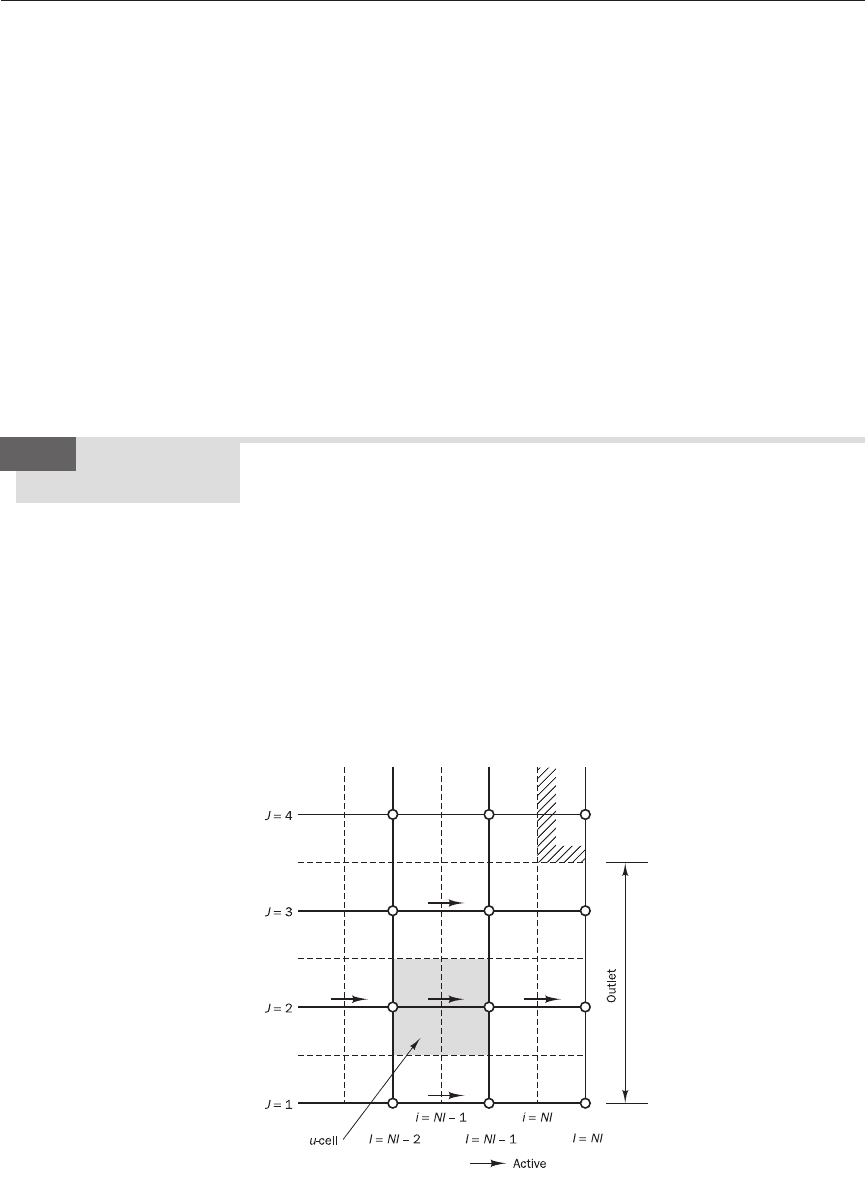
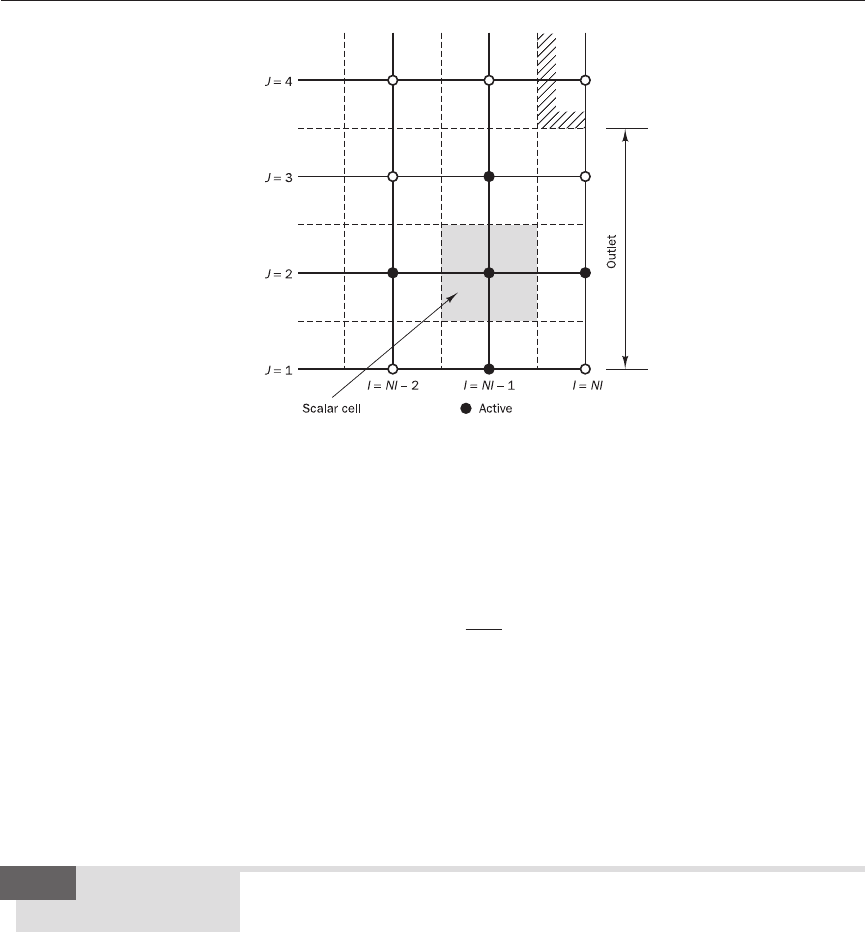
Figures 9.6 to 9.9 show grid arrangements near such an outlet boundary.
We have shaded the last cells upstream of the outlet, for which a discretised
equation is solved, and, as before, highlighted the active neighbours and faces.
Figure 9.6 u-control volume at
an outlet boundary
Outlet boundary
conditions
9.3
ANIN_C09.qxd 29/12/2006 10:01 AM Page 271
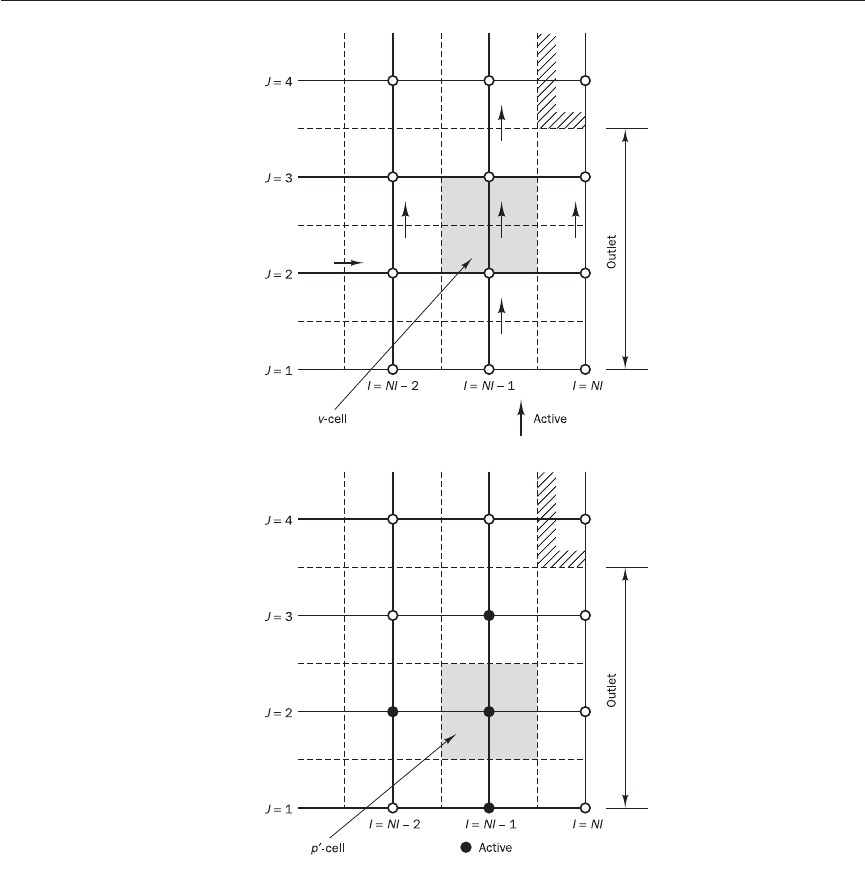
If NI is the total number of nodes in the x-direction, equations are solved
for cells up to I (or i) = NI − 1. Before the relevant equations are solved the
values of flow variables at the next node (NI), just outside the domain, are
determined by extrapolation from the interior on the assumption of zero gradi-
ent at the outlet plane. For the v- and scalar equations this implies setting
v
NI, j
= v
NI
−
1, j
and
φ
NI, J
=
φ
NI
−
1, J
. Figures 9.7 and 9.9 show that all links are
active for these variables so their discretised equations can be solved as normal.
Special care should be taken in the case of the u-velocity. Calculation of u
at the outlet plane i = NI by assuming a zero gradient gives
u
NI, J
= u
NI−1, J
(9.5)
During the iteration cycles of the SIMPLE algorithm there is no guarantee
that these velocities will conserve mass over the computational domain as a
272 CHAPTER 9 IMPLEMENTATION OF BOUNDARY CONDITIONS
Figure 9.7 v-control volume at
an outlet boundary
Figure 9.8 p′-control volume at
an outlet boundary
ANIN_C09.qxd 29/12/2006 10:01 AM Page 272
9.4 WALL BOUNDARY CONDITIONS 273
whole. To ensure that overall continuity is satisfied the total mass flux going
out of the domain (M
out
) is first computed by summing all the extrapolated
outlet velocities (9.5). To make the mass flux out equal to the mass flux M
in
coming into the domain all the outlet velocity components u
NI, J
of (9.5) are
multiplied by the ratio M
in
/M
out
. Thus the outlet plane velocities with the
continuity correction are given by
u
NI, J
= u
NI
−
1, J
× (9.6)
These values are subsequently used as the east neighbour velocities in the
discretised momentum equations for u
NI−1, J
.
The velocity at the outlet boundaries is not corrected by means of
pressure corrections. Hence in the discretised p′-equation (6.32) the link
to the outlet boundary side (east) is suppressed by setting a
E
= 0. The
contribution to the source term in this equation is calculated as normal,
noting that u*
E
= u
E
; no additional modifications are required.
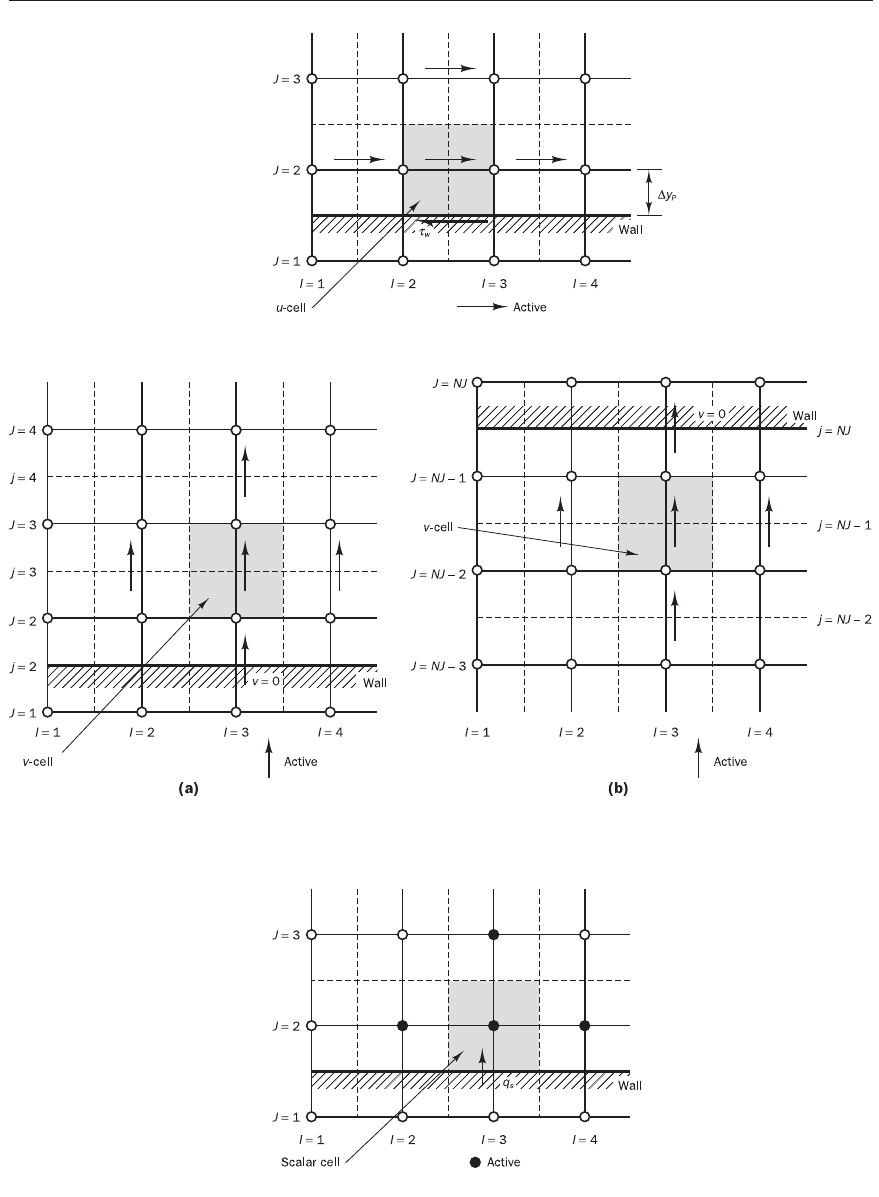
The wall is the most common boundary encountered in confined fluid flow
problems. In this section we consider a solid wall parallel to the x-direction.
Figures 9.10 to 9.12 illustrate the grid details in the near-wall regions for the
u-velocity component (parallel to the wall), for the v-velocity component
(perpendicular to the wall) and for scalar variables.
The no-slip condition (u = v = 0) is the appropriate condition for the
velocity components at solid walls. The normal component of the velocity
can simply be set to zero at the boundary ( j = 2), and the discretised momen-
tum equation at the next v-cell in the flow ( j = 3) can be evaluated without
modification. Since the wall velocity is known it is also unnecessary to
perform a pressure correction here. In the discretised p′-equation (6.32) for
the cell nearest to the wall the wall link (south) is, therefore, cut by setting
a
S
= 0, and we take v
s
* = v
s
in its source term.
M
in
M
out
Figure 9.9 Scalar cell at an
outlet boundary
Wall boundary
conditions
9.4
ANIN_C09.qxd 29/12/2006 10:01 AM Page 273
274 CHAPTER 9 IMPLEMENTATION OF BOUNDARY CONDITIONS
Figure 9.10 u-velocity cell at a
wall boundary
Figure 9.11 v-cell at a wall boundary: (a) j = 3 and (b) j = NJ
Figure 9.12 Scalar cell at a wall
boundary
ANIN_C09.qxd 29/12/2006 10:01 AM Page 274
9.4 WALL BOUNDARY CONDITIONS 275
For all other variables special sources are constructed, the precise form
of which depends on whether the flow is laminar or turbulent. In Chapter 3
we studied the multi-layered structure of the near-wall turbulent boundary
layer. Immediately adjacent to the wall we have an extremely thin viscous
sub-layer followed by the buffer layer and the turbulent core. The number
of mesh points required to resolve all the details in a turbulent boundary
layer would be prohibitively large, and normally we employ the ‘wall func-
tions’ introduced in Chapter 3 to represent the effect of the wall boundaries.
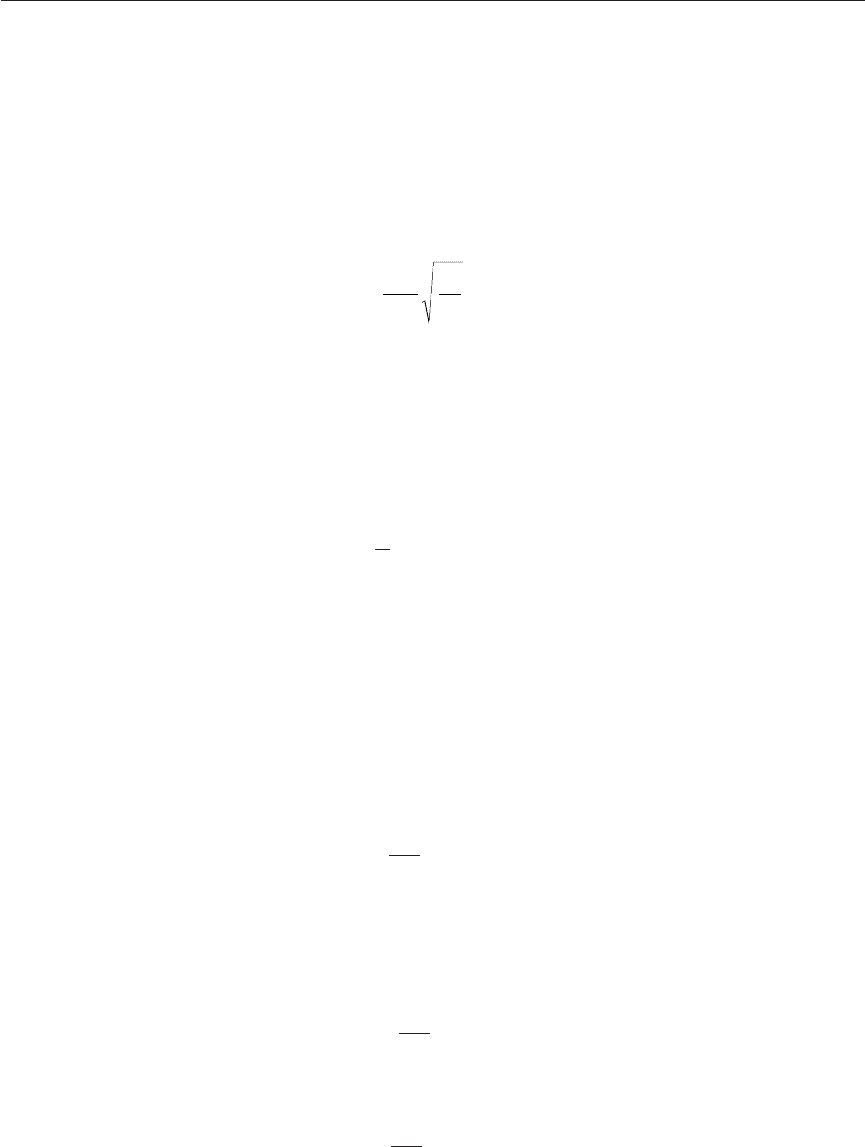
The implementation of wall boundary conditions in turbulent flows starts
with the evaluation of
(9.7)
where ∆y
P
is the distance of the near-wall node P to the solid surface (see
Figure 9.10). A near-wall flow is taken to be laminar if y
+
≤ 11.63. The wall
shear stress is assumed to be entirely viscous in origin. If y
+
> 11.63 the flow
is turbulent and the wall function approach is used. The criterion places the
changeover from laminar to turbulent near-wall flow in the buffer layer
between the linear and log-law regions of a turbulent wall layer. The exact
value of y
+
= 11.63 is the intersection of the linear profile and the log-law, so
it is obtained from the solution of
y
+
= ln(Ey
+
) (9.8)
In this formula
κ
is von Karman’s constant (0.4187) and E is an integration
constant that depends on the roughness of the wall (see section 3.4.2). For
smooth walls with constant shear stress E has a value of 9.793.
Laminar flow/linear sub-layer
The wall conditions described under this heading apply in two cases: for
solutions of (i) laminar flow equations and (ii) turbulent flow equations when
y
+
≤ 11.63. In both cases the near-wall flow is taken to be laminar. The wall
force is entered into the discretised u-momentum equation as a source. The
wall shear stress value is obtained from
τ
w
=
µ
(9.9)
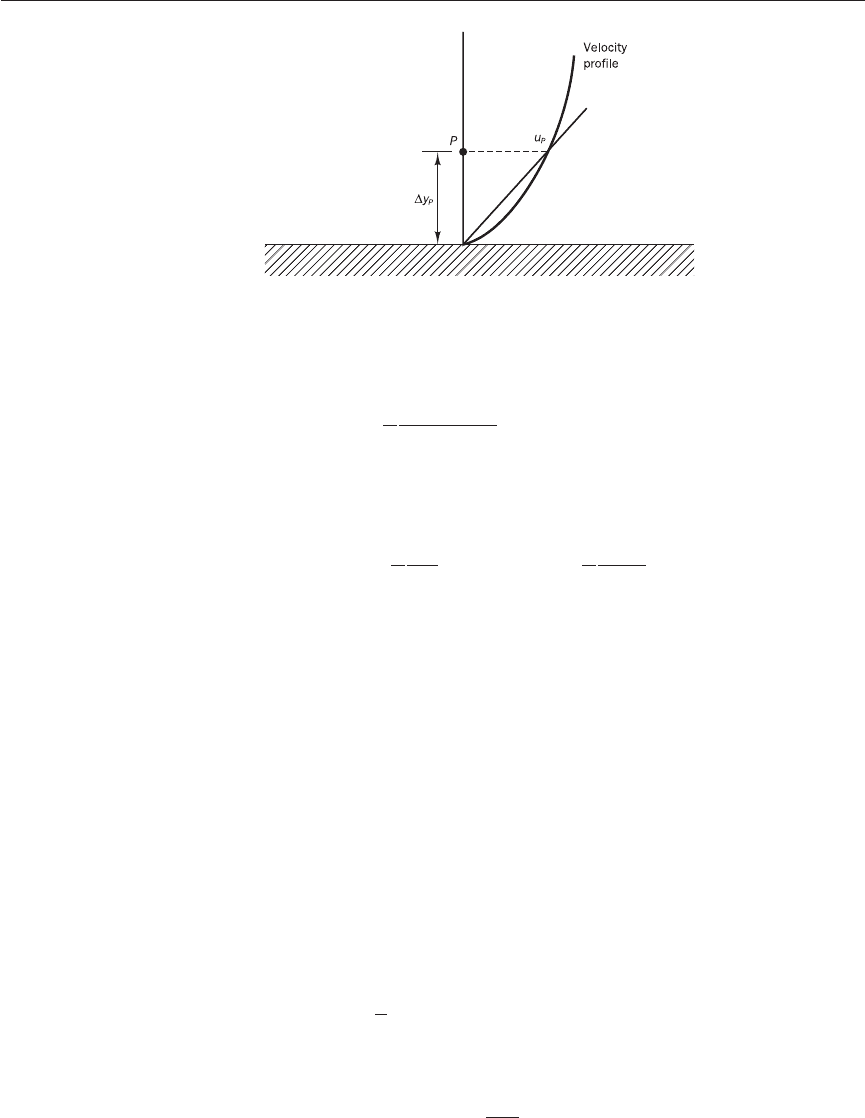
where u
P
is the velocity at the grid node. Figure 9.13 illustrates that this
formula is based on the assumption that the velocity varies linearly with
distance from the wall in a laminar flow.
The shear force F
s
is now given by
F
s
=−
τ
w
A
Cell
=−
µ
A
Cell
(9.10)
where A
Cell
is the wall area of the control volume. The appropriate source
term in the u-equation is defined by
S
P
=− A
Cell
(9.11)
µ
∆y
P
u
P
∆y
P
u
P
∆y
P
1
κ
y
y
Pw
+
=
∆
ν
τ
ρ
ANIN_C09.qxd 29/12/2006 10:01 AM Page 275
Heat transfer from a wall at fixed temperature T
w
into the near-wall cell in
laminar flow is calculated from
q
s
=− A
Cell
(9.12)
where C
P
is the specific heat of the fluid, T
P
is the temperature at the node P
and
σ
is the laminar Prandtl number. It is easy to see that the corresponding
source terms for the temperature equation are given by
S
P
=− A
Cell
and S
u
= A
Cell
(9.13)
A fixed heat flux enters the source terms directly by means of the normal
source term linearisation:
q
s
= S
u
+ S
p
T
P
(9.14)
For an adiabatic wall we have, of course, S
u
= S
p
= 0.
Turbulent flow
If the value of y
+
is greater than 11.63 node P is considered to be in the
log-law region of a turbulent boundary layer. In this region wall function
formulae (3.49) and (3.50) associated with the log-law are used to calculate
shear stress, heat flux and other variables. The formulae have been applied
in many different ways but Table 9.1 gives the optimum near-wall relation-
ships from extensive computing trials.
These relationships should be used in conjunction with the universal
velocity and temperature distributions for near-wall turbulent flows in
(3.49)–(3.50):
u
+
= ln(Ey
+
) (3.49)
and
T
+
=
σ
T,t
u
+
+ P (3.50)
D
E
F
J
K
L
σ
T,l
σ
T,t
G
H
I
A
B
C
1
κ
C
P
T
w
∆y
P
µ
σ
C
P
∆y
P
µ
σ
C
P
(T
P
− T
w
)
∆y
P
µ
σ
276 CHAPTER 9 IMPLEMENTATION OF BOUNDARY CONDITIONS
Figure 9.13 Velocity
distribution at a wall
ANIN_C09.qxd 29/12/2006 10:01 AM Page 276