
Versteeg H., Malalasekra W. An Introduction to Computational Fluid Dynamics: The Finite Volume Method
Подождите немного. Документ загружается.


9.4 WALL BOUNDARY CONDITIONS 277
In these equations the values of
κ
and E are as given in (9.8),
σ
T,l
is the
laminar (or molecular Prandtl number,
σ
T,t
is the turbulent Prandtl number
(≈ 0.9), and function P(
σ
T,l
/
σ
T,t
) is called the ‘pee-function’, which can be
evaluated using the following expression derived by Jayatilleke (1969):
P = 9.24
0.75
− 1
× 1 + 0.28 exp −0.007 (9.20)
In order of their appearance in Table 9.1 variables are treated as follows in
their discretised equations:
• u-velocity component parallel to the wall. The link with the wall (south) is
suppressed by setting a
S
= 0, and wall force F
s
from (9.16) is introduced
into the discretised u-equation as a source term, so
S
P
=− A
Cell
(9.21)
• k-equation. The link at the boundary is suppressed; we set a
S
= 0.
In the volume source (9.17) the second term contains k
3/2
. This is
linearised as k*
P
1/2
. k
P
, where k* is the k-value at the end of the previous
iteration, which yields the following source terms S
p
and S
u
in the
discretised k-equation:
S
p
=− ∆V and S
u
=∆V (9.22)
τ
w
u
p
∆y
P
ρ
C
µ
3/4
k
P
*
1/2
u
+
∆y
P
ρ
C
µ
1/4
k
P
1/2
u
+
5
4
6
4
7
J
K
K
L
D
E
F
σ
T,l
σ
T,t
A
B
C
G
H
H
I
1
4
2
4
3
J
K
L
D
E
F
σ
T,l
σ
T,t
A
B
C
G
H
I
D
E
F
σ
T,l
σ
T,t
A
B
C
Table 9.1 Near-wall relationships for the standard k–
ε
model
• Momentum equation tangential to wall
wall shear stress
τ
w
=
ρ
C
µ
1/4
k
P
1/2
u
P
/u
+
(9.15)
wall force F
s
=−
τ
w
A
Cell
=−(
ρ
C
µ
1/4
k
P
1/2
u
P
/u
+
)A
Cell
(9.16)
• Momentum equation normal to wall
normal velocity = 0
• Turbulent kinetic energy equation
net k-source per unit volume = (
τ
w
u
P
−
ρ
C
µ
3/4
k
P
3/2
u
+
)∆V/∆y
P
(9.17)
• Dissipation rate equation
set nodal value
ε
P
= C
µ
3/4
k
P
3/2
/(
κ
∆y
P
) (9.18)
• Temperature (or energy) equation
wall heat flux q
w
=−C
P
ρ
C
µ
1/4
k
P
1/2
(T
P
− T
w
)/T
+
(9.19)
ANIN_C09.qxd 29/12/2006 10:01 AM Page 277

•
ε
-equation. In the discretised
ε
-equation the near-wall node is fixed to
the value given by (9.18) by means of setting the source terms S
p
and S
u
as follows:
S
p
=−10
30
and S
u
=×10
30
(9.23)
• Temperature equation. The link with the wall is suppressed in the
T-equation by setting the boundary side coefficient a
S
to zero. The
wall heat flux is calculated using equation (9.19) and introduced by
means of the following source terms:
S
P
=− A
Cell
and S
u
= A
Cell
(9.24)
A fixed heat flux enters the source terms directly by means of the normal
source term linearisation:
q
s
= S
u
+ S
p
T
P
(9.25)
For an adiabatic wall we have S
u
= S
p
= 0, as before.
Rough walls
In the wall function approach described above, changeover from laminar to
turbulent flow as the distance from the wall increases was assumed to occur
at y
+
= 11.63, which is the solution of equation (9.8) with E = 9.8. This cri-
terion applies to smooth walls; if walls are not smooth E should be adjusted
accordingly and a new limiting value of y
+
would result. E may be estimated
on the basis of measured absolute roughness values. Schlichting (1979),
among others, gives further details.
Moving walls
Note that it has been tacitly assumed that the wall is stationary. Wall move-
ment in the x-direction is felt by the fluid by a change in the wall shear stress.
Its value is adjusted by replacing velocity u
P
by the relative velocity u
P
− u
wall
.
This modifies the laminar wall force formula (9.10) as follows:
F
s
=−
µ
A
Cell
(9.26)
and the turbulent wall force formula (9.16) as
F
s
=− A
Cell
(9.27)
The relevant source terms (9.11) and (9.21) are similarly adjusted.
Wall motion also alters the volume source term of the k-equations, which
becomes
[
τ
w
(u
P
− u
wall
) −
ρ
C
µ
3/4
k
P
3/2
u
+
]∆V/∆y
P
(9.28)
It should be noted that the wall functions described above have been derived
on the basis of the following assumptions:
ρ
C
µ
1/4
k
P
1/2
(u
P
− u
wall
)
u
+
(u
P
− u
wall
)
∆y
P
ρ
C
µ
1/4
k
P
1/2
C
P
T
wall
T
+
ρ
C
µ
1/4
k
P
1/2
C
P
T
+
C
µ
3/4
k
P
3/2
κ
∆y
P
278 CHAPTER 9 IMPLEMENTATION OF BOUNDARY CONDITIONS
ANIN_C09.qxd 29/12/2006 10:01 AM Page 278
9.5 THE CONSTANT PRESSURE BOUNDARY CONDITION 279
• the velocity is parallel to the wall and varies only in the direction normal
to the wall
• no pressure gradients in the flow direction
• no chemical reactions at the wall
• high Reynolds number
If any one of these assumptions does not hold, the accuracy of the predic-
tions using this wall function approach may be reduced or even seriously
compromised.
The constant pressure condition is used in situations where exact details of
the flow distribution are unknown but the boundary values of pressure are
known. Typical problems where this boundary condition is appropriate
include external flows around objects, free surface flows, buoyancy-driven
flows such as natural ventilation and fires, and also internal flows with
multiple outlets.
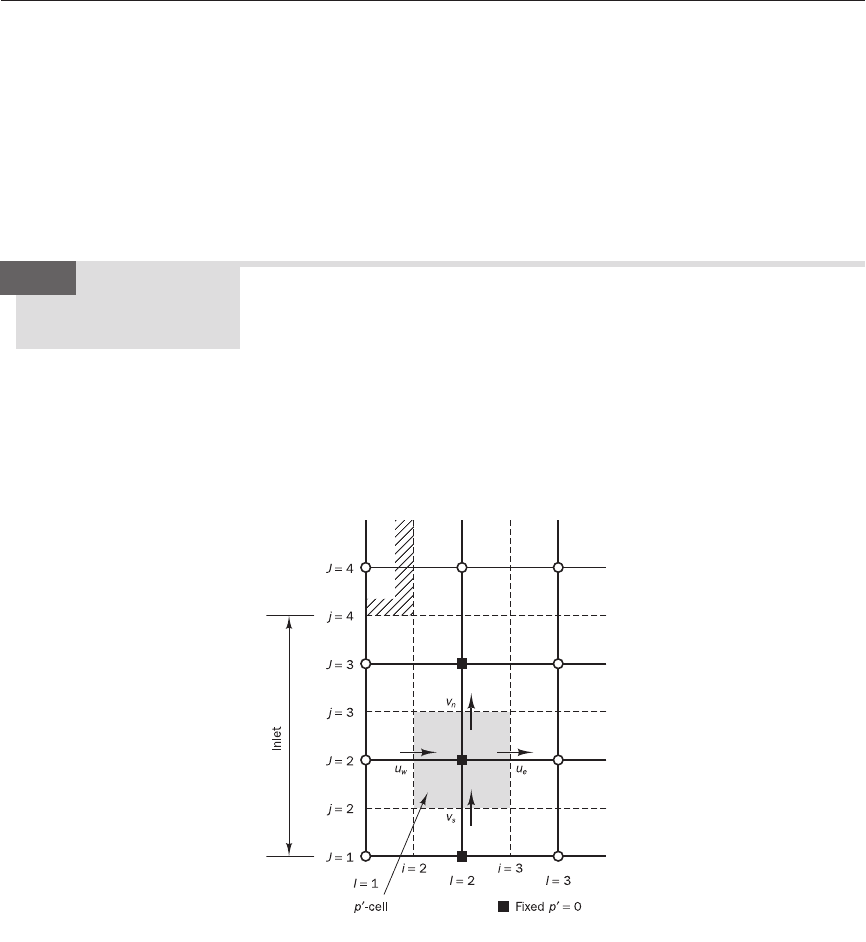
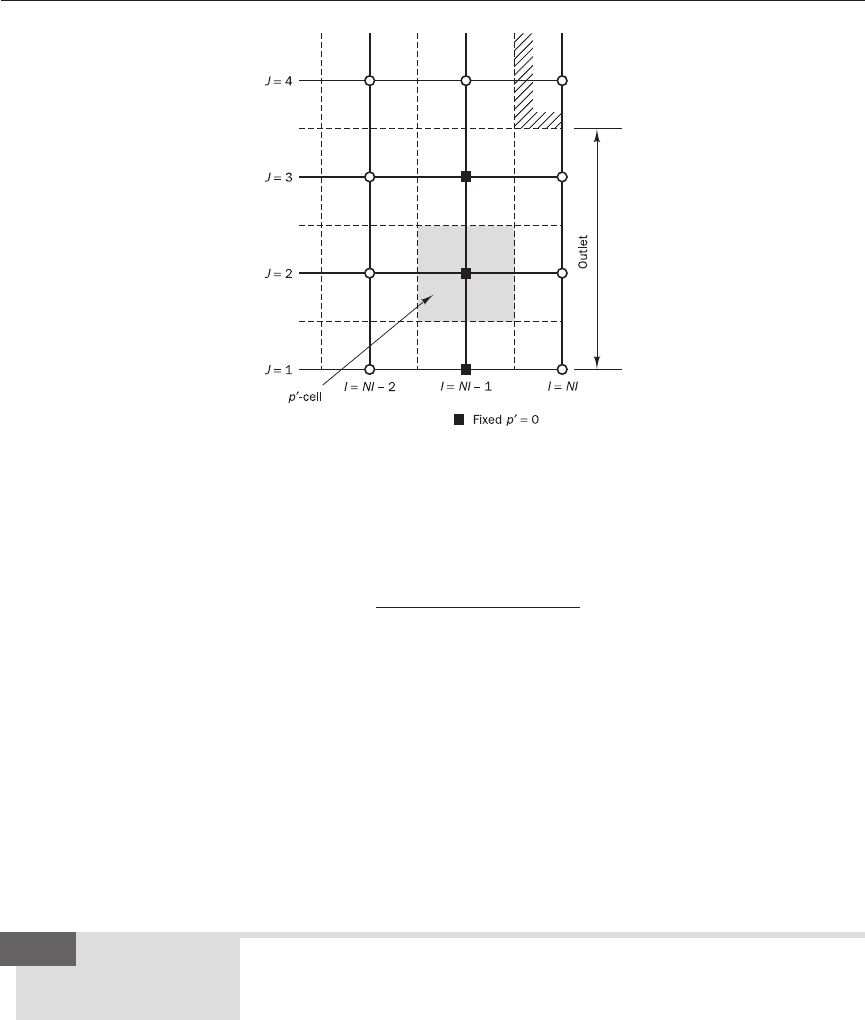
In applying the fixed pressure boundary the pressure correction is set to
zero at the nodes. The grid arrangement of the p′-cells near a flow inlet and
outlet is shown in Figures 9.14 and 9.15.
Figure 9.14 p′-cell at an inlet
boundary
A convenient way of dealing with a constant pressure boundary condition
is to fix pressure at the nodes just inside the physical boundary, as indicated
in the diagrams by solid squares. The pressure corrections are set to zero by
taking S
u
= 0.0 and S
p
=−10
30
, and the nodal pressure is set to the required
boundary pressure p
fix
. The u-momentum equation is solved from i = 3 and
v-momentum and other equations from I = 2 onwards. The main outstanding
problem is the unknown flow direction, which is governed by the conditions
inside the calculation domain. The u-velocity component across the domain
boundary is generated as part of the solution process by ensuring that con-
tinuity is satisfied at every cell. For example, in Figure 9.14 the values of u
e
The constant
pressure
boundary condition
9.5
ANIN_C09.qxd 29/12/2006 10:01 AM Page 279
and of v
s
and v
n
emerge from solving the discretised u- and v-momentum
equations inside the domain. Given these values we can compute u
w
by
insisting that mass is conserved for the p′-cell. This yields
u
w
= (9.29)
This implementation of the boundary condition causes the p′-cell nearest to
the boundaries to act as a source or sink of mass. The process is repeated for
each pressure boundary cell. Other variables such as v, T, k and
ε
must be
assigned inflow values where the flow direction is into the domain. Where the
flow is outwards their values just outside the domain may be obtained by
means of extrapolation (see section 9.3).
There are several variations that can be useful in practical circumstances.
Some codes apply (i) a condition at inlet that fixes the stagnation pressure of
the inlet flow just outside the domain (at i = 1) instead of the static pressure
just inside the domain (at i = 2) and/or (ii) the extrapolation procedure at
outlets for all variables including u.
The conditions at a symmetry boundary are: (i) no flow across the boundary
and (ii) no scalar flux across the boundary. In the implementation, normal
velocities are set to zero at a symmetry boundary, and the values of all other
properties just outside the solution domain (say I or i = 1) are equated to
their values at the nearest node just inside the domain (I or i = 2):
φ
1, J
=
φ
2, J
(9.30)
In the discretised p′-equations the link with the symmetry boundary side is
cut by setting the appropriate coefficient to zero; no further modifications are
required.
(
ρ
vA)
n
− (
ρ
vA)
s
+ (
ρ
uA)
e
(
ρ
A)
w
280 CHAPTER 9 IMPLEMENTATION OF BOUNDARY CONDITIONS
Figure 9.15 p′-cell at an outlet
boundary
Symmetry
boundary
condition
9.6
ANIN_C09.qxd 29/12/2006 10:01 AM Page 280
9.8 POTENTIAL PITFALLS AND FINAL REMARKS 281
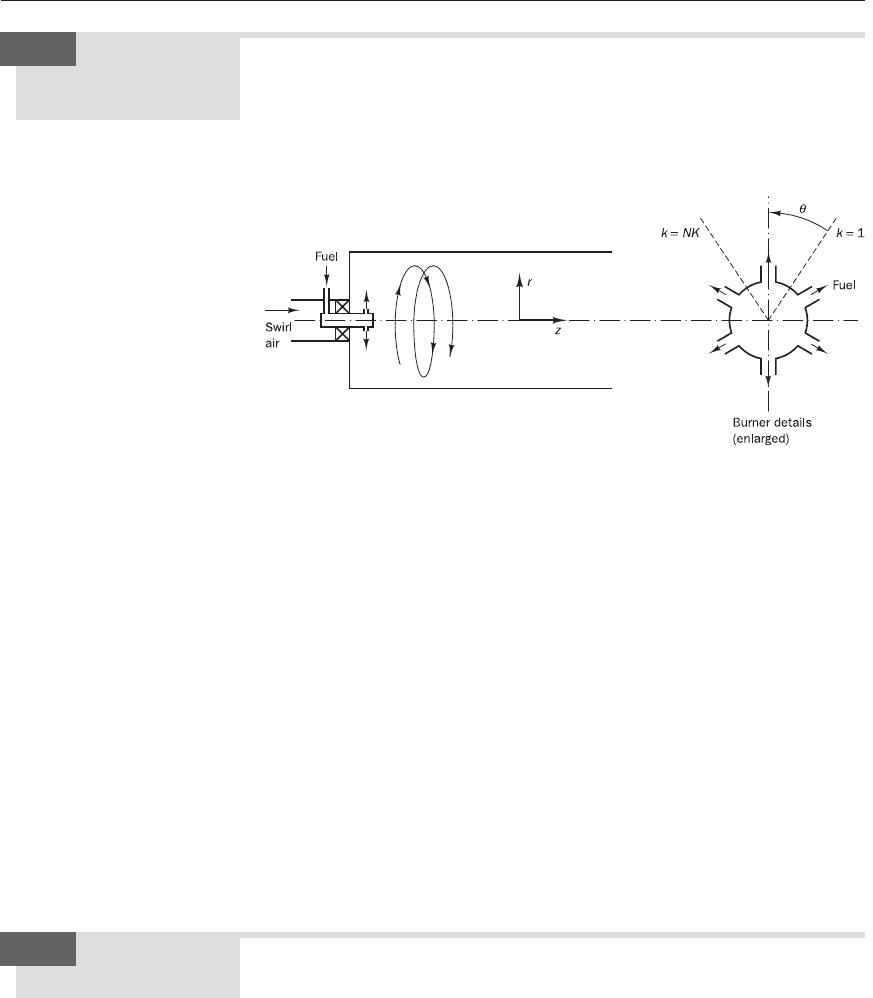
Periodic or cyclic boundary conditions arise due to a different type of
symmetry in a problem. Consider for example swirling flow in the cylindrical
furnace shown in Figure 9.16. In the burner arrangement gaseous fuel is
introduced through six symmetrically placed holes and swirl air enters
through the outer annulus of the burner.
Figure 9.16 An example of a
cyclic boundary condition
This problem can be solved in cylindrical polar co-ordinates (z, r,
θ
) by
considering a 60° angular sector as shown in the diagram, where k refers to
r–z planes in the
θ
-direction. The flow rotates in this direction, and under
the given conditions the flow entering the first k-plane of the sector should
be exactly the same as that leaving the last k-plane. This is an example of
cyclic symmetry. The pair of boundaries k = 1 and k = NK are called periodic
or cyclic boundaries.
To apply cyclic boundary conditions we need to set the flux of all flow
variables leaving the outlet cyclic boundary equal to the flux entering the
inlet cyclic boundary. This is achieved by equating the values of each vari-
able at the nodes just upstream and downstream of the inlet plane to the
nodal values just upstream and downstream of the outlet plane. For all vari-
ables except the velocity component across the inlet and outlet planes (say w)
we have
φ
1, J
=
φ
NK−1, J
and
φ
NK, J
=
φ
2, J
(9.31)
For the velocity component across the boundary we have
w
1, J
= w
NK−1, J
and w
NK+1, J
= w
3, J
(9.32)
Flows inside a CFD solution domain are driven by the boundary conditions.
In a sense the process of solving a field problem (e.g. a fluid flow) is nothing
more than the extrapolation of a set of data defined on a boundary contour or
surface into the domain interior. It is, therefore, of paramount importance
that we supply physically realistic, well-posed boundary conditions, other-
wise severe difficulties are encountered in obtaining solutions. The single,
most common cause of rapid divergence of CFD simulations is the inappro-
priate selection of boundary conditions.
In Chapter 2 we summarised a set of ‘best’ boundary conditions for
viscous fluid flows, which included the inlet, outlet and wall condition. Their
Periodic or
cyclic boundary
condition
9.7
Potential pitfalls
and final remarks
9.8
ANIN_C09.qxd 29/12/2006 10:01 AM Page 281
finite volume method implementation was discussed in sections 9.2 to 9.4,
and in sections 9.5 to 9.7 we developed three further conditions, constant
pressure, symmetry and periodicity, which are physically realistic and very
useful in practical calculations. These are by no means the only boundary
conditions. Commercial CFD packages may include time-dependent move-
ment of boundaries, facilities to include rotating and accelerating boundaries
and special conditions for transonic and supersonic flows. It would be beyond
the scope of this book to discuss the ways of implementing all of them.
A simple illustration of poor selection of boundary conditions might be an
attempt to generate a steady state solution in a domain with wall boundaries
and a flow inlet but without an outlet boundary. It is obvious that mass
cannot be conserved in the steady state and CFD calculations will ‘blow up’
swiftly. This almost trivial example also suggests that certain types of
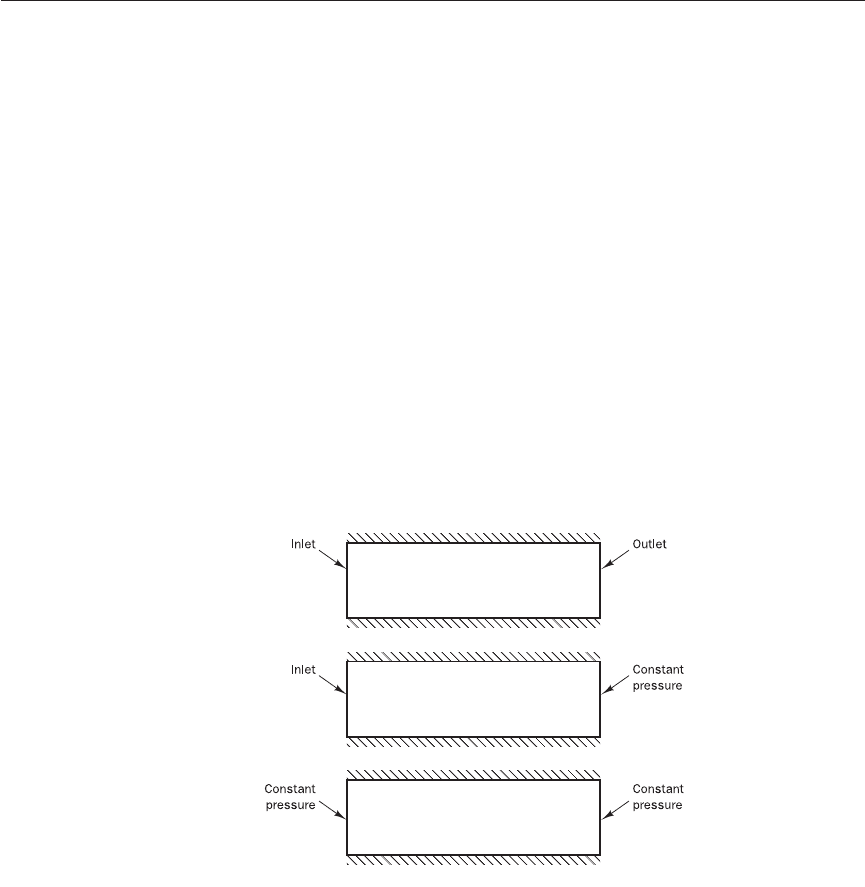
boundary conditions must be accompanied by particular other ones. We now
briefly state some permissible combinations in subsonic flows:
• walls only
• walls and inlet and at least one outlet
• walls and inlet and at least one constant pressure boundary
• walls and constant pressure boundaries
Figure 9.17 illustrates these configurations for a simple duct flow.
282 CHAPTER 9 IMPLEMENTATION OF BOUNDARY CONDITIONS
Figure 9.17 Configurations for
a simple duct flow
Particular care must be taken in applying the outlet boundary condition.
It can only be used if all flows entering the calculation domain are given by
means of inlet boundary conditions (i.e. velocity and scalars fixed at inlet)
and is only recommended for flow domains with a single exit. Physically the
exit pressures govern the flow split between multiple outlets so it is better
to specify this quantity at exits than (zero-gradient) outlet conditions. It is
not permitted to combine an outlet condition with one or more constant
pressure boundaries, because the zero-gradient outlet condition specifies
neither the flow rate nor the pressure at the exit, thus leaving the problem
under-specified.
We have glossed over a number of very complex problems by only
considering subsonic flows. We merely warn the CFD user to tread very
ANIN_C09.qxd 29/12/2006 10:01 AM Page 282
9.8 POTENTIAL PITFALLS AND FINAL REMARKS 283
carefully when attempting to tackle flows that may have regions of transonic
and supersonic flows.
Accuracy limitations of the individual boundary conditions have already
been pointed out before. Here we note a small selection of the more subtle
pitfalls of practical CFD that need to be avoided to ensure that simulation
accuracy is optimal:
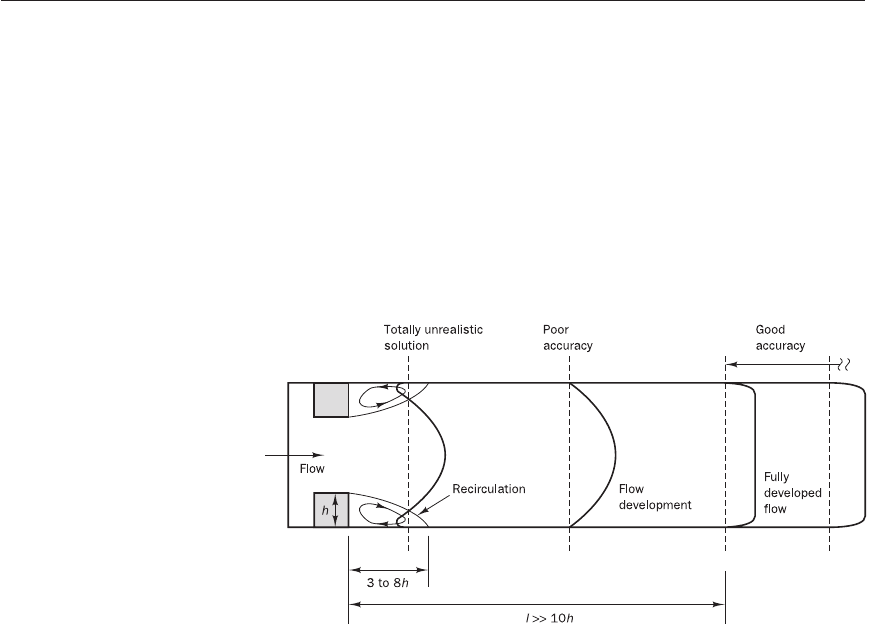
• Positioning of outlet boundaries. If outlet boundaries are placed too close
to solid obstacles it is possible that the flow has not yet reached a fully
developed state (zero gradients in the flow direction), which may lead to
sizeable errors. Figure 9.18 gives typical velocity profiles downstream of
an obstacle, which illustrate the potential hazards.
Figure 9.18 Velocity profiles at
different locations downstream of
an obstacle
If the outlet is placed close to an obstacle it may range across a wake
region with recirculation. Not only does the assumed gradient condition
not hold, but there is an area of reverse flow where the fluid enters the
domain whilst we had assumed an outward flow. Of course, we cannot
trust the solution if this condition arises. Somewhat further downstream
there may not be reverse flow, but the zero-gradient condition does not
hold since the velocity profile still changes in the flow direction. It is
imperative that the outlet boundary is placed much further downstream
than 10 heights downstream of the last obstacle to give accurate results.
For high accuracy it is necessary to demonstrate that the interior
solution is unaffected by the choice of location of the outlet by means
of a sensitivity study for the effect of different downstream distances.
• Near-wall grid. The most accurate way of solving turbulent flows in a
general-purpose CFD code is to make use of the good empirical fits
provided by the wall function approach. To obtain the same accuracy
by means of a simulation which includes points inside the (laminar)
linear sub-layer the grid spacing must be so fine as to be uneconomical.
The criterion that y
+
must be greater than 11.63 sets a lower limit
to the distance from the wall ∆y
P
of the nearest grid point. The main
mechanism for accuracy improvement available to us is grid refinement,
but in a turbulent flow simulation we must ensure that, whilst refining
the grid, the value of y
+
stays greater than 11.63 and is preferably
between 30 and 500.
ANIN_C09.qxd 29/12/2006 10:01 AM Page 283
It is very often impossible to ensure that this is the case everywhere
in a general flow; one pertinent example is a flow with recirculation.
Near the reattachment point the velocity component parallel to the
wall is zero, so by virtue of the criterion that y
+
must be greater than
11.63 the simulation reverts to the laminar case. There are additional
problems associated with the k–
ε
model in these regions that give rise
to further, even more important inaccuracies. Nevertheless, the point
that it is difficult to keep y
+
above its lower limit is well illustrated.
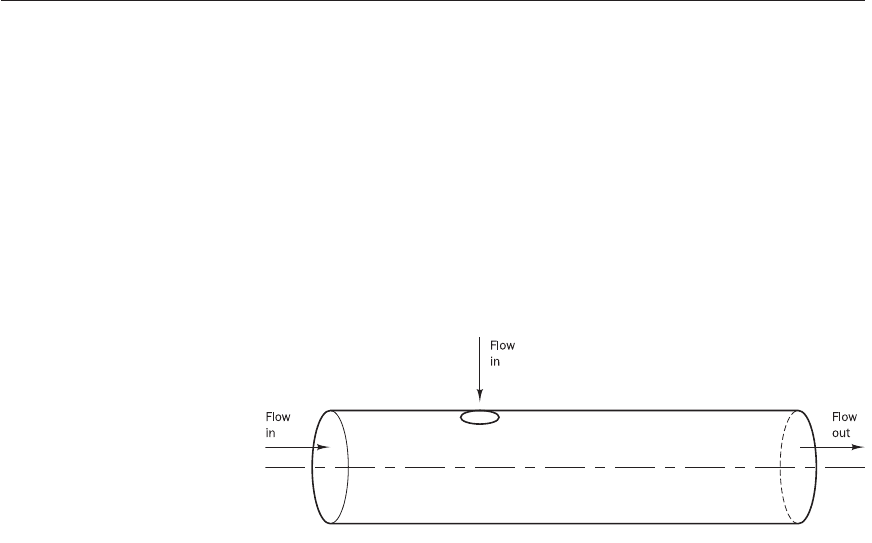
• Misapplication of the symmetry condition. It is important to realise that
geometric symmetry of the flow domain does not always imply that the
flow possesses the same symmetry. An example shown in Figure 9.19 is
the flow through a circular pipe with a side jet.
284 CHAPTER 9 IMPLEMENTATION OF BOUNDARY CONDITIONS
Figure 9.19 A non-symmetric
flow situation in a cylindrical
geometry
In spite of the fact that the domain has axisymmetry the occurrence
of the cross-flow jet makes the flow non-axisymmetric. Although it is
tempting to solve the problem in cylindrical polar co-ordinates, the flow
solution will be inaccurate because flow may not cross the centreline.
We have discussed the implementation of the most important boundary
conditions. Moreover, we have outlined suitable combinations of boundary
conditions and highlighted particular problem areas. It is of crucial import-
ance that the CFD user has a good understanding of all the relevant issues as
a first step towards accurate flow simulations with the finite volume method.
ANIN_C09.qxd 29/12/2006 10:01 AM Page 284

In this chapter we review:
• Why it is important to know about the error and uncertainty in CFD
calculations
• Definitions and causes of error and uncertainty
• Methods to quantify error and uncertainty in CFD results: verification
and validation
• Best practice in CFD as a systematic approach, which seeks to achieve
the highest possible level of confidence in CFD simulation results for
the available resources
During the 1990s the benefits of CFD were recognised by large corporations,
small and medium-sized enterprises alike, and it is now used in design/
development environments across a wide range of industries. This has
focused attention on ‘value for money’ and the potential consequences of
wrong decisions made on the basis of CFD results. The consequences of
inaccurate CFD results are at best wasted time, money and effort and at
worst catastrophic failure of components, structures or machines. Moreover,
the costs of a CFD capability may be quite substantial:
• Capital cost of computing equipment
• Direct operating cost: software licence(s) and salary of CFD specialist(s)
• Indirect operating costs: maintenance of computing equipment and
provision of information resources to support CFD activity
The value of a modelling result is clear – time savings in design and product
improvement through enhanced understanding of the engineering problem
under consideration – but rather harder to quantify. The application of CFD
modelling as an engineering tool can only be justified on the basis of its
accuracy and the level of confidence in its results. With its roots in academic
research, CFD development was initially focused on new functionality and
improved understanding without the need to make very precise statements
relating to confidence levels. Engineering industry, however, has a long tradi-
tion of making things work within the limitations of the current state of know-
ledge, provided that the confidence limits are known. Assessment of uncertainty
in experimental data, for example, is a well-established practice, and the rel-
evant techniques (should) form part of every engineer’s basic education.
To address the issue of trust and confidence in CFD the fraternity has
now carried out extensive reviews of the factors influencing simulation results
and developed a systematic process, akin to the estimation of uncertainty in
Chapter ten Errors and uncertainty in
CFD modelling
Errors and
uncertainty
in CFD
10.1
ANIN_C10.qxd 29/12/2006 10:02 AM Page 285

experimental results, for the quantitative assessment of confidence levels.
This has led to the formulation of a number of guidelines for best practice in
CFD, the most influential of which are the AIAA (1998) and ERCOFTAC
(2000) guidelines. In this section we give a review of the most important concepts
in the study of errors and uncertainty in CFD and summarise the recom-
mendations for the conduct of CFD simulations contained in the two guides.
In the context of trust and confidence in CFD modelling, the following
definitions of error and uncertainty have now been widely accepted (AIAA,
1998; Oberkampf and Trucano, 2002):
• Error: a recognisable deficiency in a CFD model that is not caused by
lack of knowledge. Causes of errors, defined in this way, are:
(i) Numerical errors – roundoff errors, iterative convergence errors,
discretisation errors
(ii) Coding errors – mistakes or ‘bugs’ in the software
(iii) User errors – human errors through incorrect use of the software
• Uncertainty: a potential deficiency in a CFD model that is caused by
lack of knowledge. The main sources of uncertainty are:
(i) Input uncertainty – inaccuracies due to limited information or
approximate representation of geometry, boundary conditions,
material properties etc.
(ii) Physical model uncertainty – discrepancies between real flows and
CFD due to inadequate representation of physical or chemical
processes (e.g. turbulence, combustion) or due to simplifying
assumptions in the modelling process (e.g. incompressible flow,
steady flow)
Coding and user errors are the most insidious forms of errors. The well-
publicised failure on 23 September 1999 of NASA’s Mars Climate Orbiter
space mission was subsequently attributed to incompatibility between pieces
of software written in SI and Imperial units, which shows that coding errors
can catch out even the most sophisticated users and organisations. User error
may be reduced or eliminated to a large extent through adequate training and
experience. Systematic reduction of coding and user errors falls within the
remit of software engineering/quality assurance. For the purposes of this
introduction we assume that the code is correct and that user error is negli-
gible. We focus our attention on the remaining unavoidable causes of errors
and uncertainty and highlight their effects on CFD results. We describe the
procedures for verification and validation of CFD aimed at quantitative
assessment of errors and uncertainty in its results. Finally, we give a sum-
mary of available guidelines for best practice and make recommendations for
the reporting of CFD model results.
CFD solves systems of non-linear partial differential equations in discretised
form on meshes of finite time steps and finite control volumes that cover the
region of interest and its boundaries. This gives rise to three recognised
sources of numerical error:
• Roundoff error
• Iterative convergence error
• Discretisation error
286 CHAPTER 10 ERRORS AND UNCERTAINTY IN CFD MODELLING
Numerical errors10.2
ANIN_C10.qxd 29/12/2006 10:02 AM Page 286