
Versteeg H., Malalasekra W. An Introduction to Computational Fluid Dynamics: The Finite Volume Method
Подождите немного. Документ загружается.


1.4 SCOPE OF THIS BOOK 7
the discussion of the k–
ε
turbulence model, to which we return later, the
material in Chapters 2 and 3 is largely self-contained. This allows the use
of this book by those wishing to concentrate principally on the numerical
algorithms, but requiring an overview of the fluid dynamics and the math-
ematics behind it for occasional reference in the same text.
The second part of the book is devoted to the numerical algorithms of
the finite volume method and covers Chapters 4 to 9. Discretisation schemes
and solution procedures for steady flows are discussed in Chapters 4 to 7.
Chapter 4 describes the basic approach and derives the central difference
scheme for diffusion phenomena. In Chapter 5 we emphasise the key prop-
erties of discretisation schemes, conservativeness, boundedness and trans-
portiveness, which are used as a basis for the further development of the
upwind, hybrid, QUICK and TVD schemes for the discretisation of con-
vective terms. The non-linear nature of the underlying flow phenomena and
the linkage between pressure and velocity in variable density fluid flows
requires special treatment, which is the subject of Chapter 6. We introduce
the SIMPLE algorithm and some of its more recent derivatives and also
discuss the PISO algorithm. In Chapter 7 we describe algorithms for the
solution of the systems of algebraic equations that appear after the discret-
isation stage. We focus our attention on the well-known TDMA algorithm,
which was the basis of early CFD codes, and point iterative methods with
multigrid accelerators, which are the current solvers of choice.
The theory behind all the numerical methods is developed around a set
of worked examples which can be easily programmed on a PC. This pres-
entation gives the opportunity for a detailed examination of all aspects of the
discretisation schemes, which form the basic building blocks of practical
CFD codes, including the characteristics of their solutions.
In Chapter 8 we assess the advantages and limitations of various schemes
to deal with unsteady flows, and Chapter 9 completes the development of the
numerical algorithms by considering the practical implementation of the
most common boundary conditions in the finite volume method.
The book is primarily aimed to support those who have access to a CFD
package, so that the issues raised in the text can be explored in greater depth.
The solution procedures are nevertheless sufficiently well documented for
the interested reader to be able to start developing a CFD code from scratch.
The third part of the book consists of a selection of topics relating to the
application of the finite volume method to complex industrial problems. In
Chapter 10 we review aspects of accuracy and uncertainty in CFD. It is not
possible to predict the error in a CFD result from first principles, which
creates some problems for the industrial user who wishes to evolve equip-
ment design on the basis of insights gleaned from CFD. In order to address
this issue a systematic process has been developed to assist in the quantifica-
tion of the uncertainty of CFD output. We discuss methods, the concepts of
verification and validation, and give a summary of rules for best practice that
have been developed by the CFD community to assist users. In Chapter 11
we discuss techniques to cope with complex geometry. We review various
approaches based on structured meshes: Cartesian co-ordinate systems, gen-
eralised co-ordinate systems based on transformations, and block-structured
grids, which enable design of specific meshes tailored to the needs of dif-
ferent parts of geometry. We give details of the implementation of the finite
volume method on unstructured meshes. These are not based on a grid of
lines to define nodal positions and can include control volumes that can have
ANIN_C01.qxd 29/12/2006 09:54 AM Page 7

any shape. Consequently, unstructured meshes have the ability to match
the boundary shape of CFD solution domains of arbitrary complexity. This
greatly facilitates the design and refinement of meshes, so that unstructured
meshes are the most popular method in industrial CFD applications. The
remaining Chapters 12 and 13 are concerned with one of the most significant
engineering applications of CFD: energy technology and combusting systems.
In order to provide a self-contained introduction to the most important
aspects of CFD in reacting flows, we introduce in Chapter 12 the basic
thermodynamic and chemical concepts of combustion and review the most
important models of combustion. Our particular focus is the laminar flamelet
model of non-premixed turbulent combustion, which is the most widely
researched model with capabilities to predict the main combustion reaction
and pollutant species concentrations. In the final Chapter 13 we discuss CFD
techniques to predict radiative heat transfer, a good understanding of which
is necessary for accurate combustion calculations.
8 CHAPTER 1 INTRODUCTION
ANIN_C01.qxd 29/12/2006 09:54 AM Page 8

In this chapter we develop the mathematical basis for a comprehensive
general-purpose model of fluid flow and heat transfer from the basic prin-
ciples of conservation of mass, momentum and energy. This leads to the
governing equations of fluid flow and a discussion of the necessary auxiliary
conditions – initial and boundary conditions. The main issues covered in this
context are:
• Derivation of the system of partial differential equations (PDEs) that
govern flows in Cartesian (x, y, z) co-ordinates
• Thermodynamic equations of state
• Newtonian model of viscous stresses leading to the Navier–Stokes
equations
• Commonalities between the governing PDEs and the definition of the
transport equation
• Integrated forms of the transport equation over a finite time interval and
a finite control volume
• Classification of physical behaviours into three categories: elliptic,
parabolic and hyperbolic
• Appropriate boundary conditions for each category
• Classification of fluid flows
• Auxiliary conditions for viscous fluid flows
• Problems with boundary condition specification in high Reynolds
number and high Mach number flows
The governing equations of fluid flow represent mathematical statements of
the conservation laws of physics:
• The mass of a fluid is conserved
• The rate of change of momentum equals the sum of the forces on a fluid
particle (Newton’s second law)
• The rate of change of energy is equal to the sum of the rate of heat
addition to and the rate of work done on a fluid particle (first law of
thermodynamics)
The fluid will be regarded as a continuum. For the analysis of fluid flows
at macroscopic length scales (say 1 µm and larger) the molecular structure
of matter and molecular motions may be ignored. We describe the behaviour
of the fluid in terms of macroscopic properties, such as velocity, pressure,
density and temperature, and their space and time derivatives. These may
Chapter two Conservation laws of fluid
motion and boundary conditions
Governing
equations of fluid
flow and heat transfer
2.1
ANIN_C02.qxd 29/12/2006 09:55 AM Page 9
10 CHAPTER 2 CONSERVATION LAWS OF FLUID MOTION
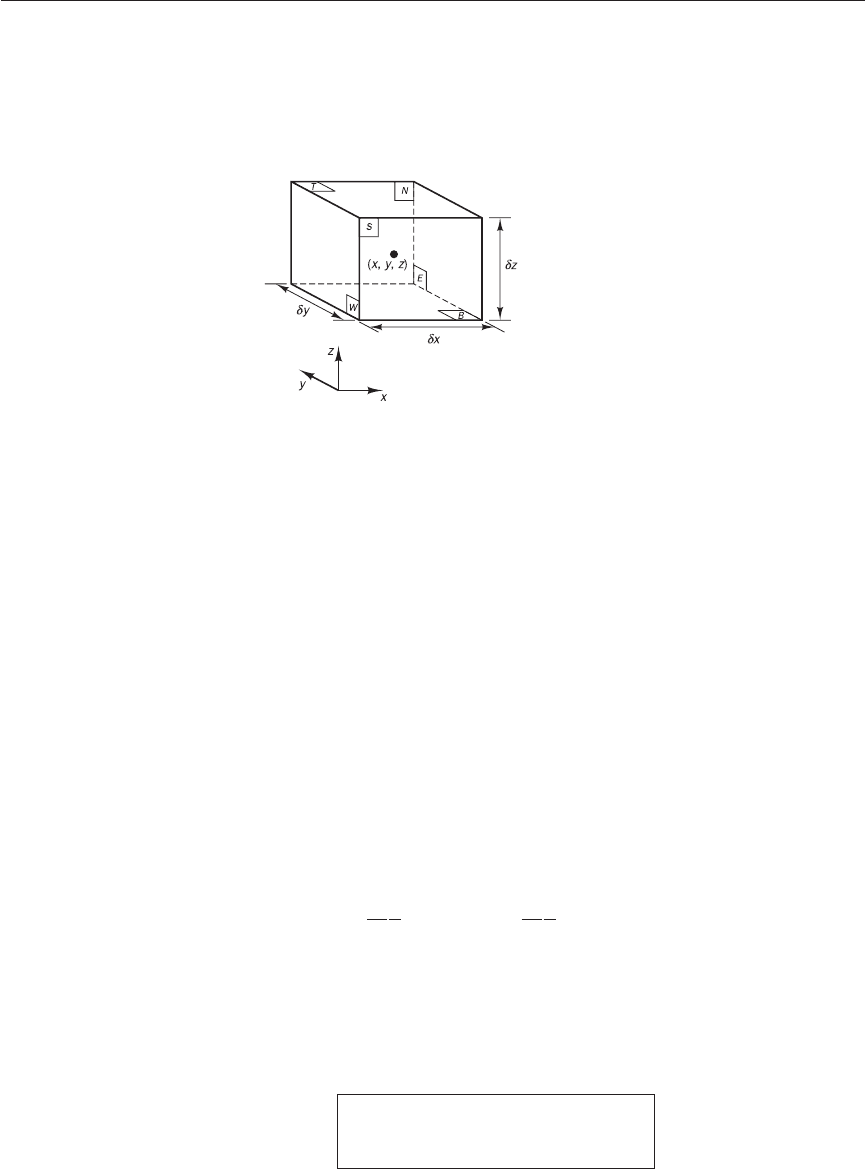
Figure 2.1 Fluid element for
conservation laws
be thought of as averages over suitably large numbers of molecules. A fluid
particle or point in a fluid is then the smallest possible element of fluid whose
macroscopic properties are not influenced by individual molecules.
We consider such a small element of fluid with sides
δ
x,
δ
y and
δ
z
(Figure 2.1).
The six faces are labelled N, S, E, W, T and B, which stands for North,
South, East, West, Top and Bottom. The positive directions along the co-
ordinate axes are also given. The centre of the element is located at position
(x, y, z). A systematic account of changes in the mass, momentum and energy
of the fluid element due to fluid flow across its boundaries and, where appro-
priate, due to the action of sources inside the element, leads to the fluid flow
equations.
All fluid properties are functions of space and time so we would strictly
need to write
ρ
(x, y, z, t), p(x, y, z, t), T(x, y, z, t) and u(x, y, z, t) for the
density, pressure, temperature and the velocity vector respectively. To avoid
unduly cumbersome notation we will not explicitly state the dependence on
space co-ordinates and time. For instance, the density at the centre (x, y, z)
of a fluid element at time t is denoted by
ρ
and the x-derivative of, say, pres-
sure p at (x, y, z) and time t by
∂
p/
∂
x. This practice will also be followed for
all other fluid properties.
The element under consideration is so small that fluid properties at the
faces can be expressed accurately enough by means of the first two terms
of a Taylor series expansion. So, for example, the pressure at the W and E
faces, which are both at a distance of
1
–
2
δ
x from the element centre, can be
expressed as
p −
δ
x and p +
δ
x
2.1.1 Mass conservation in three dimensions
The first step in the derivation of the mass conservation equation is to write
down a mass balance for the fluid element:
Rate of increase Net rate of flow
of mass in fluid = of mass into
element fluid element
1
2
∂
p
∂
x
1
2
∂
p
∂
x
ANIN_C02.qxd 29/12/2006 09:55 AM Page 10
2.1 GOVERNING EQUATIONS OF FLUID FLOW AND HEAT TRANSFER 11
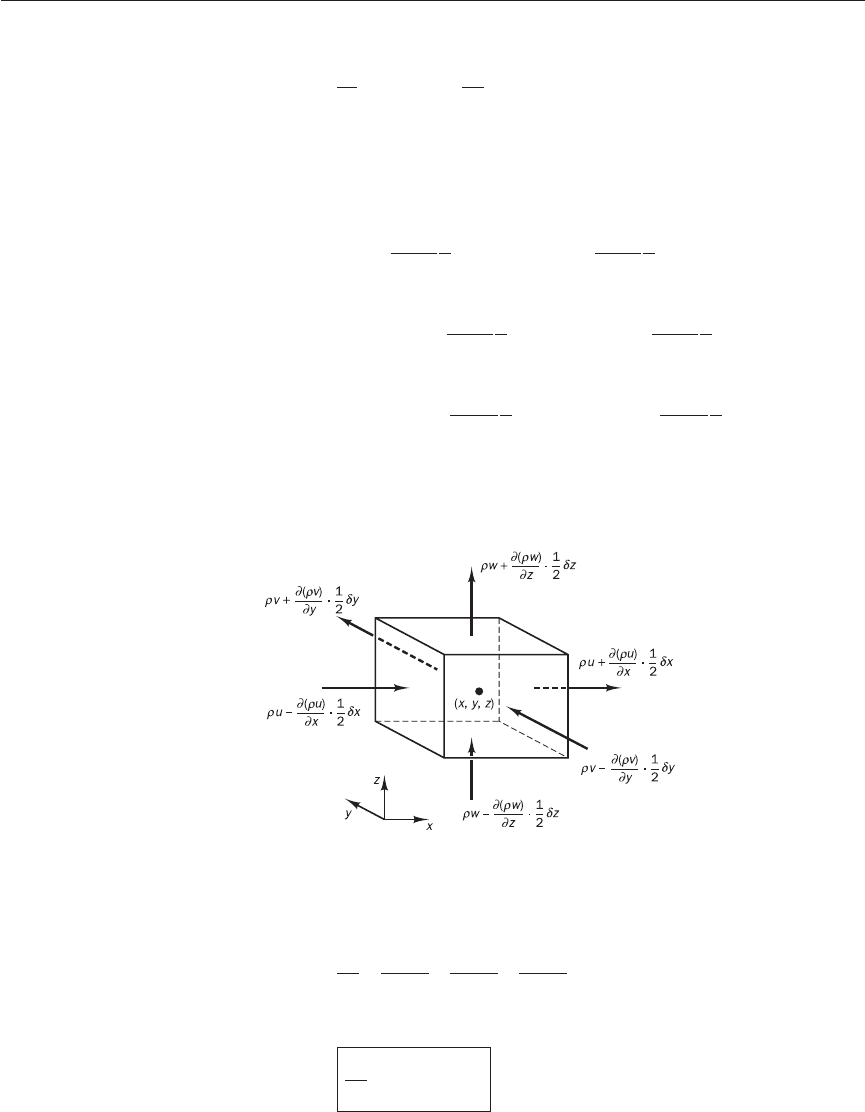
Figure 2.2 Mass flows in and
out of fluid element
The rate of increase of mass in the fluid element is
(
ρδ
x
δ
y
δ
z) =
δ
x
δ
y
δ
z (2.1)
Next we need to account for the mass flow rate across a face of the element,
which is given by the product of density, area and the velocity component
normal to the face. From Figure 2.2 it can be seen that the net rate of flow of
mass into the element across its boundaries is given by
ρ
u −
δ
x
δ
y
δ
z −
ρ
u +
δ
x
δ
y
δ
z
+
ρ
v −
δ
y
δ
x
δ
z −
ρ
v +
δ
y
δ
x
δ
z
+
ρ
w −
δ
z
δ
x
δ
y −
ρ
w +
δ
z
δ
x
δ
y (2.2)
Flows which are directed into the element produce an increase of mass in the
element and get a positive sign and those flows that are leaving the element
are given a negative sign.
D
E
F
1
2
∂
(
ρ
w)
∂
z
A
B
C
D
E
F
1
2
∂
(
ρ
w)
∂
z
A
B
C
D
E
F
1
2
∂
(
ρ
v)
∂
y
A
B
C
D
E
F
1
2
∂
(
ρ
v)
∂
y
A
B
C
D
E
F
1
2
∂
(
ρ
u)
∂
x
A
B
C
D
E
F
1
2
∂
(
ρ
u)
∂
x
A
B
C
∂ρ
∂
t
∂
∂
t
The rate of increase of mass inside the element (2.1) is now equated to the
net rate of flow of mass into the element across its faces (2.2). All terms of the
resulting mass balance are arranged on the left hand side of the equals sign
and the expression is divided by the element volume
δ
x
δ
y
δ
z. This yields
+++=0 (2.3)
or in more compact vector notation
+ div(
ρ
u) = 0 (2.4)
Equation (2.4) is the unsteady, three-dimensional mass conservation
or continuity equation at a point in a compressible fluid. The first term
∂ρ
∂
t
∂
(
ρ
w)
∂
z
∂
(
ρ
v)
∂
y
∂
(
ρ
u)
∂
x
∂ρ
∂
t
ANIN_C02.qxd 29/12/2006 09:55 AM Page 11

on the left hand side is the rate of change in time of the density (mass per unit
volume). The second term describes the net flow of mass out of the element
across its boundaries and is called the convective term.
For an incompressible fluid (i.e. a liquid) the density
ρ
is constant and
equation (2.4) becomes
div u = 0 (2.5)
or in longhand notation
++=0 (2.6)
2.1.2 Rates of change following a fluid particle and for a fluid
element
The momentum and energy conservation laws make statements regarding
changes of properties of a fluid particle. This is termed the Lagrangian
approach. Each property of such a particle is a function of the position
(x, y, z) of the particle and time t. Let the value of a property per unit mass
be denoted by
φ
. The total or substantive derivative of
φ
with respect to time
following a fluid particle, written as D
φ
/Dt, is
=+ + +
A fluid particle follows the flow, so dx/dt = u, dy/dt = v and dz/dt = w.
Hence the substantive derivative of
φ
is given by
=+u + v + w =+u . grad
φ
(2.7)
D
φ
/Dt defines rate of change of property
φ
per unit mass. It is possible
to develop numerical methods for fluid flow calculations based on the
Lagrangian approach, i.e. by tracking the motion and computing the rates of
change of conserved properties
φ
for collections of fluid particles. However,
it is far more common to develop equations for collections of fluid elements
making up a region fixed in space, for example a region defined by a duct, a
pump, a furnace or similar piece of engineering equipment. This is termed
the Eulerian approach.
As in the case of the mass conservation equation, we are interested in
developing equations for rates of change per unit volume. The rate of change
of property
φ
per unit volume for a fluid particle is given by the product of
D
φ
/Dt and density
ρ
, hence
ρ
=
ρ
+ u . grad
φ
(2.8)
The most useful forms of the conservation laws for fluid flow computation
are concerned with changes of a flow property for a fluid element that is
stationary in space. The relationship between the substantive derivative of
φ
,
which follows a fluid particle, and rate of change of
φ
for a fluid element is
now developed.
D
E
F
∂φ
∂
t
A
B
C
D
φ
Dt
∂φ
∂
t
∂φ
∂
z
∂φ
∂
y
∂φ
∂
x
∂φ
∂
t
D
φ
Dt
dz
dt
∂φ
∂
z
dy
dt
∂φ
∂
y
dx
dt
∂φ
∂
x
∂φ
∂
t
D
φ
Dt
∂
w
∂
z
∂
v
∂
y
∂
u
∂
x
12 CHAPTER 2 CONSERVATION LAWS OF FLUID MOTION
ANIN_C02.qxd 29/12/2006 09:55 AM Page 12

2.1 GOVERNING EQUATIONS OF FLUID FLOW AND HEAT TRANSFER 13
The mass conservation equation contains the mass per unit volume (i.e.
the density
ρ
) as the conserved quantity. The sum of the rate of change of
density in time and the convective term in the mass conservation equation
(2.4) for a fluid element is
+ div(
ρ
u)
The generalisation of these terms for an arbitrary conserved property is
+ div(
ρφ
u) (2.9)
Formula (2.9) expresses the rate of change in time of
φ
per unit volume plus
the net flow of
φ
out of the fluid element per unit volume. It is now rewritten
to illustrate its relationship with the substantive derivative of
φ
:
+ div(
ρφ
u) =
ρ
+ u . grad
φ
+
φ
+ div(
ρ
u)
=
ρ
(2.10)
The term
φ
[(
∂ρ
/
∂
t) + div(
ρ
u)] is equal to zero by virtue of mass conserva-
tion (2.4). In words, relationship (2.10) states
Rate of increase Net rate of flow Rate of increase
of
φ
of fluid + of
φ
out of = of
φ
for a
element fluid element fluid particle
To construct the three components of the momentum equation and the
energy equation the relevant entries for
φ
and their rates of change per unit
volume as defined in (2.8) and (2.10) are given below:
x-momentum u
ρ
+ div(
ρ
uu)
y-momentum v
ρ
+ div(
ρ
vu)
z-momentum w
ρ
+ div(
ρ
wu)
energy E
ρ
+ div(
ρ
Eu)
Both the conservative (or divergence) form and non-conservative form of the
rate of change can be used as alternatives to express the conservation of a
physical quantity. The non-conservative forms are used in the derivations of
momentum and energy equations for a fluid flow in sections 2.4 and 2.5 for
brevity of notation and to emphasise that the conservation laws are funda-
mentally conceived as statements that apply to a particle of fluid. In the final
∂
(
ρ
E)
∂
t
DE
Dt
∂
(
ρ
w)
∂
t
Dw
Dt
∂
(
ρ
v)
∂
t
Dv
Dt
∂
(
ρ
u)
∂
t
Du
Dt
D
φ
Dt
J
K
L
∂ρ
∂
t
G
H
I
J
K
L
∂φ
∂
t
G
H
I
∂
(
ρφ
)
∂
t
∂
(
ρφ
)
∂
t
∂ρ
∂
t
ANIN_C02.qxd 29/12/2006 09:55 AM Page 13

14 CHAPTER 2 CONSERVATION LAWS OF FLUID MOTION
Figure 2.3 Stress components
on three faces of fluid element
section 2.8 we will return to the conservative form that is used in finite vol-
ume CFD calculations.
2.1.3 Momentum equation in three dimensions
Newton’s second law states that the rate of change of momentum of a fluid
particle equals the sum of the forces on the particle:
Rate of increase of Sum of forces
momentum of = on
fluid particle fluid particle
The rates of increase of x-, y- and z-momentum per unit volume of a
fluid particle are given by
ρρρ
(2.11)
We distinguish two types of forces on fluid particles:
• surface forces
– pressure forces
– viscous forces
– gravity force
• body forces
– centrifugal force
– Coriolis force
– electromagnetic force
It is common practice to highlight the contributions due to the surface forces
as separate terms in the momentum equation and to include the effects of
body forces as source terms.
The state of stress of a fluid element is defined in terms of the pressure
and the nine viscous stress components shown in Figure 2.3. The pressure,
a normal stress, is denoted by p. Viscous stresses are denoted by
τ
. The usual
suffix notation
τ
ij
is applied to indicate the direction of the viscous stresses.
The suffices i and j in
τ
ij
indicate that the stress component acts in the j-
direction on a surface normal to the i-direction.
Dw
Dt
Dv
Dt
Du
Dt
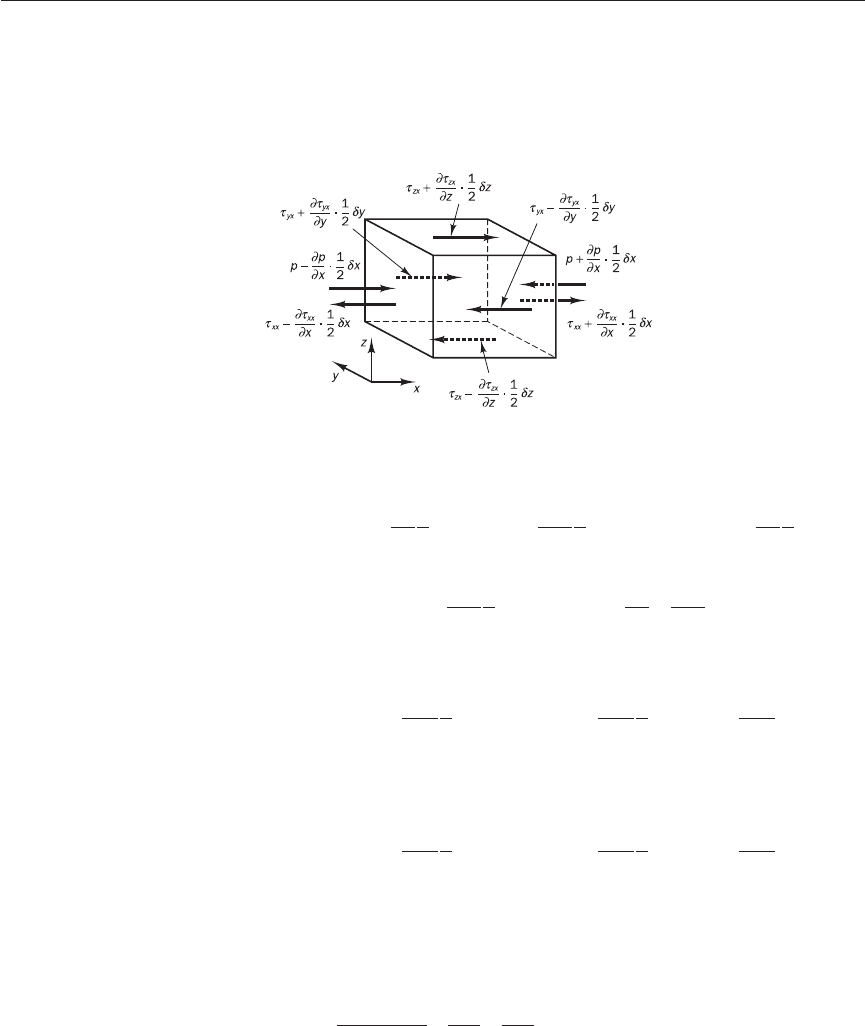
First we consider the x-components of the forces due to pressure p and
stress components
τ
xx
,
τ
yx
and
τ
zx
shown in Figure 2.4. The magnitude of a
ANIN_C02.qxd 29/12/2006 09:55 AM Page 14
2.1 GOVERNING EQUATIONS OF FLUID FLOW AND HEAT TRANSFER 15
force resulting from a surface stress is the product of stress and area. Forces
aligned with the direction of a co-ordinate axis get a positive sign and those
in the opposite direction a negative sign. The net force in the x-direction is
the sum of the force components acting in that direction on the fluid element.
Figure 2.4 Stress components
in the x-direction
On the pair of faces (E, W ) we have
p −
δ
x −
τ
xx
−
δ
x
δ
y
δ
z +−p +
δ
x
+
τ
xx
+
δ
x
δ
y
δ
z =− +
δ
x
δ
y
δ
z (2.12a)
The net force in the x-direction on the pair of faces (N, S ) is
−
τ
yx
−
δ
y
δ
x
δ
z +
τ
yx
+
δ
y
δ
x
δ
z =
δ
x
δ
y
δ
z
(2.12b)
Finally the net force in the x-direction on faces T and B is given by
−
τ
zx
−
δ
z
δ
x
δ
y +
τ
zx
+
δ
z
δ
x
δ
y =
δ
x
δ
y
δ
z
(2.12c)
The total force per unit volume on the fluid due to these surface stresses is
equal to the sum of (2.12a), (2.12b) and (2.12c) divided by the volume
δ
x
δ
y
δ
z:
++ (2.13)
Without considering the body forces in further detail their overall effect
can be included by defining a source S
Mx
of x-momentum per unit volume
per unit time.
The x-component of the momentum equation is found by setting
the rate of change of x-momentum of the fluid particle (2.11) equal to the
∂τ
zx
∂
z
∂τ
yx
∂
y
∂
(−p +
τ
xx
)
∂
x
∂τ
zx
∂
z
D
E
F
1
2
∂τ
zx
∂
z
A
B
C
D
E
F
1
2
∂τ
zx
∂
z
A
B
C
∂τ
yx
∂
y
D
E
F
1
2
∂τ
yx
∂
y
A
B
C
D
E
F
1
2
∂τ
yx
∂
y
A
B
C
D
E
F
∂τ
xx
∂
x
∂
p
∂
x
A
B
C
J
K
L
D
E
F
1
2
∂τ
xx
∂
x
A
B
C
D
E
F
1
2
∂
p
∂
x
A
B
C
G
H
I
J
K
L
D
E
F
1
2
∂τ
xx
∂
x
A
B
C
D
E
F
1
2
∂
p
∂
x
A
B
C
G
H
I
ANIN_C02.qxd 29/12/2006 09:55 AM Page 15

16 CHAPTER 2 CONSERVATION LAWS OF FLUID MOTION
total force in the x-direction on the element due to surface stresses (2.13)
plus the rate of increase of x-momentum due to sources:
ρ
= +++S
Mx
(2.14a)
It is not too difficult to verify that the y-component of the momentum
equation is given by
ρ
=+ ++S
My
(2.14b)
and the z-component of the momentum equation by
ρ
=++ +S
Mz
(2.14c)
The sign associated with the pressure is opposite to that associated with the
normal viscous stress, because the usual sign convention takes a tensile stress
to be the positive normal stress so that the pressure, which is by definition a
compressive normal stress, has a minus sign.
The effects of surface stresses are accounted for explicitly; the source
terms S
Mx
, S
My
and S
Mz
in (2.14a–c) include contributions due to body forces
only. For example, the body force due to gravity would be modelled by
S
Mx
= 0, S
My
= 0 and S
Mz
=−
ρ
g.
2.1.4 Energy equation in three dimensions
The energy equation is derived from the first law of thermodynamics,
which states that the rate of change of energy of a fluid particle is equal to the
rate of heat addition to the fluid particle plus the rate of work done on the
particle:
Rate of increase Net rate of Net rate of work
of energy of = heat added to + done on
fluid particle fluid particle fluid particle
As before, we will be deriving an equation for the rate of increase of
energy of a fluid particle per unit volume, which is given by
ρ
(2.15)
Work done by surface forces
The rate of work done on the fluid particle in the element by a surface
force is equal to the product of the force and velocity component in the
direction of the force. For example, the forces given by (2.12a–c) all act in
the x-direction. The work done by these forces is given by
DE
Dt
∂
(−p +
τ
zz
)
∂
z
∂τ
yz
∂
y
∂τ
xz
∂
x
Dw
Dt
∂τ
zy
∂
z
∂
(−p +
τ
yy
)
∂
y
∂τ
xy
∂
x
Dv
Dt
∂τ
zx
∂
z
∂τ
yx
∂
y
∂
(−p +
τ
xx
)
∂
x
Du
Dt
ANIN_C02.qxd 29/12/2006 09:55 AM Page 16