
Versteeg H., Malalasekra W. An Introduction to Computational Fluid Dynamics: The Finite Volume Method
Подождите немного. Документ загружается.

2.11 PROBLEMS IN COMPRESSIBLE FLOWS 37
ensure that the limited domain of dependence of effectively inviscid (hyper-
bolic) flows at Mach numbers greater than 1 is adequately modelled. Issa
and Lockwood (1977) and McGuirk and Page (1990) gave lucid papers that
identify the main issues relevant to the finite volume method.
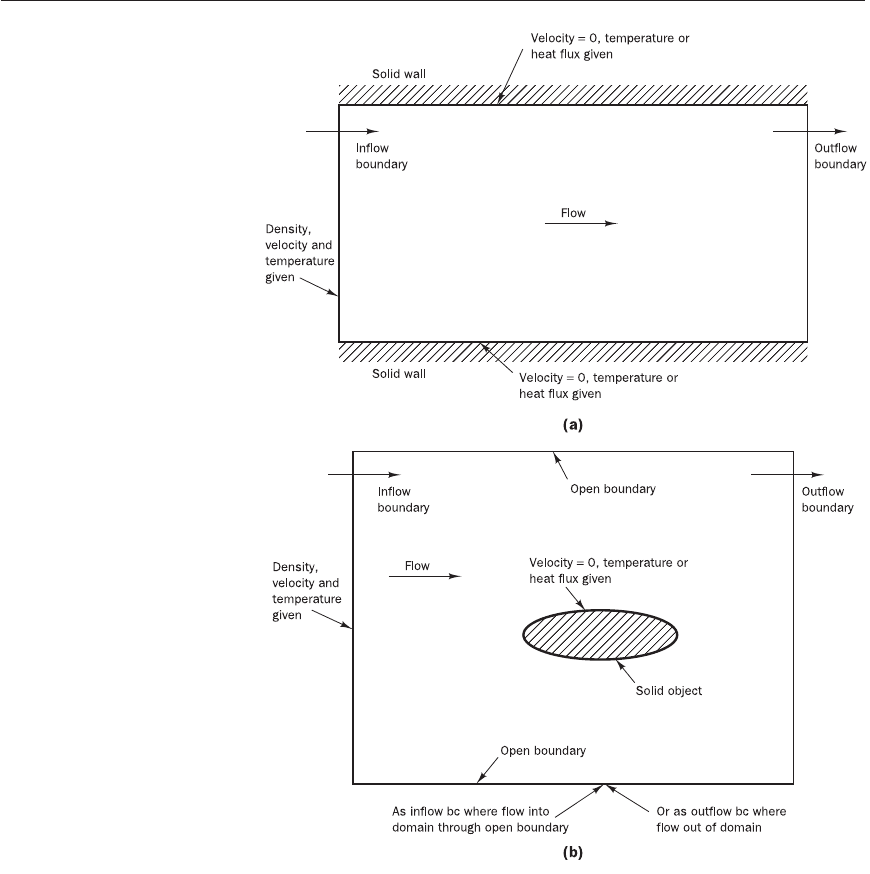
Open (far field) boundary conditions give the most serious problems for
the designer of general-purpose CFD codes. Subsonic inviscid compressible
flow equations require fewer inlet conditions (normally only
ρ
and u are spe-
cified) than viscous flow equations and only one outlet condition (typically
specified pressure). Supersonic inviscid compressible flows require the same
number of inlet boundary conditions as viscous flows, but do not admit any
outflow boundary conditions because the flow is hyperbolic.
Without knowing a great deal about the flow before solving a problem it
is very difficult to specify the precise number and nature of the allowable
Figure 2.12 (a) Boundary
conditions for an internal flow
problem; (b) boundary condition
for external flow problem
ANIN_C02.qxd 29/12/2006 09:55 AM Page 37
boundary conditions on any fluid/fluid boundary in the far field. Issa and
Lockwood’s work (1977) reported the solution of a shock/boundary layer
interaction problem where part of the far field boundary conditions are
obtained from an inviscid solution performed prior to the viscous solution.
The usual (viscous) outlet condition
∂
(
ρ
u
n
)/
∂
n = 0 is applied on the remain-
der of the far field boundary.
Fletcher (1991) noted that under-specification of boundary conditions
normally leads to failure to obtain a unique solution. Over-specification,
however, gives rise to flow solutions with severe and unphysical ‘boundary
layers’ close to the boundary where the condition is applied.
If the location of the outlet or far field boundaries is chosen far enough
away from the region of interest within the solution domain it is possible to
get physically meaningful results. Most careful solutions test the sensitivity
of the interior solution to the positioning of outflow and far field boundaries.
If results do not change in the interior, the boundary conditions are ‘trans-
parent’ and the results are acceptable.
These complexities make it very difficult for general-purpose finite vol-
ume CFD codes to cope with general subsonic, transonic and/or supersonic
viscous flows. Although all commercially available codes claim to be able to
make computations in all flow regimes, they perform most effectively at
Mach numbers well below 1 as a consequence of all the problems outlined
above.
We have derived the complete set of governing equations of fluid flow from
basic conservation principles. The thermodynamic equilibrium assumption
and the Newtonian model of viscous stresses were enlisted to close the sys-
tem mathematically. Since no particular assumptions were made with regard
to the viscosity, it is straightforward to accommodate a variable viscosity that
is dependent on local conditions. This facilitates the inclusion of fluids with
38 CHAPTER 2 CONSERVATION LAWS OF FLUID MOTION
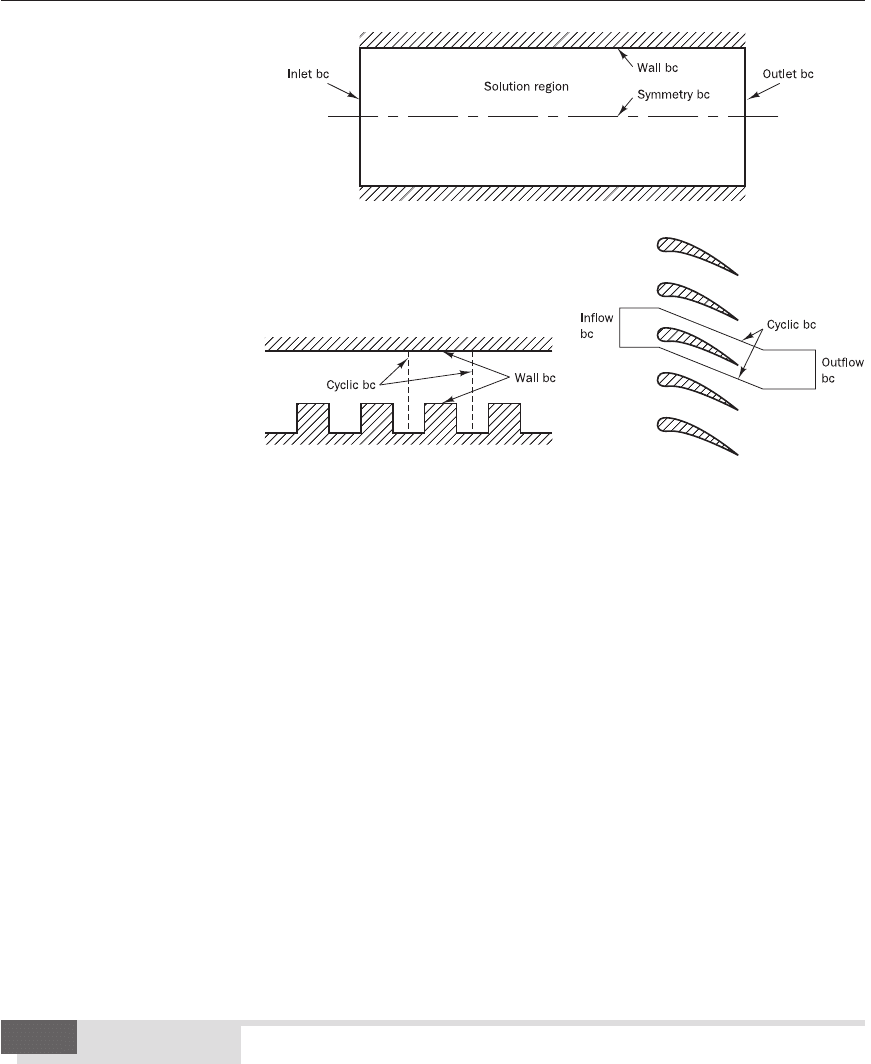
Figure 2.13 Examples of flow
boundaries with symmetry and
cyclic conditions
Summary2.12
ANIN_C02.qxd 29/12/2006 09:55 AM Page 38

2.12 SUMMARY 39
temperature-dependent viscosity and those with non-Newtonian character-
istics within the framework of equations.
We have identified a common differential form for all the flow equations,
the so-called transport equation, and developed integrated forms which are
central to the finite volume CFD method:
For steady state processes
n . (
ρφ
u)dA = n . (Γ grad
φ
)dA + S
φ
dV (2.43)
and for time-dependent processes
ρφ
dV dt + n . (
ρφ
u)dA dt
= n . (Γ grad
φ
)dA dt + S
φ
dV dt (2.44)
The auxiliary conditions – initial and boundary conditions – needed to solve
a fluid flow problem were also discussed. It emerged that there are three
types of distinct physical behaviour – elliptic, parabolic and hyperbolic – and
the governing fluid flow equations were formally classified. Problems with
this formal classification were identified as resulting from: (i) boundary-
layer-type behaviour in flows at high Reynolds numbers and (ii) compress-
ibility effects at Mach numbers around and above 1. These lead to severe
difficulties in the specification of boundary conditions for completely general-
purpose CFD procedures working at any Reynolds number and Mach
number.
Experience with the finite volume method has yielded a set of auxiliary
conditions that give physically realistic flow solutions in many industrially
relevant problems. The most complete problem specification includes, in
addition to initial values of all flow variables, the following boundary
conditions:
• Complete specification of the distribution of all variables
φ
(except
pressure) at all inlets to the flow domain of interest
• Specification of pressure at one location inside the flow domain
• Set gradient of all variables
φ
to zero in the flow direction at suitably
positioned outlets
• Specification of all variables
φ
(except pressure and density) or their
normal gradients at solid walls
CV
∆t
A
∆t
A
∆t
D
E
F
CV
A
B
C
∂
∂
t
∆t
CV
A
A
ANIN_C02.qxd 29/12/2006 09:55 AM Page 39

All flows encountered in engineering practice, simple ones, such as two-
dimensional jets, wakes, pipe flows and flat plate boundary layers, and
more complicated three-dimensional ones, become unstable above a certain
Reynolds number (UL/
ν
where U and L are characteristic velocity and
length scales of the mean flow and
ν
is the kinematic viscosity). At low
Reynolds numbers flows are laminar. At higher Reynolds numbers flows
are observed to become turbulent. A chaotic and random state of motion
develops in which the velocity and pressure change continuously with time
within substantial regions of flow.
Flows in the laminar regime are completely described by the equations
developed in Chapter 2. In simple cases the continuity and Navier–Stokes
equations can be solved analytically (Schlichting, 1979). More complex flows
can be tackled numerically with CFD techniques such as the finite volume
method without additional approximations.
Many, if not most, flows of engineering significance are turbulent, so the
turbulent flow regime is not just of theoretical interest. Fluid engineers need
access to viable tools capable of representing the effects of turbulence. This
chapter gives a brief introduction to the physics of turbulence and to its
modelling in CFD.
In sections 3.1 and 3.2, the nature of turbulent flows and the physics of
the transition from laminar flow to turbulence are examined. In section 3.3
we give formal definitions for the most common descriptors of a turbulent
flow, and in section 3.4 the characteristics of some simple two-dimensional
turbulent flows are described. Next, in section 3.5, the consequences of
the appearance of the fluctuations associated with turbulence on the time-
averaged Navier–Stokes equations are analysed. The velocity fluctuations
are found to give rise to additional stresses on the fluid, the so-called
Reynolds stresses. The main categories of models for these extra stress terms
are given in section 3.6. The most widely used category of classical turbu-
lence models is discussed in section 3.7. In section 3.8 we review large eddy
simulations (LES) and in section 3.9 we give a brief summary of direct
numerical simulation (DNS).
First we take a brief look at the main characteristics of turbulent flows.
The Reynolds number of a flow gives a measure of the relative importance
of inertia forces (associated with convective effects) and viscous forces.
In experiments on fluid systems it is observed that at values below the so-
called critical Reynolds number Re
crit
the flow is smooth and adjacent layers
Chapter three Turbulence and its modelling
What is
turbulence?
3.1
ANIN_C03.qxd 29/12/2006 04:34PM Page 40
3.1 WHAT IS TURBULENCE? 41
of fluid slide past each other in an orderly fashion. If the applied boundary
conditions do not change with time the flow is steady. This regime is called
laminar flow.
At values of the Reynolds number above Re
crit
a complicated series of
events takes place which eventually leads to a radical change of the flow
character. In the final state the flow behaviour is random and chaotic. The
motion becomes intrinsically unsteady even with constant imposed bound-
ary conditions. The velocity and all other flow properties vary in a random
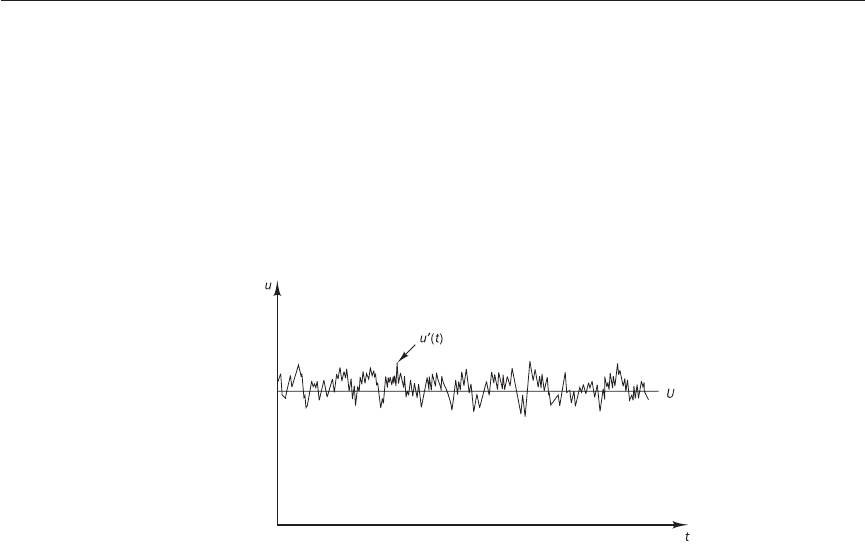
and chaotic way. This regime is called turbulent flow. A typical point velo-
city measurement might exhibit the form shown in Figure 3.1.
Figure 3.1 Typical point
velocity measurement in
turbulent flow
The random nature of a turbulent flow precludes an economical descrip-
tion of the motion of all the fluid particles. Instead the velocity in Figure 3.1
is decomposed into a steady mean value U with a fluctuating component u′(t)
superimposed on it: u(t) = U + u′(t). This is called the Reynolds decom-
position. A turbulent flow can now be characterised in terms of the mean
values of flow properties (U, V, W, P etc.) and some statistical properties of
their fluctuations (u′, v′, w′, p′ etc.). We give formal definitions of the mean
and the most common statistical descriptors of the fluctuations in section 3.3.
Even in flows where the mean velocities and pressures vary in only
one or two space dimensions, turbulent fluctuations always have a three-
dimensional spatial character. Furthermore, visualisations of turbulent
flows reveal rotational flow structures, so-called turbulent eddies, with a
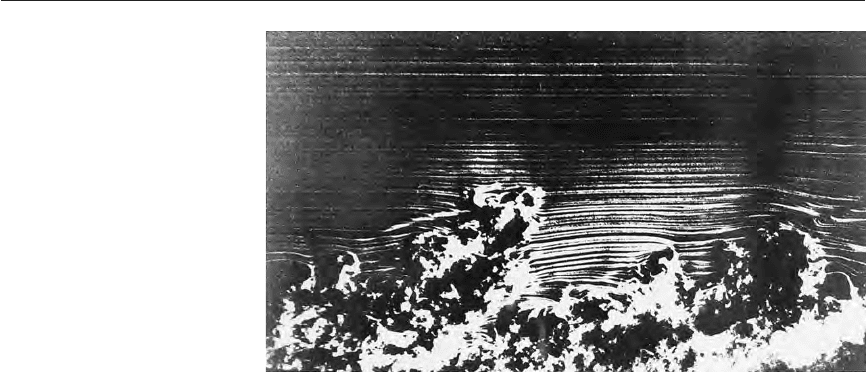
wide range of length scales. Figure 3.2, which depicts a cross-sectional
view of a turbulent boundary layer on a flat plate, shows eddies whose length
scale is comparable with that of the flow boundaries as well as eddies of inter-
mediate and small size.
Particles of fluid which are initially separated by a long distance can be
brought close together by the eddying motions in turbulent flows. As a
consequence, heat, mass and momentum are very effectively exchanged.
For example, a streak of dye which is introduced at a point in a turbulent
flow will rapidly break up and be dispersed right across the flow. Such
effective mixing gives rise to high values of diffusion coefficients for mass,
momentum and heat.
The largest turbulent eddies interact with and extract energy from the
mean flow by a process called vortex stretching. The presence of mean
velocity gradients in sheared flows distorts the rotational turbulent eddies.
Suitably aligned eddies are stretched because one end is forced to move
faster than the other.
ANIN_C03.qxd 29/12/2006 04:34PM Page 41
The characteristic velocity
ϑ
and characteristic length of the larger
eddies are of the same order as the velocity scale U and length scale L of the
mean flow. Hence a ‘large eddy’ Reynolds number Re
=
ϑ
/
ν
formed by
combining these eddy scales with the kinematic viscosity will be large in all
turbulent flows, since it is not very different in magnitude from UL/
ν
,
which itself is large. This suggests that these large eddies are dominated by
inertia effects and viscous effects are negligible.
The large eddies are therefore effectively inviscid, and angular momen-
tum is conserved during vortex stretching. This causes the rotation rate to
increase and the radius of their cross-sections to decrease. Thus the process
creates motions at smaller transverse length scales and also at smaller time
scales. The stretching work done by the mean flow on the large eddies dur-
ing these events provides the energy which maintains the turbulence.
Smaller eddies are themselves stretched strongly by somewhat larger
eddies and more weakly with the mean flow. In this way the kinetic energy is
handed down from large eddies to progressively smaller and smaller eddies
in what is termed the energy cascade. All the fluctuating properties of a
turbulent flow contain energy across a wide range of frequencies or wavenum-
bers (= 2
π
f/U where f is the frequency). This is demonstrated in Figure 3.3,
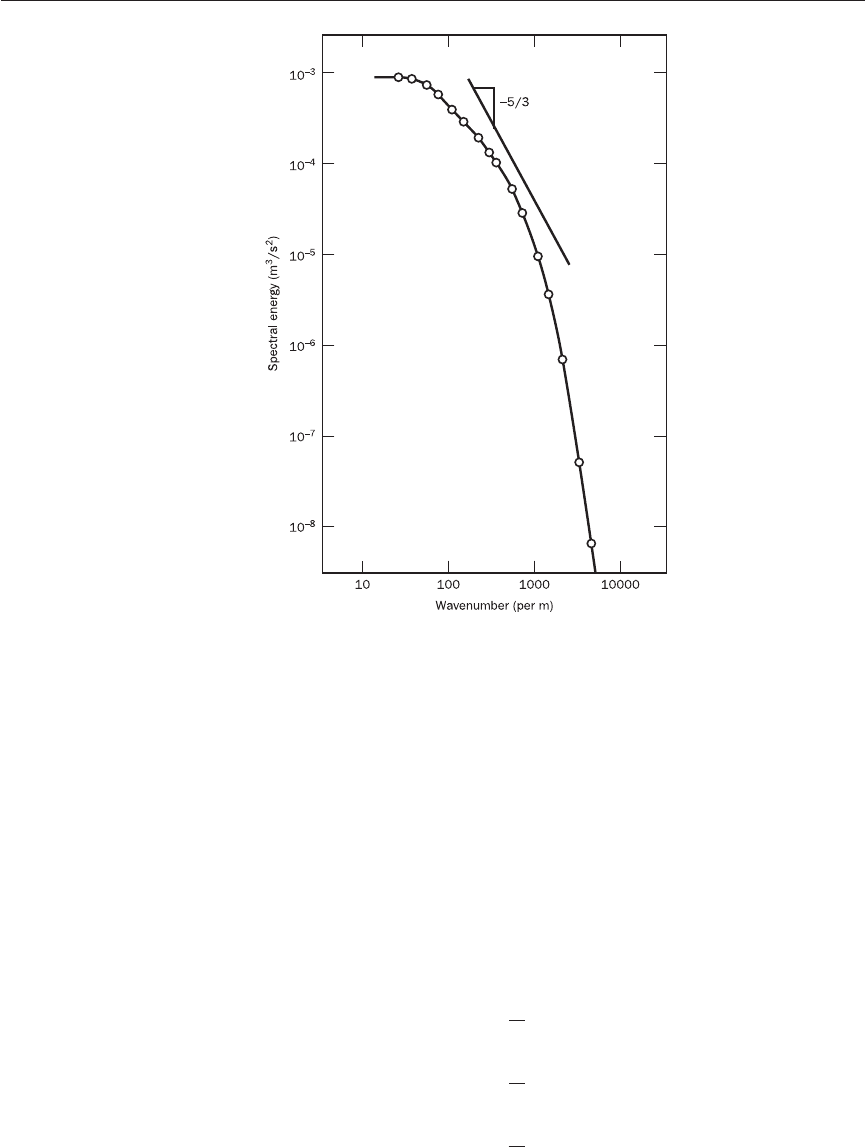
which gives the energy spectrum of turbulence downstream of a grid.
The spectral energy E(
κ
) is shown as a function of the wavenumber
κ
= 2
π
/
λ
, where
λ
is the wavelength of the eddies. The spectral energy E(
κ
)
(units m
3
/s
2
) is the kinetic energy per unit mass and per unit wavenumber of
fluctuations around the wavenumber
κ
. The diagram shows that the energy
content peaks at the low wavenumbers, so the larger eddies are the most
energetic. They acquire their energy through strong interactions with the
mean flow. The value of E(
κ
) rapidly decreases as the wavenumber increases,
so the smallest eddies have the lowest energy content.
The smallest scales of motion in a turbulent flow (lengths of the order
of 0.1 to 0.01 mm and frequencies around 10 kHz in typical turbulent
engineering flows) are dominated by viscous effects. The Reynolds number
Re
η
of the smallest eddies based on their characteristic velocity
υ
and
characteristic length
η
is equal to 1, Re
η
=
υη
/
ν
= 1, so the smallest scales
present in a turbulent flow are those for which the inertia and viscous effects
42 CHAPTER 3 TURBULENCE AND ITS MODELLING
Figure 3.2 Visualisation of a
turbulent boundary layer
Source: Van Dyke (1982)
ANIN_C03.qxd 29/12/2006 04:34PM Page 42
3.1 WHAT IS TURBULENCE? 43
are of equal strength. These scales are named the Kolmogorov microscales
after the Russian scientist who carried out groundbreaking work on the struc-
ture of turbulence in the 1940s. At these scales work is performed against the
action of viscous stresses, so that the energy associated with small-scale eddy
motions is dissipated and converted into thermal internal energy. This dissipa-
tion results in increased energy losses associated with turbulent flows.
Dimensional analysis can be used to obtain ratios of the length, time and
velocity scales of the small and large eddies. The Kolmogorov microscales
can be expressed in terms of the rate of energy dissipation of a turbulent flow
and the fluid viscosity, which uses the notion that in every turbulent flow the
rate of production of turbulent energy has to be broadly in balance with its
rate of dissipation to prevent unlimited growth of turbulence energy. This
yields the following order of magnitude estimates of the ratios of small
length, time and velocity scales
η
,
τ
,
υ
and large length, time and velocity
scales , T,
ϑ
(Tennekes and Lumley, 1972; Reynolds in Lumley, 1989):
Length-scale ratio ≈ Re
−3/4
(3.1a)
Time-scale ratio ≈ Re
−1/2
(3.1b)
Velocity-scale ratio ≈ Re
−1/4
(3.1c)
υ
ϑ
τ
T
η
Figure 3.3 Energy spectrum of
turbulence behind a grid
ANIN_C03.qxd 29/12/2006 04:34PM Page 43

Typical values of Re
might be 10
3
–10
6
, so the length, time and velocity
scales associated with small dissipating eddies are much smaller than those of
large, energetic eddies, and the difference – the so-called scale separation –
increases as Re
increases.
The behaviour of the large eddies should be independent of viscosity and
should depend on the velocity scale
ϑ
and length scale . Thus, on dimen-
sional grounds we would expect that the spectral energy content of these
eddies should behave as follows: E(
κ
) ∝
ϑ
2
, where
κ
= 1/. Since the length
scale is related to the length scale of turbulence producing processes – for
example, boundary layer thickness
δ
, obstacle width L, surface roughness
height k
s
– we expect the structure of the largest eddies to be highly
anisotropic (i.e. the fluctuations are different in different directions) and
strongly affected by the problem boundary conditions.
Kolmogorov argued that the structure of the smallest eddies and, hence,
their spectral energy E(
κ
= 1/
η
) should only depend on the rate of dissipa-
tion of turbulent energy
ε
(units m
2
/s
3
) and the kinematic viscosity of the
fluid
ν
. Dimensional analysis yields the following proportionality relation-
ship for the spectral energy: E(
κ
= 1/
η
) ∝
ν
5/4
ε
1/4
. Thus, the spectral energy
E(
κ
) of the smallest eddies only depends on the problem through the rate of
energy dissipation and is not linked to other problem variables. The diffusive
action of viscosity tends to smear out directionality at small scales. At high
mean flow Reynolds numbers the smallest eddies in a turbulent flow are,
therefore, isotropic (non-directional).
Finally, Kolmogorov derived the universal spectral properties of eddies of
intermediate size, which are sufficiently large for their behaviour to be un-
affected by viscous action (as the larger eddies), but sufficiently small that the
details of their behaviour can be expressed as a function of the rate of energy
dissipation
ε
(as the smallest eddies). The appropriate length scale for these
eddies is 1/
κ
, and he found that the spectral energy of these eddies – the
inertial subrange – satisfies the following relationship: E(
κ
) =
ακ
−5/3
ε
2/3
.
Measurements showed that the constant
α
≈ 1.5. Figure 3.3 includes a line
with a slope of −5/3, indicating that, for the measurements shown, the scale
separation is insufficient for a clear inertial subrange. Overlap between the
large and small eddies is located somewhere around
κ
≈ 1000.
The initial cause of the transition to turbulence can be explained by con-
sidering the stability of laminar flows to small disturbances. A sizeable body
of theoretical work is devoted to the analysis of the inception of transition:
hydrodynamic instability. In many relevant instances the transition to
turbulence is associated with sheared flows. Linear hydrodynamic stability
theory seeks to identify conditions which give rise to amplification of disturb-
ances. Of particular interest in an engineering context is the prediction of the
values of the Reynolds numbers Re
x,crit
(= Ux
crit
/
ν
) at which disturbances are
amplified and Re
x,tr
(= Ux
tr
/
ν
) at which transition to fully turbulent flow
takes place.
A mathematical discussion of the theory is beyond the scope of this brief
introduction. White (1991) gave a useful overview of theory and experi-
ments. The subject matter is fairly complex but its confirmation has led to a
series of experiments which reveal the physical processes causing transition
from laminar to turbulent flow. Most of our knowledge stems from work on
44 CHAPTER 3 TURBULENCE AND ITS MODELLING
Transition from
laminar to
turbulent flow
3.2
ANIN_C03.qxd 29/12/2006 04:34PM Page 44
3.2 TRANSITION FROM LAMINAR TO TURBULENT FLOW 45
two-dimensional incompressible flows. All such flows are sensitive to two-
dimensional disturbances with a relatively long wavelength, several times the
transverse distance over which velocity changes take place (e.g. six times the
thickness of a flat plate boundary layer).
Hydrodynamic stability of laminar flows
Two fundamentally different instability mechanisms operate, which are
associated with the shape of the two-dimensional laminar velocity profile
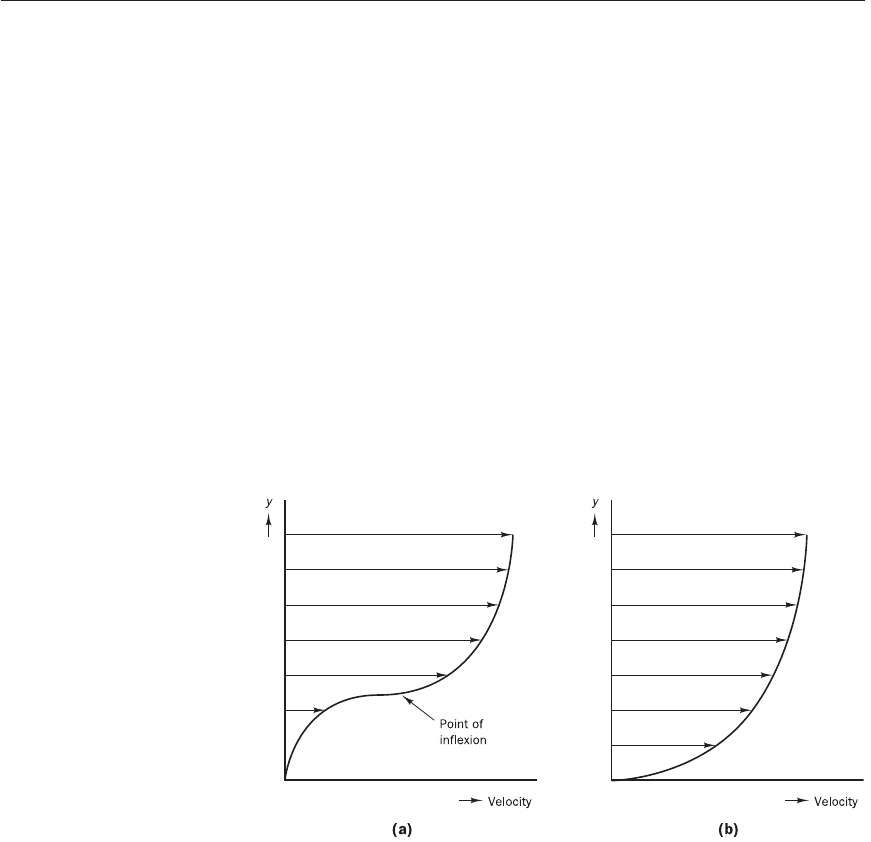
of the base flow. Flows with a velocity distribution which contains a point
of inflexion as shown in Figure 3.4a are always unstable with respect to
infinitesimal disturbances if the Reynolds number is large enough. This
instability was first identified by making an inviscid assumption in the equa-
tions describing the evolution of the disturbances. Subsequent refinement
of the theory by inclusion of the effect of viscosity changed its results very
little, so this type of instability is known as inviscid instability. Velocity
profiles of the type shown in Figure 3.4a are associated with jet flows, mix-
ing layers and wakes and also with boundary layers over flat plates under the
influence of an adverse pressure gradient (
∂
p/
∂
x > 0). The role of viscosity
is to dampen out fluctuations and stabilise the flow at low Reynolds numbers.
Figure 3.4 Velocity profiles
susceptible to (a) inviscid
instability and (b) viscous
instability
Flows with laminar velocity distributions without a point of inflexion such
as the profile shown in Figure 3.4b are susceptible to viscous instability.
The approximate inviscid theory predicts unconditional stability for these
velocity profiles, which are invariably associated with flows near solid walls
such as pipe, channel and boundary layer flows without adverse pressure
gradients (
∂
p/
∂
x ≤ 0). Viscous effects play a more complex role providing
damping at low and high Reynolds numbers, but contributing to the destabil-
isation of the flows at intermediate Reynolds numbers.
Transition to turbulence
The point where instability first occurs is always upstream of the point of
transition to fully turbulent flow. The distance between the point of instab-
ility where the Reynolds number equals Re
x,crit
and the point of transition
ANIN_C03.qxd 29/12/2006 04:34PM Page 45
Re
x,tr
depends on the degree of amplification of the unstable disturbances.
The point of instability and the onset of the transition process can be pre-
dicted with the linear theory of hydrodynamic instability. There is, however,
no comprehensive theory regarding the path leading from initial instability
to fully turbulent flows. Next, we describe the main, experimentally observed,
characteristics of three simple flows: jets, flat plate boundary layers and pipe
flows.
Jet flow: an example of a flow with a point of inflexion
Flows which possess one or more points of inflexion amplify long-
wavelength disturbances at all Reynolds numbers typically above about 10.
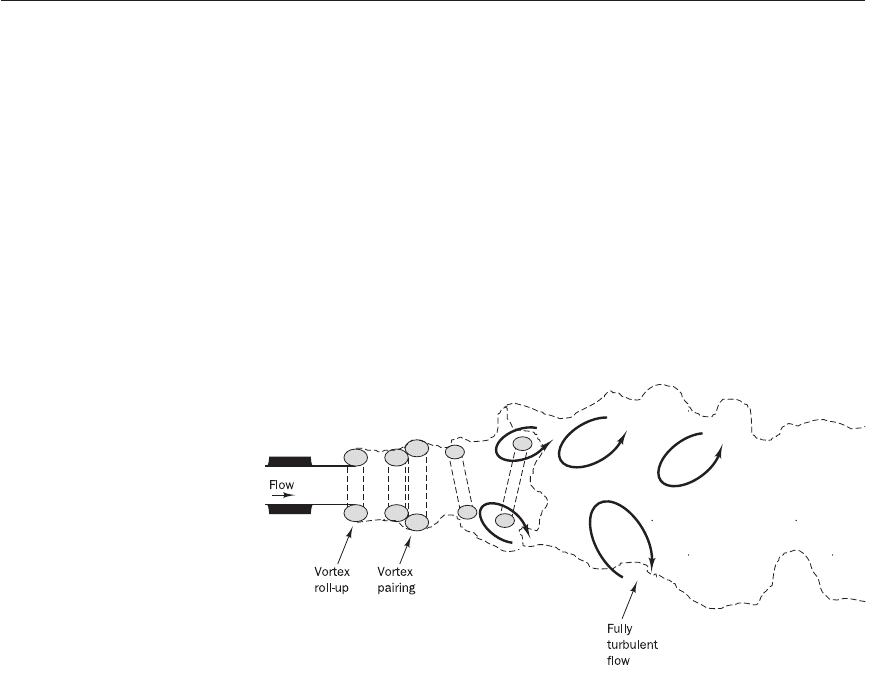
The transition process is explained by considering the sketch of a jet flow
(Figure 3.5).
46 CHAPTER 3 TURBULENCE AND ITS MODELLING
Figure 3.5 Transition in
a jet flow
After the flow emerges from the orifice the laminar exit flow produces the
rolling up of a vortex fairly close to the orifice. Subsequent amplification
involves the formation of a single vortex of greater strength through the pair-
ing of vortices. A short distance further downstream, three-dimensional dis-
turbances cause the vortices to become heavily distorted and less distinct.
The flow breaks down, generating a large number of small-scale eddies, and
the flow undergoes rapid transition to the fully turbulent regime. Mixing
layers and wakes behind bluff bodies exhibit a similar sequence of events,
leading to transition and turbulent flow.
Boundary layer on a flat plate: an example of a flow without a
point of inflexion
In flows with a velocity distribution without a point of inflexion viscous
instability theory predicts that there is a finite region of Reynolds numbers
around Re
δ
= 1000 (
δ
is the boundary layer thickness) where infinitesimal
disturbances are amplified. The developing flow over a flat plate is such a
flow, and the transition process has been extensively researched for this case.
The precise sequence of events is sensitive to the level of disturbance of
the incoming flow. However, if the flow system creates sufficiently smooth con-
ditions the instability of a boundary layer flow to relatively long-wavelength
ANIN_C03.qxd 29/12/2006 04:34PM Page 46