
Versteeg H., Malalasekra W. An Introduction to Computational Fluid Dynamics: The Finite Volume Method
Подождите немного. Документ загружается.

2.6 CLASSIFICATION OF PHYSICAL BEHAVIOURS 27
Equilibrium problems
The problems in the first category are steady state situations, e.g. the steady
state distribution of temperature in a rod of solid material or the equilibrium
stress distribution of a solid object under a given applied load, as well as many
steady fluid flows. These and many other steady state problems are governed
by elliptic equations. The prototype elliptic equation is Laplace’s equa-
tion, which describes irrotational flow of an incompressible fluid and steady
state conductive heat transfer. In two dimensions we have
+=0 (2.45)
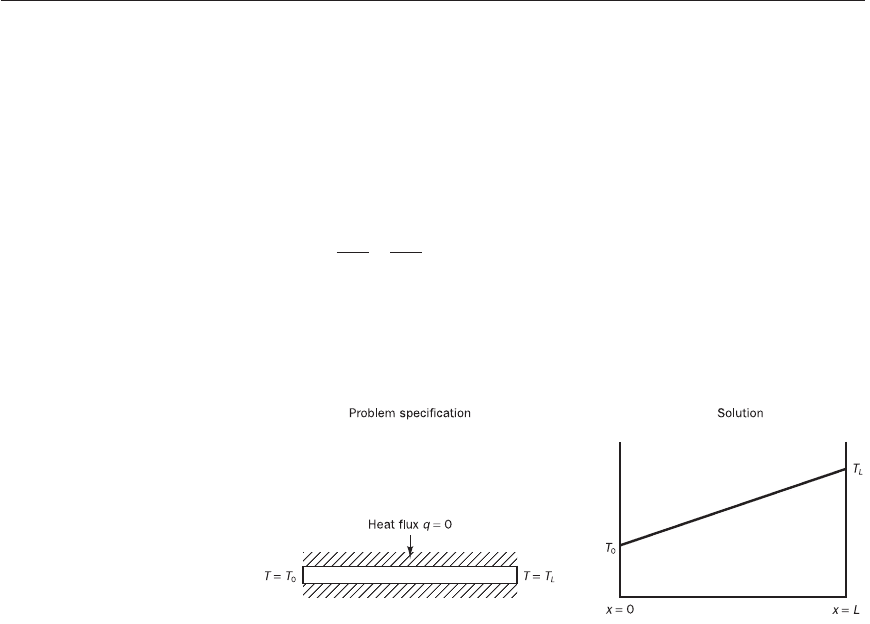
A very simple example of an equilibrium problem is the steady state heat
conduction (where
φ
= T in equation (2.45)) in an insulated rod of metal
whose ends at x = 0 and x = L are kept at constant, but different, tempera-
tures T
0
and T
L
(Figure 2.6).
∂
2
φ
∂
y
2
∂
2
φ
∂
x
2
Figure 2.6 Steady state
temperature distribution of an
insulated rod
This problem is one-dimensional and governed by the equation kd
2
T/dx
2
= 0. Under the given boundary conditions the temperature distribution in
the x-direction will, of course, be a straight line. A unique solution to this
and all elliptic problems can be obtained by specifying conditions on the
dependent variable (here the temperature or its normal derivative the heat
flux) on all the boundaries of the solution domain. Problems requiring data
over the entire boundary are called boundary-value problems.
An important feature of elliptic problems is that a disturbance in the
interior of the solution, e.g. a change in temperature due to the sudden
appearance of a small local heat source, changes the solution everywhere else.
Disturbance signals travel in all directions through the interior solution.
Consequently, the solutions to physical problems described by elliptic equa-
tions are always smooth even if the boundary conditions are discontinuous,
which is a considerable advantage to the designer of numerical methods. To
ensure that information propagates in all directions, the numerical techniques
for elliptic problems must allow events at each point to be influenced by all
its neighbours.
Marching problems
Transient heat transfer, all unsteady flows and wave phenomena are examples
of problems in the second category, the marching or propagation problems.
These problems are governed by parabolic or hyperbolic equations.
However, not all marching problems are unsteady. We will see further on
ANIN_C02.qxd 29/12/2006 09:55 AM Page 27
that certain steady flows are described by parabolic or hyperbolic equations.
In these cases the flow direction acts as a time-like co-ordinate along which
marching is possible.
Parabolic equations describe time-dependent problems, which involve
significant amounts of diffusion. Examples are unsteady viscous flows and
unsteady heat conduction. The prototype parabolic equation is the diffusion
equation
=
α
(2.46)
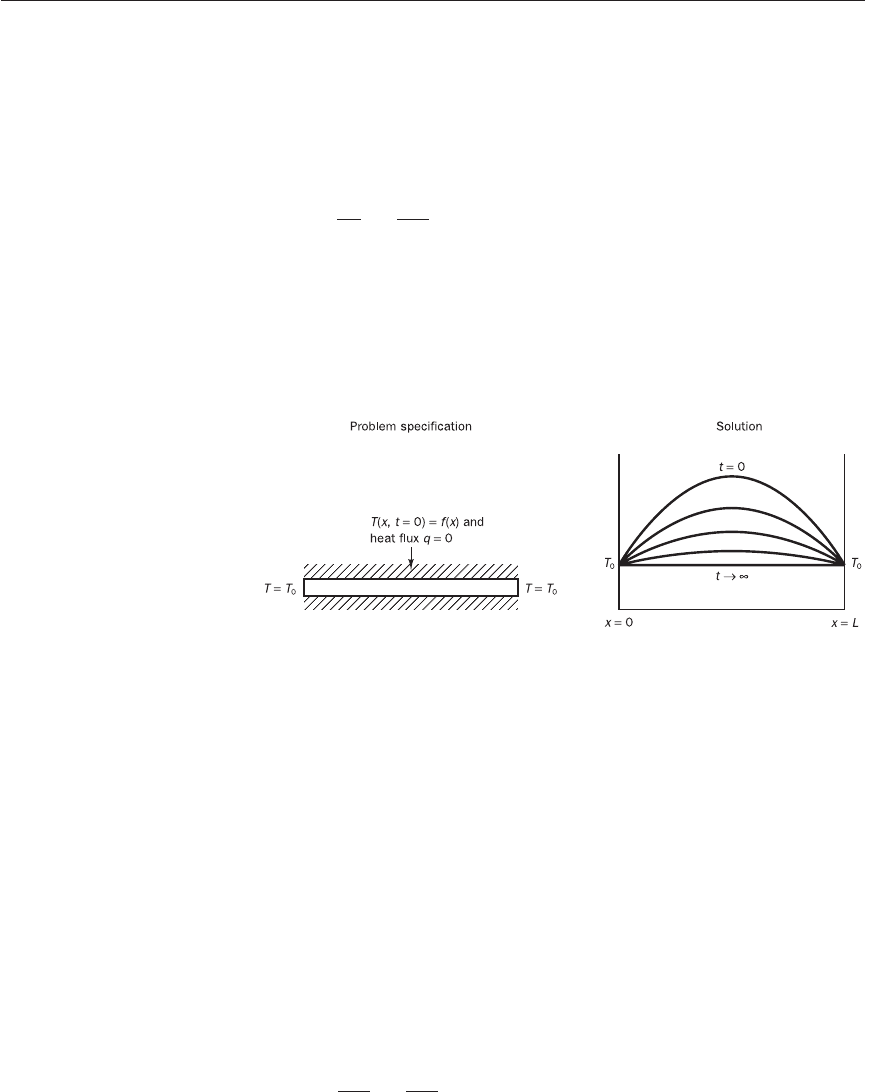
The transient distribution of temperature (again
φ
= T) in an insulated rod
of metal whose ends at x = 0 and x = L are kept at constant and equal tem-
perature T
0
is governed by the diffusion equation. This problem arises when
the rod cools down after an initially uniform source is switched off at time
t = 0. The temperature distribution at the start is a parabola with a maximum
at x = L/2 (Figure 2.7).
∂
2
φ
∂
x
2
∂φ
∂
t
28 CHAPTER 2 CONSERVATION LAWS OF FLUID MOTION
The steady state consists of a uniform distribution of temperature T = T
0
throughout the rod. The solution of the diffusion equation (2.46) yields the
exponential decay of the initial quadratic temperature distribution. Initial
conditions are needed in the entire rod and conditions on all its boundaries
are required for all times t > 0. This type of problem is termed an initial–
boundary-value problem.
A disturbance at a point in the interior of the solution region (i.e. 0 < x < L
and time t
1
> 0) can only influence events at later times t > t
1
(unless we
allow time travel!). The solutions move forward in time and diffuse in space.
The occurrence of diffusive effects ensures that the solutions are always
smooth in the interior at times t > 0 even if the initial conditions contain
discontinuities. The steady state is reached as time t →∞and is elliptic. This
change of character can be easily seen by setting
∂φ
/
∂
t = 0 in equation (2.46).
The governing equation is now equal to the one governing the steady tem-
perature distribution in the rod.
Hyperbolic equations dominate the analysis of vibration problems. In
general they appear in time-dependent processes with negligible amounts of
energy dissipation. The prototype hyperbolic equation is the wave equation
= c
2
(2.47)
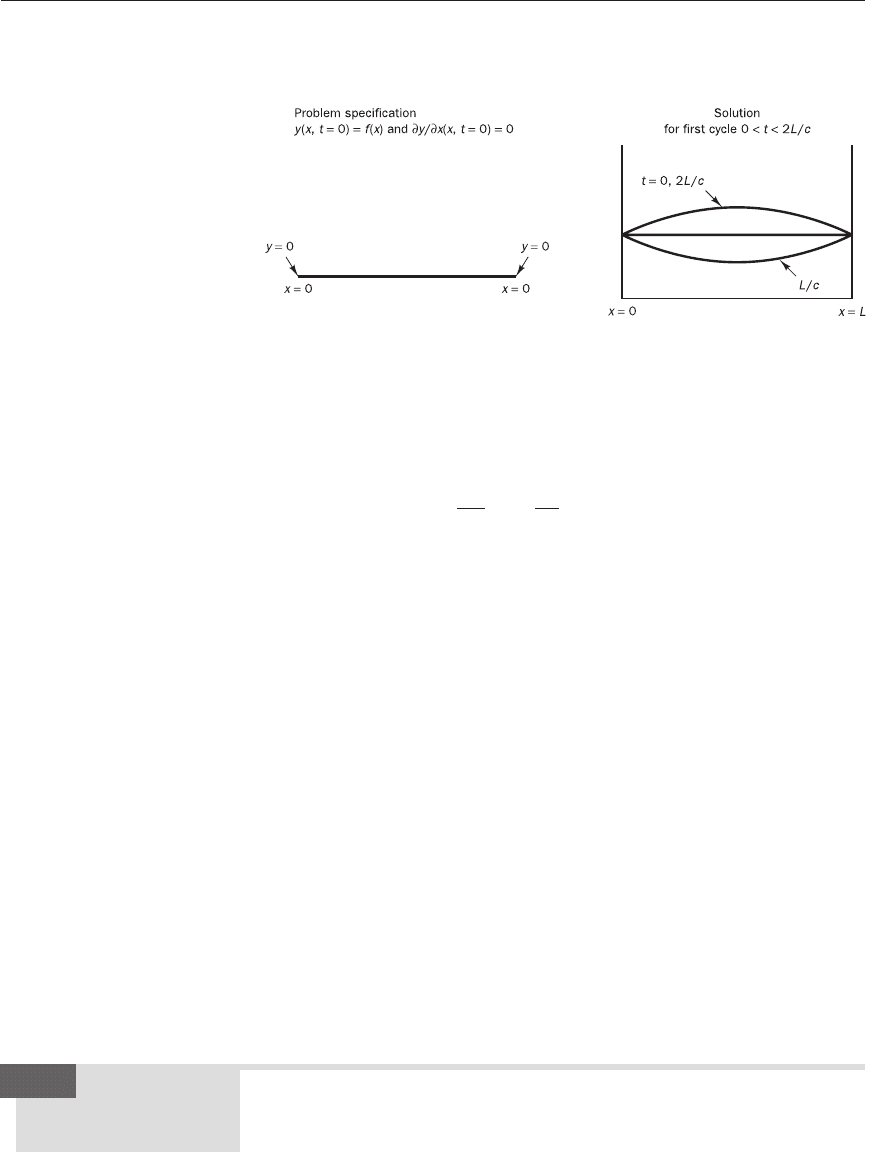
The above form of the equation governs the transverse displacement (
φ
= y)
of a string under tension during small-amplitude vibrations and also acoustic
oscillations (Figure 2.8). The constant c is the wave speed. It is relatively
∂
2
φ
∂
x
2
∂
2
φ
∂
t
2
Figure 2.7 Transient
distribution of temperature in an
insulated rod
ANIN_C02.qxd 29/12/2006 09:55 AM Page 28
2.7 THE ROLE OF CHARACTERISTICS IN HYPERBOLIC EQUATIONS 29
straightforward to compute the fundamental mode of vibration of a string of
length L using (2.47).
Solutions to wave equation (2.47) and other hyperbolic equations can be
obtained by specifying two initial conditions on the displacement y of the
string and one condition on all boundaries for times t > 0. Thus hyperbolic
problems are also initial–boundary-value problems.
If the initial amplitude is given by a, the solution of this problem is
y(x, t) = a cos sin
The solution shows that the vibration amplitude remains constant, which
demonstrates the lack of damping in the system. This absence of damping
has a further important consequence. Consider, for example, initial condi-
tions corresponding to a near-triangular initial shape whose apex is a section
of a circle with very small radius of curvature. This initial shape has a sharp
discontinuity at the apex, but it can be represented by means of a Fourier
series as a combination of sine waves. The governing equation is linear
so each of the individual Fourier components (and also their sum) would
persist in time without change of amplitude. The final result is that the
discontinuity remains undiminished due to the absence of a dissipation
mechanism to remove the kink in the slope.
Compressible fluid flows at speeds close to and above the speed of sound
exhibit shockwaves and it turns out that the inviscid flow equations are
hyperbolic at these speeds. The shockwave discontinuities are manifestations
of the hyperbolic nature of such flows. Computational algorithms for hyper-
bolic problems are shaped by the need to allow for the possible existence of
discontinuities in the interior of the solution.
It will be shown that disturbances at a point can only influence a limited
region in space. The speed of disturbance propagation through an hyperbolic
problem is finite and equal to the wave speed c. In contrast, parabolic and
elliptic models assume infinite propagation speeds.
Hyperbolic equations have a special behaviour, which is associated with the
finite speed, namely the wave speed, at which information travels through
the problem. This distinguishes hyperbolic equations from the two other
types. To develop the ideas about the role of characteristic lines in hyper-
bolic problems we consider again a simple hyperbolic problem described by
D
E
F
π
x
L
A
B
C
D
E
F
π
ct
L
A
B
C
Figure 2.8 Vibrations of a string
under tension
The role of
characteristics in
hyperbolic equations
2.7
ANIN_C02.qxd 29/12/2006 09:55 AM Page 29

wave equation (2.47). It can be shown (The Open University, 1984) that a
change of variables to
ζ
= x − ct and
η
= x + ct transforms the wave equation
into the following standard form:
= 0 (2.48)
The transformation requires repeated application of the chain rule for
differentiation to express the derivatives of equation (2.47) in terms of
derivatives of the transform variables. Equation (2.48) can be solved very
easily. The solution is, of course,
φ
(
ζ
,
η
) = F
1
(
ζ
) + F
2
(
η
), where F
1
and F
2
can be any function.
A return to the original variables yields the general solution of equation
(2.47):
φ
(x, t) = F
1
(x − ct) + F
2
(x + ct) (2.49)
The first component of the solution, function F
1
, is constant if x − ct is
constant and hence along lines of slope dt/dx = 1/c in the x–t plane. The
second component F
2
is constant if x + ct is constant, so along lines of slope
dt/dx =−1/c. The lines x − ct = constant and x + ct = constant are called the
characteristics. Functions F
1
and F
2
represent the so-called simple wave
solutions of the problem, which are travelling waves with velocities +c
and −c without change of shape or amplitude.
The particular forms of functions F
1
and F
2
can be obtained from the ini-
tial and boundary conditions of the problem. Let us consider a very long
string (−∞ < x <∞) and let the following initial conditions hold:
φ
(x, 0) = f (x) and
∂φ
/
∂
t(x, 0) = g(x) (2.50)
Combining (2.49) and (2.50) we obtain
F
1
(x) + F
2
(x) = f (x) and − cF
1
′(x) + cF
2
′(x) = g(x) (2.51)
It can be shown (Bland, 1988) that the particular solution of wave equation
(2.47) with initial conditions (2.50) is given by
φ
(x, t) = [ f(x − ct) + f (x + ct)] + g(s)ds (2.52)
Careful inspection of (2.52) shows that
φ
at point (x, t) in the solution domain
depends only on the initial conditions in the interval (x − ct, x + ct). It is par-
ticularly important to note that this implies that the solution at (x, t) does
not depend on initial conditions outside this interval.
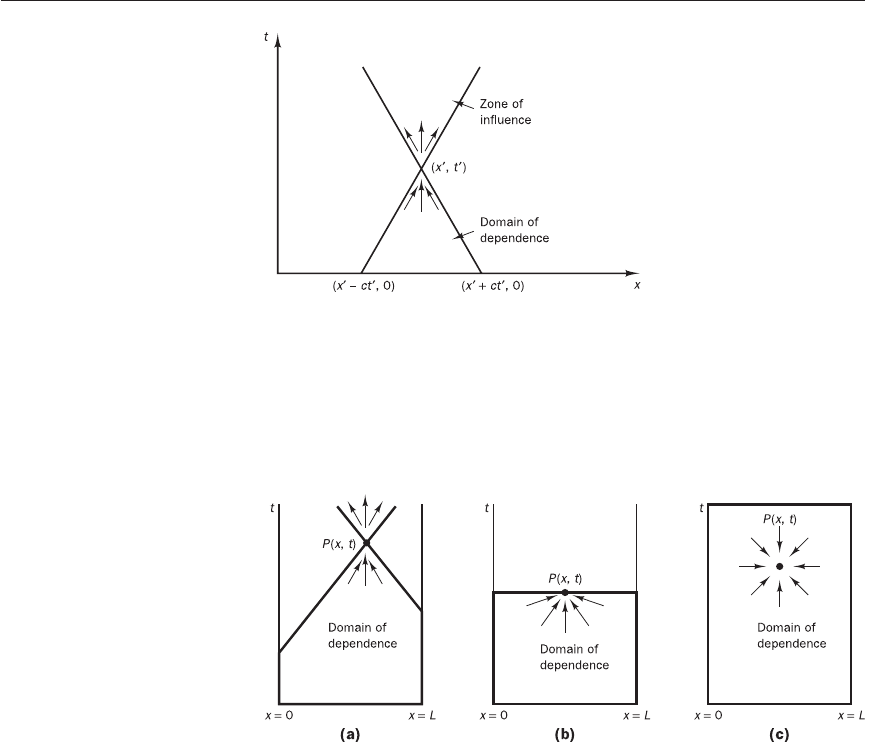
Figure 2.9 seeks to illustrate this point. The characteristics x − ct = con-
stant and x + ct = constant through the point (x′, t′) intersect the x-axis at the
points (x′−ct′, 0) and (x′+ct′, 0) respectively. The region in the x–t plane
enclosed by the x-axis and the two characteristics is termed the domain of
dependence.
In accordance with (2.52) the solution at (x′, t′) is influenced only by
events inside the domain of dependence and not those outside. Physically
this is caused by the limited propagation speed (equal to wave speed c) of
mutual influences through the solution domain. Changes at the point (x′, t′)
influence events at later times within the zone of influence shown in
Figure 2.9, which is again bounded by the characteristics.
x+ct
x−ct
1
2c
1
2
∂
2
φ
∂ζ∂η
30 CHAPTER 2 CONSERVATION LAWS OF FLUID MOTION
ANIN_C02.qxd 29/12/2006 09:55 AM Page 30
2.7 THE ROLE OF CHARACTERISTICS IN HYPERBOLIC EQUATIONS 31
The shape of the domains of dependence (see Figures 2.10b and c) in
parabolic and elliptic problems is different because the speed of information
travel is assumed to be infinite. The bold lines which demarcate the bound-
aries of each domain of dependence give the regions for which initial and/or
boundary conditions are needed in order to be able to generate a solution at
the point P(x, t) in each case.
The way in which changes at one point affect events at other points
depends on whether a physical problem represents a steady state or a tran-
sient phenomenon and whether the propagation speed of disturbances is
finite or infinite. This has resulted in a classification of physical behaviours,
and hence attendant PDEs, into elliptic, parabolic and hyperbolic problems.
The distinguishing features of each of the categories were illustrated by con-
sidering three simple prototype second-order equations. In the following
sections we will discuss methods of classifying more complex PDEs and
briefly state the limitations of the computational methods that will be devel-
oped later in this text in terms of the classification of the flow problems to be
solved. A summary of the main features that have been identified so far is
given in Table 2.2.
Figure 2.9 Domain of
dependence and zone of
influence for an hyperbolic
problem
Figure 2.10 Domains of
dependence for the (a)
hyperbolic, (b) parabolic
and (c) elliptic problem
Figure 2.10a shows the situation for the vibrations of a string fixed at
x = 0 and x = L. For points very close to the x-axis the domain of dependence
is enclosed by two characteristics, which originate at points on the x-axis.
The characteristics through points such as P intersect the problem boundaries.
The domain of dependence of P is bounded by these two characteristics and
the lines t = 0, x = 0 and x = L.
ANIN_C02.qxd 29/12/2006 09:55 AM Page 31

A practical method of classifying PDEs is developed for a general second-
order PDE in two co-ordinates x and y. Consider
a + b + c + d + e + f
φ
+ g = 0 (2.53)
At first we shall assume that the equation is linear and a, b, c, d, e, f and g are
constants.
The classification of a PDE is governed by the behaviour of its highest-
order derivatives, so we need only consider the second-order derivatives.
The class of a second-order PDE can be identified by searching for possible
simple wave solutions. If they exist this indicates a hyperbolic equation. If
not the equation is parabolic or elliptic.
Simple wave solutions occur if the characteristic equation (2.54) below
has two real roots:
a
2
− b + c = 0 (2.54)
The existence or otherwise of roots of the characteristic equation depends on
the value of discriminant (b
2
− 4ac). Table 2.3 outlines the three cases.
D
E
F
dy
dx
A
B
C
D
E
F
dy
dx
A
B
C
∂φ
∂
y
∂φ
∂
x
∂
2
φ
∂
y
2
∂
2
φ
∂
x
∂
y
∂
2
φ
∂
x
2
32 CHAPTER 2 CONSERVATION LAWS OF FLUID MOTION
It is left as an exercise for the reader to verify the nature of the three
prototype PDEs in section 2.6 by evaluating the discriminant.
The classification method by searching for the roots of the characteristic
equation also applies if the coefficients a, b and c are functions of x and y or
if the equation is non-linear. In the latter case a, b and c may be functions
of dependent variable
φ
or its first derivatives. It is now possible that the
Table 2.2 Classification of physical behaviours
Problem type Equation type Prototype equation Conditions Solution domain Solution smoothness
Equilibrium Elliptic div grad
φ
= 0 Boundary Closed domain Always smooth
problems conditions
Marching Parabolic
=
α
div grad
φ
Initial and Open domain Always smooth
problems with boundary
dissipation conditions
Marching Hyperbolic
= c
2
div grad
φ
Initial and Open domain May be
problems without boundary discontinuous
dissipation conditions
∂
2
φ
∂
t
2
∂φ
∂
t
Table 2.3 Classification of linear second-order PDEs
b
2
− 4ac Equation type Characteristics
> 0 Hyperbolic Two real characteristics
= 0 Parabolic One real characteristic
< 0 Elliptic No characteristics
Classification
method for
simple PDEs
2.8
ANIN_C02.qxd 29/12/2006 09:55 AM Page 32

2.9 CLASSIFICATION OF FLUID FLOW EQUATIONS 33
equation type differs in various regions of the solution domain. As an example
we consider the following equation:
y +=0 (2.55)
We look at the behaviour within the region −1 < y < 1. Hence a = a(x, y) = y,
b = 0 and c = 1. The value of discriminant (b
2
− 4ac) is equal to −4y. We need
to distinguish three cases:
• If y < 0: b
2
− 4ac > 0 so the equation is hyperbolic
• If y = 0: b
2
− 4ac = 0 so the equation is parabolic
• If y > 0: b
2
− 4ac < 0 and hence the equation is elliptic
Equation (2.55) is of mixed type. The equation is locally hyperbolic,
parabolic or elliptic depending on the value of y. For the non-linear case sim-
ilar remarks apply. The classification of the PDE depends on the local values
of a, b and c.
Second-order PDEs in N independent variables (x
1
, x
2
, ..., x
N
) can be
classified by rewriting them first in the following form with A
jk
= A
kj
:
A
jk
+ H = 0 (2.56)
Fletcher (1991) explains that the equation can be classified on the basis of the
eigenvalues of a matrix with entries A
jk
. Hence we need to find values for
λ
for which
det[A
jk
−
λ
I] = 0 (2.57)
The classification rules are:
• if any eigenvalue
λ
= 0: the equation is parabolic
• if all eigenvalues
λ
≠ 0 and they are all of the same sign: the equation is
elliptic
• if all eigenvalues
λ
≠ 0 and all but one are of the same sign: the equation
is hyperbolic
In the cases of Laplace’s equation, the diffusion equation and the wave
equation it is simple to verify that this method yields the same results as the
solution of characteristic equation (2.54).
Systems of first-order PDEs with more than two independent variables
are similarly cast in matrix form. Their classification involves finding eigen-
values of the resulting matrix. Systems of second-order PDEs or mixtures
of first- and second-order PDEs can also be classified with this method. The
first stage of the method involves the introduction of auxiliary variables,
which express each second-order equation as first-order equations. Care
must be taken to select the auxiliary variables in such a way that the result-
ing matrix is non-singular.
The Navier–Stokes equation and its reduced forms can be classified using
such a matrix approach. The details are beyond the scope of this introduc-
tion to the subject. We quote the main results in Table 2.4 and refer the
interested reader to Fletcher (1991) for a full discussion.
∂
2
φ
∂
x
j
∂
x
k
N
∑
k=1
N
∑
j=1
∂
2
φ
∂
y
2
∂
2
φ
∂
x
2
Classification
of fluid flow
equations
2.9
ANIN_C02.qxd 29/12/2006 09:55 AM Page 33

The classifications in Table 2.4 are the ‘formal’ classifications of the flow
equations. In practice many fluid flows behave in a complex way. The steady
Navier–Stokes equations and the energy (or enthalpy) equations are formally
elliptic and the unsteady equations are parabolic.
The mathematical classification of inviscid flow equations is different
from the Navier–Stokes and energy equations due to the complete absence
of the (viscous) higher-order terms. The classification of the resulting equa-
tion set depends on the extent to which fluid compressibility plays a role and
hence on the magnitude of the Mach number M. The elliptic nature of invis-
cid flows at Mach numbers below 1 originates from the action of pressure. If
M < 1 the pressure can propagate disturbances at the speed of sound, which
is greater than the flow speed. But if M > 1 the fluid velocity is greater than
the propagation speed of disturbances and the pressure is unable to influence
events in the upstream direction. Limitations on the zone of influence are
a key feature of hyperbolic phenomena, so the supersonic inviscid flow equa-
tions are hyperbolic. Below, we will see a simple example that demonstrates
this behaviour.
In thin shear layer flows all velocity derivatives in the flow (x- and z-)
direction are much smaller than those in the cross-stream (y-) direction.
Boundary layers, jets, mixing layers and wakes as well as fully developed
duct flows fall within this category. In these conditions the governing
equations contain only one (second-order) diffusion term and are therefore
classified as parabolic.
As an illustration of the complexities which may arise in inviscid flows we
analyse the potential equation which governs steady, isentropic, inviscid,
compressible flow past a slender body (Shapiro, 1953) with a free stream
Mach number M
∞
:
(1 − M
2
∞
) +=0 (2.58)
Taking x
1
= x and x
2
= y in equation (2.56) we have matrix elements A
11
=
1 − M
2
∞
, A
12
= A
21
= 0 and A
22
= 1. To classify the equation we need to solve
det
(1 − M
2
∞
) −
λ
0
01 −
λ
= 0
The two solutions are
λ
1
= 1 and
λ
2
= 1 − M
2
∞
. If the free stream Mach num-
ber is smaller than 1 (subsonic flow) both eigenvalues are greater than zero
and the flow is elliptic. If the Mach number is greater than 1 (supersonic
flow) the second eigenvalue is negative and the flow is hyperbolic. The reader
is left to demonstrate that these results are identical to those obtained by
considering the discriminant of characteristic equation (2.54).
∂
2
φ
∂
y
2
∂
2
φ
∂
x
2
34 CHAPTER 2 CONSERVATION LAWS OF FLUID MOTION
Table 2.4 Classification of the main categories of fluid flow
Steady flow Unsteady flow
Viscous flow Elliptic Parabolic
Inviscid flow M < 1, elliptic Hyperbolic
M > 1, hyperbolic
Thin shear layers Parabolic Parabolic
ANIN_C02.qxd 29/12/2006 09:55 AM Page 34
2.10 CONDITIONS FOR VISCOUS FLUID FLOW EQUATIONS 35
It is interesting to note that we have discovered an instance of hyperbolic
behaviour in a steady flow where both independent variables are space co-
ordinates. The flow direction behaves in a time-like manner in hyperbolic
inviscid flows and also in the parabolic thin shear layers. These problems are
of the marching type and flows can be computed by marching in the time-
like direction of increasing x.
The above example shows the dependence of the classification of com-
pressible flows on the parameter M
∞
. The general equations of inviscid,
compressible flow (the Euler equations) exhibit similar behaviour, but the
classification parameter is now the local Mach number M. This complicates
matters greatly when flows around and above M = 1 are to be computed.
Such flows may contain shockwave discontinuities and regions of subsonic
(elliptic) flow and supersonic (hyperbolic) flow, whose exact locations are not
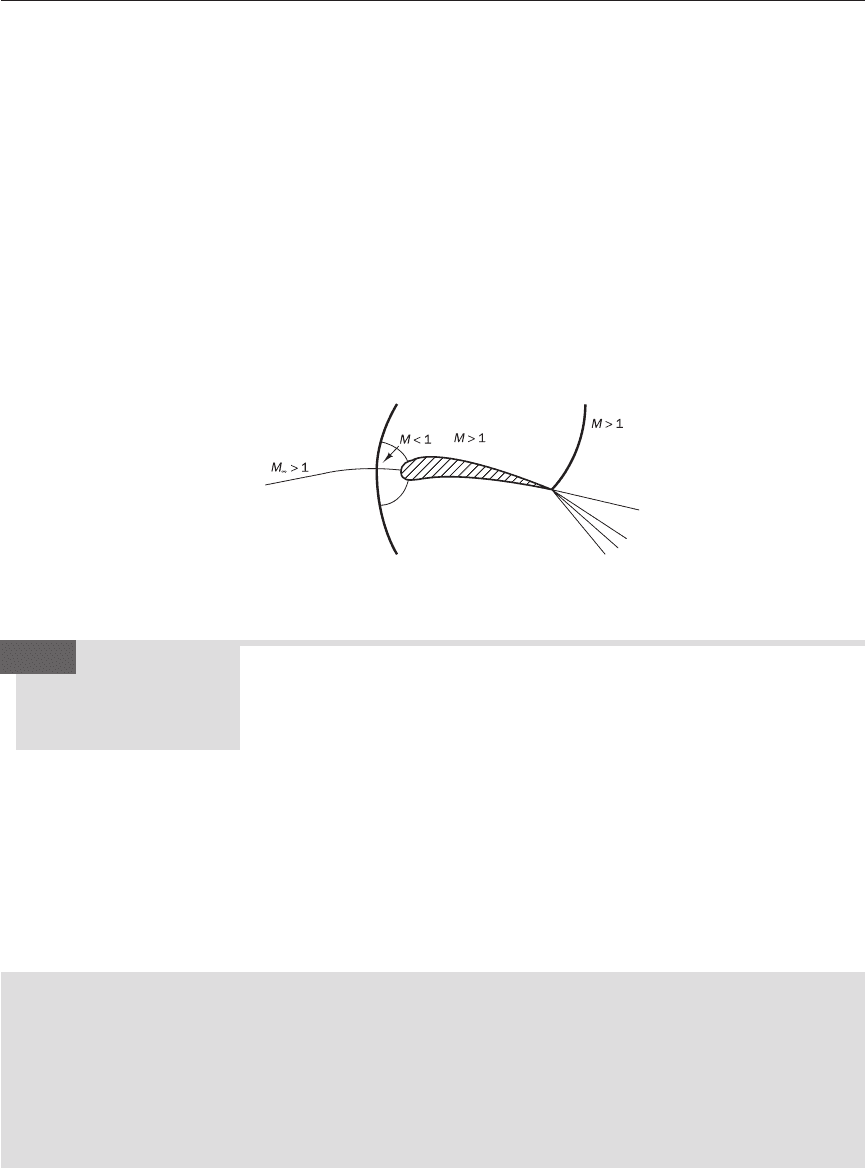
known a priori. Figure 2.11 is a sketch of the flow around an aerofoil at a
Mach number somewhat greater than 1.
The complicated mixture of elliptic, parabolic and hyperbolic behaviours
has implications for the way in which boundary conditions enter into a flow
problem, in particular at locations where flows are bounded by fluid bound-
aries. Unfortunately few theoretical results regarding the range of permiss-
ible boundary conditions are available for compressible flows. CFD practice
is guided here by physical arguments and the success of its simulations.
The boundary conditions for a compressible viscous flow are given in
Table 2.5.
In the table subscripts n and t indicate directions normal (outward)
and tangential to the boundary respectively and F are the given surface
stresses.
Figure 2.11 Sketch of flow
around an aerofoil at supersonic
free stream speed
Auxiliary
conditions for
viscous fluid flow
equations
2.10
Table 2.5 Boundary conditions for compressible viscous flow
Initial conditions for unsteady flows:
• Everywhere in the solution region
ρ
, u and T must be given at time t = 0.
Boundary conditions for unsteady and steady flows:
• On solid walls u = u
w
(no-slip condition)
T = T
w
(fixed temperature) or k
∂
T/
∂
n =−q
w
(fixed heat flux)
• On fluid boundaries inlet:
ρ
, u and T must be known as a function of position
outlet: −p +
µ∂
u
n
/
∂
n = F
n
and
µ∂
u
t
/
∂
n = F
t
(stress continuity)
ANIN_C02.qxd 29/12/2006 09:55 AM Page 35

36 CHAPTER 2 CONSERVATION LAWS OF FLUID MOTION
Problems
in transonic
and supersonic
compressible flows
It is unnecessary to specify outlet or solid wall boundary conditions for
the density because of the special character of the continuity equation, which
describes the changes of density experienced by a fluid particle along its
path for a known velocity field. At the inlet the density needs to be known.
Everywhere else the density emerges as part of the solution and no boundary
values need to be specified. For an incompressible viscous flow there
are no conditions on the density, but all the other above conditions apply
without modification.
Commonly outflow boundaries are positioned at locations where the
flow is approximately unidirectional and where surface stresses take known
values. For high Reynolds number flows far from solid objects in an external
flow or in fully developed flow out of a duct, there is no change in any of the
velocity components in the direction across the boundary and F
n
=−p and
F
t
= 0. This gives the outflow condition that is almost universally used in the
finite volume method:
specified pressure,
∂
u
n
/
∂
n = 0 and
∂
T/
∂
n = 0
Gresho (1991) reviewed the intricacies of open boundary conditions in
incompressible flow and stated that there are some ‘theoretical concerns’
regarding open boundary conditions which use
∂
u
n
/
∂
n = 0; however, its
success in CFD practice left him to recommend it as the simplest and
cheapest form when compared with theoretically more satisfying selections.
Figure 2.12 illustrates the application of boundary conditions for a typ-
ical internal and external viscous flow.
General-purpose CFD codes also often include inlet and outlet pressure
boundary conditions. The pressures are set at fixed values and sources
and sinks of mass are placed on the boundaries to carry the correct mass flow
into and out of the solution zone across the constant pressure boundaries.
Furthermore, symmetric and cyclic boundary conditions are supplied to take
advantage of special geometrical features of the solution region:
• Symmetry boundary condition:
∂φ
/
∂
n = 0
• Cyclic boundary condition:
φ
1
=
φ
2
Figure 2.13 shows typical boundary geometries for which symmetry and
cyclic boundary conditions (bc) may be useful.
Difficulties arise when calculating flows at speeds near to and above the
speed of sound. At these speeds the Reynolds number is usually very high
and the viscous regions in the flow are usually very thin. The flow in a large
part of the solution region behaves as an effectively inviscid fluid. This gives
rise to problems in external flows, because the part of the flow where the outer
boundary conditions are applied behaves in an inviscid way, which differs
from the (viscous) region of flow on which the overall classification is based.
The standard SIMPLE pressure correction algorithm for finite volume
calculations (see section 6.4) needs to be modified. The transient version of
the algorithm needs to be adopted to make use of the favourable character
of parabolic/hyperbolic procedures. To cope with the appearance of shock-
waves in the solution interior and with reflections from the domain bound-
aries, artificial damping needs to be introduced. It is further necessary to
2.11
ANIN_C02.qxd 29/12/2006 09:55 AM Page 36