
Versteeg H., Malalasekra W. An Introduction to Computational Fluid Dynamics: The Finite Volume Method
Подождите немного. Документ загружается.

3.2 TRANSITION FROM LAMINAR TO TURBULENT FLOW 47
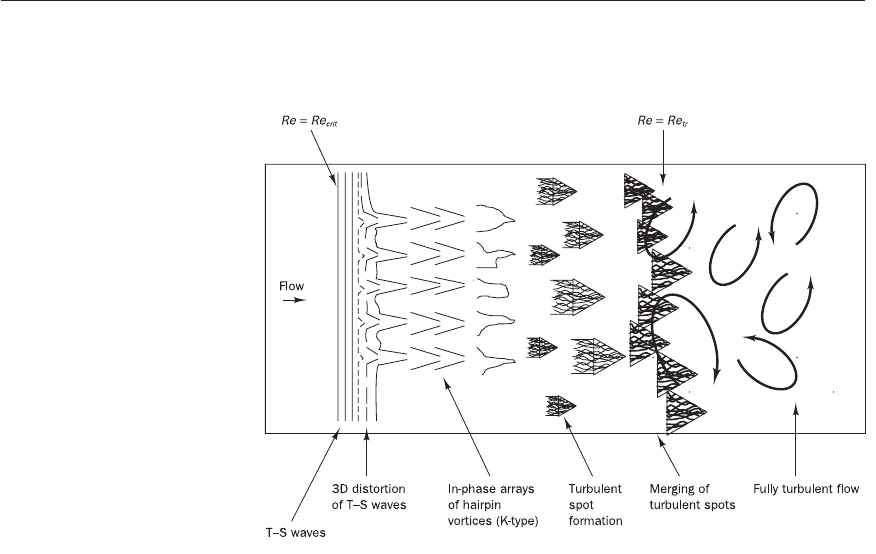
disturbances can be clearly detected. A sketch of the processes leading to
transition and fully turbulent flow is given in Figure 3.6.
Figure 3.6 Plan view sketch of
transition processes in boundary
layer flow over a flat plate
If the incoming flow is laminar numerous experiments confirm the
predictions of the theory that initial linear instability occurs around Re
x,crit
=
91 000. The unstable two-dimensional disturbances are called Tollmien–
Schlichting (T–S) waves. These disturbances are amplified in the flow
direction.
The subsequent development depends on the amplitude of the waves
at maximum (linear) amplification. Since amplification takes place over a
limited range of Reynolds numbers, it is possible that the amplified waves
are attenuated further downstream and that the flow remains laminar. If the
amplitude is large enough a secondary, non-linear, instability mechanism
causes the Tollmien–Schlichting waves to become three-dimensional and
finally evolve into hairpin Λ-vortices. In the most common mechanism of
transition, so-called K-type transition, the hairpin vortices are aligned.
Above the hairpin vortices a high shear region is induced which subse-
quently intensifies, elongates and rolls up. Further stages of the transition
process involve a cascading breakdown of the high shear layer into smaller
units with frequency spectra of measurable flow parameters approaching
randomness. Regions of intense and highly localised changes occur at random
times and locations near the solid wall. Triangular turbulent spots burst from
these locations. These turbulent spots are carried along with the flow and
grow by spreading sideways, which causes increasing amounts of laminar
fluid to take part in the turbulent motion.
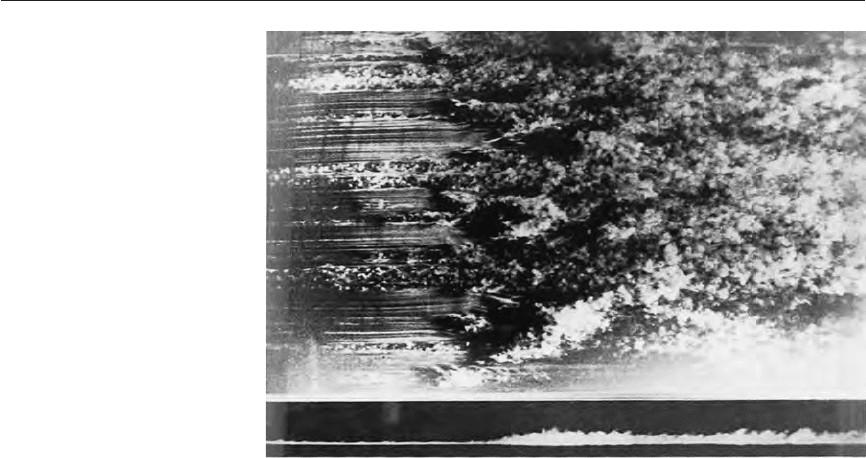
Transition of a natural flat plate boundary layer involves the formation
of turbulent spots at active sites and the subsequent merging of different tur-
bulent spots convected downstream by the flow. This takes place at Reynolds
numbers Re
x,tr
≈ 10
6
. Figure 3.7 is a plan view snapshot of a flat plate boundary
layer that illustrates this process.
ANIN_C03.qxd 29/12/2006 04:34PM Page 47
Pipe flow transition
The transition in a pipe flow represents an example of a special category
of flows without an inflexion point. The viscous theory of hydrodynamic
stability predicts that these flows are unconditionally stable to infinitesimal
disturbances at all Reynolds numbers. In practice, transition to turbulence
takes place between Re (= UD/
ν
) 2000 and 10
5
. Various details are still
unclear, which illustrates the limitations of current stability theories.
The cause of the apparent failure of the theory is almost certainly the
role played by distortions of the inlet velocity profile and the finite amplitude
disturbances due to entry effects. Experiments show that in pipe flows, as
in flat plate boundary layers, turbulent spots appear in the near-wall region.
These grow, merge and subsequently fill the pipe cross-section to form tur-
bulent slugs. In industrial pipe flows intermittent formation of turbulent
slugs takes place at Reynolds numbers around 2000 giving rise to alternate
turbulent and laminar regions along the length of the pipe. At Reynolds
numbers above 2300 the turbulent slugs link up and the entire pipe is filled
with turbulent flow.
Final comments
It is clear from the above descriptions of transition in jets, flat plate bound-
ary layers and pipe flows that there are a number of common features in
the transition processes: (i) the amplification of initially small disturbances,
(ii) the development of areas with concentrated rotational structures, (iii) the
formation of intense small-scale motions and finally (iv) the growth and
merging of these areas of small-scale motions into fully turbulent flows.
The transition to turbulence is strongly affected by factors such as
pressure gradient, disturbance levels, wall roughness and heat transfer. The
discussions only apply to subsonic, incompressible flows. The appearance of
48 CHAPTER 3 TURBULENCE AND ITS MODELLING
Figure 3.7 Merging of
turbulent spots and transition
to turbulence in a flat plate
boundary layer
Source: Nakayama (1988)
ANIN_C03.qxd 29/12/2006 04:34PM Page 48

3.3 DESCRIPTORS OF TURBULENT FLOW 49
significant compressibility effects in flows at Mach numbers above about 0.7
greatly complicates the stability theory.
It should be noted that although a great deal has been learnt from simple
flows, there is no comprehensive theory of transition. Advances in super-
computer technology have made it possible to simulate the events leading up
to transition, including turbulent spot formation, and turbulence at modest
Reynolds numbers by solving the complete, time-dependent Navier–Stokes
equations for simple geometries. Kleiser and Zang (1991) gave a review
which highlights very favourable agreement between experiments and their
computations.
For engineering purposes the major case where the transition process
influences a sizeable fraction of the flow is that of external wall boundary
layer flows at intermediate Reynolds numbers. This occurs in certain turbo-
machines, helicopter rotors and some low-speed aircraft wings. Cebeci
(1989) presented an engineering calculation method based on a combination
of inviscid far field and boundary layer computations in conjunction with
a linear stability analysis to identify the critical and transition Reynolds num-
bers. Transition is deemed to have occurred at the point where an (arbitrary)
amplification factor e
9
(≈ 8000) of initial disturbances is found. The proced-
ure, which includes a mixing length model (see section 3.6.1) for the fully
turbulent part of the boundary layer, has proved very effective for aerofoil
calculations, but requires a substantial amount of empirical input and there-
fore lacks generality.
Commercially available general-purpose CFD procedures often ignore
transition entirely and classify flows as either laminar or fully turbulent. The
transition region often constitutes only a very small fraction of the size of the
flow domain and in those cases it is assumed that the errors made by neglect-
ing its detailed structure are only small.
Let us consider a single point measurement in a turbulent flow, e.g. a velo-
city measurement made with a hot-wire anemometer (Comte-Bellot, 1976)
or a laser Doppler anemometer (Buchhave et al., 1979) or a local pressure
measurement made with a small transducer. In Figure 3.1, we saw that the
appearance of turbulence manifested itself as random fluctuations of the
measured velocity component about a mean value. All other flow variables,
i.e. all other velocity components, the pressure, temperature, density etc.,
will also exhibit this additional time-dependent behaviour. The Reynolds
decomposition defines flow property
ϕ
at this point as the sum of a steady
mean component Φ and a time varying fluctuating component
ϕ
′(t) with zero
mean value: hence
ϕ
(t) =Φ+
ϕ
′(t). We start with a formal definition of the
time average or mean Φ and we also define the most widely used statistical
descriptors of the fluctuating component
ϕ
′.
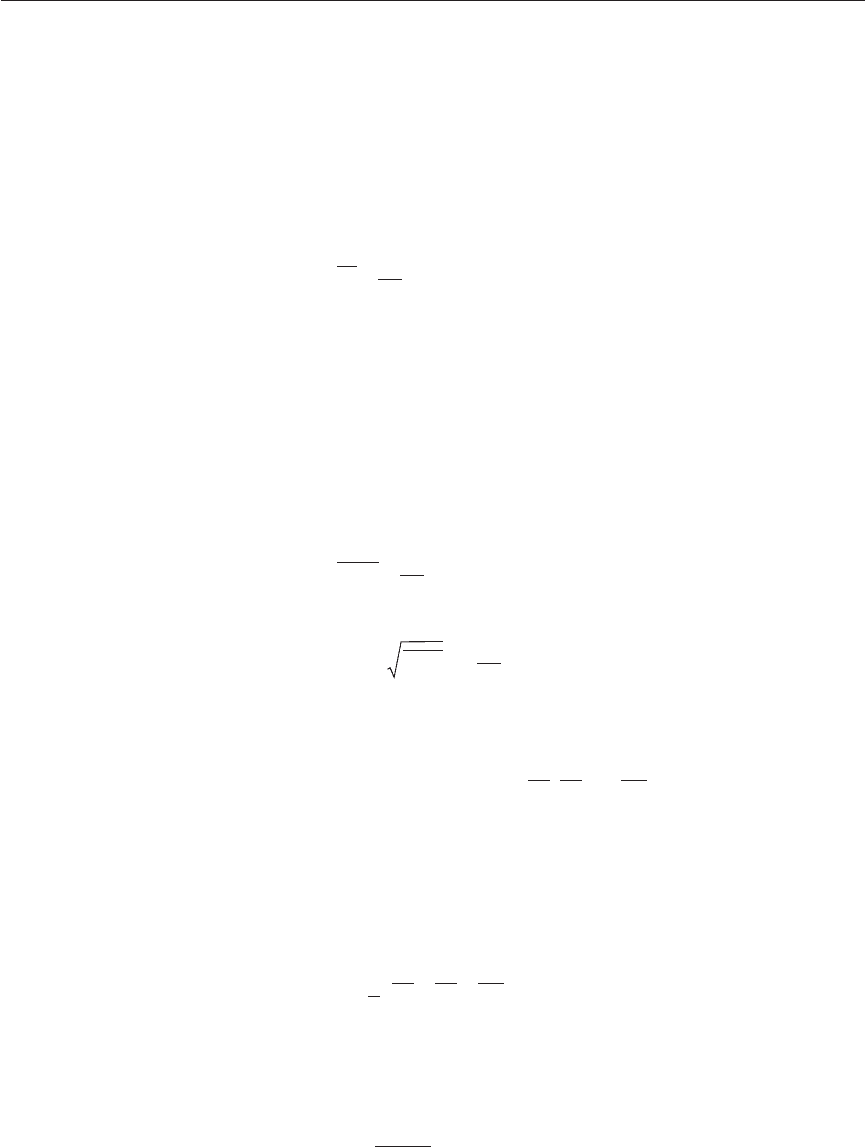
Time average or mean
The mean Φ of flow property
ϕ
is defined as follows:
Φ=
ϕ
(t)dt (3.2)
∆t
0
1
∆t
Descriptors of
turbulent flow
3.3
ANIN_C03.qxd 29/12/2006 04:34PM Page 49
In theory we should take the limit of time interval ∆t approaching infinity,
but the process indicated by equation (3.2) gives meaningful time averages
if ∆t is larger than the time scale associated with the slowest variations (due
to the largest eddies) of property
ϕ
. This definition of the mean of a flow
property is adequate for steady mean flows. In time-dependent flows the
mean of a property at time t is taken to be the average of the instantaneous
values of the property over a large number of repeated identical experiments:
the so-called ‘ensemble average’.
The time average of the fluctuations
ϕ
′ is, by definition, zero:
=
ϕ
′(t) dt ≡ 0 (3.3)
From now on we shall not write down the time-dependence of
ϕ
and
ϕ
′
explicitly, so we write
ϕ
=Φ+
ϕ
′.
The most compact description of the main characteristics of the fluctuat-
ing component of a turbulent flow variable is in terms of its statistics.
Variance, r.m.s. and turbulence kinetic energy
The descriptors used to indicate the spread of the fluctuations
ϕ
′ about the
mean value Φ are the variance and root mean square (r.m.s.):
= (
ϕ
′)
2
dt (3.4a)
ϕ
rms
==(
ϕ
′)
2
dt
1/2
(3.4b)
The r.m.s. values of the velocity components are of particular importance
since they are generally most easily measured and express the average
magnitude of velocity fluctuations. In section 3.5 we will come across the
variances of velocity fluctuations , and when we consider the time
average of the Navier–Stokes equations and find that they are proportional
to the momentum fluxes induced by turbulent eddies, which cause additional
normal stresses experienced by fluid elements in a turbulent flow.
One-half times these variances has a further interpretation as the mean
kinetic energy per unit mass contained in the respective velocity fluctuations.
The total kinetic energy per unit mass k of the turbulence at a given location
can be found as follows:
k =++ (3.5)
The turbulence intensity T
i
is the average r.m.s. velocity divided by a refer-
ence mean flow velocity U
ref
and is linked to the turbulence kinetic energy k
as follows:
T
i
= (3.6)
(
2
–
3
k)
1/2
U
ref
D
E
F
w′
2
v′
2
u′
2
A
B
C
1
2
w′
2
v′
2
u′
2
J
K
K
L
∆t
0
1
∆t
G
H
H
I
(
ϕ
′)
2
∆t
0
1
∆t
(
ϕ
′)
2
∆t
0
1
∆t
ϕ
′
50 CHAPTER 3 TURBULENCE AND ITS MODELLING
ANIN_C03.qxd 29/12/2006 04:34PM Page 50
3.3 DESCRIPTORS OF TURBULENT FLOW 51
Moments of different fluctuating variables
The variance is also called the second moment of the fluctuations. Important
details of the structure of the fluctuations are contained in moments constructed
from pairs of different variables. For example, consider properties
ϕ
=Φ+
ϕ
′
and
ψ
=Ψ+
ψ
′ with ==0. Their second moment is defined as
=
ϕ
′
ψ
′dt (3.7)
If velocity fluctuations in different directions were independent random
fluctuations, then the values of the second moments of the velocity compon-
ents , and would be equal to zero. However, as we have seen,
turbulence is associated with the appearance of vortical flow structures and
the induced velocity components are chaotic, but not independent, so in turn
the second moments are non-zero. In section 3.5 we will come across ,
and again in the time-average of the Navier–Stokes equations.
They represent turbulent momentum fluxes that are closely linked with the
additional shear stresses experienced by fluid elements in turbulent flows.
Pressure–velocity moments, , etc., play a role in the diffusion of
turbulent energy.
Higher-order moments
Additional information relating to the distribution of the fluctuations can be
obtained from higher-order moments. In particular, the third and fourth
moments are related to the skewness (asymmetry) and kurtosis (peakedness),
respectively:
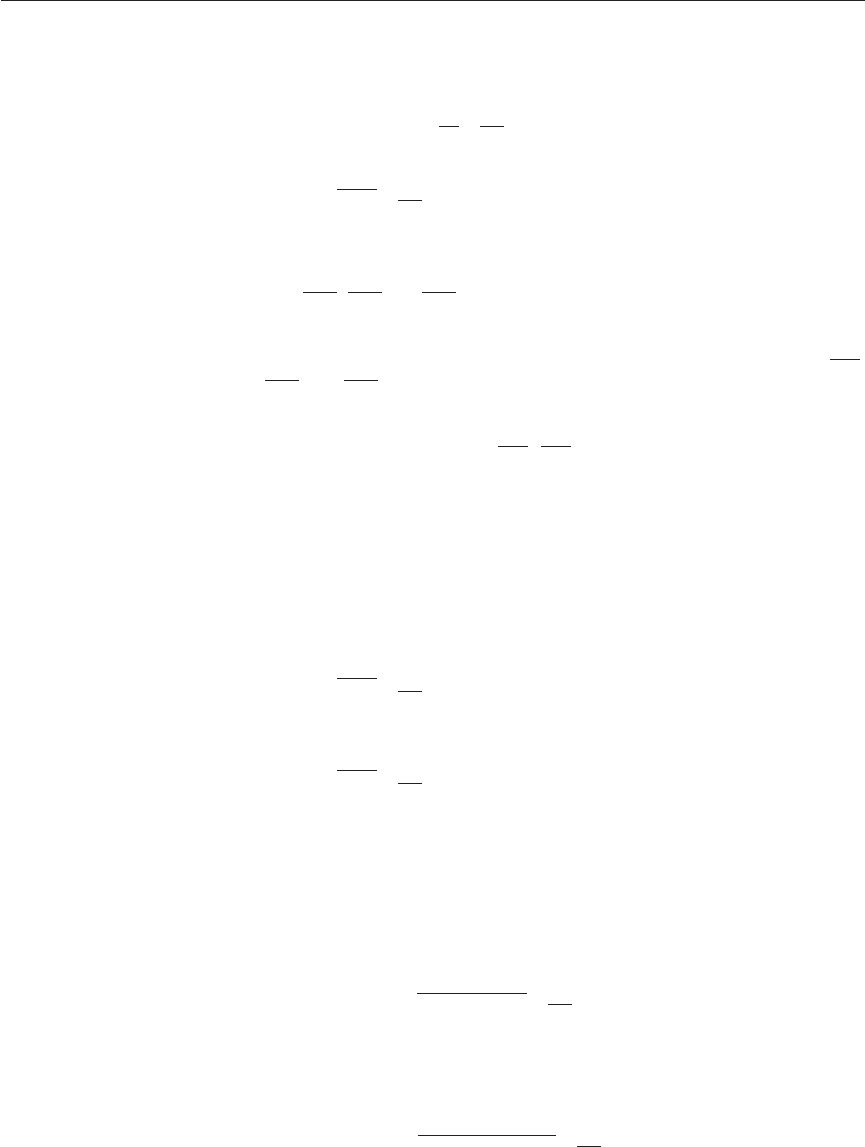
= (
ϕ
′)
3
dt (3.8)
= (
ϕ
′)
4
dt (3.9)
Correlation functions --- time and space
More detailed information relating to the structure of the fluctuations can be
obtained by studying the relationship between the fluctuations at different
times. The autocorrelation function R
ϕ
′
ϕ
′
(
τ
) is defined as
R
ϕ
′
ϕ
′
(
τ
) ==
ϕ
′(t)
ϕ
′(t +
τ
)dt (3.10)
Similarly, it is possible to define a further autocorrelation function R
ϕ
′
ϕ
′
(
ξ
)
based on two measurements shifted by a certain distance in space:
R
ϕ
′
ϕ
′
(
ξ
) ==
ϕ
′(x,t′)
ϕ
′(x +
ξ
,t′)dt′ (3.11)
t+∆t
t
1
∆t
ϕ
′(x,t)
ϕ
′(x +
ξ
,t)
∆t
0
1
∆t
ϕ
′(t)
ϕ
′(t +
τ
)
∆t
0
1
∆t
(
ϕ
′)
4
∆t
0
1
∆t
(
ϕ
′)
3
p′v′p′u′
v′w′u′w′
u′v′
v′w′u′w′u′v′
∆t
0
1
∆t
ϕ
′
ψ
′
ψ
′
ϕ
′
ANIN_C03.qxd 29/12/2006 04:34PM Page 51

When time shift
τ
(or displacement
ξ
) is zero the value of the autocorrelation
function R
ϕ
′
ϕ
′
(0) (or R
ϕ
′
ϕ
′
(0)) just corresponds to the variance and will
have its largest possible value, because the two contributions are perfectly
correlated. Since the behaviour of the fluctuations
ϕ
′ is chaotic in a turbulent
flow, we expect that the fluctuations become increasingly decorrelated as
τ
→∞(or |
ξ
|→∞), so values of the time or space autocorrelation functions
will decrease to zero. The eddies at the root of turbulence cause a certain
degree of local structure in the flow, so there will be correlation between the
values of
ϕ
′ at time t and a short time later or at a given location x and a small
distance away. The decorrelation process will take place gradually over the
lifetime (or size scale) of a typical eddy. The integral time and length scale,
which represent concrete measures of the average period or size of a turbu-
lent eddy, can be computed from integrals of the autocorrelation function
R
ϕ
′
ϕ
′
(
τ
) with respect to time shift
τ
or R
ϕ
′
ϕ
′
(
ξ
) with respect to distance in the
direction of one of the components of displacement vector
ξ
.
By analogy it is also possible to define cross-correlation functions
R
ϕ
′
ψ
′
(
τ
) with respect to time shift
τ
or R
ϕ
′
ψ
′
(
ξ
) between pairs of different
fluctuations by replacing the second
ϕ
′ by
ψ
′ in equations (3.10) and (3.11).
Probability density function
Finally, we mention the probability density function P(
ϕ
*), which is
related to the fraction of time that a fluctuating signal spends between
ϕ
*
and
ϕ
* + d
ϕ
. This is defined in terms of a probability as follows:
P(
ϕ
*)d
ϕ
* = Prob(
ϕ
* <
ϕ
<
ϕ
* + d
ϕ
*) (3.12)
The average, variance and higher moments of the variable and its fluctu-
ations are related to the probability density function as follows:
=
ϕ
P(
ϕ
)d
ϕ
(3.13a)
= (
ϕ
′)
n
P(
ϕ
′)d
ϕ
′ (3.13b)
In equation (3.13b) we can use n = 2 to obtain the variance of
ϕ
′ and n = 3, 4
. . . for higher-order moments. Probability density functions are used exten-
sively in the modelling of combustion and we come across them again in
Chapter 12.
Most of the theory of turbulent flow was initially developed by careful exam-
ination of the turbulence structure of thin shear layers. In such flows large
velocity changes are concentrated in thin regions. Expressed more formally,
the rates of change of flow variables in the (x-)direction of the flow are negli-
gible compared with the rates of change in the cross-stream (y-)direction
(
∂ϕ
/
∂
x
∂ϕ
/
∂
y). Furthermore, the cross-stream width
δ
of the region over
which changes take place is always small compared with any length scale L
in the flow direction (
δ
/L 1). In the context of this brief introduction we
review the characteristics of some simple two-dimensional incompressible
∞
−∞
(
ϕ
′)
n
∞
−∞
ϕ
ϕ
′
2
52 CHAPTER 3 TURBULENCE AND ITS MODELLING
Characteristics
of simple
turbulent flows
3.4
ANIN_C03.qxd 29/12/2006 04:34PM Page 52
3.4 CHARACTERISTICS OF SIMPLE TURBULENT FLOWS 53
turbulent flows with constant imposed pressure. The following flows will be
considered here:
Free turbulent flows
• mixing layer
• jet
• wake
Boundary layers near solid walls
• flat plate boundary layer
• pipe flow
We review data for the mean velocity distribution U = U(y) and the pertinent
second moments , , and .
3.4.1 Free turbulent flows
Among the simplest flows of significant engineering importance are those in
the category of free turbulent flows: mixing layers, jets and wakes. A mixing
layer forms at the interface of two regions: one with fast and the other with
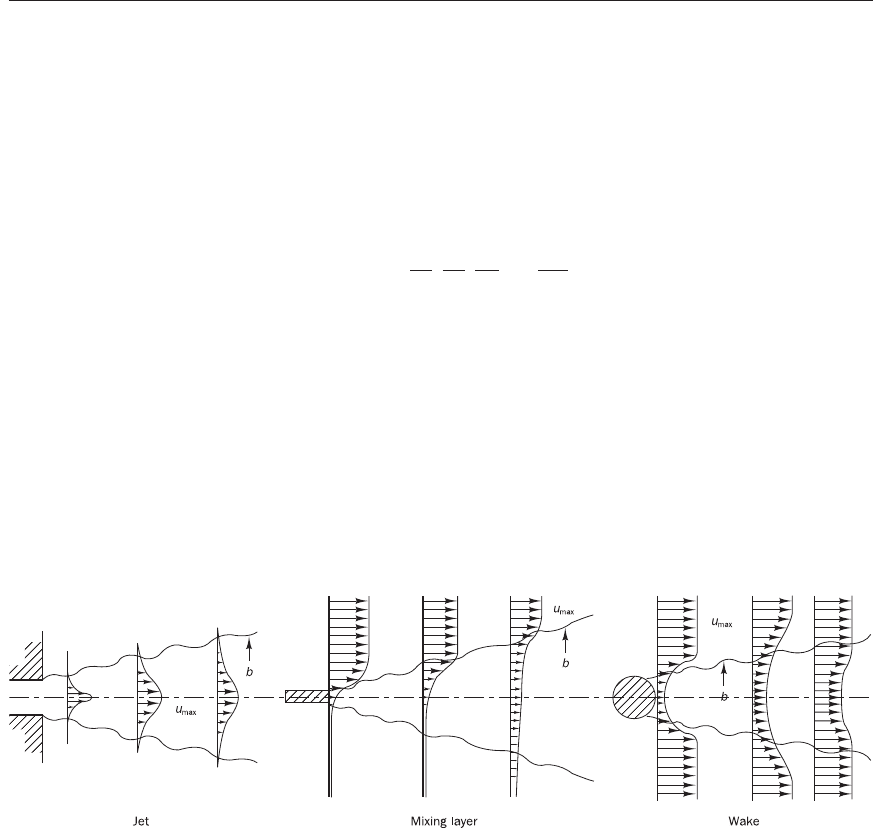
slow moving fluid. In a jet a region of high-speed flow is completely sur-
rounded by stationary fluid. A wake is formed behind an object in a flow, so
here a slow moving region is surrounded by fast moving fluid. Figure 3.8 is
a sketch of the development of the mean velocity distribution in the stream-
wise direction for these free turbulent flows.
u′v′w′
2
v′
2
u′
2
Figure 3.8 Free turbulent flows
It is clear that velocity changes across an initially thin layer are important
in all three flows. Transition to turbulence occurs after a very short distance
in the flow direction from the point where the different streams initially
meet; the turbulence causes vigorous mixing of adjacent fluid layers and
rapid widening of the region across which the velocity changes take place.
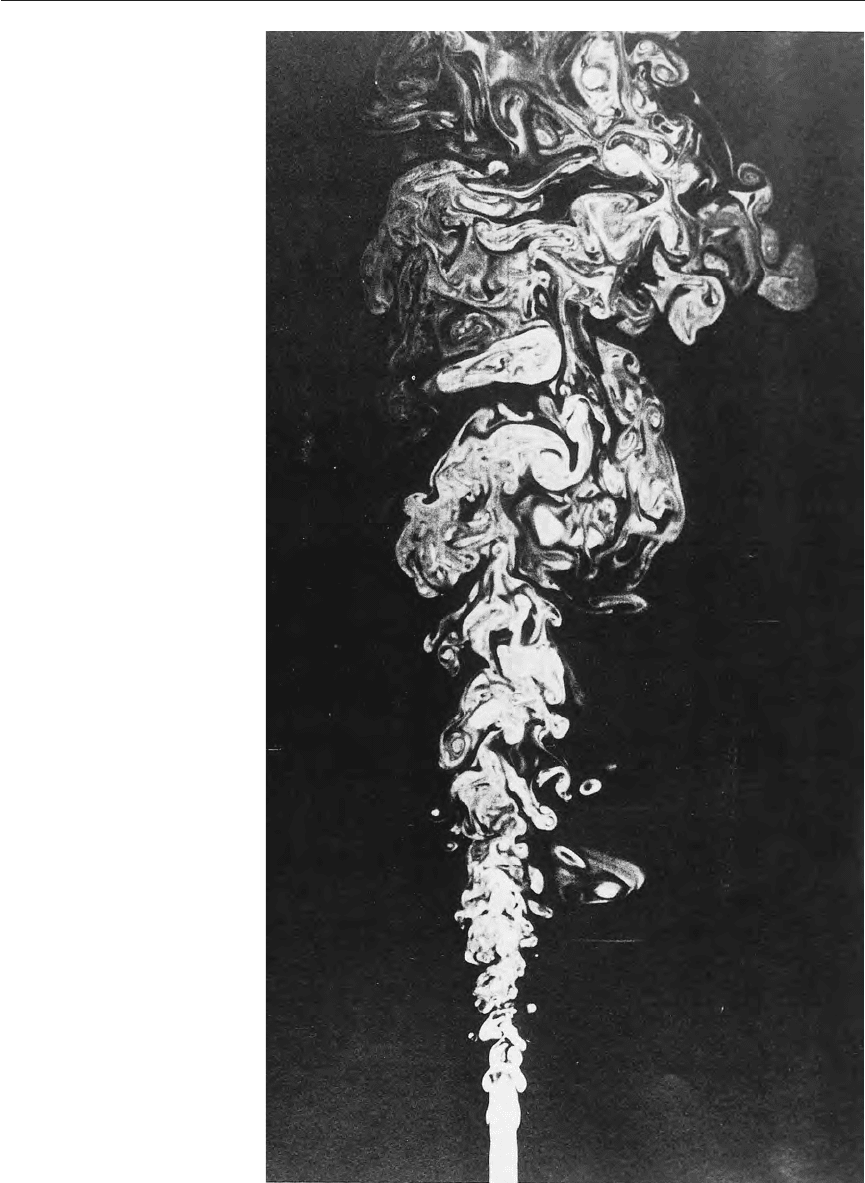
Figure 3.9 shows a visualisation of a jet flow. It is immediately clear that
the turbulent part of the flow contains a wide range of length scales. Large
eddies with a size comparable to the width across the flow are occurring
alongside eddies of very small size.
The visualisation correctly suggests that the flow inside the jet region is
fully turbulent, but the flow in the outer region far away from the jet is
smooth and largely unaffected by the turbulence. The position of the edge of
the turbulent zone is determined by the (time-dependent) passage of indi-
vidual large eddies. Close to the edge these will occasionally penetrate into
ANIN_C03.qxd 29/12/2006 04:34PM Page 53
54 CHAPTER 3 TURBULENCE AND ITS MODELLING
Figure 3.9 Visualisation of a jet
flow
Source: Van Dyke (1982)
ANIN_C03.qxd 29/12/2006 04:34PM Page 54
3.4 CHARACTERISTICS OF SIMPLE TURBULENT FLOWS 55
the surrounding region. During the resulting bursts of turbulent activity in
the outer region – called intermittency – fluid from the surroundings is
drawn into the turbulent zone. This process is termed entrainment and is
the main cause of the spreading of turbulent flows (including wall boundary
layers) in the flow direction.
Initially fast moving jet fluid will lose momentum to speed up the sta-
tionary surrounding fluid. Due to the entrainment of surrounding fluid the
velocity gradients decrease in magnitude in the flow direction. This causes
the decrease of the mean speed of the jet at its centreline. Similarly the dif-
ference between the speed of the wake fluid and its fast moving surroundings
will decrease in the flow direction. In mixing layers the width of the layer
containing the velocity change continues to increase in the flow direction but
the overall velocity difference between the two outer regions is unaltered.
Experimental observations of many such turbulent flows show that after
a certain distance their structure becomes independent of the exact nature of
the flow source. Only the local environment appears to control the turbu-
lence in the flow. The appropriate length scale is the cross-stream layer
width (or half width) b. We find that if y is the distance in the cross-stream
direction
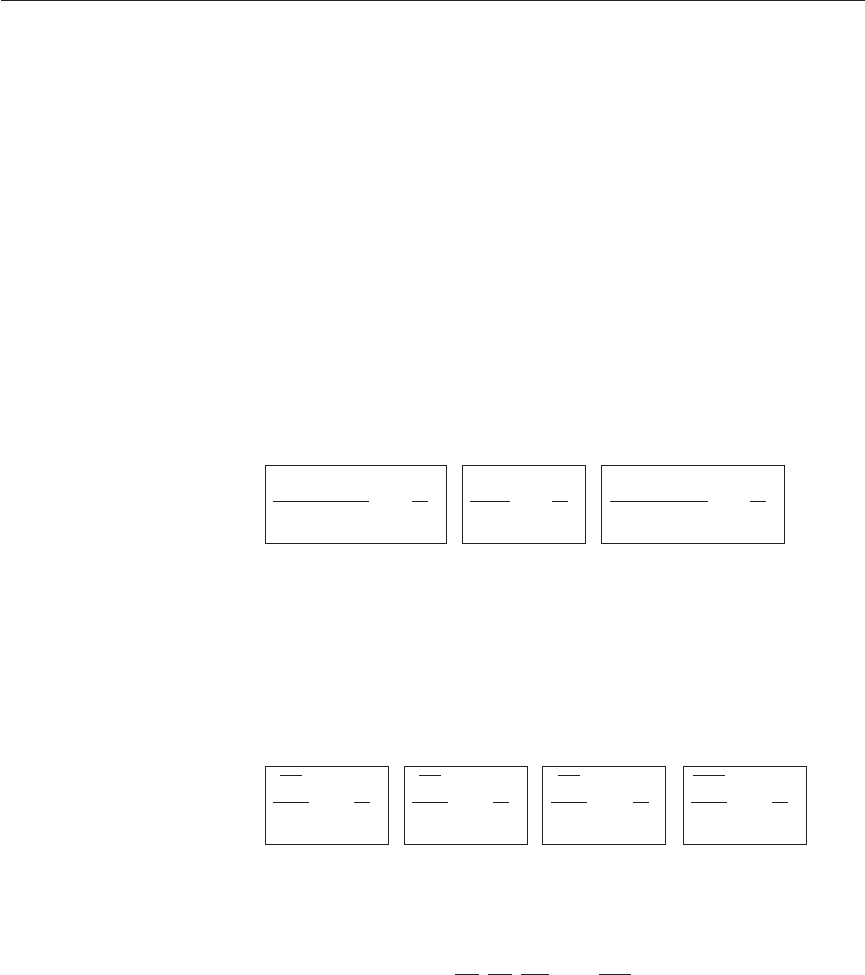
= f = g = h (3.14)
for mixing layers for jets for wakes
In these formulae U
max
and U
min
represent the maximum and minimum
mean velocity at a distance x downstream of the source (see Figure 3.8).
Hence, if these local mean velocity scales are chosen and x is large enough,
the functions f, g and h are independent of distance x in the flow direction.
Such flows are called self-preserving.
The turbulence structure also reaches a self-preserving state, albeit after
a greater distance from the flow source than the mean velocity. Then
= f
1
= f
2
= f
3
= f
4
(3.15)
The velocity scale U
ref
is, as above, (U
max
− U
min
) for a mixing layer and wakes
and U
max
for jets. The precise form of functions f, g, h and f
i
varies from flow
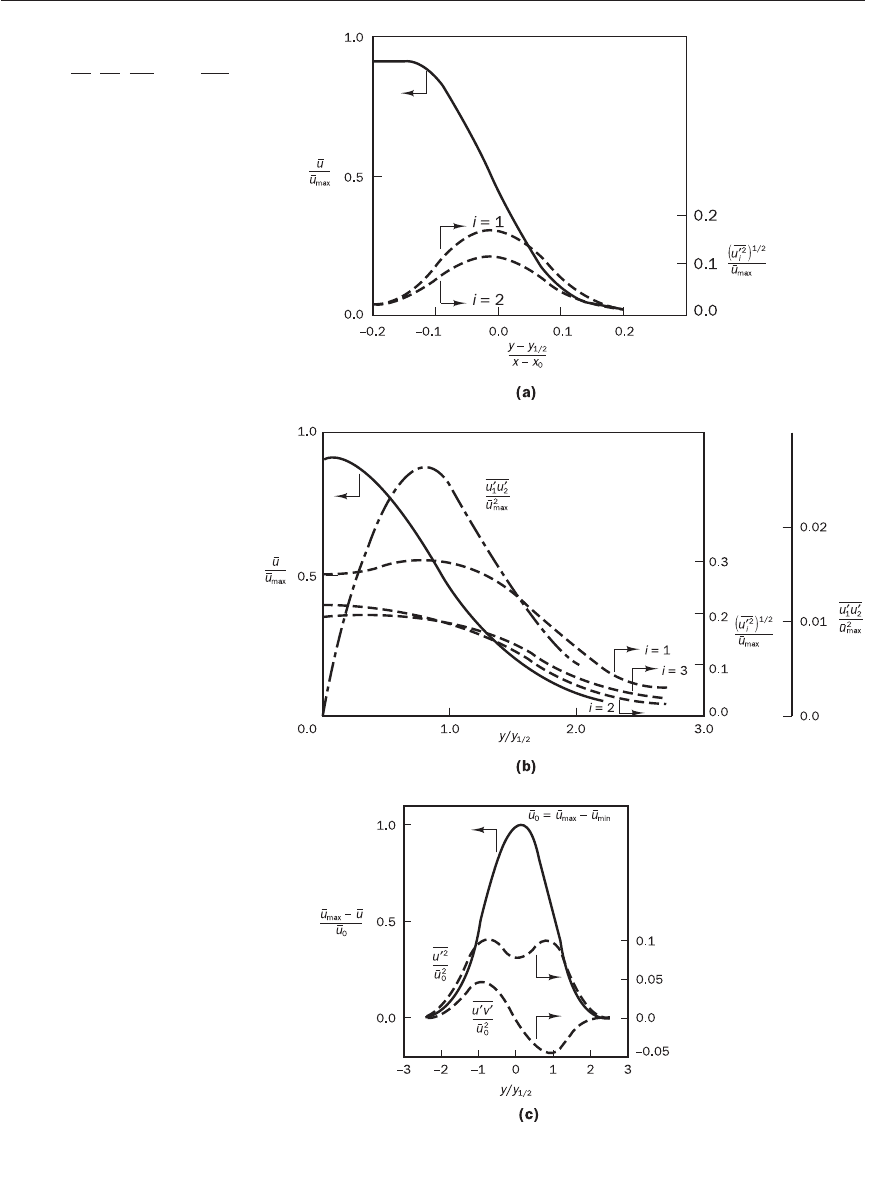
to flow. Figure 3.10 gives mean velocity and turbulence data for a mixing
layer (Champagne et al., 1976), a jet (Gutmark and Wygnanski, 1976) and a
wake flow (Wygnanski et al., 1986).
The largest values of , , and − are found in the region where
the mean velocity gradient
∂
U/
∂
y is largest, highlighting the intimate con-
nection between turbulence production and sheared mean flows. In the flows
shown above the component u′ gives the largest of the normal stresses; its
r.m.s. value has a maximum of 15–40% of the local maximum mean flow
velocity. The fact that the fluctuating velocities are not equal implies an
anisotropic structure of the turbulence.
As |y/b | increases above unity the mean velocity gradients and the veloc-
ity fluctuations all tend to zero. It should also be noted that the turbulence
u′v′w′
2
v′
2
u′
2
D
E
F
y
b
A
B
C
u′v′
U
2
ref
D
E
F
y
b
A
B
C
w′
2
U
2
ref
D
E
F
y
b
A
B
C
v′
2
U
2
ref
D
E
F
y
b
A
B
C
u′
2
U
2
ref
D
E
F
y
b
A
B
C
U
max
− U
U
max
− U
min
D
E
F
y
b
A
B
C
U
U
max
D
E
F
y
b
A
B
C
U − U
min
U
max
− U
min
ANIN_C03.qxd 29/12/2006 04:34PM Page 55
56 CHAPTER 3 TURBULENCE AND ITS MODELLING
Figure 3.10 Distribution of
mean velocity and second
moments , , and −
for incompressible mixing layer,
jet and wake
u′v′w′
2
v′
2
u′
2
ANIN_C03.qxd 29/12/2006 04:34PM Page 56