
Versteeg H., Malalasekra W. An Introduction to Computational Fluid Dynamics: The Finite Volume Method
Подождите немного. Документ загружается.


3.4 CHARACTERISTICS OF SIMPLE TURBULENT FLOWS 57
properties become more isotropic. The absence of shear means that turbu-
lence cannot be sustained in this region.
The mean velocity gradient is also zero at the centreline of jets and wakes
and hence no turbulence is produced here. Nevertheless, the values of ,
and do not decrease very much because vigorous eddy mixing trans-
ports turbulent fluid from nearby regions of high turbulence production
towards and across the centreline. The value of − has to become zero
at the centreline of jet and wake flows since it must change sign here by
symmetry.
3.4.2 Flat plate boundary layer and pipe flow
Next we will examine the characteristics of two turbulent flows near solid
walls. Due to the presence of the solid boundary, the flow behaviour and
turbulence structure are considerably different from free turbulent flows.
Dimensional analysis has greatly assisted in correlating the experimental
data. In turbulent thin shear layer flows a Reynolds number based on a
length scale L in the flow direction (or pipe radius) Re
L
is always very large
(e.g. U = 1 m/s, L = 0.1 m and
ν
= 10
−6
m
2
/s gives Re
L
= 10
5
). This implies
that the inertia forces are overwhelmingly larger than the viscous forces at
these scales.
If we form a Reynolds number based on a distance y away from the wall
(Re
y
= Uy/
ν
) we see that if the value of y is of the order of L the above
argument holds. Inertia forces dominate in the flow far away from the wall.
As y is decreased to zero, however, a Reynolds number based on y will also
decrease to zero. Just before y reaches zero there will be a range of values of
y for which Re
y
is of the order of 1. At this distance from the wall and closer
the viscous forces will be equal in order of magnitude to inertia forces
or larger. To sum up, in flows along solid boundaries there is usually a
substantial region of inertia-dominated flow far away from the wall and a thin
layer within which viscous effects are important.
Close to the wall the flow is influenced by viscous effects and does not
depend on free stream parameters. The mean flow velocity only depends on
the distance y from the wall, fluid density
ρ
and viscosity
µ
and the wall shear
stress
τ
w
. So
U = f ( y,
ρ
,
µ
,
τ
w
)
Dimensional analysis shows that
u
+
==f = f (y
+
) (3.16)
Formula (3.16) is called the law of the wall and contains the definitions of
two important dimensionless groups, u
+
and y
+
. Note that the appropriate
velocity scale is u
τ
=
τ
w
/
ρ
, the so-called friction velocity.
Far away from the wall we expect the velocity at a point to be influenced
by the retarding effect of the wall through the value of the wall shear stress,
but not by the viscosity itself. The length scale appropriate to this region is
the boundary layer thickness
δ
. In this region we have
U = g(y,
δ
,
ρ
,
τ
w
)
D
E
F
ρ
u
τ
y
µ
A
B
C
U
u
τ
u′v′
w′
2
v′
2
u′
2
ANIN_C03.qxd 29/12/2006 04:34PM Page 57

58 CHAPTER 3 TURBULENCE AND ITS MODELLING
Dimensional analysis yields
u
+
==g
The most useful form emerges if we view the wall shear stress as the cause
of a velocity deficit U
max
− U which decreases the closer we get to the edge
of the boundary layer or the pipe centreline. Thus
= g (3.17)
This formula is called the velocity-defect law.
Linear or viscous sub-layer --- the fluid layer in contact with a
smooth wall
At the solid surface the fluid is stationary. Turbulent eddying motions must also
stop very close to the wall and the behaviour of the fluid closest to the wall is
dominated by viscous effects. This viscous sub-layer is in practice extremely
thin ( y
+
< 5) and we may assume that the shear stress is approximately con-
stant and equal to the wall shear stress
τ
w
throughout the layer. Thus
τ
( y) =
µ
≅
τ
w
After integration with respect to y and application of boundary condition
U = 0 if y = 0, we obtain a linear relationship between the mean velocity and
the distance from the wall
U =
After some simple algebra and making use of the definitions of u
+
and y
+
this
leads to
u
+
= y
+
(3.18)
Because of the linear relationship between velocity and distance from the wall
the fluid layer adjacent to the wall is also known as the linear sub-layer.
Log-law layer --- the turbulent region close to a smooth wall
Outside the viscous sublayer (30 < y
+
< 500) a region exists where viscous
and turbulent effects are both important. The shear stress
τ
varies slowly
with distance from the wall, and within this inner region it is assumed to be
constant and equal to the wall shear stress. One further assumption regard-
ing the length scale of turbulence (mixing length
m
=
κ
y, see section 3.7.1
and Schlichting, 1979) allows us to derive a functional relationship between
u
+
and y
+
that is dimensionally correct:
u
+
= ln( y
+
) + B = ln(Ey
+
) (3.19)
1
κ
1
κ
τ
w
y
µ
∂
U
∂
y
D
E
F
y
δ
A
B
C
U
max
− U
u
τ
D
E
F
y
δ
A
B
C
U
u
τ
ANIN_C03.qxd 29/12/2006 04:34PM Page 58
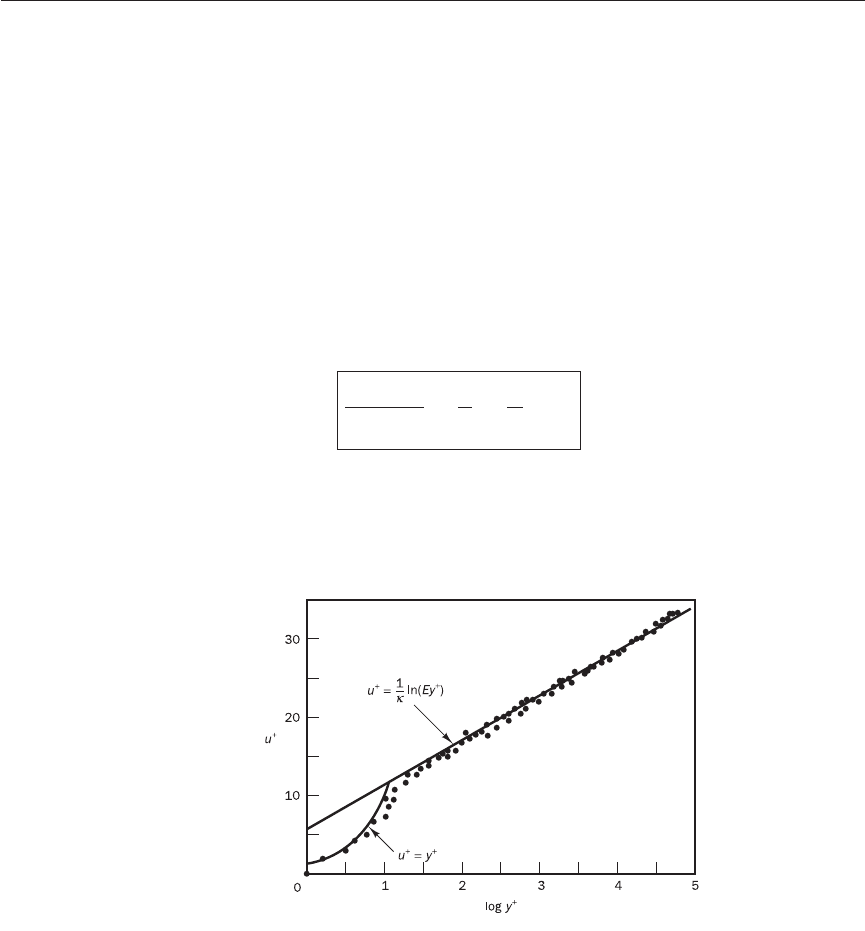
3.4 CHARACTERISTICS OF SIMPLE TURBULENT FLOWS 59
Figure 3.11 Velocity
distribution near a solid wall
Source: Schlichting, H. (1979)
Boundary Layer Theory, 7th edn,
reproduced with permission of
The McGraw-Hill Companies
Numerical values for the constants are found from measurements. We find
von Karman’s constant
κ
≈ 0.4 and the additive constant B ≈ 5.5 (or E ≈ 9.8)
for smooth walls; wall roughness causes a decrease in the value of B. The
values of
κ
and B are universal constants valid for all turbulent flows past
smooth walls at high Reynolds number. Because of the logarithmic relation-
ship between u
+
and y
+
, formula (3.18) is often called the log-law, and the
layer where y
+
takes values between 30 and 500 the log-law layer.
Outer layer --- the inertia-dominated region far from the wall
Experimental measurements show that the log-law is valid in the region
0.02 < y/
δ
< 0.2. For larger values of y the velocity-defect law (3.17)
provides the correct form. In the overlap region the log-law and velocity-
defect law have to be equal. Tennekes and Lumley (1972) show that a
matched overlap is obtained by assuming the following logarithmic form:
=− ln + A (3.20)
where A is a constant. This velocity-defect law is often called the law of the
wake.
Figure 3.11 from Schlichting (1979) shows the close agreement between
theoretical equations (3.18) and (3.19) in their respective areas of validity and
experimental data.
D
E
F
y
δ
A
B
C
1
κ
U
max
− U
u
τ
The turbulent boundary layer adjacent to a solid surface is composed of
two regions:
• The inner region: 10–20% of the total thickness of the wall layer;
the shear stress is (almost) constant and equal to the wall shear stress
τ
w
.
Within this region there are three zones. In order of increasing distance
from the wall we have:
– the linear sub-layer: viscous stresses dominate the flow adjacent to
surface
– the buffer layer: viscous and turbulent stresses are of similar magnitude
– the log-law layer: turbulent (Reynolds) stresses dominate.
ANIN_C03.qxd 29/12/2006 04:34PM Page 59
• The outer region or law-of-the-wake layer: inertia-dominated core flow
far from wall; free from direct viscous effects.
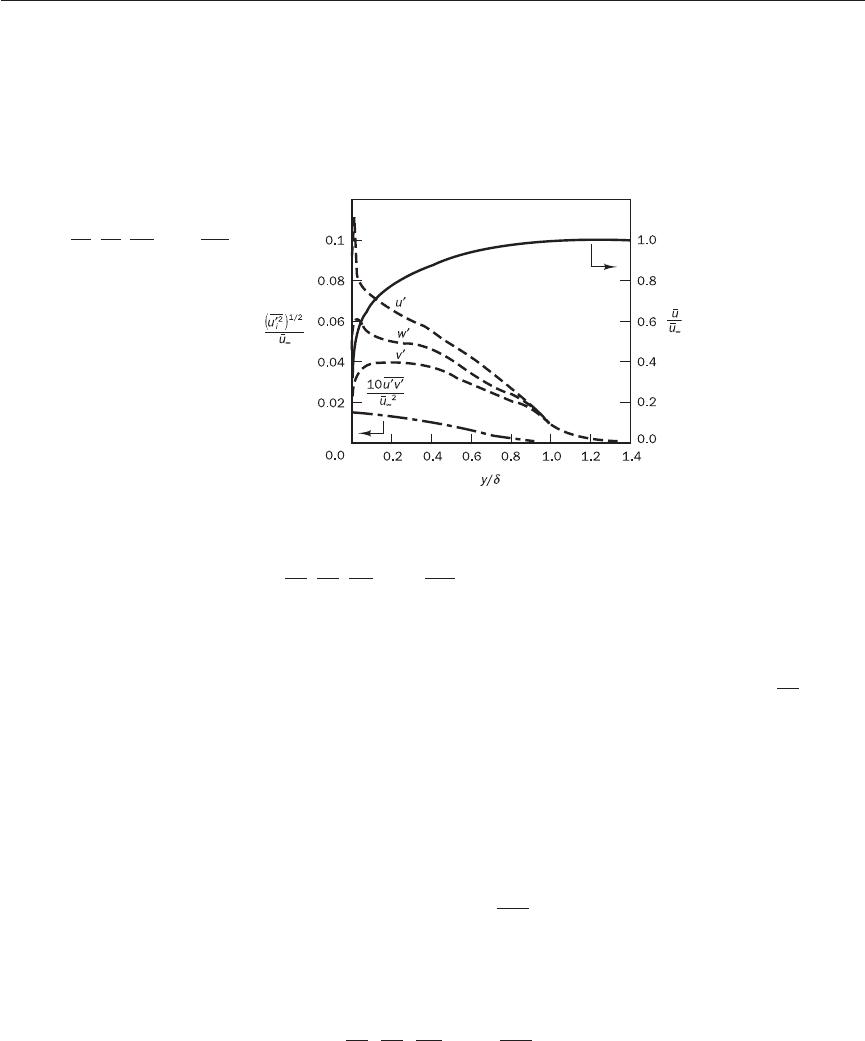
Figure 3.12 shows the mean velocity and turbulence property distribution
data for a flat plate boundary layer with a constant imposed pressure
(Klebanoff, 1955).
60 CHAPTER 3 TURBULENCE AND ITS MODELLING
Figure 3.12 Distribution of
mean velocity and second
moments , , and −
for flat plate boundary layer
u′v′w′
2
v′
2
u′
2
The mean velocity is at a maximum far away from the wall and sharply
decreases in the region y/
δ
≤ 0.2 due to the no-slip condition. High values
of , , and − are found adjacent to the wall where the large mean
velocity gradients ensure that turbulence production is high. The eddying
motions and associated velocity fluctuations are, however, also subject to
the no-slip condition at the wall. Therefore all turbulent stresses decrease
sharply to zero in this region. The turbulence is strongly anisotropic near
the wall since the production process mainly creates component . This is
borne out by the fact that this is the largest of the mean-squared fluctuations
in Figure 3.12.
In the case of the flat plate boundary layer the turbulence properties
asymptotically tend towards zero as y/
δ
increases above a value of 0.8.
The r.m.s. values of all fluctuating velocities become almost equal here, indi-
cating that the turbulence structure becomes more isotropic far away from
the wall. In pipe flows, on the other hand, the eddying motions transport
turbulence across the centreline from areas of high production. Therefore,
the r.m.s. fluctuations remain comparatively large in the centre of a pipe.
By symmetry the value of − has to go to zero and change sign at the
centreline.
This multi-layer structure is a universal feature of turbulent boundary
layers near solid surfaces. Monin and Yaglom (1971) plotted data from
Klebanoff (1955) and Laufer (1952) in the near-wall region and found not
only the universal mean velocity distribution but also that data for second
moments , , and − for flat plates and pipes collapse onto a
single curve if they are non-dimensionalised with the correct velocity scale
u
τ
. Between these distinct layers there are intermediate zones which ensure
that the various distributions merge smoothly. Interested readers may find
further details including formulae which cover the whole inner region and
the log-law/law-of-the-wake layer in Schlichting (1979) and White (1991).
u′v′w
′
2
v
′
2
u
′
2
u′v′
u
′
2
u′v′w
′
2
v
′
2
u
′
2
ANIN_C03.qxd 29/12/2006 04:34PM Page 60
3.5 EFFECT OF FLUCTUATIONS ON THE MEAN FLOW 61
3.4.3 Summary
Our review of the characteristics of a number of two-dimensional turbulent
flows revealed many common features. Turbulence is generated and main-
tained by shear in the mean flow. Where shear is large the magnitudes of tur-
bulence quantities such as the r.m.s. velocity fluctuations are high and their
distribution is anisotropic with higher levels of fluctuations in the mean flow
direction. Without shear, or an alternative agency to maintain it, turbulence
decays and becomes more isotropic in the process. In spite of these common
features, it was clear that, even in these relatively simple thin shear layers,
the details of the turbulence structure are very much dependent on the flow
itself. In regions close to solid walls the structure is dominated by shear due
to wall friction and damping of turbulent velocity fluctuations perpendicular
to the boundary. This results in a complex flow structure characterised by
rapid changes in the mean and fluctuating velocity components concentrated
within a very narrow region in the immediately vicinity of the wall. Since
most engineering flows contain solid boundaries, the turbulence structure
generated by them will be very geometry dependent. Engineering flow cal-
culations must include sufficiently accurate and general descriptions of the
turbulence that capture all the above effects and further interactions of
turbulence and body forces.
In this section we derive the flow equations governing the time-averaged
properties of a turbulent flow, but before we do this we briefly examine the
physical basis of the effects resulting from the appearance of turbulent
fluctuations.
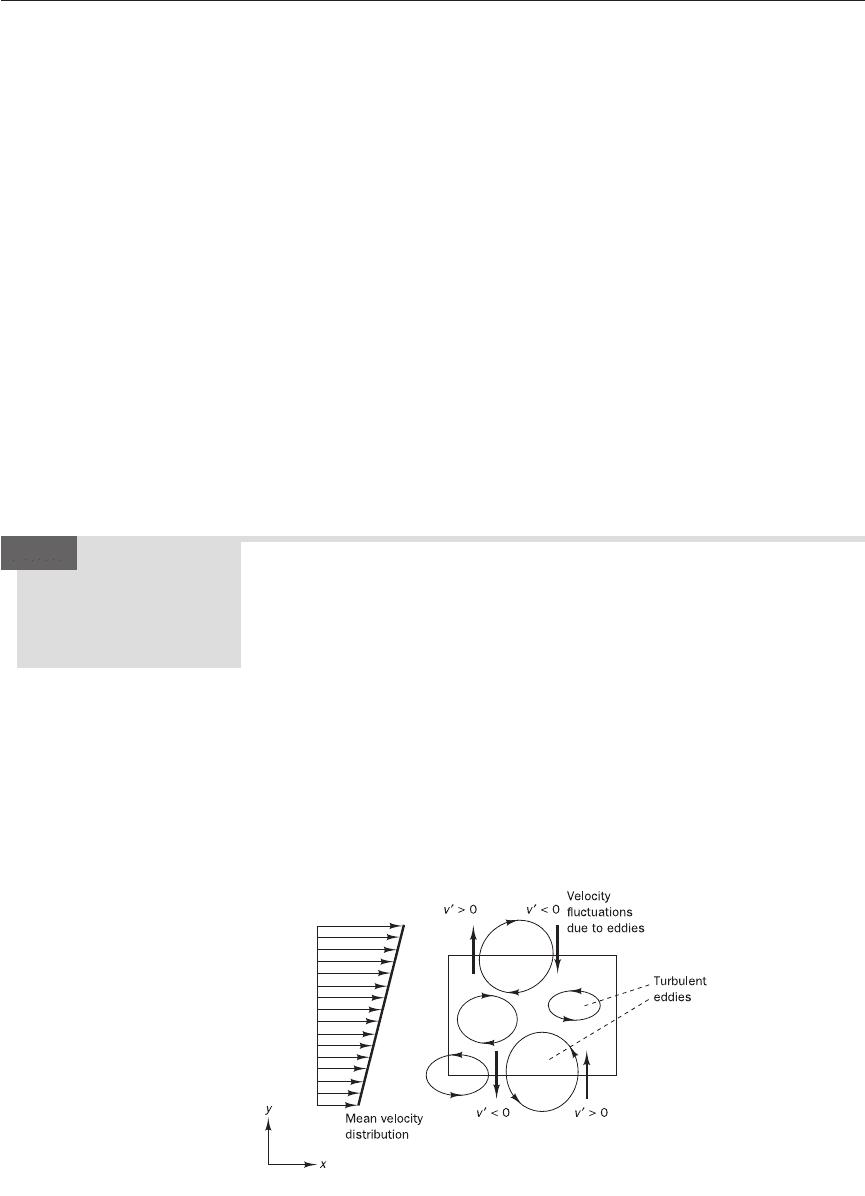
In Figure 3.13 we consider a control volume in a two-dimensional turbu-
lent shear flow parallel to the x-axis with a mean velocity gradient in the
y-direction. The presence of vortical eddy motions creates strong mixing.
Random currents that are associated with the passage of eddies near the
boundaries of the control volume transport fluid across its boundaries. These
recirculating fluid motions cannot create or destroy mass, but fluid parcels
transported by the eddies will carry momentum and energy into and out of
the control volume. Figure 3.13 shows that, because of the existence of the
velocity gradient, fluctuations with a negative y-velocity will generally bring
Figure 3.13 Control volume
within a two-dimensional
turbulent shear flow
The effect of
turbulent
fluctuations
on properties of
the mean flow
3.5
ANIN_C03.qxd 29/12/2006 04:34PM Page 61
fluid parcels with a higher x-momentum into the control volume across
its top boundary and will also transport control volume fluid to a region
of slower moving fluid across the bottom boundary. Similarly, positive y-
velocity fluctuations will – on average – transport slower moving fluid into
regions of higher velocity. The net result is momentum exchange due to
convective transport by the eddies, which causes the faster moving fluid
layers to be decelerated and the slower moving layers to be accelerated.
Consequently, the fluid layers experience additional turbulent shear stresses,
which are known as the Reynolds stresses. In the presence of temperature
or concentration gradients the eddy motions will also generate turbulent
heat or species concentration fluxes across the control volume bound-
aries. This discussion suggests that the equations for momentum and energy
should be affected by the appearance of fluctuations.
Reynolds-averaged Navier---Stokes equations for
incompressible flow
Next we examine the consequences of turbulent fluctuations for the mean
flow equations for an incompressible flow with constant viscosity. These
assumptions considerably simplify the algebra involved without detracting
from the main messages. We begin by summarising the rules which govern
time averages of fluctuating properties
ϕ
=Φ+
ϕ
′ and
ψ
=Ψ+
ψ
′ and their
summation, derivatives and integrals:
==0 =Φ = = Φds (3.21)
=Φ+Ψ =ΦΨ+ =ΦΨ =0
These relationships can be easily verified by application of (3.2) and (3.3),
noting that the time-averaging operation is itself an integration. Thus, the
order of time averaging and summation, further integration and/or differen-
tiation can be swapped or commuted, so this is called the commutative
property.
Since div and grad are both differentiations, the above rules can be
extended to a fluctuating vector quantity a = A + a′ and its combinations
with a fluctuating scalar
ϕ
=Φ+
ϕ
′:
= div A; = div( ) = div(ΦA) + div( );
= div grad Φ (3.22)
To start with we consider the instantaneous continuity and Navier–Stokes
equations in a Cartesian co-ordinate system so that the velocity vector u has
x-component u, y-component v and z-component w:
div u = 0 (3.23)
+ div(uu) =− +
ν
div(grad(u)) (3.24a)
+ div(vu) =− +
ν
div(grad(v)) (3.24b)
+ div(wu) =− +
ν
div(grad(w)) (3.24c)
∂
p
∂
z
1
ρ
∂
w
∂
t
∂
p
∂
y
1
ρ
∂
v
∂
t
∂
p
∂
x
1
ρ
∂
u
∂
t
div grad
ϕ
ϕ
′a′
ϕ
adiv(
ϕ
a)div a
ϕ
′Ψ
ϕ
Ψ
ϕ
′
ψ
′
ϕψϕ
+
ψ
ϕ
ds
∂
Φ
∂
s
∂ϕ
∂
s
Φ
ψ
′
ϕ
′
62 CHAPTER 3 TURBULENCE AND ITS MODELLING
ANIN_C03.qxd 29/12/2006 04:34PM Page 62
3.5 EFFECT OF FLUCTUATIONS ON THE MEAN FLOW 63
This system of equations governs every turbulent flow, but we investigate
the effects of fluctuations on the mean flow using the Reynolds decomposi-
tion in equations (3.23) and (3.24a–c) and replace the flow variables u (hence
also u, v and w) and p by the sum of a mean and fluctuating component. Thus
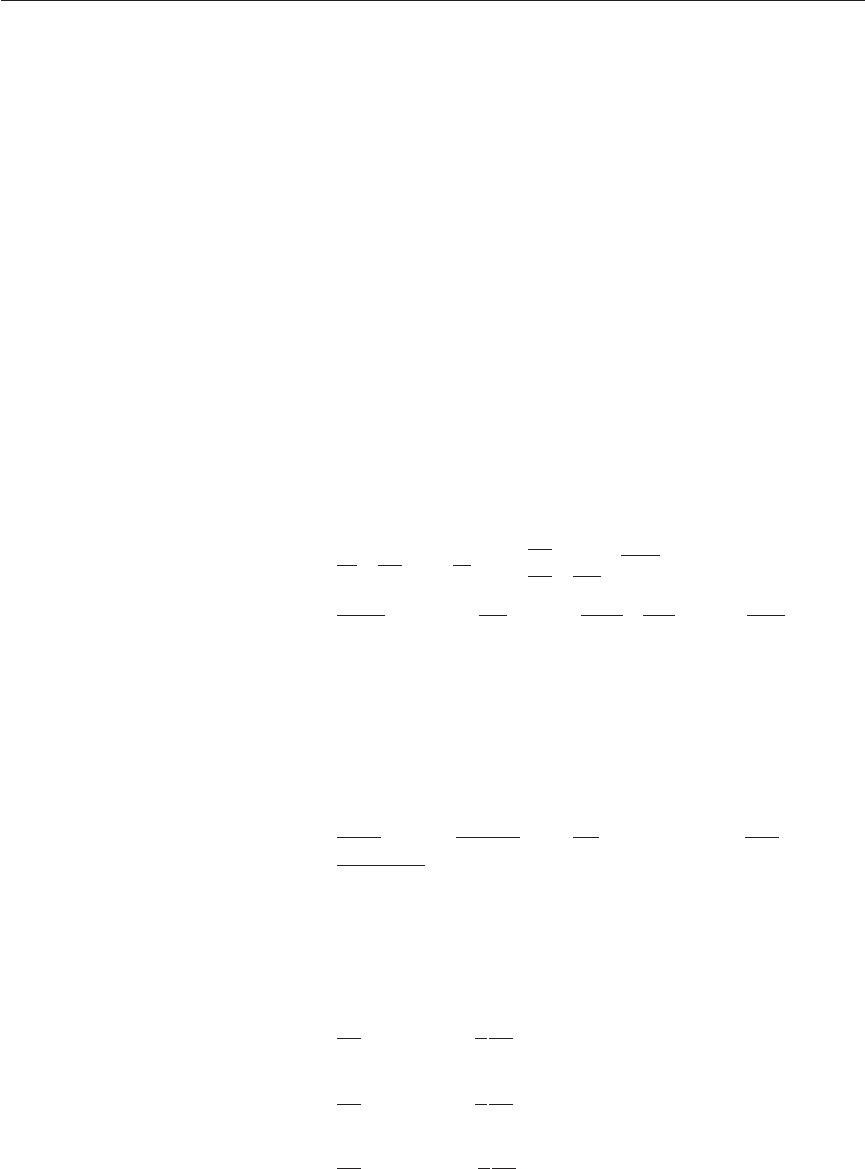
u = U + u′ u = U + u′ v = V + v′ w = W + w′ p = P + p′
Then the time average is taken, applying the rules stated in (3.21)–(3.22).
Considering the continuity equation (3.23), first we note that = div U.
This yields the continuity equation for the mean flow:
div U = 0 (3.25)
A similar process is now carried out on the x-momentum equation (3.24a). The
time averages of the individual terms in this equation can be written as follows:
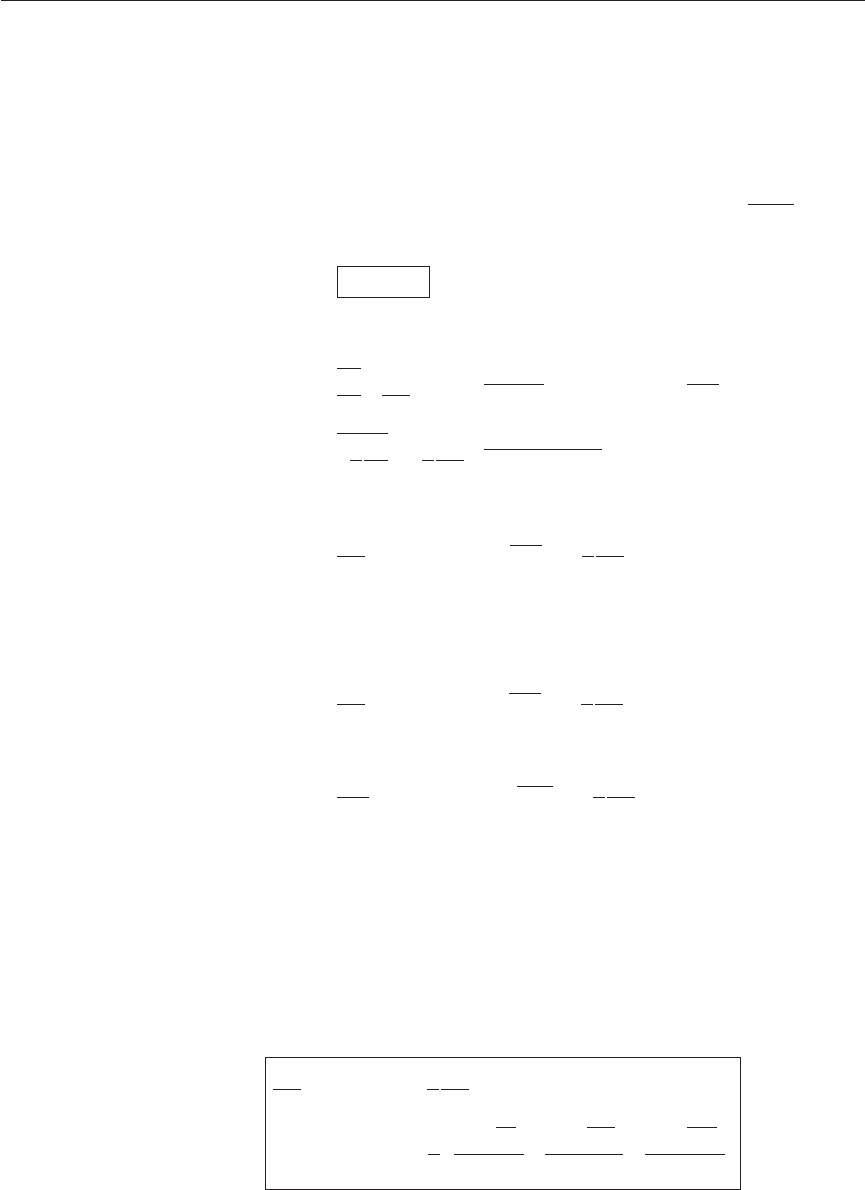
==div(UU) + div( )
−=− =
ν
div(grad(U))
Substitution of these results gives the time-average x-momentum equation
+ div(UU) + div( ) =− +
ν
div(grad(U)) (3.26a)
(I) (II) (III) (IV) (V)
Repetition of this process on equations (3.24b) and (3.24c) yields the time-
average y- and z-momentum equations:
+ div(V U) + div( ) =− +
ν
div(grad(V)) (3.26b)
(I) (II) (III) (IV) (V)
+ div(W U) + div( ) =− +
ν
div(grad(W)) (3.26c)
(I) (II) (III) (IV) (V)
It is important to note that the terms (I), (II), (IV) and (V) in (3.26a–c) also
appear in the instantaneous equations (3.24a–c), but the process of time
averaging has introduced new terms (III) in the resulting time-average
momentum equations. The terms involve products of fluctuating velocities
and are associated with convective momentum transfer due to turbulent
eddies. It is customary to place these terms on the right hand side of equa-
tions (3.26a–c) to reflect their role as additional turbulent stresses on the
mean velocity components U, V and W:
+ div(UU) =− +
ν
div(grad(U))
+++ (3.27a)
J
K
L
∂
(−
ρ
u′w′)
∂
z
∂
(−
ρ
u′v′)
∂
y
∂
(−
ρ
u′
2
)
∂
x
G
H
I
1
ρ
∂
P
∂
x
1
ρ
∂
U
∂
t
∂
P
∂
z
1
ρ
w′u′
∂
W
∂
t
∂
P
∂
y
1
ρ
v′u′
∂
V
∂
t
∂
P
∂
x
1
ρ
u′u′
∂
U
∂
t
ν
div(grad(u))
∂
P
∂
x
1
ρ
∂
p
∂
x
1
ρ
u′u′div(uu)
∂
U
∂
t
∂
u
∂
t
div u
ANIN_C03.qxd 29/12/2006 04:34PM Page 63
64 CHAPTER 3 TURBULENCE AND ITS MODELLING
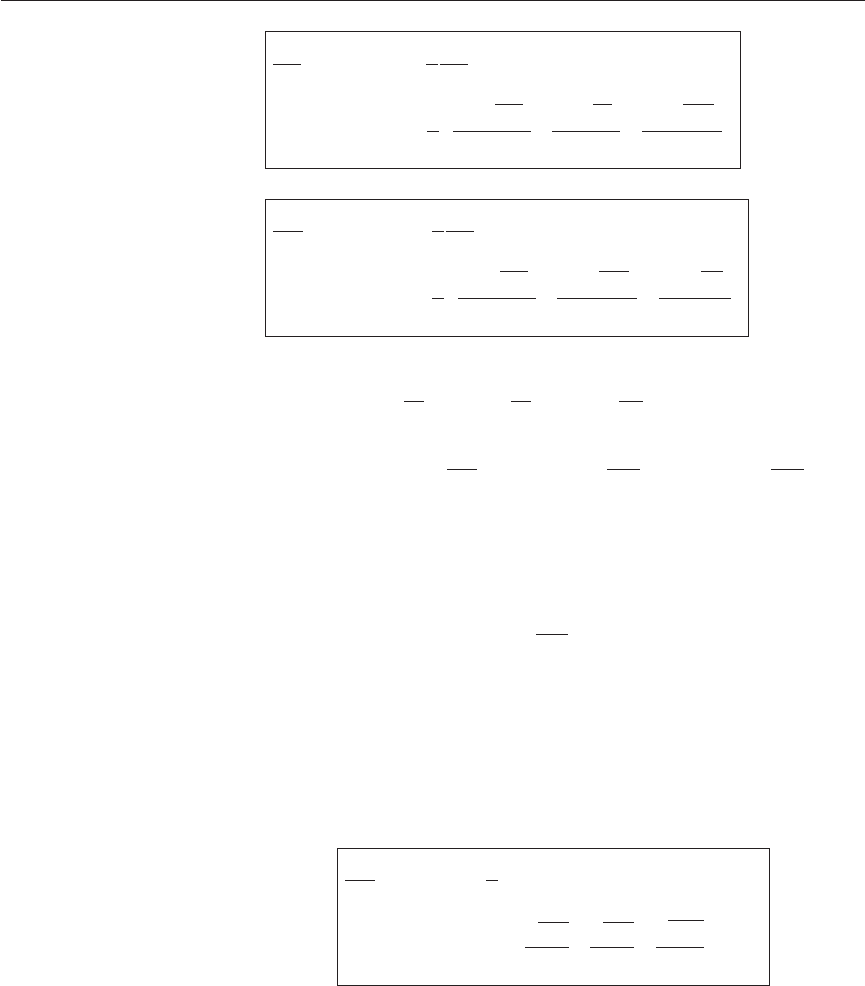
+ div(V U) =− +
ν
div(grad(V))
+++ (3.27b)
+ div(W U) =− +
ν
div(grad(W))
+++ (3.27c)
The extra stress terms have been written out in longhand to clarify their
structure. They result from six additional stresses: three normal stresses
τ
xx
=−
τ
yy
=−
τ
zz
=− (3.28a)
and three shear stresses
τ
xy
=
τ
yx
=−
τ
xz
=
τ
zx
=−
τ
yz
=
τ
zy
=− (3.28b)
These extra turbulent stresses are called the Reynolds stresses. The
normal stresses involve the respective variances of the x-, y- and z-velocity
fluctuations. They are always non-zero because they contain squared velo-
city fluctuations. The shear stresses contain second moments associated with
correlations between different velocity components. As was stated earlier,
if two fluctuating velocity components, e.g. u′ and v′, were independent ran-
dom fluctuations the time average would be zero. However, the correla-
tion between pairs of different velocity components due to the structure of
the vortical eddies ensures that the turbulent shear stresses are also non-zero
and usually very large compared with the viscous stresses in a turbulent flow.
The equation set (3.25) and (3.27a–c) is called the Reynolds-averaged
Navier–Stokes equations.
Similar extra turbulent transport terms arise when we derive a transport
equation for an arbitrary scalar quantity, e.g. temperature. The time-average
transport equation for scalar
ϕϕ
is
+ div(ΦU) = div(Γ
Φ
grad Φ)
+− − − +S
Φ
(3.29)
So far we have assumed that the fluid density is constant, but in practical
flows the mean density may vary and the instantaneous density always
exhibits turbulent fluctuations. Bradshaw et al. (1981) stated that small
density fluctuations do not appear to affect the flow significantly. If r.m.s.
velocity fluctuations are of the order of 5% of the mean speed they show that
density fluctuations are unimportant up to Mach numbers around 3 to 5. In
free turbulent flows we have seen in section 3.4 that velocity fluctuations can
easily reach values around 20% of the mean velocity. In such circumstances
J
K
L
∂
w′
ϕ
′
∂
z
∂
v′
ϕ
′
∂
y
∂
u′
ϕ
′
∂
x
G
H
I
1
ρ
∂
Φ
∂
t
u′v′
ρ
v′w′
ρ
u′w′
ρ
u′v′
ρ
w′
2
ρ
v′
2
ρ
u′
2
J
K
L
∂
(−
ρ
w′
2
)
∂
z
∂
(−
ρ
v′w′)
∂
y
∂
(−
ρ
u′w′)
∂
x
G
H
I
1
ρ
∂
P
∂
z
1
ρ
∂
W
∂
t
J
K
L
∂
(−
ρ
v′w′)
∂
z
∂
(−
ρ
v′
2
)
∂
y
∂
(−
ρ
u′v′)
∂
x
G
H
I
1
ρ
∂
P
∂
y
1
ρ
∂
V
∂
t
ANIN_C03.qxd 29/12/2006 04:34PM Page 64
3.6 TURBULENT FLOW CALCULATIONS 65
density fluctuations start to affect the turbulence around Mach numbers
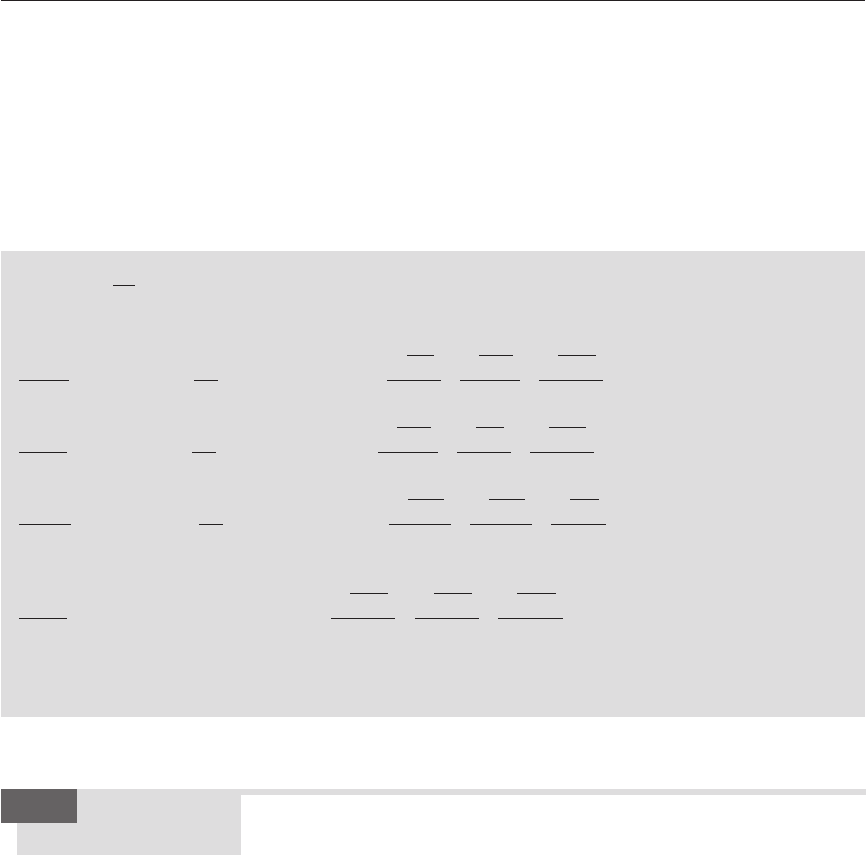
of 1. To summarise the results of the current section we quote, without
proof, in Table 3.1, the density-weighted averaged (or Favre-averaged;
see Anderson et al., 1984) form of the mean flow equations for compressible
turbulent flows where effects of density fluctuations are negligible, but mean
density variations are not. This form is widely used in commercial CFD
packages. The symbol } stands for the Favre-averaged velocity.
Table 3.1 Turbulent flow equations for compressible flows
Continuity + div(4-) = 0 (3.30)
Reynolds equations
+ div(4}-) =− +div(
µ
grad }) + − − − + S
Mx
(3.31a)
+ div(4I -) =− +div(
µ
grad I ) + − − − + S
My
(3.31b)
+ div(4| -) =− +div(
µ
grad | ) +− − − +S
Mz
(3.31c)
Scalar transport equation
+ div(45-) = div(Γ
Φ
grad 5) +− − − +S
Φ
(3.32)
where the overbar indicates a time-averaged variable and the tilde indicates a density-weighted or Favre-averaged
variable
J
K
L
∂
(4w′
ϕ
′)
∂
z
∂
(4v′
ϕ
′)
∂
y
∂
(4u′
ϕ
′)
∂
x
G
H
I
∂
(45)
∂
t
J
K
L
∂
(4w′
2
)
∂
z
∂
(4v′w′)
∂
y
∂
(4u′w′)
∂
x
G
H
I
∂
C
∂
z
∂
(4|)
∂
t
J
K
L
∂
(4v′w′)
∂
z
∂
(4v′
2
)
∂
y
∂
(4u′v′)
∂
x
G
H
I
∂
C
∂
y
∂
(4I)
∂
t
J
K
L
∂
(4u′w′)
∂
z
∂
(4u′v′)
∂
y
∂
(4u′
2
)
∂
x
G
H
I
∂
C
∂
x
∂
(4})
∂
t
∂
4
∂
t
Turbulent flow
calculations
Turbulence causes the appearance in the flow of eddies with a wide range of
length and time scales that interact in a dynamically complex way. Given the
importance of the avoidance or promotion of turbulence in engineering
applications, it is no surprise that a substantial amount of research effort is
dedicated to the development of numerical methods to capture the important
effects due to turbulence. The methods can be grouped into the following
three categories:
• Turbulence models for Reynolds-averaged Navier–Stokes
(RANS) equations: attention is focused on the mean flow and the
effects of turbulence on mean flow properties. Prior to the application
of numerical methods the Navier–Stokes equations are time averaged
(or ensemble averaged in flows with time-dependent boundary
conditions). Extra terms appear in the time-averaged (or Reynolds-
averaged) flow equations due to the interactions between various
turbulent fluctuations. These extra terms are modelled with classical
turbulence models: among the best known ones are the k–
ε
model and
3.6
ANIN_C03.qxd 29/12/2006 04:34PM Page 65

the Reynolds stress model. The computing resources required for
reasonably accurate flow computations are modest, so this approach
has been the mainstay of engineering flow calculations over the last
three decades.
• Large eddy simulation: this is an intermediate form of turbulence
calculations which tracks the behaviour of the larger eddies. The
method involves space filtering of the unsteady Navier–Stokes
equations prior to the computations, which passes the larger eddies
and rejects the smaller eddies. The effects on the resolved flow (mean
flow plus large eddies) due to the smallest, unresolved eddies are
included by means of a so-called sub-grid scale model. Unsteady
flow equations must be solved, so the demands on computing resources
in terms of storage and volume of calculations are large, but (at the time
of writing) this technique is starting to address CFD problems with
complex geometry.
• Direct numerical simulation (DNS): these simulations compute
the mean flow and all turbulent velocity fluctuations. The unsteady
Navier–Stokes equations are solved on spatial grids that are sufficiently
fine that they can resolve the Kolmogorov length scales at which energy
dissipation takes place and with time steps sufficiently small to resolve
the period of the fastest fluctuations. These calculations are highly
costly in terms of computing resources, so the method is not used for
industrial flow computations.
In the next section we discuss the main features and achievements of each of
these methods.
For most engineering purposes it is unnecessary to resolve the details of
the turbulent fluctuations. CFD users are almost always satisfied with infor-
mation about the time-averaged properties of the flow (e.g. mean velocities,
mean pressures, mean stresses etc.). Therefore, the vast majority of turbu-
lent flow computations has been and for the foreseeable future will continue
to be carried out with procedures based on the Reynolds-averaged
Navier–Stokes (RANS) equations (3.30), (3.31a–c) and (3.32). A descrip-
tion of the effects of turbulence on the mean flow is nevertheless needed
because the time-averaging operation on the momentum equations discards
all details concerning the state of the flow contained in the instantaneous
fluctuations. We have already seen in section 3.5 that this yields six addi-
tional unknowns in the time-averaged momentum equations (3.31a–c): the
Reynolds stresses −
ρ
, −
ρ
, −
ρ
, −
ρ
, −
ρ
, −
ρ
. Similarly,
time-average scalar transport equations show extra terms containing ,
and .
In order to be able to compute turbulent flows with the RANS equations
it is necessary to develop turbulence models to predict the Reynolds
stresses and the scalar transport terms and close the system of mean flow
equations (3.30), (3.31a–c) and (3.32). For a turbulence model to be useful in
a general-purpose CFD code it must have wide applicability, be accurate,
simple and economical to run. The most common RANS turbulence models
are classified on the basis of the number of additional transport equations
that need to be solved along with the RANS flow equations:
w′
ϕ
′v′
ϕ
′
u′
ϕ
′
v′w′u′w′u′v′w′
2
v′
2
u′
2
66 CHAPTER 3 TURBULENCE AND ITS MODELLING
Reynolds-
averaged Navier---
Stokes equations
and classical
turbulence models
3.7
ANIN_C03.qxd 29/12/2006 04:34PM Page 66