
Versteeg H., Malalasekra W. An Introduction to Computational Fluid Dynamics: The Finite Volume Method
Подождите немного. Документ загружается.


2.1 GOVERNING EQUATIONS OF FLUID FLOW AND HEAT TRANSFER 17
pu −
δ
x −
τ
xx
u −
δ
x
− pu +
δ
x +
τ
xx
u +
δ
x
δ
y
δ
z
+−
τ
yx
u −
δ
y +
τ
yx
u +
δ
y
δ
x
δ
z
+−
τ
zx
u −
δ
z +
τ
zx
u +
δ
z
δ
x
δ
y
The net rate of work done by these surface forces acting in the x-direction is
given by
++
δ
x
δ
y
δ
z (2.16a)
Surface stress components in the y- and z-direction also do work on the fluid
particle. A repetition of the above process gives the additional rates of work
done on the fluid particle due to the work done by these surface forces:
++
δ
x
δ
y
δ
z (2.16b)
and
++
δ
x
δ
y
δ
z (2.16c)
The total rate of work done per unit volume on the fluid particle by all
the surface forces is given by the sum of (2.16a–c) divided by the volume
δ
x
δ
y
δ
z. The terms containing pressure can be collected together and written
more compactly in vector form
−− − =−div(pu)
This yields the following total rate of work done on the fluid particle by
surface stresses:
[−div(pu)] + +++ +
++ ++ (2.17)
Energy flux due to heat conduction
The heat flux vector q has three components: q
x
, q
y
and q
z
(Figure 2.5).
J
K
L
∂
(w
τ
zz
)
∂
z
∂
(w
τ
yz
)
∂
y
∂
(w
τ
xz
)
∂
x
∂
(v
τ
zy
)
∂
z
∂
(v
τ
yy
)
∂
y
∂
(v
τ
xy
)
∂
x
∂
(u
τ
zx
)
∂
z
∂
(u
τ
yx
)
∂
y
∂
(u
τ
xx
)
∂
x
G
H
I
∂
(wp)
∂
z
∂
(vp)
∂
y
∂
(up)
∂
x
J
K
L
∂
(w(−p +
τ
zz
))
∂
z
∂
(w
τ
yz
)
∂
y
∂
(w
τ
xz
)
∂
x
G
H
I
J
K
L
∂
(v
τ
zy
)
∂
z
∂
(v(−p +
τ
yy
))
∂
y
∂
(v
τ
xy
)
∂
x
G
H
I
J
K
L
∂
(u
τ
zx
)
∂
z
∂
(u
τ
yx
)
∂
y
∂
(u(−p +
τ
xx
))
∂
x
G
H
I
J
K
L
D
E
F
1
2
∂
(
τ
zx
u)
∂
z
A
B
C
D
E
F
1
2
∂
(
τ
zx
u)
∂
z
A
B
C
G
H
I
J
K
L
D
E
F
1
2
∂
(
τ
yx
u)
∂
y
A
B
C
D
E
F
1
2
∂
(
τ
yx
u)
∂
y
A
B
C
G
H
I
J
K
L
D
E
F
1
2
∂
(
τ
xx
u)
∂
x
A
B
C
D
E
F
1
2
∂
(pu)
∂
x
A
B
C
D
E
F
1
2
∂
(
τ
xx
u)
∂
x
A
B
C
D
E
F
1
2
∂
(pu)
∂
x
A
B
C
G
H
I
ANIN_C02.qxd 29/12/2006 09:55 AM Page 17
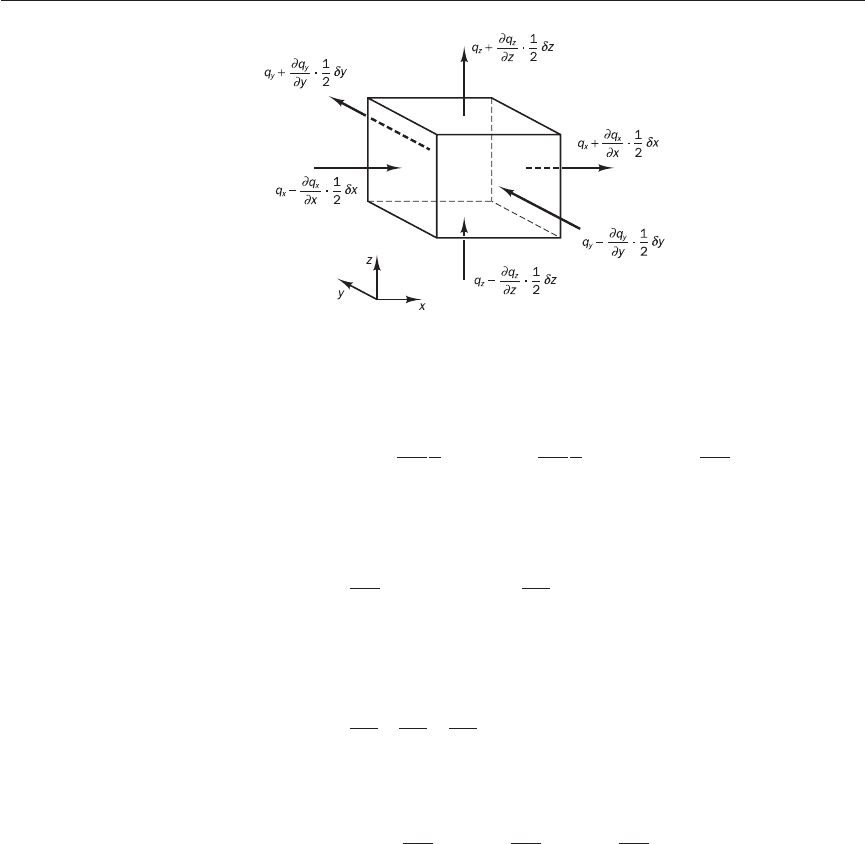
The net rate of heat transfer to the fluid particle due to heat flow in
the x-direction is given by the difference between the rate of heat input
across face W and the rate of heat loss across face E:
q
x
−
δ
x − q
x
+
δ
x
δ
y
δ
z =−
δ
x
δ
y
δ
z (2.18a)
Similarly, the net rates of heat transfer to the fluid due to heat flows in the
y- and z-direction are
−
δ
x
δ
y
δ
z and −
δ
x
δ
y
δ
z (2.18b–c)
The total rate of heat added to the fluid particle per unit volume due to heat
flow across its boundaries is the sum of (2.18a–c) divided by the volume
δ
x
δ
y
δ
z:
−−−=−div q (2.19)
Fourier’s law of heat conduction relates the heat flux to the local temperature
gradient. So
q
x
=−kq
y
=−kq
z
=−k
This can be written in vector form as follows:
q =−k grad T (2.20)
Combining (2.19) and (2.20) yields the final form of the rate of heat
addition to the fluid particle due to heat conduction across element
boundaries:
−div q = div(k grad T) (2.21)
Energy equation
Thus far we have not defined the specific energy E of a fluid. Often the
energy of a fluid is defined as the sum of internal (thermal) energy i, kinetic
energy
1
–
2
(u
2
+ v
2
+ w
2
) and gravitational potential energy. This definition
∂
T
∂
z
∂
T
∂
y
∂
T
∂
x
∂
q
z
∂
z
∂
q
y
∂
y
∂
q
x
∂
x
∂
q
z
∂
z
∂
q
y
∂
y
∂
q
x
∂
x
J
K
L
D
E
F
1
2
∂
q
x
∂
x
A
B
C
D
E
F
1
2
∂
q
x
∂
x
A
B
C
G
H
I
18 CHAPTER 2 CONSERVATION LAWS OF FLUID MOTION
Figure 2.5 Components of the
heat flux vector
ANIN_C02.qxd 29/12/2006 09:55 AM Page 18

2.1 GOVERNING EQUATIONS OF FLUID FLOW AND HEAT TRANSFER 19
takes the view that the fluid element is storing gravitational potential energy.
It is also possible to regard the gravitational force as a body force, which does
work on the fluid element as it moves through the gravity field.
Here we will take the latter view and include the effects of potential
energy changes as a source term. As before, we define a source of energy S
E
per unit volume per unit time. Conservation of energy of the fluid particle is
ensured by equating the rate of change of energy of the fluid particle (2.15)
to the sum of the net rate of work done on the fluid particle (2.17), the net
rate of heat addition to the fluid (2.21) and the rate of increase of energy due
to sources. The energy equation is
ρ
=−div(pu) + +++
+++++
+ div(k grad T) + S
E
(2.22)
In equation (2.22) we have E = i +
1
–
2
(u
2
+ v
2
+ w
2
).
Although (2.22) is a perfectly adequate energy equation it is common
practice to extract the changes of the (mechanical) kinetic energy to obtain
an equation for internal energy i or temperature T. The part of the energy
equation attributable to the kinetic energy can be found by multiplying the
x-momentum equation (2.14a) by velocity component u, the y-momentum
equation (2.14b) by v and the z-momentum equation (2.14c) by w and
adding the results together. It can be shown that this yields the following
conservation equation for the kinetic energy:
ρ
=−u . grad p + u ++
+ v ++
+ w ++ + u.S
M
(2.23)
Subtracting (2.23) from (2.22) and defining a new source term as
S
i
= S
E
− u.S
M
yields the internal energy equation
ρ
=−p div u + div(k grad T) +
τ
xx
+
τ
yx
+
τ
zx
+
τ
xy
+
τ
yy
+
τ
zy
+
τ
xz
+
τ
yz
+
τ
zz
+ S
i
(2.24)
∂
w
∂
z
∂
w
∂
y
∂
w
∂
x
∂
v
∂
z
∂
v
∂
y
∂
v
∂
x
∂
u
∂
z
∂
u
∂
y
∂
u
∂
x
Di
Dt
D
E
F
∂τ
zz
∂
z
∂τ
yz
∂
y
∂τ
xz
∂
x
A
B
C
D
E
F
∂τ
zy
∂
z
∂τ
yy
∂
y
∂τ
xy
∂
x
A
B
C
D
E
F
∂τ
zx
∂
z
∂τ
yx
∂
y
∂τ
xx
∂
x
A
B
C
D[
1
–
2
(u
2
+ v
2
+ w
2
)]
Dt
J
K
L
∂
(w
τ
zz
)
∂
z
∂
(w
τ
yz
)
∂
y
∂
(w
τ
xz
)
∂
x
∂
(v
τ
zy
)
∂
z
∂
(v
τ
yy
)
∂
y
∂
(v
τ
xy
)
∂
x
∂
(u
τ
zx
)
∂
z
∂
(u
τ
yx
)
∂
y
∂
(u
τ
xx
)
∂
x
G
H
I
DE
Dt
ANIN_C02.qxd 29/12/2006 09:55 AM Page 19

20 CHAPTER 2 CONSERVATION LAWS OF FLUID MOTION
For the special case of an incompressible fluid we have i = cT, where c is the
specific heat and div u = 0. This allows us to recast (2.24) into a temperature
equation
ρ
c = div(k grad T) +
τ
xx
+
τ
yx
+
τ
zx
+
τ
xy
+
τ
yy
+
τ
zy
+
τ
xz
+
τ
yz
+
τ
zz
+ S
i
(2.25)
For compressible flows equation (2.22) is often rearranged to give an equa-
tion for the enthalpy. The specific enthalpy h and the specific total enthalpy
h
0
of a fluid are defined as
h = i + p/
ρ
and h
0
= h +
1
–
2
(u
2
+ v
2
+ w
2
)
Combining these two definitions with the one for specific energy E we get
h
0
= i + p/
ρ
+
1
–
2
(u
2
+ v
2
+ w
2
) = E + p/
ρ
(2.26)
Substitution of (2.26) into (2.22) and some rearrangement yields the (total)
enthalpy equation
+ div(
ρ
h
0
u) = div(k grad T) +
+++
+++
+++ +S
h
(2.27)
It should be stressed that equations (2.24), (2.25) and (2.27) are not new (extra)
conservation laws but merely alternative forms of the energy equation (2.22).
The motion of a fluid in three dimensions is described by a system of five
partial differential equations: mass conservation (2.4), x-, y- and z-momentum
equations (2.14a–c) and energy equation (2.22). Among the unknowns are
four thermodynamic variables:
ρ
, p, i and T. In this brief discussion we point
out the linkage between these four variables. Relationships between the
thermodynamic variables can be obtained through the assumption of thermo-
dynamic equilibrium. The fluid velocities may be large, but they are
usually small enough that, even though properties of a fluid particle change
rapidly from place to place, the fluid can thermodynamically adjust itself to
new conditions so quickly that the changes are effectively instantaneous. Thus
the fluid always remains in thermodynamic equilibrium. The only exceptions
are certain flows with strong shockwaves, but even some of those are often
well enough approximated by equilibrium assumptions.
J
K
L
∂
(w
τ
zz
)
∂
z
∂
(w
τ
yz
)
∂
y
∂
(w
τ
xz
)
∂
x
∂
(v
τ
zy
)
∂
z
∂
(v
τ
yy
)
∂
y
∂
(v
τ
xy
)
∂
x
∂
(u
τ
zx
)
∂
z
∂
(u
τ
yx
)
∂
y
∂
(u
τ
xx
)
∂
x
G
H
I
∂
p
∂
t
∂
(
ρ
h
0
)
∂
t
∂
w
∂
z
∂
w
∂
y
∂
w
∂
x
∂
v
∂
z
∂
v
∂
y
∂
v
∂
x
∂
u
∂
z
∂
u
∂
y
∂
u
∂
x
DT
Dt
Equations of
state
2.2
ANIN_C02.qxd 29/12/2006 09:55 AM Page 20

2.3 NAVIER---STOKES EQUATIONS FOR A NEWTONIAN FLUID 21
We can describe the state of a substance in thermodynamic equilibrium
by means of just two state variables. Equations of state relate the other
variables to the two state variables. If we use
ρ
and T as state variables we
have state equations for pressure p and specific internal energy i:
p = p(
ρ
, T ) and i = i(
ρ
, T ) (2.28)
For a perfect gas the following, well-known, equations of state are useful:
p =
ρ
RT and i = C
v
T (2.29)
The assumption of thermodynamic equilibrium eliminates all but the two
thermodynamic state variables. In the flow of compressible fluids the
equations of state provide the linkage between the energy equation on the
one hand and mass conservation and momentum equations on the other.
This linkage arises through the possibility of density variations as a result of
pressure and temperature variations in the flow field.
Liquids and gases flowing at low speeds behave as incompressible
fluids. Without density variations there is no linkage between the energy
equation and the mass conservation and momentum equations. The flow
field can often be solved by considering mass conservation and momentum
equations only. The energy equation only needs to be solved alongside the
others if the problem involves heat transfer.
The governing equations contain as further unknowns the viscous stress
components
τ
ij
. The most useful forms of the conservation equations for
fluid flows are obtained by introducing a suitable model for the viscous
stresses
τ
ij
. In many fluid flows the viscous stresses can be expressed as func-
tions of the local deformation rate or strain rate. In three-dimensional flows
the local rate of deformation is composed of the linear deformation rate and
the volumetric deformation rate.
All gases and many liquids are isotropic. Liquids that contain signific-
ant quantities of polymer molecules may exhibit anisotropic or directional
viscous stress properties as a result of the alignment of the chain-like polymer
molecules with the flow. Such fluids are beyond the scope of this intro-
ductory course and we shall continue the development by assuming that the
fluids are isotropic.
The rate of linear deformation of a fluid element has nine components
in three dimensions, six of which are independent in isotropic fluids
(Schlichting, 1979). They are denoted by the symbol s
ij
. The suffix system
is identical to that for stress components (see section 2.1.3). There are three
linear elongating deformation components:
s
xx
= s
yy
= s
zz
= (2.30a)
There are also six shearing linear deformation components:
s
xy
= s
yx
=+ and s
xz
= s
zx
=+
s
yz
= s
zy
=+ (2.30b)
D
E
F
∂
w
∂
y
∂
v
∂
z
A
B
C
1
2
D
E
F
∂
w
∂
x
∂
u
∂
z
A
B
C
1
2
D
E
F
∂
v
∂
x
∂
u
∂
y
A
B
C
1
2
∂
w
∂
z
∂
v
∂
y
∂
u
∂
x
Navier---Stokes
equations for a
Newtonian fluid
2.3
ANIN_C02.qxd 29/12/2006 09:55 AM Page 21

22 CHAPTER 2 CONSERVATION LAWS OF FLUID MOTION
The volumetric deformation is given by
++ =div u (2.30c)
In a Newtonian fluid the viscous stresses are proportional to the rates
of deformation. The three-dimensional form of Newton’s law of viscosity
for compressible flows involves two constants of proportionality: the first
(dynamic) viscosity,
µ
, to relate stresses to linear deformations, and the sec-
ond viscosity,
λ
, to relate stresses to the volumetric deformation. The nine
viscous stress components, of which six are independent, are
τ
xx
= 2
µ
+
λ
div u
τ
yy
= 2
µ
+
λ
div u
τ
zz
= 2
µ
+
λ
div u
τ
xy
=
τ
yx
=
µ
+
τ
xz
=
τ
zx
=
µ
+
τ
yz
=
τ
zy
=
µ
+ (2.31)
Not much is known about the second viscosity
λ
, because its effect is small
in practice. For gases a good working approximation can be obtained by
taking the value
λ
=−
2
–
3
µ
(Schlichting, 1979). Liquids are incompressible so
the mass conservation equation is div u = 0 and the viscous stresses are just
twice the local rate of linear deformation times the dynamic viscosity.
Substitution of the above shear stresses (2.31) into (2.14a–c) yields the
so-called Navier–Stokes equations, named after the two nineteenth-century
scientists who derived them independently:
ρ
=− + 2
µ
+
λ
div u +
µ
+
+
µ
++S
Mx
(2.32a)
ρ
=− +
µ
++2
µ
+
λ
div u
+
µ
++S
My
(2.32b)
ρ
=− +
µ
++
µ
+
+ 2
µ
+
λ
div u + S
Mz
(2.32c)
J
K
L
∂
w
∂
z
G
H
I
∂
∂
z
J
K
L
D
E
F
∂
w
∂
y
∂
v
∂
z
A
B
C
G
H
I
∂
∂
y
J
K
L
D
E
F
∂
w
∂
x
∂
u
∂
z
A
B
C
G
H
I
∂
∂
x
∂
p
∂
z
Dw
Dt
J
K
L
D
E
F
∂
w
∂
y
∂
v
∂
z
A
B
C
G
H
I
∂
∂
z
J
K
L
∂
v
∂
y
G
H
I
∂
∂
y
J
K
L
D
E
F
∂
v
∂
x
∂
u
∂
y
A
B
C
G
H
I
∂
∂
x
∂
p
∂
y
Dv
Dt
J
K
L
D
E
F
∂
w
∂
x
∂
u
∂
z
A
B
C
G
H
I
∂
∂
z
J
K
L
D
E
F
∂
v
∂
x
∂
u
∂
y
A
B
C
G
H
I
∂
∂
y
J
K
L
∂
u
∂
x
G
H
I
∂
∂
x
∂
p
∂
x
Du
Dt
D
E
F
∂
w
∂
y
∂
v
∂
z
A
B
C
D
E
F
∂
w
∂
x
∂
u
∂
z
A
B
C
D
E
F
∂
v
∂
x
∂
u
∂
y
A
B
C
∂
w
∂
z
∂
v
∂
y
∂
u
∂
x
∂
w
∂
z
∂
v
∂
y
∂
u
∂
x
ANIN_C02.qxd 29/12/2006 09:55 AM Page 22

2.3 NAVIER---STOKES EQUATIONS FOR A NEWTONIAN FLUID 23
Often it is useful to rearrange the viscous stress terms as follows:
2
µ
+
λ
div u +
µ
++
µ
+
=
µ
+
µ
+
µ
+
µ
+
µ
+
µ
+ (
λ
div u)
= div(
µ
grad u) + [s
Mx
]
The viscous stresses in the y- and z-component equations can be recast in a
similar manner. We clearly intend to simplify the momentum equations by
‘hiding’ the bracketed smaller contributions to the viscous stress terms in the
momentum source. Defining a new source by
S
M
= S
M
+ [s
M
] (2.33)
the Navier–Stokes equations can be written in the most useful form for
the development of the finite volume method:
ρ
=− +div(
µ
grad u) + S
Mx
(2.34a)
ρ
=− +div(
µ
grad v) + S
My
(2.34b)
ρ
=− +div(
µ
grad w) + S
Mz
(2.34c)
If we use the Newtonian model for viscous stresses in the internal energy
equation (2.24) we obtain after some rearrangement
ρ
=−p div u + div(k grad T) +Φ+S
i
(2.35)
All the effects due to viscous stresses in this internal energy equation are
described by the dissipation function Φ, which, after considerable algebra,
can be shown to be equal to
Φ=
µ
2
2
+
2
+
2
++
2
++
2
++
2
+
λ
(div u)
2
(2.36)
5
4
6
4
7
D
E
F
∂
w
∂
y
∂
v
∂
z
A
B
C
D
E
F
∂
w
∂
x
∂
u
∂
z
A
B
C
D
E
F
∂
v
∂
x
∂
u
∂
y
A
B
C
J
K
K
L
D
E
F
∂
w
∂
z
A
B
C
D
E
F
∂
v
∂
y
A
B
C
D
E
F
∂
u
∂
x
A
B
C
G
H
H
I
1
4
2
4
3
Di
Dt
∂
p
∂
z
Dw
Dt
∂
p
∂
y
Dv
Dt
∂
p
∂
x
Du
Dt
J
K
L
∂
∂
x
D
E
F
∂
w
∂
x
A
B
C
∂
∂
z
D
E
F
∂
v
∂
x
A
B
C
∂
∂
y
D
E
F
∂
u
∂
x
A
B
C
∂
∂
x
G
H
I
D
E
F
∂
u
∂
z
A
B
C
∂
∂
z
D
E
F
∂
u
∂
y
A
B
C
∂
∂
y
D
E
F
∂
u
∂
x
A
B
C
∂
∂
x
J
K
L
D
E
F
∂
w
∂
x
∂
u
∂
z
A
B
C
G
H
I
∂
∂
z
J
K
L
D
E
F
∂
v
∂
x
∂
u
∂
y
A
B
C
G
H
I
∂
∂
y
J
K
L
∂
u
∂
x
G
H
I
∂
∂
x
ANIN_C02.qxd 29/12/2006 09:55 AM Page 23

The dissipation function is non-negative since it only contains squared terms
and represents a source of internal energy due to deformation work on the
fluid particle. This work is extracted from the mechanical agency which
causes the motion and converted into internal energy or heat.
To summarise the findings thus far, we quote in Table 2.1 the conservative
or divergence form of the system of equations which governs the time-
dependent three-dimensional fluid flow and heat transfer of a compressible
Newtonian fluid.
24 CHAPTER 2 CONSERVATION LAWS OF FLUID MOTION
Table 2.1 Governing equations of the flow of a compressible Newtonian fluid
Continuity + div(
ρ
u) = 0 (2.4)
x-momentum + div(
ρ
uu) =− +div(
µ
grad u) + S
Mx
(2.37a)
y-momentum + div(
ρ
vu) =− +div(
µ
grad v) + S
My
(2.37b)
z-momentum + div(
ρ
wu) =− +div(
µ
grad w) + S
Mz
(2.37c)
Energy + div(
ρ
iu) =−p div u + div(k grad T ) +Φ+S
i
(2.38)
Equations p = p(
ρ
, T ) and i = i(
ρ
, T ) (2.28)
of state
e.g. perfect gas p =
ρ
RT and i = C
v
T (2.29)
∂
(
ρ
i)
∂
t
∂
p
∂
z
∂
(
ρ
w)
∂
t
∂
p
∂
y
∂
(
ρ
v)
∂
t
∂
p
∂
x
∂
(
ρ
u)
∂
t
∂ρ
∂
t
Momentum source S
M
and dissipation function Φ are defined by (2.33)
and (2.36) respectively.
It is interesting to note that the thermodynamic equilibrium assumption of
section 2.2 has supplemented the five flow equations (PDEs) with two further
algebraic equations. The further introduction of the Newtonian model, which
expresses the viscous stresses in terms of gradients of velocity components,
has resulted in a system of seven equations with seven unknowns. With an
equal number of equations and unknown functions this system is mathemat-
ically closed, i.e. it can be solved provided that suitable auxiliary conditions,
namely initial and boundary conditions, are supplied.
It is clear from Table 2.1 that there are significant commonalities between
the various equations. If we introduce a general variable
φ
the conservative
form of all fluid flow equations, including equations for scalar quantities such
as temperature and pollutant concentration etc., can usefully be written in
the following form:
+ div(
ρφ
u) = div(Γ grad
φ
) + S
φ
(2.39)
∂
(
ρφ
)
∂
t
Conservative form
of the governing
equations of fluid flow
2.4
Differential and
integral forms
of the general
transport equations
2.5
ANIN_C02.qxd 29/12/2006 09:55 AM Page 24

2.5 FORMS OF THE GENERAL TRANSPORT EQUATIONS 25
In words,
Rate of increase Net rate of flow Rate of increase Rate of increase
of
φ
of fluid + of
φ
out of = of
φ
due to + of
φ
due to
element fluid element diffusion sources
Equation (2.39) is the so-called transport equation for property
φ
. It
clearly highlights the various transport processes: the rate of change term
and the convective term on the left hand side and the diffusive term (Γ=
diffusion coefficient) and the source term respectively on the right hand
side. In order to bring out the common features we have, of course, had to
hide the terms that are not shared between the equations in the source terms.
Note that equation (2.39) can be made to work for the internal energy equa-
tion by changing i into T or vice versa by means of an equation of state.
Equation (2.39) is used as the starting point for computational procedures
in the finite volume method. By setting
φ
equal to 1, u, v, w and i (or T or
h
0
) and selecting appropriate values for diffusion coefficient Γ and source
terms, we obtain special forms of Table 2.1 for each of the five PDEs for
mass, momentum and energy conservation. The key step of the finite volume
method, which is to be to be developed from Chapter 4 onwards, is the integ-
ration of (2.39) over a three-dimensional control volume (CV):
dV + div(
ρφ
u)dV = div(Γ grad
φ
)dV + S
φ
dV (2.40)
The volume integrals in the second term on the left hand side, the convec-
tive term, and in the first term on the right hand side, the diffusive term, are
rewritten as integrals over the entire bounding surface of the control volume
by using Gauss’s divergence theorem. For a vector a this theorem states
div(a)dV = n.adA (2.41)
The physical interpretation of n.a is the component of vector a in the
direction of the vector n normal to surface element dA. Thus the integral
of the divergence of a vector a over a volume is equal to the component of a
in the direction normal to the surface which bounds the volume summed
(integrated) over the entire bounding surface A. Applying Gauss’s diver-
gence theorem, equation (2.40) can be written as follows:
ρφ
dV + n .(
ρφ
u)dA = n . (Γ grad
φ
)dA + S
φ
dV (2.42)
The order of integration and differentiation has been changed in the first
term on the left hand side of (2.42) to illustrate its physical meaning. This
term signifies the rate of change of the total amount of fluid property
φ
in the control volume. The product n.
ρφ
u expresses the flux com-
ponent of property
φ
due to fluid flow along the outward normal vector n,
so the second term on the left hand side of (2.42), the convective term,
therefore is the net rate of decrease of fluid property
φ
of the fluid
element due to convection.
CV
A
A
D
E
F
CV
A
B
C
∂
∂
t
A
CV
CV
CV
CV
∂
(
ρφ
)
∂
t
CV
ANIN_C02.qxd 29/12/2006 09:55 AM Page 25

26 CHAPTER 2 CONSERVATION LAWS OF FLUID MOTION
A diffusive flux is positive in the direction of a negative gradient of the
fluid property
φ
, i.e. along direction −grad
φ
. For instance, heat is conducted
in the direction of negative temperature gradients. Thus, the product
n . (−Γ grad
φ
) is the component of diffusion flux along the outward normal
vector, so out of the fluid element. Similarly, the product n . (Γ grad
φ
),
which is also equal to Γ(−n . (−grad
φ
)), can be interpreted as a positive dif-
fusion flux in the direction of the inward normal vector −n, i.e. into the fluid
element. The first term on the right hand side of (2.42), the diffusive term,
is thus associated with a flux into the element and represents the net rate of
increase of fluid property
φ
of the fluid element due to diffusion. The
final term on the right hand side of this equation gives the rate of increase
of property
φ
as a result of sources inside the fluid element.
In words, relationship (2.42) can be expressed as follows:
Net rate of decrease Net rate of
Net rate of
Rate of increase of
φ
due to increase of
φ
creation of
φ
of
φ
inside the + convection across = due to diffusion +
inside the
control volume the control volume across the control
control volume
boundaries volume boundaries
This discussion clarifies that integration of the PDE generates a statement of
the conservation of a fluid property for a finite size (macroscopic) control
volume.
In steady state problems the rate of change term of (2.42) is equal to zero.
This leads to the integrated form of the steady transport equation:
n . (
ρφ
u)dA = n . (Γ grad
φ
)dA + S
φ
dV (2.43)
In time-dependent problems it is also necessary to integrate with respect to
time t over a small interval ∆t from, say, t until t +∆t. This yields the most
general integrated form of the transport equation:
ρφ
dV dt + n . (
ρφ
u)dAdt
= n . (Γ grad
φ
)dAdt + S
φ
dVdt (2.44)
Now that we have derived the conservation equations of fluid flows the time
has come to turn our attention to the issue of the initial and boundary
conditions that are needed in conjunction with the equations to construct
a well-posed mathematical model of a fluid flow. First we distinguish two
principal categories of physical behaviour:
• Equilibrium problems
• Marching problems
CV
∆t
A
∆t
A
∆t
D
E
F
CV
A
B
C
∂
∂
t
∆t
CV
A
A
Classification
of physical
behaviours
2.6
ANIN_C02.qxd 29/12/2006 09:55 AM Page 26