
Versteeg H., Malalasekra W. An Introduction to Computational Fluid Dynamics: The Finite Volume Method
Подождите немного. Документ загружается.

12.22 EDDY BREAK-UP MODEL OF COMBUSTION 387
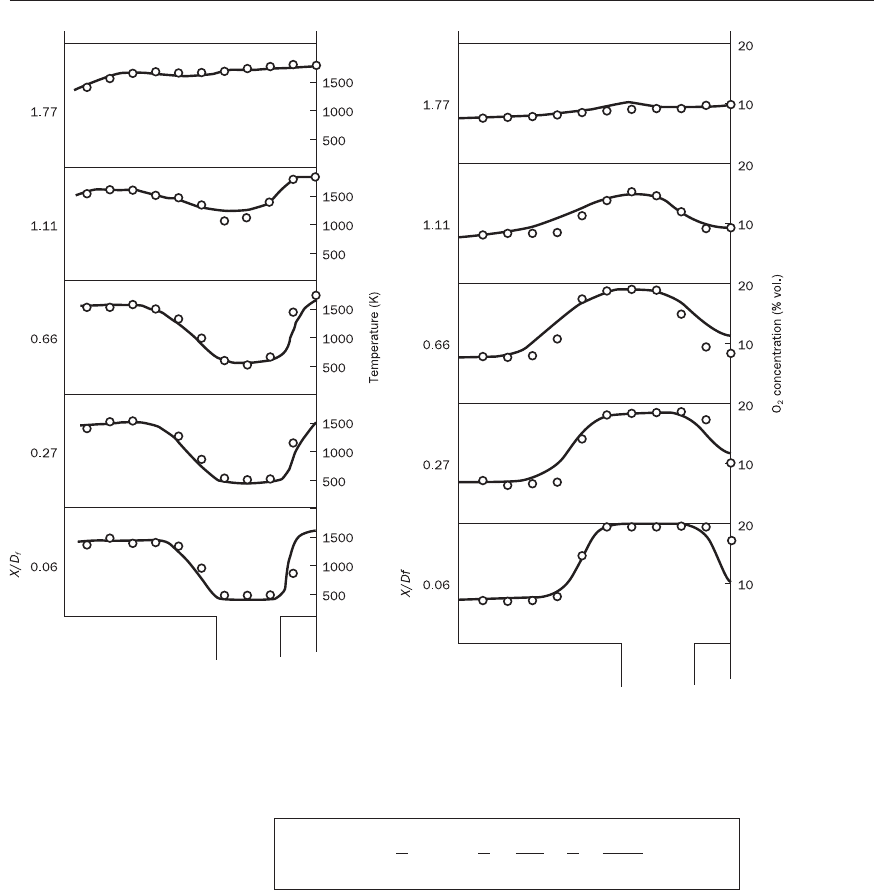
Figure 12.9 Comparison of predictions and experimental data in a furnace simulation (Case 6): radial temperature and
oxygen concentration profiles
Source: Gosman et al. (1978)
Now the reaction rate of fuel is given by
Ä
fu
=−min 4 C
R
J
fu
, 4 C
R
, 4 C ′
R
, −Ä
fu,kinetic
(12.167)
Nickjooy et al. (1988) used the above approach by considering a two-step
global reaction model which included CO formation to predict combusting
flows in axisymmetric combustors. The model constants C
R
, C ′
R
, a, b and
c used in their study for the different cases considered can be found in the
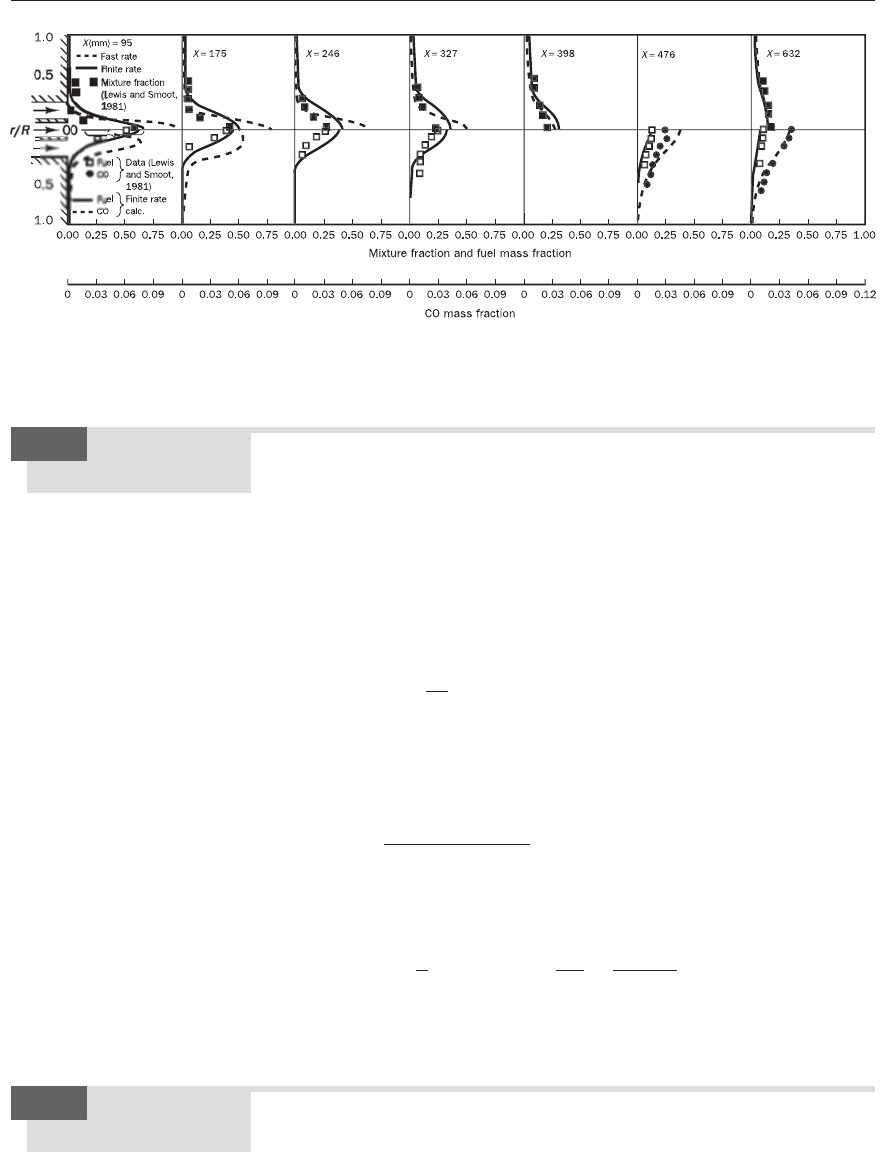
above reference. Figure 12.10 shows the predictions reported by Nikjooy
et al. (1988).
The eddy break-up model makes reasonably good predictions and is
fairly straightforward to implement in CFD procedures. However, due to
the dependence of the fuel dissipation rate on the turbulence time scale k/
ε
,
the quality of the predictions depends on the performance of the turbulence
model. Where a turbulence model fails to make accurate flow predictions the
quality of combustion simulations will, of course, also be limited.
J
K
L
J
pr
1 + s
ε
k
J
ox
s
ε
k
ε
k
G
H
I
ANIN_C12.qxd 29/12/2006 04:44PM Page 387
A modified version of the eddy break-up (EBU) model is known as the
eddy dissipation concept (EDC) of Ertesvag and Magnussen (2000). The
EDC model attempts to incorporate the significance of fine structures in a
turbulent reacting flow in which combustion chemistry is important. A com-
prehensive review of the EDC model can be found in Magnussen (2005).
Without giving the conceptual details the model may be summarised as
follows.
In the EDC model the mass fraction occupied by the fine structures is
defined as
γ
* = 4.6
1/2
(12.168)
Here
ν
is kinematic viscosity, k and
ε
are turbulent kinetic energy and dis-
sipation, and 4.6 is a model constant. The reacting fraction of the fine
structure is defined as
χ
= (12.169)
where J
pr
is the product mass fraction and, as in the EBU model,
J
min
= min(J
fu
, J
ox
/s). Then the reaction rate for fuel is obtained from
Ä
fu
=−4 C
EDC
min J
fu
, . (12.170)
Here C
EDC
is a model constant with a recommended value of 11.2.
All the above models except the equilibrium model either use single-step
combustion or accommodate only a limited degree of combustion chemistry
and do not predict intermediate and minor species. We now discuss the
D
E
F
χ
1 −
γ
*
χ
A
B
C
D
E
F
J
ox
s
A
B
C
ε
k
J
pr
/(1 + s)
J
min
+ J
pr
/(1 + s)
D
E
F
νε
k
2
A
B
C
388 CHAPTER 12 CFD MODELLING OF COMBUSTION
Figure 12.10 A comparison of the calculated and measured mixture fraction (above centre line), fuel and CO (below
centre line) for the Lewis and Smoot (1981) experiment
Source: Nikjooy et al. (1988)
Eddy dissipation
concept
12.23
Laminar flamelet
model
12.24
ANIN_C12.qxd 29/12/2006 04:44PM Page 388
12.24 LAMINAR FLAMELET MODEL 389
laminar flamelet model, which is a compromise between simplicity and the
need to account for detailed chemistry. The model views the turbulent flame
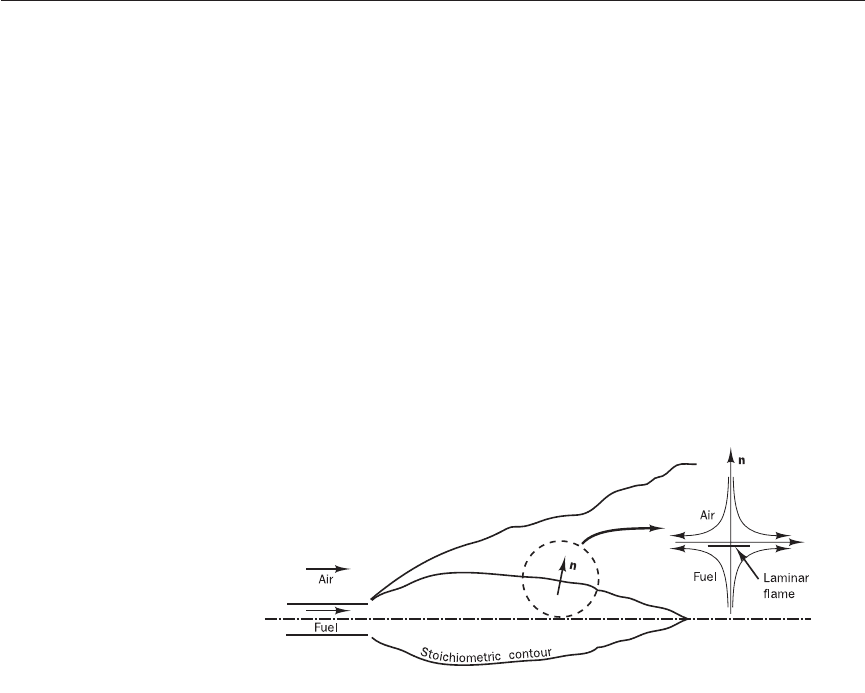
as consisting of an ensemble of stretched laminar flamelets. Figure 12.11
shows a schematic sketch of the laminar flamelet concept. Turbulent flames
are described as wrinkled, moving laminar sheets of reaction, and major heat
release is considered to occur in narrow regions in the vicinity of stoichio-
metric surfaces. These are called flamelets, which are considered to be
embedded within the turbulent flow. The approach is based on the notion
that, if the chemical time scales are much shorter than the characteristic
turbulence time scales, the fuel and oxidant react in locally thin one-
dimensional structures normal to the stoichiometric contour, as illustrated
in the inset of Figure 12.11. These structures are assumed to resemble the
flame sheets responsible for combustion in a laminar flame: hence the name
laminar flamelets. In a turbulent flow the flamelets are considered to
be stretched and strained by flow and turbulence. These effects are incor-
porated in the modelling by including appropriate parameters, as we will
see below.
Figure 12.11 Schematic
representation of the laminar
flamelet concept
The properties of laminar flamelets, e.g. the temperature, density and
species mass fractions as a function of the mixture fraction
ξ
, are evaluated
once and for all outside the flow field calculation to yield a so-called lami-
nar flamelet library. A library of such relationships used in a calculation is
shown later in an example (see Figure 12.16). The library comprises a set of
relationships
φ
(
ξ
) between scalar flow properties
φ
and the mixture fraction
ξ
. Their form is similar to Figure 12.2, but turbulence causes the flames to
be stretched, which alters the details of the relationships
φ
(
ξ
). To accommo-
date the effect of flame stretching due to the flow field in an actual turbulent
flame, it is common practice to incorporate as a parameter either the strain
rate or the scalar dissipation rate, both of which are flow properties, into
the laminar flamelet library calculations.
A key advantage of the laminar flamelet methodology is that detailed
chemistry can be incorporated relatively economically within the calculations,
because the library contains information relating to major species, minor
species, density and temperature. This enables us to evaluate important
aspects of the combustion process such as the formation of pollutants.
Without detailed chemistry it is only possible to calculate flow and approx-
imate energy release due to combustion.
In section 12.25 we give an overview of the methods used to generate
a laminar flamelet library. In section 12.26 we show how Favre-averaged
ANIN_C12.qxd 29/12/2006 04:44PM Page 389

values of a scalar variable in a turbulent flow field can be calculated from a
knowledge of the values of the mixture fraction
ξ
and the scalar dissipation
rate
χ
and the pdfs G(
ξ
) and G(
χ
). In sections 12.27 to 12.29 we discuss how
the formation of pollutants such as NO can be modelled within the laminar
flamelet framework. Finally, in section 12.30 we give an illustrative example
to demonstrate the strengths and weaknesses of the laminar flamelet model.
We summarise the main aspects of the laminar flamelet method from the
work of Peters (1984, 1986), Bray and Peters (1994), Pitsch and Peters
(1998), Williams (2000) and Veynante and Vervisch (2002). The interested
reader is directed to these publications for further details of laminar flamelet
theory for non-premixed combustion.
Laminar flamelets are generated by solving the one-dimensional governing
equations of non-premixed combustion. The simplest model for counter-flow
diffusion flames assumes a steady state, laminar, stagnation-point flow. The
governing equations for continuity, momentum, chemical species and energy
can be written and solved without much effort. A simple one-dimensional
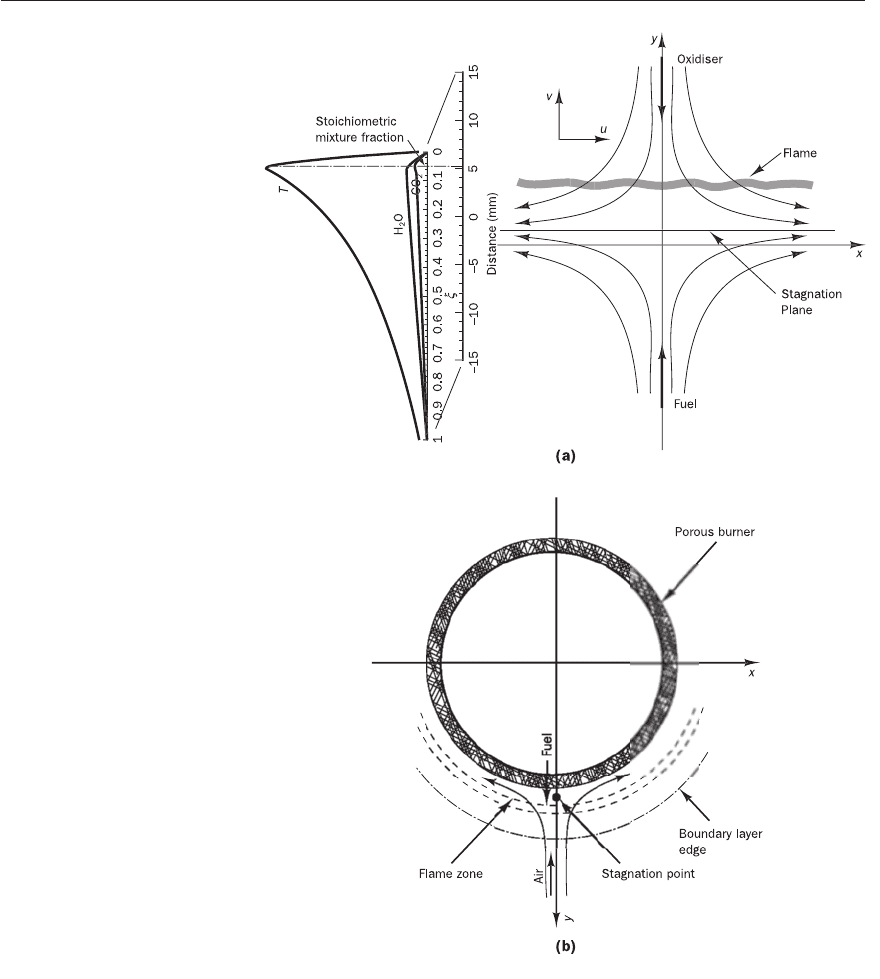
non-premixed combustion situation is shown in Figure 12.12a, where fuel
and oxidant streams are opposed jets. There are two main methods of pro-
ducing laminar flamelet libraries:
• Method 1: the physical (x–y) co-ordinate system is used to solve
governing equations for opposed flow diffusion flames
• Method 2: the governing equations of opposed flow diffusion flames are
transformed into mixture fraction space and solved
Method 1: Opposed flow diffusion flame configuration
Consider the opposed flow diffusion flame situation shown in Figure 12.12a.
Such a flow might be created using two concentric axisymmetric opposing
nozzles, one delivering fuel and the other delivering oxidant. The configura-
tion produces an axisymmetric flow field with a stagnation plane between
the nozzles as shown. The location of the stagnation plane depends on the
velocities of the two streams, and can be adjusted by varying the velocity of
one stream and keeping the other constant. A diffusion flame is established
between the two nozzles close to the stagnation plane. The position of this
thin flat flame depends on the velocities of the two streams and the proper-
ties of the fuel and oxidant. Since most fuels require more air than fuel by
mass the diffusion flame usually sits on the oxidiser side of the stagnation
plane as shown. For calculation purposes the configuration is considered to
be infinitely wide and axisymmetric. The co-ordinate system used in the
Method 1 formulation is shown in Figure 12.12a. The oxidiser jet is located
at y =∞and the fuel jet at y =−∞. The model assumes the flow to be
laminar, stagnation-point flow in cylindrical co-ordinates.
The structure of the flame is obtained by the solution of steady boundary
layer equations written along the stagnation streamline (see Smooke et al.,
1986; Lutz et al., 1997). The method looks for self-similar solutions that
are functions of the co-ordinate perpendicular to the flame, i.e. y only (note
390 CHAPTER 12 CFD MODELLING OF COMBUSTION
Generation of
laminar flamelet
libraries
12.25
ANIN_C12.qxd 29/12/2006 04:44PM Page 390
12.25 GENERATION OF LAMINAR FLAMELET LIBRARIES 391
that y is the axial co-ordinate in this case). In the usual notation the vari-
ables are
ρ
=
ρ
(y)
T = T (y)
Y
k
= Y
k
(y), k = 1,..., N
Figure 12.12 (a) An opposed
flow flame; (b) Tsuji burner
configuration (after Tsuji and
Yamaoka, 1967)
ANIN_C12.qxd 29/12/2006 04:44PM Page 391

If y denotes the axial direction and x denotes the radial direction the steady
state conservation of mass is as follows:
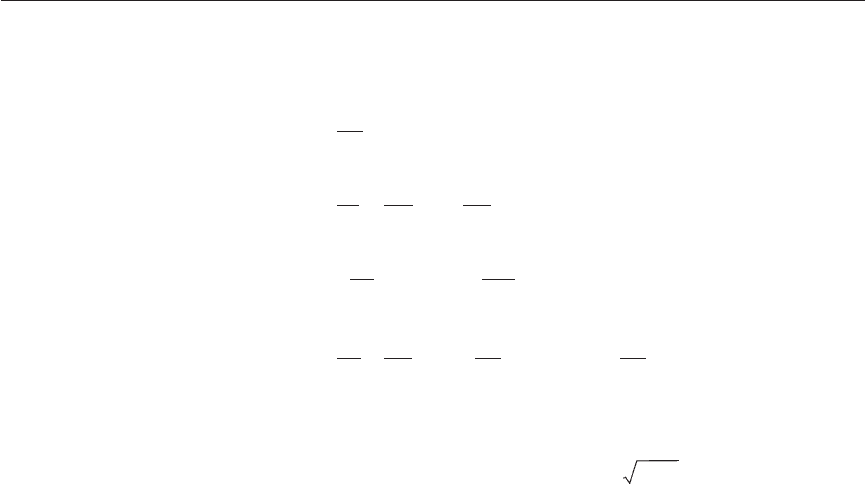
+=0 (12.171)
The radial momentum equation is
ρ
u +
ρ
v =
µ
− (12.172)
The species conservation equation is
ρ
u +
ρ
v + (
ρ
Y
k
V
k
) − M
k
= 0 k = 1, 2,..., N (12.173)
The energy equation is
ρ
u +
ρ
v − k + c
pk
Y
k
V
k
+ h
k
M
k
= 0 k = 1, 2,...,N (12.174)
The system is closed with the ideal gas law
ρ
= (12.175)
In equations (12.173) and (12.174) the parameter V
k
is known as the
diffusion velocity, which considers the diffusion of species. For a multi-
component system the diffusion velocities are given by (see Lutz et al., 1997;
Turns, 2000)
V
k
=− (MW )
j
D
kj
− (12.176)
where the X
k
denote mole fractions, (MW ) molecular weights and D
kj
the
multi-component diffusion coefficient, and D
T
k
is an equivalent diffusion
coefficient of species k into the rest of the mixture. Since calculations of
laminar flames attempt to consider detailed chemistry, these fine details are
retained in the equations, and detailed transport properties and thermo-
dynamic data calculation routines are also employed in the calculations (see
Rogg and Wang, 1997).
In an opposing flow the free stream radial and axial velocities at the edge
of the boundary layer are given by u
∞
= ax and v
∞
=−2ay, where a is the
strain rate. We may now introduce
U( y) == (12.177)
V( y) =
ρ
v (12.178)
u
ax
u
u
∞
∂
T
∂
x
1
T
D
T
k
ρ
Y
k
dX
j
dx
N
∑
j =1
1
X
k
(MW )
mix
p(MW )
mix
R
u
T
N
∑
k=1
1
c
p
∂
T
∂
y
N
∑
k=1
ρ
c
p
D
E
F
∂
T
∂
y
A
B
C
∂
∂
y
1
c
p
∂
T
∂
y
∂
T
∂
x
∂
∂
y
∂
Y
k
∂
y
∂
Y
k
∂
x
∂
p
∂
x
J
K
L
∂
u
∂
y
G
H
I
∂
∂
y
∂
u
∂
y
∂
u
∂
x
∂
(
ρ
vx)
∂
y
∂
(
ρ
ux)
∂
x
392 CHAPTER 12 CFD MODELLING OF COMBUSTION
ANIN_C12.qxd 29/12/2006 04:44PM Page 392
12.25 GENERATION OF LAMINAR FLAMELET LIBRARIES 393
Introduction of equations (12.177) and (12.178) transforms the set of equa-
tions (12.171)–(12.175) into a system of ordinary differential equations valid
along the stagnation-point streamline x = 0:
+ 2a
ρ
U = 0 (12.179)
µ
− V + a(
ρ
∞
−
ρ
U
2
) = 0 (12.180)
− (
ρ
Y
k
V
k
) − V + M
k
= 0 k = 1, 2,..., N (12.181)
k − c
p
V −
ρ
c
pk
Y
k
V
k
− h
k
M
k
= 0 (12.182)
Smooke et al. (1986) stated that the appropriate boundary conditions for the
fuel ( fu) and oxidizer (ox) streams are as follows:
Fuel stream, y =−∞: V = V
fu
U =
ρ
ox
/
ρ
fu
T = T
fu
Y
k
= Y
k, fu
Oxidiser stream, y =∞: U = 1 T = T
ox
Y
k
= Y
k,∞
Symmetry plane, y = 0: V = 0
The distances y =−∞and y =+∞refer to fuel and oxidiser steams. In
practice the infinite interval is truncated and boundary data are supplied at
y =−L
fu
(the fuel jet) and y =+L
ox
(the oxidiser jet), where the separation
distance is 2L = L
fu
+ L
ox
(see Smooke et al., 1986).
Inspection of the above equations shows that the velocity gradient or
strain rate a is a parameter of the system of ordinary differential equations
(12.179)–(12.182) – the other quantities are the dependent and independent
variables and thermodynamic or transport properties. To generate laminar
flamelet profiles in the physical space the system is solved for a series of
prescribed values of a corresponding to stretch conditions in practical tur-
bulent flows (a = 0.1 to 5000 s
−1
). Normally, finite difference techniques
and Newton’s iteration method are used to solve the set of equations.
Another commonly used experimental situation for creating one-
dimensional non-premixed flames is the Tsuji burner shown in Figure
12.12b (after Tsuji and Yamaoka, 1967). An alternative formulation of the
flamelet equations based on Tsuji’s burner configuration, which yields a
slightly different set of ordinary differential equations, is also a popular
method for laminar flamelet calculations.
There are many programs available for laminar flamelet calculations.
RUN1DL (Rogg, 1993; Rogg and Wang, 1997) is widely used for the gener-
ation of laminar flamelet profiles in physical space. Another computer
program for solving counter-flow diffusion flames is the OPPDIF code of
Lutz et al. (1997). By solving the opposed flow laminar flame problem in
physical space the results obtained will give temperature, density, major and
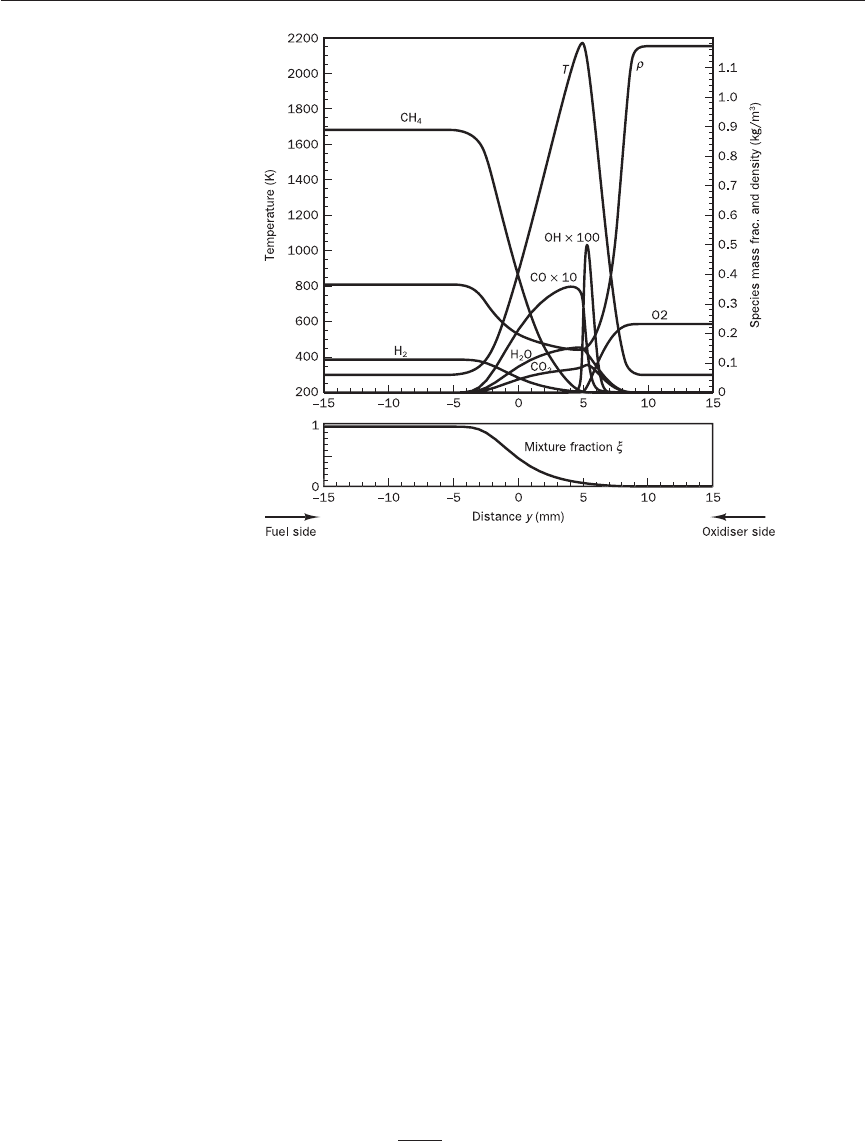
minor species as a function of distance from the stagnation point. A typical
set of calculation results is given in Figure 12.13, which shows the tempera-
ture, density and all species concentrations for an opposed flow laminar flame
with a 1:1 mixture of CH
4
and H
2
as fuel for a strain rate of a
s
= 20 s
−1
.
N
∑
k=1
dT
dy
N
∑
k=1
∂
T
∂
y
D
E
F
∂
T
∂
y
A
B
C
∂
∂
y
dY
k
dy
d
dy
dU
dy
J
K
L
dU
dy
G
H
I
d
dy
dV
dy
ANIN_C12.qxd 29/12/2006 04:44PM Page 393
In combustion procedures we solve the transport equations for mixture
fraction and mixture fraction variance. Flame property relationships, such
as those in Figure 12.2, lack detailed chemistry. The laminar flamelet model
uses the laminar flamelet library as a series of relationships Y
k
= Y
k
(
ξ
),
T = T (
ξ
),
ρ
=
ρ
(
ξ
) etc. in the form of a look-up table. This requires us
to convert the solutions of (12.179)–(12.182) in physical space Y
k
= Y
k
(y),
T = T(y),
ρ
=
ρ
(y) into the mixture fraction co-ordinate. We note that if we
go in Figure 12.13 from the fuel stream (y =−15 mm) to the oxidiser stream
( y =+15 mm), the mixture fraction will vary from 1 to 0. In between these
extremes the mixture fraction will gradually change. For each flame and
each specific value of the strain rate there will be a one-to-one correspond-
ence between the values of the y-co-ordinate and the local mixture fraction
ξ
=
ξ
(y). For example, the flame is located in the high-temperature region
around y =+5 mm, where the mixture fraction will be close to its stoichio-
metric value, so
ξ
st
=
ξ
(y = 5 mm). Thus, the results in Figure 12.13 can in
principle be replotted using the mixture fraction as the abscissa.
The most common method of evaluating the mixture fraction
ξ
in com-
busting flows with an arbitrary number of fuel and oxidiser inlet streams is
known as Bilger’s mixture fraction formula (Bilger, 1988). It is based on
the notion that species are consumed or produced during chemical reactions,
but chemical elements are conserved during reactions. Mass fractions Z of
chemical elements (e.g. C, H, O) can be obtained from the mass fractions Y
of species containing these elements:
Z
j
= Y
i
(12.183)
a
ij
W
j
MW
i
N
∑
i =1
394 CHAPTER 12 CFD MODELLING OF COMBUSTION
Figure 12.13 Laminar flamelet
structure of an opposed flow
CH
4
:H
2
(1:1) laminar flame, air
and fuel temperatures 300 K,
strain rate a = 20 s
−1
, fuel left
hand side, air right hand side,
domain size −15 mm to +15 mm
ANIN_C12.qxd 29/12/2006 04:44PM Page 394

12.25 GENERATION OF LAMINAR FLAMELET LIBRARIES 395
where MW
i
is the molecular weight of species i, W
j
is the atomic weight of
element j, and a
ij
is the number of atoms of element j in a molecule of
species i. The summation is carried out over all N molecular species. Using
these element mass fractions, Bilger’s formula for the mixture fraction for
the case of a fuel stream that contains only fuel and an oxidiser stream that
contains only element O is as follows:
ξ
= (12.184)
Here fu and ox refer to fuel and oxidant streams.
If both the fuel and oxygen streams contain the elements C, H, O this can
be written in a slightly modified form as
ξ
= (12.185)
Equation (12.185) can be used at every point of the one-dimensional calcula-
tion domain to obtain the mixture fraction from profiles of species mass
fraction such as those in Figure 12.13. In turn, this enables us to plot tem-
perature, density and species mass fractions as a function of
ξ
.
These definitions have also been widely used for the interpretation of
experimental data in terms of mixture fraction (Masri et al., 1996; Dally et al.,
1998b; Barlow et al., 2001) as well as in computational studies (Smooke et al.,
1990; Barlow et al., 2000; Hossain and Malalasekera, 2003) and offer a
consistent way of defining mixture fractions, especially for obtaining mixture
fractions from experimental data. Smooke et al. (1986) and Sick et al. (1991)
have used experimental data for strained laminar flame configurations, e.g.
using the Tsuji-type burner or similar to compare with numerical results and
validate the methodology for generating laminar flamelet libraries.
Method 2: Flamelet equations in mixture fraction space
The flamelet equations for temperature and species mass fraction of a
one-dimensional flame can also be derived by using co-ordinate transforma-
tion (of the Crocco type) using mixture fraction
ξ
as the independent
co-ordinate. An opposed-flow diffusion flame is an example of a flame that
can be entirely mapped into mixture fraction space. For details of the devel-
opment of these equations in mixture fraction space the reader is referred to
Peters (1984, 1986), who reviewed laminar flamelet concepts for turbulent
combustion. Without proof we quote from these references the flamelet
equations in mixture fraction space:
Species
ρ
−
ρ
− M
k
= 0 (12.186)
Temperature
ρ
−
ρ
−+M
k
= 0 (12.187)
The boundary conditions are
Fuel stream,
ξ
= 1.0: T = T
fu
Y
k
= Y
k,fu
k = 1,..., N
Oxidiser stream,
ξ
= 0.0: T = T
ox
Y
k
= Y
k,ox
k = 1,..., N
h
k
c
p
N
∑
k=1
∂
p
∂
t
1
c
p
∂
2
T
∂ξ
2
χ
2
∂
T
∂
t
∂
2
Y
k
∂ξ
2
χ
2
∂
Y
k
∂
t
2(Z
C
− Z
C,ox
)/W
C
+ (Z
H
− Z
H,ox
)/2W
H
− 2(Z
O
− Z
O,ox
)/W
O
2(Z
C, fu
− Z
C,ox
)/W
C
+ (Z
H, fu
− Z
H,ox
)/2W
H
− 2(Z
O, fu
− Z
O,ox
)/W
O
2Z
C
/W
C
+ Z
H
/2W
H
− 2(Z
O
− Z
O,ox
)/W
O
2Z
C, fu
/W
C
+ Z
H, fu
/2W
H
+ 2Z
O, ox
/W
O
ANIN_C12.qxd 29/12/2006 04:44PM Page 395

The initial conditions are known temperatures and mass fraction of the
species at t = 0, i.e. T = T
ambient
, Y
O
2
= 0.233, Y
N
2
= 0.767, Y
fu
mass fractions
(e.g. Y
CH
4
, Y
H
2
etc.) are specified using the given fuel composition and mass
fractions for all other species are set to zero.
In equations (12.186) and (12.187)
χ
is the so-called scalar dissipation rate
(units s
−1
) and is a parameter of this set of flamelet equations. The equations
are solved in pseudo-transient form, i.e. the transient term is retained, but
we are only interested in the final steady state solution; this model is known
as the steady laminar flamelet model (SLFM).
Equations (12.186)–(12.187) use a mixture fraction defined on the basis
of two streams, fuel and oxidiser, as a co-ordinate whose direction is normal
to the stoichiometric surface
ξ
=
ξ
st
, as shown in Figure 12.12a. In turbulent
non-premixed combustion, the reaction zone is considered to be in the im-
mediate vicinity of the high-temperature region close to the stoichiometric
mixture and convected and diffused with the mixture fraction field (Bray and
Peters, 1994).
When the method is used in a CFD computation, influence of the flow
field on the flamelet structure is represented in the above equations by the
local scalar dissipation rate, defined by
χ
= 2D
ξ
2
+
2
+
2
(12.188)
where x, y, z are the co-ordinate directions and D
ξ
=Γ
ξ
/
ρ
is the diffusion
coefficient for the mixture fraction. The scalar dissipation is the variable
which controls mixing, and represents the gradient of mixture fraction,
which is related to strain. When the flame strain increases, the scalar dissi-
pation rate increases. The scalar dissipation rate implicitly incorporates
convection–diffusion effects normal to the surface of the stoichiometric
mixture (Peters, 1984), and it can be considered as the parameter which
describes the departure from equilibrium chemistry. The reciprocal of scalar
dissipation
χ
−1
is a measure of diffusive time
τ
χ
. As this time decreases (i.e.
as the value of
χ
increases) the heat and mass transfer through the stoichio-
metric surface are enhanced (Veynante and Vervisch, 2002). Furthermore, if
χ
exceeds a critical value a flame extinguishes as heat losses becomes larger
than chemical heat release.
To generate laminar flamelet profiles in mixture fraction space the set
of governing partial differential equations (12.186) and (12.187) is solved
for given initial and boundary conditions for fuel concentration and tem-
perature for a series of prescribed values of the scalar dissipation rate
χ
.
Different scalar dissipation levels give different flame structures. A very low
scalar dissipation rate (i.e. long diffusion time) means that the combustion
takes place in conditions that are close to equilibrium, whereas a very high
rate means a highly strained flame (close to extinction). Figure 12.16 below
shows a set of flamelet relationships produced by this type of calculation.
The arrows drawn indicate the direction of increasing scalar dissipation rate.
The resulting flamelet library is a collection of temperature, species and
density profiles in the mixture fraction space for different scalar dissipation
rates T(
ξ
,
χ
), Y
i
(
ξ
,
χ
). The computer program known as FlameMaster by
Pitsch (1998) can be used for this.
Finally, it should be noted that equations (12.186)–(12.187) have been
derived neglecting many higher-order terms involving convection and cur-
J
K
K
L
D
E
F
∂ξ
∂
z
A
B
C
D
E
F
∂ξ
∂
y
A
B
C
D
E
F
∂ξ
∂
x
A
B
C
G
H
H
I
396 CHAPTER 12 CFD MODELLING OF COMBUSTION
ANIN_C12.qxd 29/12/2006 04:44PM Page 396