
Versteeg H., Malalasekra W. An Introduction to Computational Fluid Dynamics: The Finite Volume Method
Подождите немного. Документ загружается.


12.25 GENERATION OF LAMINAR FLAMELET LIBRARIES 397
vature along the mixture fraction surface. Nevertheless, they have been used
widely (Mauss et al., 1990; Seshadri et al., 1990; Lentini, 1994) to generate
flamelets in mixture fraction space. A more accurate formulation which does
not rely on the above-mentioned assumptions has been presented by Pitsch
and Peters (1998). This new formulation uses a conserved scalar which does
not depend on the two-stream formulation for mixture fraction and also
allows us to incorporate non-unity Lewis numbers.
An example of laminar flamelet relationships
In this example we consider an experimental dataset available in the literature
(and on the Internet, Barlow, 2000) and show how a laminar flamelet library
can be generated for particular flame conditions. The resulting state relation-
ships are compared with experimental data to demonstrate the accuracy and
usefulness of the laminar flamelet relationships. The calculation of field quanti-
ties using the laminar flamelet model will be demonstrated in section 12.30.
We use two popular codes – FlameMaster (Pitsch, 1998) and RUN-1DL
(Rogg, 1993; Rogg and Wang, 1997) – to generate flamelets. The Flame-
Master code uses Method 2 described above; we have used Method 1 with
the RUN-1DL code, i.e. the calculations are performed in physical space. In
RUN-1DL flamelets are generated using physical co-ordinates it is necessary
to convert the results obtained in physical co-ordinates to mixture fraction
space using Bilger’s mixture fraction formula (12.184). The chemical mech-
anism used in the calculation is the detailed mechanism for fuels up to pro-
pane by Peters (1993). The same chemical mechanism was used in both codes.
The experimental dataset considered here is the turbulent flame experi-
ment, Flame B, of Barlow et al. (2000). This experiment and other datasets
have been widely discussed in the ‘Turbulent Non-premixed Flames’ (TNF)
forums. The fuel used is CO/H
2
/N
2
with a volume ratio of 40/30/30. Flow-
dependent effects are represented by two different parameters, strain rate
and scalar dissipation rate. The scalar dissipation rate
χ
is used in mixture
fraction space and the strain rate a is used in physical space. The expression
which is used to link scalar dissipation rate
χ
(in axisymmetric cases) to strain
rate a is (Peters, 2000)
χ
st
= exp{−2[erfc
−1
(2
ξ
st
)]
2
} (12.189)
Here
χ
st
is the scalar dissipation rate at the location where the mixture frac-
tion is stoichiometric and a
s
is the corresponding strain rate in physical space.
An alternative expression used for small values of
ξ
is
χ
st
= 4a
s
ξ
2
st
[erfc
−1
(2
ξ
st
)]
2
(12.190)
where erfc
−1
is the inverse of the complementary error function (not the
reciprocal). Barlow et al. (2000) compared laminar flamelet relationships
with their experimental results using two chosen strain rates, a
s
= 10 s
−1
and
100 s
−1
, corresponding to stoichiometric scalar dissipation rates
χ
st
= 4.6 s
−1
and 46 s
−1
, respectively. We have repeated their calculations and show the
comparison between the laminar flamelet relationships and experimental
data at two axial locations of the flame, x/D = 20 and 30. The comparison is
made in mixture fraction space.
2a
s
π
ANIN_C12.qxd 29/12/2006 04:44PM Page 397
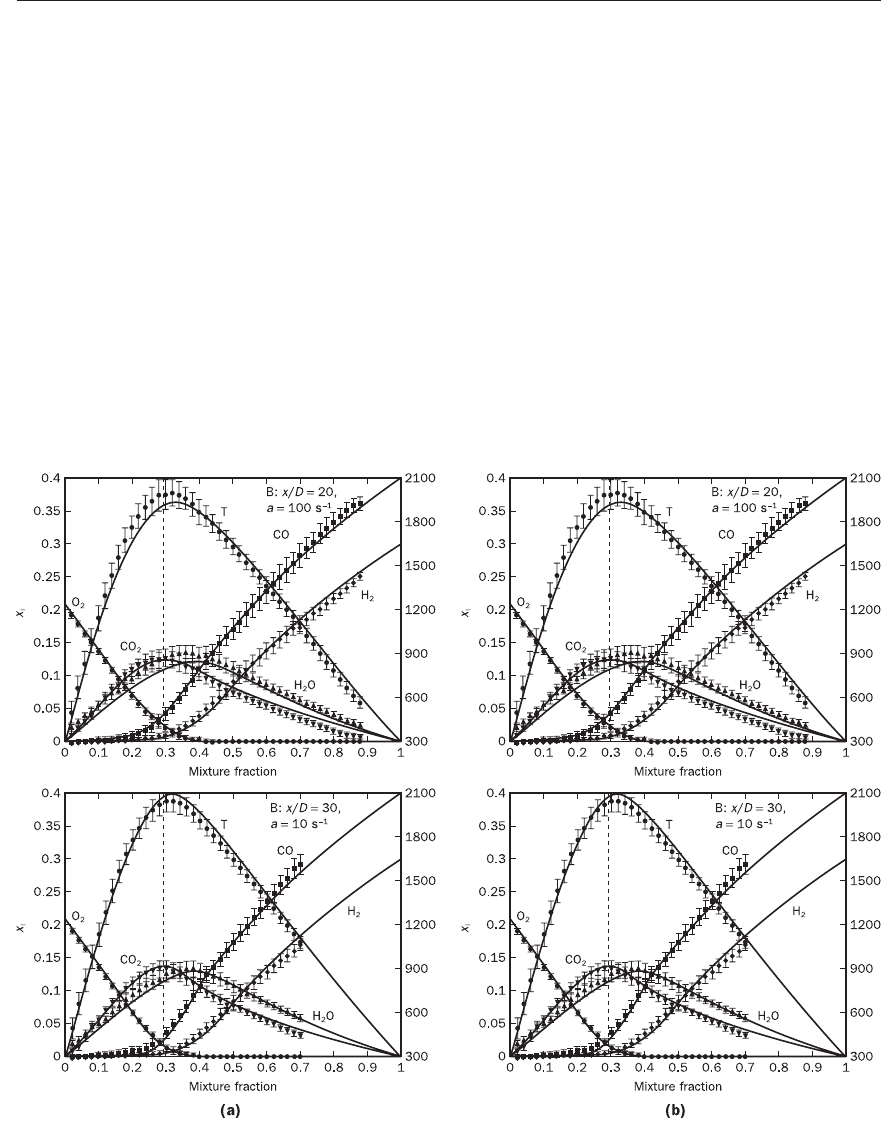
Figures 12.14a and b show the laminar flamelet relationships for tem-
perature and species mole fractions as functions of the mixture fraction.
Experimentally measured conditional mean and r.m.s. fluctuation values of
temperature and species mole fractions are shown as symbols and error bars,
respectively. The solid lines represent the calculation results. Figure 12.14a
shows the results obtained using the FlameMaster code and Figure 12.14b
shows the results obtained using the RUN-1DL code. It can be seen that
the two methods give remarkably similar results. The agreement between
flamelet profiles and experimental data is excellent at both locations and well
within the experimental error bars. The key inputs for the generation of a
flamelet library are the fuel composition and scalar dissipation rates or strain
rates. The locations and strain rates used here are those quoted by Barlow
et al. (2000). No attempt was made to find the most suitable strain rate for
a given dataset. The close match between the experimental and calculated
values clearly demonstrates the usefulness and accuracy of laminar flamelets
as a means of providing state relationships for combustion calculations in a
turbulent flame.
398 CHAPTER 12 CFD MODELLING OF COMBUSTION
Figure 12.14 Comparison of laminar flamelet relationships with experimental conditional means for temperature, CO
2
,
H
2
O, H
2
and CO for flame B of Barlow et al. (2000): (a) FlameMaster calculations; (b) RUN-1DL calculations
ANIN_C12.qxd 29/12/2006 04:44PM Page 398

12.26 STATISTICS OF THE NON-EQUILIBRIUM PARAMETER 399
In the laminar flamelet model, the thermochemical composition of the
turbulent flame is completely determined by two parameters: (i) the mixture
fraction
ξ
and (ii) a non-equilibrium parameter, the scalar dissipation rate
χ
. In turbulent flow fields, these parameters are statistically distributed. To
evaluate mean temperature, density and species mass fractions, it is therefore
necessary to know the statistical distribution of the mixture fraction and the
scalar dissipation rate in the form of a joint pdf G(
ξ
,
χ
). The mean scalar
variables are then evaluated from
É =
φ
(
ξ
,
χ
)G(
ξ
,
χ
)d
ξ
d
χ
(12.191)
In the current laminar flamelet model formulations, it is assumed that the
mixture fraction and the scalar dissipation rate are statistically independent.
This assumption simplifies the formulations, because the average value of a
scalar variable
φ
in a turbulent flow field is now given by
É =
φ
(
ξ
,
χ
)G(
ξ
)G(
χ
)d
ξ
d
χ
(12.192)
The pdf for mixture fraction is assumed to be a beta function. The pdf of the
scalar dissipation rate is assumed to be a log-normal function, an assump-
tion that is justified by experimental evidence presented in Effelsberg
and Peters (1988). Thus, the two independent pdfs are the beta pdf for the
mixture fraction
G(
ξ
) =
where parameters
α
and
β
are calculated using (12.157), and the log-normal
pdf for the scalar dissipation
G(
χ
) = exp − (ln
χ
−
µ
)
2
where the parameters
µ
and
σ
are related to the first and second moment of
χ
via
9 = exp
µ
+
σ
2
(12.193)
9″
2
= 9
2
[exp(
σ
2
) − 1] (12.194)
The variance 9″
2
is not available in this model. Therefore to obtain
µ
and
σ
it is necessary to specify 9. The mean scalar dissipation rate 9 is usually
modelled as
9 = C
χ
7″
2
(12.195)
ε
k
D
E
F
1
2
A
B
C
D
E
F
1
2
σ
2
A
B
C
1
χσ π
ξ
α
−1
(1 −
ξ
)
β
−1
Γ(
α
+
β
)
Γ(
α
)Γ(
β
)
1
0
∞
0
1
0
∞
0
2
π
Statistics of the
non-equilibrium
parameter
12.26
ANIN_C12.qxd 29/12/2006 04:44PM Page 399

400 CHAPTER 12 CFD MODELLING OF COMBUSTION
Here the model constant C
χ
is assigned a value of C
χ
= 2.0. The variance
σ
2
in the log-normal distribution is set equal to
σ
2
= 2.0. Further details of these
two model constants can be found in Peters (1984). By calculating 9 from
equation (12.195) and with the specified value of
σ
2
, the pdf G(
χ
) can be
evaluated.
A different expression proposed by Bray and Peters (1994) for the scalar
dissipation rate is
9 = C
χ
(∆
ξ
st
) (12.196)
With C
χ
= 2.0 and (∆
ξ
st
) as the range of mixture fraction values within which
the scalar dissipation process is concentrated, then (∆
ξ
st
) is an indication
of the thickness of the reaction zone. With the reaction zone centred at the
location
ξ
=
ξ
st
, the thickness of the reaction zone is approximated as
(∆
ξ
st
) ≈ 2
ξ
st
(12.197)
where
ξ
st
is the stoichiometric mixture fraction. This expression has proved
to be successful in predicting lift-off heights in jet flames.
To calculate the mean of a variable it is required to evaluate the integral
(12.192). Integration of the
β
-pdf was discussed before in section 12.20. The
same procedure applies here. Integration with the log-normal pdf G(
χ
) can
be carried out using the approximation of Lentini (1994). More details of
the origin and the theory of laminar flamelet models can be found in Peters
(1984, 1986), Bray and Peters (1994) and Veynante and Vervisch (2002).
NO
x
, SO
x
, heavy-metal compounds and particles are the main pollutants
formed in combustion. The amount and nature of pollutants formed depend
on the type of fuel, combustion equipment and temperatures used in the
combustion process.
Among the combustion gases:
•NO
x
and SO
x
contribute to acid rain and other environmental effects
•CO
2
contributes to the greenhouse effect
NO
x
is of particular concern:
• It has an impact on the formation of ozone
• It is linked to the formation of smog
• It is directly responsible for acid rain
• It has a considerable impact on human health since it causes conditions
such as acute respiratory diseases and respiratory infections
The species NO, NO
2
and N
2
O are collectively known as NO
x
and result
from two sources:
• Molecular N
2
(air)
• Fuel-bound nitrogen
Formation mechanisms of NO
x
in the combustion process are further
classified as follows:
ε
k
Pollutant
formation in
combustion
12.27
ANIN_C12.qxd 29/12/2006 04:44PM Page 400

12.28 MODELLING OF THERMAL NO FORMATION IN COMBUSTION 401
• Thermal NO
x
: This is formed by the direct reaction of molecular
nitrogen and oxygen at high flame temperatures, the formation of
which is described by the Zel’dovich mechanism. This will be
discussed further below.
• Prompt NO
x
: This is formed by oxidation of atmospheric nitrogen
in the flame front. Prompt NO
x
formation occurs by the reaction of
molecular nitrogen with hydrocarbon free radicals in oxygen-deficient
regions of the flame. The mechanism often used to describe prompt NO
formation is called the Fenimore (1970) mechanism, which considers
the rapid formation of NO long before the time required to form
thermal NO. More detailed description of the mechanism and further
details can be found in Turns (2000) and Kuo (2005).
• Fuel NO
x
: This arises due to the presence of nitrogen in the fuels
such as heavy oil and coal. Fuel NO
x
formation reactions are not well
understood. The principal reaction process appears to be devolatilisation
of fuel nitrogen, forming intermediate compounds such as NO, NO
2
,
NH
3
and HCN. Subsequent N
2
or NO formation depends strongly on
the fuel/air ratio. In general, a fuel with lower nitrogen content typically
produces less total NO
x
than a fuel with higher nitrogen content.
For further details see Kuo (2005).
In addition to these, there is a further route known as the N
2
O intermediate
mechanism, which is only important in high pressures. The relative contribu-
tion of different pathways depends on fuel type, temperature, pressure and
residence time. Out of these, thermal NO appears to be the main contributor
in most practical combustion situations. For a more detailed discussion of
NO
x
formation in combustion the reader is referred to Turns (1995, 2000),
Warnatz et al. (2001) and Kuo (2005).
Among the NO
x
components NO is the main pollutant. Thermal NO is
formed by N
2
in the air stream reacting with O
2
at high temperature. The
reaction mechanism of thermal NO formation is well known as the
Zel’dovich mechanism. The key reactions are
k
1
(1) O + N
2
bcg NO + N (12.198)
k
2
(2) N + O
2
bcg NO + O (12.199)
k
3
(3) N + OH bcg NO + H (12.200)
Forward and backward reaction rate constants for these three key reactions
are given in Table 12.4 (Turns, 2000).
Table 12.4
Forward reaction rate Backward reaction rate
Reaction
constant (m
3
/(kmol)(s)) constant (m
3
/(kmol)(s))
1 k
1, f
= 1.8 × 10
11
exp(−38370/T ) k
1,b
= 3.8 × 10
10
exp(−425/T )
2 k
2, f
= 1.8 × 10
7
T exp(−4680/T ) k
2,b
= 3.8 × 10
6
T exp(−20820/T )
3 k
1, f
= 7.1 × 10
10
exp(−450/T ) k
1,b
= 1.7 × 10
11
exp(−24560/T )
Modelling of
thermal NO
formation in
combustion
12.28
ANIN_C12.qxd 29/12/2006 04:44PM Page 401

Compare the reaction rate constant of reaction (1) with the reaction
rate constant of a typical intermediate combustion reaction H + O
2
bcg
OH + O (see section 12.10). This reaction has a forward reaction rate
constant of k
f
= 2.00 × 10
14
exp(−70.3/T )cm
3
/mol.s (see Kuo, 2005), requir-
ing an activation energy of −585 kJ/kmol. Reaction (1) of the above mech-
anism by contrast has a very high activation energy (E
a
=−319027 kJ/mol)
and is sufficiently fast only at high temperatures. It has the slowest rate of the
reaction in the Zel’dovich mechanism and therefore it is the rate-limiting
reaction in the formation of NO. Because of this high-temperature depend-
ence it is a common practice to assume that the thermal NO mechanism is
unimportant below 1800 K. Thermal NO reactions (1)–(3) are much slower
than other combustion reactions, so NO formation takes too long to achieve
equilibrium. Hence, NO concentrations cannot be calculated using equilib-
rium chemistry. The rate of conversion is governed by the gas temperature
(exponentially), residence time of the gas in high-temperature regions, and
excess air levels (affecting oxygen availability). The use of laminar flamelet
concepts for combustion assumes relatively fast chemistry. Even in the
absence of other NO production mechanisms the inclusion of the above
NO equations in a laminar flamelet library calculation does not produce
experimentally observed NO levels (see Drake and Blint, 1989; Sanders and
Gökalap, 1995; Vranos et al., 1992). Laminar flamelet modelling of thermal
NO requires some special treatment, which is explained below. As noted
above, the other two principal mechanisms of NO formation are prompt
(or Fenimore) NO formation and fuel-bound NO formation. These are not
included in the method outlined below.
As explained earlier, attempts to obtain concentrations of thermal NO from
a flamelet library can be inaccurate. One way around this problem is to
include an accurate account of the effects of residence time on NO formation
by using the Zel’dovich mechanism in conjunction with a transport equation
for the mass fraction of NO:
(4J
NO
) + (4U
j
J
NO
) =+N
NO
(12.201)
where
σ
NO
is the turbulent Schmidt number, usually assigned a value of
0.7. The average source term N
NO
of the transport equation represents
the mean rate of production of NO, which can be evaluated using the pdf
approach:
N
NO
= 4M
NO
(
ξ
,
χ
)G(
ξ
)G(
χ
)d
ξ
d
χ
(12.202)
where G(
ξ
) and G(
χ
) are pdfs introduced in section 12.26. The NO source
term M
NO
(
ξ
,
χ
) can be generated using the rate constants of equations
(12.198)–(12.200) and (12.69) and (12.71). It is stored in the laminar flamelet
library alongside the flamelet relationships for temperature T(
ξ
,
χ
) and
species mass fraction Y
i
(
ξ
,
χ
).
1
0
∞
0
D
E
F
∂
J
NO
∂
x
j
µ
eff
σ
NO
A
B
C
∂
∂
x
j
∂
∂
x
j
∂
∂
t
402 CHAPTER 12 CFD MODELLING OF COMBUSTION
Flamelet-based
NO modelling
12.29
ANIN_C12.qxd 29/12/2006 04:44PM Page 402
12.30 AN EXAMPLE 403
We consider an experimental flame configuration for which a set of well-
documented experimental data is available and show the predictions of
temperature, major and minor species and NO using the laminar flamelet
calculation methodology explained in the above sections. The problem
considered here is the bluff-body CH
4
/H
2
flame experimentally studied by
Dally et al. (1996, 1998b). This experimental flame is designated as HM1 in the
dataset. The experimental data were provided by Masri (1996) via the Sydney
University website. The bluff body considered here has an outer diameter of
D
B
= 50 mm and a concentric fuel jet diameter of D
j
= 3.6 mm. The fuel com-
position is 50% by volume CH
4
and 50% by volume H
2
. The mean velocity
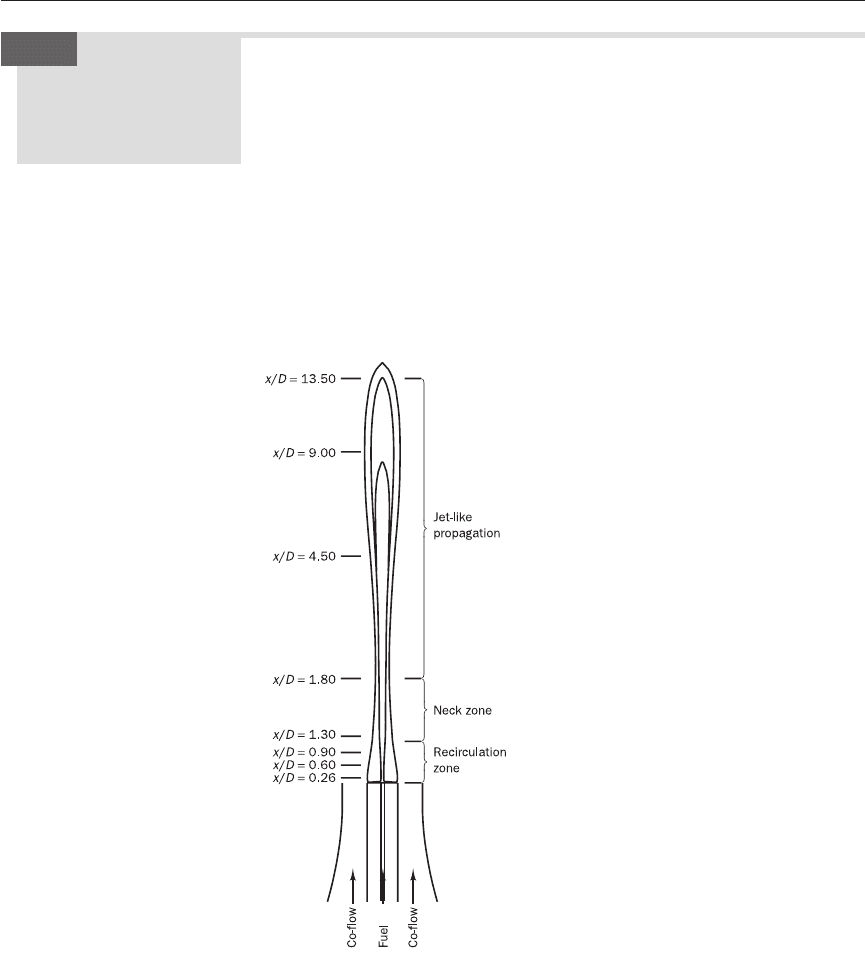
of the fuel jet is 118 m/s and the mean air velocity is 40 m/s. A schematic
diagram of the flame and important zones is shown in Figure 12.15. Further
experimental details are available in the aforementioned references.
Figure 12.15 Schematic
drawing of the bluff body
stabilised flame and measurement
locations
Computational details
The governing differential equations (continuity, momentum, turbulence
variables k and
ε
, mixture fraction, mixture fraction variance) were solved in
Favre-averaged form by means of an in-house finite volume code based on
the SIMPLE algorithm. The k–
ε
turbulence model was used for turbulence
closure. In section 3.7.2 it was noted that the standard k–
ε
model overpredicts
the decay rate and the spreading rate of a round jet. Several modifications to
An example to
illustrate laminar
flamelet modelling and
NO modelling of a
turbulent flame
12.30
ANIN_C12.qxd 29/12/2006 04:44PM Page 403
the k–
ε
model are available for correcting this problem (McGuirk and Rodi,
1979; Pope, 1978). In this study the value of constant C
1
ε
in the
ε
-transport
equation is modified from 1.44 to 1.60 following the work of Dally et al.
(1998b) and Hossain et al. (2001). Following the International Workshop
on Measurements and Computations of Turbulent Nonpremixed Flames
(TNF) this modification is now recommended practice for modelling bluff-
body flames.
The computational domain has a size of 170 mm in the radial direction
and 216 mm in the axial direction. A grid arrangement with 89 radial and 99
axial nodes was used in all the calculations presented here. Sensitivity tests
were carried out to establish that the grid was sufficiently fine to give accur-
ate results. A fully developed velocity profile was specified as the boundary
condition at the air and fuel inlets.
Prediction of flame structure
The laminar flamelet library for different scalar dissipation rates was generated
using the RUN-1DL program mentioned earlier. The calculations presented
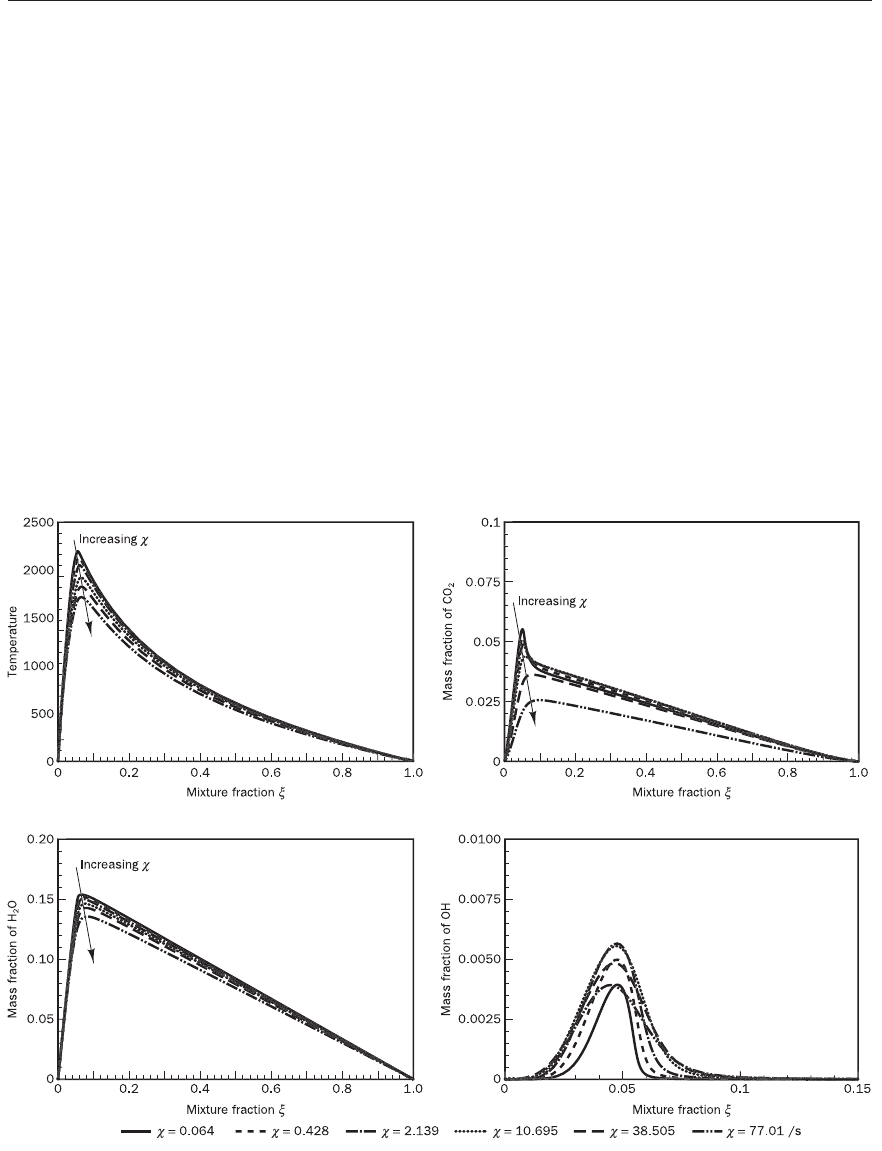
here have been performed using unity Lewis number. Figure 12.16 shows
examples of the laminar flamelet relationships for temperature, CO
2
, H
2
O
and OH mass fractions. Turbulent combustion calculations are carried out
404 CHAPTER 12 CFD MODELLING OF COMBUSTION
Figure 12.16 A sample of laminar flamelet profiles
ANIN_C12.qxd 29/12/2006 04:44PM Page 404
12.30 AN EXAMPLE 405
by following the methodology explained in sections 12.25 and 12.26. Local
values of the scalar dissipation rate were obtained using the approximate
relationship (12.196)–(12.197). The library stores relationships at discrete
values of scalar dissipation rate
χ
. Local values of
χ
are likely to be inter-
mediate between those of the library. The appropriate flamelet relationships
required in the calculation process are obtained by linear interpolation of
values from neighbouring library look-up tables.
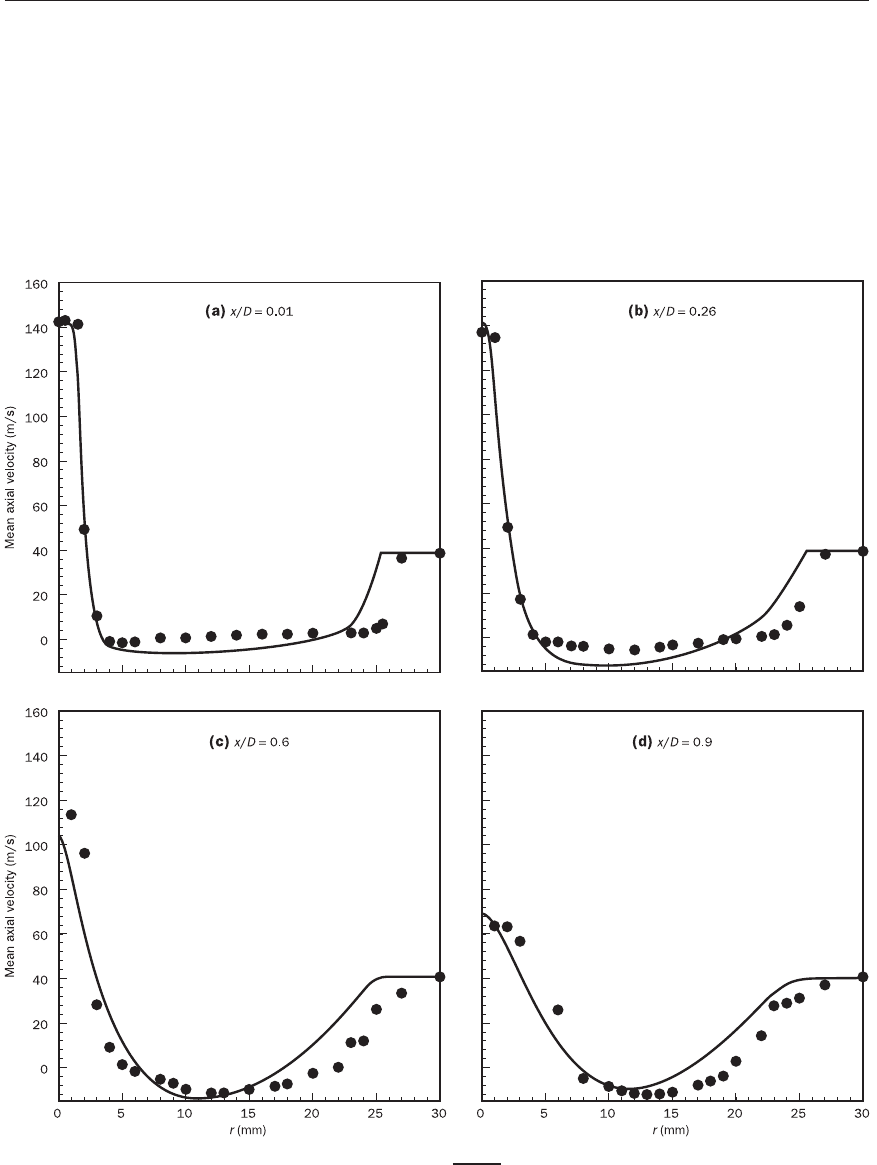
To illustrate the effectiveness of the laminar flamelet model we present in
Figures 12.17–12.26 a comparison of numerical predictions with a selection
of experimental data in the near field of the burner (i.e. in the region closest
Figure 12.17 Mean axial velocity profiles:
•
, measurements; , calculations
ANIN_C12.qxd 29/12/2006 04:44PM Page 405
to the inlets). To start, we note that it is essential that the flow field is
adequately represented in the simulation, because the mixture fraction stat-
istics completely determine the thermochemical state of the flame. It is even
more important for this CH
4
/H
2
flame, because it has a low stoichiometric
mixture fraction (
ξ
st
= 0.05). As a result, a small error in the flow field will
lead to a large error in temperature, species concentrations and location of
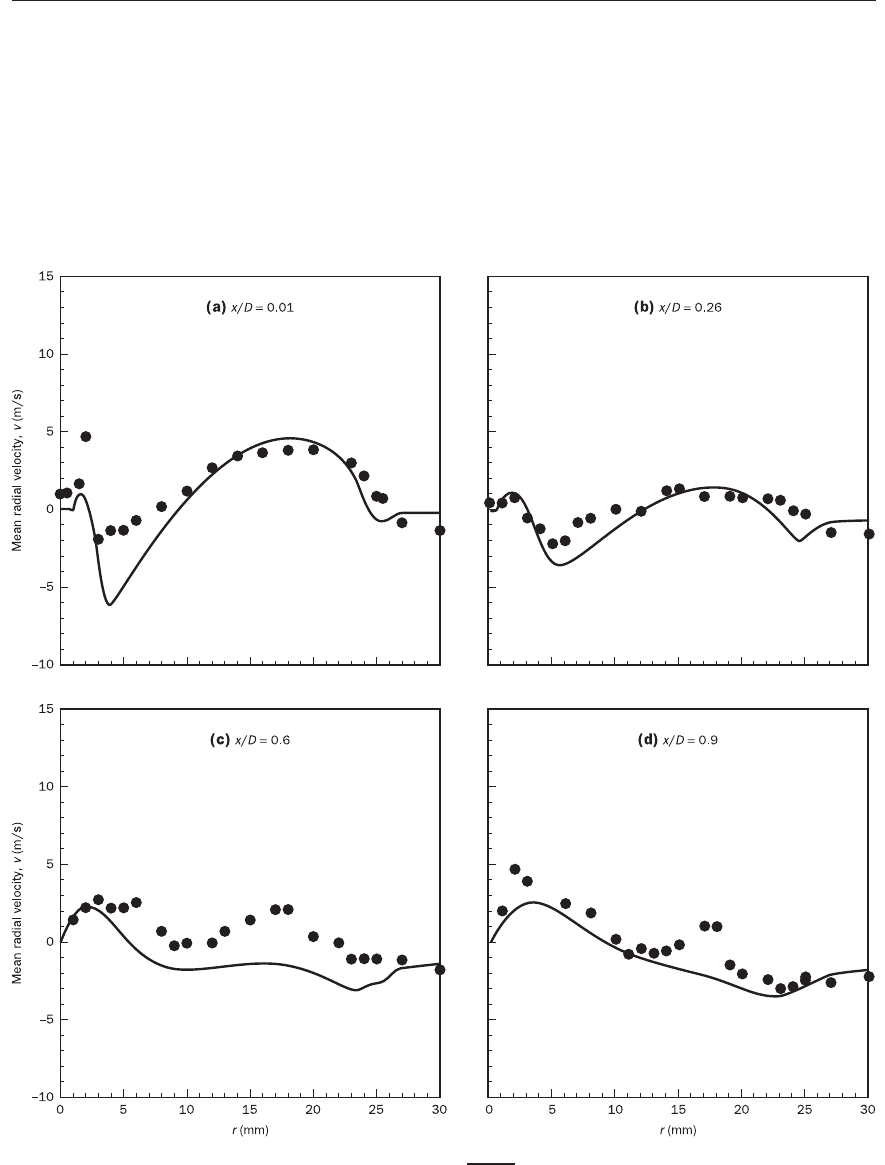
the flame front. Figures 12.17 and 12.18 show a comparison between mea-
sured and computed radial profiles of mean axial and radial velocities plotted
at different near-field locations. The mean axial velocity measurements are
406 CHAPTER 12 CFD MODELLING OF COMBUSTION
Figure 12.18 Mean radial velocity profiles:
•
, measurements; , calculations
ANIN_C12.qxd 29/12/2006 04:44PM Page 406