
Versteeg H., Malalasekra W. An Introduction to Computational Fluid Dynamics: The Finite Volume Method
Подождите немного. Документ загружается.


Conduction, convection and radiation are the three modes of heat transfer.
In previous chapters we have seen how problems involving multi-dimensional
conductive and convective heat transfer can be solved using CFD.
Conduction-only problems are simply dealt with by solving the heat conduc-
tion equation, i.e. diffusion equation (4.1). When fluid flow is involved the
resulting convective heat transfer problem is solved by tackling the enthalpy
equation (2.27) alongside the Navier–Stokes equations (2.32a–c) and the
continuity equation (2.4). The boundary conditions for the enthalpy equation
take care of heat transfer into and out of the computational domain across its
boundaries. The internal distribution of heat source and sink processes and
the transport of heat by means of diffusion and convection determine the
enthalpy distribution due to fluid flow.
The third mechanism of heat transfer – thermal radiation – is caused
by energy emission in the form of electromagnetic waves or streams of
photons. Radiative energy sources emit a broad-band spectral distribu-
tion with maximum energy content at a wavelength that is determined by
the source temperature. Most engineering systems emit thermal radiation at
infrared wavelengths (0.7–100 µm). The peak wavelength of sources at room
temperature will be around 10 µm, whereas an increasing fraction of the
radiation will be emitted at visible wavelengths when the source temperature
exceeds 1000–1500 K.
Engineering problems with significant radiation effects
Radiative heat transfer is often neglected in CFD calculations, because the
majority of engineering problems are dominated by high rates of convective
heat transfer. There are, however, several practically important categories
of problems where radiative heat transfer should be considered. Three pro-
minent examples are:
1 Manufacturing processes involving lasers or other high-energy beams:
these involve exposure of materials to radiation with very high energy
density. The radiative heat input will dominate these problems.
2 Combustion equipment: there is usually vigorous convection in
combustors, but the chemical reactions generate operating temperatures
that are sufficiently high for radiative heat fluxes to be of similar order
of magnitude.
3 Naturally ventilated spaces in buildings: the temperatures are low so
radiative heat fluxes are modest but comparable in size with convective
heat fluxes since buoyancy-driven flow velocities are often small.
Chapter thirteen Numerical calculation of
radiative heat transfer
Introduction13.1
ANIN_C13.qxd 29/12/2006 04:49PM Page 417

All these problems involve combined-mode or conjugate heat transfer: coupled
radiation and conductive heat transfer or, if fluid flow occurs, coupled radi-
ation, conductive and convective heat transfer. Laser-based material proces-
sing falls within the complex category of free boundary problems with phase
change. We do not discuss these further. In this section we focus on coupled
radiation/CFD problems in enclosures or flow domains with fixed bound-
aries. Radiation acts to redistribute energy through interactions within the
fluid, through radiative exchanges between boundary surfaces, and through
interactions between the surfaces and the fluid.
Definitions
We give a selection of basic facts and definitions of radiative heat transfer
needed to support our review of the main solution algorithms.
The emitted radiative heat flux is a strong function of the temperature
of the substance. Materials at higher temperature will emit more radiation.
The rate of heat flow per unit surface area emitted by a radiating surface is
called its emissive power E (units W/m
2
). For a so-called black body the
emissive power is related to its temperature by E
b
=
σ
T
4
, where
σ
= 5.67 × 10
−8
(W/m
2
.K
4
) is Stefan–Boltzmann’s constant and T is absolute temperature (K).
The incident radiative heat flux at a certain location varies as a
function of orientation of the receiver relative to the radiation source. The
intensity I (units W/m
2
.sr) is the rate of heat flow received per unit area
perpendicular to the rays and per unit solid angle (steradians = sr), and is a
quantity with a magnitude that will vary with direction.
The black-body emissive power E
b
=
σ
T
4
can also be expressed as a (non-
directional) black-body intensity using I
b
= E
b
/
π
=
σ
T
4
/
π
. The black-body
intensity is used to compute the emitted intensity from surfaces and fluids.
Surface properties
The emissive power of an ideal black surface is, of course, given by E
s
=
σ
T
s
4
,
where T
s
is the surface temperature. Real surfaces usually emit less radiative
heat. The ratio of the heat flux emitted by a real surface and a black surface
at the same temperature is called the surface emissivity
ε
. Hence, the emis-
sive power of a real surface with surface emissivity
ε
is given by E
s
=
εσ
T
s
4
.
The (non-directional) emitted intensity I
s
of a real surface is the product
of its surface emissivity and the black-body intensity: I
s
=
ε
I
b
=
εσ
T
s
4
/
π
.
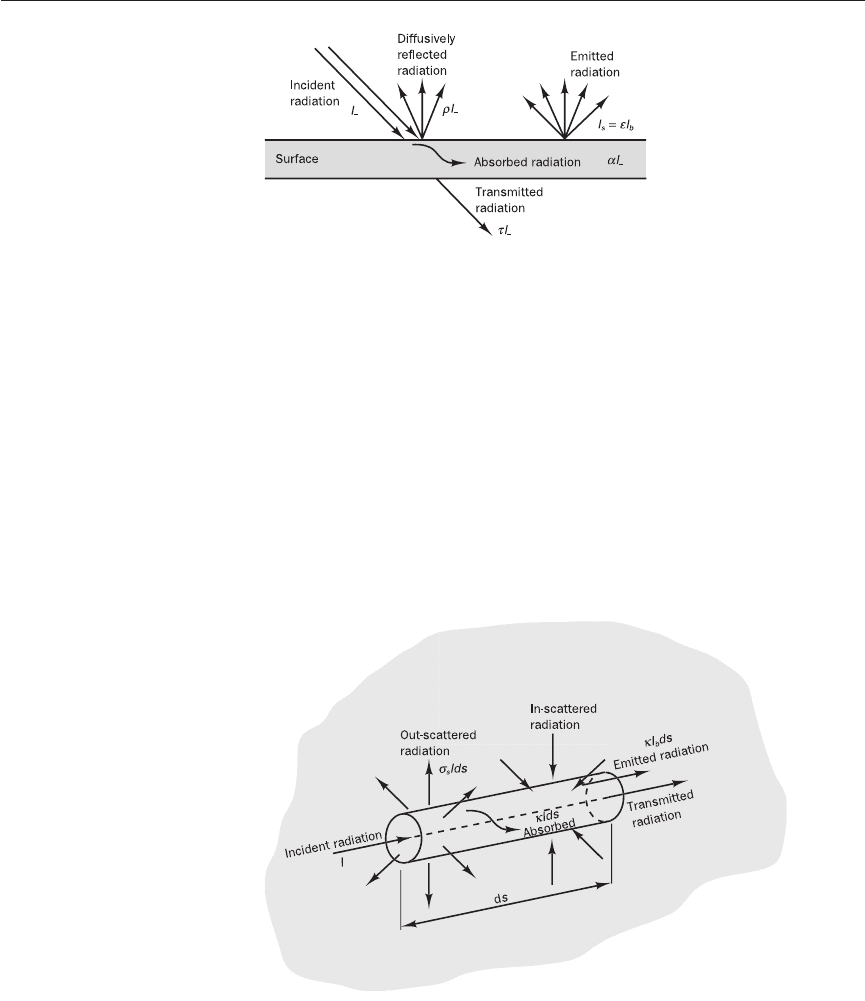
Figure 13.1 shows that surfaces interact with incident radiation in three
ways. The incident radiation can be (i) absorbed, (ii) reflected or (iii) trans-
mitted. The fraction absorbed is denoted by
α
, the fraction reflected by
ρ
and the fraction transmitted by
τ
. Of course, the sum of the absorbed,
reflected and transmitted fractions equals unity:
α
+
ρ
+
τ
= 1. In many
coupled CFD/radiation problems the surfaces will be (i) opaque, so
τ
= 0,
and (ii) diffusely reflecting, i.e. the reflected radiation leaves the surface in
all directions irrespective of the incident angle of the incoming radiation.
Real surfaces may have different properties, e.g. non-zero transmissivity
τ
or specular reflection (equal angle between surface normal and incident and
reflected radiation). All the surface properties are dependent on the type of
material, the surface roughness and the presence of surface contaminants,
as well as the temperature, and surface properties may also depend on the
direction and wavelength of the incident radiation.
418 CHAPTER 13 CALCULATION OF RADIATIVE HEAT TRANSFER
ANIN_C13.qxd 29/12/2006 04:49PM Page 418
13.1 INTRODUCTION 419
Fluid properties
We have noted before that air is transparent to the infrared radiation typically
associated with room temperature. The species present in clean atmospheric
air do not absorb readily at these wavelengths, and this fluid medium will
not participate in the radiative heat exchanges. Products of combustion reac-
tions, on the other hand, contain large amounts of carbon dioxide and water
vapour, which are both strong absorbers/emitters in the infrared part of the
spectrum. Moreover, scattering may occur under certain conditions if a com-
bustion reaction produces particulate matter in the form of soot, or if the fuel
is in the form of solid particles. Thus, in combusting flows incident radiation
is absorbed, transmitted and/or scattered and radiation may be emitted (see
Figure 13.2). In such cases the fluid is termed a participating medium.
Figure 13.1 Radiation processes
at a surface
Figure 13.2 Schematic of
a pencil of ray in a medium
subjected to emission,
absorption, scattering and
transmission processes.
The strength of the interactions between a participating fluid medium
and radiation can be measured in terms of its absorption coefficient
κ
and its scattering coefficient
σ
s
, both of which have units m
−1
. The sum of
these two properties is called the extinction coefficient
β
=
κ
+
σ
s
. The
emitted intensity I
f
of a participating fluid medium is the product of the
absorption coefficient and the black-body intensity: I
f
=
κ
I
b
=
κσ
T
f
4
/
π
,
ANIN_C13.qxd 29/12/2006 04:49PM Page 419

where T
f
is the fluid temperature. The distribution of emitted intensity by
a point radiation source in a participating fluid medium is uniform in all
directions, but the scattered intensity is generally not. The distribution of
the latter can described by the so-called scattering phase function Φ(s
i
, s),
which is defined as the fraction of radiation incident upon the medium
along direction vector s
i
, which is subsequently scattered in direction s. The
absorption coefficient, scattering coefficient and the scattering phase function
are properties of the participating medium. The absorption coefficient
κ
will depend on the fluid temperature and species concentrations and may
also depend on pressure. The scattering coefficient
σ
s
and the scattering
phase function Φ(s
i
, s) depend on the size, concentration, shape and
material characteristics of suspended particulate matter in the fluid. All these
radiative properties generally have a complex wavelength dependence.
The nature of coupled CFD/radiation problems
Radiation can be considered as an electromagnetic wave phenomenon.
Therefore, the propagation speed of thermal radiation is the speed of light,
which, at 3 × 10
8
m/s, is at least 10
5
times as fast as the speed of sound of
common fluids encountered in engineering problems. This large separation
of the velocity scales means that radiative heat exchanges are always in
quasi-steady state. This means that radiation propagates sufficiently fast to
effectively adjust itself immediately to variations in flow conditions and/or
boundary conditions.
There is no direct coupling between radiation and the flow field, since
radiation or radiation properties of fluids and boundaries do not depend
directly on the fluid velocity. However, the flow field influences the spatial
distributions of temperature and species concentration. These determine the
intensity of radiation emitted by boundary surfaces and participating fluids
as well as the radiation properties of a participating medium. This ensures
that there is strong indirect coupling between the flow field and radiation
environment, which is particularly important in combustion problems where
product species are at high temperature. We now review the consequences
for CFD of these coupling effects:
1 If the fluid is absorbing/emitting and/or scattering there will be an
additional radiation source term in the energy equation
2 Radiation effects will cause changes in the boundary conditions of the
energy equation
Radiation source term in energy equation
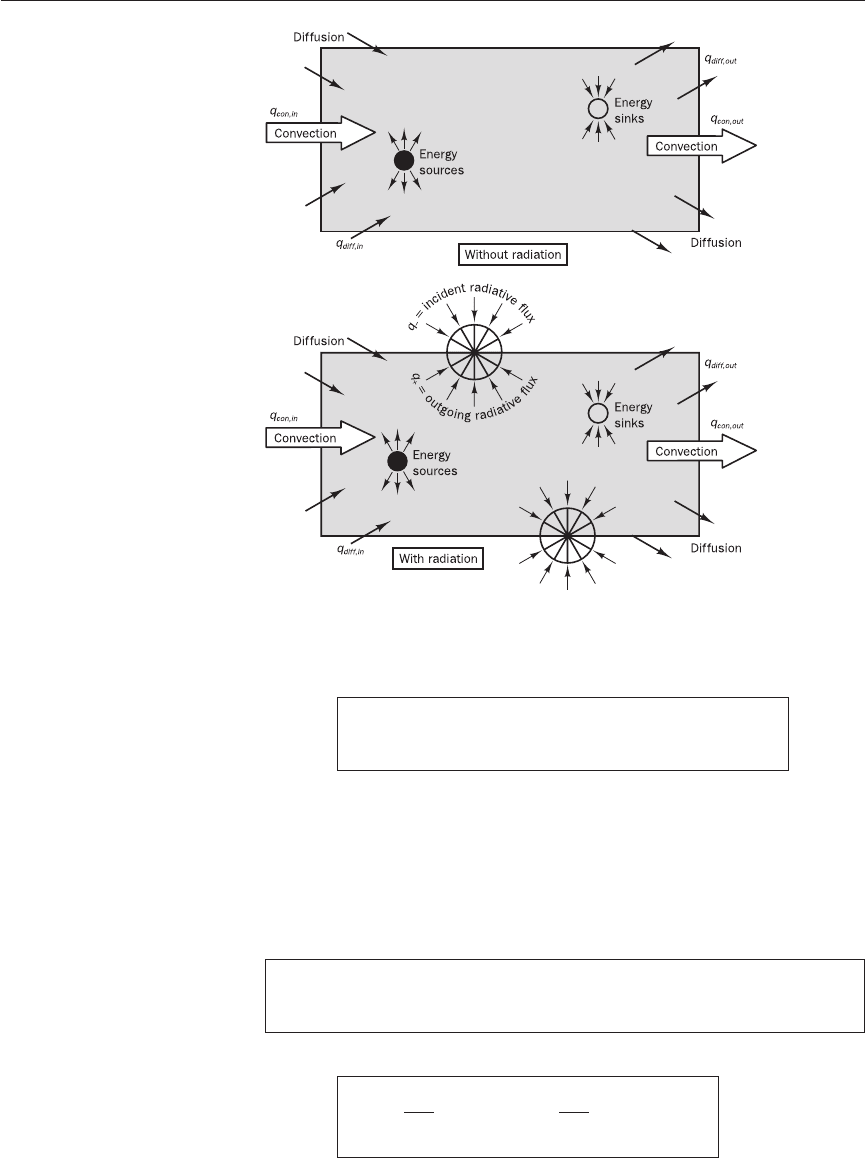
In a steady flow without radiation there is a balance within each fluid control
volume between the sources and sinks of energy on the one hand and diffu-
sive and convective fluxes across the boundaries on the other hand (see
Figure 13.3). Depending on the radiative properties of the fluid inside the
control volume, it may absorb, emit and/or scatter radiation. When these
effects are significant there will be additional heat fluxes across the control
volume boundaries due to radiation. The net radiative heat flux into or out
of the control volume will appear in the energy equation as a source or sink,
respectively.
Thus, the steady flow energy balance for the control volume in the two
cases is as follows:
420 CHAPTER 13 CALCULATION OF RADIATIVE HEAT TRANSFER
ANIN_C13.qxd 29/12/2006 04:49PM Page 420
13.1 INTRODUCTION 421
Figure 13.3 Heat fluxes and
sources for a fluid control volume
without and with radiation
Without radiation: S
h
dV = q
conv
. n dA + q
diff
. n dA (13.1a)
Net energy Net convective Net diffusive
source in CV = flux across + flux across
boundaries boundaries
With radiation: S
h
dV + S
h,rad
dV
= q
conv
. n dA + q
diff
. n dA + q
rad
. n dA (13.1b)
Non-radiative Net radiative Net Net Net radiative
energy source + energy source = convective + diffusive + flux across
in CV in CV flux flux boundaries
So
D
h,rad
= q
rad
. ndA = (q
−
− q
+
)dA (13.1c)
where D
h,rad
is the net radiative source per unit volume for the energy equation.
A
1
∆V
A
1
∆V
A
A
A
CV
CV
A
A
CV
ANIN_C13.qxd 29/12/2006 04:49PM Page 421
422 CHAPTER 13 CALCULATION OF RADIATIVE HEAT TRANSFER
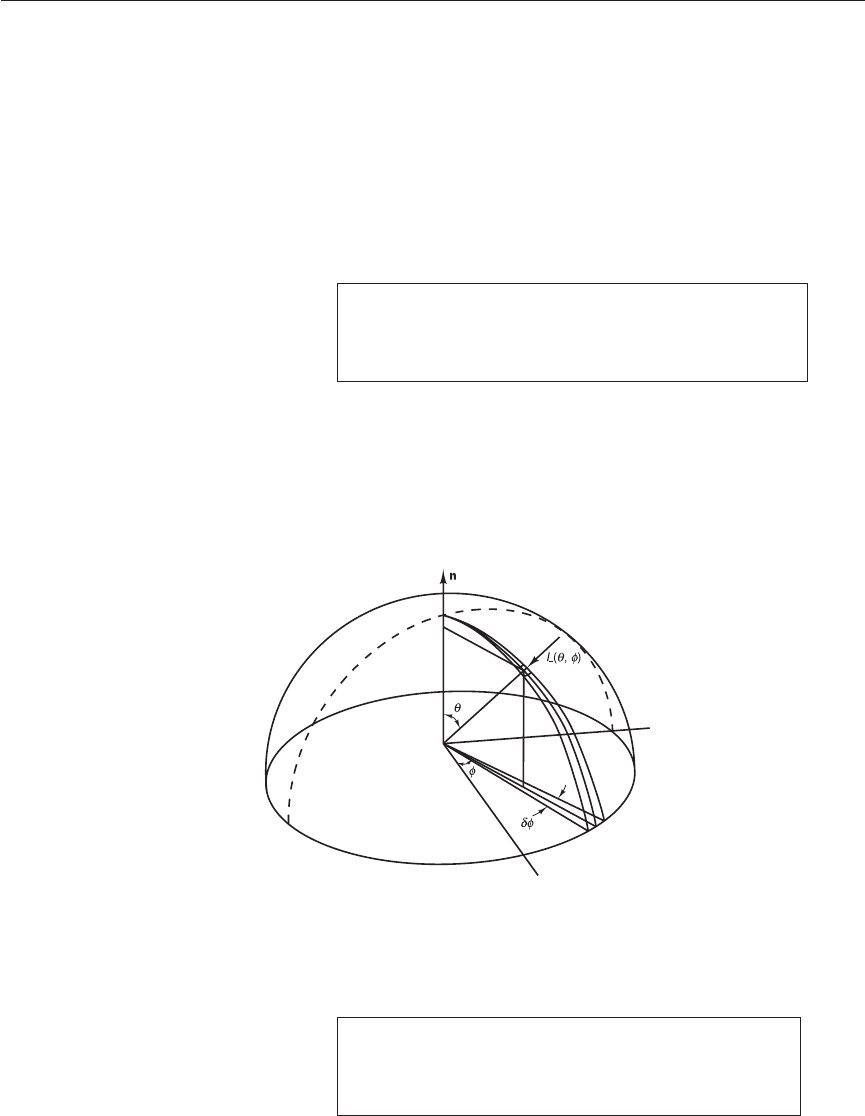
Figure 13.4 Angular notation
for equation (13.2), incoming
radiative flux
In (13.1c) the net radiative heat flux q
rad
. n at a point on the control
volume boundary has been written as the difference between the incident
radiative heat flux q
−
and the outgoing heat flux q
+
. The integral of the
difference q
−
− q
+
over the bounding surface of the control volume gives the
net radiative heat flux into the control volume to obtain the net radiative heat
source for the energy equation. To obtain the incident heat flux q
−
at a point
it is necessary to integrate the intensity, which varies with direction, and hence
we must consider all possible incoming ray directions. It can be shown (Modest,
2003) that this can be written as an integration over a unit hemisphere
(i.e. over a solid angle of 2
π
steradians) surrounding the point just outside the
control volume boundary (indicated as a semi-circle in Figure 13.3). So,
q
−
= I
−
(s) s.ndΩ= I
−
(
θ
,
φ
) cos(
θ
) sin(
θ
) d
θ
d
φ
(13.2)
The dot product s.nin the first integral ensures that we consider the
component of the incident radiative heat flux vector in the direction of
the outward surface normal n. We note that the swap of argument of the
incident intensity I
−
from ray direction vector s to angular co-ordinates
(
θ
,
φ
) is simply a matter of notation. The co-ordinate system is illustrated
in Figure 13.4.
π
/2
0
2
π
0
2π
To obtain the outgoing radiative heat flux q
+
we integrate over all pos-
sible ray directions pointing outwards at the point. This corresponds to an
integration over a unit hemisphere (indicated as a semi-circle in Figure 13.3)
surrounding the point just inside the control volume boundary. So,
q
+
= I
+
(s) s.ndΩ= I
+
(
θ
,
φ
) cos(
θ
) sin(
θ
) d
θ
d
φ
(13.3)
I
+
(s) and I
+
(
θ
,
φ
) represent the outgoing intensity of radiation in the direc-
tion of vector s corresponding to angular direction (
θ
,
φ
). The limits in the
π
π
/2
2π
0
2
π
ANIN_C13.qxd 29/12/2006 04:49PM Page 422
13.1 INTRODUCTION 423
θ
-integration have been adjusted to indicate the unit hemisphere just inside
the control volume with outward-pointing radiation rays.
The effect of radiation on boundary conditions
Without radiation there is a balance between the conductive and/or convec-
tive heat fluxes at the interface that constitutes the imaginary boundary
between two materials. Radiation will cause an additional heat flux towards
the interface due to incident radiation and an extra outgoing heat flux asso-
ciated with emission of radiation.
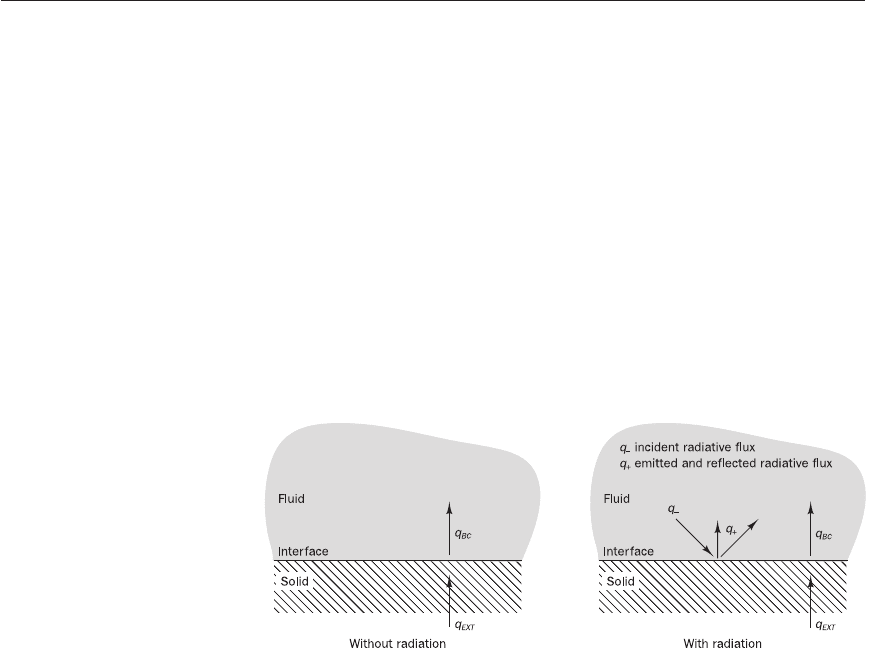
The overall heat balance for the interface between the fluid and the
boundary states that the heat flux out of the interface must be equal to the
heat flux into the interface. Thus, as illustrated in Figure 13.5,
Without radiation: q
BC
= q
EXT
(13.4a)
With radiation: q
BC
+ q
+
= q
EXT
+ q
−
⇒ q
BC
= q
EXT
+ (q
−
− q
+
) (13.4b)
Figure 13.5 Boundary
conditions with and without
radiation
Both the incident radiative heat flux q
−
and the outgoing radiative
heat flux q
+
, which is the sum of emitted and reflected heat fluxes, depend
on the intensity of the radiation. To obtain the incident heat flux at a point
on the surface we use equation (13.2) with the surface normal n pointing into
the fluid region.
The outgoing radiative heat flux is given by
q
+
=
ε
E
s
+ (1−
ε
)q
−
=
εσ
T
s
4
+ (1 −
ε
)q
−
(13.5)
The first term on the right hand side is the emitted heat flux and the second
term is the reflected heat flux. The latter is just equal to the fraction (1 −
ε
)
times the incident heat flux q
−
in the case of diffuse reflection. The corres-
ponding non-directional intensity of the outgoing radiation is
I
+
= q
+
/
π
= [
εσ
T
s
4
+ (1 −
ε
)q
−
]/
π
(13.6)
If we use a fixed temperature boundary condition, we need to bear in mind
that the net radiative heat flux q
−
− q
+
will vary across the boundary surfaces.
Radiation problems always involve combined-mode heat transfer, and surface
locations experiencing positive values of q
−
− q
+
are likely to heat up com-
pared with areas with zero or negative q
−
− q
+
. Similarly, if we use a heat flux
boundary condition, a CFD computation requires us to specify the heat flux
into the fluid q
BC
, but it is generally more convenient to specify the external
heat flux q
EXT
. As we can see in the interface heat balance, q
BC
= q
EXT
for a
ANIN_C13.qxd 29/12/2006 04:49PM Page 423

424 CHAPTER 13 CALCULATION OF RADIATIVE HEAT TRANSFER
flow without radiation. In an environment with radiation, however, the heat
flux going into the fluid q
BC
at a boundary point will be different from the
external heat flux q
EXT
by an amount equal to the local net radiative heat
flux q
−
− q
+
. These remarks serve to emphasise that completely accurate
specification of surface boundary conditions is difficult without a priori
knowledge of the radiation environment.
The incident intensity I
−
and the outgoing intensity I
+
, which are needed in
equations (13.2) and (13.3) for the radiative heat fluxes, need to be computed
from the governing equation of radiative transfer. The general relationship
that governs the changes in intensity at a point along a radiation ray due to
emission, absorption and scattering in a fluid medium is as follows (Modest,
2003):
=
κ
I
b
(r) −
κ
I(r, s) −
σ
s
I(r, s) + I
−
(s
i
) Φ(s
i
, s) dΩ
i
(13.7)
Rate of change of Emitted Absorbed Out-scattered In-scattered
intensity per unit = intensity − intensity − intensity + intensity
path length
where I(r, s) is the radiation intensity at a given location indicated by
position vector r, in the direction s within a small pencil of rays, travelling
through a participating medium (see Figure 13.2 and Modest, 2003). The
in-scattering integral on the right hand side of equation (13.7) accounts for
the effect of intensity I
−
(s
i
) incident upon the point at r from all possible
directions s
i
. This involves integration over a unit sphere (i.e. a solid angle of
4
π
steradians) surrounding the point in the medium.
The absorbed and out-scattered intensity are often drawn together by
defining the extinction coefficient
β
=
κ
+
σ
s
as the sum of the absorption
coefficient and the scattering coefficient. Thus,
=
κ
I
b
(r) −
β
I(r, s) + I
−
(s
i
) Φ(s
i
, s)dΩ
i
(13.8)
This is the radiative transfer equation (RTE), which governs radiative heat
transfer along a ray path indicated by the direction vector s. If the incident
intensity field for the in-scattering integral (last term on the right hand side
of the RTE) is somehow known, the RTE is a first-order ordinary differen-
tial equation.
Many computational algorithms for radiative heat transfer proceed to
simplify the radiative transfer equation by introducing non-dimensional
optical co-ordinates:
τ
= (
κ
+
σ
s
)ds′=
β
ds′ (13.9)
s
0
s
0
4
π
σ
s
4
π
dI(r, s)
ds
4
π
σ
s
4
π
dI(r, s)
ds
Governing
equations of
radiative heat transfer
13.2
ANIN_C13.qxd 29/12/2006 04:49PM Page 424

13.2 GOVERNING EQUATIONS OF RADIATIVE HEAT TRANSFER 425
and the single scattering albedo
ω
defined as
ω
== (13.10)
The radiative transfer equation can be re-written as
=−I(
τ
, s) + (1 −
ω
)I
b
(
τ
) + I
−
(s
i
) Φ(s
i
, s)dΩ
i
(13.11)
Finally, we introduce the source function, which is defined as follows:
S(
τ
, s) = (1−
ω
)I
b
(
τ
) + I
−
(s
i
) Φ(s
i
, s)dΩ
i
(13.12)
This enables us to write the radiative transfer equation in a form with a very
simple appearance:
+ I(
τ
, s) = S(
τ
, s) (13.13)
Boundary conditions
Equation (13.8) or (13.13) is solved by integration along ray paths starting
at the boundaries of the computational domain, which requires initial con-
ditions on these surfaces. For a point on a diffusely emitting and reflecting
opaque surface located at position vector r
w
we use expression (13.6) to
obtain the initial condition of a ray propagating along direction vector s:
I(r
w
, s) =
ε
I
b
(r
w
) + I
−
(r
w
, s
i
)n.s
i
dΩ
i
(13.14)
This is the most widely used boundary condition in combustion-related
radiative transfer problems. Expressions for other possible boundary condi-
tions can be found in Modest (2003).
Incident intensity integrals
The RTE (13.8) and boundary condition (13.14) contain integrals of intensity
over a sphere and hemisphere, respectively. To evaluate these it is necessary
to know the integrands beforehand as a function of the direction of the incid-
ent radiation. Since the incident intensity integrals are unknown and must
be solved alongside the intensity along an RTE ray path, equation (13.8) is
not an ordinary differential equation but actually an integro-differential
equation. This type of equation is clearly very different in nature from the
transport equations we have seen before. This requires solution of RTEs
along all the relevant ray paths, so the transport of heat by radiation is always
three-dimensional. Moreover, radiative transfer is heavily dependent on the
2
π
(1 −
ε
)
2
π
dI(
τ
, s)
d
τ
4
π
ω
4
π
4
π
ω
4
π
dI(
τ
, s)
d
τ
σ
s
β
σ
s
κ
+
σ
s
ANIN_C13.qxd 29/12/2006 04:49PM Page 425

geometry. Therefore, the calculation of radiative heat transfer requires an
approach that is quite different from the finite volume method we have dis-
cussed elsewhere in this book. We will discuss the most prominent general-
purpose solution algorithms in the next section.
Exact analytical solutions of the RTE are not available except in a small
number of idealised cases. In most practical problems further simplification
of the transfer equation is not possible. In particular, the boundary conditions
are dictated by the problem geometry, and full three-dimensional effects and
all angular directions must be considered in solving the transfer equation.
Before we discuss the details of solution methods we examine the RTE and
boundary conditions to gain insight into some of the general features of
likely solution procedures. First, we note that the incident intensity integrals
in (13.2) and (13.8) are unknown at the start of a calculation, so an iterative
approach is required. Assumed values of the surface intensities are initially
used and, after solving the RTE for a sufficiently large number of ray paths,
the incident intensity integrals can be evaluated. This enables us to make
improved estimates of the boundary conditions and the in-scattering inte-
grals to carry out another round of RTE solutions. This process is iterated
until there is no further change in the solution.
Further complications arise in combusting systems, because the equation
of transfer contains terms involving the unknown temperature field and
radiative properties, which are dependent on temperature and composition.
Combustion effects dominate the temperature field, and the radiative prop-
erties of the medium should be determined from the concentration of species
of combustion. The interaction between radiative heat transfer and flow
enters into the fluid flow calculation through the source term (see equation
(12.80) in Chapter 12) and wall heat transfer effects. Due to this coupling of
temperature and radiative properties of the medium the solution of the RTE
in combustion problems requires an outer iteration loop, which is executed
until the solution satisfies all the fluid flow equations and the RTE.
Finally, the radiation properties of combustion products are dependent
on the wavelength of the radiation and, for accurate simulations, it is neces-
sary to perform spectrally resolved radiation calculations or to model the
effect of this wavelength dependence.
The calculation of radiation is numerically challenging and resource
intensive, since algorithms have to compute radiation intensity as a function
of position (x, y, z) in the computational domain, angular direction (
θ
,
φ
)
and, in the most accurate calculations, radiation wavelength
λ
. In our brief
review of techniques for radiation calculations we focus our attention on
computational methods for the dependence of radiation intensity on position
and direction and illustrate their application by means of three examples of
increasing complexity. We finish the chapter by making some brief remarks
on issues relating to wavelength-dependent radiation calculations.
Over the years many methods have been developed for the solution
of radiative heat transfer. These include various analytical approximation
techniques and a suite of numerical methods. Some early methods have
now largely been abandoned because of their limited applicability to general
situations. Other methods, such as the zone method, P–N methods, flux
methods and finite element methods are not discussed here. Details can be
found in the reviews and texts by Sarofim (1986), Viskanta and Mengüç
426 CHAPTER 13 CALCULATION OF RADIATIVE HEAT TRANSFER
Solution methods13.3
ANIN_C13.qxd 29/12/2006 04:49PM Page 426