
Versteeg H., Malalasekra W. An Introduction to Computational Fluid Dynamics: The Finite Volume Method
Подождите немного. Документ загружается.

12.30 AN EXAMPLE 407
well predicted. The mean radial velocity measurements, which are much
smaller in magnitude, are also well reproduced at all near-field locations.
There is some deviation at locations further downstream (not shown here).
The mean radial velocity measurements show some scatter, which may be
attributed to the inaccuracies in the radial component measurements, as
discussed in Dally et al. (1998b).
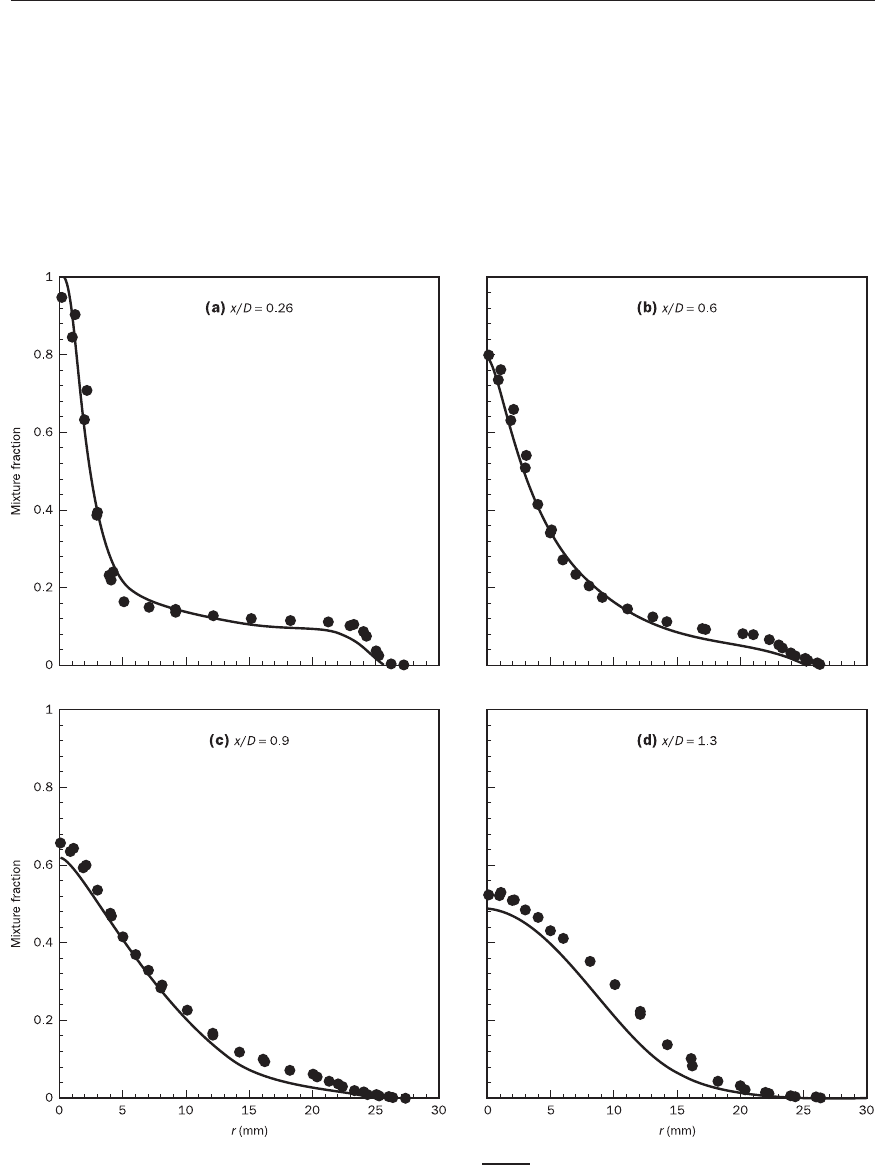
Figure 12.19 shows the radial mixture fraction profiles at four axial locations.
The mixture fraction profiles are in excellent agreement with measurements
in the near field (x/D < 0.9). Here D is the bluff-body diameter. Further
Figure 12.19 Mean mixture fraction profiles:
•
, measurements; , calculations
ANIN_C12.qxd 29/12/2006 04:44PM Page 407
downstream (x/D > 1.3), the mixture fraction near the axis is underpredicted
(not all the results are shown here). This error can be attributed to the known
overestimation of the spreading rate of the round jet by the k–
ε
turbulence
model as explained earlier. Clearly, the decay rate is not well represented
even after modifying the constant C
1
ε
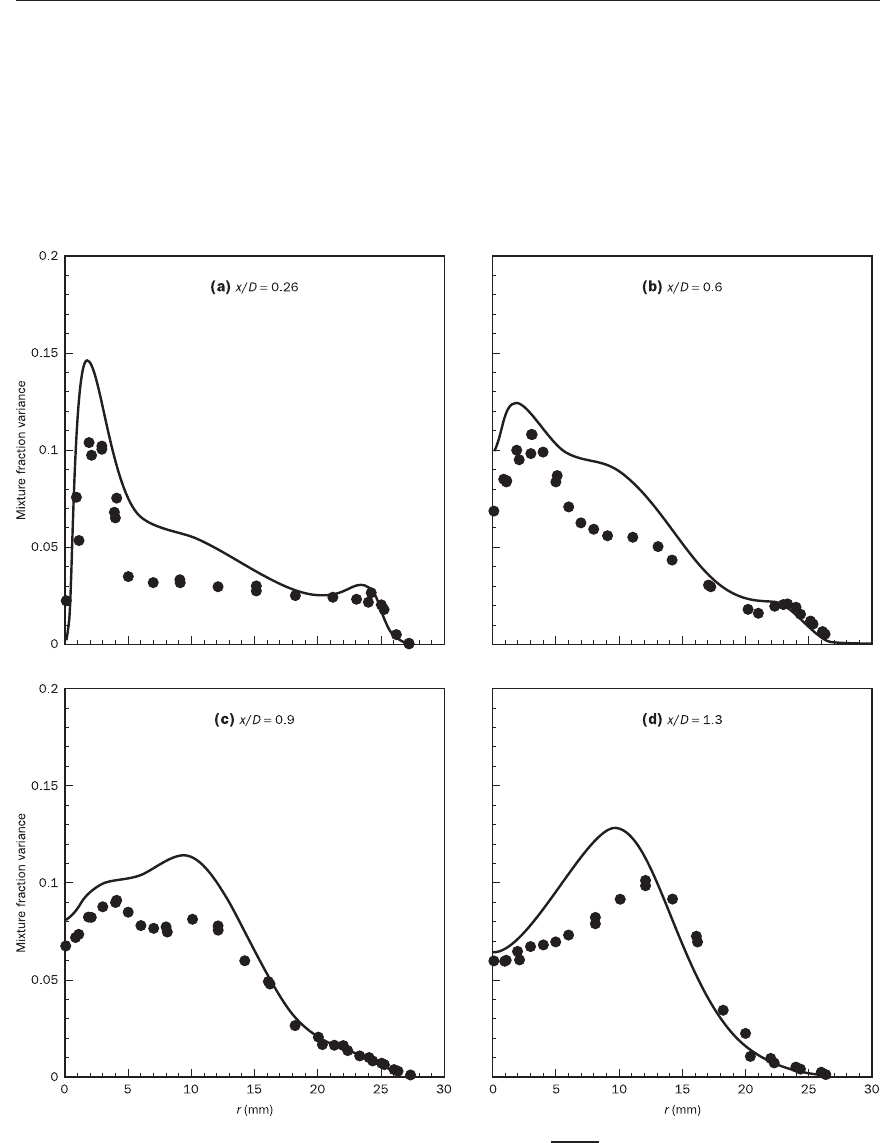
. Radial profiles of the mixture fraction
variance are shown in Figure 12.20. Mixture fraction variance is slightly
overpredicted in the near field (x/D < 1.3). However, the location of the peak
in the near field is well reproduced.
408 CHAPTER 12 CFD MODELLING OF COMBUSTION
Figure 12.20 Mean mixture fraction variance profiles:
•
, measurements; , calculations
ANIN_C12.qxd 29/12/2006 04:44PM Page 408
12.30 AN EXAMPLE 409
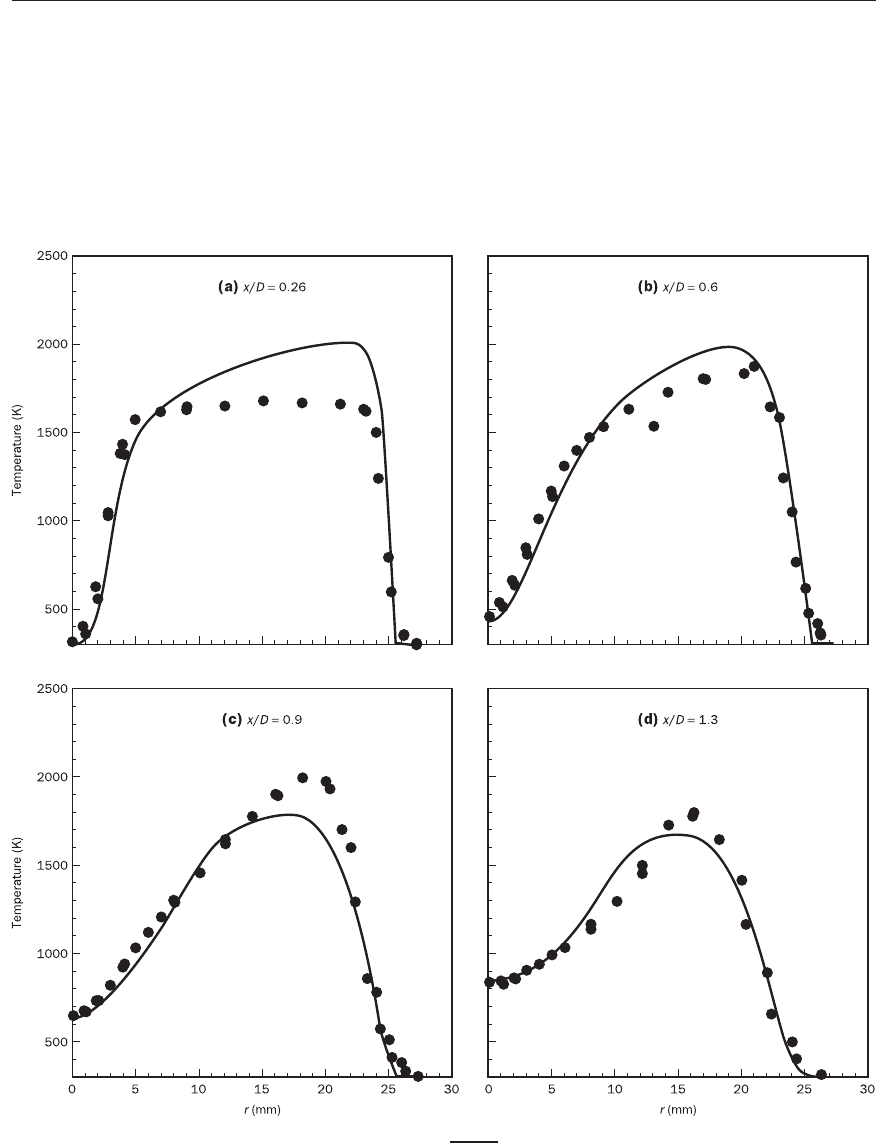
Radial temperature profiles are shown in Figure 12.21. The mean tem-
perature distribution is fairly well predicted by the laminar flamelet model.
Further downstream results show a slight overprediction. It is worth men-
tioning that a significant overprediction at x/D = 0.26 was also observed by
Dally et al. (1998a). They noted that this might not be due to shortcomings
of the simulation, but caused by averaging effects in the temperature meas-
urements as a result of the intermittency in the flame at these locations.
Figure 12.21 Mean temperature profiles:
•
, measurements; , calculations
ANIN_C12.qxd 29/12/2006 04:44PM Page 409
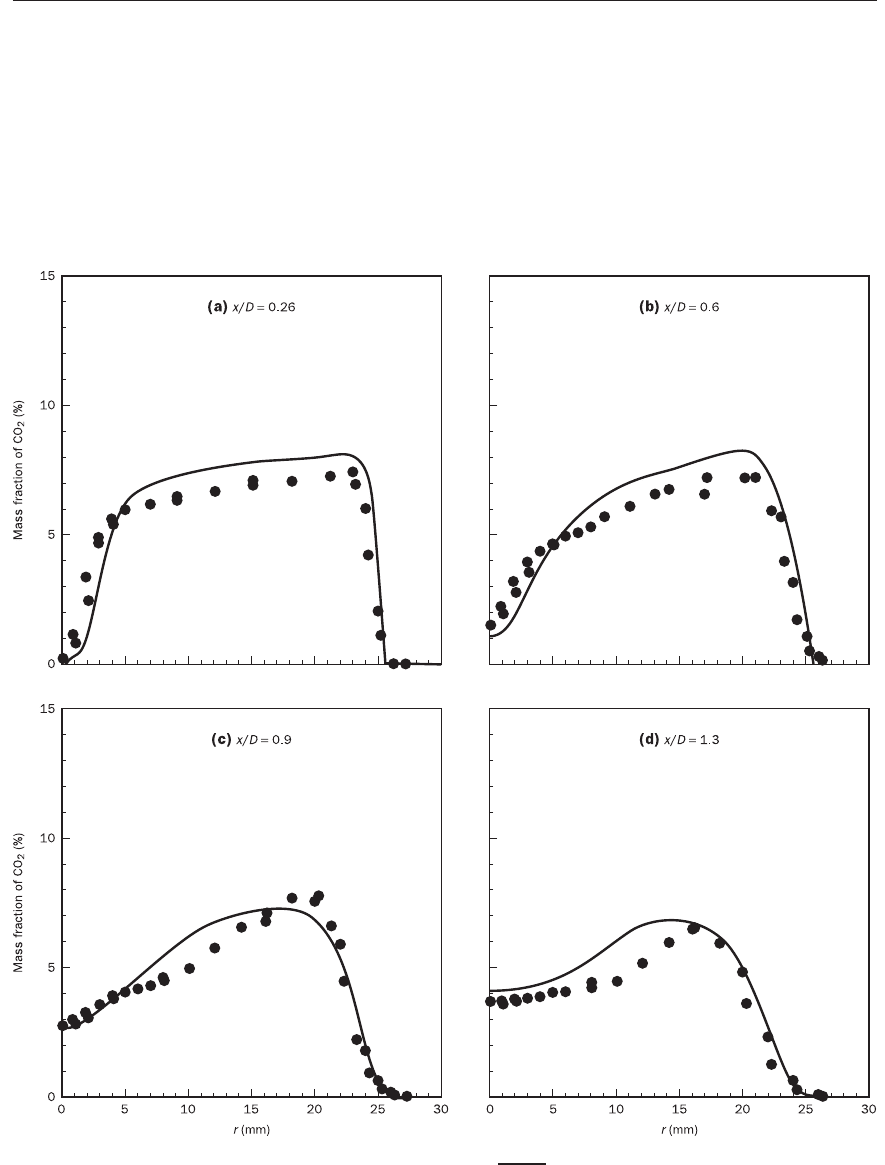
Radial distributions of the mass fractions of major species CO
2
and
H
2
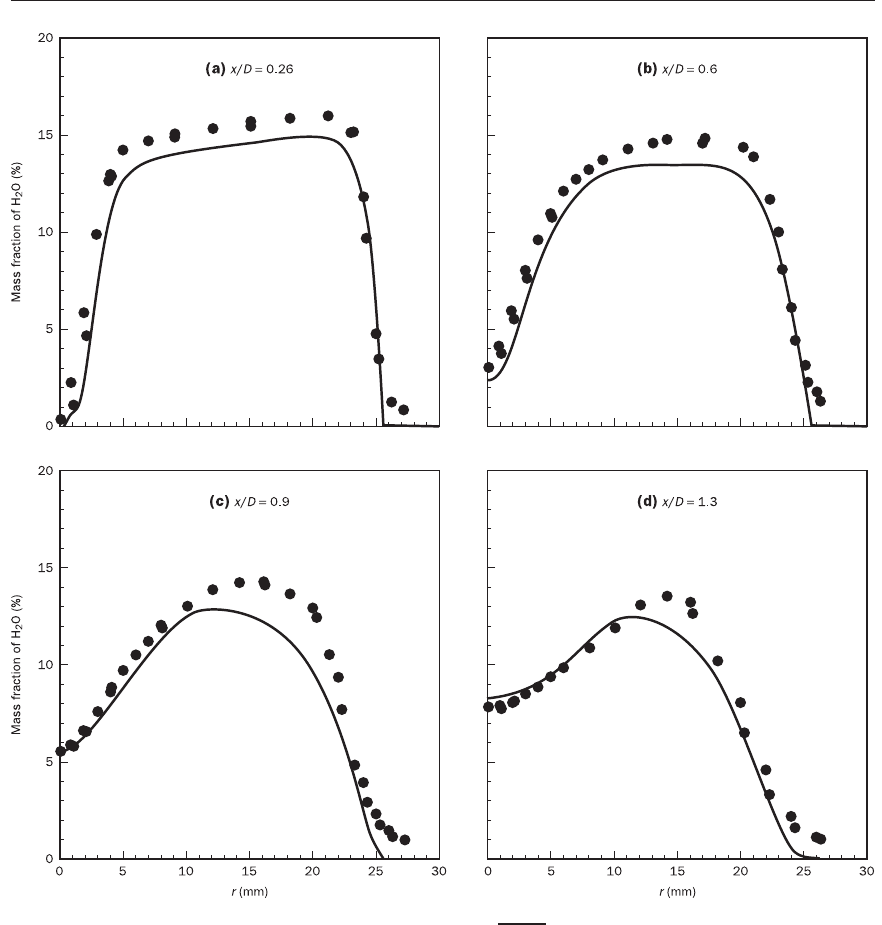
O are shown in Figures 12.22 and 12.23 respectively. Again reasonable
agreement with the experimental data is obtained. As mentioned earlier, the
inclusion of detailed chemistry in the laminar flamelet calculation allows us
to predict minor species such as OH and CO. Radial profiles of the mass frac-
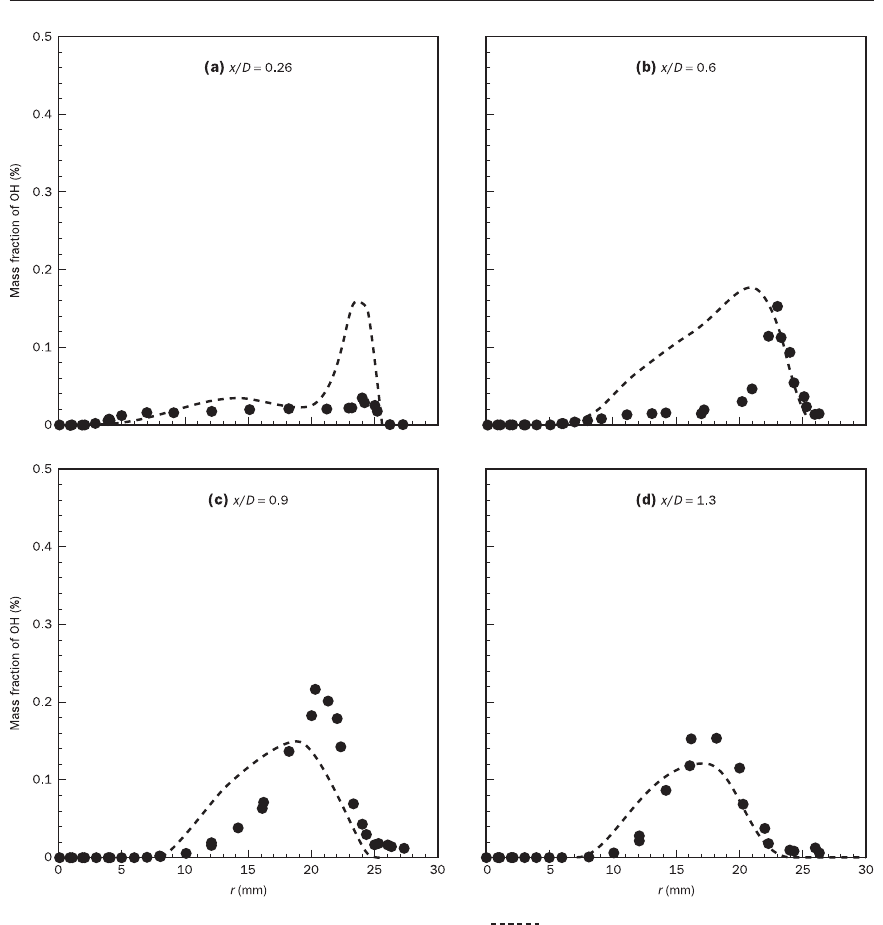
tion of OH, which is formed by dissociation in the high-temperature region
of the flame, are shown in Figure 12.24. The experimental data show that the
reaction zone of OH is thin in the near field. The thickness of the reaction
zone increases further downstream. This illustrates that the flamelet model
410 CHAPTER 12 CFD MODELLING OF COMBUSTION
Figure 12.22 Mean CO
2
mass fraction profiles:
•
, measurements; , calculations
ANIN_C12.qxd 29/12/2006 04:44PM Page 410
12.30 AN EXAMPLE 411
is able to capture the general trends of increasing thickness of the OH reac-
tion zone and the rate of decay of OH in the downstream direction.
Prediction of NO
We have also applied the thermal NO prediction procedure explained in
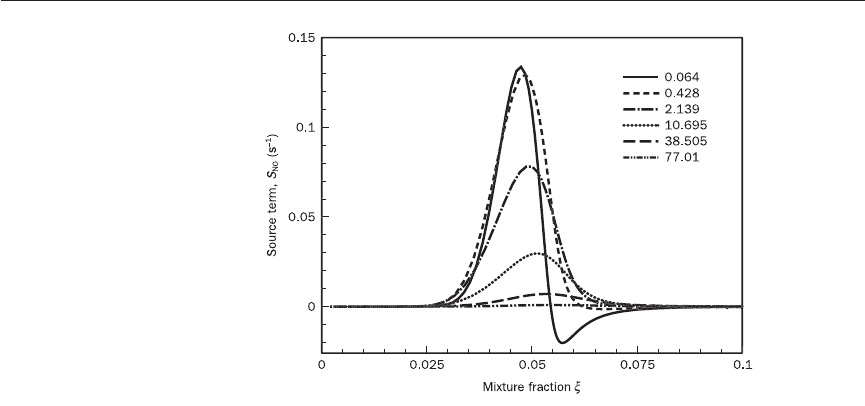
section 12.29. Figure 12.25 shows the NO source terms N
NO
/4 as a function
of mixture fraction for different stretch conditions. The figure shows that the
source term is very sensitive to the scalar dissipation rate. At
χ
= 0.064 s
−1
,
Figure 12.23 Mean H
2
O mass fraction profiles:
•
, measurements; , calculations
ANIN_C12.qxd 29/12/2006 04:44PM Page 411
the source term is negative in the fuel-rich zone (
ξ
> 0.055), indicating con-
sumption of NO. At
χ
= 0.428 s
−1
, the negative zone of the source term
almost vanishes, but the peak value remains constant. At scalar dissipation
rates higher than
χ
= 0.428 s
−1
, the decrease of temperature is more promin-
ent and this reduces the source term rapidly. As the scalar dissipation rate
increases further to
χ
= 77.01 s
−1
the formation of NO has almost completely
ceased.
412 CHAPTER 12 CFD MODELLING OF COMBUSTION
Figure 12.24 Mean OH mass fraction profiles:
•
, measurements; , calculations
ANIN_C12.qxd 29/12/2006 04:44PM Page 412
12.30 AN EXAMPLE 413
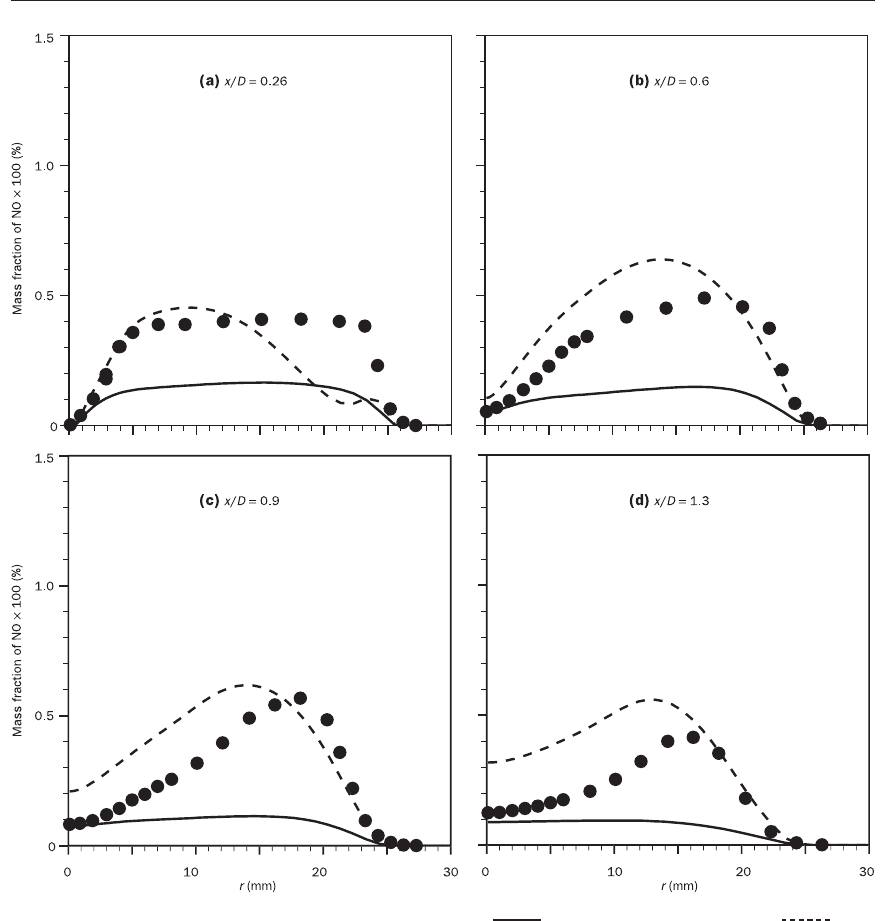
The comparison between the predictions and the measurements for the
radial mass fraction of NO is shown in Figure 12.26. The flamelet model
seems to underpredict the NO profiles, but it should be noted that we have
only considered thermal NO formed through the Zel’dovich mechanism.
Even though Chen and Chang (1996) have shown that the Zel’dovich mech-
anism is the dominant pathway for the production of NO in a turbulent
CH
4
/H
2
jet flame, it appears that calculations conducted with the thermal
NO mechanism alone do not give correct NO levels in this flame. This is
further illustrated in this example by considering a more elaborate NO
x
mechanism. Shown by dashed lines in Figure 12.26 is a repeat of the NO
x
calculation using the GRI 2.11 mechanism, which consists of 49 species and
279 reactions. This mechanism includes reactions to represent both thermal
and prompt NO
x
chemistry. It can be seen that the dashed lines are in better
agreement with the experimental data than the thermal-only predictions
(solid lines). The trend is also well predicted. There is still some degree of
over-prediction further away from the burner exit. This could be due to dis-
crepancies in temperature predictions seen earlier. Given that the NO mass
fractions are very small, the degree of agreement from the GRI 2.11 predic-
tions seen here could considered to be very good (see Murthy et al., 2006, for
further details).
In summary, we have illustrated how the laminar flame model can be used
to predict important flame properties such as temperature, major species,
minor species and NO. The predictions were compared against reported
experimental data. In the laminar flamelet model, the mean temperature,
density and composition in the turbulent field are obtained by appropriate
averaging of the flamelets. The concentration of NO, however, is calculated
by solving its own transport equation with a source term obtained from the
flamelet library. The flow field is reasonably well reproduced in the calcula-
tion. The temperature and concentration of major and minor species are
also well reproduced by the flamelet model with unity Lewis number. The
prediction of NO is not as good as other species, and it is suggested that
inclusion of other NO production mechanisms can improve NO predictions.
Figure 12.25 Flamelet profiles
of the NO source term for
different scalar dissipation rates
ANIN_C12.qxd 29/12/2006 04:44PM Page 413
Further details of this example and the effects of using differential diffusion
(non-unity Lewis numbers) can be found in Hossain and Malalasekera
(2003) and Hossain (1999). The quality of the results presented in this exam-
ple is very similar to that of Kim and Huh (2002), who used the conditional
moment closure (CMC) method. Overall, laminar flamelet model predic-
tions are very good, and the ability to incorporate detailed chemistry at an
acceptable cost allows us to predict minor species and pollutants, which is a
major advantage over simpler models such as SCRC.
414 CHAPTER 12 CFD MODELLING OF COMBUSTION
Figure 12.26 Mean NO mass fraction profiles:
•
, measurements; , predictions (thermal NO only), ,
predictions including prompt NO
x
ANIN_C12.qxd 29/12/2006 04:44PM Page 414

12.32 MODELLING OF PREMIXED COMBUSTION 415
There are several other modelling concepts available for non-premixed
combustion modelling. Among them, the conditional moment closure (CMC)
model, pdf transport models and flame surface density models have been
demonstrated to be successful in predicting turbulent combustion. It is
beyond the scope of this chapter to describe these models in detail. The
interested reader should consult the relevant literature. For the CMC model,
Bilger (1993), Smith et al. (1992), Klimenko and Bilger (1999) and Kim and
Huh (2002); for pdf transport models, Pope (1985, 1990, 1991) and Dopazo
(1994); and for the flame surface density models, Marble and Broadwell (1977),
Blunsdon et al. (1996), Beeri et al. (1996) and Veynante and Vervisch (2002)
provide details and example applications. There is also growing interest in
large eddy simulation (LES) models for turbulent combustion. Details can
be found in Poinsot and Veynante, (2005), DesJardin and Frankel (1998),
Cook and Riley (1998), Branley and Jones (2001) and Selle et al. (2004).
As mentioned in the introduction to this chapter, fuel and air are mixed prior
to combustion in premixed combustion. The strength of the mixture may be
expressed by the equivalence ratio. During combustion in a premixed flame,
the flame front propagates at a certain speed and leaves burnt products
behind the flame front. In premixed combustion, laminar and turbulent
flame speeds and a parameter known as the reaction progress variable are
used to formulate models. If we define T
u
as the temperature of unburnt gas,
T
b
as the temperature of burnt gas and T as the flame temperature, then the
reaction progress variable c is defined as
c = (12.203)
Sometimes the same reaction progress variable (c) is defined as
c = (12.204)
where Y
F
, Y
u
F
and Y
b
F
are local, unburnt and burnt fuel mass fractions,
respectively. With these definitions the value of the reaction progress vari-
able is zero where the mixture is unburnt and unity where the mixture is fully
burnt. It can be shown that, like mixture fraction in non-premixed combus-
tion, the reaction progress variable c in premixed combustion is governed by
the following transport equation (see Veynante and Vervisch, 2002):
ρ
c +
ρ
u
i
c =
ρ
D + M (12.205)
Special variants of the main combustion models for diffusion flames
(presumed-pdf, laminar flamelet, flame surface density, eddy break-up model
etc.) have been formulated for premixed combustion. As we mentioned
at the beginning of this chapter, we do not intend to describe the details of
premixed combustion models here, and the interested reader is referred,
among others, to Peters (1986), Veynante and Vervisch (2002) and Poinsot
and Veynante (2005) for further details.
D
E
F
∂
c
∂
x
i
A
B
C
∂
∂
x
i
∂
∂
x
i
∂
∂
t
Y
F
− Y
u
F
Y
b
F
− Y
u
F
T − T
u
T
b
− T
u
Modelling
of premixed
combustion
12.32
Other models
for non-premixed
combustion
12.31
ANIN_C12.qxd 29/12/2006 04:44PM Page 415

At the start of this chapter we introduced some basic thermodynamic and
chemical kinetics concepts useful for the CFD combustion modeller. We
have shown in detail how the fast chemistry assumption can be used to
simplify combustion calculations, and demonstrated and its direct applica-
tion to a laminar flame was demonstrated. The basics of chemical kinetics
and reaction rates were introduced, and the advantage of using reduced
mechanisms over detailed chemical mechanisms was discussed. The com-
plexities arising from turbulent non-premixed combustion modelling were
discussed, and the advantages of employing Favre-averaged equations were
explained. The probability density function approach for the calculation of
mean quantities in turbulent combusting flows was discussed in detail. We
have also shown how the fast chemistry assumption can be used in conjunc-
tion with the pdf approach to calculate mean temperatures and species mass
fractions. Some other approaches, such as the eddy break-up model, equi-
librium models etc., were briefly discussed, and the need to incorporate some
degree of detailed chemistry in order to be able to predict minor species was
highlighted. Finally, we introduced the concepts of the laminar flamelet
model, which allows the use of detailed chemistry. We discussed in some
detail the methods for generating laminar flamelet libraries and calculating
mean variables in the laminar flamelet method and showed how pollutant
concentrations could be evaluated. A complete example illustrating the use
of the laminar flamelet model was presented. Other models available for
turbulent combustion were mentioned, along with a brief description of the
main features of models for premixed combustion. This chapter should be
useful for novice combustion modellers wishing to gain some overall under-
standing of the basic approach used in CFD. In the interest of brevity many
intermediate details have been omitted in the presentation of various con-
cepts. The reader should follow up appropriate references and gather full
details in order to understand the finer points of various models.
416 CHAPTER 12 CFD MODELLING OF COMBUSTION
Summary12.33
ANIN_C12.qxd 29/12/2006 04:44PM Page 416