
Versteeg H., Malalasekra W. An Introduction to Computational Fluid Dynamics: The Finite Volume Method
Подождите немного. Документ загружается.


13.4 FOUR POPULAR RADIATION CALCULATION TECHNIQUES 427
(1987), Howell (1988), Siegel and Howell (2002), Modest (2003), Carvalho
and Farias (1998) and Maruyama and Guo (2000). In this chapter we discuss
four of the most popular general-purpose radiation algorithms:
• Monte Carlo method (Howell and Perlmutter, 1964)
• Discrete transfer method (Lockwood and Shah, 1981)
• Discrete ordinate method (Chandrasekhar, 1960; Hyde and Truelove,
1977; Fiveland, 1982, 1988)
• Finite volume method (Chui et al, 1992, Chui and Raithby, 1993)
These methods each have a different way of treating the angular dependence
and spatial variation of intensity. The Monte Carlo and discrete transfer
methods are based on ray tracing. The last two methods use numerical dis-
cretisation of the distance and directional integrals, so there is not such an
obvious connection with rays.
13.4.1 The Monte Carlo method
In the Monte Carlo (MC) ray tracing method the radiative heat transfer
is calculated by randomly releasing a statistically large number of energy
bundles and tracking their progress from their emission points through the
medium. The domain boundary and the medium, which can be emitting,
absorbing and scattering, are usually discretised into surface and volume
elements for calculation purposes. The method is independent of the co-
ordinate system and therefore applicable to arbitrarily shaped and complex
configurations. Several variations of Monte Carlo algorithms are available,
and are described in Farmer (1995) and Howell (1998). Depending on the
chosen variation of the Monte Carlo method, the emission points can
be boundary surface elements or volume elements within the media. The
energy of an individual bundle is taken as the total emissive power of the
originating sub-region divided by the number of bundles (N) released from
this area. The method requires ray tracing to compute the path followed
by the bundles through the computational domain. Each bundle can gain or
lose energy along its path, depending on the properties of the medium. The
amount of energy gained or lost in this transfer process is used to calculate
the net energy source or sink in the medium due to radiation. It will eventu-
ally strike another surface, the properties of which are used to determine
whether the bundle is absorbed by the surface element. The method can
accommodate all properties of radiative transfer including non-isotropic
scattering, spectral effects and complex surface properties.
There are several probabilistic features, which give the Monte Carlo
method its name. Random numbers are used to determine the emission loca-
tion and direction of the energy bundles as well as the fractions emitted,
absorbed and scattered during interactions with the medium and boundary
surfaces. Random number generators provided by present-day programming
language compilers or a dedicated random number generator algorithm may
be used to draw random numbers between 0 and 1. The calculation process
starts by drawing a set of independent random numbers R
x
, R
y
, R
z
to deter-
mine the location of the emission. For a two-dimensional rectangular surface
element a location on the element may be identified as
x = x
o
+ R
x
∆x (13.15a)
y = y
o
+ R
x
∆y (13.15b)
Four popular
radiation
calculation techniques
suitable for CFD
13.4
ANIN_C13.qxd 29/12/2006 04:49PM Page 427

428 CHAPTER 13 CALCULATION OF RADIATIVE HEAT TRANSFER
where x
o
, y
o
are the co-ordinates of the vertex of the element, and ∆x and ∆y
are dimensions of the cell measured from x
o
, y
o
. The polar and azimuthal
angles are used to determine the direction of a bundle. For a diffuse emitter,
for example, the angles are given by
θ
= sin
−1
R
θ
(13.16)
φ
= 2
π
R
φ
(13.17)
where R
θ
and R
φ
are random numbers. As stated above, ray tracing is used
to calculate the path followed by each energy bundle.
For a bundle with initial energy E, travelling through a grey medium with
a constant absorption coefficient
κ
, the energy remaining in the bundle
(E
bundle
) and energy gained by the medium (E
absorbed
) are given by
E
bundle
= E(e
−
κ
s
) (13.18)
E
absorbed
= E(1 − e
−
κ
s
) (13.19)
where s is the path length travelled, which is obtained from
s =− ln(R
l
) (13.20)
where R
l
is a random number (see Siegel and Howell, 2002).
When an energy bundle strikes a surface its absorptivity (
α
) is interpreted
as the probability that the bundle is absorbed. A random number R
α
is com-
pared with the absorptivity value
α
to determine the process:
R
α
<
α
the bundle is absorbed (13.21)
R
α
>
α
the bundle is reflected (13.22)
By keeping track of energy absorbed or emitted within volumes and surface
elements, appropriate radiation quantities such as surface heat flux, diver-
gence or temperature may be evaluated depending on the problem. The total
energy absorbed (E
absorbed
) by surfaces and volumes is tallied during the
simulation procedure. Then the radiation source term and surface heat flux
may be evaluated from
S
rad,h
f
= E
absorbed
− E
emitted
(13.23)
Q
si
= E
absorbed
− E
emitted
(13.24)
In problems with prescribed wall temperature the initial intensity is
unknown; therefore simulation has to continue until convergence is achieved
for the heat flux value.
The accuracy of the Monte Carlo method is proportional to the square
root of the total number of bundles released in the calculations. Since sub-
stantial probabilistic elements are involved, the standard error in the mean
values of calculated quantities (e.g. flux or cell source term) can be estimated.
D
E
E
F
emitted
bundles
∑
absorbed
bundles
∑
A
B
B
C
1
A
i
D
E
E
F
emitted
bundles
∑
absorbed
bundles
∑
A
B
B
C
1
V
j
1
κ
ANIN_C13.qxd 29/12/2006 04:49PM Page 428

13.4 FOUR POPULAR RADIATION CALCULATION TECHNIQUES 429
This gives a unique – amongst radiation methods – indication of the uncer-
tainty of the results. The origin of the expressions in this section can be
found in Siegel and Howell (2002), Modest (2003) and Mahan (2002).
Details of the treatment of more advanced problems involving spectral and
angular dependent properties and/or scattering can be found in the above
textbooks and also in Farmer (1995).
13.4.2 The discrete transfer method
In the discrete transfer method (DTM) of Lockwood and Shah (1981), the
solution proceeds by first discretising the radiation space into homogeneous
surface and volume elements. Rays are emitted from the centre of each
boundary surface element, with position vector r, in directions determined
by discretising the 2
π
hemispherical solid angle above the surface into finite
solid angles,
δ
Ω. Shah (1979) chose to divide the hemisphere into N
θ
equal
polar angles and N
φ
equal azimuthal angles such that N
Ω
= N
θ
N
φ
and
δθ
=
δφ
= (13.25)
These features are illustrated in Figures 13.6 and 13.7.
In vector terms a ray is traced through the centre of each solid angle
element, in the direction −s
k
, until it strikes a boundary at r
L
= r − s
k
L
k
, such
that the ray path length is L
k
=|r − r
L
|. To calculate the contribution due
to the solid angle element to the incident intensity at the origin, the ray is
followed back, starting at r
L
, to origin r. The intensity distribution along its
path is solved with the recurrence relation
I
n+1
= I
n
e
−
βδ
s
+ S(1 − e
−
βδ
s
) (13.26)
where n and n + 1 designate successive boundary locations, separated by a dis-
tance
δ
s, as the ray passes through each medium control volume. The source
function S includes the scattering integral in its angular discretised form:
S = (1 −
ω
)I
b
+ I
−
(s
i
) Φ(s, s
i
)dΩ
i
= (1 −
ω
)I
b
+ I
−,ave
(s
i
) Φ(s, s
i
)
δ
Ω
i
(13.27)
where the averaged intensity I
−,ave
(s
i
) is taken as the arithmetic mean of the
entering and leaving radiant intensities for each ray passing through the cell
volume within the finite solid angle
δ
Ω. The finite solid angle is evaluated for
each angular sub-division as
δ
Ω= sin
θ
d
φ
d
θ
= 2 sin
θ
sin(
δθ
/2)
δφ
(13.28)
Source function S is assumed to be constant over the interval. A cell-averaged
(directionally independent) value is taken for S. This considerably simplifies
the analysis, but as a consequence of this approximation the DTM does not
have the ability to describe scattering anisotropy.
δθ
δφ
N
∑
i=1
ω
4
π
4
π
ω
4
π
2
π
N
φ
π
2N
θ
ANIN_C13.qxd 29/12/2006 04:49PM Page 429
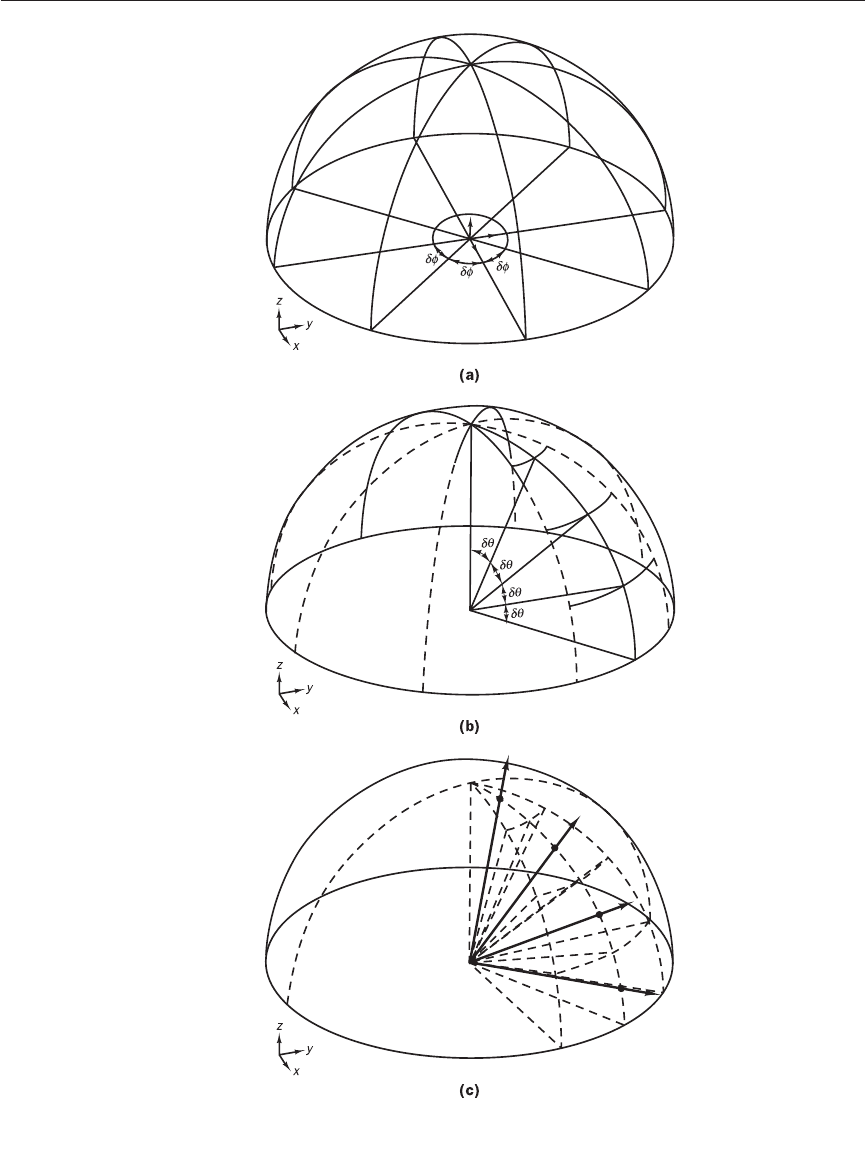
430 CHAPTER 13 CALCULATION OF RADIATIVE HEAT TRANSFER
Figure 13.6 Angular
discretisation and representative
ray selection in the discrete
transfer method: (a) angular
discretisation in the azimuthal
direction; (b) angular
discretisation in the polar
direction; (c) selection of ray
directions for a single d
φ
angular
sector
ANIN_C13.qxd 29/12/2006 04:49PM Page 430
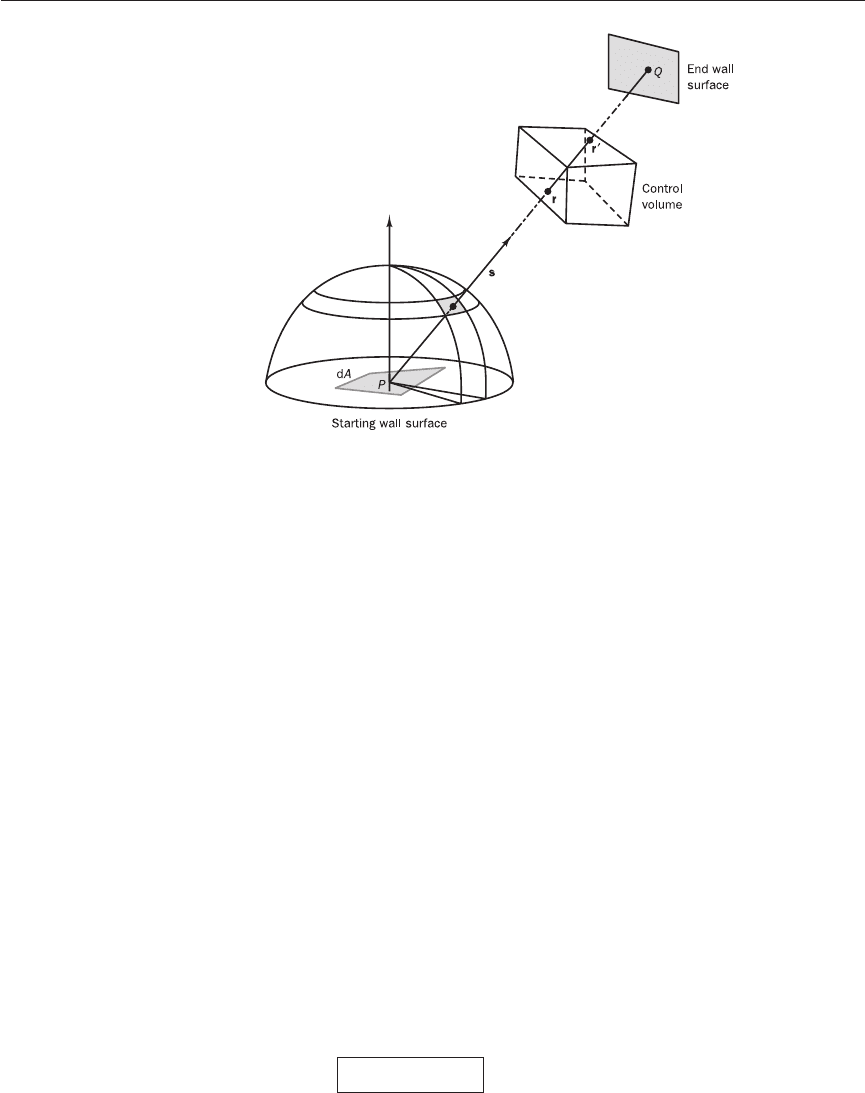
13.4 FOUR POPULAR RADIATION CALCULATION TECHNIQUES 431
Figure 13.7 An illustration of
the discrete transfer method
The initial intensity value of each ray is evaluated at the originating
surface element and is given by
I
o
= q
+
/
π
(13.29)
with
q
+
=
ε
E
s
+ (1 −
ε
)q
−
(13.30)
Equation (13.26) is applied in the direction towards the origin of each ray,
and the incident radiative heat flux q
−
is evaluated by summing contributions
over all solid angles, assuming that the intensity is constant over each finite
solid angle. This gives
q
−
= I
−
(s) s . n
δ
Ω= I
−
(
θ
,
φ
) cos(
θ
) sin(
θ
) sin(
δθ
)
δφ
(13.31)
where N
R
is the number of incident rays arriving at the surface element.
Since q
+
in (13.30) depends on the value of q
−
, an iterative solution is
required, unless the surfaces are black (
ε
= 1). In an iterative calculation the
initial intensity leaving a surface is evaluated on the basis of its own temper-
ature only. Estimates of the incident radiative heat flux will be available after
the first iteration to calculate corrected intensities leaving boundary surfaces
using (13.29) and (13.30). The process is repeated until the difference
between successive values of the negative flux is within a specified limit.
When the calculation has converged the net radiative heat flow out of each
surface element with area A
i
is computed from
Q
si
= A
i
(q
+
− q
−
) (13.32)
DTM calculates the radiative source for each medium element via an energy
balance. Lockwood and Shah (1981) evaluated the radiative source associated
with the passage of each ray through a volume n by means of
∑
N
R
∑
N
Ω
ANIN_C13.qxd 29/12/2006 04:49PM Page 431

432 CHAPTER 13 CALCULATION OF RADIATIVE HEAT TRANSFER
δ
Q
gk
= (I
n+1
− I
n
)A
s
(− s
k
. n)dΩ
k
= (I
n+1
− I
n
)A
s
cos
θ
k
sin
θ
k
sin(
δθ
k
)
δφ
k
(13.33)
where A
s
is the area of the surface element from which the ray was emitted.
Summing the individual source contributions from all the N rays passing
through a volume element, and then dividing this value by its volume, ∆V,
gives the divergence of radiative heat flux as
S
h,rad
=∇. q
r
=
δ
Q
g,k
(13.34)
Each DTM ray originates from a certain surface element and selects its
initial intensity on the basis of the properties of this element. However,
the incremental solid angle, represented by the ray, may partly cover an
adjacent surface element. Since the influence of the initial intensity decays
exponentially along its transmission path, the resulting inaccuracy is likely
to be small.
The accuracy of the DTM depends on two factors, surface discretisation
(number of surface elements used to fire rays) and angular discretisation
(number of rays used per point). Mathematical expressions for the errors
resulting from these discretisation practices have been derived for simple
situations (Versteeg et al, 1999a, b). The studies using transparent media
show that the decay rate of the angular discretisation error
ε
H
with increas-
ing ray number N
R
depends on the smoothness of the irradiation. For
smooth irradiating intensity
ε
H
∝ 1/N
R
, for piecewise sources
ε
H
∝ 1/ N
R
and for intensity fields field with derivative discontinuities
ε
H
∝ 1/N
R
. The
surface discretisation error is generally small compared with
ε
H
and can
be reduced by refinement of the surface mesh. Our predictive experience
is that when an adequately refined mesh and a sufficiently large number of
rays are used the standard method produces results which are comparable
in accuracy with Monte Carlo solutions. Our tests have shown that, for
non-scattering, absorption/emission-only problems, the DTM is around
500 times faster than MC in terms of CPU times. For isotropic scattering,
absorbing and emitting problems DTM is about 10 times faster than MC
calculations (see Henson and Malalasekera, 1997a).
Further details of the basic method can be found in Shah (1979),
Lockwood and Shah (1981) and Henson (1998). The discrete transfer
method is mathematically simple and also applicable to any geometrical
configuration. When a fast and efficient ray tracing algorithm is used the
method is computationally efficient. It is well established in application to
combustion-related problems, and extensions of the method to isotropic
scattering problems and non-grey calculations have been demonstrated in
Carvalho et al. (1991) and Henson and Malalasekera (1997b). The method
is, however, not suitable for anisotropic scattering applications. Several
enhancements and modifications to the original method have been proposed,
e.g. Cumber (1995) and Coelho and Carvalho (1997).
N
∑
k =1
1
∆V
δ
Ω
ANIN_C13.qxd 29/12/2006 04:49PM Page 432

13.4 FOUR POPULAR RADIATION CALCULATION TECHNIQUES 433
13.4.3 Ray tracing
Both the MC and DTM require ray tracing in a given volume mesh. For
Cartesian and cylindrical geometries the path of rays can be calculated using
simple vector algebra. For non-orthogonal and unstructured mesh arrange-
ments ray tracing requires some attention, particularly because the process
has to be computationally efficient. For such applications a very efficient
method is described in Malalasekera and James (1995, 1996), Henson and
Malalasekera (1997a) and Henson (1998). This method has been successfully
used to generate discrete transfer and MC solutions in complex geometries
with non-orthogonal structured mesh systems. The method is also suitable
for unstructured mesh arrangements, including those with mixed elements
(tetrahedral and hexahedral elements).
13.4.4 The discrete ordinates method
In the discrete ordinates method the equation of transfer is solved for a set of
n different directions in the total of 4
π
solid angle, and the integrals over
directions are replaced by numerical quadrature. Thus the equation of trans-
fer is approximated by
=
κ
I
b
(r) −
β
I(r, s
i
) + w
j
I
−
(s
j
) Φ(s
i
, s
j
)
i = 1, 2,..., n (13.35)
where w
j
are quadrature weights associated with the directions s
j
(see
Modest, 2003). The equation is subject to the boundary condition
I(r
w
, s
i
) =
ε
(r
w
)I
b
(r
w
) + w
j
I
−
(r
w
, s
j
) |n . s
j
| (13.36)
The angular ordinates s
j
=
ξ
i +
η
j +
µ
k and angular weights w
j
are available
in Lathrop and Carlson (1965), Fiveland (1991), and the basis of obtaining
the weights is discussed further in Modest (2003). The order of the S
N
approximation is denoted by S
2
, S
4
, S
6
...S
N
. The total number of direc-
tions used (n) is related to N through the relation n = N(N + 2).
Direction cosines
ξ
,
η
or
µ
and weights w
j
for basic discrete ordinates
approximations are shown in Table 13.1. Only the positive direction cosines
n
∑
j =1
1 −
ε
(r
w
)
π
n
∑
j =1
σ
s
4
π
dI(r, s
i
)
ds
Table 13.1 Ordinate directions and weights for S
2
and S
4
approximations
S
N
approximation Ordinates Weights
ξξ ηη µµ
S
2
(symmetric) 0.5773 0.5773 0.5773 1.57079
S
2
(non-symmetric) 0.5000 0.7071 0.5000 1.57079
S
4
0.2959 0.2959 0.9082 0.52359
0.2959 0.9082 0.2959 0.52359
0.9082 0.2959 0.2959 0.52359
ANIN_C13.qxd 29/12/2006 04:49PM Page 433
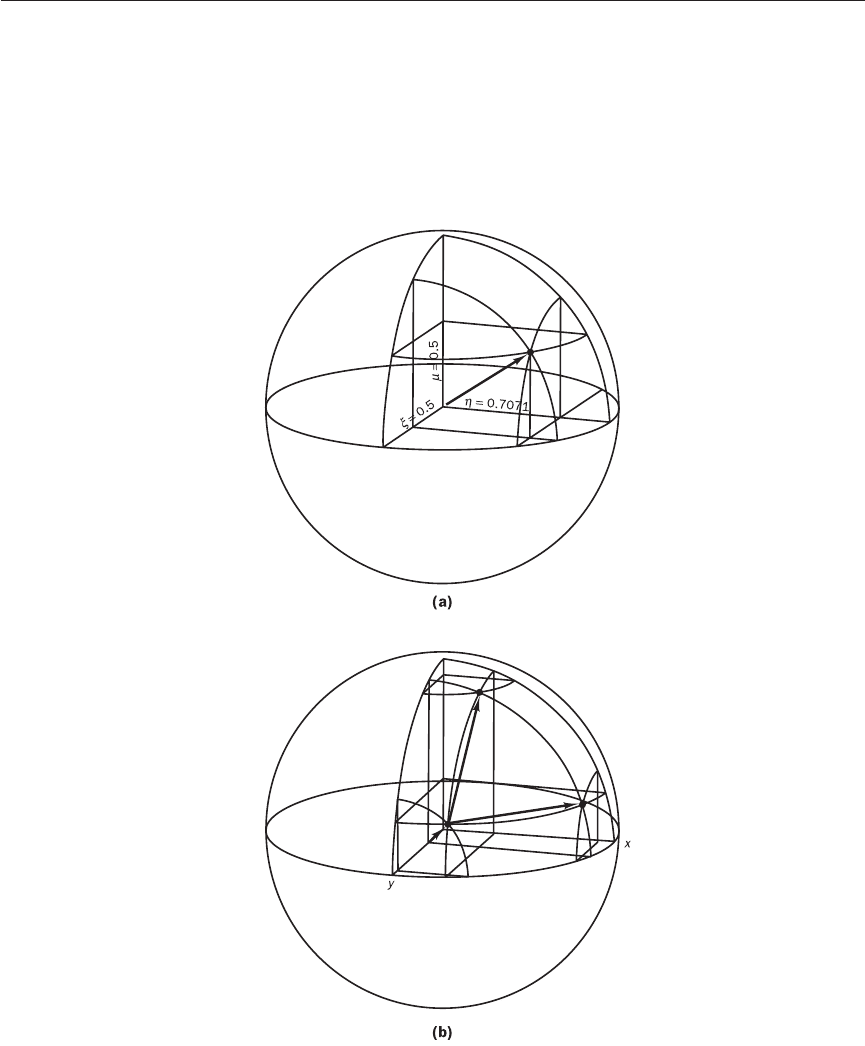
and weights are shown. The most basic discrete ordinate approximation is
S
2
. In S
2
, two different direction cosines are used to define a principal direc-
tion. Therefore one direction is used in an eighth of a sphere. In total 2(2+2)
or 8 directions are used per sphere. There are two S
2
representations: sym-
metric and non-symmetric. The symmetric representation uses equal values
for all direction cosines whereas the non-symmetric representation uses dif-
ferent values. Figure 13.8a illustrates the non-symmetric S
2
representation
in one-eighth of a sphere.
434 CHAPTER 13 CALCULATION OF RADIATIVE HEAT TRANSFER
Figure 13.8 Discrete ordinates
in one-eighth of a sphere:
(a) illustration of the S
2
(non-symmetric) representation;
(b) illustration of the S
4
representation
The next improved approximation is S
4
. Here four different direction
cosine values are used. They are ±0.2959 and ±0.9082 for
ξ
,
µ
or
η
. Using
two different positive values we can generate three principal directions in
one-eighth of a sphere as illustrated in Figure 13.8b. Only three directions
are shown; all other directions may be obtained by using appropriate negative
ANIN_C13.qxd 29/12/2006 04:49PM Page 434
13.4 FOUR POPULAR RADIATION CALCULATION TECHNIQUES 435
and positive values, giving a total of 4(4+2) = 24 permutations. The angular
discretisation represents the solid angle subtended by a sphere. Therefore,
the sum of the weights for all directions should be equal to the solid angle of
a sphere, i.e. 4
π
. This can be easily verified in Table 13.1 for the S
2
and S
4
approximations.
More detailed tabulations of ordinates including S
N
approximations with
N > 4 can be found in Siegel and Howell (2002) and Modest (2003).
The angular approximation transforms the original integro-differential
equation into a set of coupled differential equations. For Cartesian co-ordinates
equation (13.34) may be discretised as follows:
ξ
i
+
η
i
+
µ
i
+
β
I
i
=
β
S
i
i = 1, 2, . . . , n (13.37)
where
ξ
i
,
η
i
and
µ
i
are the direction cosines of direction i and
S
i
= (1 −
ω
)I
b
+ w
j
I
j
Φ
ij
i = 1, 2,..., n (13.38)
The set of coupled differential equations is solved by discretisation using
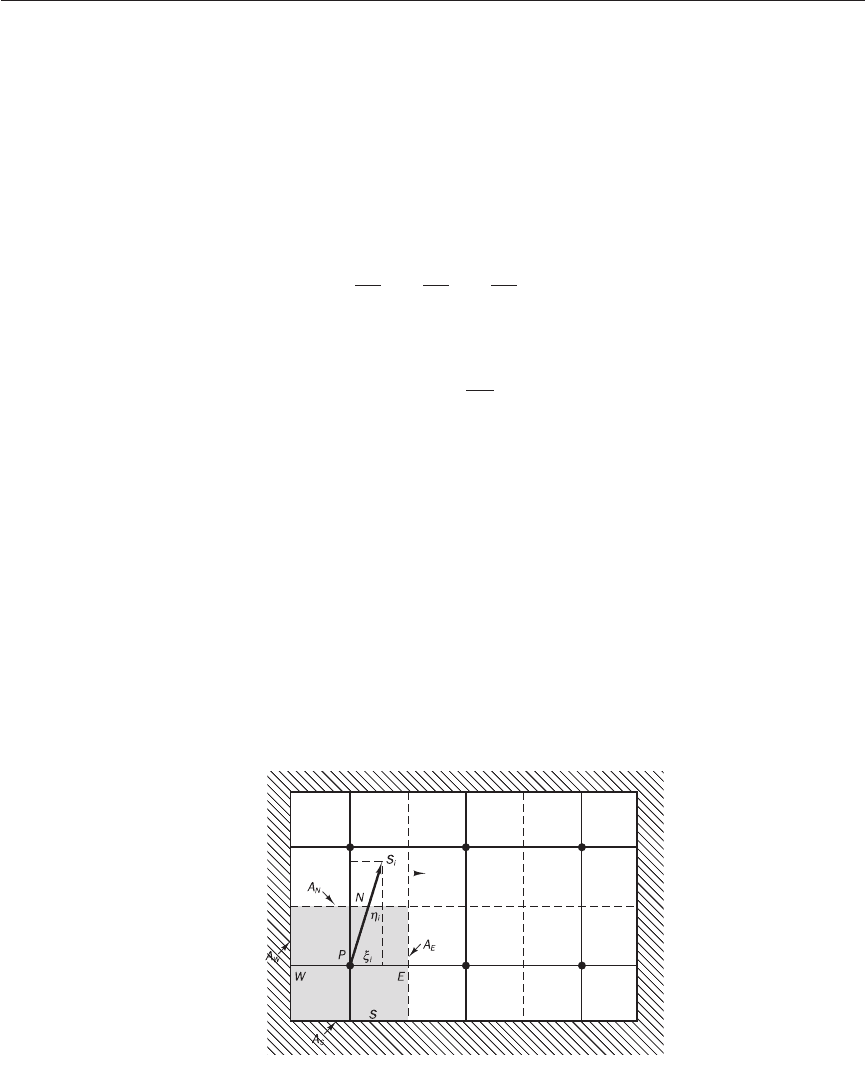
the finite volume method: see Modest (2003). For example, consider the
two-dimensional control volume shown in Figure 13.9. The components
dI
i
/dx, dI
i
/dy, dI
i
/dz of the intensity gradient and other terms of equation
(13.37) are integrated over the control volume, applying the usual finite
volume approximations. Using the areas shown in Figure 13.9 we obtain
ξ
i
(I
E
i
A
E
− I
W
i
A
W
) +
η
i
(I
N
i
A
N
− I
S
i
A
S
)
=−
β
I
P
i
(∆V) +
β
S
P
i
(∆V) i = 1, 2, . . . , n (13.39)
where I
P
i
and S
P
i
are volume averages of the intensity and source function.
The intensity I
P
i
at the centre of the cell is approximated as
I
P
i
=
γ
I
E
i
+ (1 −
γ
)I
W
i
(13.40a)
I
P
i
=
γ
I
N
i
+ (1 −
γ
)I
S
i
(13.40b)
n
∑
j =1
ω
4
π
dI
i
dz
dI
i
dy
dI
i
dx
Figure 13.9 A general
two-dimensional geometry
to illustrate the discrete
ordinates method
The parameter
γ
is a weighting factor used to relate cell edge intensities to
the volume average intensity. The weighting factor
γ
is a constant 0 ≤
γ
≤ 1.
The most widely used diamond and step difference schemes are obtained by
setting
γ
to 0.5 and 1.0, respectively.
ANIN_C13.qxd 29/12/2006 04:49PM Page 435

436 CHAPTER 13 CALCULATION OF RADIATIVE HEAT TRANSFER
The solution marches through the computational domain as follows. At a
boundary some I
i
values are known from boundary conditions. Consider for
example the two-dimensional corner cell shown in Figure 13.9. I
W
i
and I
S
i
are
known for this cell. Using equations (13.40a) and (13.40b) we may write
γ
I
E
i
= I
P
i
− (1 −
γ
)I
W
i
(13. 41a)
γ
I
N
i
= I
P
i
− (1 −
γ
)I
S
i
(13.41b)
Substitution of equations (13.41a and b) into equation (13.39) and rearrang-
ing gives
I
P
i
= (13.42a)
where A
WE
=
γ
A
W
+ (1 −
γ
)A
E
(13.42b)
and A
SN
=
γ
A
S
+ (1 −
γ
)A
N
(13.42c)
Equation (13.42a) gives a means of calculating I
P
i
from boundary intensities
I
W
i
and I
S
i
. Once I
P
i
is calculated, I
E
i
and I
N
i
can be obtained from equations
(13.41a and 13.41b), and the process can move to the next cell where newly
calculated values are used as boundary values for the next cell and so on.
Starting from a boundary where the intensity is known the domain can be
swept to find unknown intensities along each ordinate direction. The above
procedure has to be repeated for all ordinate directions. For negative ordinate
directions the process starts from the north and east boundaries. Iteration is
required as initial boundary intensities are based only on approximate values
(usually calculated using surface temperatures) and can only be updated once
all incoming intensities are known.
Equation (13.42a) may be generalised to three dimensions as follows:
I
P
i
= (13.43a)
where ∆V is the volume of the cell. Absolute values of direction cosines
are used in the above equation to indicate that the equation is valid for both
positive and negative direction cosines, and
A
x
= (1 −
γ
)A
x
e
+
γ
A
x
i
(13.43b)
A
y
= (1 −
γ
)A
y
e
+
γ
A
y
i
(13.43b)
A
z
= (1 −
γ
)A
z
e
+
γ
A
z
i
(13.43c)
where subscripts i and e denote entering and exit faces of a control volume,
respectively, and A
x
, A
y
and A
z
refer to x, y and z control volume areas in
a three-dimensional Cartesian control volume. As before, we start from
boundary cells to calculate I
Pi
and progress into inner cells. Once all the
directional intensities are known, the radiative flux at a surface may be
calculated from
q
−
(r) = I
−
(r, s)n . sdΩ= w
i
I
i
(r, s
i
)n . s
i
(13.44)
n
∑
i =1
2
π
β
(∆V)
γ
S
P
i
+|
ξ
i
|A
x
I
x
i
,i
+|
η
i
|A
y
I
y
i
,i
+|
µ
i
|A
z
I
z
i
,i
β
(∆V)
γ
+|
ξ
i
|A
x
+|
η
i
|A
y
+|
µ
i
|A
z
β
(∆V )
γ
S
P
i
+
ξ
i
A
WE
I
W
i
+
η
i
A
SN
I
S
i
β
(∆V)
γ
+
ξ
i
A
E
+
η
i
A
N
ANIN_C13.qxd 29/12/2006 04:49PM Page 436