
Versteeg H., Malalasekra W. An Introduction to Computational Fluid Dynamics: The Finite Volume Method
Подождите немного. Документ загружается.

13.5 ILLUSTRATIVE EXAMPLES 437
The radiative source term for the enthalpy equation may be calculated from
S
h,rad
=∇. q
r
(r) = 4
πκ
I
b
−
κ
w
i
I
i
(r, s) (13.45)
Further details of the method and its derivation can be found in Modest
(2003), Fiveland (1982, 1988, 1991), Fiveland and Jessee (1994), Jamaluddin
and Smith (1988) and Hyde and Truelove (1977). The standard discrete
ordinates method is suitable for Cartesian and axisymmetric geometries,
but it is not directly applicable to non-orthogonal and unstructured grids.
However, a modified version of the discrete ordinates method that is suitable
for complex geometries has been demonstrated by Charette et al. (1997) and
Sakami et al. (1996, 1998).
13.4.5 The finite volume method
Raithby and co-workers (Raithby and Chui, 1990; Chui et al., 1992, 1993;
Chui and Raithby, 1993) have presented a control volume integration method
for the calculation of radiative heat transfer that shares several features with
the discrete ordinates method. Equations for intensity are solved for a set of
discrete directions, which span the total solid angle 4
π
. In addition to control
volume integration the finite volume method uses a control angle integration
as well (see Chai et al., 1994a, b). Further improvements to the original
method along with appropriate interpolation techniques for non-orthogonal
mesh systems are available for radiative heat transfer calculations in complex
geometries. The difficulty that arises in the application of this class of
methods to non-orthogonal cells is the evaluation of cell intensities and
handling of control angle overhanging. These are both caused by misalign-
ment of cell surfaces with discretised control angles. Several techniques have
been developed to overcome this problem: details can be found in Chai and
Modar (1996), Baek and Kim (1998), Baek et al. (1998) and Murthy and
Mathur (1998). An illustrative program that demonstrate the finite volume
method is available in the appendices of Modest (2003).
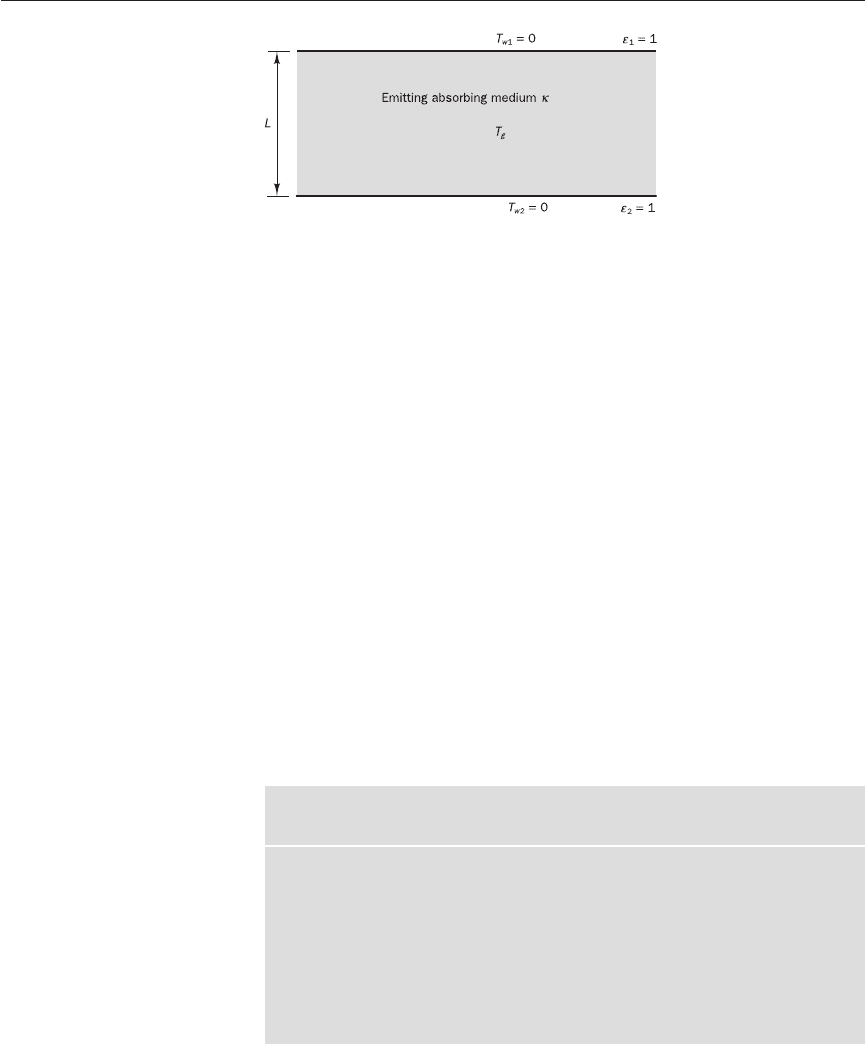
First we consider the one-dimensional radiative heating of two cold black
plates by a layer of emitting/absorbing hot gas at temperature T
g
and with
absorption coefficient
κ
. The problem considered is shown in Figure 13.10.
An analytical solution is available for this very simple problem: see e.g.
Shah (1979), Siegel and Howell (2002) or Modest (2003). We apply the MC,
DTM and discrete ordinates methods to calculate the heat flux to the plate
surfaces and compare the solutions obtained with the analytical result. The
non-dimensional wall heat flux is given by
= 1 − 2E
3
(
κ
L) (13.46)
q
σ
T
4
g
n
∑
i =1
Illustrative examples13.5
Example 13.1
One-
dimensional
emitting/
absorbing
problem with
prescribed
temperature
ANIN_C13.qxd 29/12/2006 04:49PM Page 437
438 CHAPTER 13 CALCULATION OF RADIATIVE HEAT TRANSFER
Table 13.2 MC statistics
Optical Total number Standard error
length of bundles S
n
CPU time
0.1 6.80×10
5
8.50×10
4
44
0.2 1.30×10
6
2.10×10
4
98
0.5 3.40×10
6
4.60×10
4
320
1.0 6.80×10
6
3.70×10
4
564
1.5 1.00×10
7
3.30×10
4
800
2.0 1.30×10
7
4.80×10
4
874
2.5 1.70×10
7
3.60×10
4
1047
3.0 2.00×10
7
3.30×10
4
1430
Discrete ordinates method (DOM)
The DOM solution to this simple problem can be obtained by applying
equations (13.37) and (13.38). The solution procedure and the S
2
and S
4
discrete ordinates solutions are available in Modest (2003).
Figure 13.10 Configuration for
one-dimensional temperature
prescribed problem
where E
3
(
κ
L) is an exponential integral, values of which can be found in
tabulated form in Siegel and Howell (2002), and L is the distance between the
two plates. In this expression the wall heat flux has been non-dimensionalised
by means of the black-body emissive power of the gaseous medium. We have
computed solutions for optical path lengths
κ
L = 0.1, 0.2, ..., 3.0; this
ranges from ‘almost transparent (optically thin)’ to ‘optically dense (optically
thick)’.
DTM and MC methods
Although the problem is essentially one-dimensional, the DTM and MC
methods solve the directional intensity distribution by ray tracing, which
must be applied in a three-dimensional fashion. Simple trigonometric
expressions are sufficient to determine all ray intersections in this problem.
For the DTM the solid angle was discretised using 10 × 10 for the N
θ
and
the N
φ
directions; hence, 100 rays were used per surface in the calculation.
For the MC solution the number of bundles fired was increased from 6 × 10
5
to 2 × 10
7
as the optical path length of the medium increased from
κ
L = 0.1
to 3.0. The standard error, S
n
, was of the order of 10
−4
for each MC simula-
tion performed. Table 13.2 shows the level of error and CPU time used for
MC solutions. CPU time depends on the computer system, but all DTM
solutions used less than 1 CPU second, which highlights the cost of MC
solutions.
ANIN_C13.qxd 29/12/2006 04:49PM Page 438

13.5 ILLUSTRATIVE EXAMPLES 439
Using the S
2
approximation the radiative heat flux to walls in non-
dimensional form is given by
= w′
i
µ
i
{exp(−
τ
/
µ
i
) − exp[−(
τ
L
−τ
)/
µ
i
]} (13.47)
where
τ
=
κ
y and
τ
L
=
κ
L
Here
κ
is the absorption coefficient, y is the co-ordinate direction perpendicular
to plates, and w′
i
are appropriately summed weights for this one-dimensional
problem. For example, for the non-symmetric S
2
approximation
µ
1
= 0.5, the
associated weight is
π
/2 = 1.5707, and four
µ
-values are involved, giving the
summed weights w′
i
= 4 ×
π
/2 = 2
π
.
Using the non-symmetric S
2
approximation the non-dimensional heat
flux is given by
= {exp(−
τ
/0.5) −exp[−(
τ
L
−
τ
)/0.5]} (13.48)
With the S
4
discrete ordinates approximation the non-dimensional heat flux
is given by
= 0.3945012{exp(−
τ
/0.2958759) − exp[−(
τ
L
−
τ
)/0.2958759]
+ 0.6054088[exp(−
τ
/0.9082483) − exp[−(
τ
L
−
τ
)/0.9082483]} (13.49)
The lower plate solution ( y = 0) using the S
2
approximation is as follows:
= [1 − exp(−
κ
L/0.5)] (13.50)
and with S
4
:
= 0.3945012[1 − exp(−
κ
L/0.2958759)]
+ 0.6054088[1 − exp(−
κ
L/0.9082483)] (13.51)
Results
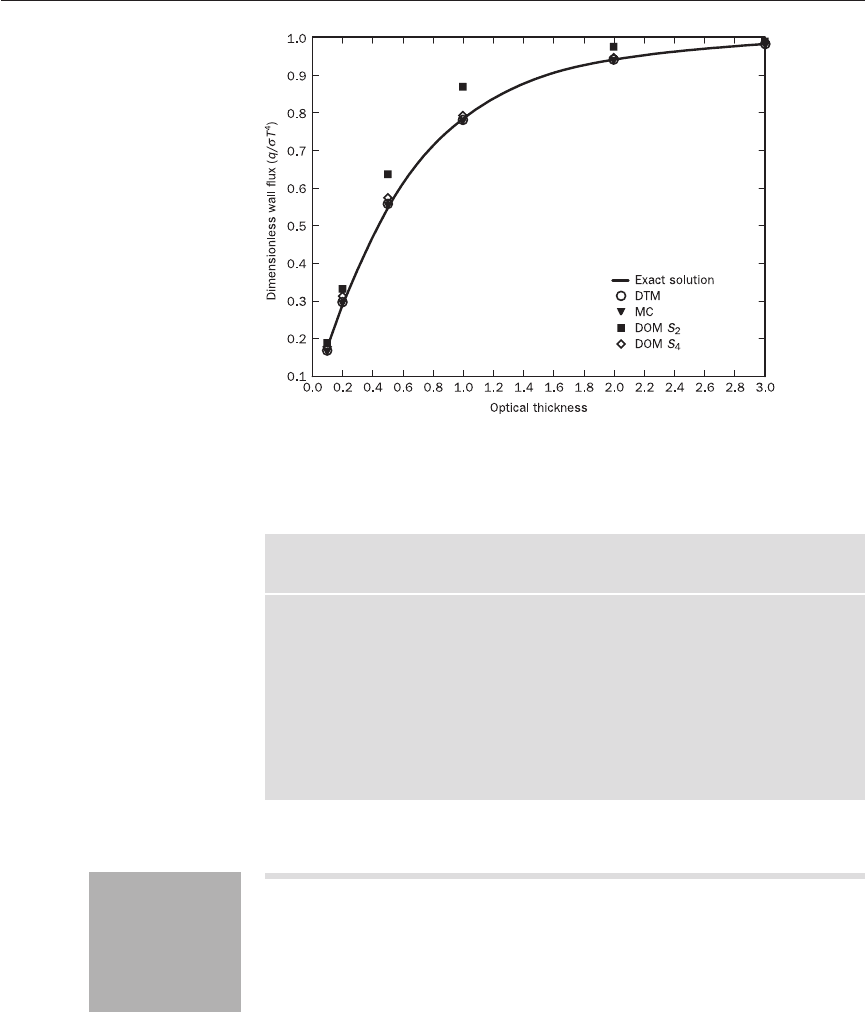
The predictions of the wall heat flux for all three solution methods are
compared with the analytical solution in Table 13.3 and Figure 13.11. It
can be seen that all solutions except the DOM S
2
appear to give good
agreement. The MC solution is the most accurate of all. The S
2
discrete
ordinates approximation is too simplistic to produce close agreement, but
it does predict the correct trend. In terms of calculation cost the resources
used by the DOM are negligible compared with the CPU times for the MC
method.
q
σ
(T
4
w
− T
4
g
)
q
σ
(T
4
w
− T
4
g
)
q
σ
(T
4
w
− T
4
g
)
q
σ
(T
4
w
− T
4
g
)
N/2
∑
i =1
1
π
q
σ
(T
4
w
− T
4
g
)
ANIN_C13.qxd 29/12/2006 04:49PM Page 439
Next we consider the much more challenging, but realistic problem of the
three-dimensional IFRF furnace geometry, which has been widely used
in the radiative heat transfer literature to evaluate calculation methods. The
configuration is outlined in detail in the paper by Jamaluddin and Smith
(1988). In this illustration we apply the MC, DTM and S
16
DOM methods
for the calculation of radiative flux to the floor and roof of the furnace,
described in the IFRF-M3 Trial (Flame 10). The furnace dimensions are
6.0 m × 2.0 m × 2.0 m in the x-, y- and z-directions and the measured tem-
peratures by Hyde and Truelove (1977) are used to define the radiation
problem. In the absence of an analytical solution, the MC results along with
the standard error estimate are used as the benchmark solution. The discrete
transfer calculation has been performed with 400 rays per surface element,
while S
16
quadrature is used for the discrete ordinates solution.
440 CHAPTER 13 CALCULATION OF RADIATIVE HEAT TRANSFER
Figure 13.11 Comparision of
numerical results for one-
dimensional temperature
prescribed problem
Table 13.3 Comparison of results from different solution methods for the one-
dimensional temperature prescribed problem
Optical Exact
thickness solution
MC DTM DOM S
2
DOM S
4
0.1 0.16742 0.167702 0.16923 0.18127 0.17626
0.2 0.29779 0.296686 0.29610 0.32968 0.31349
0.5 0.55732 0.557363 0.55680 0.63212 0.57800
1.0 0.78076 0.780648 0.78062 0.86467 0.78516
1.5 0.88551 0.886071 0.88653 0.95021 0.88134
2.0 0.93970 0.939207 0.93974 0.98168 0.93251
2.5 0.96737 0.966947 0.96740 0.99326 0.96122
3.0 0.98211 0.981435 0.98214 0.99752 0.97763
Example 13.2
Radiation in
a three-
dimensional
furnace
geometry
ANIN_C13.qxd 29/12/2006 04:49PM Page 440
13.5 ILLUSTRATIVE EXAMPLES 441
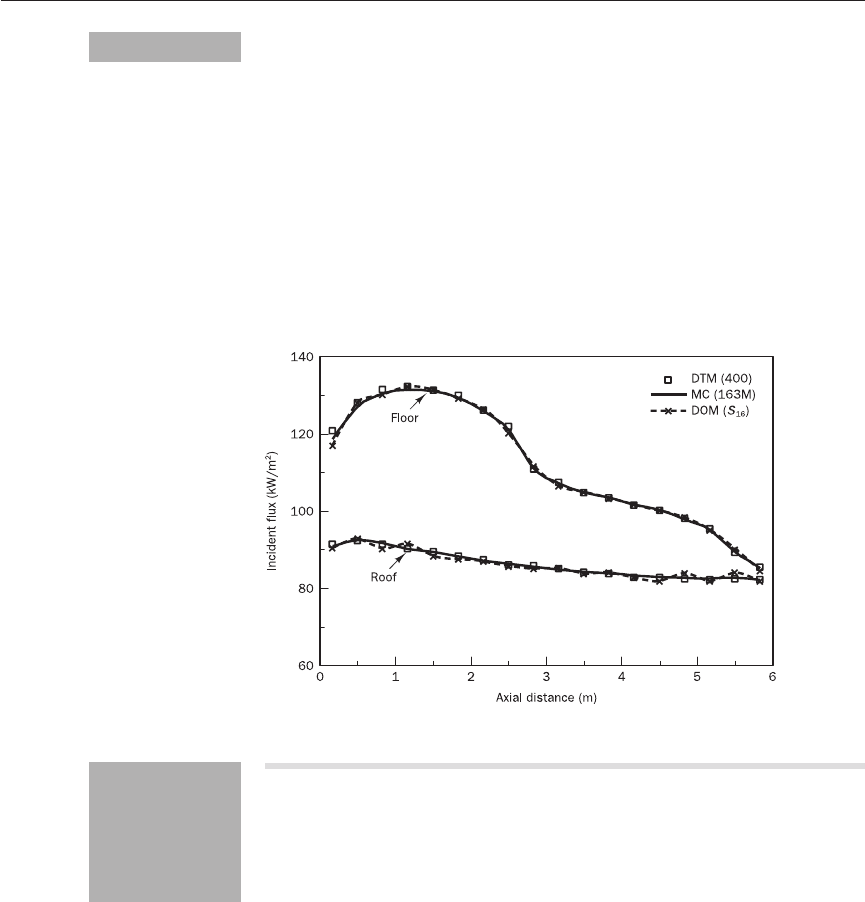
Figure 13.12 shows the calculated incident radiative flux on the floor and the
roof of the furnace, and it is clear that the differences between the 400-ray
discrete transfer, the S
16
discrete ordinates and the MC solutions are very
small. A closer look at the actual numerical values (not presented here)
reveals that the discrete ordinate solution has the highest deviation. This
could be attributed to its spatial differencing practice and the accuracy of the
quadrature set. Malalasekera et al. (2002) have also shown that lower-order
discrete ordinates solutions do not provide good agreement with MC results.
This example illustrates that careful selection of numerical discretisation
parameters for the DTM and DOM can yield solutions that are very close to
MC solutions. It is worth noting that MC solutions require a vast amount of
computer resources (more than 20 times larger compared with DTM and
DOM) and therefore are not suitable for practical calculations involving CFD.
Figure 13.12 Calculated
incident radiative flux on the
floor and the roof of the furnace.
DTM (400) is the discrete
transfer method solution with
400 rays per point, MC (163M)
is the Monte Carlo solution with
163 million bundles, and DOM
(S16) is the discrete ordinates
S
16
solution
In this example we present a further comparison of methods in the L-
shaped geometry shown in Figure 13.13. This more complex geometry has
also been used in the literature to evaluate different radiation calculation
techniques (Malalasekera and James, 1995, 1996; Henson and Malalasekera,
1997a; Sakami et al, 1998; Hsu and Tan, 1997). The problem specification is:
(i) all walls are black at a temperature of 500 K and (ii) the enclosure is filled
with an emitting/absorbing and non-scattering medium at a temperature of
1000 K. The L-shape presents additional complexity for solution methods
because in a CFD computation the geometry cannot be discretised using
Cartesian co-ordinates without unnecessarily wasting storage by blocking
off a large number of cells. For the application of the DTM the geometry
has been modelled using the non-orthogonal surface mesh shown in Fig-
ure 13.13. The standard discrete ordinates method is not applicable when a
non-orthogonal mesh is employed. Here we have used a special version of
the discrete ordinates method by Sakami et al (1998). Figure 13.14 shows the
predicted distribution of net radiative heat flux along line B–B (Figure 13.13)
for different values of the absorption coefficient
κ
= 0.5, 1.0, 2.0, 5.0 and 10.0
using the MC, DTM (16 × 16 rays per hemisphere), DOM method (with the
Example 13.3
Radiation in
three-
dimensional
complex
geometry
Solution
ANIN_C13.qxd 29/12/2006 04:49PM Page 441
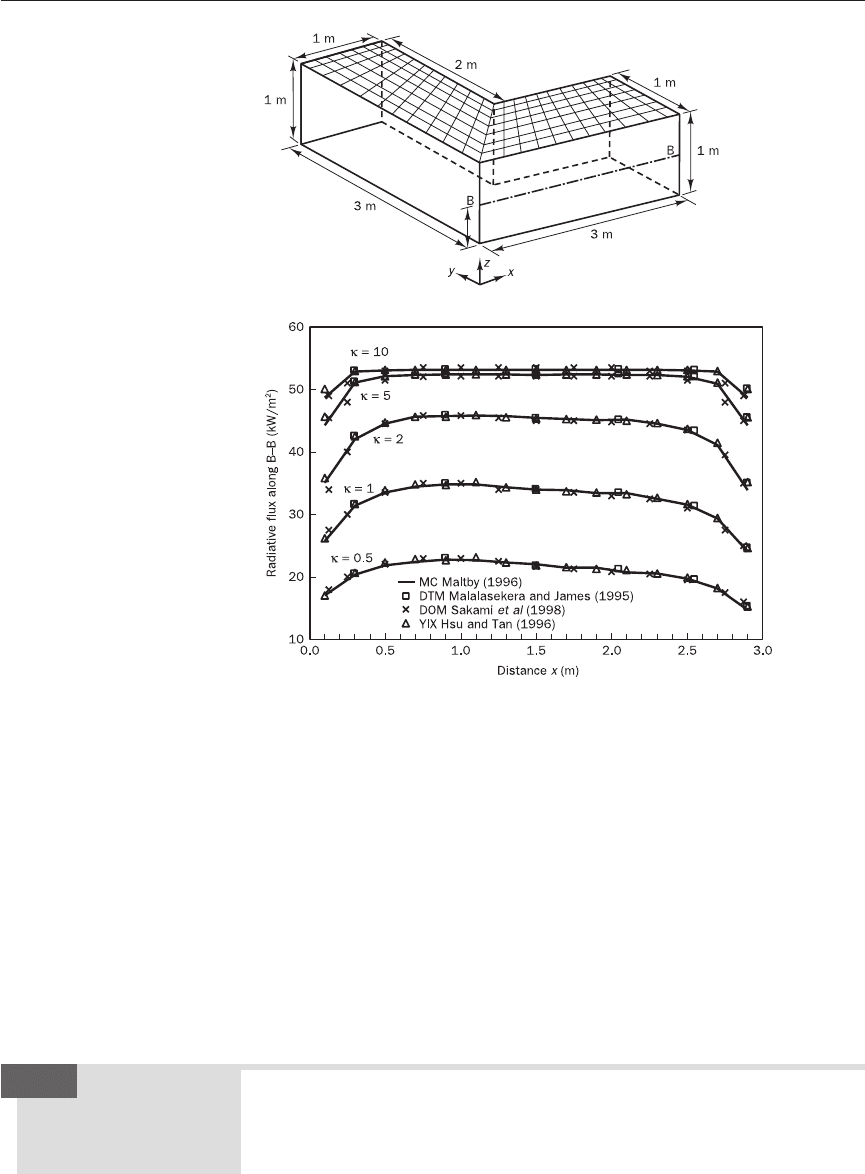
S
4
approximation), and also a general-purpose integral equation technique
known as the YIX method (Hsu et al, 1993). The discrete transfer solution
is from Malalasekera and James (1995), the MC results are by Maltby (1996)
and the YIX solution by Hsu and Tan (1997). The MC calculation has
been performed using a mesh of 204 volumes using symmetry and releasing
1 024 000 bundles per volume or per surface. It can be seen that results of all
methods agree very well. The example is a good illustration to show the flexi-
bility of the DTM and MC methods, which can both be applied without any
modifications to complex meshes. The DOM requires a special formulation.
When adequate resources are used all methods produce equally good results
that are in agreement with the MC solution. Further applications of the
DTM and MC method in complex geometry applications can be found in
Henson (1998), Henson and Malalasekera (1997a), Malalasekera and James
(1995, 1996) and Hsu and Tan (1997).
In many practical situations where radiative heat transfer is important,
e.g. furnaces and combustors, the participating medium consists of a gaseous
mixture of combustion products. Its radiative properties, such as the absorp-
tion coefficient, required for radiation calculations have to be evaluated by
442 CHAPTER 13 CALCULATION OF RADIATIVE HEAT TRANSFER
Figure 13.13 L-shaped
geometry
Figure 13.14 Comparison
of numerical results for the
L-shaped geometry
Calculation of
radiative
properties in
gaseous mixtures
13.6
ANIN_C13.qxd 29/12/2006 04:49PM Page 442

13.7 SUMMARY 443
considering the composition, temperature and pressure of the mixture.
Accurate calculations have to take into account the spectral characteristics of
radiative properties but, for practical purposes, total emissivity values and
scattering coefficients can be used. There are a number of well-established
techniques of estimating total properties, including spectral band models,
correlations for gas absorptivities and emissivities, k-distribution methods
and weighted-sum-of-grey-gases model. The most widely used approximate
radiative property calculation method for combustion problems is the weighted-
sum-of-grey-gases (WSGG) model (see above references). Another popular
model in the radiation literature is the RADCAL program of Groshandler
(1993), which takes into account detailed spectral properties. Detailed dis-
cussions of the techniques can be found in Siegel and Howell (2002),
Brewster (1992), Denison and Webb (1993, 1995) and Modest (2003).
When radiation is involved in combustion simulations the overall success
of predictions depends on many modelling aspects: flow and the turbulence
model, the combustion model, degree of detailed chemistry included, the
radiative property calculation methods and the radiation model. All these
are coupled and, therefore, given the available resources, the best possible
submodelling practice should be used to achieve a good overall result. More
advanced property calculations and finer radiation calculations will give the
benefit of higher accuracy and better resolution in radiation source terms.
The level of detail required in the application and affordable cost of a calcu-
lation is the major factor which determines the choice. It is well known that
temperatures are overpredicted if radiation is neglected. As minor species
such as NO are very sensitive to temperature, CFD combustion predictions
need to include radiation in order to achieve accurate predictions of these
pollutant species. In order to save computing resources it is sometimes pos-
sible to carry out the radiation calculations on a much coarser mesh than the
one used for the fluid flow and combustion calculations. The source terms
for the fluid flow calculation can be appropriately interpolated from the
coarse mesh calculation. This practice is quite adequate in many situations,
saving considerable computational overheads.
Most commercial CFD packages provide the user with the option of one or
more of the radiation models described in this chapter. Their main features
can be summarised as follows:
• Monte Carlo method: the most general and versatile of all models.
It requires very large amounts of computing resources and is, therefore,
unsuitable for general-purpose CFD calculations. The probabilistic
basis of the method enables its users to generate error estimates. The
MC method is useful in situations where solutions with quantifiable
uncertainty are required, e.g. for benchmarking and validation of
other models.
• Discrete transfer method: an economical general-purpose algorithm
based on ray tracing. The DTM has been successfully applied to a wide
range of combusting flows. It is suitable for all types of structured and
unstructured meshes. The DTM is limited to isotropic scattering, and
is non-conservative (non-zero sum of the radiative heat fluxes incident
upon the bounding surfaces of an enclosure); Coelho and Carvalho
Summary13.7
ANIN_C13.qxd 29/12/2006 04:49PM Page 443

(1997) have proposed a conservative DTM formulation. Uncertainty
estimates are available for a limited number of simple cases.
• Discrete ordinates method: a method based on the numerical quadrature
of angular direction integration and control volume integration for
path integration. The original method was limited to Cartesian and
axisymmetric grids, but the Sakami et al. (1996, 1998) DOM enables
applications involving unstructured meshes and more complex
geometry. The method in general is efficient and applicable to scattering
and non-scattering problems. Higher-order discrete ordinates are
required to achieve accuracy and one of the drawbacks of the method
is that it is non-conservative and can suffer from what are known as ‘ray
effects’ mainly due to the discretisation practice used in the formulation.
• Finite volume method: a method based on integration over the control
angle for direction integration and the control volume method for path
integration developed by Raithby and co-workers. The main advantage
of this method is that it is fully conservative and applicable to arbitrary
geometries. One of the disadvantages is that the method can incur errors
due to what is known as ‘solid angle overhanging’.
In this chapter we have presented the key aspects of the more popular
methods, which should clarify the role played by the numerical parameters
associated with each model (ray number, order of discrete ordinates, grey gas
models etc.). The interested reader should follow up the relevant literature
to understand the finer details of these methods and also to research the
many other methods that we were forced to omit for the sake of brevity.
444 CHAPTER 13 CALCULATION OF RADIATIVE HEAT TRANSFER
ANIN_C13.qxd 29/12/2006 04:49PM Page 444
In the derivations of Chapter 4 a linear profile assumption was used to cal-
culate the gradients (
∂φ
/
∂
x), (
∂φ
/
∂
y) etc. at the faces of the control volume.
For simple diffusion problems the practice was shown to give reasonably
accurate results even for coarse grids. In Example 4.3 we also observed that
by refining the grid the accuracy of the solution can be improved. Grid
refinement is the main tool at the disposal of the CFD user for the improve-
ment of the accuracy of a simulation. The user would typically perform a
simulation on a coarse mesh first to get an impression of the overall features
of the solution. Subsequently the grid is refined in stages until no (signific-
ant) differences of results occur between successive grid refinement stages.
Results are then called ‘grid independent’. Here we briefly demonstrate the
theoretical basis of this method of accuracy improvement and compare the
order of discretisation schemes as a measure their efficacy.
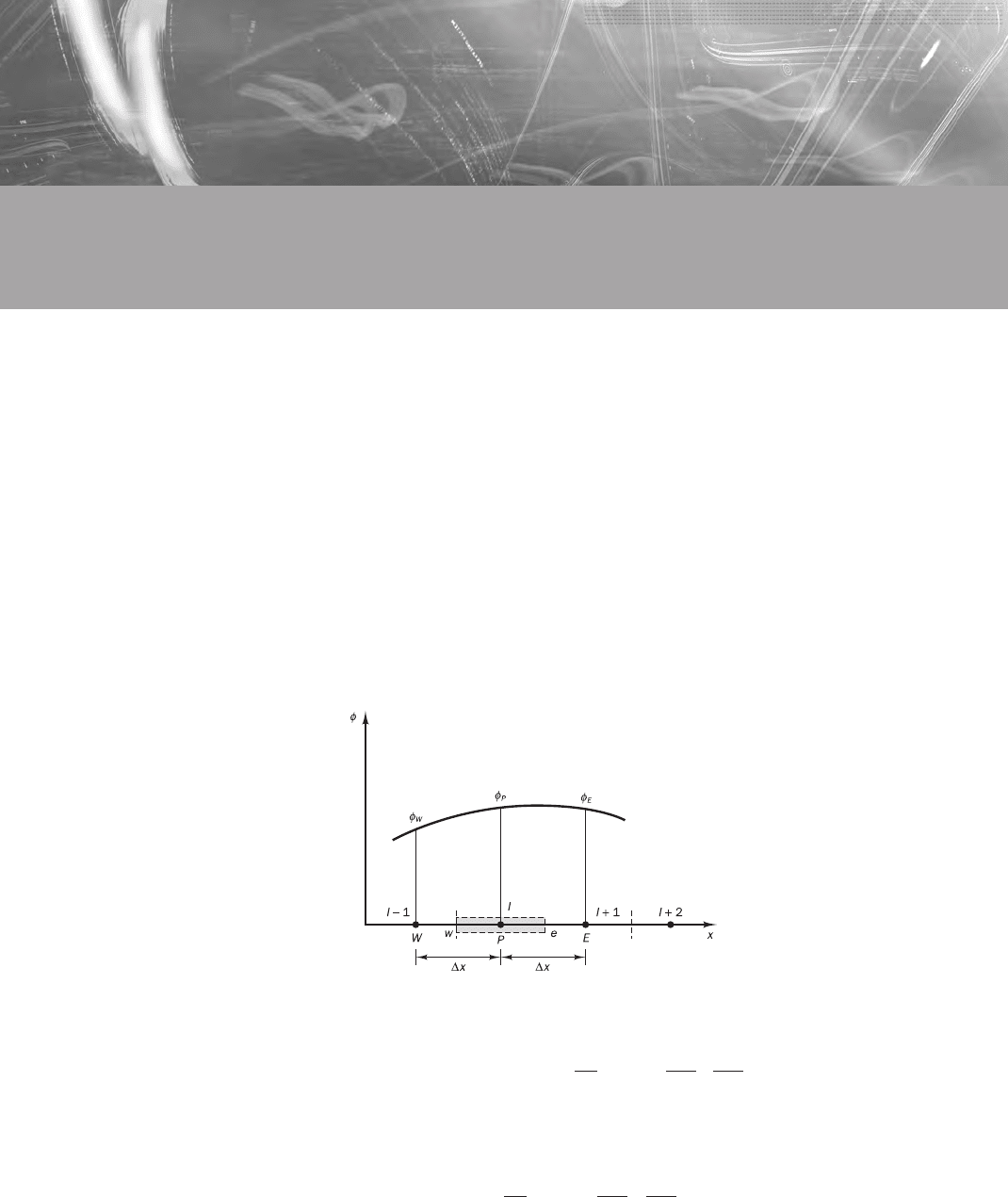
Consider the equally spaced one-dimensional grid (spacing ∆x) shown in
Figure A.1.
Appendix A Accuracy of a flow simulation
Figure A.1
For a function
φ
(x) the Taylor series development of
φ
(x +∆x) around
the point i at x is
φ
(x +∆x) =
φ
(x) +
x
∆x +
x
+ . . . (A.1)
In our notation we use discrete values
φ
P
and
φ
E
for
φ
(x) and
φ
(x +∆x)
respectively so that equation (A.1) can be written as
φ
E
=
φ
P
+
P
∆x +
P
+ . . . (A.2)
∆x
2
2
D
E
F
∂
2
φ
∂
x
2
A
B
C
D
E
F
∂φ
∂
x
A
B
C
∆x
2
2
D
E
F
∂
2
φ
∂
x
2
A
B
C
D
E
F
∂φ
∂
x
A
B
C
ANIN_Z01.qxd 29/12/2006 10:06 AM Page 445

446 APPENDIX A
This may be rearranged to give
P
∆x =
φ
E
−
φ
P
−
P
− . . . (A.3)
P
=−
P
− ...
So
P
=+Truncated terms (A.4)
By neglecting the truncated terms which involve the multiplying factor ∆x
we may write
P
≈ (A.5)
The error involved in the approximation (A.5) is due to neglect of the trun-
cated terms. Formula (A.3) suggests that the truncation error can be reduced
by decreasing ∆x. In general the truncated terms of a finite difference scheme
contain factors ∆x
n
. The power n of ∆x governs the rate at which the error
tends to zero as the grid is refined and is called the order of the difference
approximation. Therefore equation (A.5) is said to be first-order in ∆x and
we write
P
=+O(∆x) (A.6)
Since it uses values at points E and P (where x
E
> x
P
) to evaluate the gradi-
ent (
∂φ
/
∂
x) at P, formula (A.6) is called a forward difference formula with
respect to point P.
Similarly we may derive a backward difference formula for (
∂φ
/
∂
x) at P
from
φ
(x −∆x) =
φ
(x) −
x
∆x +
x
+ . . . (A.7)
After some algebra we find the backward difference formula for (
∂φ
/
∂
x) at P:
P
=+O(∆x) (A.8)
Equations (A.7) and (A.8) are both first-order accurate. The backward and
forward difference formulae described here involve values of
φ
at two points
only.
By subtracting equation (A.7) from (A.1) we get
φ
(x +∆x) −
φ
(x −∆x) = 2
P
∆x +
P
+ . . . (A.9)
∆x
3
3!
D
E
F
∂
3
φ
∂
x
3
A
B
C
D
E
F
∂φ
∂
x
A
B
C
φ
P
−
φ
W
∆x
D
E
F
∂φ
∂
x
A
B
C
∆x
2
2
D
E
F
∂
2
φ
∂
x
2
A
B
C
D
E
F
∂φ
∂
x
A
B
C
φ
E
−
φ
P
∆x
D
E
F
∂φ
∂
x
A
B
C
φ
E
−
φ
P
∆x
D
E
F
∂φ
∂
x
A
B
C
φ
E
−
φ
P
∆x
D
E
F
∂φ
∂
x
A
B
C
∆x
2
D
E
F
∂
2
φ
∂
x
2
A
B
C
φ
E
−
φ
P
∆x
D
E
F
∂φ
∂
x
A
B
C
∆x
2
2
D
E
F
∂
2
φ
∂
x
2
A
B
C
D
E
F
∂φ
∂
x
A
B
C
ANIN_Z01.qxd 29/12/2006 10:06 AM Page 446