
Versteeg H., Malalasekra W. An Introduction to Computational Fluid Dynamics: The Finite Volume Method
Подождите немного. Документ загружается.

APPENDIX A 447
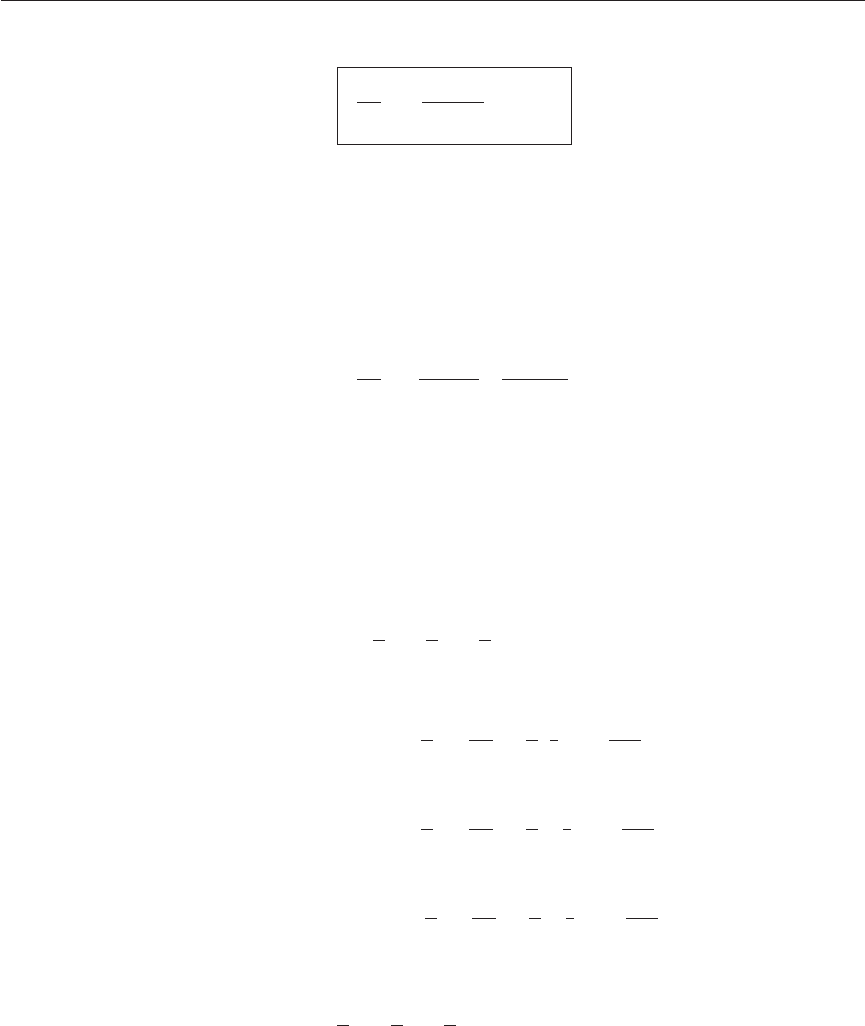
A third formula for (
∂φ
/
∂
x)
P
can be obtained by rearranging equation (A.9) as
P
=+O(∆x
2
) (A.10)
Equation (A.10) uses values at E and W to evaluate the gradient at the mid-
point P, and is called a central difference formula. The central differencing
formula is second-order accurate. The quadratic dependence of the error on
grid spacing means that after grid refinement the error reduces more quickly
in a second-order accurate differencing scheme than in a first-order accurate
scheme.
In the finite volume discretisation procedure developed in section 4.2 the
gradient at a cell face, e.g. at ‘e’, was evaluated using
e
== (A.11)
By comparing formulae (A.10) and (A.11) it can be easily recognised that
(A.11) evaluates the gradient at the midpoint between P and E through a
central difference formula at point ‘e’: therefore its accuracy is second-order
for uniform grids.
It is relatively straightforward to demonstrate the third-order accuracy of
the QUICK differencing scheme for the convective flux at a midpoint cell
face in a uniform grid of spacing ∆x. The QUICK scheme calculates the
value
φ
e
at the east cell face of a general node as
φ
e
=
φ
E
+
φ
P
−
φ
W
(A.12)
Taylor series expansion about the east face gives
φ
E
=
φ
e
+∆x
e
+∆x
2
e
+ O(∆x
3
) (A.13)
φ
P
=
φ
e
−∆x
e
+−∆x
2
e
+ O(∆x
3
) (A.14)
φ
W
=
φ
e
−∆x
e
+−∆x
2
e
+ O(∆x
3
) (A.15)
If we add together 3/8 × (A.13) + 6/8 × (A.14) − 1/8 × (A.15) we obtain
φ
E
+
φ
P
−
φ
W
=
φ
e
+ O(∆x
3
) (A.16)
The terms involving orders ∆x and ∆x
2
cancel out in this uniform grid and
the QUICK scheme is a third-order accurate approximation.
If necessary formulae involving more points (in backward or forward
directions) can be derived which have higher-order accuracy: see texts such
as Abbott and Basco (1989) or Fletcher (1991) for further details.
1
8
6
8
3
8
D
E
F
∂
2
φ
∂
x
2
A
B
C
D
E
F
3
2
A
B
C
1
2
D
E
F
∂φ
∂
x
A
B
C
3
2
D
E
F
∂
2
φ
∂
x
2
A
B
C
D
E
F
1
2
A
B
C
1
2
D
E
F
∂φ
∂
x
A
B
C
1
2
D
E
F
∂
2
φ
∂
x
2
A
B
C
D
E
F
1
2
A
B
C
1
2
D
E
F
∂φ
∂
x
A
B
C
1
2
1
8
6
8
3
8
φ
E
−
φ
P
2(∆x/2)
φ
E
−
φ
P
∆x
D
E
F
∂φ
∂
x
A
B
C
φ
E
−
φ
W
2∆x
D
E
F
∂φ
∂
x
A
B
C
ANIN_Z01.qxd 29/12/2006 10:06 AM Page 447
For the sake of simplicity the worked examples have focused on uniform
grids of nodal points. However, the derivation of discretised equations in
Chapters 4 and 5 used general geometrical dimensions such as
δ
x
PE
,
δ
x
WP
etc. and is also valid for non-uniform grids. In a non-uniform grid the faces
e and w of a general node may not be at the midpoints between nodes E
and P, and nodes W and P, respectively. In this case the interface values of
diffusion coefficients Γ are calculated as follows:
Γ
w
= (1 − f
W
)Γ
W
+ f
W
Γ
P
(B.1a)
where the interpolation factor f
w
is given by
f
W
= (B.1b)
and
Γ
e
= (1 − f
P
)Γ
P
+ f
P
Γ
E
(B.1c)
where
f
P
= (B.1d)
For a uniform grid these expressions simplify to equations (4.5a–b): since
f
W
= 0.5, f
P
= 0.5, we have Γ
w
= (Γ
W
+Γ
P
)/2 and Γ
e
= (Γ
P
+Γ
E
)/2.
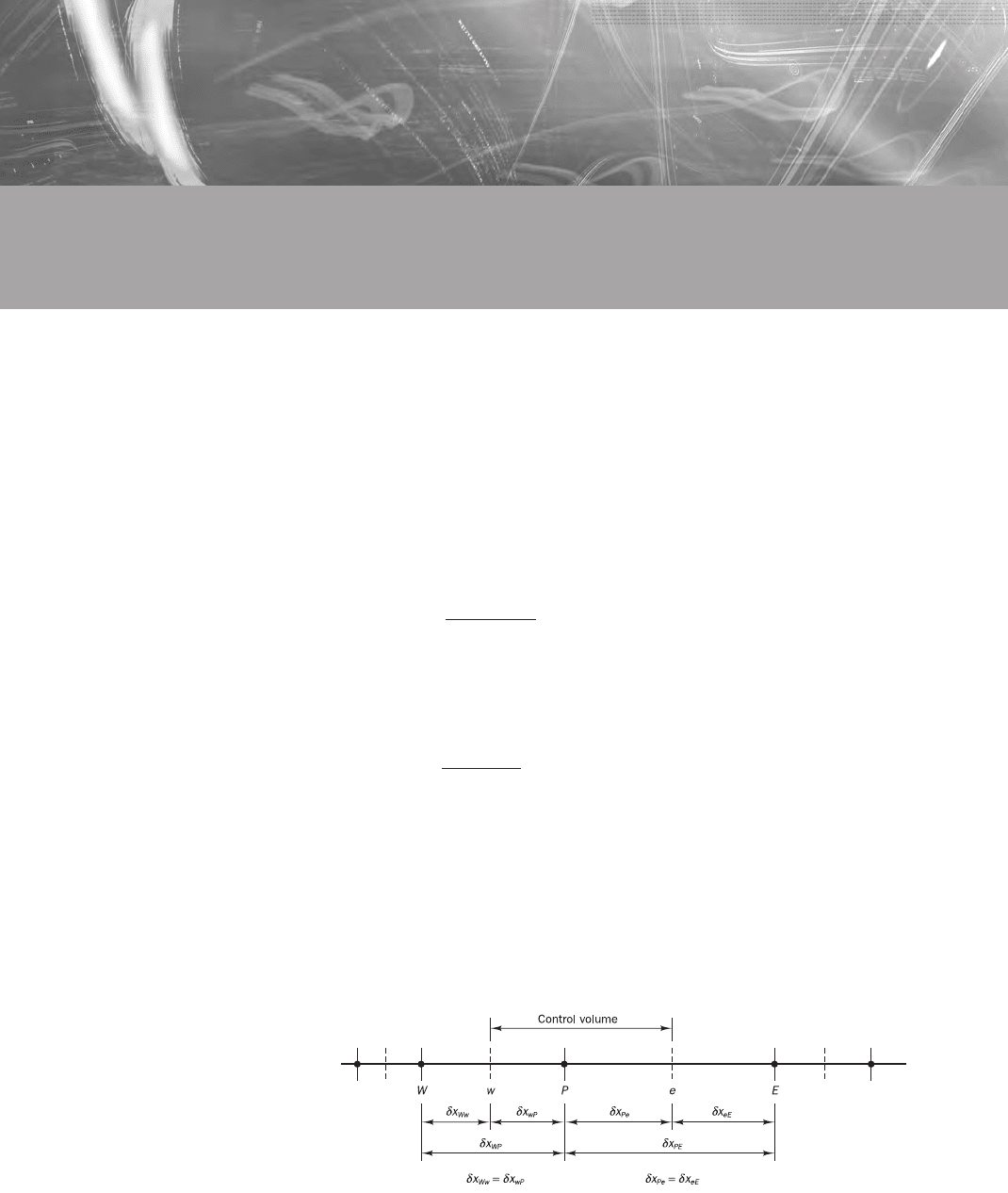
Basically there are two practices used to locate control volume faces in
non-uniform grids (Patankar, 1980):
Practice A: Nodal points are defined first and the control volume faces
located mid-way between the grid points. This is illustrated in Figure B.1.
δ
x
Pe
δ
x
Pe
+
δ
x
eE
δ
x
Ww
δ
x
Ww
+
δ
x
wP
Appendix B Non-uniform grids
Figure B.1
ANIN_Z02.qxd 29/12/2006 10:06 AM Page 448
APPENDIX B 449
Here the faces of a control volume are not at the midpoint between the
nodes. The evaluation of gradients obtained through a linear approximation
is unaffected because the gradient remains the same at any point between the
nodes in question, but the values of diffusion coefficient Γ need to be evalu-
ated using interpolation functions (B.1).
It is very important to note that central difference formulae for the
calculation of gradients at cell faces and the QUICK scheme for convective
fluxes are only second- and third-order accurate respectively when the con-
trol volume face is mid-way between nodes. In practice A a control volume
face, e for example, is mid-way between nodes P and E, so the differencing
formula used to evaluate the gradient (
∂φ
/
∂
x)
e
is second-order accurate.
A further advantage of practice A is that property values Γ
e
, Γ
w
etc. can be
easily evaluated by taking the average values. The disadvantage of practice A
is that the value of the variable
φ
at P may not necessarily be the most repres-
entative value for the entire control volume as point P is not at the centre of
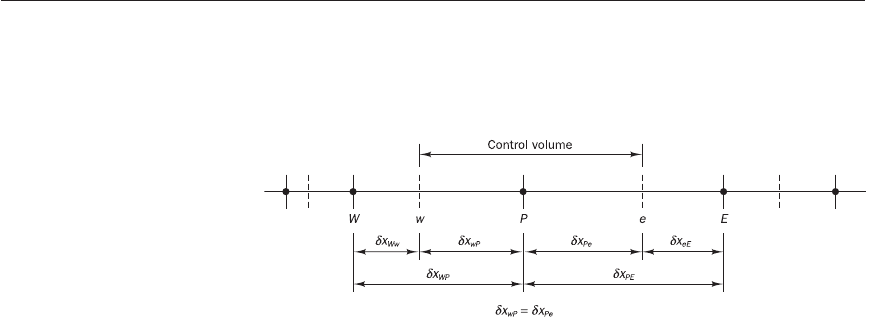
the control volume. In practice B the value of
φ
at P is a good representative
value for the control volume as P lies at the centre of the control volume, but
the discretisation schemes lose accuracy. A thorough discussion of these two
practices can be found in Patankar (1980), to which the reader is referred for
further details.
Figure B.2
Practice B: Locations of the control volume faces are defined first and the
nodal points are placed at the centres of the control volumes. This is illus-
trated in Figure B.2.
ANIN_Z02.qxd 29/12/2006 10:06 AM Page 449
Source terms of the discretised equations are evaluated using prevailing
values of the variables. Since a staggered grid is employed in the calculation
procedures, interpolation is required in the calculation of velocity gradient
terms which often appear in source terms. For example, consider the two-
dimensional u-momentum equation
(
ρ
uu) + (
ρ
vu) =
µ
+
µ
−+S
u
(C.1)
where
S
u
=
µ
+
µ
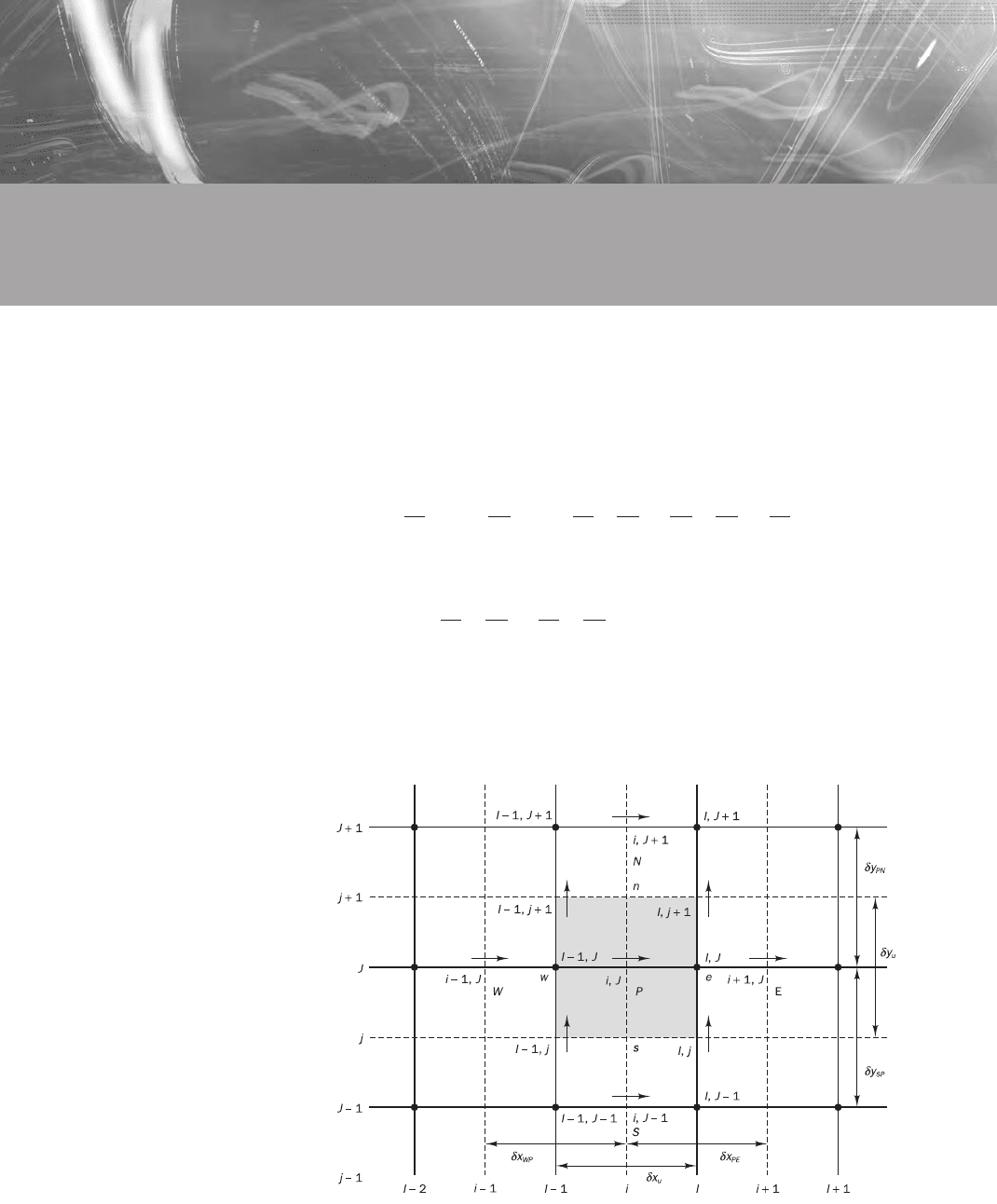
A small part of the solution grid is shown in Figure C.1; we use the standard
notation for the backward staggered velocity components introduced in
Chapter 6.
D
E
F
∂
v
∂
x
A
B
C
∂
∂
y
D
E
F
∂
u
∂
x
A
B
C
∂
∂
x
∂
p
∂
x
D
E
F
∂
u
∂
y
A
B
C
∂
∂
y
D
E
F
∂
u
∂
x
A
B
C
∂
∂
x
∂
∂
y
∂
∂
x
Appendix C Calculation of source terms
Figure C.1
ANIN_Z03.qxd 29/12/2006 10:07 AM Page 450

APPENDIX C 451
The discretised form of equation (C.1) for the u-control volume centred
at (i, J ) is
a
i, J
u
i, J
=∑a
nb
u
nb
−∆V
u
+ D
u
∆V
u
(C.2)
where
δ
x
u
is the width of the u-control volume and ∆V
u
is the volume of the
u-control volume.
The source term for the u-velocity equation at the cell shown is evaluated
as
D
u
∆V =
µ
+
µ
Cell
∆V
µ
e
−
µ
w
+
µ
n
−
µ
s
= ∆V
µ
−
µ
=
µ
−
µ
+
δ
x
u
δ
y
u
(C.3)
Source terms of other equations are calculated in a similar manner.
J
K
K
K
L
δ
y
u
D
E
F
v
I, j
− v
I−1, j
∂
x
u
A
B
C
D
E
F
v
I, j+1
− v
I−1, j+1
∂
x
u
A
B
C
δ
x
u
G
H
H
H
I
D
E
F
u
i, J
− u
i−1, J
∂
x
WP
A
B
C
D
E
F
u
i+1, J
− u
i, J
∂
x
PE
A
B
C
J
K
K
K
L
δ
y
u
δ
x
u
G
H
H
H
I
D
E
F
∂
v
∂
x
A
B
C
D
E
F
∂
v
∂
x
A
B
C
D
E
F
∂
u
∂
x
A
B
C
D
E
F
∂
u
∂
x
A
B
C
J
K
L
D
E
F
∂
v
∂
x
A
B
C
∂
∂
y
D
E
F
∂
u
∂
x
A
B
C
∂
∂
x
G
H
I
(P
I, J
− P
I−1, J
)
δ
x
u
ANIN_Z03.qxd 29/12/2006 10:07 AM Page 451
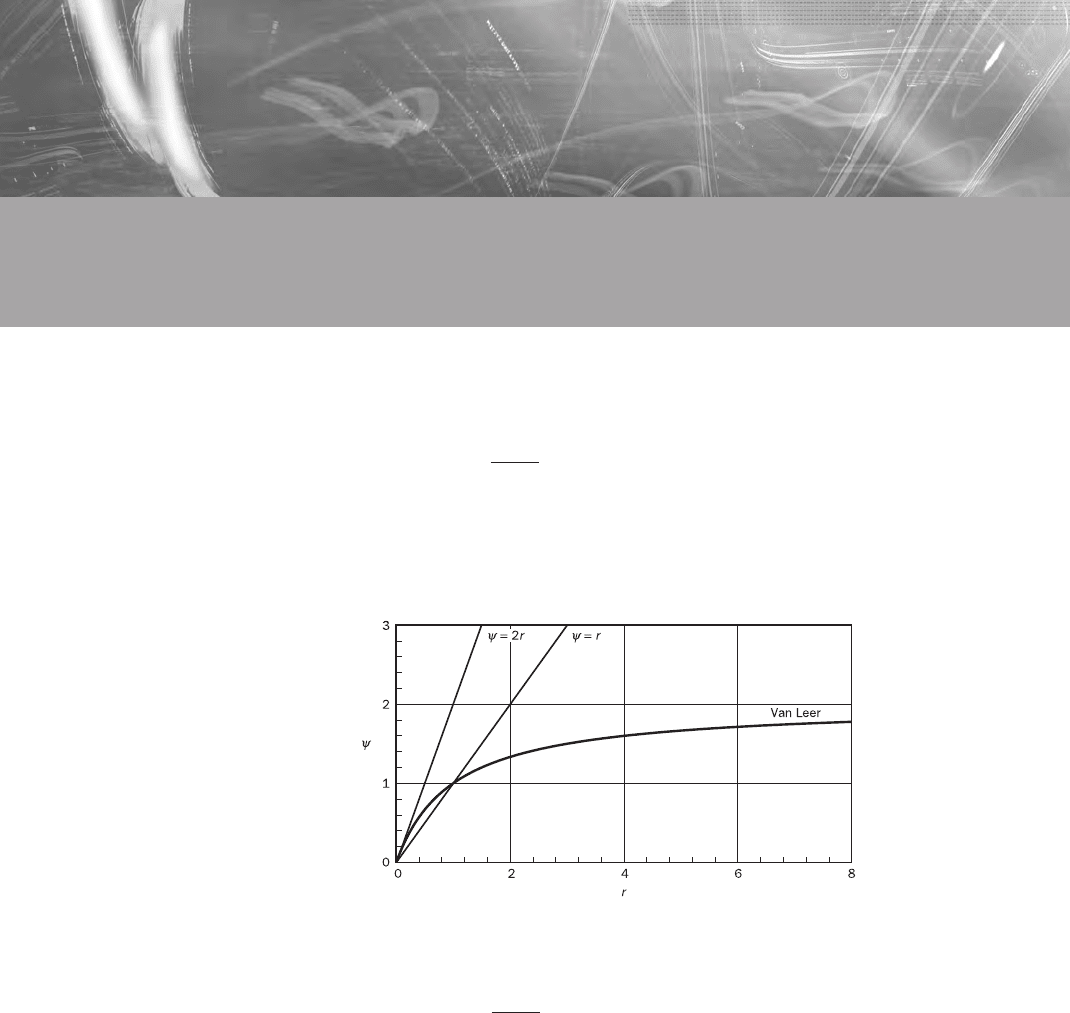
1 Van Leer limiter (Van Leer, 1974):
ψ
(r) = (D.1)
Figure D.1 shows this limiter on a r−
ψ
diagram. The limiter function
stays in the TVD region and goes through the point (1, 1), so it is
therefore a second-order accurate TVD limiter. The limiter tends
to
ψ
= 2 for large values of r and is symmetrical.
r +|r |
1 + r
Figure D.1 Van Leer limiter
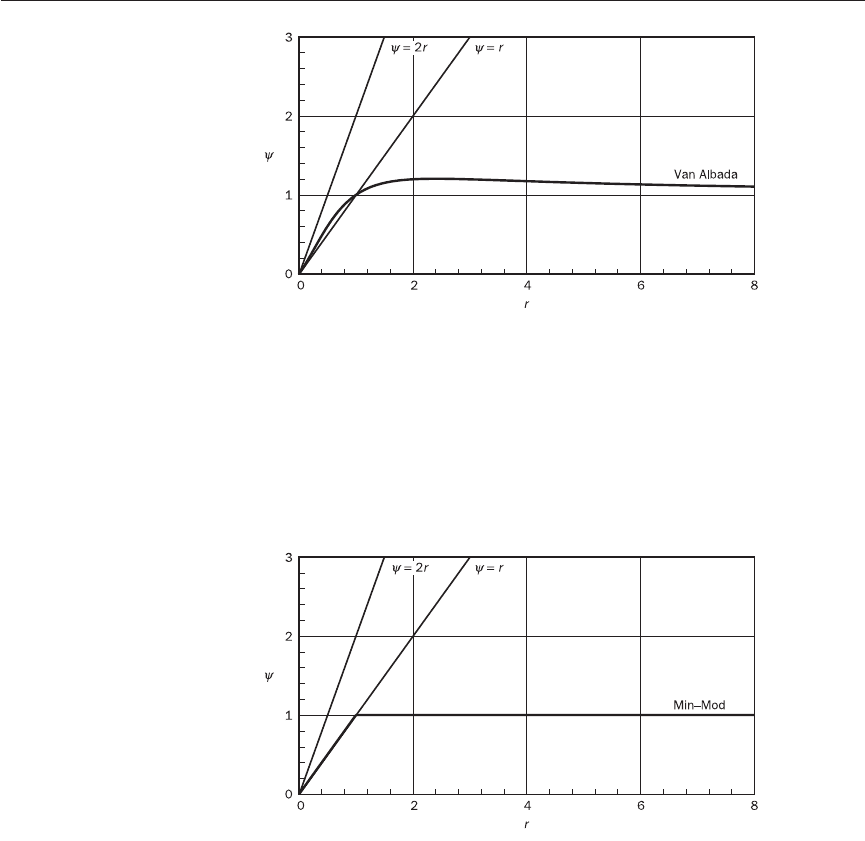
2 Van Albada limiter (Van Albada et al, 1982):
ψ
(r) = (D.2)
This function is shown in Figure D.2. This limiter also goes through
(1, 1) and stays well below the upper limit for TVD schemes. As can be
seen from Figure D.2, this limiter tends to
ψ
= 1 as r →∞. It is
straightforward to check that the limiter is symmetrical.
r + r
2
1 + r
2
1
For details of references see Chapter 5.
Appendix D Limiter functions used in
Chapter 5
1
ANIN_Z04.qxd 29/12/2006 10:08 AM Page 452
APPENDIX D 453
Figure D.2 Van Albada limiter
Figure D.3 Min–Mod limiter
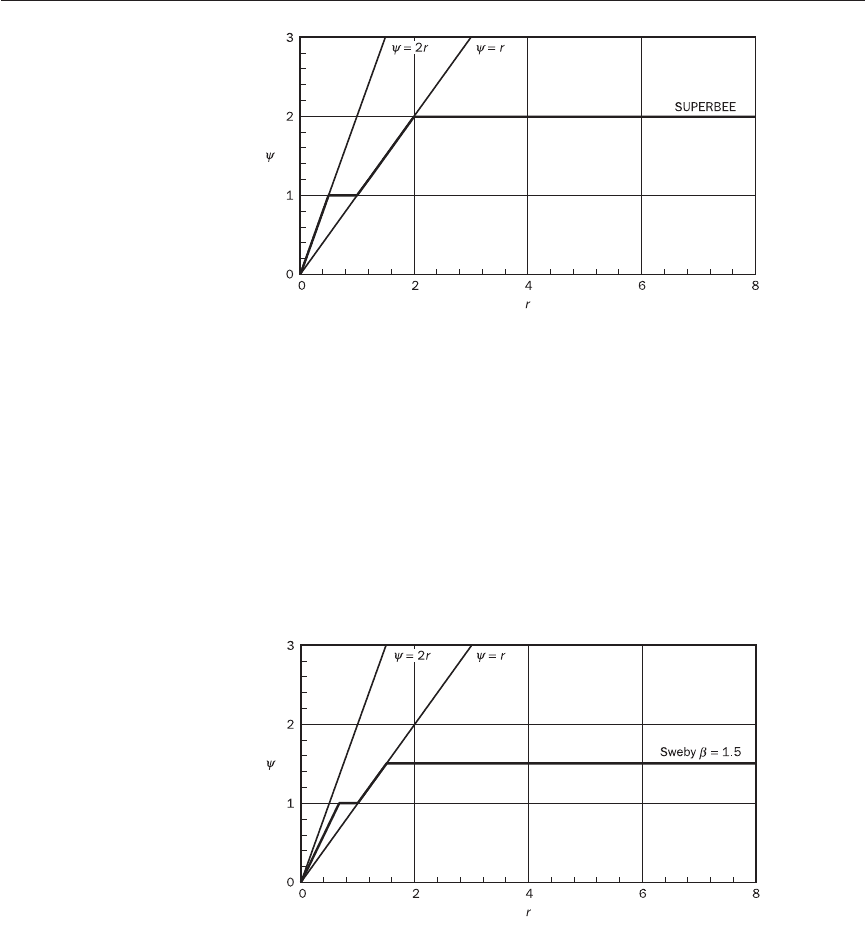
4 SUPERBEE limiter of Roe (1983):
ψ
(r) = max[0, min(2r, 1), min(r, 2)] (D.4)
Figure D.4 shows that this limiter is also a combination of linear
expressions. The limiter is symmetrical and follows the upper limit
of the TVD region on the r−
ψ
diagram.
3 Min–Mod limiter:
ψ
(r) =
!
min(r, 1) if r > 0
@
0 if r ≤ 0 (D.3)
Figure D.3 shows that this limiter is piecewise linear and follows the
lowest boundary for a second-order accurate TVD scheme on a r−
ψ
diagram. The limiter is symmetrical.
ANIN_Z04.qxd 29/12/2006 10:08 AM Page 453
454 APPENDIX D
Figure D.4 SUPERBEE limiter
Figure D.5 Sweby limiter
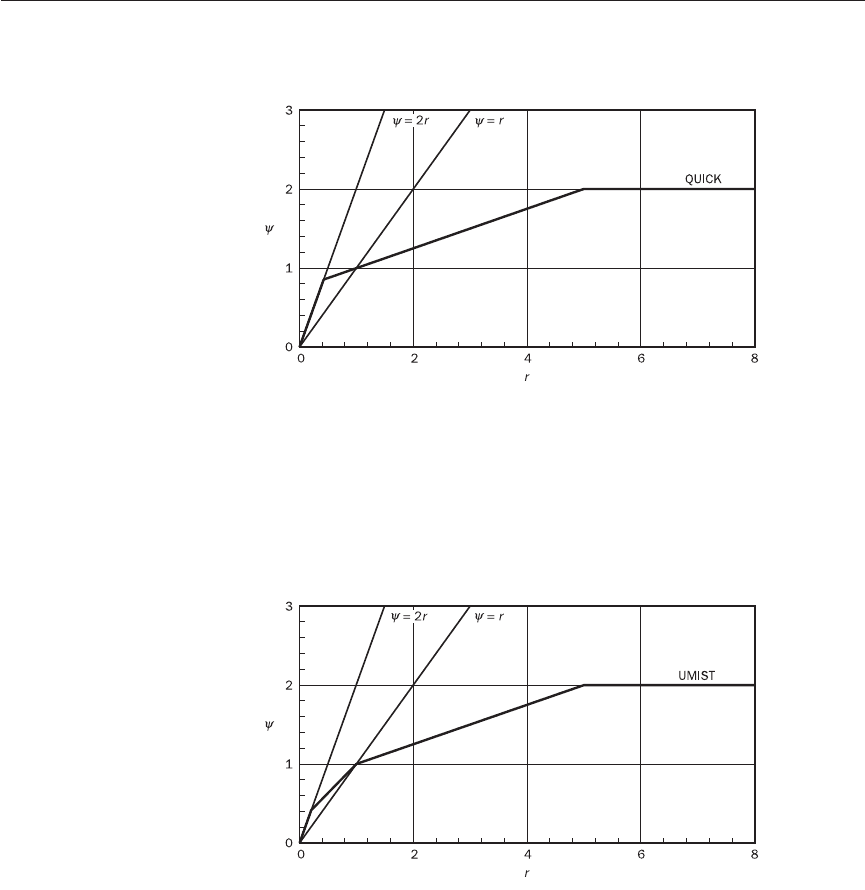
6 QUICK limiter of Leonard (Leonard, 1988): A monotonic TVD version
of the QUICK scheme can be achieved by the following function
(see Lien and Leschziner, 1993):
ψ
(r) = max[0, min(2r, (3 + r)/4, 2)] (D.6)
5 Sweby limiter (Sweby, 1984): This limiter represents a generalisation of
the Min–Mod and SUPERBEE limiters by means of a single parameter
β
. The limiter function is as follows:
ψ
(r) = max[0, min(
β
r, 1), min(r,
β
)] (D.5)
The limiter is symmetrical. We consider only the range of values
1 ≤
β
≤ 2, and note that Sweby’s limiter becomes the Min–Mod
limiter when
β
= 1 and the SUPERBEE limiter of Roe when
β
= 2.
The limiters span the whole TVD region between its upper and
lower limits. Figure D.5 shows the r−
ψ
diagram for Sweby’s limiter
when
β
= 1.5.
ANIN_Z04.qxd 29/12/2006 10:08 AM Page 454
APPENDIX D 455
Figure D.6 QUICK limiter
Figure D.7 UMIST limiter
Figure D.6 shows the r−
ψ
diagram for this limiter, which is not
symmetric.
7 UMIST limiter (Lien and Leschziner, 1993): UMIST, which stands
for Upstream Monotonic Interpolation for Scalar Transport, is a
symmetrical form of the QUICK limiter. The function is given by
ψ
(r) = max[0, min(2r, (1 + 3r)/4, (3 + r)/4, 2)] (D.7)
Figure D.7 shows this limiter on the r−
ψ
diagram.
ANIN_Z04.qxd 29/12/2006 10:08 AM Page 455
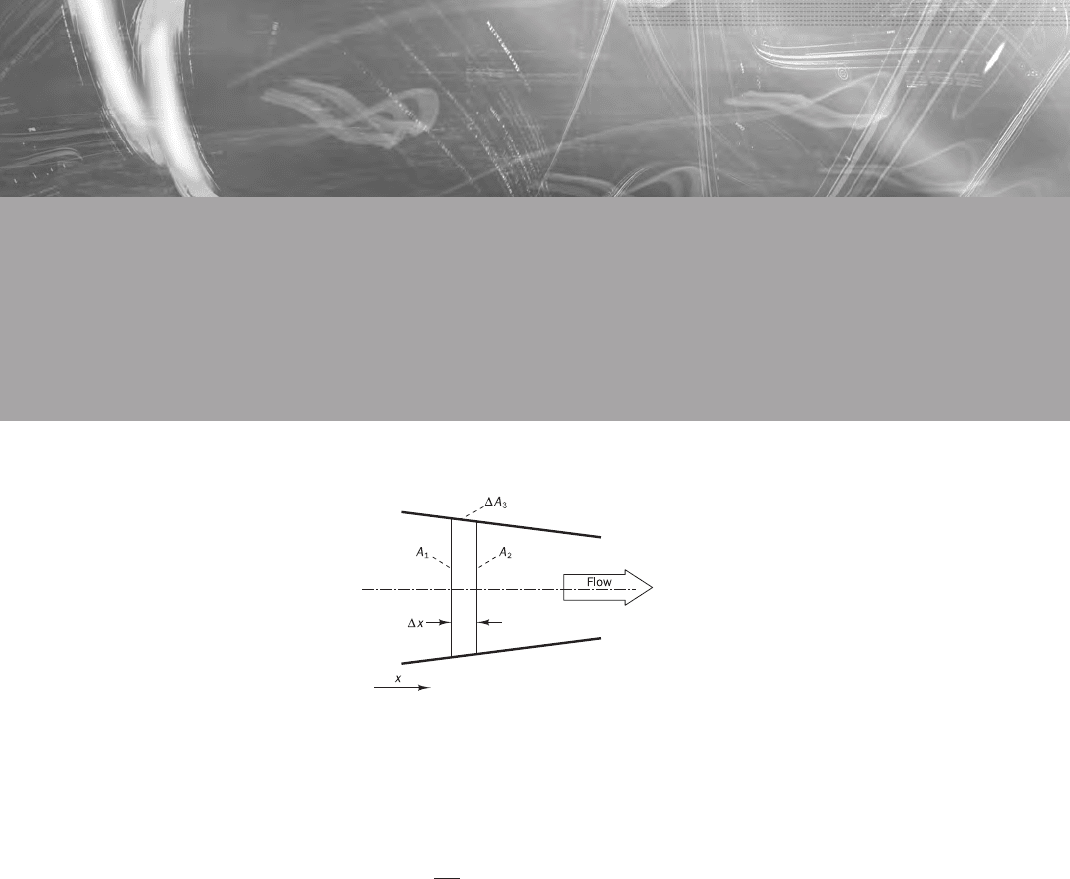
We develop one-dimensional equations for frictionless, incompressible flow
by application of the mass conservation and x-momentum equations from
Chapter 2 to a small control volume ∆V of length ∆x in the flow direction.
Mass conservation:
+ div(
ρ
V ) = 0 (2.4)
Since the flow is steady we have: div(
ρ
V) = 0 (E.1)
We integrate over the control volume and apply Gauss’ divergence theorem
(2.41) to convert the resulting volume integral into an integral over the
bounding surfaces of the control volume:
div(
ρ
V)dV =
ρ
V . ndA +
ρ
V . ndA +
ρ
V . ndA = 0 (E.2)
There is no mass flow across the side walls, so the last integral over ∆A
3
is
equal to zero.
The velocity distribution is uniform and the velocity only changes as
a function of the streamwise x-co-ordinate. The velocity vector V
1
is in
the positive x-direction, so V
1
=+u
1
i, where u
1
is the magnitude of the
x-velocity at A
1
; similarly V
2
=+u
2
i, where u
2
is the magnitude of the x-
velocity at A
2
. The outward normal vector n
1
is in the negative x-direction,
so n
1
=−i. The outward normal vector n
2
on the other hand is in the posi-
tive x-direction, so n
2
=+i. Thus,
∆A
3
A
2
A
1
∆V
∂ρ
∂
t
Appendix E Derivation of one-dimensional
governing equations for steady,
incompressible flow through
a planar nozzle
Figure E.1
ANIN_Z05.qxd 29/12/2006 10:08 AM Page 456