
Watts J.F., Wolstenholme J. An Introduction to Surface Analysis by XPS and AES
Подождите немного. Документ загружается.

METALLURGY
ir
10
f
3
O
JD
10
2
OJ
aFe-Sb
aFfeSn»V
•Cu-Sb
•aFe-P
»crFe-P
/ •
aFe-P
/ypf
Sn
• •
*crFe-Sn
are-sn*
_ .
^aFe-Cu
•aFe-Cu
io-
2
Atomic
solid solubility,
10-
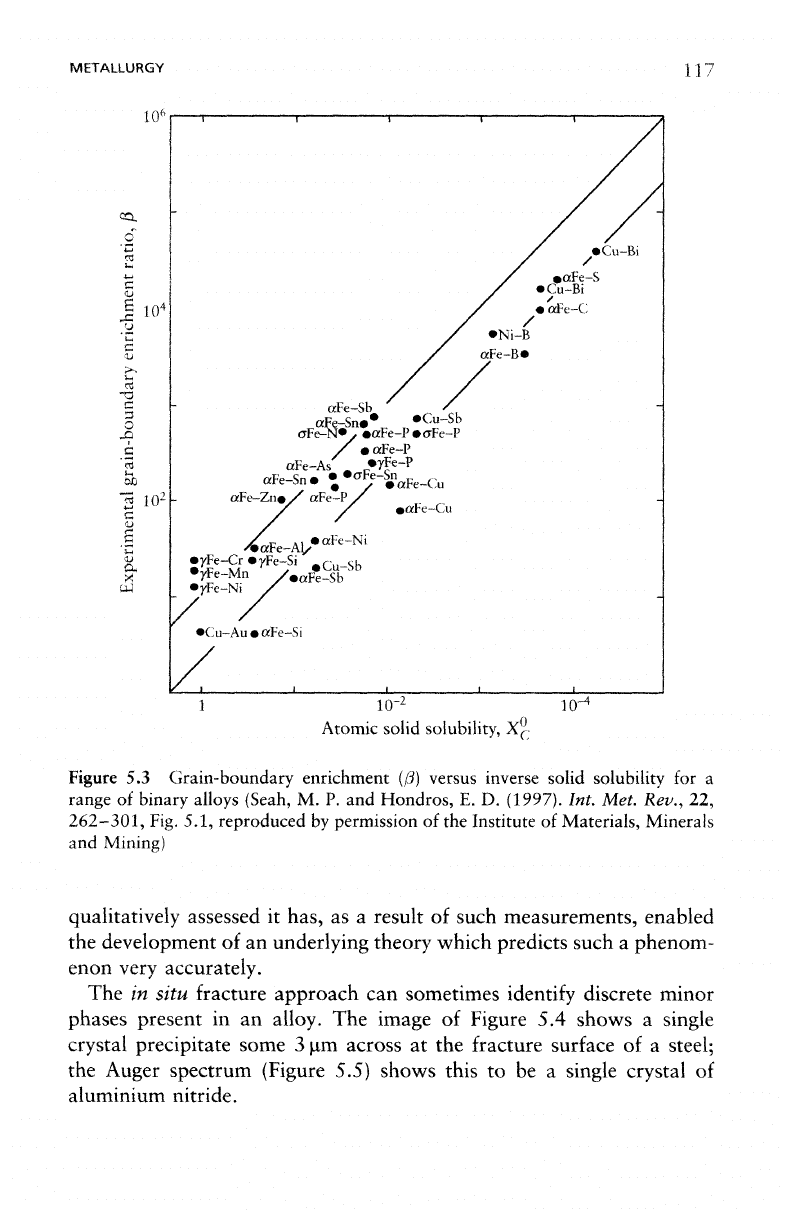
Figure
5.3
Grain-boundary enrichment
([3)
versus inverse solid solubility
for a
range
of
binary
alloys
(Seah,
M. P. and
Hondros,
E. D.
(1997).
Int. Met. Rev.,
22,
262-301,
Fig.
5.1,
reproduced
by
permission
of the
Institute
of
Materials, Minerals
and
Mining)
qualitatively
assessed
it
has,
as a
result
of
such measurements, enabled
the
development
of an
underlying theory which predicts such
a
phenom-
enon
very
accurately.
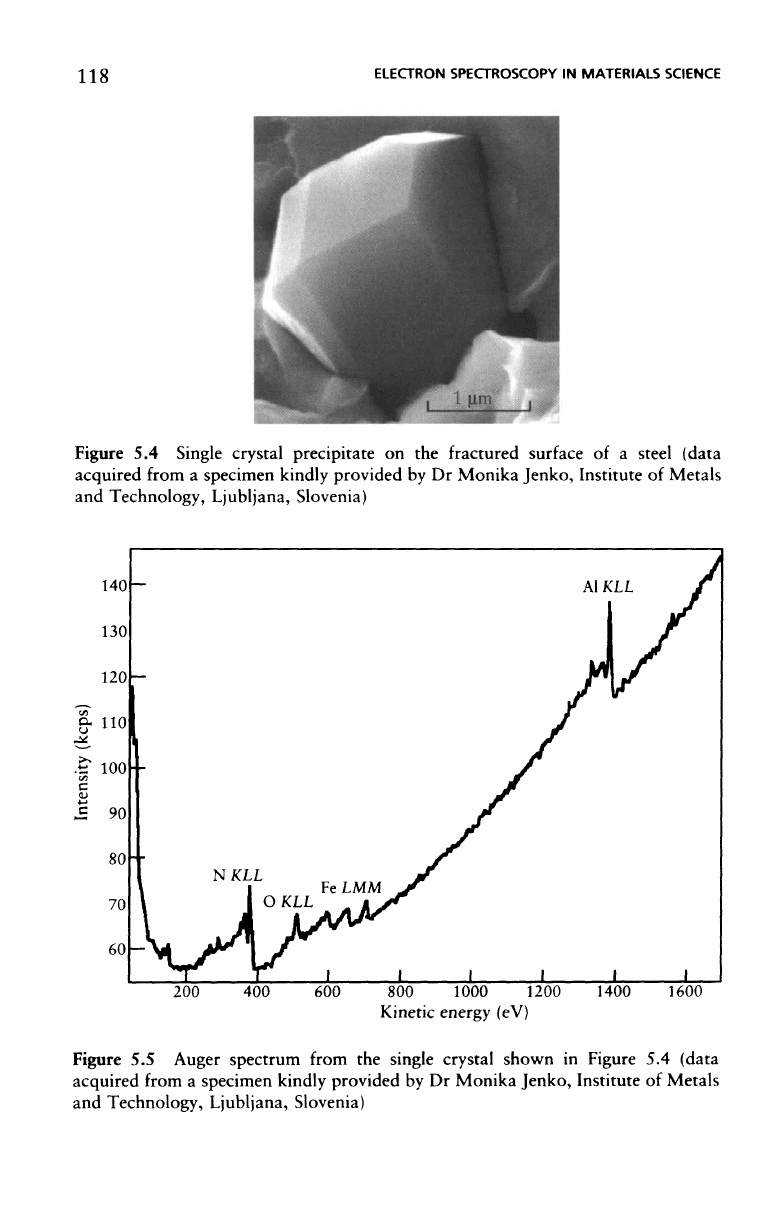
The in
situ fracture
approach
can
sometimes
identify
discrete
minor
phases present
in an
alloy.
The
image
of
Figure
5.4
shows
a
single
crystal precipitate some
3 um
across
at the
fracture surface
of a
steel;
the
Auger spectrum (Figure
5.5)
shows this
to be a
single crystal
of
aluminium
nitride.
118
ELECTRON
SPECTROSCOPY
IN
MATERIALS
SCIENCE
Figure
5.4
Single crystal precipitate
on the
fractured
surface
of a
steel (data
acquired
from
a
specimen kindly provided
by Dr
Monika Jenko, Institute
of
Metals
and
Technology,
Ljubljana,
Slovenia)
60
-
200 400 600 800
1000 1200
Kinetic
energy
(eV)
1400
1600
Figure
5.5
Auger spectrum
from
the
single crystal shown
in
Figure
5.4
(data
acquired
from
a
specimen kindly provided
by Dr
Monika Jenko, Institute
of
Metals
and
Technology,
Ljubljana,
Slovenia)
METALLURGY 119
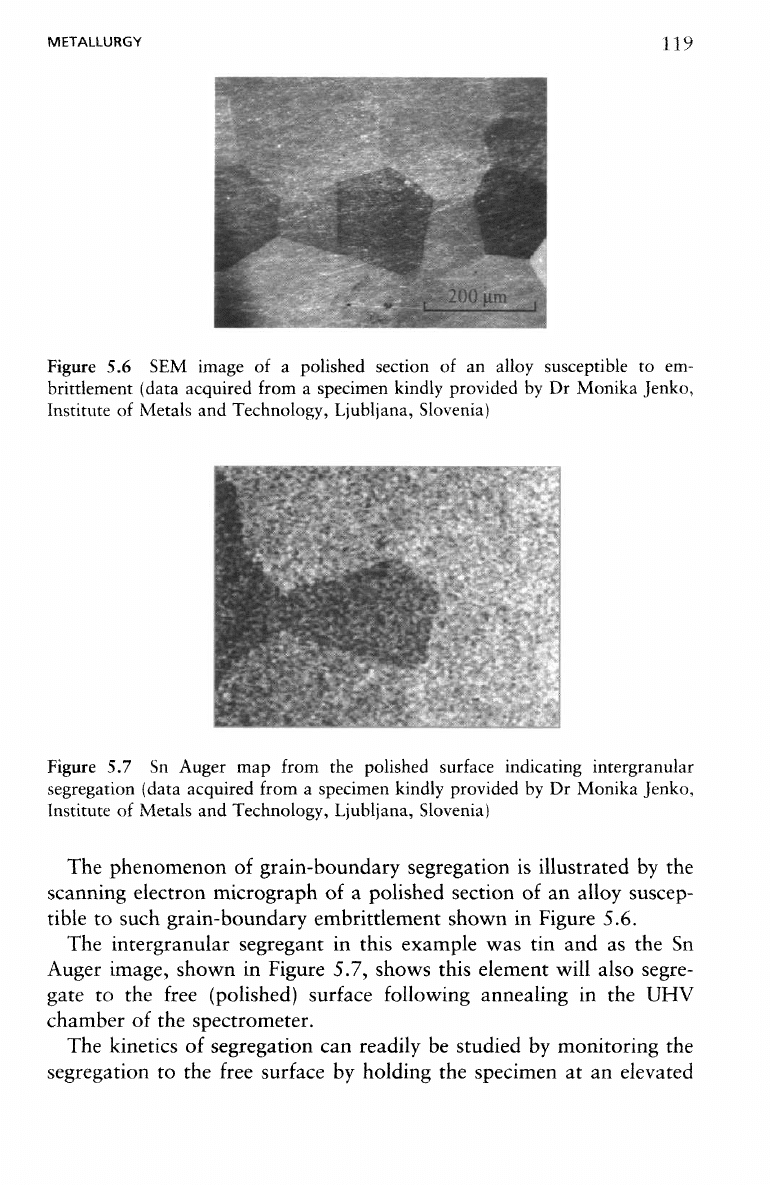
Figure
5.6 SEM
image
of a
polished section
of an
alloy susceptible
to em-
brittlement (data acquired
from
a
specimen kindly provided
by Dr
Monika Jenko,
Institute
of
Metals
and
Technology,
Ljubljana,
Slovenia)
Figure
5.7 Sn
Auger
map
from
the
polished
surface
indicating intergranular
segregation (data acquired
from
a
specimen kindly provided
by Dr
Monika Jenko,
Institute
of
Metals
and
Technology,
Ljubljana,
Slovenia)
The
phenomenon
of
grain-boundary segregation
is
illustrated
by the
scanning electron micrograph
of a
polished section
of an
alloy suscep-
tible
to
such grain-boundary embrittlement shown
in
Figure 5.6.
The
intergranular segregant
in
this example
was tin and as the Sn
Auger
image, shown
in
Figure 5.7, shows this element will also segre-
gate
to the
free
(polished) surface following annealing
in the UHV
chamber
of the
spectrometer.
The
kinetics
of
segregation
can
readily
be
studied
by
monitoring
the
segregation
to the
free
surface
by
holding
the
specimen
at an
elevated
120
ELECTRON SPECTROSCOPY
IN
MATERIALS
SCIENCE
Temperature
=
700°C
200
400
Time
(s)
600
800
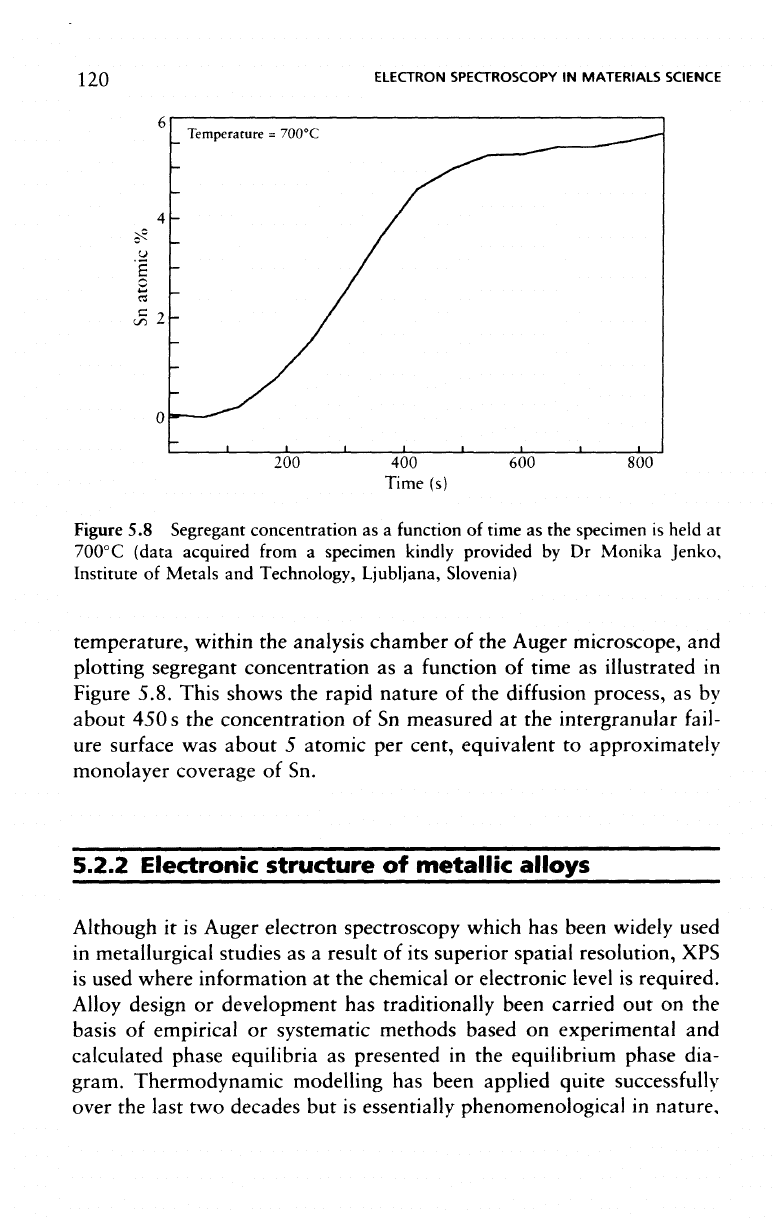
Figure
5.8
Segregant
concentration
as a
function
of
time
as the
specimen
is
held
at
700°C
(data acquired from
a
specimen kindly provided
by Dr
Monika Jenko,
Institute
of
Metals
and
Technology,
Ljubljana,
Slovenia)
temperature, within
the
analysis chamber
of the
Auger microscope,
and
plotting segregant concentration
as a
function
of
time
as
illustrated
in
Figure
5.8. This shows
the
rapid nature
of the
diffusion
process,
as by
about
450 s the
concentration
of Sn
measured
at the
intergranular
fail-
ure
surface
was
about
5
atomic
per
cent, equivalent
to
approximately
monolayer
coverage
of Sn.
5.2.2
Electronic
structure
of
metallic
alloys
Although
it is
Auger electron
spectroscopy
which
has
been widely used
in
metallurgical studies
as a
result
of its
superior spatial resolution,
XPS
is
used where information
at the
chemical
or
electronic
level
is
required.
Alloy
design
or
development
has
traditionally been carried
out on the
basis
of
empirical
or
systematic methods based
on
experimental
and
calculated
phase equilibria
as
presented
in the
equilibrium
phase dia-
gram. Thermodynamic modelling
has
been applied quite
successfully
over
the
last
two
decades
but is
essentially phenomenological
in
nature.
METALLURGY
121
and
cannot provide adequate information
on the
subsequent electronic
changes
(such
as
charge redistribution) that occur upon alloying. These
data
are
accessible
by
making so-called
first
principle calculations
but
are
not
easily
able
to
provide phase diagrams
of
sufficient
accuracy,
and
there
is a
serious need
for
experimental evidence regarding
the
phenom-
ena
accompanying alloy formation such
as
charge transfer
and
redistri-
bution.
This
can be
achieved
by the use of the
Auger parameter
of the
solvent
and
solute elements
of the
alloy
and the
linear potential core
model, developed
by
Thomas
and
Weightman,
to
relate
the
Auger param-
eter
to
changes
in
electronic structure.
The
description
of the
model
is
outside
the
scope
of the
text,
and the
reader
is
referred
to
papers
cited
in
the
Bibliography,
but
examples
from
a
Ti-Al-V
alloy
are
given below
to
indicate
the
power
of the
technique.
In
order
to
obtain reliable information
from
Auger parameter data
one
must
use
core-like Auger transitions, i.e., ones where
all
three elec-
trons involved
in the
Auger process originate
in
core-like orbitals rather
than
the
degenerate band structure
of the
atom.
In
order
to
achieve this
with metals heavier than magnesium
it is
necessary
to
resort
to a
high-
energy X-ray source. Recent work
has
made
use of a
CrK/3 source,
as
this
fulfils
fourth-order reflections
in a
conventional AlKa monochro-
mator, which provides
a
photon energy
of
5946.7
eV and a
line width
of
approximately
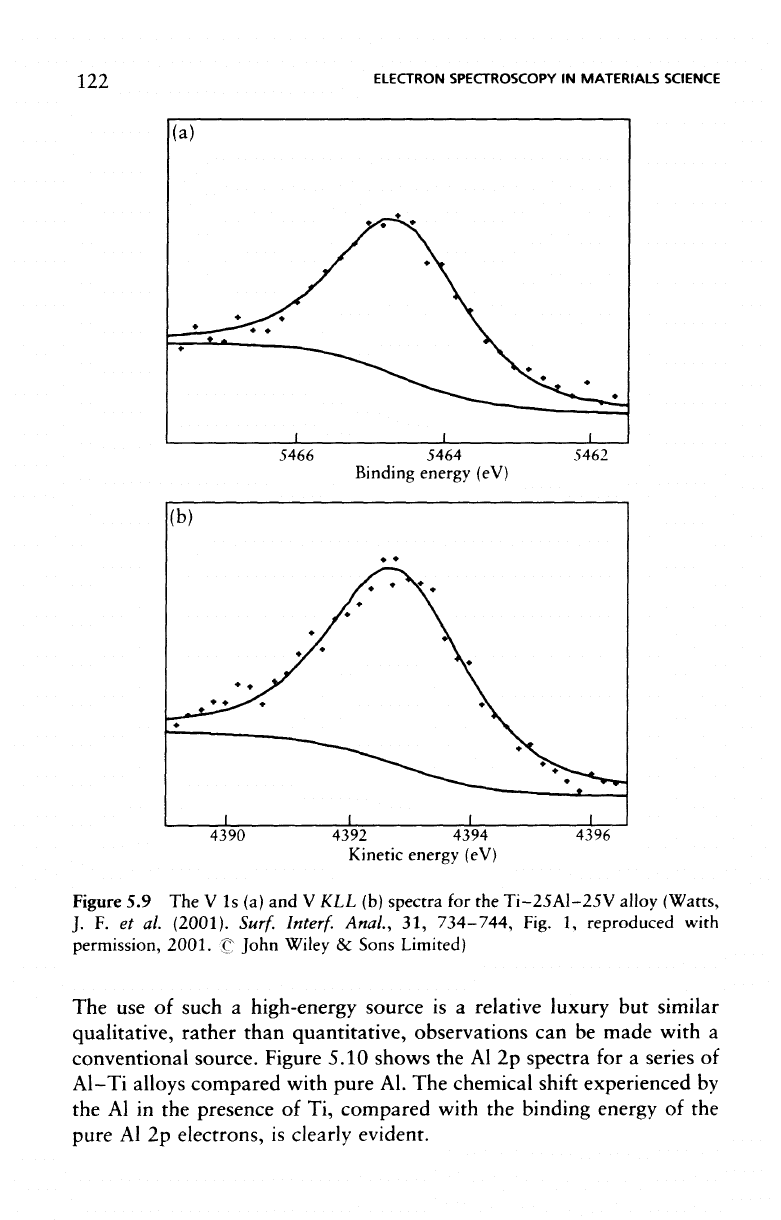
1.6 eV. The V 1s and V KLL
spectra
for the
Ti-25Al-
25V
alloy
are
shown
in
Figure 5.9, while
the Al, Ti and V
data relative
to the
pure metal,
and
Auger parameters, calculated using
the
1s-KLL
energies
for a
range
of
alloys,
are
presented
in
Table 5.1.
It has
been suggested that
the
Auger parameter changes
are a
measure
of
the
screening
efficiency
of a
system
in
response
to the
presence
of a
localized
core
hole. Considering
that
metals
are
characterized
by
perfect
screening, reduced screening means that
the
atoms experience
a
'less
metallic' environment.
The
Auger parameter shifts (both initial
and final
state)
of the
elements
of
interest between pure metal
and
alloy
in
Table
5.1
suggest that
the
metal with
sp
valence configuration
(i.e.,
Al)
is
better screened
in the
elemental solid than
in
both
the
binary
and
ternary
alloys.
The
difference
in the
Auger parameter values
of Al
between
the
pure element
and in the
alloys
is
bigger
for the
alloy systems
with ordering tendency
(Ti-Al,
Ti-Al-V)
than
a
system with
no
order-
ing
tendency such
as
V-A1. Furthermore,
the Al
Auger parameter
is
lower
for all
alloys compared with pure
Al,
indicating
a
lower intra-
atomic
and
extra-atomic relaxation
or a
reduced screening
efficiency.
122
ELECTRON
SPECTROSCOPY
IN
MATERIALS
SCIENCE
5466
5464
Binding
energy (eV)
5462
4390
4392
4394
Kinetic
energy
(eV)
4396
Figure
5.9 The V 1s (a) and V KLL (b)
spectra
for the
Ti-25Al-25V
alloy (Warts,
J. F. et al.
(2001).
Surf.
Interf.
Anal.,
31,
734-744,
Fig.
1,
reproduced with
permission, 2001.
C:
John Wiley
&
Sons
Limited)
The use of
such
a
high-energy source
is a
relative luxury
but
similar
qualitative, rather than quantitative, observations
can be
made with
a
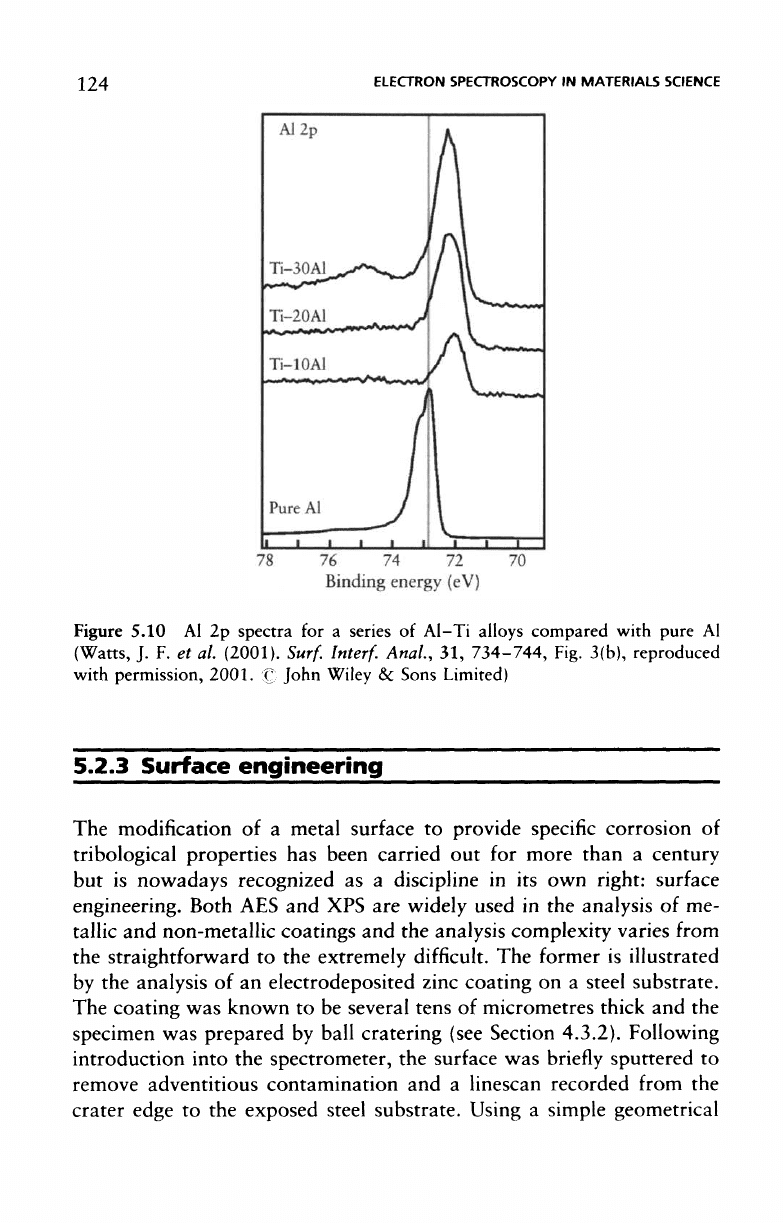
conventional source. Figure 5.10 shows
the Al 2p
spectra
for a
series
of
Al-Ti
alloys compared with pure
Al. The
chemical
shift
experienced
by
the Al in the
presence
of Ti,
compared with
the
binding energy
of the
pure
Al 2p
electrons,
is
clearly evident.
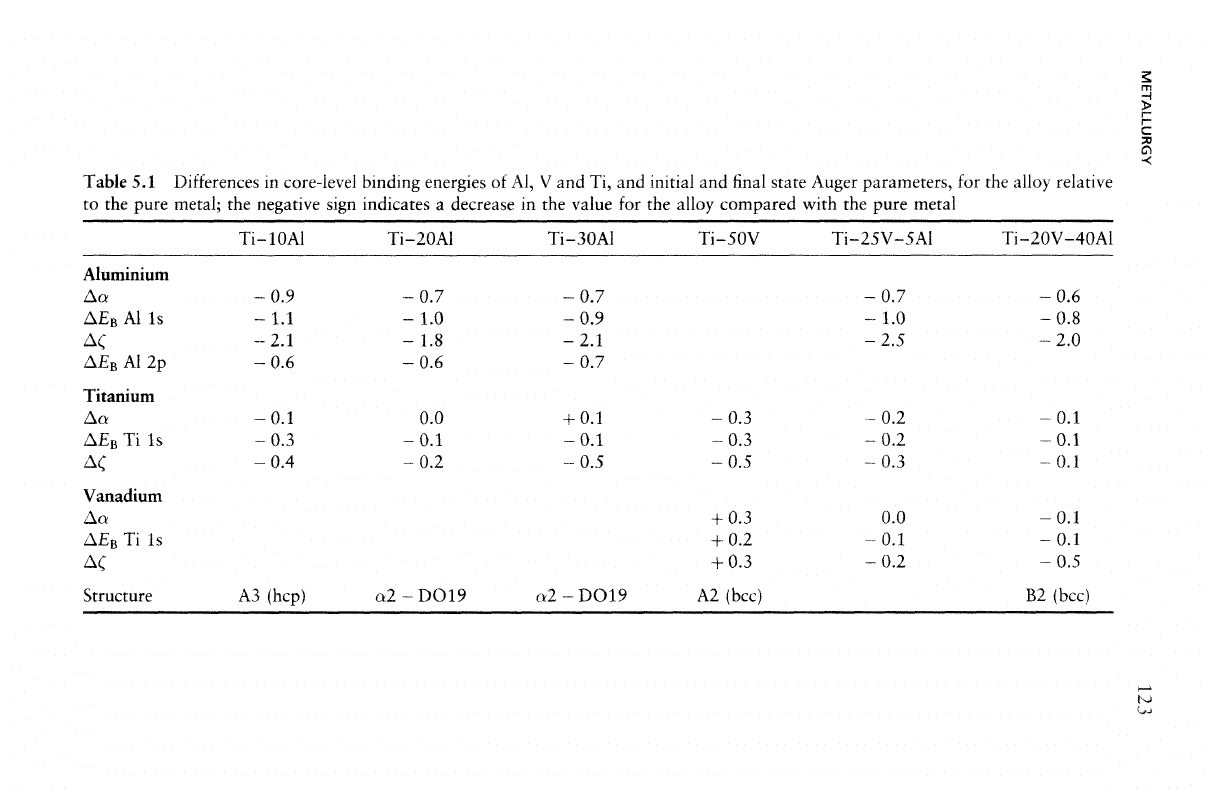
Table
5.1
Differences
in
core-level binding energies
of Al, V and Ti, and
initial
and
final
state Auger parameters,
for the
alloy
relative
to the
pure metal;
the
negative sign indicates
a
decrease
in the
value
for the
alloy compared with
the
pure metal
Aluminium
Aa
AE
B
Al 1s
AC
AE
B
Al 2p
Titanium
Ac*
AE
B
Ti Is
AC
Vanadium
Ad
AE
B
Ti 1s
AC
Structure
Ti-l0Al
-0.9
-1.1
-2.1
-0.6
-0.1
-0.3
-0.4
A3
(hcp)
Ti-20A1
-0.7
-1.0
-1.8
-0.6
0.0
-0.1
-0.2
a2-DO19
Ti-30Al
-0.7
-0.9
-2.1
-0.7
+ 0.1
-0.1
-0.5
Q2-DO19
Ti-50V
-0.3
-0.3
-0.5
+ 0.3
+ 0.2
+ 0.3
A2
(bcc)
Ti-25V-5Al
-0.7
-1.0
-2.5
-0.2
-0.2
-0.3
0.0
-0.1
-0.2
Ti-20V-40Al
-0.6
-0.8
-2.0
-0.1
-0.1
-0.1
-0.1
-0.1
-0.5
B2
(bcc)
124
ELECTRON
SPECTROSCOPY
IN
MATERIALS
SCIENCE
76 74 72 70
Binding
energy (eV)
Figure
5.10
Al 2p
spectra
for a
series
of
Al-Ti
alloys compared with pure
Al
(Watts,
J. F. et al.
(2001).
Surf.
Interf.
Anal,
31,
734-744, Fig.
3(b), reproduced
with permission,
2001.
•£'.•
John Wiley
&c
Sons Limited)
5.2.3
Surface
engineering
The
modification
of a
metal surface
to
provide specific corrosion
of
tribological
properties
has
been carried
out for
more than
a
century
but is
nowadays recognized
as a
discipline
in its own
right: surface
engineering. Both
AES and XPS are
widely used
in the
analysis
of me-
tallic
and
non-metallic
coatings
and the
analysis complexity varies from
the
straightforward
to the
extremely
difficult.
The
former
is
illustrated
by
the
analysis
of an
electrodeposited zinc coating
on a
steel substrate.
The
coating
was
known
to be
several tens
of
micrometres thick
and the
specimen
was
prepared
by
ball cratering (see Section
4.3.2).
Following
introduction into
the
spectrometer,
the
surface
was
briefly
sputtered
to
remove adventitious contamination
and a
linescan recorded
from
the
crater edge
to the
exposed steel substrate. Using
a
simple geometrical
METALLURGY
125
20
Depth
(jiim)
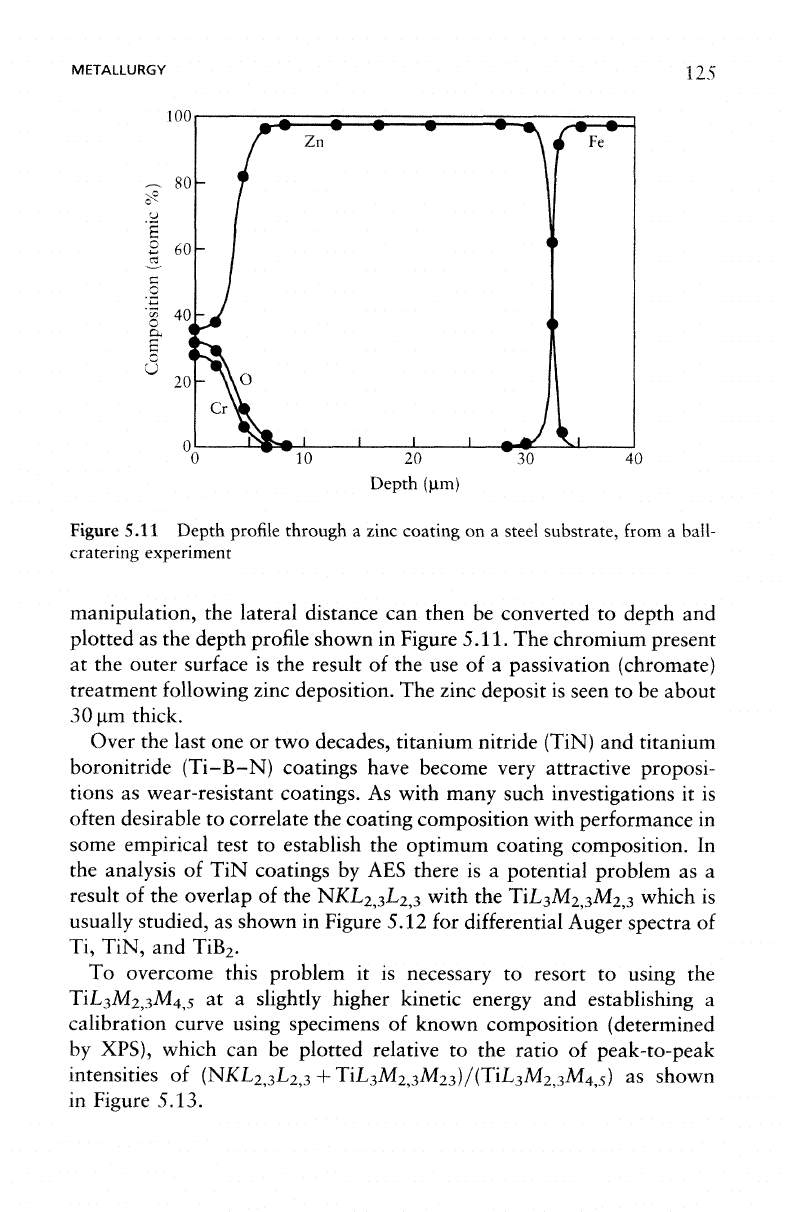
Figure
5.11 Depth profile
through
a
zinc coating
on a
steel substrate,
from
a
ball-
cratering
experiment
manipulation,
the
lateral distance
can
then
be
converted
to
depth
and
plotted
as the
depth
profile shown
in
Figure 5.11.
The
chromium present
at the
outer
surface
is the
result
of the use of a
passivation (chromate)
treatment following zinc deposition.
The
zinc deposit
is
seen
to be
about
30 urn
thick.
Over
the
last
one or two
decades, titanium nitride (TiN)
and
titanium
boronitride
(Ti-B-N)
coatings have become
very
attractive proposi-
tions
as
wear-resistant coatings.
As
with many such investigations
it is
often
desirable
to
correlate
the
coating composition with performance
in
some
empirical test
to
establish
the
optimum coating
composition.
In
the
analysis
of TiN
coatings
by AES
there
is a
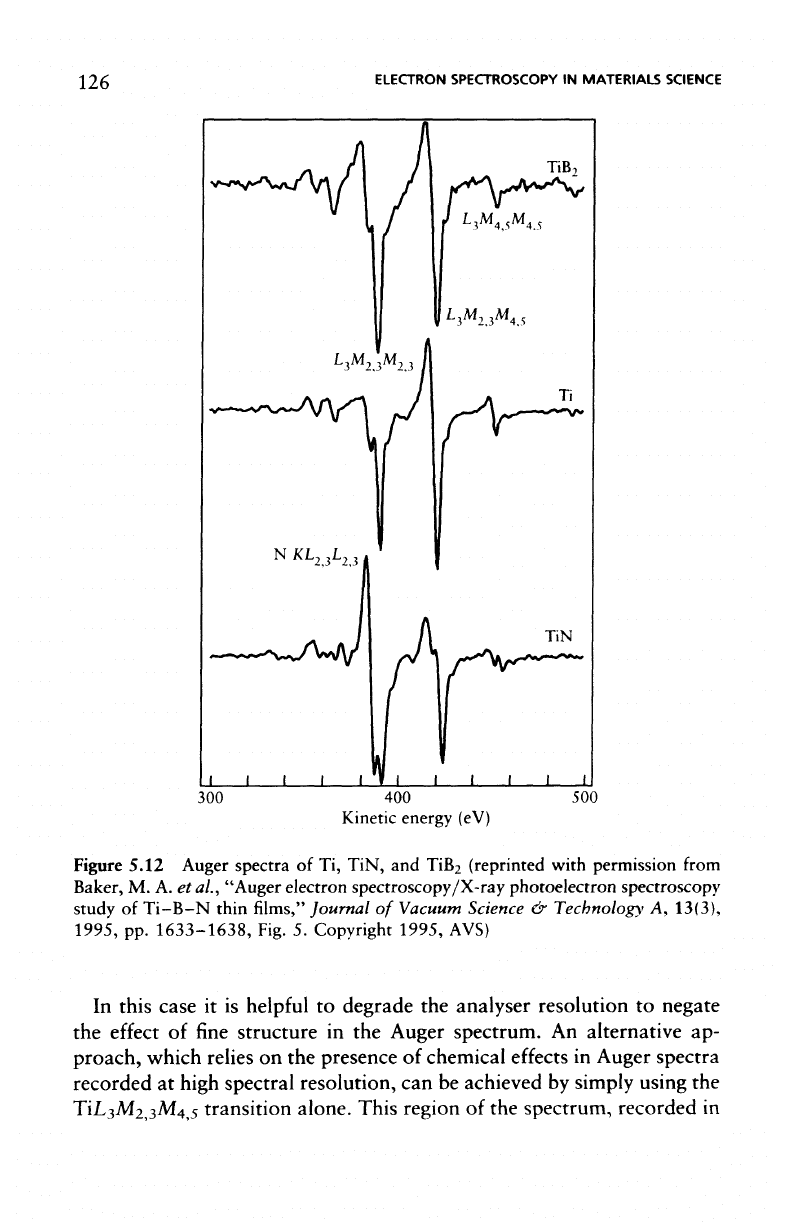
potential problem
as a
result
of the
overlap
of the
NKL
2,3
L
2,3
with
the
TiL
3
M
2
,
3
M
2
,
3
which
is
usually
studied,
as
shown
in
Figure 5.12
for
differential
Auger
spectra
of
Ti,
TiN,
and
TiB
2
.
To
overcome this problem
it is
necessary
to
resort
to
using
the
TiL
3
M
2,3
M
4,5
at a
slightly higher kinetic energy
and
establishing
a
calibration curve using specimens
of
known composition (determined
by
XPS), which
can be
plotted relative
to the
ratio
of
peak-to-peak
intensities
of
(NKL
2
,
3
L
2
,
3
+
TiL
3
M
2
3M
2,3
)/(TiL
3
M
2
,
3
M
4i
5)
as
shown
in
Figure 5.13.
126
ELECTRON SPECTROSCOPY
IN
MATERIALS
SCIENCE
TiB
2
300
400
Kinetic
energy (eV)
500
Figure
5.12
Auger spectra
of Ti,
TiN,
and
TiB2 (reprinted with permission
from
Baker,
M. A. et
al.,
"Auger
electron
spectroscopy/X-ray
photoelectron
spectroscopy
study
of
Ti-B-N
thin
films,"
Journal
of
Vacuum Science
&
Technology
A,
13(3),
1995,
pp.
1633-1638, Fig.
5.
Copyright
1995,
AVS)
In
this case
it is
helpful
to
degrade
the
analyser resolution
to
negate
the
effect
of fine
structure
in the
Auger spectrum.
An
alternative
ap-
proach, which relies
on the
presence
of
chemical
effects
in
Auger spectra
recorded
at
high spectral resolution,
can be
achieved
by
simply
using
the
TiL
2,3
M
4,5
transition alone. This region
of the
spectrum, recorded
in