
Westermeier R., Naven T., H?pker H.-R. Proteomics in Practice: A Guide to Successful Experimental Design
Подождите немного. Документ загружается.


Abbreviations, Symbols, Units
V Volume (L)
v Speed of migation (m/s)
v/v Volume per volume
W Watt
w/v Weight per volume (mass concentration)
ZiO
2
Zirconium dioxide
XX

1
Introduction
In a living cell, most activities are performed by proteins. Therefore
proteins are the subject of intense research in life science. “Proteo-
mics” is the study of quantitative changes of protein expression levels
and their application to drug discovery, diagnostics and therapy.
Thereby it is important to apply the correct strategy to discover
induced biological changes against the background of inherent biolo-
gical variations of the sample sources.
Proteomics research has many different application areas: Pharma-
ceutical companies search for faster identification of new drug targets
in transformed cell lines or diseased tissues. Also the validation of
the detected targets, in vitro and in vivo toxicology studies, and checks
for side effects can be performed with this approach. Clinical
researchers want to compare normal versus disease samples, dis-
eased versus treated samples, find molecular markers in body fluids
for diagnosis and prognosis, monitor diseases and their treatments,
determine and characterize post-translational modifications. In clini-
cal chemistry it would be interesting to subtype individuals to predict
response to therapy. Biologists study basic cell functions and molecu-
lar organizations. Another big field is microbiology for various
research areas. Proteomics is also applied for plant research for many
different purposes, for instance for breeding plants of higher bacter-
ial, heat, cold, drought, and other resistances, increasing the yield of
crop and many more.
1
History
The original definition of the “Proteome” analysis means “The analy-
sis of the entire PROTEin complement expressed by a genOME, or by
a cell or tissue type” (Wasinger et al. 1995). Originally the technolo-
gies behind proteome analysis were two-dimensional electrophoresis
and identification of proteins by subsequent MALDI mass spectrome-
Proteomics in Practice. A Guide to Successful Experimental Design 2
nd
Ed.
Reiner Westermeier, Tom Naven, and Hans-Rudolf Hçpker
Copyright 2008 WILEY-VCH Verlag GmbH & Co. KGaA, Weinheim
ISBN: 978-3-527-31941-1
Wasinger VC, Cordwell SJ,
Cerpa-Poljak A, Yan JX, Gooley
AA, Wilkins MR, Duncan MW,
Harris R, Williams KL,
Humphery-Smith I. Electro-
phoresis 16 (1995) 1090–1094.
Introduction2
try with peptide mass fingerprinting. Therefore the proteins spots of
interest were picked from the gel and digested with trypsin. In case
of failure of identification the peptide mixtures were submitted to
sequencing by tandem mass spectrometry. Although the concept of
Proteome analysis is older than the phrase, it only began to become
widely employed, because several prerequisites came real at the same
time:
.
Availability of genomic sequence information
.
Development of novel techniques of mass spec-
trometry.
.
Availability of computing power, memory, and
database accessibility.
.
Improvement of separation technologies.
Furthermore it became obvious that the genomic sequence and pro-
tein function cannot be directly correlated: Co- and post-translational
protein modifications cannot be predicted from the genome
sequence. And it is known, they play a very important role in causing
diseases. However, the DNA sequence can be “in silico” translated
into the protein sequence, and therefore genome databases can be
used for identification.
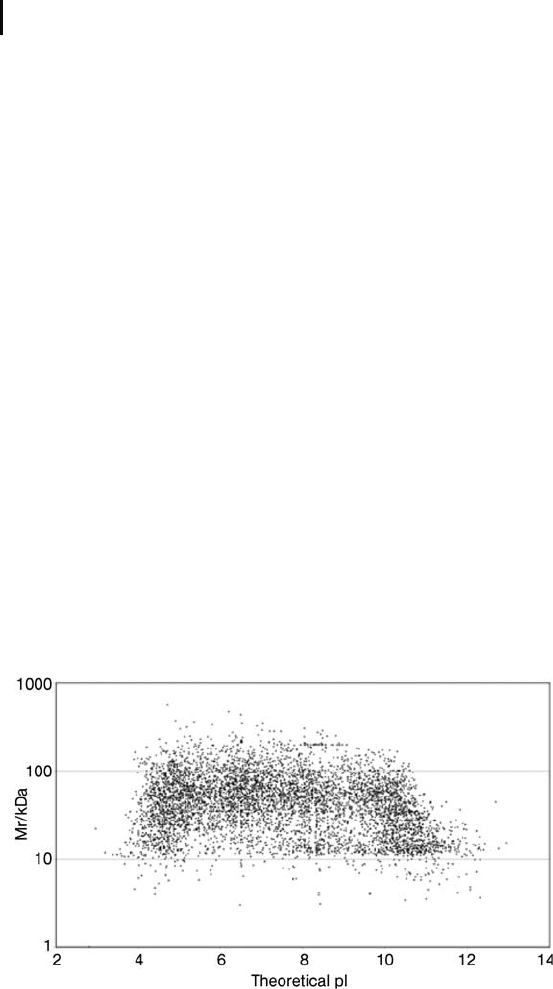
As an example a plot of the molecular masses versus the isoelectric
points of the theoretically expressed proteins of the yeast genome is
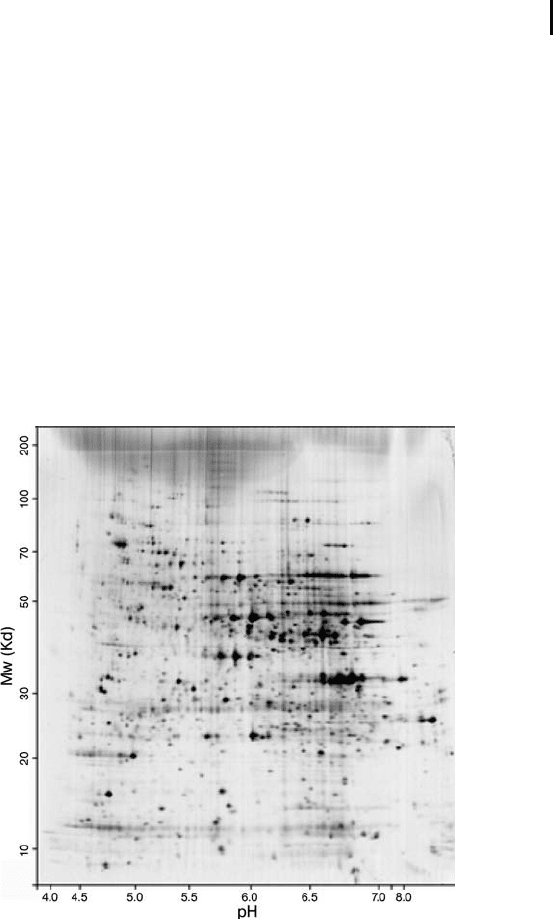
shown in Figure 1. There are many reasons, why this picture looks
very different from the result of a 2-D electrophoresis of a yeast cell
extract (see Figure 2):
Fig. 1: Theoretical two-dimensional map of masses and isoelectric
points calculated from the protein sequences which have been “in silico”
translated from the open reading frames of the yeast genome
(from Wildgruber et al. 2000).
There are more definitions to
find. Often they are linked to
the application area.
The theoretical 2-D maps of
other organisms look in prin-
ciple similar; they differ mainly
in the complexity.
Wildgruber R, Harder A, Ober-
maier C, Boguth G, Weiss W,
Fey SJ, Larsen PM, Gçrg A.
Electrophoresis 21 (2000)
1 History 3
.
A proteome reflects the actual metabolic state of
a cell. It is a highly dynamic object and strongly
dependent on many parameters.
.
The plot cannot reflect the protein expression
levels.
.
Not all possible proteins are expressed.
.
Many proteins are expressed in low copy num-
bers, often they are below the detection limit.
Particularly proteins in the basic area, like regu-
latory proteins, transcription factors, and other
DNA-binding proteins are mostly missed.
.
A number of proteins have become modified in
different ways during or after translation.
.
A number of proteins are outside the working
range of 2-D electrophoresis.
Fig. 2: Two-dimensional electrophoresis of yeast proteins as
shown on the SWISS-2DPAGE database on the free accessible
Expasy server (from Sanchez et al. 1996).
Sanchez JC, Golaz O, Frutiger
S, Schaller D, Appel RD,
Bairoch A, Hughes GJ, Hoch-
strasser DF. Electrophoresis 17
(1996) 556–565.
Introduction4
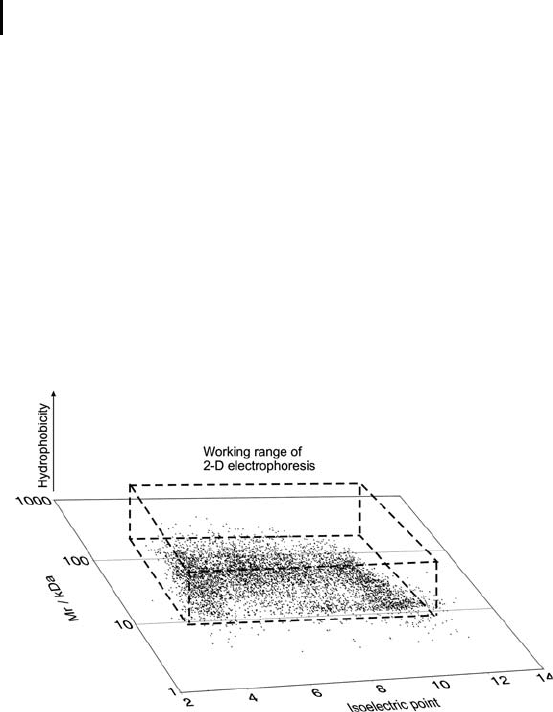
A view on the working range of 2-D electrophoresis – as displayed in
Figure 3 – can explain, why 2-D electrophoresis had been selected as
the first choice of separation methods for the analysis of proteomes.
Still the separation according to two completely independent physico-
chemical parameters of proteins, isoelectric point and size, offers the
highest resolution. Several thousands of proteins can be separated,
displayed and stored in one gel. Proteins in the size range from
10 kDa to 200 kDa and with isoelectric points between 3 and 11 can
be analyzed. Because the separation takes place under completely
denaturing conditions, also quite hydrophobic proteins are included
in the work range. It seems like two-dimensional electrophoresis will
remain the major separation technique, because its resolution and
the advantage of storing the isolated proteins in the gel matrix until
further analysis is unrivalled by any of the alternative techniques.
Fig. 3: Estimated working range of 2-D electrophoresis for
separating highly complex protein mixtures.
However, there also some shortcomings of 2-D electrophoresis:
.
Small, very large, very basic, and very hydropho-
bic proteins are widely excluded.
.
2-D electrophoresis is rather complex, not auto-
mated, labor-intensive, and therefore dependent
on the skills of the operator.
.
Even optimal separations show gel-to-gel varia-
tions. This results in difficult image analysis pro-
cedures.
.
The peptide yield after in-gel digestion of pro-
teins is considerably lower than in liquid phase.
This leads to limited sensitivity in the subse-
quent mass spectrometry analysis.
A large 2-D electrophoresis gel
of 20 20 cm has a theoretical
separation space of about
10,000 proteins.

1 History 5
Therefore proteomics researchers started to look for alternatives to
either replace or – at least – to complement the results acquired with
the 2D gel-based workflow. The most successful approach employs
tryptic digestion of the entire protein mixture and analysis of the pep-
tides with the combination of nanoscale liquid chromatography and
electrospray mass spectrometry. This procedure was either called
DALPC (Direct analysis of protein complexes, see Link et al. 1999) or
MudPIT (Multidimensional protein identification technology, see
Washburn et al. 2001). The major advantages of the LC-based work-
flows are the superior sensitivity and the possibility of automation by
an LC-ESI MS via on-line connection. Several orthogonal separation
techniques are combined to MDLC (Multi Dimensional Liquid Chro-
matography).
At the present time, most multi-dimensional LC applications in
proteomics deal with the separation of tryptic peptides. A variety of
semi-automated off-line and fully automated on-line, as well as high-
throughput configurations are available as commercial systems or
can be customized according to the individual needs and preferences
of the operators. Although this type of advanced tryptic peptide
separation is often referred as multi-dimensional, actually it only uti-
lizes two dimensions, namely ion exchange chromatography – cation
exchange chromatography preferred – in combination with reversed
phase chromatography.
Still in its infancy, multi-dimensional chromatography is enjoying
more and more acceptance as a sample preparation tool for the pre-
fractionation of intact proteins further upstream the proteomics
workflow. The techniques and methods applied in protein pre-fractio-
nation have been derived and adapted from protein purification,
which are in use since decades with great success and reliability.
Finally, the orthogonal, high resolution separation at both protein
and peptide level would deserve the term multidimensional liquid
chromatography (MDLC).
Practice has shown that these different workflows develop different
subsets of the same proteome with surprisingly little overlaps. A typi-
cal example can be found in the paper by Vanrobaeys et al. (2005).
Thus none of them can be replaced by the other one. But it has been
recognized that several complementary workflows need to be
employed in order to keep the number of missed proteins as low as
possible.
Furthermore, another important aspect is stated in a paper by
Chamrad and Meyer (2005): Today . . . “there are no basic rules on
how to perform a proteomic study and manuscripts can frequently be
found that publish results from single . . . experiments without any
repetition, which can become problematic for further independent
validation steps. Thus, search strategies and data evaluation methods
Link AJ, Eng J, Schieltz DM,
Carmack E, Mize GJ, Morris
DR, Garvik BM, Yates JR III.
Nature Biotech 17 (1999)
676–682.
Washburn MP, Wolters D,
Yates JR III. Nature Biotech 19
(2001) 242–247.
Vanrobaeys F, Van Coster R,
Dhondt G, Devreese B, Van
Beeumen J. J Proteome Res 4
(2005) 2283 – 2293.
There are even differences
within the same workflows,
caused by different design of
equipment.
Chamrad D, Meyer HE. Nat
Methods 2 (2005) 647–648.
Elias JE, Haas W, Faherty BK,
Gygi SP. Nat Methods 2
(2005) 667–675.
Introduction6
in . . . proteome studies must be improved, and the manuscript by
Gygi and colleagues gives some very useful directions . . .”.
Other combinations than 2-D gel-MS and LC-MS have been intro-
duced, which deliver highly satisfying results for special samples and
experiments. For instance, very frequently one-dimensional SDS
PAGE followed by tryptic digestion of proteins with subsequent LC-
MS is employed. Also for separations on the peptide level electro-
phoretic alternatives have been developed to complement liquid chro-
matography, at least in the first stage. Furthermore, it became
obvious that pre-fractionation of the highly complex protein mixtures
leads to more successful protein identifications than direct analysis of
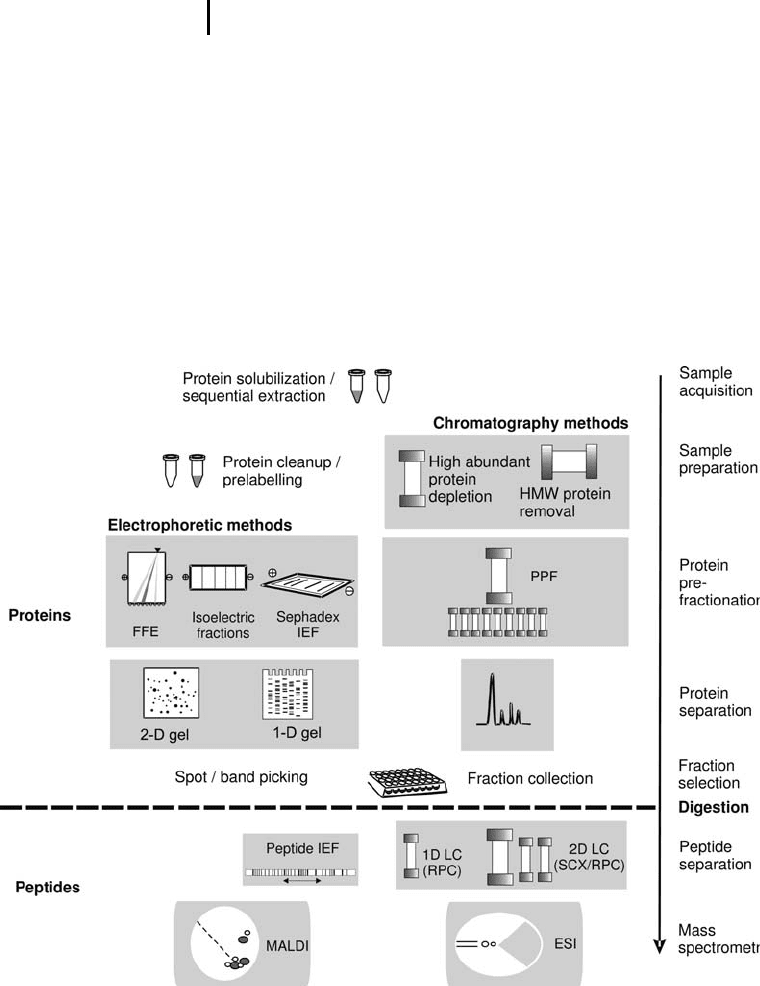
crude samples. Figure 4 shows an overview of analysis modules
applied in proteomics, which can be assembled to various workflows.
Fig. 4: Toolbox for proteome analysis. The modules can be combined
to various workflows in different ways. The functions and features of the
techniques displayed here will be described in more detail in the following
book chapters. On the right hand side the chronological order of the
analysis is indicated. Note the important division between protein and
peptide level.
1 History 7
These technologies and their combinations will be described in the
first part of the book.
Since the start of the “Proteomics Era” huge progress has been
made in the instrumental development for improved nanoscale liquid
chromatography, higher resolution and more sensitive mass spectro-
meters, evaluation software, and peripherical technologies.
A great step forward is the concept of difference gel electrophoresis
(DIGE). With this method, introduced by nl et al. (1997), protein
samples are pre-labeled with modified cyanine dyes (CyeDye), mixed,
and separated together in the same gel. The co-migr ated protein spots
of the different samples are detected by scanning at different wave-
lengths; their abundance ratios are determined with dedicated soft-
ware, which employs a spot co-detection algorithm. This approach
makes it now possible to use an internal standard in 2-D gel electro-
phoresis (Alban et al. 2003). In this way gel-to-gel variations are com-
pensated, which leads to highly confident quantitative and qualitative
results. The technique has been applied on almost all different sam-
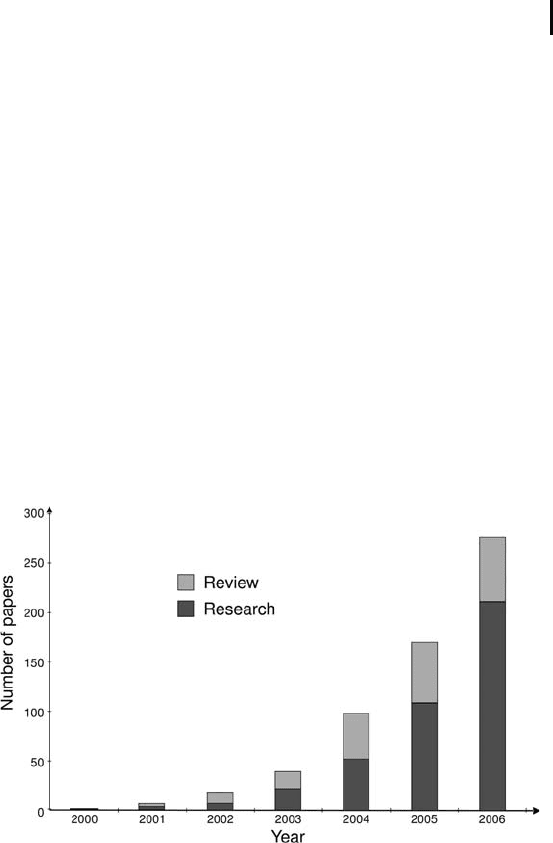
ple types, and during the last couple of years the number of papers
on the DIGE method has increased exponentially (see Figure 5).
Fig. 5: Graphical representation of the number of published papers in DIGE
until end of the year 2006.
At present, some major projects and developments are pursued,
which raise high expectations for proteomics. Here are a few exam-
ples:
.
The systematic exploration of the human pro-
teome with Affinity (Antibody) Proteomics to
generate quality assured antibodies to all non-
redundant human proteins (Uhln and Ponten,
2005).
nl M, Morgan EM, Minden
JS. Electrophoresis 19 (1997)
2071–2077.
Alban A, David S, Bjorkesten L,
Andersson C, Sloge E, Lewis S,
Currie I. Proteomics 3 (2003)
36–44.
Uhln M, Ponten F. Mol Cell
Proteomics 4 (2005) 384–393.

Introduction8
.
The combination of DIGE labeling, liquid chro-
matography of proteins, SDS PAGE and LC-MS
for finding biomarkers in samples with very
wide dynamic ranges of protein expression levels
(Misek et al. 2005).
.
The further developments for the top-down
approach with FT-ICR mass spectrometry.
.
The development of protein arrays.
During the first few years of the proteomics era holistic approaches,
mostly not hypothesis driven, were preferred in order to study com-
plete proteomes at once by high-throughput methods. It was
assumed that a proteome could be analyzed in a similar way like a
genome, just with a higher effort. Unfortunately it turned out that
these protein samples have more challenges in store than expected.
Thus it can be observed that Proteomics is now evolving from a high-
throughput industrial-scale concept (“shotgun proteomics”) to care-
fully planned experiments and hypothesis driven analyses in order to
answer certain biological questions.
2
Critical Points
2.1
Challenges of the Protein Samples
Usually the complexity of the protein and/or peptide mixture lies
beyond the theoretical separation space of any separation method.
This issue can only be solved by intelligent pre-fractionation of the
sample and analyzing smaller protein subsets. But it should be noted
that the more separation steps are involved, the more proteins can
get lost due to technical reasons. Furthermore, the analysis of one
complex sample can take quite a long time.
Five steps with 80% recovery each – which is not too bad – gives
less than 40% overall recovery (see Figure 6). It becomes obvious, if
not choosing a proper strategy, that there is a high risk of losing the
entire sample.
Misek DE, Kuick R, Wang H,
Galchev V, Deng B, Zhao R,
Tra J, Pisano MR, Amunugama
R, Allen D, Walker AK, Strahler
JR, Andrews P, Omenn GS,
Hanash SM. Proteomics 5
(2005) 3343–3352.
The generation of small subsets
of intact proteins is still a chal-
lenge.
Many of these critical points
will be described in the
following sub-chapter.
As many steps as necessary, but
as little as possible!
Example: the human genome
contains about 22,000 genes.
With PTMs a few hundred
thousand human proteins can
be expected.

Introduction8
.
The combination of DIGE labeling, liquid chro-
matography of proteins, SDS PAGE and LC-MS
for finding biomarkers in samples with very
wide dynamic ranges of protein expression levels
(Misek et al. 2005).
.
The further developments for the top-down
approach with FT-ICR mass spectrometry.
.
The development of protein arrays.
During the first few years of the proteomics era holistic approaches,
mostly not hypothesis driven, were preferred in order to study com-
plete proteomes at once by high-throughput methods. It was
assumed that a proteome could be analyzed in a similar way like a
genome, just with a higher effort. Unfortunately it turned out that
these protein samples have more challenges in store than expected.
Thus it can be observed that Proteomics is now evolving from a high-
throughput industrial-scale concept (“shotgun proteomics”) to care-
fully planned experiments and hypothesis driven analyses in order to
answer certain biological questions.
2
Critical Points
2.1
Challenges of the Protein Samples
Usually the complexity of the protein and/or peptide mixture lies
beyond the theoretical separation space of any separation method.
This issue can only be solved by intelligent pre-fractionation of the
sample and analyzing smaller protein subsets. But it should be noted
that the more separation steps are involved, the more proteins can
get lost due to technical reasons. Furthermore, the analysis of one
complex sample can take quite a long time.
Five steps with 80% recovery each – which is not too bad – gives
less than 40% overall recovery (see Figure 6). It becomes obvious, if
not choosing a proper strategy, that there is a high risk of losing the
entire sample.
Misek DE, Kuick R, Wang H,
Galchev V, Deng B, Zhao R,
Tra J, Pisano MR, Amunugama
R, Allen D, Walker AK, Strahler
JR, Andrews P, Omenn GS,
Hanash SM. Proteomics 5
(2005) 3343–3352.
The generation of small subsets
of intact proteins is still a chal-
lenge.
Many of these critical points
will be described in the
following sub-chapter.
As many steps as necessary, but
as little as possible!
Example: the human genome
contains about 22,000 genes.
With PTMs a few hundred
thousand human proteins can
be expected.