
Westermeier R., Naven T., H?pker H.-R. Proteomics in Practice: A Guide to Successful Experimental Design
Подождите немного. Документ загружается.

2 Critical Points 9
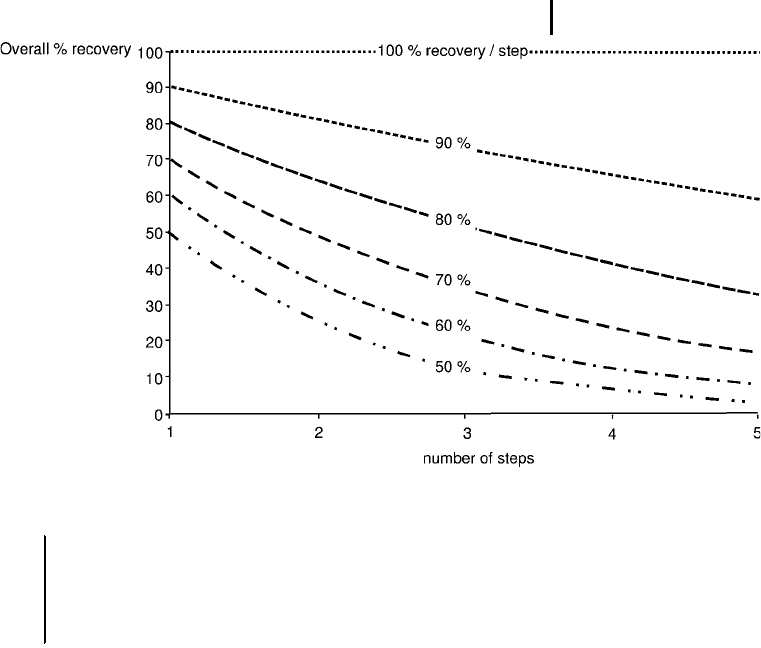
Fig. 6: Graph showing the dependence of overall recovery versus number of steps.
&
Note: The way of sample acquisition and
sample preparation prior to the separation
needs to be optimized for each sample type.
This optimization work can take up to several
months.
The concentrations of proteins are not evenly distributed within a
sample. It is very difficult for all separation methods and for mass
spectrometry to detect and analyze very low concentrated proteins in
the presence of highly abundant proteins. While regulatory proteins
and transcription factors are expressed in very low copy numbers
(a few proteins per cell), house keeping proteins exist in some million
copies per cell: e.g. b-actin in 15 million molecules per cell (Kis-
lauskis et al. 1997). The protein concentrations in human plasma
even span over ten orders of magnitude (Anderson and Anderson
2002).
Often the complex protein samples have limited stability. Because
many proteins exhibit biological activities, some of them start to mod-
ify other proteins in the sample mixture immediately during and
after taking the sample. Some enzymes, like proteases are even active
under “denaturing” conditions. The measures for sample stabiliza-
tion need to be optimized for different sample types. Only when the
sample acquisition and sample preparation is under control, it is
worth to invest time and money in a major experiment.
In tissue samples protein
concentrations span a dynamic
range of six orders of magni-
tudes.
Kislauskis EH, Zhu X, Singer
RH. Cell Biol 136 (1997)
1263–1270.
Anderson NL, Anderson NG.
Mol Cell Proteomics 1 (2002)
845–867.
Enzyme inhibitors can only
partly stabilize the sample.

Introduction10
Many parameters influence the composition of a proteome. In a
proteomics experiment it is critical to distinguish between induced
biological changes and inherent biological variations. Those are, for
instance, genetic differences, gender and age of patients, slightly dif-
ferent cell or plant growth conditions. Therefore it is important to
always analyze several biological replicates. The required number of
replicates can be different for different sample types. Some guide-
lines can be found in the paper by Hunt et al. 2005.
The expression level differences of target proteins and biomarkers
associated with induced biological changes are mostly subtle, as
shown for instance in the paper by Moumen et al. (2005). On and off
effects are very rare. Therefore it is very important to be able to detect
and prove the significance of the experimental effect over the back-
ground of bio-variability of the sample source and the “noise” of the
analytical tool with high statistical confidence. Also this fact greatly
influences the required sample size (number of replicates).
Membrane proteins are very difficult to solubilize, highly hydro-
phobic, and they can get easily lost during sample preparation and
separation by sticking to a surface or by aggregation.
Post-translational modifications like phosphorylation and glycosyla-
tion require sophisticated analysis tools like MS
n
(MS/MS/MS),
where the peptide ions get several times fragmented. At present
about 350 different ways of post-translational modifications are pub-
lished (see Delta mass database: http://www.abrf.org/index.cfm/
dm.home). It is very difficult to keep the overview and have all tools
available for their identification and characterization.
The presently available detection methods are not sufficiently sensi-
tive. It is desirable to reach down to a LOD of one protein expressed
in a cell. Should the protein detection method be sensitive enough,
then there is still another limitation of detection in mass spectrome-
try for protein identification.
When the proteome analysis starts on the peptide level, as it is
nowadays still the case for the MudPIT type of workflow, any type of
correlation to the parent proteins such as information on post-transla-
tional modifications and different protein isoforms can easily get lost
or is difficult to trace.
Automation as much as possible or available is desirable, in order
to keep the results independent of differences of human skills and to
increase the sample throughput.
Statisticians would demand at
least five replicates, in many
cases three replicates can
already deliver highly confident
results. In clinical proteomics
the numbers of required
patients are much higher.
Hunt SMN, Thomas MR,
Sebastian LT, Pedersen SK,
Harcourt RL, Sloane AJ,
Wilkins MR. J Proteome Res. 4
(2005) 809–819.
Moumen A, Masterson P,
O’Connor MJ, Jackson SP. Cell
123 (2005) 1065–1078.
It is often necessary to apply
special methods, which are
suited for membrane protein
analysis, like for instance blue
native electrophoresis.
. . .not to mention the many
different possibilities of glycosy-
lation types.
Alternative identification strate-
gies like, for instance, western
blotting need to be further
developed.

2 Critical Points 11
2.2
Challenges of the Analysis Systems
Depending on their methodological focus proteomics researchers
have different points of view on the analytical steps:
.
Mass spectrometry experts call every technology
used prior to mass spectrometry “Sample pre-
paration”; this includes also electrophoresis,
chromatography, and protein arrays.
.
Separation technologists sometimes call mass
spectrometry “Detection”.
There are inherent variabilities in each analysis system, from pre-frac-
tionation and separation to detection and mass spectrometry. The
major sources of variations are: gel-to-gel variations in 2-D electro-
phoresis, protein losses inherent with each analysis step, retention
time drifts and shifts in liquid chromatography, and ionization differ-
ences in mass spectrometry. Therefore of each biological replicate
several analytical replicates are required.
Most of the techniques employed in proteomics are quite demand-
ing for hands-on skills, or they are highly sophisticated to operate.
Good operator skills and knowledge are at least as important as the
performance of the equipment. Education programs and tutorials
have become an indispensable part of the various proteomics socie-
ties, which have been established almost everywhere around the
world.
Because of the points described above, there are standards needed
for quality control of the results. Development of standards for pro-
teomics is on the way. There is the International Proteome Standardi-
zation Initiative (PSI), and the relevant scientific journals regularly
review their instructions to the authors.
For the top-down approach of analysis of intact proteins with high
resolution mass spectrometry, the resolving power of the sample pre-
paration procedure should be as high as possible. Polyacrylamide gel
electrophoresis would be the preferred method of choice. However, it
is very difficult to elute intact proteins from the polyacrylamide gel
matrix.
Quantitative proteomics is based on relative quantifications. Abso-
lute quantification would be desirable, but is still not possible.
Univariate statistics like Student’s t-test and ANOVA (Analysis of
variance between groups) need to be applied to analyze whether the
detected biological event is significant or not.
The application of multivariate statistical tools like principal com-
ponent analysis (PCA), hierarchical clustering, and K-means cluster-
This should be kept in mind,
when methodical issues are
discussed.
Statisticians would demand at
least five replicates, in many
cases three replicates can
already deliver highly confident
results.
Also this book is intended as a
contribution.
Even with very sophisticated
equipment and highly devel-
oped analysis concepts, errors
like mixing up samples or
wrong annotation cannot be
completely avoided.

Introduction12
ing on large experimental data sets help to discover errors and deliver
very important information:
.
They can reveal experimental errors like wrong
sample annotation, for instance by detecting out-
liers.
.
They find proteins with similar expression pro-
files, prognostic or diagnostic markers, and clas-
sifiers without bias of the operator.
3
Proteomics Strategies
In short the following proteomics strategy is pursued: At first target
proteins are identified, characterized and correlated with biochemical
pathways. This part is often called “Classical Proteomics” or “Expres-
sion Proteomics”. Once some structural information is known, smal-
ler subsets of proteins are analyzed with milder separation and mea-
suring techniques: for instance, some proteins are fished out of a cell
lysate with affinity chromatography and then proteins with intact ter-
tiary structure, or protein–protein complexes are studied. This is
called “Functional Proteomics”.
3.1
Proteome Mapping
As already mentioned above, non-hypothesis-driven proteomics
experiments do not deliver meaningful results. In contrast to a gen-
ome a proteome is never static. Therefore a snapshot of a protein
expression status without any biological context cannot contain valu-
able information. However, proteome maps are necessary for estab-
lishing databases for protein identification and characterization.
3.2
Differential Analysis
Differential analysis between wild type and mutant, diseased and
healthy material, treated and control, is a powerful approach to detect
significant changes in protein expression levels. In practice it is very
rare that a protein is either present or completely absent. In most
cases only partly up- and down-regulations of certain proteins are
observed. These quantitative changes should be determined with pre-
cision and confidence.
When samples are pre-labeled with spectrally distinct fluorescent
dyes, mixed, and separated together under completely identical condi-
See for instance Swiss-prot
(now Uni-prot) and TrEMBL.
And it is very helpful to have
software tools available which
are dedicated to differential
display analysis.
In such a case the protein
detection is carried out with a
multifluorescence imager at
different wavelengths.

Introduction12
ing on large experimental data sets help to discover errors and deliver
very important information:
.
They can reveal experimental errors like wrong
sample annotation, for instance by detecting out-
liers.
.
They find proteins with similar expression pro-
files, prognostic or diagnostic markers, and clas-
sifiers without bias of the operator.
3
Proteomics Strategies
In short the following proteomics strategy is pursued: At first target
proteins are identified, characterized and correlated with biochemical
pathways. This part is often called “Classical Proteomics” or “Expres-
sion Proteomics”. Once some structural information is known, smal-
ler subsets of proteins are analyzed with milder separation and mea-
suring techniques: for instance, some proteins are fished out of a cell
lysate with affinity chromatography and then proteins with intact ter-
tiary structure, or protein–protein complexes are studied. This is
called “Functional Proteomics”.
3.1
Proteome Mapping
As already mentioned above, non-hypothesis-driven proteomics
experiments do not deliver meaningful results. In contrast to a gen-
ome a proteome is never static. Therefore a snapshot of a protein
expression status without any biological context cannot contain valu-
able information. However, proteome maps are necessary for estab-
lishing databases for protein identification and characterization.
3.2
Differential Analysis
Differential analysis between wild type and mutant, diseased and
healthy material, treated and control, is a powerful approach to detect
significant changes in protein expression levels. In practice it is very
rare that a protein is either present or completely absent. In most
cases only partly up- and down-regulations of certain proteins are
observed. These quantitative changes should be determined with pre-
cision and confidence.
When samples are pre-labeled with spectrally distinct fluorescent
dyes, mixed, and separated together under completely identical condi-
See for instance Swiss-prot
(now Uni-prot) and TrEMBL.
And it is very helpful to have
software tools available which
are dedicated to differential
display analysis.
In such a case the protein
detection is carried out with a
multifluorescence imager at
different wavelengths.

3 Proteomics Strategies 13
tions (like in 2-D DIGE), possible protein losses will be qualitatively
and quantitatively the same for the different samples. This makes the
differential analysis highly reliable.
In order to study protein functions and pathways, cells can be sti-
mulated for instance by heat or cold, applications of chemicals or
drugs, oxygen or nutrients withdrawal. This can result in up-regula-
tion of certain proteins, which are otherwise not expressed.
3.3
Time Point Experiments
In pharmaceutical drug development it is very interesting to watch
changes in protein expression levels over a certain time period. With
the help of statistical tools for pattern analysis proteins with similar
expression profiles can be detected and grouped together.
3.4
Verification of Targets or Biomarkers
The functions of the detected targets or biomarkers must be proven
by a second entirely independent analysis method.
3.5
Integration of Results into Biological Context
The major goal of all proteomics research is the acquisition of knowl-
edge on the function of the identified protein. With the help of exter-
nal databases and the literature it is studied in what pathways and
processes the protein is involved, also depending on the location in
the cell.
3.6
Systems Biology
Eventually proteomics data will be linked to genomics, transcrip-
tomics, and metabolomics data. The goal is to develop mathematical
models to describe complex biological systems (Aebersold et al. 2000;
Souchelnytskyi, 2005).
This strategy is often performed
in microbial proteomics.
This type of analysis needs high-
throughput methods.
In most cases Western Blotting
is employed for this task.
Aebersold R, Hood LE, Watts
JD. Nature BioTech 18 (2000)
359.
Souchelnytskyi S. Proteomics 5
(2005) 4123–4137.

Introduction14
4
Concept of Experimental Planning
4.1
Biological Replicates
For cell cultures, animal and plant experiments usually three biologi-
cal experiments tend to be sufficient to detect induced biological var-
iations on the background of inherent biological variations. However,
for analyzing patients in clinical studies, the situation is more com-
plex: it is advised to analyze at least six patients for control, diseased,
and treated samples, in special cases many more.
4.2
Pooling of Samples: Yes or No?
It is not advised to pool samples for analysis. Each sample should be
analyzed separately. If samples have been pooled, the results cannot
be traced back any longer. It would be impossible to differentiate
between inherent biological variations, methodological, and induced
biological variation.
4.3
Pre-fractionation of Samples: Yes or No?
No single separation or detection device is capable of deciphering an
entire proteome. Only the smartest combination of techniques and
methods will deliver superior results. Depending on the complexity
of the initial sample, in order to obtain significant and reproducible
data, it might be inevitable to consider the application of pre-fractio-
nation.
In general every manipulation applied on a complex protein mix-
ture will lead to some unspecific losses of proteins. This fact would
suggest that any pre-fractionation of a protein mixture for proteome
analysis should be avoided. However, the practical experience col-
lected over the last couple of years shows that there is anyhow no
workflow existing, which offers a complete coverage of an entire pro-
teome. For instance, protein detection and identification using differ-
ent workflows, the protein 2-D gel-based and the peptide chromato-
graphy-based, are complementary with only small overlaps. Because
each analysis method covers only a part of a proteome, the claim to
acquire a complete proteome with one procedure is anyhow obsolete.
Thus, also from this aspect, pre-fractionation can be seen as a valu-
able tool in proteomics.
The more stringent the condi-
tions for the biological experi-
ment can be controled, the less
biological replicates are
required.
Pooling of samples is only
performed for creating an
internal standard for DIGE
(see page 73 ff ).
Reducing the complexity of a
proteome by pre-fractionation
considerably increases the
number of identifications
(see page 189 ff ).

4 Concept of Experimental Planning 15
4.4
Which is the Best Workflow to Start With?
2-D gels allow high-throughput analysis on the protein level. It is
advisable to optimize first the biological experimental conditions with
2-D gels, and only at a second step apply the slow and cost-intensive
LC-MS based workflow.
As all major workflows, if executed properly with all their modifica-
tions and adaptations lead to valuable results, it can be good advice to
begin with those techniques that are already successfully established
in a laboratory. Once good results have been obtained in a reproduci-
ble and repeatable fashion complementary techniques can be trained
and introduced.

17
Part I:
Proteomics Technology
The following chapters describe selected techniques, which in the
eyes of the authors form the “mainstream” in proteomics research
with respect to future developments. Recently introduced methodical
modifications and improvements are also included. If you are looking
for a very comprehensive collection of methods with detailed descrip-
tion of the particular steps, it is highly recommended to look into the
two books by Richard Simpson, issued in 2003.
As already mentioned above, it was the approach of using 2-D elec-
trophoresis in combination with mass spectrometry which triggered
the introduction “proteome analysis” and “proteomics”. Therefore we
begin the chapter of proteomics technology with a description of the
electrophoresis methods.
Proteomics in Practice. A Guide to Successful Experimental Design 2
nd
Ed.
Reiner Westermeier, Tom Naven, and Hans-Rudolf Hçpker
Copyright 2008 WILEY-VCH Verlag GmbH & Co. KGaA, Weinheim
ISBN: 978-3-527-31941-1
Simpson RJ. Proteins and
proteomics. A laboratory
manual. Cold Spring Harbor
Laboratory Press, Cold Spring
Harbor, New York (2003).
Simpson RJ, Ed. Purifying
proteins for proteomics: a
laboratory manual. Cold Spring
Harbor Laboratory Press, Cold
Spring Harbor, New York
(2003).

19
1
Electrophoretic Techniques
In the presently applied proteomics workflows various electrophoretic
techniques are employed: for protein pre-fractionation, for high reso-
lution separation of proteins and peptides prior to direct mass spec-
trometry or LC-MS, and for verification of results.
1.1
The Principle of Electrophoresis and Some Methodological Background
The principle of electrophoresis is the migration of charged particles
in an electric field. Because different particles have different sizes
and net charges, they migrate with different velocities and form
therefore distinct zones. The higher the net charge and the smaller
the molecule, the faster is its electrophoretic migration. Electrophor-
esis methods can be applied for the separation of the components of
a mixture, but also for creating characteristic images of a substrate
for differential analysis.
In proteomics mostly protein and peptide molecules are analyzed;
but also intact cell organelles and native protein complexes are sepa-
rated with electrophoretic methods.
Proteins and peptides are amphoteric substances: they can become
positively or negatively charged, depending on the pH value of their
environment. Thus they will migrate towards the cathode or the
anode respectively. Electrophoretic separations are carried out in buf-
fers with precise pH value and a constant ionic strength. The condi-
tions are most frequently chosen in such a way that all molecules
become charged in the same direction to achieve migration into the
same direction.
In the electric field also the buffer ions are migrating: negatively
charged ions towards the anode, positively charged ions towards the
cathode. To guarantee constant pH and buffer conditions the supplies
of electrode buffers must be large enough. The buffer ion migration
transports the electric current: the more ions the higher the current.
Proteomics in Practice. A Guide to Successful Experimental Design 2
nd
Ed.
Reiner Westermeier, Tom Naven, and Hans-Rudolf Hçpker
Copyright 2008 WILEY-VCH Verlag GmbH & Co. KGaA, Weinheim
ISBN: 978-3-527-31941-1
For anionic electrophoresis very
basic and for cationic electro-
phoresis very acidic buffers are
used.
Yet a minimum buffering capa-
city is required so that the pH
value of the samples analyzed
does not have any influence on
the system.