
Woodward D. Lloyd George and the Generals
Подождите немного. Документ загружается.

The German setback was cause for rejoicing. A sobering thought, however, was
that the war would be longer and would entail greater sacrifice than almost anyone
had realized. Lloyd George clearly had mixed feelings about the great adventure
upon which he and his poorly prepared country had embarked. But he now shed
publicly his pro-Boer image and committed himself totally to the conflict, first in
a little-noticed speech to a deputation from the Association of Municipal
Corporations on September 8 and then in a speech to London Welshmen at the
Queen’s Hall on Saturday, September 19, which guaranteed extensive coverage
in the Sunday papers. Believing that his September 19 speech was a “landmark in
his career,” he was filled with apprehension.
23
Shortly before speaking, he lay on
a sofa, “yawning and stretching himself in a state of high nervous excitement.”
24
At the Queen’s Hall, Lloyd George was composed. Standing before a large
crowd, he stressed Britain’s obligation to defend the “five-feet-high” nations
against the “road hog of Europe.”
25
Lloyd George’s subsequent actions gave support to his fighting words. He began
to deal with questions beyond his departmental responsibilities. He was especially
concerned about the shortage of munitions. He saw that the demands of the
battlefield were outstripping production. This interest in munitions production
gave him his first opportunity to go to the front.
On October 16, he crossed the Channel at night to discuss munitions production
in France. He found Paris guarded by old men with obsolete rifles. From the capital
he motored to Amiens near the front. For the first time in his life, he listened to
“the crack of shells fired with murderous intent against human beings.”
26
General
Castelnau, one of France’s most tactful and urbane generals, took him on a tour
of the French lines beyond Douleens. As they drove through war-scarred territory,
General Castelnau, who had already lost two sons in battle, talked about the war.
He was disturbed. Like other generals, he had thought that the conflict would be
a war of movement. The other war leaders with whom Lloyd George talked were
equally at a loss in dealing with trench warfare. “It is stalemate. We can not turn
them out of their trenches,” he wrote his wife, “& they cannot turn us out.”
27
By the time of Lloyd George’s visit to France the mobile phase of the war in
the West was over. Soldiers were digging in where their advances had been halted.
From the Belgian North Sea coast to the border of Switzerland, an almost
continuous system of fortifications was being constructed. Crude at first, these
earthworks were to be vastly improved in the months and years ahead. By the end
of 1915 there were perhaps twenty miles of trench for every mile of front line.
And this figure continued to climb. Before 1914, the British army required
annually 2,500 shovels and spades. During the war, however, 10,638,000 digging
implements were produced.
The defenses consisted of parallel trenches dug in a zigzag pattern to provide
for a better field of fire. The first line, which was usually within rifle range of the
enemy but beyond the range of grenades, was where casualties were the greatest.
Not far behind the foremost breastworks was a second line of trenches, where the
bulk of the troops were housed in dugouts to protect them during bombardment.
BIRTH OF AN “EASTERNER” 7
Some of these dugouts were lined with boards and protected by large beams and
sandbags. Communications trenches connected the first trench to the second.
Beyond the trenches to the rear were fortified points in villages or woods or even
a reserve line. Sup plies and reliefs were usually brought up at night in the open.
Soldiers had to operate below the surface of the ground because of the new fire
weapons, especially the improved artillery and machine gun.
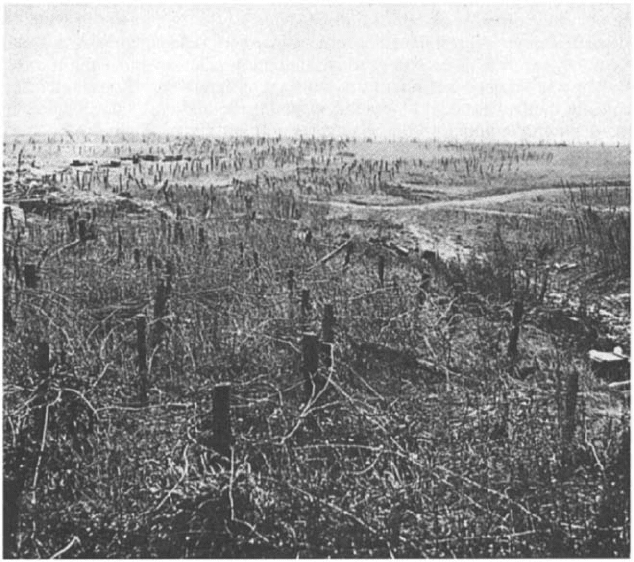
Between the trenches of the belligerents was no-man’s-land. This shellpocked
area was crisscrossed with barbed wire in double and treble thickness strung on
trestles and stakes to a height of between three and five feet. At night no-man’s s-
land was often a beehive of activity as patrols reconnoitered in the darkness broken
only by flares.
For soldiers at the front, life was muddy, cold, and wet. Only the large rats,
which shared the soldiers’ quarters and food, seemed to prosper. Despite the
frequent rotation of troops, most of the armies had broken or were near the breaking
point before the war was over.
In 1914, the British army held a short section of the line—about twentyone miles
—on the Flemish plain. On the British left toward the sea, the line was held by
A section of the Hindenburg Line, the most formidable defensive line on the western
front.
8 LLOYD GEORGE AND THE GENERALS
the French and Belgians. On their right, the French, who held over 400 miles of
the line, had their forces stretching to Switzerland.
After the First Battle of the Marne, both sides attempted to envelop the other
in what has been called the “race to the sea.” The British Expeditionary Force,
strengthened by reinforcements, was soon locked in a bloody struggle with the
German army. The First Battle of Ypres (called “Wipers” by British soldiers) was
just getting underway as Lloyd George was returning to London. It was the British
army’s first experience with trench warfare. When this indecisive battle came to
an end the old British army had been practically destroyed. Less than half of the
first soldiers sent to France were still on their feet.
When the opposing forces reached the sea, there were no more flanks to attempt
to turn. General Joseph-Jacques Césaire Joffre, the commander in chief of the
French army and the commander of the British Expeditionary Force, Sir John
French, a former cavalry officer, then turned to frontal assaults against well-
defended German positions. They believed that a breakthrough was possible. Yet
until 1918 all efforts to break into the open failed on the western front. Why did
these “siege-offensives,” as Churchill aptly called them, miscarry? The attackers
did not have the means to maintain the momentum of their attack. “The assault
could never be driven through into the open country fast and cleanly enough,”
Cyril Falls has written, “to prevent new lines of resistance being established and
the defense congealing about the bulge, as skin reestablished itself about a wound.
The break-in could not be converted into a break-through.”
28
Additional points
that could be made are: the railroad enabled reserves to be brought quickly to the
front to plug any hole; and the new rapid-fire weapons strengthened the defense
more than the offense.
The last days of the First Battle of Ypres found Lloyd George in a deep
depression. He told Frances Stevenson, to whom he often bared his soul, that he
feared that he would be overwhelmed by it all. “War is not his work,” she recorded
in her diary, “and he feels that he has not the heart to deal with it. It is all so
horrible.”
29
There was little if any war news to lift one’s spirits. Turkey had come into the
war in early November, slamming shut the Straits, Russia’s best outlet to her allies.
The Russian army had suffered staggering losses. The myth of the Russian “steam
roller” had been exposed. It could roll backwards as well as forwards. Elsewhere
in the East, Serbia was fighting for survival against an Austrian invasion. On
December 2, the Austrians occupied Belgrade. Although the Serbian capital was
quickly liberated and the Austrians thrown back, there was great concern in the
cabinet that this “five-feet-high” nation—standing alone—could not long defend
herself.
As these momentous events occurred in Europe and the Near East, the war
began to spread to other parts of the world. Although Britain sent the bulk of her
available forces to France, she also used her imperial position, supported by her
sea power, to strike at Germany’s overseas possessions in the Pacific and Africa.
When Turkey joined the Central Powers, a tiny imperial force quickly occupied
BIRTH OF AN “EASTERNER” 9
Basra near the Persian Gulf, the opening move of what eventually developed into
a great campaign up the Tigris toward Baghdad. Also, the British began to
strengthen their defenses in Egypt to protect the Suez Canal from Turkish attack.
As the war map expanded, Lloyd George began to look beyond the west ern
front. The slaughter in France horrified him. Although he was as perplexed as the
military authorities about trench warfare, he blamed the heavy Anglo-French
casualties on inept generalship. Running hot and cold on Kitchener, he referred
to him among his friends as “just a big figurehead.”
30
He told Miss Stevenson that
“our soldiers are the best in Europe, but they are being wantonly sacrificed because
those in authority do not know how to make the best use of them.”
31
Lloyd George’s lack of experience did not deter him. Never in awe of the
“expert,” he believed that the civilians could not afford to leave the conduct of the
war exclusively in the hands of the military. Whatever he lacked in formal training,
he believed that he made up for in imagination and boldness, qualities which he
thought were in short supply in the British high command. His knowledge of
warfare was gained from reading books and memoranda written for him and
especially through conversations with soldiers, both high and low.
Lloyd George’s understanding of the revolution in warfare caused by the new
rapid-fire weapons played a major role in his opposition to hurling men against
barbed wire and machine guns. With the erection of formidable defenses in the
West, he concluded that large-scale, plodding, and prolonged offensives there
were senseless slaughter, resulting in a human holocaust. Protective of British
blood, he never accepted the generals’ battles of attrition. He found support for
this view in the Warsaw banker I.S.Bloch’s important six-volume work, The War
of the Future, which was published in French in 1898. Bloch’s final volume, Is
War Now Impossible?, published in English in London in 1899, argued that the
new military technology gave the advantage to the defense and led to indecisive
siege warfare.
32
Convinced by his reading of Bloch and his tour of the western front that there
was little likelihood that the Allies could obtain decisive results in the West in the
foreseeable future, Lloyd George began to focus his attention on the Balkans.
Concern for Serbia’s precarious position and the opportunities he saw there for
both the soldier and the diplomat galvanized him into action. As December came
to an end, he began his long, acrimonious, and controversial campaign to influence
British strategy.
NOTES
1. David Lloyd George, War Memoirs of David Lloyd George, 2 vols. (1938), 1:47,
and entry of March 29, 1915, A.J.P.Taylor, ed., Lloyd George: A Diary by Frances
Stevenson (1971), p. 37.
2. Albert James Sylvester, The Real Lloyd George (1947), p. 11.
3. Committee of Imperial Defence (114), August 23, 1911, CAB 38/19/49.
10 LLOYD GEORGE AND THE GENERALS
4. Lloyd George to Churchill, August 25, 1911, Lloyd George MSS, C/3/15/6; also see
Churchill to Lloyd George, August 31, 1911, Lloyd George MSS, C/3/15/7. For a
recent account of Lloyd George’s and Churchill’s support of intervention on the
Continent, see K.M. Wilson, “The War Office, Churchill and the Belgian Option:
August to December 1911,” Bulletin of the Institute of Historical Research 50
(November 1977): 218–28.
5. Peter Rowland, David Lloyd George: A Biography (1975), p. 251.
6. Lloyd George to Margaret Lloyd George, August 3, 1914, quoted in Kenneth
O.Morgan, ed., Lloyd George Family Letters, 1885–1936 (1973), p. 167.
7. Cameron Hazlehurst, Politicians at War, July 1914 to May 1915: A Prologue to the
Triumph of Lloyd George (1971), p. 63.
8. Lord Beaverbrook, Politicians and the War, 1914–1916 (1960), p. 23. It has been
suggested that Lloyd George made this statement at lunch on August 2. Don
M.Creiger, Bounder from Wales: Lloyd George’s Career Before the First World
War (1976), pp. 249–50. Lloyd George also repeated these sentiments to C.P.Scott,
the editor of the Manchester Guardian, on August
4. But my reading of Scott’s diary is that he was at that time referring to his position
of the preceding days. See Trevor Wilson, ed., The Political Diaries of C.P.Scott,
1911–1928 (1970), pp. 96–97. The genesis of this idea may have been a General
Staff appreciation which suggested that “it seems to be likely that the Belgians will
not treat a German advance across her country as a violation of her territory.” Major
A.H.Ollivant, “A Short Survey of the Present Military Situation in Europe,” August
1, 1914, Lloyd George MSS, C/16/1/14.
9. Hazlehurst, Politicians at War, July 1914 to May 1915, pp. 54–65. Michael G.Fry
aptly characterizes Lloyd George’s position with his chapter heading,
“Understandable Emotions, Predictable Decisions.” Lloyd George and Foreign
Policy, vol. 1: The Education of a Statesman: 1890–1916 (1977), pp. 183–213.
10. Ollivant, “A Short Survey of the Present Military Situation in Europe,” August 1,
1914, Lloyd George MSS, C/16/1/14, and Wilson Diary, August 1, 1914.
11. Entry of September 30, 1931, Lord Hankey, The Supreme Command, 1914–1918,
2 vols. (1961), 1:161, and Lord Riddell’s War Diary, 1914–1918, pp. 3–5.
12. Hazlehurst, Politicians at War, July 1914 to May 1915, p. 108.
13. Lord George to Murray of Elibank, August 4, 1914, quoted in ibid., p. 117.
14. Frances Lloyd George, The Years That Are Past (1967), pp. 73–74.
15. H.C.Deb., 5th series, vol. 65 (August 3, 1914).
16. For prewar planning, see Samuel R.Williamson, Jr., The Politics of Grand Strategy:
Britain and France Prepare for War (1969), John Gooch, The Plans of War: The
General Staff and British Military Strategy c. 1900–1916 (1974), Nicholas
d’Ombrain, War Machinery and High Policy: Defence Administration in Peacetime
Britain 1902–1914 (1973), and Paul Kennedy, ed., The War Plans of the Great
Powers, 1880–1914 (1979). Also see Michael Howard, The Continental
Commitment; The Dilemma of British Defence Policy in the Era of the Two World
Wars. The Ford Lectures in the University of Oxford (1972).
17. “Secretary’s Notes of a War Council Held at 10, Downing Street, August 5, 1914,”
CAB 42/1/2.
18. The Earl of Oxford and Asquith, Memories and Reflections, 1852–1927, 2 vols.
(1928), 2:30.
19. Philip Magnus, Kitchener: Portrait of an Imperialist (1959), p. 284.
BIRTH OF AN “EASTERNER” 11
20. Hankey Diary, September 11, 1915, 1/1.
21. Lloyd George, War Memoirs, 1:51.
22. See the illuminating article by John Terraine which touches on press coverage of the
British retreat from Mons, ‘The Impact of Mons, August 1914,” History Today 14
(August 1964) :521–31.
23. Frances Lloyd George, Years That Are Past, p. 75.
24. Entry of September 19, 1914, Lord Riddell’s War Diary, p. 32.
25. Times (London), September 20, 1914. Earlier Lloyd George had made his first speech
on the war to a deputation from the Association of Municipal Corporations, Times
(London), September 9, 1914. For an analysis of this speech, see Hazlehurst,
Politicians at War, July 1914 to May 1915, pp. 175–76.
26. Lloyd George, War Memoirs, 1:92.
27. Lloyd George to Margaret Lloyd George, October 20, 1914, quoted in Morgan,
Family Letters, p. 173.
28. Cyril Falls, The Great War (paperback edn., 1959), p. 83.
29. Entry of October 30, 1914, A Diary by Frances Stevenson, p. 8.
30. Entry of October 25, 1914, Lord Riddell’s War Diary, p. 36.
31. Entry of December 16, 1914, A Diary by Frances Stevenson, p. 17.
32. Lloyd George was influenced by I.S.Bloch in preparing his famous January 1, 1915,
memorandum which advocated the diversion of British military power to the eastern
Mediterranean. See Lloyd George MSS, C/16/1/3.
12 LLOYD GEORGE AND THE GENERALS
2
Balkanite
ON December 31, Lloyd George wrote the prime minister:
I am uneasy about the prospects of the war unless the Government take some
decisive measures to grip the situation. I can see no signs anywhere that our
military leaders and guides are considering any plans for extricating us from
our present unsatisfactory position…. Could we not have a series of
meetings of the War Committee of the C.I.D. at an early date? Occasional
meetings at intervals of a week or a fortnight will end in nothing.
1
By this time Lloyd George had very bold and specific views on strategy, which
he circulated on New Year’s Day to his colleagues in the War Council, a small
body created by the cabinet to deal with general matters of war policy. Great
Britain was rapidly putting a splendid fighting force in the field, he noted, and this
new army should not be sent to France to be flung “against impregnable positions”
in “futile enterprises.” The Welshman’s alternative strategy to the western front
involved “two independent operations” on opposite sides of the Mediterranean,
one against Austria in the Balkans and the other against the Ottoman Empire in
Syria, which would isolate the Turkish troops moving against the Suez Canal.
2
Dearest to his heart was a political-military thrust in the Balkans. Since the
beginning of the war he had been encouraged by his contacts with the brothers
Noel and Charles Buxton, who headed a British mission to the Balkans in August,
to believe that the Balkan states could be easily mobilized against Austria-
Hungary.
3
He was convinced that Britain’s failure to create a Balkan confederation
was largely due to excessive caution and timidity by British diplomacy and the
absence of a strong British military presence in the area. He did not hesitate to
infringe upon the Foreign Office’s domain. In mid-December, he lobbied
Rumanian representatives who were seeking a British loan, believing that he had
“‘roped Roumania in.’ ”
4
If Britain made the Balkans her principal theater of military operations, he was
confident that Rumania and Greece, and perhaps even Bulgaria, would join forces
with Serbia and Montenegro. Austria, already suffering heavily at the hands of
the Russians, he argued, would then be confronted with a sizable Allied force on
her southern flank. Germany would be faced with the unhappy choice of either
abandoning her primary ally or attempting to keep entact “an enormous front, in
the aggregate of 1,200 miles.” Trench warfare, he hopefully noted, might be
avoided because the new front “would be much too lengthy for the Austrian forces
to entrench and hold.”
5
Political considerations were a dominant theme in Lloyd George’s January 1
memorandum. He stressed the psychological advantage of a “dramatic victory”
somewhere to keep his countrymen united behind the war effort, and warned his
colleagues that the volunteers who were eagerly lining up before the recruiting
offices were “vastly superior” in “intelligence, education and character” to earlier
soldiers. They would not tolerate senseless bloodletting on the western front.
6
And, of course, he contended that the fence-sitting Balkan nations would be
brought into the war on the side of the Entente.
To his credit, the chancellor of the exchequer emphasized the need for an early
decision by the government in order to begin preparations for opening a new front
in the Balkans. “Expeditions decided upon and organised with insufficient care
and preparation,” he prophetically warned, “generally end disastrously.”
7
Lloyd George’s proposal for an alternative strategy was not the only one put
forward. The competition, in fact, was brisk. Maurice Hankey on Boxing Day
(December 28) had first broached the subject of concentrating British power in
the East because of the stalemate in the West. Hankey had one of the keenest and
most active military minds in the government. A career officer, he had served in
the Royal Marine Artillery at sea and the Department of Naval Intelligence in the
Admiralty. Prior to the war, he had been a central figure in strategic planning as
the secretary of the Committee of Imperial Defence. Now he was at the very center
of policy making as the secretary of the War Council. Although he had not talked
with Lloyd George, there were striking similarities between the two proposals.
Both a Balkan offensive and an attack on Syria were discussed by Hankey.
8
Hankey’s indirect strategy formed the basis for a very close relationship between
himself and Lloyd George for the rest of the war.
Another entry into the realm of grand strategy was the forceful and imaginative
Winston Churchill, the first lord of the Admiralty. “Are there not other alternatives
than sending our armies to chew barbed wire in Flanders?”
9
Churchill asked the
prime minister on December 29, 1914. Although Churchill considered Germany’s
“northern flank the primary and most vulnerable objective”
10
as the new year
began, he was quickly to shift his attention to the Dardanelles. Thus were born the
“Easterners,” who were united by their distaste for the huge losses on the western
front and the political advantages of military operations in the Near East. Fabulous
prospects seemed in the offing as they cast their eyes toward Turkey and the
Balkans. Russia might be relieved through the conquest of the Straits and the defeat
of Turkey, the Balkans mobilized against the Central Powers and Austria-Hungary
brought to her knees. Germany would stand weakened and alone. If Germany
continued to concentrate on the western front, so much the better. “We should ask
nothing better,” Hankey had written, “than he should hurl fresh masses to
destruction on our impregnable position.”
11
14 LLOYD GEORGE AND THE GENERALS
On January 7, the War Council began an important examination of Britain’s
future strategy. Lord Kitchener opened the discussion by bringing up a proposal
by Churchill and Sir John French to turn the German flank at Zeebrugge along the
Flanders coast by land and amphibious operations. To ensure success, French
wanted fifty Territorial battalions dispatched to the Continent. Fearing that this
would drastically disrupt his attempt to create a new army, Kitchener was hostile
to the proposal.
This breach in the ranks of the army gave the “Welsh Wizard” an opportunity
to introduce his Balkan strategy. Before a final decision on the Zeebrugge
operation was made, he wanted to
consider the large question of the future employment of the new Armies. If
our army on the Continent was to be thrown away and shattered in an
operation which appeared to him impossible, the war might continue
indefinitely, or at any rate for two or three years more. Was it impossible,
he asked, to get at the enemy from some other direction, and to strike a blow
that would end the war once and for all? If some new plan should be decided
on, every man would be required for it in April or May, and the loss of some
fifty battalions of Territorial troops would be very severely felt.
12
The following day at noon, when the War Council resumed its deliberations, Lloyd
George attempted once again to guide the discussion. With “great ability and
persuasiveness,”
13
according to Hankey, he lobbied for an attack on Austria.
Having talked with Hankey since his New Year’s Day memorandum, he was
prepared to admit that his bold scheme had a weakness—lines of
communication.
14
One route to Austria was by way of Salonika. From that Greek
city an army could move over the top of the Balkans on the Salonika-Nish-
Belgrade railway. But, Lloyd George confessed, “the Salonica railway, though a
good railway of German construction, had only a single line of track, and it would
be difficult to supply a large army along it, particularly if the Greeks also had to
be supplied by it.” In his next breath, he attempted to overcome this deficiency.
Ragusa (or Dubrovnik) on the Dalmatian coast, he argued, “might be used to
supplement the Salonica line, giving two lines of communication.”
15
Lloyd George was actually too quick to accept the alleged deficiency of
communications from Salonika to Serbia. True, the present carrying capac-ity of
the railway to Belgrade was low. But with Greek support the number of trains
going both ways could easily have been doubled from six to twelve. Access to
Serbia by road was indeed limited. But this, too, could have been vastly improved
if the Allies had acted with energy and determination.
16
By introducing Ragusa into the discussion, Lloyd George weakened his case.
Asquith, who had visited Ragusa the previous year immediately made objections.
“The railway was of narrow gauge, and there was only one road, which, though
a good one, ran through difficult and mountainous country,” he said. Kitchener,
the oracle of high strategy, was even more trenchant in his comments. “Ragusa,”
BALKANITE 15
he bluntly proclaimed, “was an impossible sea base.” As for Salonika, “it could
only be used if Greece were an ally; the single line of railway leading to Serbia
could only support, at the outside, an army of 200,000 men.” The Dardanelles,
rather than Austria, Kitchener argued, “appeared to be the most suitable objective,
as an attack here could be made in co-operation with the Fleet.”
Another blow to the Welshman’s Balkan strategy was a letter from Sir John
French which Kitchener summarized for the War Council. French denied “the
impossibility of breaking through the German lines.” French also warned the
civilians that “a crushing defeat, however, of the French would be very dangerous
and embarrassing to our safety, and must be made impossible…not a man could
be diverted from France to any other theatre of operations without the consent of
the French, and this would never be obtained.”
17
Lloyd George’s initial attempts to redirect the war effort thus ended in failure.
His considerable powers of persuasion had gone for naught. The commander in
chief of the British Expeditionary Force was hostile, and logistical arguments
which Lloyd George was in no position to refute had been raised by Kitchener.
Churchill, who was at this time interested in land and sea operations at Zeebrugge
or especially in the Baltic, had given him no support. Furthermore, the prime
minister had raised objections. Lloyd George could only take comfort in the War
Council’s opposition to an increased British effort on the Continent at Zeebrugge
and in Hankey’s mindboggling suggestion that a successful attack on the
Dardanelles would “give us the Danube as a line of communications for an army
penetrating into the heart of Austria, and bring our sea power to bear in the middle
of Europe.”
18
Lloyd George’s response to this setback was to redouble his efforts. His
advocacy of Balkan operations had one great strength. The strongest and most
influential voices in the War Council—himself, Churchill, and Kitchener—were
all unhappy with the frontal attacks on the western front. If the support of Kitchener
and Churchill could be gained, his Balkan plans had a chance of being
implemented. Caught between the “Easterners” and “Westerners,” who wanted
to concentrate almost exclusively on the German army in the West, the prime
minister was characteristically irresolute. If he leaned in one direction, it was
toward the “Westerners.” Asquith’s indecision might be ended, however, if
support among the professional soldiers could be found for a Balkan thrust.
The War Council’s opposition to the proposed Zeebrugge operation and its
growing interest in military operations in the eastern Mediterranean created
anxiety at general headquarters. On January 12, Sir John French hurried across
the Channel to present the views of the “Westerners.” Lloyd George was waiting
for him. In a long interview the persistent and persuasive Welshman attempted to
convert French. Lloyd George, who was intrigued by statistical data, had fresh
War Office figures to show that Berlin had a superiority in numbers and was
sending additional soldiers to the West. Lloyd George was often to note—only
partly in fun—that the “sol diers must be ignorant of simple arithmetic.”
19
The
soldiers, if given a chance to respond, would have replied that Lloyd George placed
16 LLOYD GEORGE AND THE GENERALS