
Woodward D. Lloyd George and the Generals
Подождите немного. Документ загружается.

documents from general headquarters to the War Office requesting more
ammunition, especially high-explosive shells, they told the chancellor of the
exchequer that Kitchener had ignored Sir John’s urgent pleas for months. Lloyd
George was profoundly shocked. It had been rumored earlier that the British army
was running short of shells, but Kitchener had assured the government that the
supply of munitions was adequate. It now appeared that the head of the War Office
was guilty of criminal deception. No civilian knew of Sir John’s plight. As Lloyd
George later wrote, “This was the first communication on the shell question that
I had received from the Commander-in-Chief.”
10
Lloyd George apparently believed that French’s intrigue against Kitchener was
perfectly justified under the circumstances. He would not have been so tolerant
of this internecine struggle among the “brass hats” if he had known that he was
being used, in part, in an attempt to reverse the government’s “Eastern” strategy.
Sir John French hoped to destroy Kitchener because of the latter’s support of
strategy which threatened to take men and shells away from the West.
11
Sir John French also gave his one-sided views on the shell shortage and the
meager reinforcements the British Expeditionary Force was receiving to the most
influential military correspondent of the day, Colonel Charles a Court Repington
of the Times. On May 14, Repington discussed the recent British offensive, the
Battle of Festubert, under the provocative headline: “NEED FOR SHELLS.
BRITISH ATTACKS CHECKED. LIMITED SUPPLY THE CAUSE.” It is the
contention of Max Aitken (Lord Beaverbrook) that Lloyd George immediately
saw the “potential political dynamite” in this report from the front.
12
Furious with
Kitchener’s apparent incompetence and his secretiveness, he seized upon
Repington’s account in the Times to undermine the secretary of state for war and
gain control of munitions. As was often his method, he chose an indirect approach.
According to Aitken he went to the most powerful press lord in Britain, Lord
Northcliffe, the owner of the Times and Daily Mail, and urged him to launch a
press campaign against Kitchener.
13
The megalomaniac Northcliffe apparently
needed little encouragement.
14
Lloyd George also met secretly with Repington
and was given incriminating material to be used against the head of the War
Office.
15
Lloyd George’s use of the press was hardly unusual. With Parliament’s role
considerably diminished and with partisan party politics generally in abeyance
because of the war, Fleet Street, with its hold on the British public, served as the
opposition to the government. Rather than deliver a direct attack on an opponent,
politicians leaked stories and material to their supporters in the press, a practice
which is certainly not unknown today. Lloyd George was a master at planting
stories. No British politician was better connected with the press lords. Riddell,
owner of News of the World, C.P.Scott, the owner and editor of the Manchester
Guardian, Robertson Nicoll, the editor of the British Weekly, Robert Donald, the
editor of the Daily Chronicle, and Lord Burnham, the owner of the Daily
Telegraph, among others, were frequently in his company. With Lord Northcliffe,
LLOYD GEORGE AND THE GENERALS 37
however, he enjoyed a very uneasy relationship. Perhaps it was his realization that
he was likely to be used by Northcliffe rather than the reverse.
As Northcliffe moved to launch his press campaign on munitions to discredit
Kitchener, an unguided missile emerged from the Admiralty—Lord Fisher.
Seething with discontent with Churchill over the Dardanelles and determined to
win control of the Admiralty, “Jacky” Fisher decided to resign. Lloyd George,
quite accidentally, was one of the first to learn of his intentions. As he was passing
the entrance lobby of 10 Downing Street on Saturday morning, May 15, he saw a
glum first sea lord who blurted out: “I have resigned!”
16
With a munitions scandal
brewing and with the nation’s most famous naval figure determined to resign,
Asquith’s Liberal ministry was in serious trouble.
Fisher’s resignation had a decisive impact on Bonar Law, the leader of the
Unionists, who telephoned Lloyd George and told him that the government was
faced with either a rebellion of the Unionists in the House or the acceptance of a
coalition government. The chancellor of the exchequer agreed that coalition was
the only solution and invited Bonar Law to visit him at the treasury. When Bonar
Law arrived, Lloyd George excused himself and went down the corridor to 10
Downing Street to see the prime minister.
17
In a matter of minutes, the decision
was made to include the Unionists in a coalition government to preserve the party
peace in Parliament. Lloyd George then collected Bonar Law and the three men
met in the cabinet room. During the discussion of a reconstructed government,
Asquith and Lloyd George agreed that it was “absolutely necessary to get rid of
Kitchener.”
18
Who would replace him? Asquith suggested Lloyd George.
On the same day, May 17, an excited Lloyd George told an astonished Miss
Stevenson, “Well Pussy, I’m leaving this place!” Asquith, he informed his
secretary, had offered him the War Office and he was going to accept it.
19
In the
next three days, however, he clearly had second thoughts. “He does not want to
leave this place,” Stevenson recorded in her diary on the eighteenth.
20
By the
nineteenth, he still had reservations and Stevenson believed that he would “leave
it in the hands of the Prime Minister to decide.”
21
On May 20, Lloyd George was
no longer equivocable. “Tories want me in the War Office—but I will not go,” he
wrote his wife.
22
One can only guess what was going through Lloyd George’s mind during these
days. He apparently had no idea of undermining Asquith. If he was involved in a
conspiracy, it would seem to be directed against Kitchener rather than the prime
minister.
23
Supplanting Kitchener at the War Office would enable him to have his
way on munitions. On reflection, however, he must have perceived many
disadvantages. His amateur standing and lack of support from his Liberal
colleagues would allow him no influence over British strategy. The generals would
fight him tooth and nail; Asquith was certain not to back him; and the press would
recoil in horror if he attempted to interfere with the strategic direction of the war.
His strongest support came from the Unionists and they were not opposed to the
generals’ “Western” strategy. Even a friend and fellow opponent of the Western
offensives such as Churchill wrote Asquith, “I am sure LG will not do for WO.”
24
38 MUNITIONS, COMPULSION, AND THE FALL OF SERBIA
There was also the very serious problem of occupying Kitchener’s shoes.
Kitchener’s standing had fallen within the government, but he was still held in
high esteem by the public. A small crowd gathered every day at the War Office
just to see the nation’s hero. Surely, some of the public outrage at his dismissal
would be directed at his successor.
Remaining at the treasury, the second most important position in the
government, seemed preferable, especially if Lloyd George were given the
authority he wanted to reorganize munitions production. On May 19, Northcliffe’s
mass-circulation paper, the Daily Mail, fired a shot across the bow of the War
Office. “THE TRAGEDY OF THE SHELLS. LORD KITCHENER’S GRAVE
ERROR,” screamed the heading of its leading article.
On that same day, Lloyd George wrote a very strong letter to Asquith. Under
the circumstances, it came close to being an ultimatum.
If these facts [shell shortage] are approximately correct, I hesitate to think
what action the public would insist on if they were known. But it is quite
clear that the proceedings of a Munition Committee from which vital
information of this character is withheld must be a farce. I cannot therefore
continue to preside over it under such conditions.…
A Cabinet Committee cannot have executive power: it can only advise
and recommend. It is for the department to act. They have not done so, and
all the horrible loss of life which has occurred in consequence of the lack
of high-explosive shell is the result.
25
As Asquith mulled over Lloyd George’s request for an independent Ministry of
Munitions, Northcliffe continued to pile on the pressure. On May 24, the Daily
Mail’s leading article asserted: “Within the next few days the War Office will be
reorganized. It is to be hoped that Lord Kitchener will remain the gatherer of
armies.… It is equally to be hoped that the whole question of shells and other
munitions of war will be put into the hands of another Cabinet Minister, who will
take into his confidence some of the leading business men of the country.” Who
else but the present chancellor of the exchequer would fit this description? In fact,
Northcliffe and Lloyd George had discussed the munitions situation at Walton
Heath the day before this leading article appeared.
26
Northcliffe’s press campaign may indeed have helped Lloyd George get his
Ministry of Munitions. But the attack against Kitchener had unexpected
consequences. There was a violent reaction from the public. Copies of the Daily
Mail and the Times were burned at the London Stock Exchange and elsewhere. A
sign, “The Allies of the Huns,” was placed over the plate of the Daily Mail’s office
on Throgmorton Street. Angry letters poured in, and the paper suffered a large
temporary circulation loss. The national clamor helped convince Asquith to keep
Kitchener at the War Office.
27
When the new coalition government was announced on May 26, there was a
Ministry of Munitions headed by Lloyd George. The treasury was given to
LLOYD GEORGE AND THE GENERALS 39
Reginald McKenna with the understanding that Lloyd George could reclaim it
later. The Welshman had gained one of his greatest victories over the military
hierarchy. His direction of the production of munitions in the next
months gave abundant proof that he was the right man for the job. He understood
the requirements of modern war better than most of the generals. The new
technology of war, especially if it offered hope of breaking the stalemate, excited
him. He immediately grasped the value of the heavily armored vehicle or tank
when Kitchener viewed this clanking contraption as “‘a pretty mechanical toy.’”
28
Kitchener was equally remiss about the machine gun, believing that at the very
most four machine guns per battalion were sufficient. Lloyd George’s response
to Kitchener’s figures was: “Take Kitchener’s maximum (four per battalion);
square it, multiply that result by two; and when you are in sight of that, double it
again for good luck.”
29
This produced sixty-four machine guns per battalion,
which actually fell a bit short of eventual requirements. Another important new
weapon which Lloyd George rescued from oblivion was the Stokes light mortar,
which had been rejected by the soldiers.
30
Lloyd George’s involvement in delivering the sinews of war kept him away
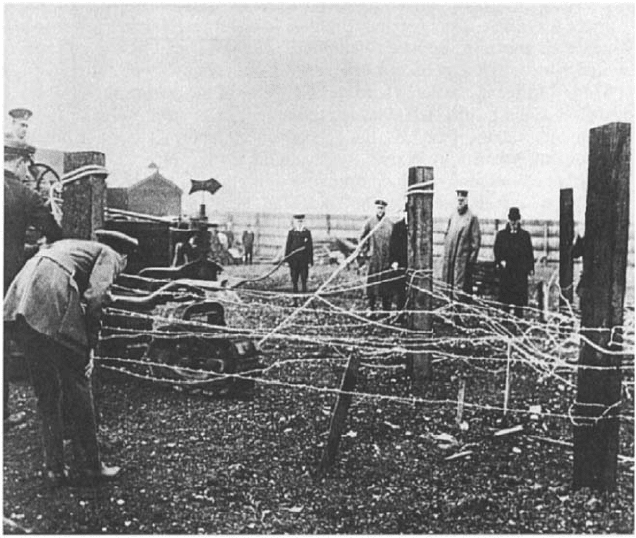
from the inner councils of war. Throughout June, he was absent from the
Lloyd George at Wormwood Scrubbs watching a Killen-Strait tractor fitted with
torpedo wire-cutters.
40 MUNITIONS, COMPULSION, AND THE FALL OF SERBIA
Dardanelles Committee, which had replaced the War Council. The committee’s
new name accurately reflected the dominant interest of the politicians. On April
25, beachheads on Gallipoli had been established by an amphibious assault at
dawn. Once ashore, however, the British, Australian, and New Zealand troops
were unable to move beyond the beaches and capture the high ground.
Reinforcements were sent but the troops remained on their precarious beachheads.
The conflict assumed the depressing character of the stalemated trench warfare of
the West.
Lloyd George, with his Balkan plans stymied by this operation, was profoundly
pessimistic about the British effort at the Dardanelles. Without any khaki in the
Balkans, he also was convinced that it was only a matter of time before the
Germans and Austrians would overrun Serbia, seduce Bulgaria, and establish a
direct line of communications with Turkey. He told his friend C.P.Scott in mid-
June that Berlin was toying with London in the Near East: “When it suited them
they could drive us into the sea.”
31
On June 19–20, Lloyd George chaired a conference on munitions at Boulogne.
Since that French city “was crowded up to the attics,” the only space available for
the discussion was a dirty and ill-smelling room at a second-rate hotel. During the
talk it became obvious to the British delegation (which included military
representatives) that there would not be enough big guns and high-explosive shells
to justify a big British effort on the western front until 1916.
32
Lloyd George returned to London with his opposition to a large-scale British
attack in the West in 1915 reinforced by the technical arguments of this munitions
conference. His country’s continued subordination to French strategy alarmed him
more than ever. The British Expeditionary Force had more than doubled in size
since the beginning of the year and he feared that Joffre, despite the gigantic losses
suffered by the French in the spring and the British failure at Festubert, would
insist that these fresh but poorly equipped forces should be hurled against machine
guns and barbed wire. Without adequate artillery support, Lloyd George believed,
this would be tantamount to the murdering of thousands of British soldiers. At his
first Dardanelles Committee meeting (July 5) he emphasized that “it would be the
greatest mistake to send out any reinforcements to the Army in France until it
could be fully supported with heavy guns and ammunition.”
33
Caught between
Joffre, who desired a big offensive, and the British ministers, who did not,
Kitchener hedged. He “said that he would do his best, but the French said that the
offensive is vital to them. They provided most of the men and were defending
their own territory, and we therefore considered them entitled to do what they
liked.”
34
In fairness to Kitchener, there is no question that he was in a difficult position.
After the Battle of Festubert had begun poorly for the British, he had wired Sir
John French that the dispatch of the new army to France was contingent upon
breaking through the German lines.
35
On the other hand, with the Russian army
in full retreat in the East, there might be merit in Joffre’s argument that the Anglo-
French forces had to launch a big attack in the West to take the pressure off the
LLOYD GEORGE AND THE GENERALS 41
Russians. Perhaps Kitchener’s belief that the French had to be supported because
of their predominant military role in the West is the best explanation for his actions.
After the July 5 Dardanelles Committee meeting, Kitchener and other British
leaders (Lloyd George was not among them) crossed the Channel to Calais for the
first inter-Allied conference to coordinate war policy. Although Kitchener was
genuinely in favor of delaying a great offensive in the West until 1916, he was
more inclined to support Joffre than the British civilians. Sir Henry Wilson
recorded this revealing conversation he had with Kitchener just before the latter
departed for France: “He wants to see Joffre alone and to tell him of all his fears,
show him his whole hand, and come to an agreement as to what he shall say in
front of the politicians whom he hates and distrusts as much as, I told him, Joffre
did.”
36
Early in the morning on the sixth, Kitchener had his private conference
with Joffre, apparently telling him that, if the French supported an expansion of
the Gallipoli campaign, he would not oppose a major offensive later in the year,
by which time he seems to have believed that the Turks would be flying the white
flag of surrender over the Dardanelles. But he apparently made it clear that the
burden of fighting would fall to the French. British support would be largely
confined to taking over more line to free French soldiers for the offensive.
37
At the conference which began at 10:00 A.M. and lasted three hours, Kitchener
in fluent French presented London’s s case against a premature offensive.
Although no formal conclusions were drawn up, Hankey succeeded in putting
down some “unformulated” conclusions by talking to the British leaders who
participated in the discussion. These conclusions included an agreement that no
general (as opposed to local) offensive would be launched. In sum, the Anglo-
French policy in the coming months was to be that of an active defensive to tie
the Germans down in the West,
38
and the British politicians returned to London
convinced that a large-scale attack had been ruled out for the rest of 1915. Joffre,
however, as we will shortly see, placed a different interpretation on the conclusions
of the conference.
Lloyd George’s relations with the head of the War Office continued to
deteriorate during the summer. There was considerable friction and jealousy
between Lloyd George’s civilians in the new Ministry of Munitions and the
professionals in the War Office. Kitchener’s rejection of Lloyd George’s offensive
plans in southeastern Europe also created a wide gulf between the two men. Earlier,
Lloyd George had believed that Kitchener was Britain’s greatest general because
of his dislike of big and futile attacks in the West and his support of an indirect
strategy. In June, however, Kitchener stated his strategical views for British arms
after the Dardanelles campaign. He wrote: “Even assuming that we secure both
the Dardanelles and the Bosphorus, it is now practically impossible for us to
undertake a great campaign directed against Austria-Hungary during the year
1915.”
39
In August, Lloyd George latched on to the divisive issue of compulsion (or
compulsory service) to use as a stick with which to beat both Kitchener and his
protector, Asquith. It became a symbol for the Welshman’s determination to win
42 MUNITIONS, COMPULSION, AND THE FALL OF SERBIA
the war at all costs. Rejecting the Liberals’ almost laissez-faire attitude toward the
conflict, he sought to use state power to mobilize the country for total war. On
August 18, he appeared before the War Policy Committee of the cabinet, which
had been created to examine the question of compulsion. “Would you go to the
point of placing every citizen at the orders of the Government?” the chairman,
Lord Crewe, wanted to know. “If you ask me whether personally I think it would
help the efficient conduct of the war,” Lloyd George responded without hesitation,
“I say at once that it certainly would. I would say that every man and woman was
bound to render the services that the state required of them, and which in the
opinion of the state they could best render. I do not believe you will get through
this war without doing it in the end; in fact, I am perfectly certain you will have
to come to it.” Lloyd George, of course, did not want to seem the accomplice of
Joffre, who insisted on squandering men in futile attacks. As he told the committee,
“I do not feel myself that the only field of operations is in France by any means.”
40
Because of his position in the government, the most important critic of
compulsion was Kitchener. His opposition is surprising, but it perhaps can be
explained. He may have believed that it would be butchery to draft more men into
the army before they could be properly equipped. At least, that was Hankey’s
conclusion from conversations he had with Kitchener on the subject.
41
In justifying
his position on compulsion to the government, he displayed the dark side of his
character. To be blunt, he lied and got other officers to lie for him about the military
facts.
42
Meanwhile, military developments in the East and the West combined with the
fight over compulsion to bring Lloyd George’s irreconcilable differences with
Kitchener to a head. First, the British campaign on Gallipoli continued to miscarry.
A surprise attack at Suvla Bay on August 6 was poorly executed. Initially only a
brigade and a half of the Turkish defenders stood in the way. But a great
opportunity was lost because of the inertia and mistakes of the generals. The troops
once ashore did not immediately advance to occupy the commanding heights of
the Dardanelles. The local commander, Sir William Stopford, took a nap aboard
his ship; some of his troops cavorted on the beach and in the water, while others
made tea. It was rather like a summer holiday at Brighton. When the fighting began
in earnest, the British were unable to dislodge the reinforced Turks from their
commanding position. This failure was a crushing setback to those who hoped the
fresh assault would end the stalemate on Gallipoli.
The “Easterners” were dealt another blow on August 20. This time it was
Kitchener rather than the Turks who delivered the punch. After a four-day
conference with French and Joffre, Kitchener surprised the Dardanelles
Committee with the news that he now favored a big attack on the western front.
Because of Russia’s precarious position, “he could no longer maintain the attitude
which was agreed upon in conjunction with the French at Calais [in July], namely,
that a real serious offensive on a large scale in the West should be postponed until
all the Allies were quite ready.” Perhaps echoing Joffre, he made the dubious
assertion that “trench work was becoming very irksome to the French troops, and
LLOYD GEORGE AND THE GENERALS 43
that an offensive was necessary for the moral of the French army, amongst the
members of which there was a good deal of discussion about peace.”
How an all-out attack rather than local attacks to occupy the German army
would give more assistance to the Russians he could not explain. In response to
sharp questioning from Churchill, he could only answer lamely that “unfortunately
we had to make war as we must, and not as we should like.”
43
With profound reluctance and skepticism, the civilians bowed to Kitchener’s
will. Few decisions made by the government during the war were as crucial as
this one. “It was with this decision,” Michael Howard has written, “that the total
commitment of British resources to the Western Front really began.”
44
A truly
astonishing aspect of this incident is that Kitchener had been deceived by Joffre’s
argument that Britain might break up the alliance if she withheld her support. The
truth was that the French government was opposed to Joffre’s plan and feared with
reason that he would destroy the morale of the French army with his headlong
attacks.
45
If Kitchener had stood up to Joffre, he might have given the French
civilians the courage to overrule their granite-willed commander in chief.
Lloyd George, who had not been present, was informed of the government’s
capitulation to Joffre by Bonham Carter, the prime minister’s private secretary.
46
His frustration over the direction of the war now knew no bounds. In the West,
the Kitchener-Joffre combination was sponsoring an offensive in which almost
no British politician believed. In the East, it was clear that the British were
stalemated at Gallipoli; the campaign there was consuming men and equipment
at an ever-increasing rate with no end in sight. The survival of Serbia, meanwhile,
hung in the balance, with Kitchener apparently oblivious to the potential German
threat to that small state. When the government’s oracle on strategy was asked in
the Dardanelles Committee if he had considered a Balkan thrust by Berlin to link
up with Turkey, Kitchener had answered that he had, “but he thought it would be
a mistake on the part of the Germans.” Churchill’s sarcastic comment to this bit
of strategical wisdom is worth recording. He noted that “it would be a mistake we
should be very sorry to see them make.”
47
To Loyd George there was no better proof of Kitchener’s indifferent attitude
toward Serbia and the Balkans than his failure to make any plans or preparations
to deal with a German attack. In January and February, the War Council—at Lloyd
George’s prompting—had instructed Kitchener to make the necessary initial
preparations for the sending of an expeditionary force to the Balkans.
48
Kitchener
had turned a deaf ear. As Lloyd George later bitterly commented: “Not even a
mule had been bought for transport when the German blow fell on Serbia.”
49
Kitchener was made to look foolish in early September when the French
suddenly offered to furnish four divisions for the war against Turkey. Kitchener
was completely taken aback by this unexpected development. Perhaps it meant,
he told an equally puzzled Dardanelles Committee, “that the French had decided
to postpone their offensive.”
50
Lloyd George and Churchill were elated, with
Churchill passing the Welshman a note which read,” ‘I feel like a man who was
about to be shot, and who instead is left a large fortune.’ “
51
A few days later
44 MUNITIONS, COMPULSION, AND THE FALL OF SERBIA
Kitchener had to tell the ministers that it was the dispatch of the four French
divisions which had been postponed. Joffre’s offensive was still on.
52
The
confusing signals emanating from Paris were the result of a furious tug of war
going on between the French civilians, who wanted to support the Dardanelles
venture, and Joffre, who opposed any diversion of French military strength away
from the West.
This comedy was not lost on Lloyd George. Britain, he believed, was certain
to lose the war if Kitchener continued in the War Office. His obses sive secrecy,
the contradictory opinions he often expressed in the Dardanelles Committee, and
his kowtowing to Joffre appeared to make him a greater menace to the nation than
the German Zeppelin and U-boat. Some of his ire at the secretary of state for war
was directed at Asquith, who dared not risk the public outcry and sack Kitchener.
There was little chance that Lloyd George, acting alone, would be able to have
his way with the prime minister. His influence with his chief was now at its nadir,
all his suggestions “pooh-poohed.”
54
His relations with most of his fellow Liberals
were equally bad. Only Churchill was really close to him. In desperation, he turned
to the Unionists for support, especially Bonar Law, Curzon, and Sir Edward
Carson.
55
They approved of his strong stand on compulsion and they shared his
contempt for the head of the War Office, with Bonar Law and Curzon openly
ridiculing Kitchener’s direction of the Gallipoli campaign in the Dardanelles
Committee.
56
This was a combination to be reckoned with.
On September 14, Lloyd George dined with Churchill and Curzon, agreeing to
join with the Unionists to force Asquith to remove Kitchener and accept
compulsion.
57
Lloyd George was almost certainly ambivalent about plotting with
the Tories against Kitchener and especially Asquith. As he told Stevenson, he
hated “going against his party.”
58
Serbia dominated Lloyd George’s thinking in the latter part of September. With
the Austro-German campaign against Russia drawing to a close, the enemy would
soon be able to concentrate on Britain’s s only Balkan ally. Meanwhile, “Foxy
Ferdinand,” the king of Bulgaria, moved closer to the Central Powers, announcing
general mobilization and armed neutrality on September 19. Serbia appeared
doomed if Bulgaria launched an assault from the rear. Her only chance of survival
appeared to depend upon decisions being made in London and Paris. Would her
allies, Belgrade asked, be willing to send immediately a force of 150,000 men to
the Balkans? This show of determination by London and Paris might stiffen
Greece’s backbone and cool Bulgaria’s ardor for war.
Faced with a desperate situation, Britain’s war leaders were forced to reconsider
Lloyd George’s Balkan strategy. There could not have been a more inopportune
time to send an expeditionary force to the Balkans. A big attack was about to be
launched in the West and British forces in the East were still locked in combat
with the Turks in Gallipoli. Something had to give. Lloyd George suggested in
the Dardanelles Committee on September 23 that the some 40,000 British soldiers
at Suvla Bay be transferred to Salonika. Athens should be telegraphed immediately
and informed that eventually a force of 150,000 would be sent. Kitchener, as usual,
LLOYD GEORGE AND THE GENERALS 45
threw cold water on the Welshman’s Balkanite ideas. He still felt that the German
threat to Serbia was exaggerated and he warned that the proposed intervention
“might be a greater drain than the Dardanelles operation.”
To bolster his case for involvement in the Balkans, Lloyd George
characteristically fell back on the political considerations involved. Always the
adroit politician, the Welshman used a clever argument which was calculated to
appeal to the British politician. Berlin can not “do us much harm in the West,” he
warned, but in the East, Britain’s Asian empire was at stake. To block the road to
Egypt, Persia, and India, Britain must construct a wall in the Balkans. For the most
part, the bricks for this barrier would come in the form of Balkan soldiers. Once
again, he emphasized that khaki in the Balkans might mean as many as 1,000,000
new soldiers for the Entente.
The Dardanelles Committee was divided and the discussion was long and
heated. As was often the case, no clear plan of action emerged. Instead, it was
decided to explore the situation further.
59
When the French government was
sounded out, it enthusiastically endorsed the idea of sending 150,000 men to
Salonika. This forced the hand of a reluctant British government, to the delight of
Lloyd George. Preparations were begun to send a small AngloFrench force to
Salonika.
Meanwhile, the Anglo-French armies launched their general offensive in France
on September 25. In a pouring rain, mud-caked soldiers went “over the top” and
advanced toward the German fortifications. The French generals were supremely
confident. Ten divisions of cavalry had been brought up to exploit the anticipated
breakthrough. In the British sector, there was not the same confidence.
Handicapped by a shortage of big guns and shells—the French usually had twice
as many—the British attack, known as the Battle of Loos, was doomed from the
outset.
Kitchener had told the Dardanelles Committee that the French hoped to break
the German lines within five or six days after they delivered their attack. By the
end of September, however, the French cavalrymen still had their swords sheathed
and their horses tethered. Lloyd George was convinced that Joffre would never
admit defeat and that the fighting would drag on for weeks to no purpose while
the British position in the East crumbled.
60
On September 30, he lunched secretly with the important Unionist leader Lord
Milner and Geoffrey Dawson, the influential editor of the Times, who was more
under the influence of Milner than his employer, Northcliffe. A meeting place,
incidentally, had been difficult to arrange. Dawson had first suggested his home.
But Lloyd George had balked when informed that Reginald McKenna, his bitter
rival, lived next door. McKenna would surely inform Asquith that Lloyd George
was conspiring with the opposition. Hence Milner’s residence, which was
“opposite to a blank wall,” was chosen. At this luncheon, Lloyd George attacked
Kitchener’s and Asquith’s stand on compulsion, expressed his pessimism about
the offensive in France, and suggested a shake-up of the government. He wanted
a small committee with “full responsibility” to replace the Dardanelles Committee,
46 MUNITIONS, COMPULSION, AND THE FALL OF SERBIA