
Yam, Kit L. (ed.). The Wiley encyclopedia of packaging technology
Подождите немного. Документ загружается.

diffusion increases while solubility decreases), (4)
glass-transition temperature, and (5) the presence of
plasticizers and fillers.
Diffusion Coefficient. In Fick’s law, the diffusion coeffi-
cient D is a parameter that relates the flux of a penetrant
in a medium to its concentration gradient. A diffusion-
coefficient value is always given for a particular molecule–
polymer pair. For solid polymers, the diffusion coefficient
values may range from 1 10
8
to 1 10
13
cm
2
/s. The
diffusion theory shows that diffusion is an activated
phenomenon that follows Arrhenius’ law. In addition to
temperature, penetrant concentration and plasticizers
also affect the value of the diffusion coefficient. Excellent
references covering the diffusion process are the books by
Crank (23) and by Crank and Park (24).
Permeability Coefficient. The permeability coefficient
(P) combines the effect of the diffusion and solubility
coefficients. The barrier characteristic of a polymer is
commonly associated with its permeability coefficient
value. The well-known relationship P = DS holds when D
is concentration independent and S follows Henry’s law.
Methods for measuring the permeability to organic com-
pounds are described by Hernandez et al. (25). ASTM E96
describes a method for measuring the water-vapor trans-
mission rate (WVTR). ASTM D1434 covers a method for
the determination of oxygen permeability.
Solubility Coefficient. The solubility coefficient indicates
the sorption capacity of a polymer with respect to a
particular sorbate. The simplest solubility coefficient is
defined by Henry’s law of solubility, which is valid at low
concentration values. The solubility of CO
2
in PET at high
pressure is described by combining Henry’s and Lang-
muir’s laws (26). In the case of organic compounds, the
Flory–Huggins equation is applicable (24); and for sorption
of water in nylons, a special model has been proposed (27).
SURFACE AND ADHESION
Adhesive Bond Strength. Adhesive bond strength be-
tween an adhesive and a solid substrate is a complex
phenomenon and is controlled (at least in part) by the
values of surface tension, solubility parameters, and ad-
hesive viscosity. To obtain wettability and adhesion be-
tween a polymeric substrate and an adhesive, the surface
tension of the adhesive must be lower than that of the
substrate. Usually, the difference between the two values
must be at least 10 dyn/cm. The similarity in solubility
parameters between the two phases indicates the similar-
ity of the intermolecular forces between the two phases.
For good compatibility, the values of the solubility para-
meters must be very close. Low viscosity in the adhesive is
necessary for good spreadability and wettability of the
substrate (28).
Blocking. Blocking is the tendency of a polymer film to
stick to itself simply by physical contact. This effect is
controlled by the adhesion characteristic of the polymer.
Blocking is enhanced by surface smoothness and by
pressure on the films present in stacked sheets or com-
pacted rolls. Blocking can be measured by the perpendi-
cular force needed to separate two sheets, and it can be
minimized by incorporating additives such as talc in the
polymer film. ASTM D1893, ASTM D3354, and Packaging
Institute procedure T3629 present methods to evaluate
blocking.
Cohesive Bond Strength. Cohesive bond strength is the
force within the adhesive itself when bonding two sub-
strates. The cohesive bond strength depends mainly on
the intermolecular forces of the adhesive, molecular mass,
and temperature.
Friction. The coefficient of friction (COF) is a measure
of the friction forces between two surfaces, and it char-
acterizes a film’s frictional behavior. The COF of a surface
is determined by the surface adhesivity (surface tension
and crystallinity), additives (slip, pigment, and antiblock
agents), and surface finish. Cases in which the material’s
COF values require careful consideration include film
passing over free-running rolls, bag forming, the wrapping
of film around a product, and the stacking of bags and
other containers. Besides the intrinsic variables affecting
a material’s COF, environmental factors such as machine
speed, temperature, electrostatic buildup, and humidity
also have considerable influence in its final value. The
static COF is associated with the force needed to start
moving an object. It is usually higher than the kinetic
coefficient, which is the force needed to sustain movement.
Determination of static COF is described in TAPPI stan-
dard T503 and ASTM D1894. Thompson (29) has also
analyzed the action of additives on the value of COF of
polypropylene.
Heat Sealing. An important property for wrapping,
bagmaking, or sealing a flexible structure is the heat
sealability of the material. At a given thickness, heat-
sealing characteristics of flexible web material are deter-
mined by the material’s composition (which controls
strength), average molecular mass (controlling tempera-
ture and strength), molecular-mass distribution (setting
temperature range and molecular entanglement), and the
thermal conductivity (controlling dwell time (30). Tests
normally conducted to evaluate the heat sealability of a
polymeric material are the cold-peel strength (ASTM F88)
and the hot-tack strength (31). Hot tack is the melt
strength of a heat seal when the seal interface is still
liquid and without mechanical support. The hot adhesiv-
ity is associated with the molecular entanglement of the
polymer chains, viscosity, and intermolecular forces of the
material.
Surface Tension. In solids and liquids, the forces asso-
ciated with inside molecules are balanced because each
molecule is surrounded by like molecules. On the other
hand, molecules at the surface are not completely sur-
rounded by the same type of molecules, thereby generat-
ing unbalanced forces. Therefore, at the surface, these
molecules show additional free surface energy. The
998 POLYMER PROPERTIES
intensity of the free energy is proportional to the inter-
molecular forces of the material. The free surface energy
of liquids and solids, called surface tension, can be ex-
pressed in mJ/m
2
(millijoules per square meter) or dyn/cm
(dynes per centimeter). Values of surface tension in poly-
mers range from 20 dyn/cm for Teflon to 46 dyn/cm for
nylon 6,6. The measurement of surface tension by contact-
angle measurement is covered by ASTM D2578. Several
independent methods are used to estimate surface tension
of liquids and solid polymers, including the molar para-
chor (1).
When two condensed phases are in close contact, the
free energy at the interface is called interfacial energy.
Interfacial energy and surface energy in polymeric mate-
rials control adhesion, wetting, printing, surface treat-
ment, and fogging.
Wettability. Adhesion and printing operations on a
plastic surface depend on the value of the substrate
wettability or surface tension. A measure of the wettabil-
ity of a surface is given by a material’s surface tension as
described in ASTM D2578.
ELECTRICAL PROPERTIES
Electrical conductivity, dielectric constants, dissipation
factors, and triboelectric behavior are electrical properties
of polymers subject to low electric-field strength. Materi-
als can be classified as a function of their conductivity (k)
in (O/cm)
1
(reciprocal ohms per centimeter) as follows:
conductors, 0–10
5
; dissipatives, 10
5
–10
12
; and insula-
tors, X10
12
. Plastics are considered nonconductive ma-
terials (i.e., not counting the newly developed conducting
materials).
Dielectric Constant. The relative dielectric constant of
an insulating material (e) is the ratio of the electric
capacities of parallel-plate condenser with and without
the material between the plates. A correlation between the
dielectric constant and the solubility parameter (d)is
given by the relationship of dE7.0e (1). There is also a
relationship between resistivity R (inverse of conductivity)
and the dielectric constant at 298 K: log R =232e (1).
Values of e for polymers are presented in Refs. (1) and (2).
Triboelectric Behavior. When two polymers are rubbed
against each other, one becomes positively charged and
the other becomes negatively charged, depending on the
relative electron donor–acceptor characteristics of the
polymers. A triboelectric series is the listing of polymers
according to their charge intensity, which goes from the
most negative charge (electron acceptor) to the most
positive (electron donor). The charge of polymer films
also takes place by friction during industrial operations
such as form/fill/seal. The most negative polymers are
(value in parentheses is the dielectric constant): PP
(e = 2.2), PE (e = 2.3), and PS (e = 2.6); neutral charged
polymers include PVC (e = 2.8), PVDC (e = 2.9), and PAN
(e = 3.1); and positively charged polymers include cellulose
(e = 3.7) and nylon 6,6 ( e = 4.0). As these values suggest, the
tribolectric series of dry polymers can be correlated with
the polymer dielectric constant. Since hydrophilic poly-
mers absorb water, they become more conductive, and
their dielectric constants increase. Standard methods for
measuring the triboelectric charge of films and foams are,
at the time of this article, still under consideration by
ASTM Committee D10.13 (32).
OPTICAL APPEARANCE
Among the most important optical properties of polymers
are absorption, reflection, scattering, and refraction. Ab-
sorption of light takes place at the molecular level, when
the electromagnetic energy is absorbed by atoms or group
of atoms. If visible light is absorbed, a color will appear;
however, most polymers show no specific absorption with
visible light and, therefore, are colorless. Reflection is the
light that is remitted on the surface and depends on the
refractive indices of air and polymer. Scattering of light is
caused by optical inhomogeneities reflecting the light in
all directions. Refraction is the change in direction of light
due to the difference between the polymer and air refrac-
tion indices. Transparency, opacity, and gloss of a polymer
are not directly related to the chemical structure or
molecular mass; they are determined mainly by the poly-
mer morphology. Optical appearance properties are of two
types: optical morphological properties, which correlate
with transparency and opacity; and optical surface proper-
ties, which produce the specular reflectance and attenu-
ated reflectance (1, 33).
Gloss. Gloss is the percentage of incident light that is
reflected at an angle equal to the angle of the incident rays
(normally 451). It is a measure of the ability of a surface to
reflect the incident light. If the specular reflectance is near
zero, the surface is said to be ‘‘mat.’’ A surface with high
reflectance has a high gloss, which produces a sharp image
of any light source and gives a pleasing sparkle. Surface
roughness, irregularities, and scratches all decrease gloss.
Test method is covered by ASTM 2457.
Haze. Haze
is the percentage
of transmitted light that,
in passing through the sample, deviates by more than 2.51
from an incident parallel beam. The appearance of haze is
caused by light being scattered by surface imperfections
and nonhomogeneity. The measurement of haze is de-
scribed in ASTM D1003.
Transparency and Opacity. Transmittance is the per-
cent of incident light that passes through the sample
and is determined by the intensity of the absorption and
scattering effects. The absorption in polymers is insignif-
icant; thus, if the scattering is zero, the sample will be
transparent. An opaque material has low transmittance
and, therefore, large scattering power. The scattering
power of a polymer results from morphological inhomo-
geneities and/or the presence of crystals. Then, an amor-
phous homogeneous polymer such as ‘‘crystal’’ polystyrene
will have little or no scattering power and therefore will be
transparent, while a highly crystalline polymer such as
POLYMER PROPERTIES 999
HDPE will be mostly opaque. Transmittance can be
determined according to standard ASTM D1003. A trans-
parent material has a transmittance value above 90%.
BIBLIOGRAPHY
1. D. W. Van Krevelen, Properties of Polymers, 3rd edition,
Elsevier, New York, 1990.
2. J. Brandup, and E. Immergut, eds., Polymer Handbook, 3rd
edition, Wiley-Interscience, New York, 1989.
3. D. Braun, Identification of Plastics, 2nd edition, Hanser
Publishers, New York, 1986.
4. American Society for Testing and Materials, Vols. 08.01–
08.03, 1988.
5. R. C. Progelhof and J. L. Thorne, Polymer Engineering
Principles, Hanser Publishers, New York, 1993.
6. Guide to Plastics Property and Specification Charts, Modern
Plastics, McGraw-Hill, New York, 1987, pp. 46–48.
7. B. Wunderlich, S. Cheng, and K. Loufakis, in J. I. Kroschwitz,
ed., Encyclopedia of Polymer Science and Engineering, Vol.
16, Wiley, New York, 1989, pp. 767–807.
8. D. Rosato, Rosato’s Plastic Encyclopedia and Dictionary,
Hanser Publishers, New York, 1993.
9. G. Kampf, Characterization of Plastic by Physical Methods,
Hansen Publishers, New York, 1986.
10. A. Birley, B. Harworth, and J. Batchelor, Physics of Plastics,
Hansen Publishers, New York, 1992.
11. R. P. Brown, ed., Handbook of Plastic Testing, 2nd edition,
Pitman Press, Bath, UK, 1981.
12. S. H. Hamid, M. B. Amin, and A. G. Maadhah, eds., Handbook
of Polymer Degradation, Marcel Dekker, New York, 1992.
13. R. J. Hernandez, J. Food Eng. 22, 495–505 (1991).
14. J. J. Strebel, Polym. Test. 14, 189–202 (1995).
15. C. P. Fenimore and F. J. Martin, Modern Plast. 44, 141 (1966).
16. F. L. Fire, Combustion of Plastics, Van Nostrand Reinhold,
New York, 1991.
17. C. J. Hilado, Flammability Handbook for Plastics, 4th edition,
Technomic, Lancaster, PA, 1990.
18. P. N. Son, ‘‘UV Stabilizers’’ in Modern Plastics Encyclopedia
Handbook, McGraw-Hill, 1994, p. 119.
19. G. M. Bristow and W. F. Watson, Trans. Faraday, Soc. 54,
1731,1742 (1958).
20. H. Mark and A. V. Tobolsky, Physical Chemistry of High
Polymers, 2nd edition, Interscience, New York, 1950.
21. A. F. M. Barton, Handbook of Polymer-Liquid Interaction
Parameters and Solubility Parameters, CRC Press, Boca
Raton, FL, 1990.
22. D. Braun, Simple Methods for Identification of Plastics, 2nd
edition, Hanser Publishers, New York, 1986.
23. J. Crank, The Mathematics of Diffusion, 2nd edition, Clar-
endon Press, London, 1975.
24. J. Crank and G. S. Park, Diffusion in Polymers, Academic
Press, New York, 1968.
25. R. J. Hernandez, J. R. Giacin, and A. L. Baner, J. Plast. Film
Sheet. 2,
187–211 (1986).
26. W.
R. Vieth, J. M. Howell, and J. Hsieh, J. Membrane Sci. 1,
177 (1976).
27. R. J. Hernandez and R. Gavara, J. Polym. Sci., Part B 32,
2367–2374 (1994).
28. D. E. Packham, Handbook of Adhesives, John Wiley & Sons,
New York, 1993.
29. K. I. Thompson, TAPPI J., 157 (September 1988).
30. J. W. Spink, R. J. Hernandez, and J. R. Giacin, TAPPI
Proceedings Polymer, Laminations and Coating Conference,
1991, pp. 579–587.
31. H. Theller, J. Plast. Film Sheet. 5(1), 66 (1989).
32. C. W. Hall, S. Singh, and G. Burgess, J. Test. Evaluation, 21,
57–61 (1993).
33. M. Born and E. Wolf, Principle of Optics, 6th edition, Perga-
mon Press, Oxford, 1980.
Cited Publications
Ruben J. Hernandez, in A. L. Brody and K. S. Marsh, The Wiley
Encyclopedia of Packaging Technology, 2nd ed., 1997, pp. 758–
765.
POLYMERIC OXYGEN SCAVENGING SYSTEMS
KAY COOKSEY
Michigan State University, East
Lansing, Michigan
Oxygen scavengers are mainly used for food and pharma-
ceutical applications but also can be used for any product
that needs a low oxygen storage atmosphere. Essentially,
oxygen scavengers are so named because they preferen-
tially absorb oxygen within the environment, thus, pre-
venting the oxygen from reacting with the product. Many
other terms have been used to describe oxygen scavengers,
which include the following: antioxidants, interceptors,
controllers, and absorbers. According to Brody, the defini-
tion of an oxygen scavenger is a material in which a
chemical (or combination of reactive compounds); incorpo-
rated into a package structure may combine with oxygen
and effectively remove oxygen from the inner package
environment. The purpose of an oxygen scavenger is to
limit the amount of oxygen available for deteriorative
reactions that can lead to reduced functionality of the
product. For foods and pharmaceutical products, deteriora-
tive reactions include lipid oxidation, nutritional loss,
changes in flavor and aroma, alteration of texture, and
microbial spoilage. Typically, oxygen scavengers are used
in packages that have air tight seals and are used in
conjunction with other means of preservation, such as
chemical preservatives, reduced water activity, reduced
pH, vacuum packaging, or modified atmosphere packaging.
BACKGROUND AND HISTORY
Research on oxygen scavengers began in the 1920s for
enclosed packages using a ferrous sulfate and moisture
absorbing mixture (1). Rooney (2) indicates that a British
patent from 1938 used iron, zinc, or manganese to sca-
venge oxygen from canned foods. Research continued
1000 POLYMERIC OXYGEN SCAVENGING SYSTEMS
throughout the 1940s with the bulk of the work performed
in the United Kingdom and by the U.S. Army for military
rations. During the 1970s the first major commercial
oxygen scavenger was introduced by Mitsubishi Gas and
Chemical Company in Japan, which was available in the
United States by the late 1970s. The product eventually
became known under the tradename Ageless
s
and func-
tions using permeable sachet that contains a reduced iron
salt and moisture absorbent material. Another company
from Japan, Toppan Printing Company, also produced a
commercially available oxygen scavenging system, but it
functioned using ascorbic acid-based reaction. During the
1970s and 1980s, more oxygen scavenging systems were
introduced by Japanese and American companies using
several scavenging methods (1–2). During the 1980s, work
began on oxygen scavenger development using singlet
oxygen reaction by the Commonwealth Scientific Indus-
trial Research Organization (CSIRO) in Australia. See
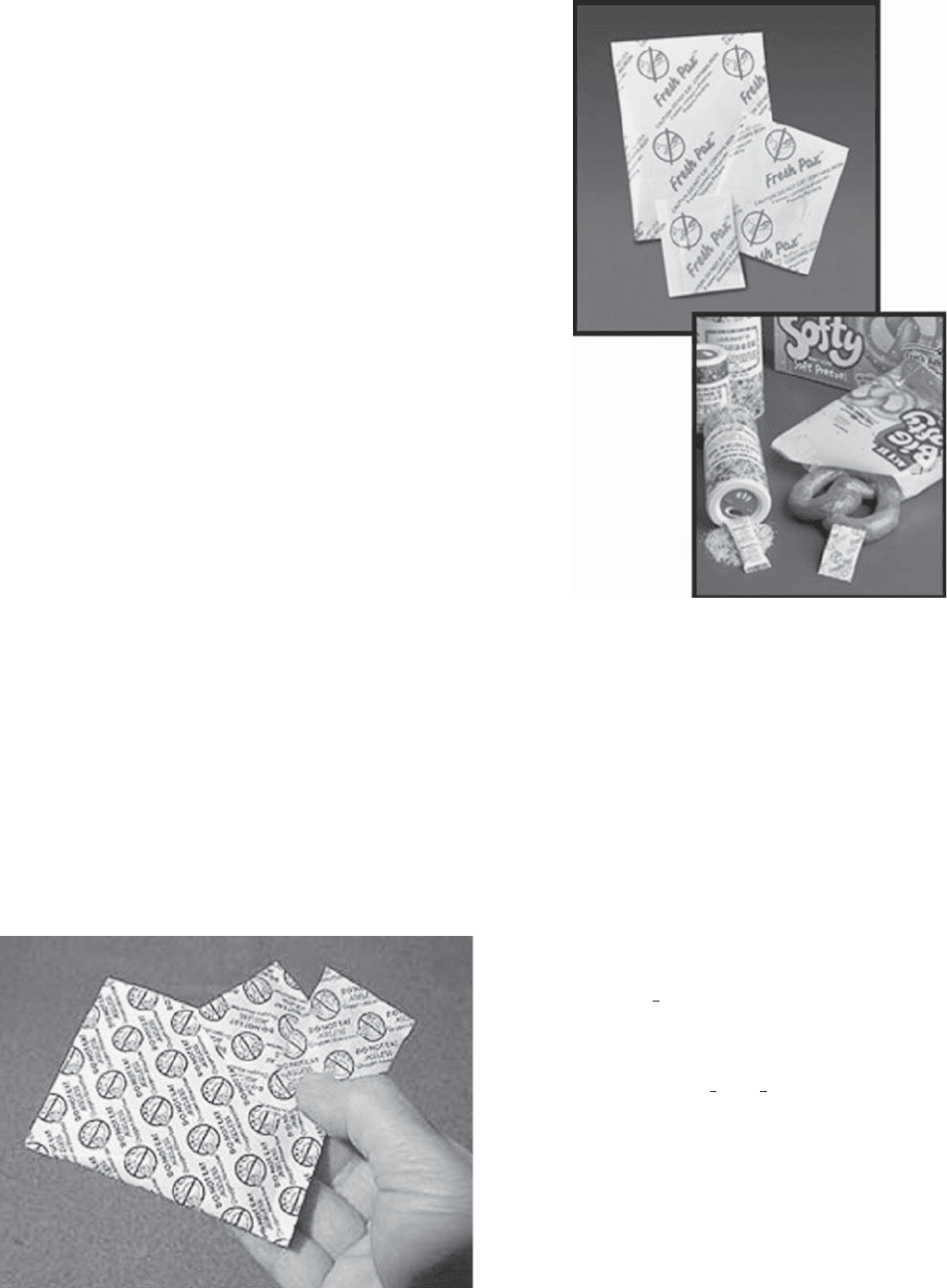
sachets shown in Figures 1 and 2.
According to de Kruijf (3), oxygen scavengers are the
most patented of all active packaging technologies with at
least 50 patents through 1989 and 20 issued from 1990 to
1994. In the 1990s work focused more heavily on technol-
ogies to incorporate oxygen scavengers directly into film
and other package forms such as closure liners, thermo-
formed cups, tubs, and trays rather than sachets. Part
of the reason for this change was related to concern
over consumers accidentally using the sachets as ‘‘flavor
packets’’ and incidents whereupon the contents of the
sachet may seep out into the food. These problems
can lead to loss of product quality and can also lead to
serious consumer safety concerns. For example, iron in
concentrated amounts, can be toxic to children or pets,
because of their small body mass. For this reason, the FDA
mandated that iron-based sachets must be labeled with
‘‘Do not eat’’ on the sachets sold in the United States to
avoid accidental ingestion of the contents. (4).
Based on information made available in 2002, oxygen
scavengers in bottles made up the largest portion of the
market with 43.8% of the market, followed by cap/liner/
lidding representing 31.5%, sachets with 22.6%, and oxy-
gen absorbing film with 2%.
TYPES AND MECHANISMS OF ACTION
Iron-Based Systems. Iron-based sachets are the type of
oxygen scavenging system that has been used commer-
cially for many years. It generally involves a reaction
between iron powder contained in a permeable sachet
that also may contain a dessicant. Iron powder reacts
with oxygen using the following reaction (6, 7):
Fe ! Fe
2þ
þ 2e
1
2
O
2
þ H
2
O þ2e
! 2OH
Fe
2þ
þ 2OH
! FeðOHÞ
2
FeðOHÞ
2
þ
1
4
O
2
þ
1
2
H
2
O ! FeðOHÞ
3
Oxygen Scavenging Polymer Materials. Many polymers
have been developed using a wide variety of chemistries
(2), however, the most commercially successful materials
have been homogenous blends of reactive substances with
polymers. An effective oxygen scavenging polymer was
developed in which dissolved reagents of known chemistry
were incorporated into a polymer, and the trigger mechan-
ism was light, which excited the reactive components in
Figure 2. Multisorb Freshpax.
Figure 1. Mitsubishi Ageless Sachets.
POLYMERIC OXYGEN SCAVENGING SYSTEMS 1001
the film, thus, influencing oxygen diffusion into the poly-
mer. The oxygen has to be in an excited singlet state,
which required the use of a photsensitizing dye and
exposure to visible light. Another approach was based on
transition-metal-catalyzed oxidation of an aromatic nylon.
The transition metal in this case was cobalt or cobalt salt.
This material eventually became known under the trade-
name Oxbart The material easily could be blended with
polyester eventually to become important for packaging
wine and beer in plastic bottles, because it effectively
could prevent oxidation in both products. Amoco Chem-
cials introduced a material called Amosorbt, which
blended polyester and polybutadiene and was catalyzed
by a transition metal salt. When the catalyst was added
late in the injection molding process, the resulting mate-
rial became an oxidizable polymer. Another material using
light as a triggering mechanism was developed by Speer
and coworkers (8). This patent process used a transition
metal catalyst and a photosensitizer. The reaction was
designed in such a way as to prevent the rupture of the
polymer backbone as might normally occur through oxida-
tion. The material was composed of unsaturated polymers
such as poly(1,2 butdiene), which could scavenge ground
state oxygen as opposed to singlet oxygen. This product is
marketed under the trade name OS 1000t or 2000t by
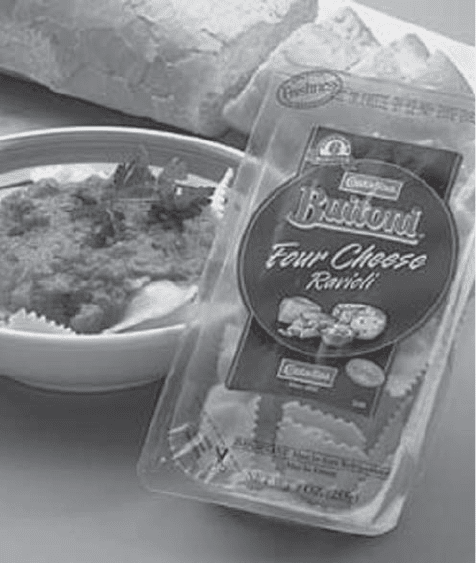
Cryovac Division of Sealed Air (Figure 3).
Other materials that incorporate active components
into the polymer include material marketed by Chevron
Chemical Company, which works by auto-oxidation of
unsaturated groups on the polymer backbone. Oxidation
of aromatic nylons and hydrocarbon polymers with active
side groups use light to trigger the oxygen scavenging
process. One method that differs from the light triggering
systems involves the light excitation of a photoreducible
component such as phenolic compound, which is reduced
by oxygen, thereby scavenging oxygen.
Designing an oxygen scavenging system for specific
types of packaging is quite complex and still not well
understood except by the vendors who specialize in such
systems. Most oxygen scavengers are designed for packa-
ging based on the removal of a specified amount of oxygen
from the interior of the package over a period of a few
days. Tewari and coworker (9) studied the oxygen absorp-
tion kinetics of six commercial oxygen scavengers that
differed in oxygen scavenging capacity as well as oxygen
scavenging methods (i.e., iron-based and enzyme based).
It was determined that oxygen concentration was the
primary limiting factor in the kinetics of oxygen scaven-
gers in atmosphere of less than 500 ppm but other factors
such as temperature, capacity, and variation between
types of scavengers also occurred. Miltz and Perry (10)
studied the performance of iron-based oxygen sachets to
improve methods to apply them more effectively because
their cost and lack of technical understanding has limited
their use. Based on their study, the actual scavenging
capacity was higher than the manufacturers specifica-
tions. They also found that, in modified atmosphere
packages containing carbon dioxide, the sachets also
absorbed the carbon dioxide as well as oxygen. Oxygen
sachets were found to reduce the transient period time
(time to reach equilibrium) for active modified atmosphere
packaging by nearly half compared to passive modified
atmosphere packaging without a sachet. This effect al-
lowed the shelf life to be extended because of optimal
atmosphere as soon as quickly as possible (11).
APPLICATIONS
Oxygen scavengers were initially used by the U.S. military
for the meals ready to eat (MRE) rations. Foods with
oxygen scavengers for MREs include the following: white
and whole wheat bread, pound cake, fudge brownies,
wheat snack bread, potato sticks, chow mein noodles,
nut raisin mix, pretzels, waffles, and hamburger buns
(1). In the retail market, typical uses in the United States
include fresh pasta, beef jerky, pepperoni, beer (cap liner
and some bottles), ketchup, juice, case-ready meats, pre-
pared foods, and shredded cheese. Use of oxygen sachets is
more prevalent and diverse in Japan for products such as
seasonings, cheese, aseptically packaged cooked rice, dry
pet foods, cough capsules, plant growth hormone, anti-
biotics, vitamins pills and tablets, medical kits to preserve
reagents, kidney dialysis kits, and other products.
CURRENT RESEARCH ON SPECIFIC APPLICATIONS
Meat Packaging. Oxygen scavengers are used in meat
packaging to control color in red meat packages. When the
pigment for red meat (myglobin) is exposed to oxygen, the
Figure 3. Cryovac OS1000 oxygen scavenging film.
1002 POLYMERIC OXYGEN SCAVENGING SYSTEMS
meat appears as a bright red color, which is associated
with freshness and overall acceptability. However, when
meat is exposed to too much oxygen over time, the pigment
converts to metmyoglobin, which appears as a brown color
and is not visually acceptable to consumers. Many studies
have used oxygen scavengers in modified atmosphere
packages to extend the display life of red meat packages.
Gill and McGinnis (12) studied the conditions under which
commercially available scavengers with an oxygen absorb-
ing capacity of 200 ml/sachet could prevent transient
discoloration of nitrogen flushed ground beef. The rate of
oxygen absorption decreased with decreasing oxygen con-
centration when the oxygen concentration was between 10
and 20%, but the rate of oxygen absorption became
exponentially proportional with time when the oxygen
concentration was less than 1%. Oxygen concentration
in packages needed to be reduced below 10 ppm in 30
minutes at 2 1C or 2 hours at 1.5 1C to prevent transient
discoloration. It was determined that to achieve this, more
sachets than were economically feasible would have been
required at that time. Continued work on prevention of
transient discoloration of beef was done by Tewari and
others (13), who determined that steaks removed from a
controlled atmosphere masterpack had less discoloration
when packaged with an oxygen scavenger and that the
number of sachets had more impact on discoloration
prevention than the type of scavenger used. The same
research group also studied the effect of oxygen scaven-
gers inside retail trays, lidding and over-wrapped trays,
which were all equally effective for extending the accep-
table shelf life of modified atmosphere, display ready beef
and pork cuts (14). They also found that eight oxygen
scavengers with a capacity sufficient to achieve an oxygen
half life of 0.6–0.7 were needed when oxygen concentra-
tion could otherwise remain at less than 500ppm during
storage. Isdell (15) measured the redness of meat 96 hours
after removal from a gas flushed mother pack. They found
that redness of meat packaged in a retail tray containing
oxygen scavengers was better than retail trays that
did not contain an oxygen scavenger. In another study,
researchers (16) found that, combined with a controlled
atmosphere mother pack (outer bag), double flushed
with 50% carbon dioxide and 50% nitrogen was effective
for maintaining the display shelf life of variety of red
meat cuts. The oxygen scavenger helped maintain a
low level of oxygen (0.1%) to prevent formation of
metmyoglobin.
Payne and others, (17) studied vacuum controlled
atmosphere packaging with carbon dioxide, carbon diox-
ide flushed packages containing iron-based oxygen sca-
venging sachets, and packages that contain oxygen
scavengers alone for beef stored for up to 20 weeks at
1.5 1C. Beef packaged with oxygen scavenger alone
provided the best results with regard to drip loss, micro-
bial and sensory properties. Martinez and coworkers (18)
found that fresh pork sausages packaged in a 20% carbon
dioxide, 80% nitrogen atmosphere with an iron-based
oxygen scavenging sachet, had reduced psychrotropic
aerobic counts and extended shelf life with regard to color
and lipid stability for 20 days at 2 1C. Catfish steaks were
packaged in barrier film and vacuum packaged with and
without an iron-based sachet. Shelf life was extended 10
days (20 days with sachet v. 10 days without sachet) with
the aid of the sachet based on sensory, microbiological,
and volatile base nitrogen analysis. The oxygen in the
packages containing the sachets reached 0.42% within 24
hours of packaging (19). Labels are manufactured that
absorb 10–20 mL of oxygen, and larger labels are starting
to become available that scavenge 100–200 mL O
2
(7).
Besides labels, oxygen scavengers also can be incorporated
into the polymer film. The film is capable of reducing
oxygen in the headspace to less than 1 ppm in 4–10 days
for products such as dried, smoked meat as well as
processed meat products (20).
Bakery Products. Baked goods such as bread, pastries,
cakes, and cookies can have an extended shelf life with use
of oxygen scavengers combined with modified atmosphere
packaging. The low-oxygen condition retard molds and
other spoilage bacteria and also reduces lipid oxidation,
which can produce off flavors. According to Kotsianis and
coworkers (21), an advantage over using an oxygen sca-
venger system compared to modified atmosphere packa-
ging alone was because of the fact that lower oxygen levels
could be achieved, and oxygen can be reduced in case of
leakage through defective seals. The disadvantages could
be cost and possible consumer objection to a packet in-
serted inside the package that could become loose and
cause accidental ingestion by a child or pet. A few studies
have reported on the effectiveness of oxygen scavengers for
bakery products. Sponge cakes (0.8–0.9 a
w
) were packed in
a modified atmosphere package (MAP) with oxygen absor-
ber sachets of two different absorption capacities (100 and
210 mL). The cakes were analyzed for mold growth over a
period of 28 days at 25 1C storage. MAP alone provided
some benefits regarding mold prevention; however, com-
bining oxygen scavengers (using either 100 or 210 mL)
with modified atmosphere (30% CO
2
) prevented mold
growth entirely during the 28 days of storage. The results
also indicated that a greater benefit existed for cakes with
a higher a
w
(0.9) compared to lower a
w
(0.8) (22).
In another study (23), oxygen absorbers were added to
wheat crackers formulated with high levels of oil for
storage in hermetically sealed cans used as military
rations. The study included storage at 15, 25, and 35 1C.
Shelf life was assessed using sensory panels as well as
hexane concentration and headspace oxygen measure-
ments. As storage temperature increased, headspace oxy-
gen decreased within the can. Overall, cans of crackers
without oxygen sachets reached unacceptable levels of
rancidity within 24 weeks at 25 and 351C. Cans of crackers
with oxygen sachets did not have rancid odors after 44
weeks of storage, regardless of storage temperature. Thus,
shelf life of canned crackers was extended for 20 weeks
with oxygen absorbers added to the can.
Other Products. In a study by Zerdin and coworkers
(24), orange juice contained in aseptic packages with an
oxygen scavenging barrier layer had better retention of
ascorbic acid than packages with plain oxygen barrier
film. Packages that contained oxygen scavengers had less
mold growth on cheddar cheese compared to packages
POLYMERIC OXYGEN SCAVENGING SYSTEMS 1003

without the oxygen scavengers over a 16 week refriger-
ated storage period (25).
Milk processed using ultra-high temperature proces-
sing, (UHT) was packaged and stored in aseptic pouches
that contain an oxygen scavenging film or a pouch without
the scavenging film. The milk in the oxygen scavenging
pouch had significantly lower levels of dissolved oxygen
and levels of volatiles associated with staleness (26).
Hazelnuts were packaged under controlled atmosphere
conditions with and without iron-based oxygen sachets.
The nuts packaged using the sachets were significantly
less oxidized compared to the nuts without the sachets.
However, when the sachets were analyzed for volatile
compounds, other flavor compounds were also scavenged
by the sachets (27)
REGULATORY STATUS
A program was developed by the EU Fair R&D program to
establish and implement active and intelligent packaging
technologies within existing EU regulations, which would
enable technologies to be used and allow for products to be
globally competitive with other technologies. The program
included, inventory, classification, evaluation, and recom-
mendations for regulation of active and intelligent packa-
ging systems. Oxygen scavenging systems were examined
as part of the evaluation step and was tested for migration
into a variety of food simulants. It was determined (3) that
migration from oxygen scavengers varied significantly
depending upon type of system (sachet, cap, crown, or
film) and food stimulant. For example, migration of oxy-
gen scavenger in water (mg/sample) was 620, 74, 1.0, and
0.2 for sachet, cap, crown, and film, respectively. Based on
a study by Lopez-Cervantes and coworkers (23), migration
into liquid, solid, and gelled food stimulants using
two different types of oxygen sachets were tested. Migra-
tion from oxygen scavengers did not exceed European
Union migration limits as long as the sachet was properly
located in the package, and the packaging process did not
favor the content becoming wet from water released from
the food.
FUTURE OF OXYGEN SCAVENGERS
New methods of producing oxygen scavengers will
continue to be developed. For example, Alteiri and cow-
orkers (29), suggested the use of aerobic microorganisms
as the mechanism for oxygen scavenging. The microorgan-
isms can be trapped in poly-vinyl alcohol and used as a
coating for high humidity foods. Another use that may
see increased application is addition of an oxygen sachet
with biopolymer film. Polylactic acid film did not have
oxygen barrier properties equal to the polyester film
typically used for packaging semi-hard cheese (30).
However, when an oxygen scavenger was added to the
package, lipid oxidation of the cheese was significantly
reduced and continued to improve with dark storage
(Tables 1, 2).
Another new method may involve radiation treatment
of ethyl vinyl alcohol copolymers. Researchers (30), irra-
diated EVOH (29% ethylene) with 30 and 90 kGy dosages
and found that as the dosage increased, the longer the
polymer was able to react with oxygen.
Oxygen scavengers that function better under a variety
of temperatures will also be used. A patent was issued for
an oxygen scavenging film that acts under ambient and
refrigerated conditions and can be incorporated uniformly
into a multilayer film (32). Another development involves
a patent that indicates that the activation of the oxygen
scavenging component of a film can be triggered upon
packaging with the product to prevent loss of scavenging
capacity in films that may be active while film is in storage
(prior to product packaging). The film would receive an
initial trigger using actinic radiation, which would not be
sufficient to activate the film fully and would receive the
total dose necessary to trigger the oxygen scavenging
component when desired (33).
An oxygen scavenger that also indicates the level of
oxygen present has been developed, which makes it both
an active, and intelligent package component. The sca-
venger is in a pouch form with a layer in the pouch that
has a color changing substance that can be viewed
through a clear window (34).
Table 1. Oxygen Scavenging Components
Sulfites
Boron
Glycols and sugar alcohols
Unsaturated fatty acids and hydrocarbons
Palladium catalysts
Enzymes
Yeast
Ferrous-iron
Organometallic ligands
Photosensitive Dyes
Polydiene block copolymers
Polymer-bound olefins
Aromatic nylon
Table 2. Commercially Available Oxygen Scavenging
Systems
Ageless
s
Mitsubisihi Gas and Chemical Co., Japan
ATCO
s
Emco Packaging Systems, UK; Standa
Industries, France
Freshilizers series Toppan Printing, Japan
Freshpax
s
Freshmax
s
Multisorb Technologies, Inc. USA
Bioka
s
Bioka, Finland
Smartcap ZapatA Industries, USA
Daraform, Cryovac
s
OS 1000
Cryovac, Division of Sealed Air, USA
Oxyguard Toyo Seikan Kaisha, Japan
Oxbart Carnaud Metal Box, UK
Zero
2
t CSIRO, Southcorp Packaging, Australia
Amsorb
s
Amoco Chemicals, USA
1004 POLYMERIC OXYGEN SCAVENGING SYSTEMS
REFERENCES
1. A. L. Brody, E. R. Strupinsky, and L. R. Kline. Active
Packaging for Food Applications, CRC Press, Boca Raton,
FL, 2001.
2. M. L. Rooney, in J. H. Han, ed. Innovations in Food Packaging.
Elsevier Academic Press, San Diego, CA., 2005, pp. 123–137.
3. N. de Kruijf, M. van Beest, R. Rijk, T. Spilainen-Malm, P.
Paserio Losada, and B. De Meulenaer, Food Add. and Contam,
19 Supplement, 144–162 (2002).
4. M. Ozdemir and J. D. Floros, Crit. Rev. Fd. Sci. and Nutri. 44,
185–193 (2004).
5. A. Brody, Active Packaging: Beyond Barriers. Packaging
Strategies, West Chester, PA and BRG Townsend, Mt. Olive,
NJ (2002).
6. F. Charles, J. Sanchez, N. Gontard, J. Fd. Eng, 72, 1–7 (2006).
7. J. P. Kerry, M. N. O’Grady,S. A. Hogan. Meat Sci, 74, 113–130
(2006).
8. U. S. Patent 5,211,875, D. V. Speer, W. P. Roberts, and C. R.
Morgan, 1993.
9. G. Twari, L. E. Jeremiah, D. S. Jayas, R. A. Holley, Internat. J.
Fd. Sci. & Tech. 37, 199–207 (2002).
10. J. Miltz, M. Perry, Packag. Technol. Sci. 18, 21–27 (2005).
11. F. Charles, J. Sanchez, N. Gontard, J. Fd. Sci. 70, E443–E449
(2005).
12. C. O. Gill and J. C. McGinnis, Meat Sci. 41, 19–27 (1995).
13. G. Twari, D. S. Jayas, E. Jeremiah, and R. A. Holley, J. Fd.
Sci. 66, 506–510 (2001).
14. G. Twari, Jayas, D. S., Jeremiah, L. E., and Holley, R. A.
Internatl. J. Fd. Sci. and Tech., 37, 209–217 (2002).
15. E. Isdell, P. Allen, A. Doherty, and F. Butler, Internat. J. Fd.
Sci. & Tech., 34, 71–80 (1999).
16. E. Isdell, P. Allen, A. Doherty, and F. Butler, Internat. J. Fd.
Sci. & Tech., 38, 623–632 (2003).
17. S. R. Payne, C. J. Durham, S. M. Scott, and C. E. Devine, Meat
Sci., 49, 277–287 (1998).
18. L. Martinez, D. Djenane , I. Cilla, J. A. Beltran, and P.
Roncales, Fd. Chem., 94,219–225 (2006).
19. C. O. Mohan, C. N. Ravishankar, T. K. Srinivasagopal, J. Sci
Fd. Agric., 88, 442–448 (2008).
20. B. Butler, Proceedings of Worldpak 2002 East Lansing, MI,
USA., (2002).
21. I. S. Kotsianis, V. Giannou, C. Tzia, Trends in Food Sci. and
Tech., 13, 319–324 (2002).
22. M. E. Guynot,V. Sanchis ,A. J. Ramos, and S. Marı
´
n, J
. Fd Sci.
68,
2547–2552 (2003).
23. S. Berenzon and I. S. Saguy, Lebens.-Wisse und Tech., 31, 1–5
(1998).
24. K. Zerdin, M. Rooney, and J. Vermue, Fd. Chem., 82, 387–395
(2003).
25. E. Oyugi and E. Mbuy., Internat. J. Dairy Tech. 60, 89–95
(2007).
26. M. Perkins, K. Zerdin, M. L. Rooney, B. R. D’Arcy, and H. C.
Deeth, Packg. Technol. Sci. 20, 137–146 (2007).
27. S. Pastorelli, S. Valzacchi, A. Rodriguez, and C. Simoneau, Fd.
Contam., 23, 1236–1241 (2006).
28. J. Lopez-Cervantes, D. I. Sanchez-Machado, S. Pastorelli, R.
Rijk, and P. Paserio-Losada, Fd. Add. Contam., 20, 291–299
(2003).
29. C. Altieri, M. Sinigaglia, M. R. Corbo, G. G. Buonocore, P.
Falcone, and M. A. Del Nobile, Lebensm.-Wiss. u.-Technol.,
37, 9–15 (2004).
30. V. K. Holm, G. Mortensen, M. Vishart, M. A. Petersen,
Internat. Dairy j., 16, 931–939 (2006).
31. A. Lopez-Rubio, J. M. Lagaron, T. Yamamoto, and R. Gavara.
J. Appl. Poly. Sci., 105, 2676–2682 (2007).
32. U. S. Patent 7,078,100 B2, C. L. Ebner, A. E. Matthews,
and T. O Millwood, for Cryovac Division of Sealed Air,
(2006).
33. U. S. Patent 7,238,300, J. A. Solis, R. Dayrit, S. W. Beckwith,
B. L. Butler, R. L. Cotterman, D. V. Speer and T. D. Kennedy,
(2007).
34. European Patent Application EP 1 676 790 A1, W. Yang, Y.
Yang, and L. Xiuzhi, (2006).
General References
M. L. Rooney, in M. L. Rooney (ed.) Active Food Packaging.
Blackie Academic Professional, London, UK, pp. 145–165
(1995).
F. N. Teumac, in M. L. Rooney (ed.) Active Food Packaging.pp.
193–202 (1995).
G. Robertson, in G. Robertson (ed.) Food Packaging, Principles
and Practices 2nd ed. CRC Press, Boca Raton, FL pp. 292–293
(2006).
V. Daniel, and F. L. Lambert. Available at http://palimpsest.
stanford.edu/waac/wn/wn15/wn15-2/wn15-206.html. Accessed
November 7, 2008.
POLYPROPYLENE
R.C. MILLER
Montell USA, Inc., Wilmington,
Delaware
Updated by Staff
INTRODUCTION
Polypropylene is an extremely versatile material in the
packaging industry. The reason for its adaptability is the
ease with which its polymer structure and additive
packages can be tailored to meet diverse requirements.
Many useful properties are inherent in polypropylene. It
has low density (high yield), excellent chemical resistance,
a relatively high melting point, and good strength, at
modest cost.
GENERAL CATEGORIES AND DEFINITIONS
Polypropylene is the result of linking a large number
(typically 1000 to over 30,000) of propylene molecules to
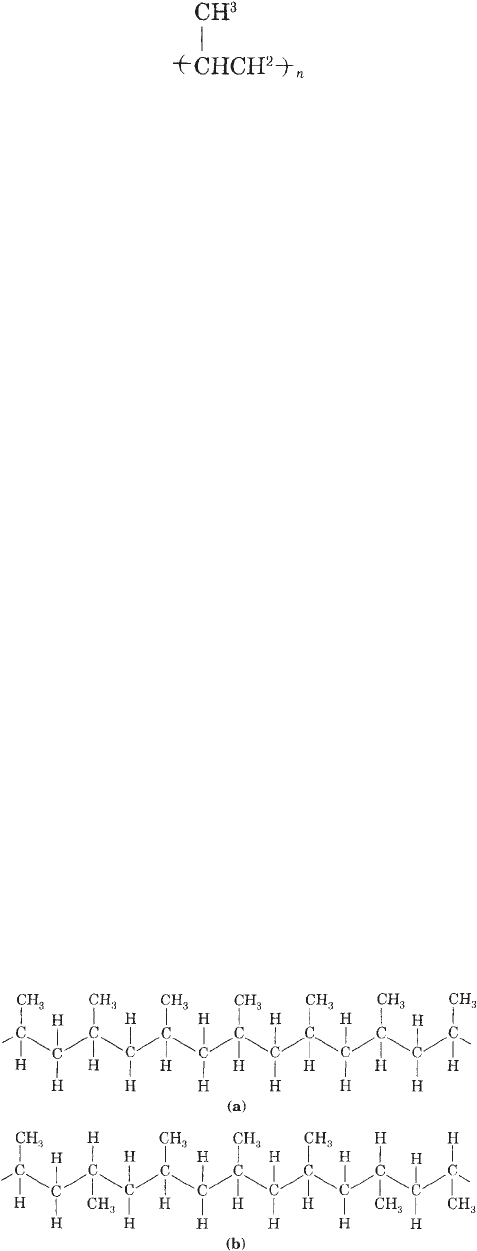
build long polymer chains (see Figure 1). Polymers made
up only of propylene are called homopolymers. If another
monomer is added (typically ethylene), the polymer is
POLYPROPYLENE 1005
called a copolymer. The order and regularity of the mono-
mer units in the polymer control the properties of the
product.
One end of a propylene molecule is different from the
other. The end with three hydrogens is called the head; a
head-to-tail linkage is called stereoregular. If the process
links the monomers head-to-head about as often as they
are linked head-to-tail, the resulting polymer has little
order and does not crystallize (1). At room temperature,
this material has a density of about 0.850 g/cm
3
.Itis
called atactic or amorphous polypropylene and is soft,
tacky, and soluble in many solvents. Such polymers are
useful in hot-melt adhesives (see Adhesives) and several
other applications.
If monomers are connected head-to-tail almost every
time, the polymer is said to be isotactic and crystallizes
(see Figure 2). Crystallinity is the reason for the solvent
resistance, stiffness, and heat resistance of the commer-
cial plastic material. At normal conditions, isotactic poly-
propylene is usually about half crystalline and has a
density of 0.90270.005 g/cm
3
. Normal polypropylene
melts at about 3291F (1651C) when heated slowly and
contains roughly 5% of atactic material as well as inter-
mediate structures. In this article, the term polypropylene
(PP) implies the plastic of commerce.
When discussing copolymers and alloys, an additional
level of complexity is added. Alloys, also called blends, are
mixtures of polymers. Copolymers are the result of poly-
merizing two or more monomers together. There are many
possible types (structures) of copolymer (2), not all of
which are useful.
Random copolymers result when a small amount
of comonomer, usually ethylene, is polymerized at random
intervals along the PP chain. Typical ethylene levels are
from 1 to 5 wt%, and the product has only one phase.
These copolymers are relatively clear and have lower
and broader melting points than PP homopolymers.
The lowering of the melting point is proportional to
the randomness of incorporation and the amount of como-
nomer incorporated. At ethylene levels well above 10%,
the product becomes less crystalline and is called
EPR, or ethylene–propylene rubber. One cannot make
an alloy (polymer blend) that resembles a random
copolymer.
Impact copolymers generally contain larger amounts
of ethylene monomer, typically 4 to W25%, and are
heterophasic. The ethylene may be polymerized in the
form of polyethylene and/or EPR. Usually, such products
are made by polymerizing a homopolymer and changing
the conditions to add ethylene to the polymer chain.
Reasonably comparable materials can be made by me-
chanically blending polypropylene with EPR and/or
polyethylene. If crystalline EPR or polyethylene is pre-
sent, it can be detected by a second melting point at
224–2711F (118–1331C). These products are characterized
by lower stiffness, much enhanced toughness at low
temperatures, and a relatively opaque appearance (see
Table 1).
The molecular weight (related to the average number of
monomer units in a chain) and the molecular-weight
distribution (MWD) are significant polymer characteris-
tics. High-molecular-weight (HMW) polymers are highly
viscous when melted and are difficult to injection-mold or
push through restrictive dies, but they have high tough-
ness and good ‘‘melt strength’’ (melt elasticity). Melts
of low-molecular-weight (LMW) polymers are more fluid.
They have less toughness and lower melt strength. In a
narrow-MWD polymer, there is less variation in the length
of the chains than in a broad-MWD polymer. Narrow
MWD allows retention of the toughness of HMW grades
(3) in a more easily processed material. Narrow MWD
materials do not generally have high melt strength.
They offer advantages in fiber spinning and injection
molding.
Substantial modification in properties can be achieved
by the use of additives (see Additives, plastics) and
fillers. Virtually all commercial grades are stabilized to
increase resistance to oxidation on aging or at elevated
temperatures. Additives can confer resistance to sunlight,
reduce the tendency to retain static electric charges,
modify the coefficient of friction, and prevent surface
tackiness.
The additives should be selected for the application. In
food packaging, the stabilization should be chosen to avoid
transfer of taste and odor to the package contents. Anti-
stats reduce static electricity, which attracts dust and
makes packages appear dirty. In sunlight, the damaging
wavelengths are in the UV range. UV resistance is im-
portant for items that may be stored outdoors. Coefficient
of friction and antiblocking properties are important in
the winding and handling of film (see Slitting/rewinding).
Frictional characteristics are also important in threaded
closures (see Closures).
Fillers can greatly increase stiffness, improve proces-
sing behavior, confer conductivity, and change the
Figure 1. Polypropylene.
Figure 2. Comparison of the structures of isotactic and atactic
polypropylenes: (a) isotactic PP–methyl groups in orderly align-
ment; (b) atactic PP–methyl groups in random alignment.
1006 POLYPROPYLENE

appearance of PP. Commonly used fillers are talc, calcium
carbonate (usually powdered marble), glass fiber, mica,
carbon black, clays, cellulose fibers, lubricants, and pig-
ments. Many exotic fillers have been used for special
purposes. The use of fillers in PP usually reduces tough-
ness and raises density and cost per volume.
PROCESSING
Melt-flow rate (MFR) is one of the key variables in the
processing of PP. ASTM International (formerly The
American Society for Testing and Materials) (4) specifies
that PP is to be tested at 4461F (2301 C) under a pressure
exerted by a nominal 4.4-1b (2-kg) mass in the apparatus
specified under ASTM Standard D-238. The result is the
weight of material extruded through the standard orifice
in 10 min.This test is a crude measure of the melt viscosity
of the plastic under low shear rate. Melt viscosity corre-
lates to the weight-average molecular weight of the poly-
mer. Commercial PP grades of interest in packaging span
a MFR range of 0.3–40 g/10 min. The low flow grades (up to
about 2.5 g/10 min) are used in sheet extrusion (see Ex-
trusion) and blow molding (see Blow molding). Film is
manufactured from intermediate-flow grades (MFR 2–
15 g/10 min). Injection-molding processes (see Injection
molding) ordinarily use PP with MFR of 3–40 g/10 min
(see Table 2).
Thermoforming
Sheet extrusion for thermoforming (see Thermoforming) is
a small, rapidly growing segment of the PP market. Until
the late 1970s, few converters were willing to attempt
thermoforming of PP. Since that time, thermoforming
techniques and grades have been improved. Random co-
polymers and impact copolymers have a broader tempera-
ture ‘‘window’’ and are more easily formed than
homopolymers. Several grades are available that promise
excellent forming characteristics, even in homopolymers.
The several available high-melt strength PP grades ease
manufacture via improved material distribution and
higher forming rates. The factors that promote the use of
PP in thermoforming are low odor and taste transfer, good
moisture barrier, chemical resistance, and adequate clarity
in thin sections.
Blow Molding
In blow molding, most of the resin consumed is for consumer
products. High melt strength is required for extrusion blow
molding, which is used to produce relatively large contain-
ers up to 5.3 gal (20 L) in size. Injection blow molding
usually requires MFR of 1 –2.5 g/10 min. This process is
particularly useful for relatively small containers. The
ability to withstand temperatures or aggressive chemicals
that would stress-crack or attack other materials is usually
Table 2. Effect of Molecular Weight (Melt Flow) on Homopolymer Properties
Property Values
Melt-flow condition L, g/10 min 0.4 2 12 35
Tensile strength (yield), psi (MPa) 4800 (33.1) 5000 (34.5) 5100 (35.2) 4600 (31.7)
Yield elongation, % 13 11 10 12
Flexural modulus (1% secant), psi (MPa) 190,000 (1310) 220,000 (1520) 220,000 (1520) 170,000 (1170)
Hardness Rockwell R (HRR) 92 91 90 88
Heat-deflection temperature (66 psi or
455 kPa), 1F(1C)
207 (97) 203 (95) 207 (97) 201 (94)
Notched Izod, 231C, ft lbf/in. (J/m) 1 (53) 0.8 (43) 0.7 (37) 0.6 (32)
Application Sheet extrusion,
thermoforming,
blow molding
Sheet extrusion,
thermoforming,
blow molding
Injection molding, film Injection molding
Table 1. Typical Polypropylene Properties
Values
Property Homopolymer
Clarified Random
Copolymer Impact Copolymer
High-Impact
Copolymer
Melt flow condition L, g/10 min 4 10 4 4
Tensile strength (yield), psi (MPa) 4900 (33.8) 4300 (29.6) 3900 (26.9) 3000 (20.7)
Yield elongation (%) 11 9 9 8
Flexural modulus, (1% secant), psi
(MPa)
200,000 (1,380) 150,000 (1,030) 175,000 (1210) 130,000 (900)
Hardness Rockwell R (HRC) 86 77 73 70
Heat-deflection temperature (66 psi or
455 kPa), 1F(1C)
199 (93) 189 (87) 189 (87) 176 (80)
Notched Izod, 231C, ft lbf/in. (J/m) 0.7 (37) 1.4 (75) 1.8 (96) W10 W500
Application Injection molding Injection molding Injection molding Injection molding
POLYPROPYLENE 1007