
Yam, Kit L. (ed.). The Wiley encyclopedia of packaging technology
Подождите немного. Документ загружается.

conceived the idea of having valve corners inserted into a
gusseted tube, or ‘‘in-fold’’ feature. These were first made
in the mid-1920s, and their advantages were promptly
recognized. During the first year of production, millions
were manufactured and sold, and by 1927 about 130
million were made annually.
While the cotton bags with their paper-filling sleeves
had solved the bag-filling problem, the other problem of
their return and reuse to reduce bag costs still existed.
Into this breach came the multiwall paper sacks (either
with or without filling sleeves), and thus the paper ship-
ping sack industry was born.
Portland cement and masonry cement plants, grain
products and flour factories, and saltworks were the ear-
lier multiwall sack users, because these new bags solved
the dusty conditions that had been so dangerous, health-
wise. Now the workers were freed from breathing unde-
sirable dust and airborne mineral deposits, and working
conditions were greatly improved.
The terms multiwall bags and paper shipping sacks are
often used synonymously. Other industries followed suit as
soon as more producers of multiwall bags were established,
and the shipping sack industry prospered accordingly.
World War II caused severe shortages in burlap and manila
fibers due to the extremely long distance from the primary
sources in Southeast Asia; concurrently, cotton fiber for
bags was in short supply, due to U.S. military and naval
needs (as well as for civilian clothing). These shortages
resulted in a large expansion of the use of paper shipping
sacks, and the cotton bag never recovered its earlier
dominance, just as cotton and burlap had replaced the
rigid containers such as wood boxes, crates, and barrels.
During World War II the multiwall bag really came into
common useage. W ith a wide range of special papers to
control moisture and insect infestation plus the ability
to tailor-make whatever package strength was required to
fit the rough military handling, multiwalls came to be the
approved specification packages for government purchasing.
From these early beginnings the sack industry has
grown into a multi-billion-dollar business with shipments
of over three billion sacks annually for over 2000 different
products in the United States. Over four billion sacks are
used annually in Europe (1). These end-uses fall into four
major categories: agricultural products and supplies, food
products, chemical products, and rock and mineral
products.
The primary advanges of paper shipping sacks are low
tare weight, flexibility, ease of filling and handling, low
cost, minimum storage space, biodegradability, and good
graphics. Other advantages include the basic material,
which is a renewable resource; protection of contents from
moisture absorption; control of contents from moisture
loss; protection of contents from chemical action; control of
seepage or penetration of hot-packed products; provision
of loss of gas or vapor; prevention of product sifting or
contamination; good stacking and utilization of warehouse
space; FDA approval for human food products; excellent
graphics; and ease of use in merchandising displays.
Multiwall bags exclude single-ply bags and bags of
duplex construction, but do include those with three or
more plies of paper or other barrier protectors. They are
produced by combing several layers of paper (or other
substrate) over a metal former that nests the walls into a
long continuous tube (flat or gusseted). These walls are
bonded together with adhesives so that each tube is
independent of the other tubes, and therein lies the
bag’s strength. The tubes may be cut straight (all at
once) or in stepped-end formation where each wall is first
perforated, then simultaneously snapped apart.
Next, in order for the tubes to be filled and used, the
tubes are delivered to bottoming machines in the bag
plant where they are either sewn closed at one or both
ends. Or, the tubes may go to a pasting bottomer to form
either pasted open-mouth, stepped-end pasted valve, or
pinch-bottom open-mouth sacks (see Figure 1).
TYPES OF MULTIWALL SACKS
There are two basic multiwall types: the open-mouth type
and the valve type bags. Multiwalls are custom-made to
order according to the customer’s requirements and for
adequate strength to ensure the safe arrival of their
contents to the destination locations.
Whether the product is packaged with high-speed open-
mouth weighing and filling machines with automatic closing
and sealing machinery, or with even faster valve packers
and automatic bag placers, a proper and successfully de-
signed and printed multiwall bag may be readily developed.
Most multiwall bag suppliers have very well trained
sales personnel, as well as experienced factory technical
representatives with a wide range of user experience who
are well qualified to recommend the best bag for any
product requirement.
OPEN-MOUTH BAG TYPE
Sewn Open Mouth (SOM)
This style, with any number of walls, has a factory sewn
bottom and open top, and may be either flat or with side
gussets. These bags are used primarily to package gran-
ular or large-particle products. The product is delivered
into the open top, and the top may be closed by sewing or
other means. If a polyethylene liner ply is specified, this
may also be heat-sealed. These types of packaging lines
may be fully automated.
Pasted Open Mouth (POM)
This style has a pasted bottom and open-mouth top, and it
is
sealed after filling
by folding and pasting, or, in some
cases, sewing the top. This latter style is not preferred for
packaging and shipping free-flowing products because a
finlike (nonflat) package is obtained. But it is ideal for
containing a number of previously filled and sealed unit
bags–for example, 12.5-lb sugar or 5- to 10-lb bags of
potatoes. These are called master container or baler bags.
Pinch-Bottom Open-mouth (PBOM)
This style has the plies cut in a stepped fashion with the
bottom sealed by gluing or heat sealing at the bag factory.
88 BAGS, MULTIWALL
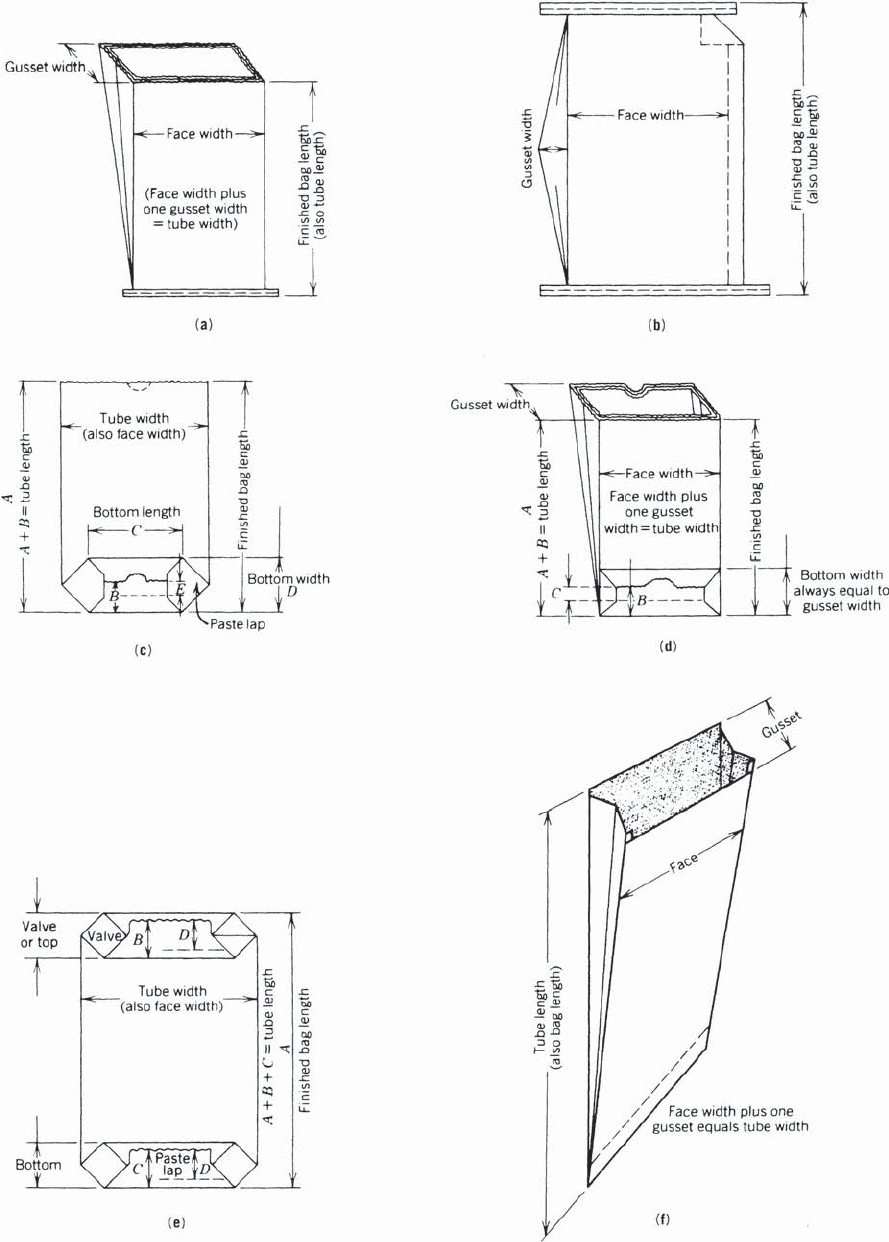
Figure 1. Common bag styles in current use: (a) sewn open-mouth; (b) sewn valve, (c, d) pasted open-mouth; (e) pasted-valve stepped-
end; (f) pinch-bottom open-mouth.
BAGS, MULTIWALL 89
After filling at the user’s plant, the open mouth top is
folded over and sealed by reactivating preapplied hot-melt
adhesive. This style of bag provides completely moisture-
proof and sift-proof packages. PBOM bags are the fastest-
growing segment of the total multiwall bag industry
because of the secure and strong closure ends, and full
control of sifting or infestation.
VALVE BAG TYPE
Sewn Valve (SV)
These are made with the plies at the top and bottom ends
sewn at the bag plant usually with sewn-through crepe
paper tape. The bags are filled with a valve packing
machine by forcing the product through a built-in valve
corner. For small particles and large powders, the contents
may be retained without any leakage, by hand-folding in
the paper valve extension.
This old style with sewn tape at both ends has fallen
out of favor in recent years, and the modern pasted valve
style has supplanted it.
Pasted Valve Stepped End (PVSE)
As in the pinch-bottom open-mouth bag, the plies are cut
off in a stepped configuration; then the bag factory bot-
toming machine folds and, with adhesive, seals both top
and bottom ends of the tubes. An added valve sleeve is
built into a corner, permitting rapid bag placement on a
valve packer; and when the filled package falls to a take-
away conveyor, the valve automatically is closed by the
internal pressure of the product.
PVSE-type bags, introduced in 1956, are the present
standard package for most automatic or high-speed opera-
tions such as cements, powders, feeds, fertilizers, or other
chemical or building products. When stacked or palletized,
they provide stable and attractive three-dimensional
containers.
Valve bags may also be purchased with paper tuck-in
sleeves that, when folded in, will control all possible leakage.
SIZING MULTIWALL BAGS
First, the weight to be packaged and the product density
must be determined. This latter may be done by using a
box of known dimensions (1 ft 1ft1 ft) or 1 ft
3
to deter-
mine the weight per cubic foot. With the known weight
and volume requirements and with the bag type selected
(by product characteristics), an educated estimated set of
dimensions can be offered. A supplier can fine-tune these
numbers by offering several handmade factory samples.
When test-filled, these may be adjusted to supply a larger
number of machine-made test packages to finalize all
specifications such as dimensions, filling, handling and
shipping, and palletizing conditions.
CONSTRUCTIONS
The paper most commonly used to fabricate multiwall
bags is natural-colored virgin pulp brown kraft. Made
primarily in the Southern U.S. states using a modified
sulfate pulping process, it affords longer fibers that en-
hance the paper’s cross- and machine-direction strength.
Typically brown, it may be lightened through bleaching, or
semibleaching sulfate pulping.
Kraft is usually designated in basis weights ranging
from 40 to 80 lb per ream of 500 sheets of 24 in. 36 in. in
area. These grades are known as multiwall kraft and have
higher strength specifications than grocery-bag kraft (NK)
used for light-duty brown paper bags.
Other popular grades used in multiwall bags are
extensible (XTK) and free-dry (FDK) process papers.
These developments during the 1960s and 1980s resulted
in improved cross- and machine-direction stretch specifi-
cations and greater overall bag strength. Other grades,
such as high-finish, rough, calendered, machine-finish,
and wet-strength, are available for specific end-use pur-
poses (see Paper).
Subsequent to the mid-1940s with the development of
tailor-made plastics, polyethylene (PE) films have been
integrated into many bag constructions. Prior to this,
asphalt laminated kraft (ALK) provided moisture barrier
properties to multiwall bags, but it was difficult to fabri-
cate on the tuber and bottoming equipment, and it is no
longer in use.
Multiwall paper bags may be lightly coated with high-
shear, low-stress adhesives to overcome bag slippage when
stacked on pallets or in storage. This inexpensive treat-
ment is invisible yet very effective.
Heavy-duty single-wall plastic film bags are also avail-
able, however, when compared in cost with multiple-ply
kraft or a kraft paper ply plus a lightweight poly ply
or polyethylene-coated kraft, the single-wall plastic bags
are not cost-effective. They also are slippery, and palle-
tized filled bags cause shipping difficulties (see Bags,
plastic).
Depending on the physical characteristics of the pro-
duct being packaged in multiwall bags, they can be
custom-designed to provide all the protection that is
necessary. Low-or high-density polyethylene, poly(vinyl
chloride), poly(vinyl dichloride), nylon, saran, foil, and
polypropylene are some of the available substrates.
Most multiwall bag suppliers have well-trained sales
personnel and specially trained factory technical repre-
sentatives who are well qualified to recommend the best
construction for any particular requirement.
SPECIFICATIONS
With the complete knowledge of a product’s physical and
flow characteristics, a bag style may be selected. This is
only a minor portion of the information required to design
a new multiwall bag that will deliver the product in
acceptable condition. The product density and the desired
weight to be bagged must be known; from this, the
required capacity (in cubic inches) is calculated.
General rules are usually followed to select the total
kraft paper basis weight and the number of kraft plies. For
instance, 50 lb of product might require three walls of
50-lb natural kraft to total 150 lb, and 80 lb would need
90 BAGS, MULTIWALL
three or four walls of combined 40- and 50-lb basis weight
multiwall kraft, totaling ~180 lb.
The requirements for product protection must be care-
fully evaluated. This might include moisture protection
and control, gas or odor control, grease or oil control,
siftproofness, chemical resistance, mold protection, and
toxicity or hazardous chemical protection.
Each of these factors can be controlled by the use of one
or more of the following available sheets: low-density PE
(LDPE), high-density PE (HDPE), polyethylene-coated
kraft paper (PEK), saran, Tyvek, saran-coated polypropy-
lene (SCPP), polyfoil–polykraft laminate (PE-AL-PE-K)
biaxially oriented polypropylene (BOPP), or even poly-
coated crepe kraft tape, or heat-sealed waxed kraft tape.
About 25% of the multiwalls now being produced specify
some kind of special liner ply.
Special barrier plies are commonly used in multiwall
bags to protect the product from gaining or losing its
intended moisture content. This is stated in terms of its
water vapor transmission rate (WVTR). A wall of material
may be laboratory-tested, to determine its WVTR rating in
terms of g/m
2
per 1001F at 95% RH (relative humidity) in
24 h. The more effective barriers usually are the heavy
2.5–4.0-mil HDPE and LDPE, or 0.75-mil BOPP film,
while those most frequently needed are the less expensive
0.5-mil HDPE and 0.8–1.0-mil. LDPE films.
Some products have specific needs, such as controlled
porosity to permit proper air or moisture transfer, grease
or oil penetration, wet-strength protection with urea for-
maldehyde, or melamine formaldehyde, which enable the
paper to retain its original strength when saturated by
water. All these and more—toxicity, hazardous nature,
odor control, acidity, or alkalinity—can be controlled.
Or, for a really attractive consumer package, the man-
ufacturer might select a supercalendered high-finish full-
bleached white sheet with gravure-quality printing.
Multiwall prices are developed by applying cost factors
for bag style, bag size (sheet width and tube length), basis-
weight factors for kraft, and the plies of other substrates.
To these the supplier adds the cost for printing by area and
number of colors required. Bags are usually ordered by the
carload or trailerload to obtain the lowest unit price.
In cases where a product is highly aerated and moist-
ure protection is only nominal, one or more kraft plies may
require allover pinhole perforations (AOPHP) of different
diameter and spacing. These allow the internal pressure
to be expended during bag filling and they prevent bag
breakage.
Discussing the particular needs that are required for
your product with a multiwall bag supplier will direct you
to the correct and complete bag specifications from the
weighing and filling stages to the customer’s ultimate
place of use.
PACKAGING EQUIPMENT
For each style and size of bag used, there is a wide choice
of equipment available for weighing, filling, and closing
the packages. There are two main styles of bagging
equipment: open-mouth and valve.
Open-Mouth Packers
The older, original method of open-mouth bagging required
a scale, a vertical delivery spout, and a closing function.
With today’s modern high-speed open-mouth equipment,
there are automatic and accurate weighing scales, auto-
matic bag placers, and finally, automatic bag closures.
These systems usually run up to 20 or more preweighed
charges of up to 100 lb of material per minute with only
token supervisory requirements. There are two preferred
methods of closing open-mouth multiwall bags: sewn
closure or heat sealing.
Most common of the sewn types is the stitching of the
bag mouth with cotton or polypropylene sewing thread
with an industrial sewing head. With more secure or
special product requirements, either sewn-through tape,
adhesive, or heat-sealed tape over sewing may be provided.
Valve Bag Packer
With the invention of the valve packer in the mid-1920s,
the valve-style bag may be filled by forcing the product
through a spout (usually horizontal) into the valve corner
and then down into the bag. The product is either pre-
weighed and then forced into the bag, or it is weighed in
the package (gross-weighed).
Choices are available when weighing and filling valve
bags, and they depend on the product’s physical charac-
teristics, price, and production speed requirements.
Most valve packers use either the impeller-wheel
method or the belt-feed method. With the former, rotating
high-speed paddles force the material into the package.
This causes a great amount of aeration to occur, and the
PV or PVSE bags must be capable of withstanding great
pressure. One operator with a four-spout impeller valve
packer may produce up to thirty 94-lb (206-kg) filled bags
per minute.
With the belt valve packer, the product is thrust
between a moving belt and a rotating grooved pulley and
then into the valve opening. This is gentler on the
material, but not as fast as the impeller method. Fertili-
zers and small-pelleted materials are usually packaged on
belt-style valve packers.
Three other less popular valve packer styles are avail-
able auger, gravity, and airflow. The latter is more modern
than the other two and has the advantages of handling
non-free-flowing finely powdered materials, without degra-
dation with much better accuracy. The auger packer uti-
lizes a horizontal screw within a hollow tube. These work
well for non-free-flowing products, and since the screw’s
rate of rotation can be adjusted, better weight accuracies
are obtained. The last and least popular valve packing
method is the vertical-gravity style. But, since it is used for
very free-flowing or inexpensive materials, accurate bag
weighments are sometimes difficult to obtain.
GRAPHICS
Previously, the fabrics of multiwall paper bags were
printed with simple yet effective designs to identify the
manufacturer, the product, the net weight, and some
methods for using the contents.
BAGS, MULTIWALL 91
Cotton and burlap bags had a second life, since they
must either be returned, cleaned, and filled for reship-
ment or, in the case of the cotton bags, be washed and then
sewn into towels or items of apparel at home.
With the conversion from fabric to paper bags came the
important advantage of superior printing capabilities.
With smooth surfaces and all-around six-sided printing
of up to four colors, a company’s marketing message could
be extolled, thereby differentiating itself from all its
competitors.
If brown kraft is not attractive enough, a supplier can
readily furnish semibleached (SBW) or full-bleached
(FBW) kraft. Smoother or brighter papers and coatings
in conjunction with modern printing capabilities provide
appealing and forceful advertising that make the bags
effective billboards for marketing their contents. Whether
they were small-unit consumer bags or large industrial-
size bags, they can utilize flexographic printing to carry
the intended messages.
If more definition is required, prepress gravure print-
ing using up to six colors will result in photographic
quality printing, with the following advantages: excellent
product and protection; unlimited supplier capabilities;
biodegradable materials; and proven shipping and storage
environments
Pet-food and charcoal briquette bags are excellent
examples of effectively printed packages found in all
supermarket shelves today.
Multiwall bags are readily accepted and desirable as
shipping containers in all domestic and export markets,
including hundreds of uses for agricultural products, build-
ing materials, chemicals, food products, and minerals.
TRANSPORTATION
In the past 40 years the shipment of filled multiwall bags to
the market where they are used has swung almost com-
pletely from railroad boxcars to over-the-road trailers or
straight trucks. Also, pallets have replaced the individual
handling of filling bags. Coincidentally, plastic film has in
many cases been incorporated into the bag’s construction.
These changes have resulted in lighter basis-weight re-
quirements and lower costs. Multiwall sacks are covered by
the Uniform Freight Classification for Rail Rule 40; Na-
tional Motor Freight by Truck Item 200; Hazardous Mate-
rials Regulations title 49 CFR; and Federal Specifications
UUS-48, sacks for government shipment (2).
ENVIRONMENTAL CONSIDERATIONS
At present, the essential element in all paper sacks is virgin
fiber. Secondary or recycled fiber is not an option because
such material can result in an inconsistent pack that would
be weaker and unsuitable for automated filling and in
handling systems. The bags would be more costly to
produce and in many cases would be unacceptable for direct
contact with food. As a result of continuous research, there
has been substantial reductions in the average construction
weight of a multiwall paper sack. Recovered bags can be
recycled. It has been suggested that specifications should be
revised to maxmize the content of secondary fber. A levy on
virgin fiber has been proposed in Europe.
USES
Some examples of products that are packaged in weights
of under 20 lb are additives, animal food, baking products,
cat litter, charcoal, chemicals, coffee, cookies, dried foods,
grits, insecticides, microwave popcorn, plant food, theater
popcorn, salt, and sugar. Industrial products weighing
more than 20 lb and packed in multiwall bags are absor-
bents, abrasives, cement, lawn and garden supplies, and
animal feeds (3).
Helpful Hints. The list below is meant to be of use to a
packager in selecting an appropriate multiwall paper
sack.
1. In the initial planning stage of a new use for multi-
wall shipping sacks, obtain the guidance of bag
suppliers.
2. Develop accurate product physical and chemical
properties.
3. Finalize decision on desired package weights.
4. Determine annual production requirements.
5. Select proper bag style and features.
6. Consider styles of packaging equipment available.
7. Decide on the transportation and distribution
modes.
8. Determine probable bag sizes and constructions.
9. Plan bag transporting methods to provide minimum
individual handlings.
BIBLIOGRAPHY
Allan M. Baylis,‘‘Bags, Multiwal’’ in The Wiley Encyclopedia of
Packaging, 2nd edition, by John Wiley & Sons, New York,
1997, pp. 61–66.
Cited Publications
1. The Environmental and Technical Association for the Paper
Sack, ‘‘Multiwall Paper Sacks’’ in M. J Kirwan, ed., Paper and
Paperboard Packaging Technology, Blackwell Publishers, Lon-
don, 2005.
2. Transportation Regulations, Paper Shipping Sack Manufac-
turer’s Association, Inc., Coopersburg, PA, www.pssma.com,
accessed June 2008.
3. End Uses, Paper Shipping Sack Manufacturers Association,
Inc., Coopersburg, PA, www.pssma.com, accessed June 2008.
BAGS, PLASTIC
Plastic bags, available in virtually all shapes, sizes, colors,
and configurations, have replaced paper in most light-
duty packaging applications. Paper has been more difficult
92 BAGS, PLASTIC
to replace in heavy-duty applications (see Bags, heavy-
duty plastic). Light-duty plastic bags are generally de-
scribed in one of two ways: by the sealing method or by
application. This article explains the methods used to
produce plastic bags and defines the various types of
plastic bags in terms of their intended use. A plastic bag
is defined here as a bag manufactured from extensible film
(see Films, plastic) by heat-sealing one or more edges and
produced in quantity for use in some type of packaging
application.
METHODS OF MANUFACTURE
By definition, all plastic bags are produced by sealing one
or more edges of the extensible film together. The proce-
dure by which this heat-sealing occurs (see Sealing, heat)
is typically used to identify and categorize types of plastic
bags. Three basic sealing methods are used today that
include the following: sideweld, bottom seal, and twin seal.
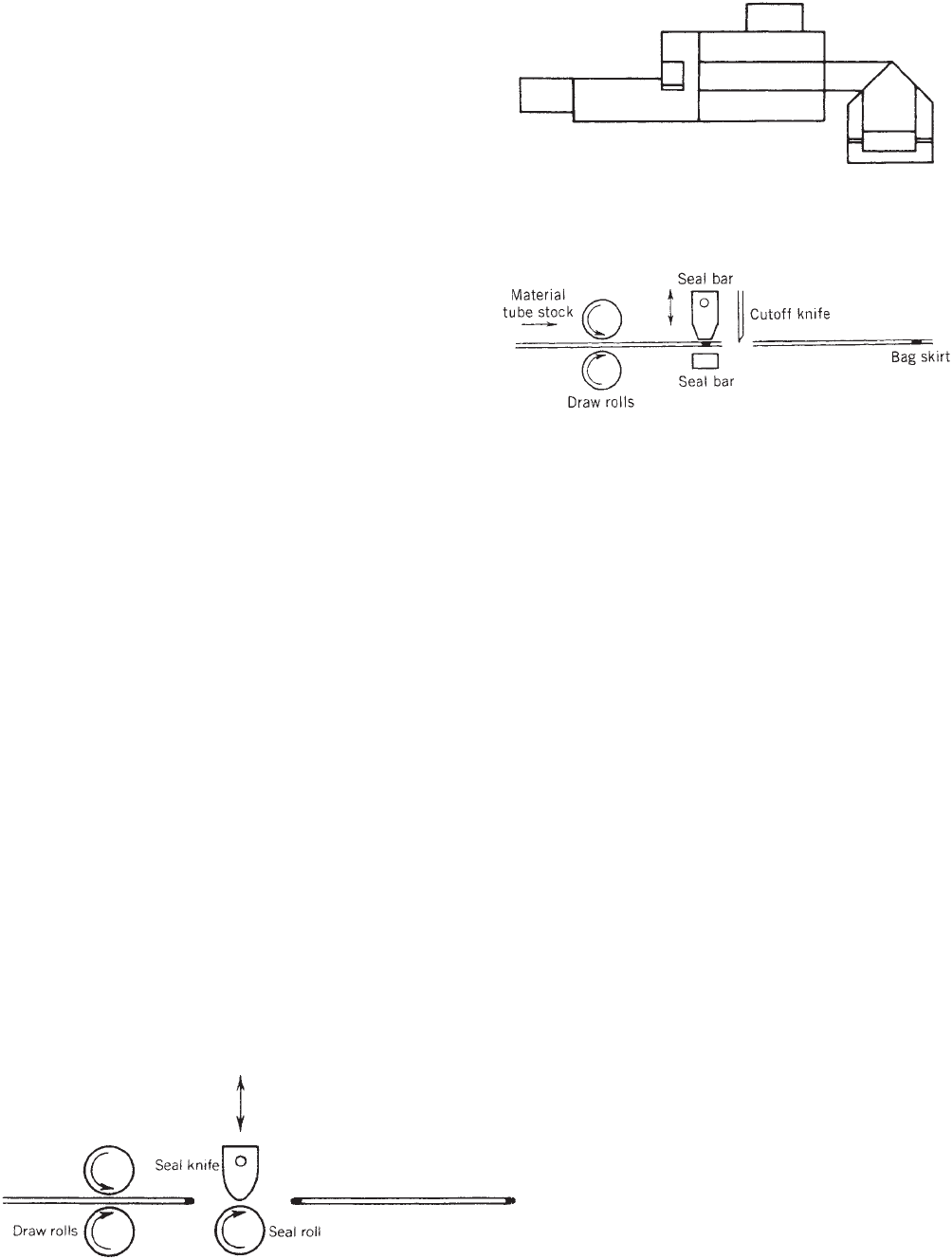
Sideweld Seal. A sideweld seal is made with a heated
round-edged sealing knife or blade that cuts, severs, and
seals two layers of film when the knife is depressed
through the film material and into a soft rubber backup
roller. The materials are fused by a combination of pres-
sure and heat (see Figure 1).
The sideweld seal is the most common bag-sealing
method. Typical high usage bags, e.g., bread bags and
sandwich bags, are produced using the sideweld techni-
que. The term ‘‘sideweld’’ is derived from the fact that
many of the bags produced in this fashion pass through
the bag machine with the length (or depth) of the finished
bag perpendicular to the machine floor. The film fed into
the machine is either prefolded, i.e., J stock, or folded
during the in-feed process (see Figure 2).
Bottom Seal. The bottom-seal technique seals the bag
at the bottom only. Tube stock is fed into a bag machine,
the single seal is produced at the bottom of the bag,
and the bag is cut off with a knife action that is separate
from the sealing action. A bottom seal is generally made
by a flat, heated sealing bar, which presses the layers of
film to be sealed against a Teflon (Du Pont)-covered rubber
pad, i.e., seal pad (see Figure 3), or another hot-seal bar
(see Figure 4). A separate cut-off knife is used to separate
the bag from the feedstock while the seal is made or
immediately thereafter. Both bottom-seal mechanism de-
signs produce a bag with only one seal, unless the tube has
been manufactured by slit-sealing (see below). The small
amount of unusable, wasted film between the edge of the
seal and the cutoff point, called the ‘‘skirt’’ of the bag, is an
important factor in the total cost of the bag. Any disad-
vantages caused by the presence of the unwanted skirt are
usually offset by greater control of the sealing process. The
sideweld method actually melts through the plastic film,
and overheating of the film resins can change the physical
structure of the plastic molecules when the seal cools. In
contrast, the bottom-seal method controls the amount of
heat and the dwell time, i.e., the time that the heat is
applied to the film, to produce a seal that does not destroy
the film or change its physical properties. In addition, the
total amount of film sealed together is usually larger,
because the seal bar has a fixed width and none of the
film material is melted or burned away.
The bottom-seal method is commonly used to produce
(HDPE) merchandise bags and (LDPE) industrial liners,
trash bags, vegetable and fruit bags, and many other types
of bag supplied on a roll. In contrast to the sideweld
method, designed primarily for high-speed production of
bags made from relatively light-gauge films — i.e., 0.5–2.0
mil (13–51 mm)—bottom-seal methods are often used to
produce bags from film from 0.5 to Z6 mil (13–Z152 mm)
at slower production speeds. Bags manufactured by
bottom-seal methods are delivered through and out of
the bag machine with the length (or depth) of the bag
parallel to the machine direction. Because all of the bags
Figure 1. Sideweld-seal mechanism.
Figure 2. Sideweld process (top view).
Figure 3. Bottom-seal mechanism (top heat only).
BAGS, PLASTIC 93
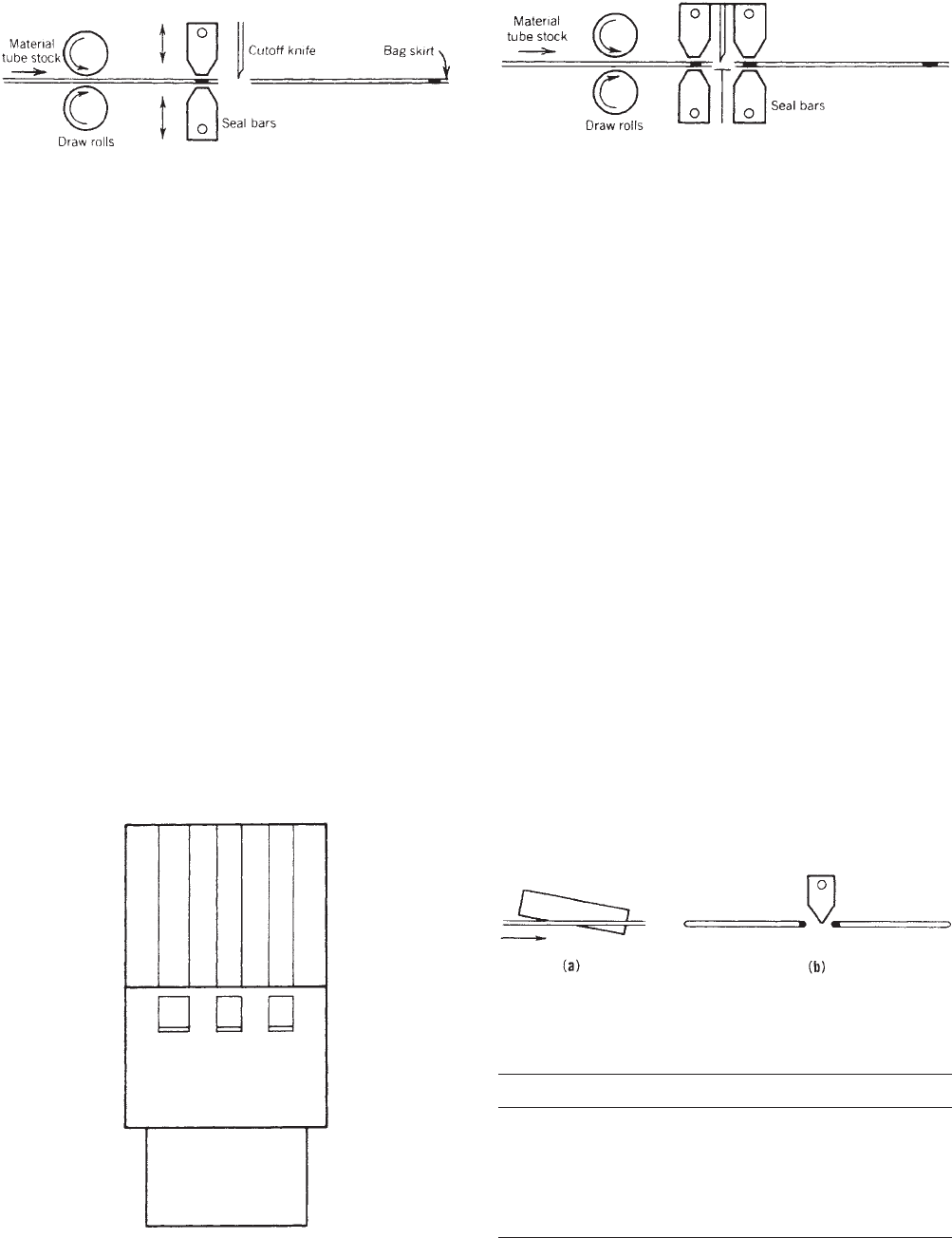
are produced from tube sock, multiple-lane production of
bags is limited only by the widths of the machine and the
bags and the film-handling capability of the bag machine
(see Figure 5).
Twin Seal. The twin-seal method employs a dual bot-
tom-seal mechanism with a heated or unheated cutoff
knife located between the two seal heads (see Figure 6).
The unique feature of the twin-seal mechanism is that
it supplies heat to both the top and bottom of the film
material and makes two completely separate and inde-
pendent seals each time the seal head cycles. Like the
bottom-seal method, the twin-seal technique can supply a
large amount of controlled heat for a given duration. This
ability makes the twin seal useful in sealing heavier-
gauge films as well as coextrusions and laminates. Be-
cause two seals are made with each machine cycle, the
twin-seal method can be used to make bags with the seals
on the sides of the finished bag, i.e., like sideweld bags, or
on the bottom of the bag in some special applications, such
as retail bags with handles. Many special applications call
for the use of a twin-seal-type sealing method, but it most
often is used in production of the plastic ‘‘T-shirt’’ grocery
sack.
Slit Seal. Another type of sealing method, the slit seal,
involves sealing two or more layers (usually only two) of
film together in the machine direction through the use of a
heated knife, hot air, laser beam, or a combination of
methods. The slit-seal technique is usually used to convert
a single large tube of film into smaller tubes. In the
production of grocery sacks, for example, a single extruded
60-in. (152-cm) lay-flat tube of film (see Extrusion) can be
run through two slit sealers in line with the bag machine.
This process results in three tubes of 20-in. (51-cm) lay-
flat material being fed to the bag-making system (see
Figure 7).
APPLICATIONS
Most plastic bags are characterized in terms of their
intended use, e.g., sandwich bags, primal-meat bags,
grocery sacks, handle bags, or bread bags. To provide
some order to this user-based classification and definition
system, it is convenient to separate the bags into commer-
cial bags and consumer bags.
Commercial Bags. A commercial plastic bag is used
as a packaging medium for another product, e.g., bread.
Typical commercial bags and seal methods are listed in
Table 1.
Consumer Bags. Consumer bags are purchased and
used by the consumer, e.g., sandwich bags, trash bags.
The plastic bag is the product. Typical consumer bags and
seal methods are listed in Table 2.
Figure 5. Bottom-deal bag machine, three-level.
Figure 6. Twin-seal mechanism.
Figure 4. Bottom-seal mechanism (top and bottom heat).
Figure 7. Slit sealer (hot-knife type). (a) side view; (b) top view.
Table 1. Commercial Plastic Bags
Sealing Method Types of Bag
Sideweld Bread bags, shirt and millinery bags, ice
bags, potato and apple bags, hardware
bags
Bottom seal Vegetable bags on a roll, dry-cleaning
bags, coleslaw bags, merchandise bags
Twin seal Primal-meat bags, grocery sacks
a
a
With dual bottom seal.
94 BAGS, PLASTIC
In addition to the conventional bags, an enormous
variety exists of special bags that have been created by
bag producers to meet commercial and consumer needs.
These bags are usually described as specialty bags, but
they are all variations of the standard bags described
above. Specialty bags include rigid-handle shopping bags,
sine-wave handle bags, pull-string bags, patch-handle
bags, double-rolled bags, square-bottom bags, round-
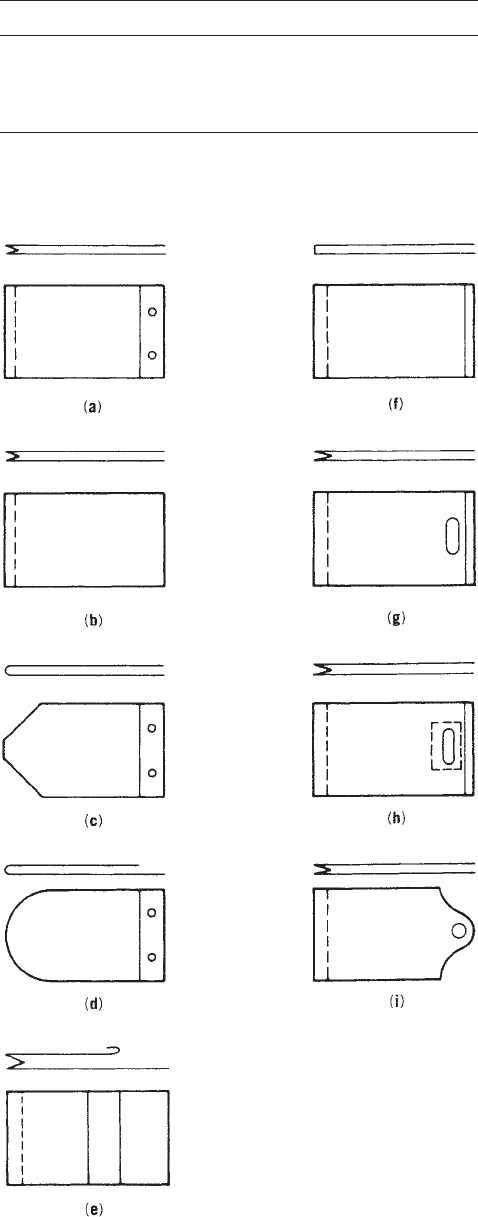
bottom bags, deli bags, etc. Examples of both common
and specialty bags are shown in Figure 8.
BIBLIOGRAPHY
‘‘Bags, Plastic,’’ in L. L. Claton, ed. The Wiley Encyclopedia of
Packaging Technology, 1st ed., Wiley, New York, by FMC
Corporation, 1986, pp. 39–42.
General References
‘‘Bag Making: Inline or Off-Line,’’ Plast. Technol. 30(2), 55 (1984).
L. R. Whittington, Whittington’s Directory of Plastics, 2nd ed.,
Technomic Publishing, Lancaster, PA, 1978.
Polyethylene Film Extrusion, U.S. Industrial Chemicals Co., New
York, 1960.
BANDS, SHRINK
DAVID R. KOPSILK
ED FISHER
CMS Gilbreth Packaging
Systems, Trevose, Pennsylvania
Updated by Staff
INTRODUCTION
Shrink labels, bands, and sleeves provide today’s packa-
ging companies with a unique and versatile method for
labeling their products. Developed in Japan during the
1960s, shrink bands became popular in the United States
in the early 1980s, mainly as unprinted or one-color
tamper-evident neckbands. Today, the shrink band is
used as a primary label, as a decoration, for multipack
applications, and as a traditional tamper-evident feature.
The high-quality printing and gloss inherent in shrink
labels ensure packagers that their product will generate
tremendous visual shelf appeal.
MANUFACTURING
Shrink bands are generally produced using special poly
(vinyl chloride) (PVC) films, although PETG films,
oriented polystyrene films, and poly(lactic acid) are also
used (1). Film thicknesses generally run from 1.25 to 3.0
mils, with 1.50 and 2.0 mils the most prevalent. Material
is available in two varieties: seamed film, and tubing.
Seamed film is converted by bonding a flat sheet of printed
Table 2. Consumer Plastic Bags
Typical Sealing Method Types of Bag
Sideweld Sandwich bags, storage bags
Sideweld or bottom seal Trash bags, freezer bags,
can liners
Bottom seal Industrial liners
Figure 8. Bags, plastic: (a) conventional wicket bag; (b) conven-
tional bag; (c) square-bottom bag; (d) round-bottom bag; (e)
sandwich bag; (f) trash bag; (g) handle bag; (h) patch-handle
bag; and (i) sine-wave bag.
BANDS, SHRINK 95
or unprinted material into a sleeve configuration. This is
achieved through a process of solvent seaming into the
desired dimension or flat width. Tubing is extruded into
the desired flat width before printing. Seamed film can be
reverse printed with 3601 graphics and generally provides
more consistent dimensions in both flat width and gauge
profile. Tubing is generally less expensive, and it is used
for unprinted or one-color work.
Important dimensional measurements associated with
shrink bands are (a) flat width, which represents the
dimension relating to the diameter or circumference of
the container, and (b) cut height or impression height,
which represents the length of the container or the length
of the section of the container to which the shrink band
will be applied. These dimensions are usually expressed in
millimeters.
The inherent shrink is imparted into the material in a
heated stretching process. With tubing, this is achieved
during the initial extrusion process. With seamed film, a
process known as tentering is used. A tenter frame is a
modified oven that uses a combination of airflow and
temperature zones to orient the material. For example, a
30-in.-wide roll of 5.0-mil material will be converted into a
60-in. roll of 2.0- or 2.5-mil film. Shrink ratios of 50–70%
can be achieved by adjusting the process. Various ratios
are used, depending on the contour of the container being
labeled.
Shrink bands are generally processed using the gra-
vure printing method. Reverse rotogravure allows the
image or copy to be printed on the back side of the film,
which results in a glossy look to the package as well as
protection of the image from scratching or scuffing that
may occur in final packaging or distribution. Gravure
printing provides excellent color reproduction consistency,
high speed, and productivity, and it is an excellent method
for printing smooth film surfaces. Flexo printing has made
inroads into this market as the technology improves, but
gravure is still dominant.
After printing, several other features can be added to
the shrink band. Vertical and horizontal perforations, as
well as tear tape strips, can be added to make the band
removable for the consumer. Some packagers use a hor-
izontal perforation to make part of the label removable,
the tamper-evident feature is removed, and the primary
label stays on the container. Some examples of this are
toothpaste pumps, lip balms, syrups, and salad dressings.
Bands can be provided in continuous roll-fed form, or in
individual cut pieces for manual application.
APPLICATION
Bands can be applied manually or by automatic machin-
ery. Machinery on the market today is capable of applying
bands at speeds of 500 per minute or more, depending on
container size, container contour, and label dimensions.
For example, a lip-balm label of approximately 27-mm flat
width and 60-mm length can be applied faster than a
190-mm-flat width, 40-mm length band for a large dairy
container, due to both the label size and the container size.
Machinery is dominant in the dairy, packaged-food, and
pharmaceutical markets. Most machinery applies shrink
bands in a horizontal method, but recent developments
have allowed for vertical application of pen barrels, lip
balms, and other small cylindrical objects. Most machin-
ery requires material of 2.0 mils or more for process-
ing, and the use of a wedge or other device to open the
material before application is common. After application,
the container is sent through a heat tunnel, which uses a
combination of airflow and heat to shrink the band
securely onto the container. A dwell time of 3 s at roughly
3001F is used for most applications, although some pro-
ducts require an elaborate system of varying tempera-
tures and product rotation to achieve the desired effect.
Machinery is available to pack two containers together
with one band. This process is used in lieu of an overall
bundling method, which then may require the application
of another printed label for bar coding or to convey the
promotional message. Manual applications are used when
product volume is small or in market trial introductions.
Since shrink bands adhere using shrink energy, no glue
or glue applicating systems is required to apply shrink
bands.
USES
Shrink bands are generally used in three ways: as tamper-
evident neck bands, as primary labels and decorations, or
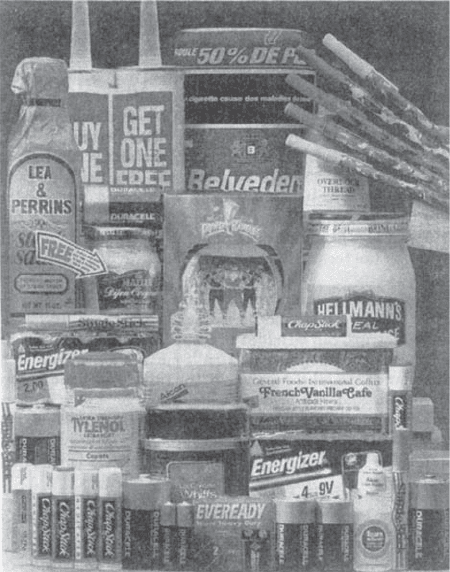
for promotional multipacking (see Figure 1 for examples).
Food and pharmaceutical packagers have been using
neckbands as a tamper-evident feature ever since the
Tylenol incident in Chicago in 1982. They are often used
in conjunction with vacuum packaging, inner seals, and
breakaway closures for product integrity. One advantage
for consumers is that neckbands provide evidence of
tampering before the consumer brings the product home,
as any attempt at removal is evident on the store shelf. In
the food-packaging market, yogurt, sour cream, salad
dressing, mayonnaise, syrup, mustard, and jelly are just
some examples of products that use neckbands (2). In the
pharmaceutical and health–beauty arena, use of neck-
bands is even more prevalent. Eye care, mouthwash,
cough syrup, pain relief, and vitamins as well as many
ethical medicines are among the products that utilize this
tamper-evident feature (see Tamper-Evident Packaging).
In the primary label and decorating market, shrink
bands provide a versatile and unique way to package
various products. The reverse printing capability allows
graphics
to stand out
on the store shelf as well as provide
durability. Batteries have been labeled using shrink film
for years, because the fine copy and metallic look required
on these products are achievable with shrink labels. Lip-
balm labeling combines a primary and tamper-evident
label using a horizontal perforation for easy removal of
the tamper-evident feature. Since this product is often
sold loose at drug and convenience-store checkout coun-
ters, the lip-balm package can be easily displayed without
any further packaging. In recent years, writing instru-
ments decorated with multicolor graphics have become
popular, especially those with designs targeted to the
teenage market. One advantage of shrink labels on this
product is that the reverse printing protects the image
from the oils and dirt that occur naturally on people’s
96 BANDS, SHRINK
hands, which can erode an image directly printed on a
writing instrument. Other products using shrink bands as
primary labels or decorations are Christmas ornaments,
Easter egg decorating kits, children’s shampoos and soaps,
deodorant sticks, plastic baseball bats, golf clubs, yarn and
thread spools, craft paints, and tobacco containers. Seal-it
Inc offers holographic labels (3).
Full-body sleeves cover 3601 of a product from top to
bottom., and they provide the maximum promotional area.
Perforations are available that are easily removed, but the
label remains on the containers. Up to 10 colors are
available (2).
A third use of shrink labels is for multipacking pur-
poses. Two or more products are bundled together using a
shrink band. Printing the bands eliminates the need to
apply a paper label later in the distribution process. Two
products are placed side by side, and the label is applied
vertically over the top. It is not uncommon to put two
different products together. Examples of this would be
16 oz of shampoo and a trial size of conditioner, or
mouthwash and a toothbrush. When three containers
are banded, placing the products in a triangle configura-
tion provides for a more secure package, because this
prevents the third product from falling out of the middle.
Just about any product can be packaged this way; some
common uses are for packaging of hair-care products,
vitamins, car-care products, lubricants, peanut butter,
caulking compounds, and cooking sauces. Three tubs of
baby wipes are stacked on top of each other and vertically
sleeved using a shrink band. Most multipacks are done
manually, and almost any product or container allows for
this banding method. Basic uses for multipacks are trial
sizes, values, twin packs, buy-one-get-one-free, and seaso-
nal promotions (4).
Shrink bands will continue to provide packaging com-
panies with a unique method of labeling their products.
The double benefit of increased tamper evidence and
integrity along with attractive graphic impact is beneficial
for almost any product. Shrink bands will continue to
grow as a labeling method in the beverage, industrial, and
toy markets as well as maintaining an important position
in the traditional food, health and beauty, and pharma-
ceutical markets.
BIBLIOGRAPHY
D. R. Kopsilk and E. Fisher, ‘‘Bands, Shrink’’ in A. J. Brody and
K. S. Marsh, eds., The Wiley Encyclopedia of Packaging
Technology, 2nd edition, Wiley, New York, 1997, pp. 69–70.
Cited Publications
1. ‘‘Shrink Bands and Sleeves,’’ www.servipak.com, September
2008.
2. J. C. Brennan and B. P. F. Day, in J. G. Brennan, ‘‘Packaging’’
ed., Food Processing Handbook, Wiley-VCH, Weinheim,
Germany, 2006.
3. ‘‘Shrink Bands,’’ www.sealit.com, September 2008.
4. ‘‘Multipack Bands,’’ www.mpilabels.com, September 2008.
BARRELS
FRANK J. SWEENEY
Sweeney Cooperage Ltd.
A barrel, or cask, is a cylindrical vessel of wood that is flat
at the bottom and top, with a slightly bulging middle. The
three primary parts of a barrel are heads (bottom and top),
staves (sides), and hoops (rings that bind the heads
and staves together) (see Figure 1). Specifications are
contained in the Department of Transportation regula-
tions (1).
In architecture and physics, the arch is probably the
stongest possible structure. The more pressure or weight
exerted on the top (keystone) of the arch, the stronger the
arch becomes.
The wooden barrel is designed according to the double-
arch principle of strength. Like an egg shell, it is doubly
arched, both in length and girth. The bend in the stave’s
length is the first arch, and the bilge circumference of the
stave’s width is the second arch. These arches impart
great strength.
There are three basic cooperage operations: logging the
timber, milling the logs, and assembling the barrel staves
and heading material. Saws reduce the logs to length,
produce edge-grained pieces of cylindrically shaped and
jointed wood for the staves, and produce flat pieces of wood
for the heading. In recent times, staves have been quarter-
sawn as opposed to earlier cylindrical-sawn staves. The
Figure 1. Examples of commercial uses of shrink bands.
BARRELS 97