
Yam, Kit L. (ed.). The Wiley encyclopedia of packaging technology
Подождите немного. Документ загружается.

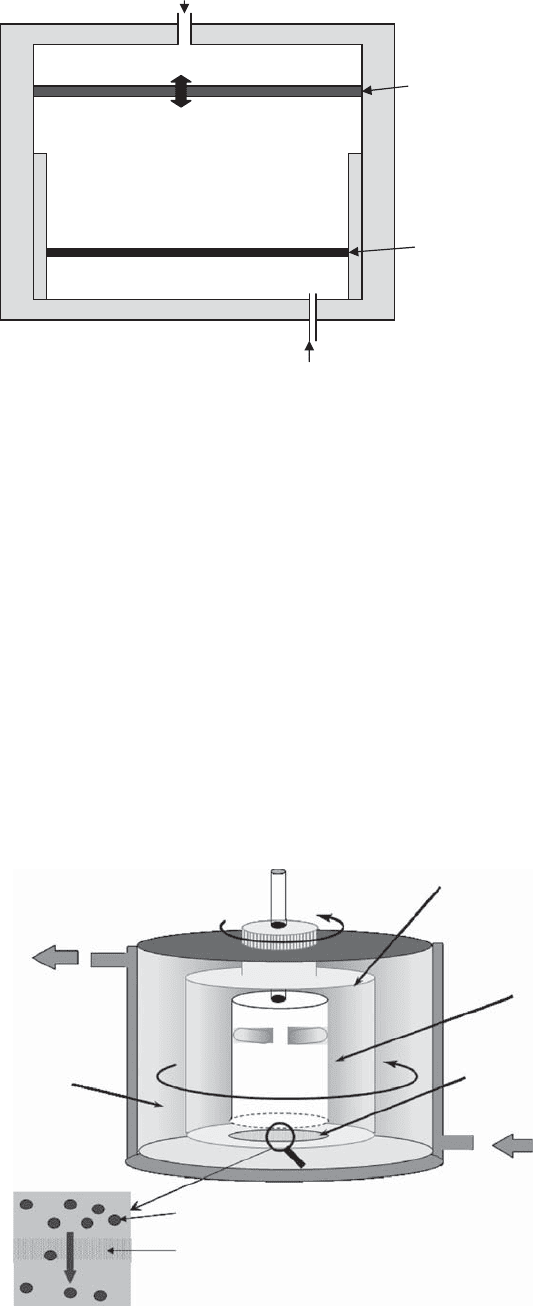
to high pressure. A two-compartment permeation cell
was integrated in a high-pressure autoclave (Figure 10).
The bottom of a compartment of the cell is moving like a
piston to apply high pressure on the liquid in contact with
the film. The pressure p
0
of the hydraulic fluid (water/
glycol) is applied by a piston to the lower region of the
autoclave filled with water. Another piston separates the
water from the aroma–solvent (water/ethanol) solution.
After the pressure is built up, the cell is rinsed again in
order to obtained the amount of aroma that permeated at
p
max
= p
0
through the film. The end of the rinsing defines
the beginning of the holding time. After the holding
time, the cell is rinsed again with the solvent out of the
reservoir. The amount permeated and then the liquid
permeability is determined by GC analysis of the solvent
after holding time.
Dynamic Isobaric Method
The rotating diffusion cell is designed hydrodynamically
so that stationary diffusion layers of known thickness are
created on each side of the film (Figure 11). The flux of
aroma compound from the inner compartment across the
film was measured by periodically sampling with a micro
syringe from the solution in the outer compartment and
analyzed by GC. The rotating diffusion cell method en-
ables us to carry out a study on the mass transfer of
solutes from a liquid phase to another liquid. The funda-
mental theory of the Levich model (22) provides the means
of aroma compound transfer from the inner to the outer
compartment by the overall permeability of aromas but
also the aroma diffusivity within the film packaging and
the interfacial resistances.
SORPTION METHODS
There are many works focused on the determination of
aroma mass barrier which are based on sorption experi-
ments. The retention or the release of substances is
monitored during the experiment. This evolution can be
followed by gravimetry (DVS, electrobalances, spring bal-
ances), by manometry, by GC or HPLC, and so on. Figure
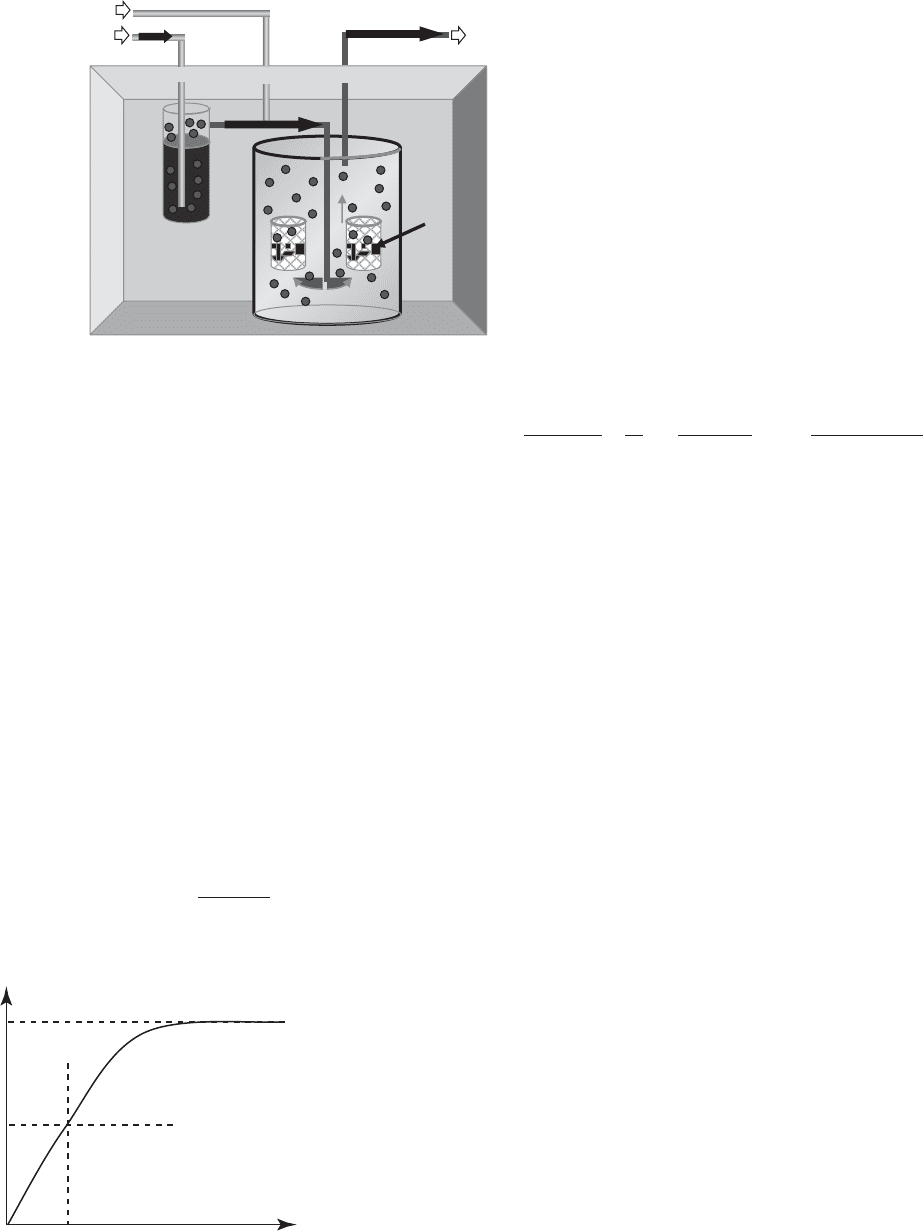
12 (24) presents aroma compound sorption kinetics. The
quantity of aroma compounds adsorbed by the film during
transient state of the mass transfer was often obtained
using a modified microatmosphere method. Dried films
cut into small pieces were exposed to atmospheres satu-
rated with pure or dilute aroma compound. This atmo-
sphere was usually conditioned at 0% relative humidity
and continuously swept with a carrier gas (helium) con-
taining a known vapor concentration of aroma compounds.
The atmosphere inside the flask containing the film was
kept at a constant aroma concentration. The total amount
of volatile compound sorbed at a given time until constant
Q was determined after solvent extraction such as n-
hexane (for which extraction yield is 97%) of a film sample
Hydraulic pressure fluid
Piston
Film
Solvent and
aroma compound
Samplin
g
and volume measurement
Figure 10. Experimental design of a liquid permeation cell
under high pressure. [Adapted from Gotz and Weisser (21).]
Cylindrical rotating baffle
Inner compartment with
aroma compounds
Film or membrane
Thermostatted
water
Aroma compounds
Film or membrane
Outer
compartment
Figure 11. Rotating diffusion cell for mea-
suring permeability of aroma compound be-
tween two liquid phases. [Adapted by
Debeaufort from works of Rogacheva et al.
(23).]
68 AROMA BARRIER TESTING
and by injection of the resulting aroma solution in a gas–
liquid chromatograph (GLC). The quantities of aroma
compounds adsorbed in the films are expressed as
mg mL
1
of dry film. The aroma flux was defined as the
ratio of the weight of permeated vapors (g) to the product
of exposed area (m
2
) and time (s). The flux was expressed
as g m
2
s
1
. In practice, permeability P and solubility
coefficients S are calculated from the following equations:
P ¼ F=Dp e and S ¼ Q=Dp
where F is the transfer rate (mg m
2
s
1
), Dp is the vapor
partial pressure gradient, e is the film thickness (m), and
Q is the quantity of volatile compound sorbed in the film
(mg mL
1
).
The diffusion coefficient can be calculated from the
half-time method of sorption experiment (Figure 13),
designating the time t
1/2
at which the transfer rate is
equal to half of the transfer rate at the steady state
obtained by a differential permeation method (5, 8, 25)
or from numerical solution of Fick equations. The diffu-
sion coefficient (D) was calculated using the equations
D ¼
e
2
7:199t
1=2
and
M
1
M
t
M
1
M
0
¼
8
p
2
X
1
n¼1
1
2n 1ðÞ
2
exp
2n 1ðÞ
2
p
2
Dt
4e
2
"#
where M
t
is the aroma quantity sorbed at the time t, M
N
is
the aroma quantity sorbed at the equilibrium, and M
0
is
the initial aroma quantity in the film sample.
The measurements methods of sorption are often used to
search the affinity properties of the aroma compounds.
These methods can also be used to determine diffusion
and then the permeability from the sorption kinetics. But
permeability can be only estimated from the sorption
method when the Henry and Fick’s laws are obeyed. This
calculation applies only in the absence of strong interac-
tions between the volatile compound and the polymer– that
is for a constant diffusivity and a linear sorption isotherm.
BIBLIOGRAPHY
1. H. Maarse, Volatile Compounds in Food and Beverages,
Marcel Dekker, New York, 1991.
2. J. Ylvisaker, ‘‘The Application of Mass Transport Theory to
Flavor and Aroma Barrier Measurement,’’ Tappi Polymers,
Laminations & Coatings Conference Proceedings, 1995, Book
2, p. 533.
3. P. T. DeLassus, ‘‘Permeation of Flavors and Aromas through
Glassy Polymers,’’ Tappi J., 77(1), 109 (1994).
4. W. E. Brown, Plastics in Food Packaging: Properties, Design
and Fabrication, Marcel Dekker, New York, 1992.
5. J. Crank, The Mathematics of Diffusion, 2nd edition, Oxford
University Press, New York, 1975, pp. 32, 52.
6. R. Gavara, R. Catala, P. M. Hernandez-Mun˜ oz and R. J.
Hernandez, Packag. Technol. Sci. 9(4), 215–224 (1996).
7. R. M. Felder and G. S. Huvard, Methods of Experimental
Physics, Vol. 16c, Academic Press, New York, 1980, pp. 324, 344.
8. R. M. Felder, J. Membr. Sci., 3, 15–27 (1978).
9. Q. Zhou, B. Guthrie, and K. R. Cadwallader, Packaging
Technol. Sci., 17(4), 175–185 (2004).
10. F. Debeaufort and A. Voilley, Second International Sympo-
sium on Food Packaging: Ensuring the Safety and Quality of
Food, Vienna, Austria, November 2000.
Dried air
(Dilution of aroma)
Air + Aroma
(atmospheric
pressure)
Dried air
Pure
aroma
Film
Thermostated
bath (25°C)
Figure 12. System to determine aroma com-
pound sorption kinetics (micro-climate method).
M
t
/M
∞
Time
1
0.5
t
1/2
M
t
: aroma quantity sorbed at the time t
M
∞
: aroma quantity sorbed at the equilibrium
Figure 13. The half-time method of diffusivity determination
from sorption kinetics.
AROMA BARRIER TESTING 69
11. M. G. Kontominas, Sci. Alim. 5(2), 321–329 (1985).
12. M. Rubino, M. A. Tung, S. Yada, and I. J. Britt, J. Agric. Food
Chem. 49(6), 3041–3045 (2001).
13. D. Cava, R. Catala, R. Gavara, and J. M. Lagaron, Polym.
Testing 24, 483–489 (2005).
14. F. Debeaufort and A. Voilley, J. Agric. Food Chem., 42(12),
2871–2876 (1994).
15. A. Nestorson, A. Leufven, and L. Ja
¨
rnstro
¨
m, Polym. Testing
26, 916–926 (2007).
16. R. Franz, Packag. Technol. Sci. 6, 91–102 (1993).
17. A. G. Wientjes, H. Maarse, and S. A. Van Straten, Lebensmit-
tel Hunters Hyg., 58(1), 61–70 (1967).
18. M. Lomax, Polymer Testing 1, 105–147 (1980).
19. H. Okuno, K. Renzo, and T. Uragami, J. Membr. Sci., 103
(1–2), 31–38 (1995).
20. I. Bodnar, A. C. Alting, and M. Verschueren, Food Hydrocoll.
21(5–6), 889–895 (2007).
21. J. Gotz and H. Weisser, Innov. Food Sci. Emerging Technol. 3,
25–31 (2002).
22. V. G. Levich, Physico-chemical Hydrodynamics, Prentice-
Hall, Englewoods Cliffs, NJ, 1962.
23. S. Rogacheva, M. A. Espinosa-Diaz, and A. Voilley, J. Agric.
Food Chem. 47(1), 259–263 (1999).
24. J. A. Quezada-Gallo, F. Debeaufort, and A. Voilley, J. Agric.
Food Chem. 47(1), 103–108 (1999).
25. R. R. Chao and H. H. Rizvi, in J. H. Hotchkiss, ed., Oxygen
and Water Vapor Transport through Polymeric Films: A Re-
view of Modeling Approach, Food and Packaging Interactions
365, American Chemical Society: Washington, DC, pp. 216–
242, 1988.
70 AROMA BARRIER TESTING

B
BAG-IN-BOX, DRY PRODUCT
GILLES DOYON
Agriculture & Agri-Food
Canada, Ministry, Saint-
Hyacinthe, Quebec, Canada
When the bag-in-box concept is applied to dry products, it
generally involves a bag inside a folding carton (see
Cartons, Folding). In order to appreciate the impact of
the bag-in-box (BIB) concept for dry products, one must
understand the history of the folding carton. The turn of
the century marked the first use of the folding carton as a
package when National Biscuit Company introduced the
‘‘Uneeda Biscuit’’ (soda cracker). Instead of opting for the
conventional bulk method of selling crackers, Nabisco
decided to prepackage in smaller boxes, using a system
that would prolong freshness. The paperboard carton shell
with creased score line flaps had recently been developed,
along with a method for bottom and top gluing on auto-
matic machinery (see Cartoning machinery). Waxed paper
(see Paper; Waxes) was to be added manually to the inside
of the carton. So was born the ‘‘lined carton.’’
The evolutionary process eventually culminated in two
basic methods of producing lined cartons. The first was a
machine to automatically open a magazine-fed side-
seamed carton and elevate it around vertically indexed
mandrels where glue is applied to the bottom flaps and
folded up against the end of the mandrel with great
pressure. The result is a squarely formed open carton
with a very flat bottom surface capable of being conveyed
upright to a lining machine that plunges a precut waxed-
paper sheet into it by a system of reciprocating vertical
mandrels. The lining is overlapped at the edges and sealed
together to form an inner barrier to outside environmental
factors. It protrudes above the carton top score line by a
sufficient amount of paper to be later folded and sealed at
a top-closure machine. Straight-line multiple-head filling
machines are used to fill premeasured product into the
carton. Initial fill levels are often above the carton-top
score line and contained within the upper portion of the
lining, which eventually settles with vibration before top
sealing takes place. This fact has relevance with respect to
the bag-in-box concept.
The second method involves the use of a double-pack-
age maker (DPM), which combines the carton forming/
gluing operation with a lining feed mechanism that wraps
the lining paper around a solid mandrel prior to the carton
feed station. In this instance the carton blank is flat and is
side-seamed on the DPM. The lined carton is then dis-
charged upright onto a conveyor leading to the filler and
top closing machine.
These packaging lines are typically run at up to 80
packages per minute (in some special cases 120/min).
They are considered to be very complex machines
requiring skilled operating personnel and are usually
restricted up to a single size.
Although the time reference is rather vague, it would
appear that the bag-in-box concept began with the refine-
ment of vertical form/fill/seal (VFFS) machinery in the
1950s (see Form/Fill/Seal, Vertical). Packaging machinery
manufacturers and users saw an alternative to the DPM
in the horizontal cartoner coupled with VFFS equipment.
The idea of automatically end-loading a sealed bag of
product into a carton offers the following important ad-
vantages compared to lined cartons: simplicity (i.e., fewer
and less-complicated motions); flexibility (i.e., size
changes more easily and quickly accomplished); higher
speed (i.e., up to 200 packages per minute is theoretically
possible with multiple VFFS machines in combination
with a continuous-motion cartoner); lower packaged cost
(i.e., higher speeds and lower-priced machinery); im-
proved package integrity (i.e., bags are hermetically
sealed using heat-seal jaws); reduced personnel (i.e.,
possible for one operator to run line); requires less floor-
space (i.e., more compact integrated design); and wider
choice of packaging materials (i.e., unsupported as well as
supported films can be handled).
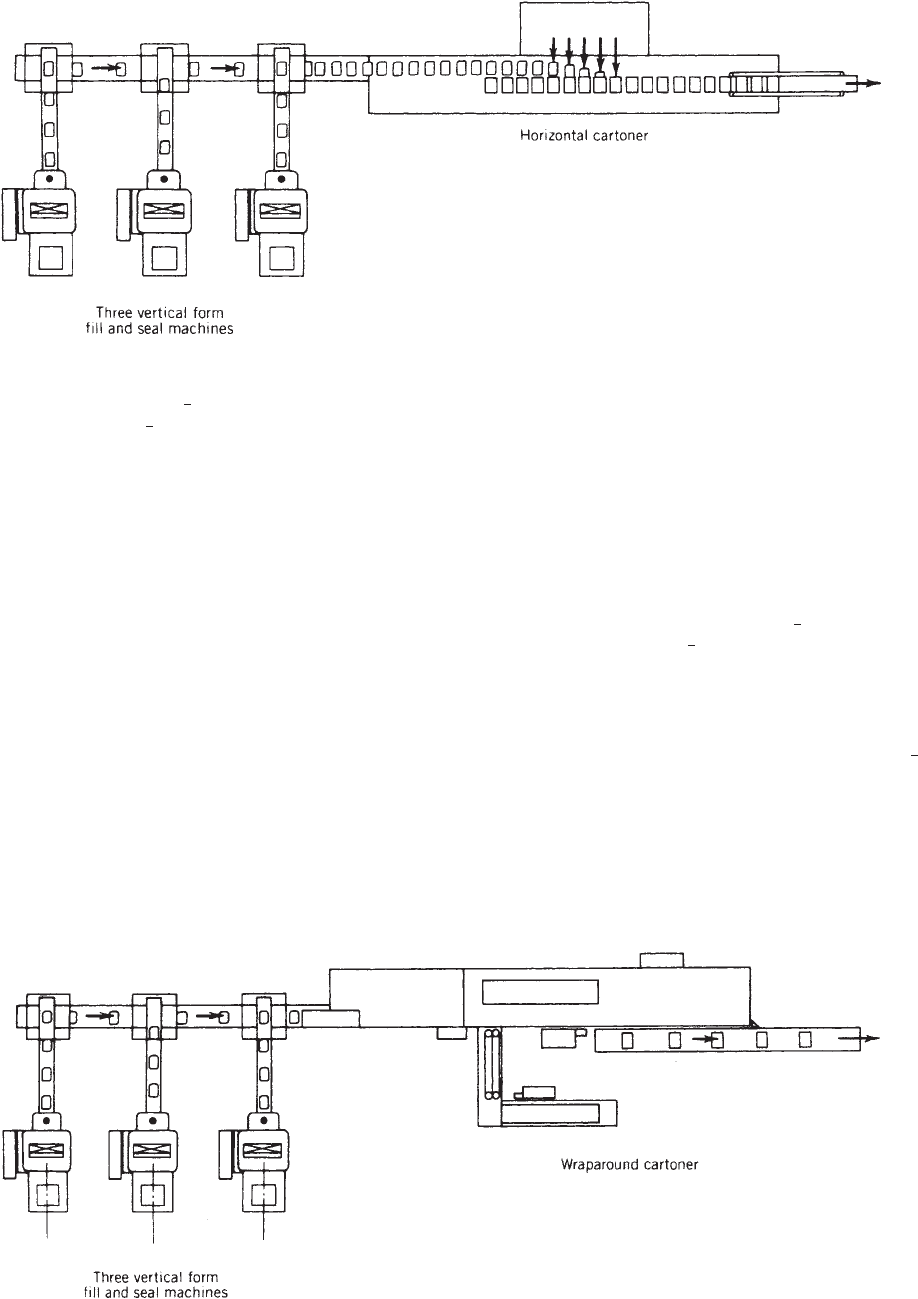
Although bags are sometimes inserted manually, the
high-speed methodology (see Figure 1) employs multiple
VFFS machines stationed at right angles to the cartoner
infeed, dropping filled and sealed bags of product onto an
inclined conveyor that carries them to a sweep-arm transfer
device for placement into a continuously moving bucket
conveyor. The VFFS machines are electrically synchronized
with the cartoner, and the transfer device is mechanically
driven by the bucket conveyor. When the bag reaches the
carton-loading area, it is gradually pushed out of the bucket
by cammed push rods through guides and into the open
mouth of the box which is contained within chain flights
traveling at the same speed adjacent to the bucket. A guide
plate drops into the bucket from overhead to confine the bag
during insertion into the box. Once the bag is in the box, the
end flaps are glued and rail closed before entering compres-
sion belts for discharge to the case packer.
When difficulties occur in this system, it is usually at
the insertion station, caused by misshaped or rounded
bags with a girth larger than the carton opening. An
attempt is made to condition the bag on the inclined
conveyor by redistributing the product within the bag
more evenly and, once in the bucket, by vibrating tampers
to flatten it. However, if there is too much air entrapment
in the bag, or a high product fill level, or an improperly
shaped bag, these devices become futile. Increasing the
carton size would be a simple solution, but the packager is
often not free to do this. Marketing departments are
generally reluctant to change the size of a carton that
has been running satisfactorily on DPM equipment. The
main problem is that the BIB manufacturer must allow
more clearance of bag to box than is required on a close-
fitting lining. The usual BIB bag-sizing rule of thumb is a
71
gusseted bag having a width
3
6
in. (9.53 mm) less than the
carton face panel and
1
4
in. (6.4 mm) less than carton
thickness. This can vary somewhat, but the bag must be
small enough to transfer positively into the bucket and
subsequently into the box without interference.
One manufacturer has attempted to deal with the
problem by wrapping the carton blank around the bucket
after the bag has been top-loaded into it (see Figure 2).
In wraparound cartoning, flat blanks are used and glue
is applied to the manufacturer’s joint and side-seamed
against the mandrel by rotating-compression bars. The
mandrel/bucket is withdrawn, leaving the bag in the
box ready for flap gluing and closing. This approach is
more forgiving than end-loading, but is still susceptible
to bag-sizing problems because additional clearance
must be allowed to compensate for the gauge of the
three-sided bucket walls. Speeds of r140 per minute
are possible.
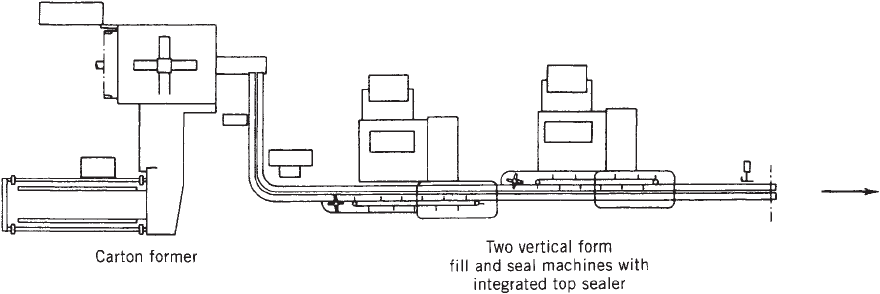
The vertical load concept has gone a long way toward
overcoming bag insertion problems (see Figure 3). It relies
on simple gravity and special bag-shaping techniques to
drop the bag directly into the box from a film transport-
belt-driven type of VFFS machine. The carton shell is
formed from a flat blank and bottom glued on a rotary
four-station mandrel carton former. The upright carton is
conveyed to a starwheel-timed flighted chain indexing
device to position it squarely under the VFFS rectangular
forming tube. Two VFFS machines with electronically
synchronized motor drives operate independently of the
carton former. A prime line of empty cartons initiates the
operation of each VFFS machine.
The bag-forming parts consist of a rectangular-forming
shoulder and tube that has been manufactured to produce
a bag with cross-sectional dimensions
1
4
in. (6.4 mm) less
than carton face panel and
1
6
in. (3.2 mm) less than the side
panel. This very close fit is made possible by a combination
of several mechanisms. First a gusseting device creates a
true flat-bottom bag using fingers that fold in the film from
the sides as contoured cross-seal jaws close on the bag. The
bottom of the rectangular forming tube is within
1
4
in.
(6.4 mm) of the seal jaws and acts as a mandrel around
which the bag bottom is formed. The bag is thereby given a
sharply defined rectangular shape, which is maintained as
it is filled with product and lowered through a shape-
retaining chamber. This chamber is vibrating so as to
present a moving surface to the bag to reduce frictional
Figure 2. Bag-in-box packaging system with wraparound cartoner.
Figure 1. Bag-in-box packaging system with horizontal cartoner.
72 BAG-IN-BOX, DRY PRODUCT
contact and, more important, to settle the product before
the top seal is made. Since the bag is confined and not
allowed to round out, headspace between product and top
seal is kept to a minimum, thereby reducing air entrap-
ment to manageable levels. Flap spreaders ensure that
there is unobstructed access into the box.
The shaped filled bag slips freely into the box, allowing
the four corners of the bag to settle snugly into the
bottom, making maximum use of available volume. The
bag cutoff is determined by product fill level and, if
necessary, can be made so that the top seal protrudes
over the score line by several inches. (centimeters) when
fully seated in the box, which is neatly pressed down at
the next station. While the carton is contained in the
flighted chain, it is indexed through a top sealer where
hot-melt glue is applied to the flaps, which are railed over
before passing under compression rollers. The top sealer
is integrated mechanically and electrically with each
VFFS machine, and because the operation is performed
immediately after bag insertion, the carton never has a
chance to bulge, which is eventually important for effi-
cient case packing.
This packaging system is rated at up to 100 cartons per
minute, and two lines can be mirror-imaged for higher
speeds. A recent adaptation of the vertical-load system
integrates a carton erector for side-seamed blanks with
one VFFS and a top-and-bottom gluer into a single
compact module rated at up to 50 boxes per minute.
Another BIB system close-couples a carton former
(preglued or flat blanks) with a pocket conveyor that
indexes the box to a series of bag insertion, filling, sealing,
and carton top/bottom gluing stations. The bag is formed
using vertical form/fill techniques utilizing a rectangular
forming tube. A unique gripping mechanism engages the
bottom seal of the bag and pulls it into the box from
underneath. The bag top is left open to be filled with
product at succeeding stations. This system offers the
advantages of multiple-stage filling for optimum accuracy,
checkweighing, and settling before the bag top is sealed.
This is a very effective way of dealing with the problem of
high fill levels. Outputs of 65–80 packages per minute are
claimed for this type of machinery.
RELATED CONCEPTS
A field that has grown is institutional bulk packaging of
large quantities of product in 10 to 20-lb (4.5 to 9.1-kg)
sizes which usually require corrugated-box materials (see
Boxes, Corrugated). The VFFS unit is an expanded ma-
chine capable of producing large deeply gusseted bags and
is usually set up for vertical bag loading. Speeds are in the
range of 15–30 cartons per minute. In a related process,
not technically ‘‘bag-in-box,’’ horizontal pouch (three-side-
seal) machines are close-coupled to a cartoner to auto-
matically insert one or multiple pouches into a carton at
high speeds.
BIBLIOGRAPHY
N. H. Martin, Jr., ‘‘Bag-In-Box, Dry Product’’ in The Wiley
Encyclopedia of Packaging Technology, 1st edition, John Wiley
& Sons, New York, 1986, pp. 24–26.
General Reference
S. Sacharow, A Guide to Packaging Machinery, Books for the
Industry and the Glass Industry Magazine, Divisions of
Magazines for Industry, NewYork, 1980, 191pp.
BAG-IN-BOX, LIQUID PRODUCT
JIM ARCH
Scholle Corporation
GILLES DOYON
MARCO LAGIMONIE
`
RE
Agriculture & Agri-Food
Canada, Ministry, Saint-
Hyacinthe, Quebec, Canada
Bag-in-box is a form of commercial packaging for food and
nonfood, liquid and semiliquid products consisting of three
Figure 3. Bag-in-box packaging system with mandrel carton former.
BAG-IN-BOX, LIQUID PRODUCT 73
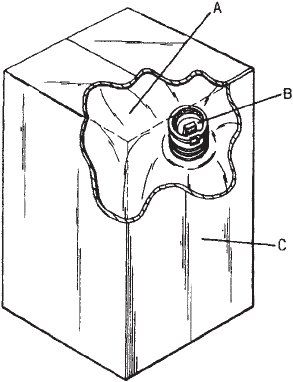
main components: (a) a flexible, collapsible, fully sealed
bag made from one or more plies of synthetic films; (b) a
closure and a tubular spout through which contents are
filled and dispensed; and (c) a rigid outer box or container,
usually holding one, but sometimes more than one, bag
(see Figure 1).
The bag-in-box concept appeared in the United States
in the late 1950s. As early as 1957 (1), the package was
introduced into the dairy industry in the form of a
disposable, single-ply bag for bulk milk. By 1962, it had
gained acceptance as a replacement for the returnable 5-
gal (19-L) can used in institutional bulk-milk dispensers
(2). One of the first nonfood items to be offered in a bag-in-
box package was corrosive sulfuric acid used to activate
dry-charge batteries.
During this early period, bags were manufactured from
tubular stock film by labor-intensive methods. Initially,
the physical properties of monolayer films (chiefly low-
density polyethylene homopolymers) limited the applica-
tions, and filling equipment was slow and often imprecise.
This situation changed significantly with the introduction
in the 1960s of ethylene–vinyl acetate (EVA) copolymer
films that provided added sealability and resistance to
stress and flex cracking. By 1965, faster, dual-head fillers
became available featuring semiautomatic capping cap-
abilities. Developments in automated box forming and
closing kept pace. Also, by 1965, proprietary bag-manu-
facturing equipment capable of making bags from single-
wound sheeting sealed on all four sides had been devel-
oped (see Sealing, heat). In the mid-1970s, filling ma-
chines that automatically loaded filled bags into boxes
came on-line. This was followed by totally automatic
filling equipment that accepted a continuous feed of bags
in strips (3), separated, filled, and capped them, then
placed them in outer boxes. Meanwhile, barrier films (4)
(see Barrier polymers) with improved handling and sto-
rage characteristics were being developed. Multilayer
films of polyethylene coextruded with polyvinylidene
chloride or PVDC to provide an oxygen barrier had become
commercially available as Saranex (Dow Chemical Co.) in
the early 1970s (see Vinylidene chloride copolymers). The
application of this barrier film permitted packaging of
oxygen-sensitive wines and highly acidic foods such as
pineapple and tomato products. Beginning in 1979, multi-
ple-ply laminates (5) (see Multilayer flexible packaging)
combining foil (aluminum) or metallized polyester sub-
strates were introduced and were also in wide use by 1982
(see Film, polyester). Such laminations are thermally or
adhesively bonded and in some instances by hot melt
extruding the adhesive layer (see Adhesives; Extrusion
coating). The most commonly used barrier film in the
United States today is a three-ply laminate consisting of
2-mil (51-mm) EVA/48-gauge (325-mm) metallized polye-
ster/2-mil (51-mm) EVA. The barrier properties of metal-
lized polyester are directly proportional to the optical
density (OD) of the metal deposit. Multilayer coextruded
films combining the barrier properties of ethylene–vinyl
alcohol copolymer (EVOH), the strength of nylon, and
sealability of linear low-density polyethylene are being
successfully used for some bag-in-box applications. It is
the sensitivity to moisture by EVOH that is limiting the
films’ wider use (see Ethylene-vinyl alcohol; Nylon; Poly-
ethylene, low density).
Fully automatic filling machines with as many as six
heads (6) handling up to 40 two-liter (B2 qt) bags per
minute are in operation. Films have been refined and
specialized to meet tight packaging specifications for such
procedures as hot fill at 2001F (93.31C) temperatures.
Bags are also presterilized by irradiation for filling with
a growing number of aseptically processed products for
ambient storage without preservatives (see Aseptic packa-
ging). Outer boxes have become not only stronger, but
more attractive and appealing as consumer sales units.
MANUFACTURING PROCESS
In general, large producers of bag-in-box packaging de-
sign, develop, and manufacture packages to specifications
meeting customer requirements. Containers vary in capa-
city from small, consumer and institutional sizes 1 qt to
5 gal (or 2–20 L), to large, process and transportation
packs of 52–312 gal (or 200–1200 L).
A corrugated board box for enclosing a flexible, collap-
sible bag with a closed spout is described (1997). The box
may be used to deliver soft drink syrups, milk, water
contained in plastic pouch (7). The next invention (8)
relates to post-mix dispensers of the type using peristaltic
pump located below a bag-in-box package of concentrate
(1997). Novel use of oxygen-scavenging compositions in
packaging material that comprise a gas and vapor barrier-
forming layer or coating is introduced (1998) and disclosed
(9). Applications could be for carton, bag-in-box, thermo-
formed trays or cups, over-wraps, shrink-wraps, closure
liners, and cans. More recently (2000), an improved bag-
in-box packaging system for storing, transporting, and
dispensing liquid products such as chemicals, soft drink
syrup, fruit juices, and food condiments is patented (10).
It allows for more complete drainage of the liquids. An
Figure 1. A bag-in-box package for liquid products consists of a
bag (A), a closure and tubular spout (B), and a rigid outer
container (C).
74 BAG-IN-BOX, LIQUID PRODUCT
improved bag-in-box packaging has a shell surrounding
the carton (11) that can be separated to form a stand for
the carton (2004) is presented. It facilitates dispensing of
the beverage from the bag by allowing glasses and cups to
be placed on the table under the tap, eliminating the need
to use two hands to fill the glass. A multipurpose four-
sided sealed bag with a bag-in-box container system for
viscous or powdery (particulate) products as vegetable
oils, syrups, salad dressings, peanut butter, or soy sauce
is described (12). The method of producing and using the
bag are also included (2004). A bridge and adapter system
for filling a bag-in-box packaging with liquids, solids, and
semisolid products is claimed to provide a quick connec-
tion between the supply line and the dispensing part of the
packaging (13). The bridge can be made of food grade
stainless steel, plastic, or aluminum (2004). A collapsible
flexible liner for a bag-in-box container system or flexible
intermediate bulk container (FIBC) is detailed (14). The
liner is designed to prevent unwanted collapsing of the
liner during filling or draining (2005). It is also suitable for
shipping various products including powder detergent. A
new bag-in-box beverage container and dispenser is pa-
tented (15, 16), which incorporates (a) an outer shell
preferably fabricated from corrugated paperboard mate-
rial and (b) an inner liquid-containing bag fabricated from
a suitable material (2006). A recessed handle is also
provided. Finally, a bag-in-box for containing and dispen-
sing liquids (e.g., beverages) is described (2006). The
interior surface of the bottom of the box preferably slopes
downwards toward the spout of the bag and/or has ter-
races, curves, corrugations, fan-like ridges, or beams to
help feed the liquid toward the spout (17). The invention
may also be used to advantage in other liquid dispensing
applications.
Bag
The principal considerations in choosing a film laminate
or coextruded for the bag construction are strength and
flexibility, with low permeability and heat resistance
added critical factors in an increasing number of applica-
tions. In the case of laminates, the bond between the
layers of dissimilar materials must be maintained at a
high level. Minimum requirements of over 1.1 lbf (500 gf)
per inch (2.54 cm) (i.e., B193 N/m) is not uncommon.
Films, laminates, and coextruded have to be resistant
and must also, of course, be compatible with the product
from which they are in direct contact with.
Once the appropriate film compositions have been
determined for a specific application, the typical manu-
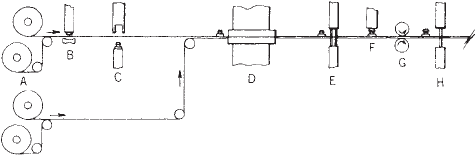
facturing procedure is as follows: Referring to Figure 2,
two or three pairs of rolls of single-wound sheeting (A) are
unwound on a machine where the webs advance inter-
mittently, holes are punched (B), and spouts are sealed (C)
into one of the duplex or triplex film sheets at predeter-
mined points depending on finished size, and the bags are
formed by sealing the two films together along the sides
(D) and then at the ends (E). Therefore, the bags for
liquids are of a ‘‘flat’’ nature, not gusseted. Because precise
time and temperature must be maintained to generate
the seal between the thin films, the uneven thickness
resulting from wrinkles or folds must be avoided because
the resulting ‘‘darts’’ will not be fully sealed. A removable
closure is applied to the spout (F), and after passing by the
draw rolls (G) the bags are either cut apart as the final
operation or are perforated (H) for subsequent machine
separation at time of filling.
Bag Size
The box size must be measured first, and then the exact
sizing of the inner bag can be determined with respect to
capacity or desired volume. The bag must occupy virtually
all of the interior space of the box without unfilled corners
or potentially damaging excess headspace resulting from
an oversize box. The relationship between the effective
surface area in contact with atmospheric air from the bag-
in-box and the volume capacity is important, as well as,
the residual air bubble inside. Referring to Table 1, one
can demonstrate by doing some rapid calculations that a
better shelf life for larger bag-in-box capacity is antici-
pated for similar bag structure. Furthermore, variability
of the bubble diameter or its out-of-control specification
per type of volume capacity is a good visual tool for quality
control (QC) procedures and automatic filling machine
adjustment.
Spout and closure
The spout is the filling port of the bag. Together with the
closure, they are designed to mate with filling heads and
must be able to withstand the mechanical shock of the
closure being removed and replaced during the filling
operation without damage to the spout or closure. Spouts
are generally molded of polyethylene with a thin flexible
flange to which the bag film is sealed. The spout has
handling rings for holding the spout during the filling
sequence, and the closure likewise has rings for the same
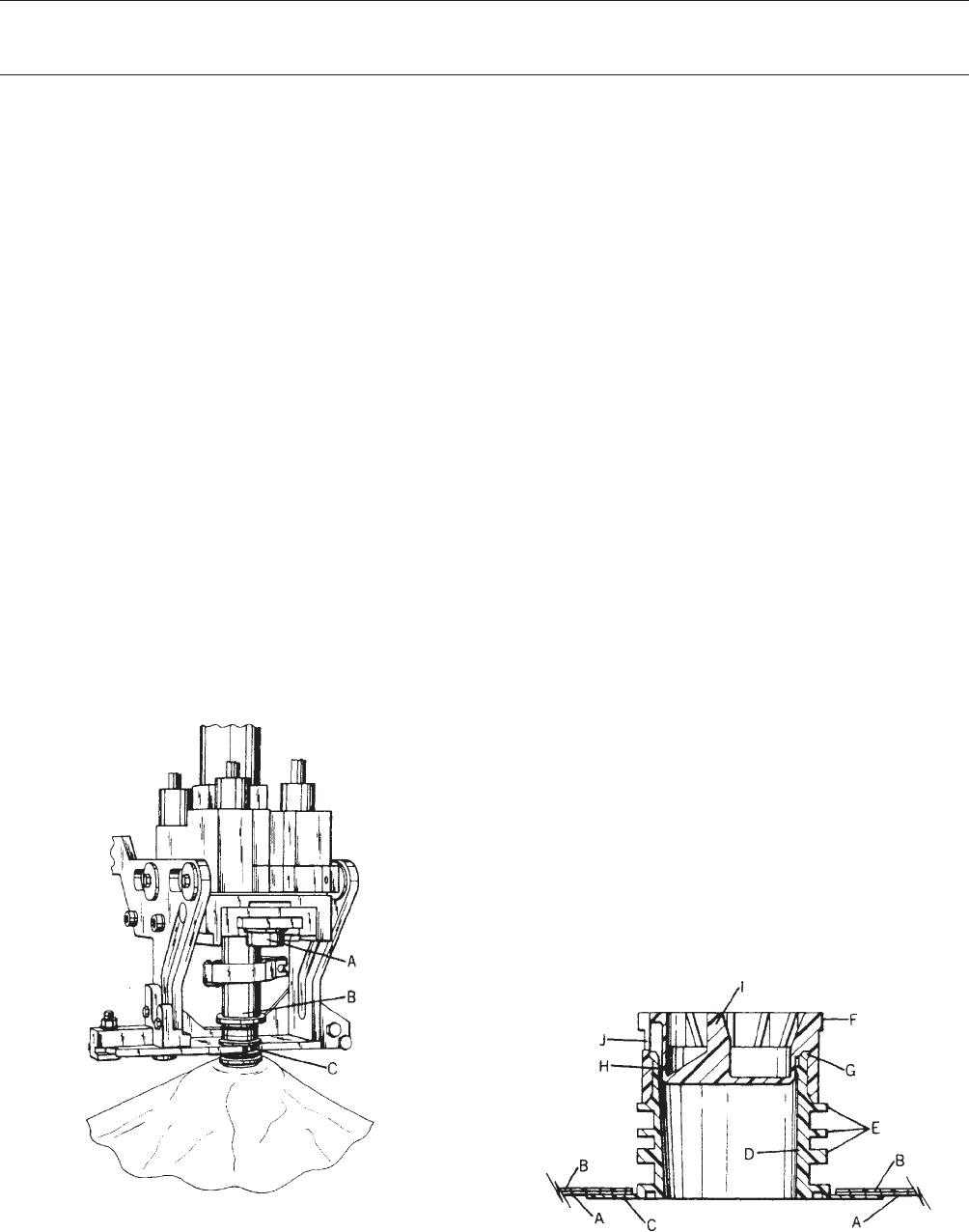
purpose. Figure 3 shows the filling head in the fill position.
The closure (A) has been removed and lifted up and away
at an angle permitting the filling nozzle (B) to come
downward and enter the spout (C) that is being held
firmly in position. Because the design of bag-in-box
packages provides for the contents always to be in contact
with the spout, the spout-closure fit must be leakproof.
When high oxygen-barrier property is essential, the spout
and closure appear as the weakest area of the global bag +
spout/closure structure, even though the valve is now of
high barrier material. The oxygen ingress remains im-
portant unless the tightness or snugness of the spout/
closure is ensured. This is a mechanical fit with tight
Figure 2. Typical bag-in-box manufacturing procedure.
BAG-IN-BOX, LIQUID PRODUCT 75
specifications. Their behavior with respect to temperature
changes is not to be forgotten. Some commercial products
are available, but the list is not exhaustive: Presstap,
Malpass, Vitop, Flextap, Viniplus, to name a few. The
reader is recommended to peruse references 19 and 20
for complementary information. Also of importance is
some application of nitrogen gas (N
2
) or the liquid- form
droplet to flush the headspace of residual air moments
prior to final positioning of the valve or spout on the bag-
in-box neck.
There are many designs for spouts and closures, de-
pending on function. In packages destined for consumer
use, the closure typically is a simple, one-piece, flexible
valve that opens and closes as a lever is activated. Such a
combination is shown in Figure 4. Two layers (A, B) of film
are sealed to the spout sealing flange (C). Around the
tubular wall (D) are one or more spout handling rings (E).
The closure also has a handling ring (F) that facilitates its
removal by the filler capping head. The closure is retained
on the spout by a mating groove and head (G), and the
liquid seal is achieved by a pluglike fit (H) between the two
components. The one-piece closure is molded from a
resilient material and becomes a dispensing valve by
flexing the toggle (I), creating an opening to an orifice
(J) and providing a path for the contents to exit.
For food-service use, such as in restaurants, the closure
may have a dispensing tube attached or be compatible
with a quick-connect-disconnect coupler leading to a
pump. For other uses, just a cap may need to be removed
prior to emptying of contents.
Box
In some dairy applications, the bags are transported in
returnable plastic crates. Most typically a wide variety of
materials in many forms may be used for the nonreturn-
able box of bag-in-box packages. For smaller sizes (1–6 gal,
or 4–23 L), the outer box is usually made of corrugated
board in a conventional cubic configuration. For larger
sizes (30–54 gal, or 114–208 L), rigid plastic and metal
containers, or even cylindrical drums, may be employed.
The required strength must be designed into the box as
dictated by the specific application.
Outer boxes may be manufactured with built-in hand-
holds or locked-in-place handles, and some have special
wax or plastic coatings for moisture protection. Most boxes
are built with punch-out openings for easy access to the
spout and closure.
FILLING
Filling bag-in-box packages may be a manual or semi- to
fully automatic operation and is adaptable to a wide range
Figure 4. A flexible-valve closure. See text.
Table 1. Bag-in-Box (BIB) Capacity, Effective Surface Area, and Equivalence per Unit of Volume
Capacity (BIB) 2 L (2.10 qt) 3 L (3.15 qt) 4 L (4.20 qt) 10 L (10.5 qt) 20 L (21.0 qt)
Mean surface. cm
2
or [in.
2
] 1376 [213] 1546 [240] 2140 [332] 3941 [611] 5838 [905]
Surface equivalent cm
2
/L or [in.
2
/qt] 688 [101] 515 [76] 535 [79] 394 [58] 292 [43]
Conversion units used in this paper are
0.001 in. = 1 mil = 25.4 mm (micrometer)
1cm
2
= 0.155 square inch (in.
2
)
1 Liter (L) = 1.05 US quart (qt)
1 L = 0.26 US gallon (gal)
1 US gal = 3.79 L
Figure 3. Filling head in fill position. The closure (A) has been
removed to permit the filling nozzle (B) to come down and enter
the spout (C).
76 BAG-IN-BOX, LIQUID PRODUCT
of standard industrial processing procedures, including
cold, ambient, high-temperature, and aseptic filling. The
basic design of a typical filling machine incorporates a flow
meter, filling head or heads, an uncap–draw vacuum–fill–
recap sequence, and filled bag discharge (see Filling
machinery, still liquid). Bags may be manually loaded
into the film head or automatically fed in strip form into
more sophisticated models. Advanced filling equipment
can also be provided with such devices as a cooling tunnel
where hot-filled bags are agitated and cooled by jets of
chilled water; a specialized valve to allow passage of
liquids with large particulates; steam sterilizing and
sterile air chambers for aseptic filling; or other modifica-
tions as determined by application.
Five-gallon (or 19-L) bags can be filled at speeds that
range from four units per minute (1200 gal/h or 76 L/min)
to 20 units per minute (6000 gal/h or 380 L/min). Low-
speed filling is done on single-head, worker-attended
fillers, whereas high-speed is done on filling on multihead
equipment, comparing favorably with line speeds of con-
ventional rigid-container operations. Complete systems
including box formers, conveyors, automatic bag loading,
and top sealers are available to support the automated
large-capacity fillers.
SHIPPING AND STORAGE
Bag-in-box packaging offers significant weight- and space-
saving economies. Before filling, components are shipped
flat; after filling, the basic cubic shape of most bag-in-box
outer boxes occupies less space and tare weight than
cylindrical metal containers of comparable volume. Lim-
itations include (a) restrictions on palletizing and stacking
height, where content weight may exceed outer box rat-
ings, especially those constructed of corrugated board, (b)
vulnerability of uncoated boxes to humidity and moisture,
(c) possibility of flex cracking of the bag structure is
plausible, mainly if we have metallized polyester from
the effect of internal handling, (d) short as well as long
transportation, and (e) age in distribution (national and
international levels). Damages by surrounding materials,
leaking units, and vibrations as well as shocks (frequency
and intensity) must not be forgotten nor neglected.
DISPENSING
Dispensing may be accomplished in one of three basic
ways: uncapping and discharging contents; attaching one
or more packages to a pumping system; or activating a
small volume, user-demand closure often referred to as a
dispensing valve.
In single-bag packages, the spout closure is contained
within the outer box for protection and withdrawn prior to
use through a perforated keyhold opening in the box.
During dispensing, the bag collapses from atmospheric
pressure as contents are expelled without the need for air
to be admitted. When completely empty, bag-in-box pack-
age components, except those outer boxes or containers
specifically designed for reuse, are fully disposable.
Corrugated board and polyethylene are easily incinerated,
and metallized and foil inner bags compact readily to go to
landfills.
APPLICATIONS
With advancements constantly being made in bag film
capabilities, along with filling and dispensing techniques,
practically every commercial product is either being con-
sidered for or is now available in bag-in-box packages.
Major users include the dairy industry with fluid milk,
cream, and soft ice cream mixes. Also of interest are fruit
juices and concentrates, edible oil, sauce, and jams, from
5- to 1000-L (1.3- to 260-gal ) capacity. Clients are increas-
ing for restaurants, institutions, and fast food markets
(21, 22). The wine industry since the 1970s in Australia
and South Africa have expended their success of the bag-
in-box material and packing technologies worldwide (23);
and, finally, most important transportation abuse and
shelf-life extension are under close scrutiny (19, 24).
From 3–4 L (3.2 qt to 1 gal), soon some 2-L (2.1 qt) contain-
ers will be available for retail; also, institutional size
(10–20 L, or 2.6l–5.2 gal) and long preservation storage
size (1200 L, or 312 gal), respectively, will be available.
Purees and ketchup have modest applications too. Some
soft drinks are also prepared from fountain syrup pumped
from a bag-in-box arrangement (18), which eliminates the
need for recycling and accounting for metal transfer
containers.
BIBLIOGRAPHY
1. U.S. Patent 2,831,610 (April 28, 1958), H. E. Dennis (to Chase
Bag Company).
2. U.S. Patent 3,090,526 (May 21, 1963), R. S. Hamilton and
coworkers (to The Corrugated Container Company).
3. U.S. Patent 4,120,134 (October 17, 1978), W. R. Scholle (to
Scholle Corporation).
4. ‘‘Films, Properties Chart,’’ in Packaging Encyclopedia 1984,
Vol. 29, No. 4, Cahners Publication, pp. 90–93.
5. J. P. Butler, ‘‘Laminations and Coextrusions,’’ in Packaging
Encyclopedia 1984, Vol. 29, No. 4, Cahners Publication, pp.
96–101.
6. U.S. Patent 4,283,901 (August 18, 1981), W. J. Schieser (to
Liqui-Box Corporation).
7. U.S. Patent 6,223,981 (May 1, 1997) T. L. Gunder (to The
Coca-Cola Company, GA (US)).
8. W.O. Patent 9,747,532 (December 18, 1997) A. A. Schroeder
(to The Coca-Cola Company, GA (US)).
9. U.S. Patent 6,601,732 (August 5, 1998) M. L. Rooney and M.
A. Horsham (to Commonwealth Scientific and Industrial
Research Organisation (CSIRO), Campbell (AU)).
10. U.S. Patent 6,609,636 (August 26, 2000) P. F. Petriekis and W.
H. Williams (to Packaging Systems LLC, Romeoville, IL
(US)).
11. W.O. Patent 2,005,019,063 (March 3, 2004) A. Kjellberg, R.
Olsson, M. Otterstedt, and A. Rydfjall (to all designed states
except the US: STORA ENSO AB, Falun (SE). (to the authors
and inventors directly, if in the US.
BAG-IN-BOX, LIQUID PRODUCT 77