
Yam, Kit L. (ed.). The Wiley encyclopedia of packaging technology
Подождите немного. Документ загружается.


Additives are blended into polymers to improve mechan-
ical or chemical properties such as flexibility, cling, and
thermal stability. When the additive is a small molecule
and it is soluble in the polymer, the polymer is likely to be
plasticized. This effect increases the diffusion coefficient for
permeant molecules. The solubility coefficient is unaf-
fected. The effect can be small if the additive is included
at less than about 1 wt%. However, at larger concentrations
the effect can be large. The oxygen permeability of poly
(vinyl chloride) increases by about 10 times when enough
plasticizer is added to make the resulting film flexible. The
phenomenon of antiplasticization is under investigation.
The potential exists that, for some small molecule addi-
tives, the diffusion coefficient can be decreased.
If the additive is not soluble in the polymer, the result is
more complicated. For an inorganic filler, the permeability
might increase if the polymer does not wet the filler. The
permeability will decrease if the polymer wets the filler.
However, the effect is likely to be small unless the loading
of filler is greater than about 20 wt%. Loadings this high
are avoided since these composites are typically difficult to
handle.
Filler in the form of platelets can lower the permeabil-
ity more than filler with a more compact shape. If the
platelets tend to lie in the plane of the film, permeant
molecules must make wide detours (tortuous path) while
traversing the film. This gives a greatly reduced effective
diffusion coefficient.
Crystallinity is an overrated contributor to barrier in
polymers. First, if a polymer has crystallinity, the level of
crystallinity typically exists within a narrow range with
only modest variation allowed from fabrication variables.
Hence, crystallinity is not a strong design parameter.
Second, the same properties that lead to crystallinity
also lead to efficient packing in the amorphous phase.
Efficient packing in the amorphous phase gives a low
diffusion coefficient. Polyolefins are glaring exceptions
because they have considerable crystallinity and high
diffusion coefficients.
Orientation is frequently cited as a contributor to
barrier in polymer films. If the polymer molecules truly
are oriented in the plane of the film, either uniaxially or
biaxially, the permeability is probably lower than that in
an unoriented film. However, sometimes the word ‘‘or-
iented’’ merely means that the film has been stretched. If
the polymer molecules relax during stretching, little or-
ientation results and little effect is expected. A few cases
have been noted where stretching has created microfis-
sures in the polymer and the permeability has increased.
Table 7 contains permeability data for elongated films.
The results vary. A practitioner is wise to test permeabil-
ity before concluding that a fabrication involving elonga-
tion will lower the permeability. When elongation does
lower the permeability, the causes are a combination of
better packing among parallel molecules, difficulty in
moving perpendicular to the alignment of the polymer
molecules, and, when crystallinity is present, the ten-
dency for crystallites to act as platelets aligned in the
plane of the film. When performed correctly, orientation is
an effective means of improving barrier properties and
reducing material requirements.
POLYMER COMPOSITION
Although a case has been made for a situational definition
for barrier polymers, common practice still focuses on a
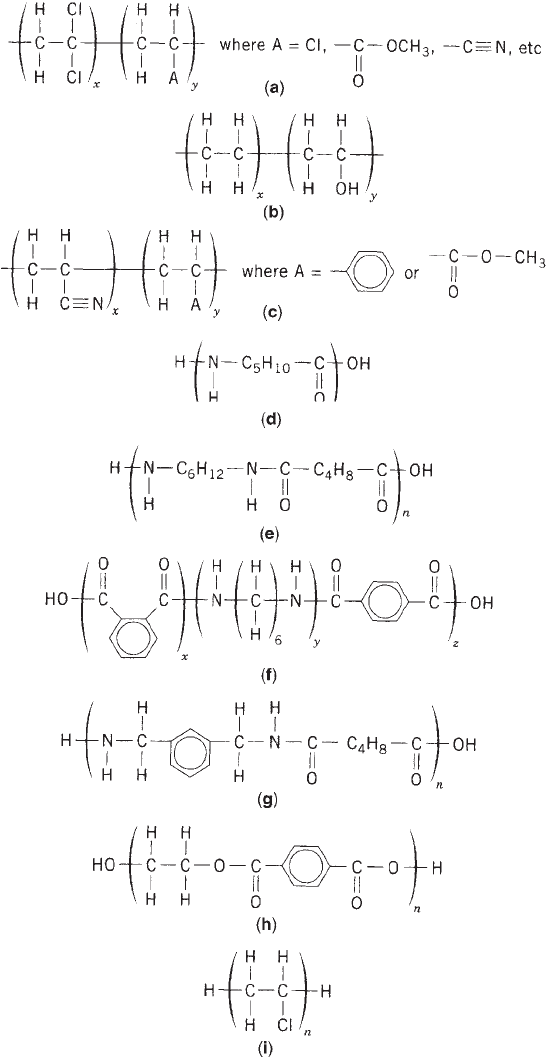
rather small set of polymers. Figure 2 contains schematic
chemical structures of polymers with low permeabilities to
permanent gases, especially oxygen.
Finding common traits among this diverse group is
difficult. However, each has some polarity which leads to
chain-to-chain interactions that give good packing in the
amorphous phase. Also, frequently, sufficient symmetry
exists to allow crystallinity to develop. Again, this can lead
to good packing in the amorphous phase.
AVAILABILITY
Barrier polymers are available as resins for extrusion,
resins for dissolution and coating, and latices for coating.
Each form has its own advantages and disadvantages.
Resins for extrusion can be made into monolayers or multi-
layers with thicknesses to give adequate barrier for de-
manding applications. However, extrusion can give a severe
thermal stress to the polymer which could lead to degrada-
tion. For semicrystalline polymers the extrusion tempera-
ture must exceed the melting temperature. When more
modest total barrier is needed, a coating may be adequate.
Typically, coatings more than 3 mm (0.1 mil) are difficult to
achieve. However, semicrystalline polymers can be used in
solvents well below the melting temperature. Hence, poly-
mers with marginal thermal stability may be used. Solvent
recovery and management must be considered. For latices,
the particles are too small to allow crystallinity to develop;
hence, semicrystalline polymers remain amorphous until
after coating and drying. Latices cannot be stored indefi-
nitely and must be used before coagulation occurs.
CONCLUSION
The choice of barrier polymer(s) for any given application
is determined by economics, performance requirements,
and the package format. A wide variety of barrier
Table 7. Effect of Orientation on Oxygen Permeability
for Certain Polymers
a
Polymer
Degree of
Orientation, %
Oxygen permeability,
b
nmol/m s GPa)
c
Polypropylene 0 300
300 160
Polystyrene 0 840
300 600
Polyester 0 20
500 10
Copolymer of 70%
acrylonitrile and
30% styrene
0 2.0
300 1.8
a
Reference (2).
b
At 231C.
c
See Table 1 for unit conversions.
108 BARRIER POLYMERS
polymers are available for use, and the number of material
options will continue to grow. In extreme cases, barrier
requirements can be met without the use of foil by
combining the correct barrier polymers, with technologies
such as gas flushing and active packaging scavengers.
BIBLIOGRAPHY
1. P. T. DeLassus, ‘‘Barrier Polymers’’ in J. I. Kroschwitz,
ed., Kirk–Othmer Encyclopedia of Chemical Technology,
4th edition Vol. 3, John Wiley & Sons, New York, 1992,
pp. 931–962.
2. M. Salame and S. Steingiser, Polymer-Plastics Technol. Eng.
8(2), 155–175 (1977).
3. J. Lange and Y.Wyser, Packag. Technol. Sci. 16, 149–158
(2003).
4. L. Massey, Permeability Properties of Plastics and Elastomers,
2nd edition, Plastics Design Library/William Andrew Publish-
ing, 2003.
5. M. Alexandre and P. Dubois, Mater. Sci. and Eng. 28, 1–63
(2000).
Figure 2. Chemical structures of barrier polymers. (a)
Vinylidene chloride copolymers; (b) hydrolyzed ethylene–
vinyl acetate (EVOH); (c) acrylonitrile barrier polymers;
(d) nylon-6; ( e) nylon-6,6; (f) amorphous nylon (Selar PA
3426), y = x + z;(g) nylon-MXD6; (h) poly(ethylene ter-
ephthalate); and (i) poly(vinyl chloride).
BARRIER POLYMERS 109
BIOBASED MATERIALS
LINSHU LIU
Eastern Regional Research
Center, Agricultural Research
Service, U.S. Department of
Agriculture, Wyndmoor,
Pennsylvania
JOSEPH KOST
Department of Chemical
Engineering, Ben-Gurion
University, Beer-Sheva, Israel
The prefix ‘‘bio-’’ means life in Greek. Biobased materials
indicate the substances obtained from living or dead
animals or plants. Biobased materials are a large group
of loosely related processing (or engineering) materials,
which are mainly derived from substances originally
existing in nature, such as in living tissues or organisms,
but may also be obtained by synthetic methods. Accord-
ingly, biobased materials include common commodities
such as leather and wood, as well as those that have
undergone more extensive processing such as pectin, oleic
acid and carboxymethyl cellulose. In literature, the term
‘‘biobased material’’ is often used synonymously with the
words biomass or biomaterial. The three words differ from
each other slightly in definition and mostly in habitual
uses. Biomass refers to animal or plant matter grown for
uses for production of chemicals and fibers, but does not
include their products after processing; and more com-
monly, biomass is frequently used in literature of energy
production, emphasizing its status in the carbon cycle as a
renewable fuel. The term ‘‘biomaterial’’ has an additional
meaning. As a result of its long use for biomedical applica-
tions, it refers to materials that can perform biological
functions and are biocompatible when in contact with
living tissues. The study of biobased materials is now a
large sector in material science and agrobusiness, as are
(a) the study of biomaterials in biomedical and pharma-
ceutical sciences and (b) the study of biomass in renewable
energy.
Based on their sources and production, biobased mate-
rials can be divided into three major categories (1, 2):
. Category 1 includes those removed (extraction, exud-
ing, isolation after milling, etc.) from biomass. Ex-
amples are (a) polysaccharides such as starch and
cellulose and (b) proteins such as collagen and casein.
. Category 2 includes polymers produced by a chemical
method using renewable biobased monomers. Exam-
ples are some polyesters such as poly(lactic acid),
which is produced from the polymerization of lactic
acid, a fermentation product of carbohydrate feed-
stock. Category 2 biobased materials also include
monomers or low-molecular-weight chemicals (so-
called ‘‘building blocks’’) obtained from biobased feed-
stocks by chemical or biochemical methods, such as
rosin, castor oil, and terpene.
. Category 3 includes materials produced by microor-
ganisms or genetically modified bacteria. Examples
are bacterial cellulose and polyhydroxyalkonoates
such as polyhydroxybutyrate.
Because of their overwhelming presence in the world and
the versatility of their chemistry and architecture, bio-
based materials are the sources of many industrial pro-
ducts, such as medicinal, chemicals, fibers, and paint, as
well as plastics, and so on. Although most of them can be
used for packaging purpose, the consumption of biobased
materials in the packaging industry is only about 1%; a
large portion of these products are currently produced
from petroleum-derived materials. The limitation of pet-
roleum resources and the awareness of environmental
protection have raised a new prospect that biobased
materials may be once again the major contributor to
the industries. Biobased materials are less dense than
metal, and some petroleum-derived thermal plastics, are
ideal components for many structural materials. Most
biobased polymers perform in a fashion similar to that of
conventional polymers. Unlike petroleum-derived materi-
als, most biobased materials are biodegradable. This
property enables the end-use products of biobased materi-
als to be disposed of upon completion of their useful life
without causing any environmental concerns. This is
attractive in the production and applications of packaging
materials and has become their main focus. The use of
biobased materials also addresses other economic issues:
the use of surplus stocks and the production of higher
value-added material from agricultural products and by-
products. Therefore, the use of biobased materials pro-
motes agrobusiness development.
Scientists and engineers are developing new technolo-
gies that will provide competitive cost for products from
biobased materials, meet the standards of various applica-
tions, and optimize their performance (3–9). Presently,
important research areas include: (I) Reproducibility
and quality of biobased materials. These not only depend
on the methods and processing conditions of separation,
purification and fabrication, but also dramatically rely on
the sources of raw materials, such as where grown, when
harvested, and how and how long they are stored. All
these variations make product quality control more com-
plicated and difficult. (II) In composites, water absorption
can be considered a disadvantage. Migration of water
through the polymer can lead to disturbance of the filler/
matrix interface, reducing the overall strength of the
composites. Most biopolymers are hydrophilic. It is a
challenge to improve the water resistance of biobased
materials in order to retain good mechanical properties
when the composites are exposed to highly humid condi-
tions. (III) The durability of biobased materials is related
to their biodegradability. The degradation of biobased
products should be controllable and their properties
should be constant during the time of their useful life.
(IV) Gas barrier properties have specific significance in
packaging materials. In particular, food packaging re-
quires specific atmospheric conditions to sustain food
freshness and overall quality during storage. Biobased
materials mimic quite well the oxygen permeability of a
wide range of the conventional petroleum-derived thermal
plastics. As many of the biobased materials are
110 BIOBASED MATERIALS
hydrophilic, their gas barrier properties are very depen-
dent on environmental humidity. (V) Thermal stability.
Most category 1 biobased materials are not stable at
higher temperature, limiting applications and choices of
processing methods. (VI) Safety. Biobased materials, par-
ticularly those come from biological processes, may sup-
port microorganism growth. Concerns have risen over the
spread of novel trails in existing populations and the
introduction of modified species.
CATEGORY 1 BIOBASED MATERIALS
There are a large amount of polysaccharides and proteins
that are directly isolated from agricultural or marine
plants and animals, and they can be used in packaging
applications. Examples of category 1 biobased materials
include starch, cellulose, pectin, alginate, collagen, soy-
bean flour protein, and zein. Most category 1 biobased
materials exhibit useful gas barrier properties; but they
are hydrophilic and unstable at higher temperature,
causing problems in processing.
Starch
Starch is a widely available raw material suitable for a
variety of applications, including packaging (10–12).
Starch is a storage polysaccharide found in the cytoplas-
mic granules of plant cells. Starch is a composite consist-
ing mainly of amylose and amylopectin, and it is primarily
derived from corn, wheat, potatoes, and rice. Due to its
huge availability and low cost in processing, starch is
economically competitive with petroleum-derived materi-
als and is therefore a promising candidate for preparing
compostable plastics. Starch is nontoxic, biologically ab-
sorbable, resistant to passage of oxygen, and semiperme-
able to carbon dioxide. On the other hand, starch granules
are rigid, and starch blends are brittle. Plasticizers,
such as glycerol, low-molecular-weight polyhydroxy com-
pounds, polyethers, or ureas, can be included in starch
blends to reduce the intermolecular hydrogen bonding and
thus increase the flexibility. Because of the hydrophilic
nature of starch, the performance of starch blends
changes during and after processing as a result of water
content changes with the changes in humidity. Side-chain
modification to obtain more hydrophobic starch deriva-
tives is a strategy to overcome this challenge.
Cellulose
Cellulose is the most abundant naturally occurring poly-
mer. Cellulose is a high-molecular-weight 1-4-beta-
linked polymer of
D-glucopyranose, which displays a
diverse range of conformations and crystalline packing
arrangements, as well as fiber structure. Because of its
regular linear structure and array of hydroxyl groups,
cellulose-based films tend to be tough and flexible and
resistant to fat and oil. Cellulose is hydrophilic; it swells,
but does not dissolve in water. To produce cellulose films,
an aggressive process is required that involves several
strong basic, strong acid and toxic solvents. Although, the
resultant films possess good mechanical properties, they
are hydrophilic and moisture-sensitive (1, 13).
Cellulose derivatives are used for film forming, coating,
and encapsulating applications. Cellulose derivatives,
such as ethyl cellulose, methyl cellulose, carboxy methyl
cellulose, hydroxyethyl or hydroxypropyl cellulose, and
cellulose acetate, are commercially available. Cellulose
acetate possesses relatively low gas and moisture barrier
properties (1, 10, 14–16).
Pectin
Pectin is a cell wall polysaccharide. The majority of
the pectin structure consists of homopolymeric partially
methylated poly a-(1-4)-
D-galacturonic acid residues
(‘‘smooth’’ regions), but there are substantial ‘‘hairy’’
regions of alternating a-(1-2)-
L-rhamnosyl-a-(1-4)-D-
galacturonosyl sections containing branch-points with
mostly neutral side chains (1–20 residues) of mainly
L-
arabinose and
D-galactose (rhamnogalacturonan I). Pec-
tins may also contain rhamnogalacturonan II with
side chains containing other residues such as
D-xylose, L-
fucose,
D-glucuronic acid, D-apiose, 3-deoxy- D-manno -2-
octulosonic acid, and 3-deoxy-
D-lyxo-2-heptulosonic acid
attached to poly a-(1-4)-
D-galacturonic acid regions. The
types and amounts of substructural entities in pectin
preparations depend on their source and extraction meth-
odology. Commercial pectin is mainly derived from citrus
peels and apple pomace. It can also come from sugar beet
pulp and sunflower heads. Commercial extraction causes
extensive degradation of the neutral sugar-containing
side chains. The pectin molecule does not adopt a straight
conformation in solution, but is extended and curved
with a large amount of flexibility. The carboxylate groups
tend to expand the structure of pectin. Methylation of
these carboxylic acid groups forms their methyl esters,
which are much more hydrophobic and have a different
effect on the structure of surrounding water. Thus, the
properties of pectin depend on the degree of esterification
(D.E.). High D.E. pectin (W40% esterified) tends to gel
through the formation of hydrogen-bonding and hydro-
phobic interactions at low solution pH (pH B3.0) to reduce
electrostatic repulsions, or in the presence of sugars
(W70% esterified). Low D.E. pectin (o40% esterified)
gels by calcium divalent cations that bridge adjacent
twofold helical chains to form the so-called ‘‘egg-box’’
junction zone structures so long as a minimum of 14–20
residues can cooperate (17).
In addition to its gelling properties, pectin is a well-
established film-forming material. In isolated form, pectin
readily reassociates or aggregates to form networks, and it
interacts with proteins, other polysaccharides, and syn-
thetic hydrocolloids via hydrogen bonding, ionic, or hydro-
phobic interactions. This character has led to applications
of pectin in encapsulation, coating, packaging, and wrap-
ping for food and pharmaceutical products (18–20).
Alginate
Alginates are mainly derived from seaweed. The alginic acid
family of linear 1-4-linked glycuronans are copolymers
composed of beta-
D-mannopyranuronic acid (M) residues
BIOBASED MATERIALS 111
and alpha-L-gulupyranuronic acid residues (G) that are
arranged in homopolymeric blocks (GG and MM) and
heteropolymeric (GM) sequences in varying proportions
and distribution patterns. Alginates possess good film-form-
ing properties that make them particularly useful in food
packaging applications . Divalent cations, such as calcium,
magnesium, manganese, and aluminum, are used as gelling
reagents in alginate film formation. Calcium ion appears
to be more effective in gelling alginate than other divalent
ions; calcium propionate provides acceptable flavor. Desir-
able properties of alginate films include the improved
product texture, juiciness, color, odor, and appearance, along
with moisture retention and shrinkage reduction. Sodium
alginate is water soluble. Sodium alginate coatings are used
to extend the shelf life of foods and fruits (21, 22).
Chitin and Chitosan
In its structure, chitin is a cellulose analogue and is
comprised of 1-4-beta-linked
N-acetyl-D-glucosamine
units. Chitin is the second most abundant glycan after
cellulose, being present in the exoskelton of invertebrates.
Chitin occurs in several crystalline polymorphic forms, of
which the alpha-chitin is the most common. Like cellulose,
chitin chains adopt a 2
1
screw axis. All of the hydroxyl
groups are hydrogen bonded, and the bonding between
sheets accounts for the fact that chitin does not swell in
water. The fully or partially N-deacetylated derivative of
chitin, chitosan, has received considerable attention. Some
desirable properties of chitosan include its film forming
properties, its antimicrobial activity, and the ability to
absorb heavy metal ions. Chitosan films exhibit good
oxygen and carbon dioxide permeability, as well as good
mechanical properties. Chitosan films and coatings show
activity against bacterial yeasts and molds, and they inhibit
the growth of a number of microorganisms. The cationic
nature of chitosan allows for electronic interactions with
anionic compounds during processing and can lead to the
incorporation of specific properties into products (23–25).
Collagen and Gelatin
Collagen is a major structural protein in vertebrates. Most
of the ectodermal and mesodermal tissues are composed of
collagen. In this sense, collagen is similar to cellulose and
pectin, which serve a somewhat analogues role in plants.
Collagen has triple helix architecture, thus collagen is
insoluble and difficult to process. Commercially available
collagens are extracted from animal skin, bone, and
tendons. By taking advantages of biotechnology and ge-
netic engineering, collagen can be obtained not only from
animal tissues but also from bacterial cultures and even
from genetically modified plants. Collagen films have
strong mechanical properties and have been proposed for
use in food packaging. Edible collagen films can become an
integral part of meat products, and thus they function to
reduce shrink loss and to increase juiciness and smoke
permeability to the meat products (26–28).
Gelatin is a substantially pure product obtained
by either partial acid or alkaline hydrolysis of collagen.
The denaturation treatments disrupt the tight, helical
structure of collagen and release water-soluble fragments
that can form stiff gels and films. Gelatin is a highly
processable material and is moisture-sensitive. Gelatin
gels or films show thermally reversible behavior and melt
below body temperature. Gelatin films and coatings have
been used to carry flavors or antioxidants in food packa-
ging applications (29, 30).
Soybean Flour Protein
Soy proteins are commercially available as soy flour (50%
protein), soy concentrate (70% protein), and soy isolate
(90% protein). Flours are made by grinding and sieving
flakes. Concentrates are prepared by extracting and re-
moving the soluble sugars from defatted flakes, by leach-
ing with diluted acid at pH 4.5, or by leaching with
aqueous ethanol. Isolate soy proteins are obtained by
extracting the soluble proteins with water at pH 8–9,
precipitating at pH 4.5, followed by centrifugation and
drying. Soy proteins consist of two major protein fractions,
7S (conglycinin, 35%) and 11S (glycinin, 52%). Both frac-
tions are considered as storage proteins and contain
cysteine residues leading to disulfide bridge formation.
Soy proteins are adhesive- and moisture-sensitive. Soy
protein coatings can reduce moisture loss and control lipid
oxidation in coated samples. Soy proteins are also used as
binders for aqueous inks and as pigmented coatings on
paperboard. Furthermore, soy flour proteins are proposed
for the use in food coating, encapsulation, and active
packaging (18, 19, 31, 32).
Zein
Zein is a class of alcohol-soluble prolamine proteins, ob-
tained from corn gluten meal. Pure zein forms a hard,
edible, clear, odorless , tasteless , and water-insoluble mate-
rial, making it invaluable in processed foods and pharma-
ceuticals. Zein is now used as a coating for candy, nuts, fruit,
pills, and other encapsulated foods and drugs. Zein can be
further processed into resins and other bioplastic polymers
by extrusion or rolling into a variety of plastic products .
Zein-based films can function as water barriers and, thus,
have potential use for packaging materials (33, 34).
Casein and Whey
Casein and whey are milk-derived proteins. Both have
high nutritional values, excellent mechanical, and emul-
sion and barrier properties, and they are available in large
volume worldwide. They have been used in the manufac-
ture of edible films. Due to its random coil structure,
casein is easily processable. By controlling the types of
plasticizers, casein films can be made with very different
mechanical properties varying from stiff and brittle to
flexible and tough materials. Casein and whey films can
reduce moisture loss, delay lipid oxidation, and reduce
peroxide value of packaged food products (35–37).
CATEGORY 2 BIOBASED MATERIALS
The use of classical chemical methods to produce poly-
mers, monomers, and other chemical ‘‘building block’’
112 BIOBASED MATERIALS
materials from biobased feed stocks have generated a wide
spectrum of category 2 products. Theoretically, all the
conventional packaging materials currently derived from
petroleum can be produced from monomers obtained from
biobased materials; however, due to their high cost, the
production of those monomers is not economically feasible.
Thus, these costs have been an obstacle on the road to
broadening the application of biobased monomers. An
exception may be poly(lactic acid) (PLA) production. As a
result of the increase in both the efficiency of lactic acid
fermentation and the market price of raw oil, the cost of
making poly(lactic acid) from biobased materials is gra-
dually approaching the price of PLA obtained from fossil
fuel.
Poly(Lactic acid)
Poly(lactic acid) or polylactide (PLA) is a thermoplastic,
aliphatic polyester derived from fermentation of agricul-
tural products and byproducts such as corn starch and
other starch-rich substances like maize, sugar, or wheat.
Bacterial fermentation is used to produce lactic acid,
which is oligomerized and then catalytically dimerized
for ring-opening polymerization. It can be easily produced
in a high-molecular-weight form, most commonly using a
stannous octoate catalyst. The properties of PLA strongly
depend on the ratio of the two mesoforms (
L and D) of the
lactic acid monomer. Poly
L-lactide (PLLA) is the product
resulting from polymerization of
L-lactide. PLLA has
crystallinity around 37%, a glass transition temperature
(T
g
) of 50–801 C, and a melting temperature (T
m
) of 173–
1781 C. If a mixture of
D- and L-PLA is used, a polymer
with adjustable T
m
and T
g
, PDLLA, can be obtained. The
physical blends of PDLA and PLLA are useful for produ-
cing loose-fill packaging, compost bags, microwavable
trays, food packaging and disposable tableware. PLA can
also be plasticized by blending it with its monomer or
oligomer. The resultant blends possess lower T
m
and T
g
.
PLA resembles conventional petrochemical-based plastics
in its characteristics and has good water vapor barrier
properties and relatively low gas transmittance. PLA can
be processed into fibers, blown films, injected molded
objects, and coatings on standard equipment that already
exist for the production of conventional thermoplastics. To
date, PLA has shown the highest potential for a commer-
cial major-scale production of biobased packaging materi-
als (38–41).
Monomers and Chemical ‘‘Building Blocks’’
A number of monomers and chemical ‘‘building blocks,’’
low-molecular-weight organic compounds or chemical pre-
cursors for preparing polymeric materials, can be obtained
from biobased materials (1, 2, 42, 43). Examples include
castor oil, oleic acid, molasses, furfural, multifunctional
alcohols, multifunctional acids, and terpenes.
Castor oil is used for the preparation of polyurethane.
The resultant polyurethane is water-resistant and widely
used in the electronics industry. Unsaturated fatty acids
and oils, such as oleic acid, linoleic acid, and ricinoleic
acid, can be recovered from seed crops, castor beans,
coconut, flax, and other agricultural origins and have
found applications in water-proof coatings and multi-
layered packaging materials. Furthermore, oleic acid can
be chemically transformed to multi-functional alcohols
and acids, amines and esters. The resultant azelaic acid
and azelaic diacid are used in polyamide synthesis.
Furfural can be produced from woody biomass and
molasses. Furfural can be transformed to furfuryl alcohol
and to furan resin and a wide range of furan chemicals.
Levulinic acid also can be produced from woody materials.
Levulinic acid is a precursor for the synthesis of various
lactones, furans, and other functional building blocks,
which are used in the production of packaging materials.
Succinic acid and 1,3-propanediol are two examples of
chemicals, which are prepared by fermentation of carbo-
hydrate-rich materials using selected microorganisms.
Succinic acid and 1,3-propanediol can be used to make
polyesters, which, in turn, are used for preparation of
packaging materials. Terpene chemicals are isolated from
pine trees and have resulted in a number of terpene-based
products, which are used to prepare resin materials, or as
fragrances incorporated into resin materials for active
packaging (1, 42).
At present, biobased monomers and ‘‘building blocks’’
may not be commercially attractive. However, with the
progress in biotechnology and genetic engineering, these
represent promising alternatives to petroleum-derived
materials.
CATEGORY 3 BIOBASED MATERIALS
This group includes polymers produced directly from
biomass by natural or modified organisms.
Bacterial Cellulose
Cellulose is an important starting material in many
industries. Plants are the main source of cellulose. A
harsh chemical treatment is required to isolate plant
cellulose from lignin, hemicellulose, and pectins. The
treatment severely impairs the chemical and physical
characteristics of plain cellulose, such as molecular depo-
lymerization and changes in crystal structure. Bacterial
strains of Acetobacter xylinum and A. pasteurianus are
able to produce pure cellulose that originally formed in
plants (homo-beta-1,4-glucan) under ambient conditions.
Bacterial cellulose is highly crystalline (70% in cellulose I
form) and has a molecular weight 15 times higher than
that isolated from wood pulp. Although the bacterial
cellulose shows outstanding mechanical properties, the
production cost of bacterial cellulose is high and hampers
its application in current packaging industries (44, 45).
Poly(hydroxyalkanoates)
Poly(hydroxyalkanoates) (PHAs) are a family of polyesters
that are produced by a large number of bacteria, in the
form of intracellular particles, functioning as energy and
carbon reserve. The properties of PHAs are dependent on
their monomer composition. The specific monomer compo-
sition of PHAs depends on the nature of carbon sources
used and the bacterial strains selected, providing a tool to
BIOBASED MATERIALS 113
control the properties of the resultant final products.
PHAs of medium-chain length are elastomers with low
melting point and low crystallinity. Poly(hydroxybutyrate)
(PHB) is an important member of PHAs. PHB is a highly
crystalline thermoplastic. PHB mimics the mechanical
behavior of poly(isopropylene). The incorporation of hy-
droxyvalerate can remarkably change the mechanical
properties of PHB, such as a decrease in stiffness and
tensile strength and an increase in toughness. PHAs
possess a low water vapor permeability, which is close to
LDPE. The functional groups in the side chains of PHAs
make it possible to chemically modify the polymers. PHA
also can be produced from genetically modified crops, such
as switchgrass. All these provide an enormous potential of
the polymer for packaging applications (46, 47). A com-
mercially available PHA product, Mirel
TM
, can be ob-
tained from Metabolix (Cambridge, MA, USA).
BIBLIOGRAPHY
1. Report. Biobased Packaging Materials for the Food Industry.
C. J. Weber, FAIR-CT98-4046, 2000, pp. 13–44.
2. C. J. Weber, V. Haggard, R. Festersen, and G. Bertelsen, Food
Additives Contam. 19, 172–177 (2002).
3. J. L. Peter, J. Sci. Food Agric. 86, 1741–1742 (2006).
4. R. Montgomery, Bioresource Technol. 91, 1–29 (2004).
5. A. Bismarck, A. Baltazar-Y-Jimenez, and K. Sarikakis, En-
viron. Dev. Sustainability 8, 445–463 (2006).
6. Panel Report, Portfolio1.3: Food and Non-Food Products,
Cooperative State Research, Education, and Extension Ser-
vice, Office of the Administrator, U.S. Department of Agricul-
ture. 2004, pp. 43–47.
7. Panel Report, Industrial Bioproducts: Today and Tomorrow,
Office of Energy Efficiency and Renewable Energy, Office of
the Biomass Program, U.S. Department of Energy. 2003, pp.
1–12.
8. K. van de Velde and P. Kiekens, Polym. Testing 21 , 433–442
(2002).
9. P. A. Fowler, J. M. Hughes, and R. Elias, J. Sci. Food Agric. 86,
1781–1789 (2006).
10. C. N. Cutter, Meat Science 74, 131–142 (2006).
11. C. N. Cutter and S. S. Summer, in A. Gennadios, ed., Protein-
Based Films and Coatings, CRC Press, Boca Raton, FL, 2002,
pp. 467–484.
12. M. Cannarsi, A. Baiano, R. Marino, M. Sinigaglia, and M. A.
Del Nobile, Meat Sci. 70, 259–265 (2005).
13. H. J. Cumba and D. Bellmer, ASAE Annual International
Meeting. Tampa, FL, 2005, Paper number: 057032. http://
asae.frymulti.com/request.asp?JID=5&AID=19659&-
CID=tfl2005&T=2.
14. J. M. Hackney, Int. J. Biol. Macromol. 16(4), 215–218 (1994).
15. N. E. Kotelnikova and E. F. Panarin, Cellulose Chem. Technol.
39(5–6), 437–456 (2005).
16. Ø. Ellefsen and N. Norman, J. Polym. Sci. 58(166), 769–779
(2003).
17. H. A. Schols and A. G. J. Voragen, in J. Visser and A. G. J.
Vorangen, eds., Pectin and Pectinase, Elsevier Science, Am-
sterdam, Holland, 1996, pp. 3–19.
18. L. S. Liu, C. -K. Liu, M. L. Fishman, and K. B. Hicks, J. Agric.
Food Chem. 55, 2349–2355 (2007).
19. L. S. Liu, M. L. Fishman, K. B. Hicks, D. R. Coffin, and
M. Tunick, in M. L. Fishman, P. X. Qi, and L. Wicker, eds.,
Advances in Biopolymers: Molecules, Clusters, Networks, and
Interactions, ACS series #935, ACS Press, Washington, DC,
2006, pp. 272–284.
20. M. L. Fishman, D. R. Coffin, J. J. Unruh, and T. Ly,
J. Macromol. Sci. A33(5), 639–654 (1996).
21. J. C. N. Shackelford, G. W. Hanlon, and J.-Y. Maillard,
J. Antimicrob. Chemother. 57(2), 335–338 (2006).
22. S. K. Williams, J. L. Oblinger, and R. L. West, J. Food Sci.
43(2),
292–296 (1978).
23. P
. C. Srinivasa, M. N. Ramesh, K. R. Kumar and R. N.
Tharanathan, J. Food Eng. 63(1), 79–85 (2004).
24. O. B. G. Assis and J. H. Hotchkiss, Packaging Technol. Sci.
20(4), 293–297 (2007).
25. N. E. Suyatma, A. Copinet, L. Tighzert, and V. Coma, J.
Polym. Environ. 12, 1–6 (2004).
26. H. Dinklage, H. Fink, and H-P. Wolf, U.S. Patent 4,525,418
(1985).
27. A. R. Schoenberg, U.S. Patent 5,083,665 (1992).
28. R. Villegas, T. P. O’Connor, J. P. Kerry, and D. J. Buckley, Int.
J. Food Sci. Technol. 34, 385–389 (1999).
29. C. N. Cutter and B. J. Miller, J. Associ. Food Drug Officials
68(4), 64–77 (2004).
30. A. Gennadios, Protein-Based Films and Coatings, CRC Press,
Boca Raton, FL, 2002.
31. Q. Wu and L. Zhang, Ind. Eng. Chem. Res. 40(8), 1879–1883
(2001).
32. H. Park, S. H. Kim, S. T. Lim, D. H. Shin, S. Y. Choi, and K. T.
Hwang, JAOCS 77(3), 269–273 (2006).
33. A. M. Rakotonirainy, Q. Wang, and Q. W. Padua, J. Food Sci.
66(8), 1108–1111 (2001).
34. D. Sessa, A. Mohamed, J. Byars, S. Hamaker, and G. Selling,
J. Appl. Polym. Sci. 105, 2877–2883 (2007).
35. J. H. Han, in A. Gennadios, ed., Protein-Based Films and
Coatings, CRC Press, Boca Raton, FL, 2002, pp. 485–500.
36. A. A. Khwaldia, C. Perez, S. Banon, S. Desobry, and J. Hardy,
Criti. Rev. Food Sci. Nutr. 44, 239–251 (2004).
37. B. Cuq, N. Goutard, J-L. Cuq, and S. Guilbert, Nahrung 42,
260–263 (1998).
38. P. Gruber and M. O’Brien, ‘‘Polylactides NatureWorkst PLA’’
in A. Steinbu
¨
chel, ed., Biopolymers, Vol. 4. Toronto, Wiley-
VCH, 2003, pp. 235–252.
39. K. Krishnamurthy, A. Demirci, V. Puri, and C. N. Cutter,
Transa. Am. Soc. Agric. Eng. 47, 1141–1149 (2004).
40. L. S. Liu, V. L. Finkenstadt, C.-K. Liu, T. Jin, M. L. Fishman,
and K. B. Hicks, J. Appl. Polym. Sci. 106(2), 801–810 (2007).
41. D. V. Plackett, V. K. Holm, P. Johansen, S. Ndoni, P. V.
Nielsen, T. Sipilainen-Malm, A. So
¨
derga
˚
rd, and S. Verstichel,
Packaging Technol. Sci. 19(1), 1–24 (2006).
42. Panel Report, Alternative Feedstocks Program, Technical and
Economic Assessment: Thermal/Chemical and Bioprocessing
Components. Office of Industrial Technologies, the U.S. De-
partment of Energy. 1993.
43. Panel Report, Industrial Uses of Agricultural Materials:
Situation and Outlook Report. Economic Research Service,
the U.S. Department of Agriculture. 2004.
44. T. Tsuchida and F. Yoshinaga, Pure Appl. Chem. 69(11), 2453–
2458 (1997).
114 BIOBASED
MATERIALS
45. M. Popa and N. Belc, in A. Mcelhatton and R. J. Marshall,
eds., Food Safety: A Practical and Case Study Approach,
Springer, 2007, pp. 68–87.
46. G. M. Bohlmann, ‘‘Polyhydroxyalkanoate Production in
Crops’’ in J. J. Bozell and M. K. Patel, eds., Feedstocks for
the Future: Renewables for the Production of Chemicals and
Materials, ACS Symposium Series number No. 921, ACS
Press, Washington DC, (2006), 253–270.
47. C. Kuckertz, S. Jacobsen, and R. Brandt, EP Patent 1,334,160
(2003).
BIOFILM DEVELOPMENT ON PACKAGING
MATERIALS
PAUL TAKHISTOV
Department of Food Science,
Rutgers University, New
Brunswick, New Jersey
INTRODUCTION
The term ‘‘microbial biofilm’’ or ‘‘biofilm’’ refers to the
complex aggregation of microorganisms growing on a solid
substrate such as a packaging material, not a film that is
made of biopolymer. This article provides an introductory
understanding of biofilm and its formation. Since a major
function of packaging is to protect the product from
microbial contamination and its associated heath risks,
an understanding of biofilm is important, particularly for
products which require aseptic packaging and retortable
packaging.
Bacteria on the surface develop a biofilm-associated
community with higher resistance to toxic compounds
(1, 2) than their planktonic counterparts in the bulk. In
general, biofilms result from physicochemical conditions
and interactions in the bacteria/environment complex
(3, 4). A biofilm consists of a living microbial biomass
surrounded by an exopolysaccharide envelope (EPS), pro-
teins, and nucleic acids, which the biofilm microorganisms
produce. These components help bacteria to attach to
surfaces, stabilize local environment, and spatially orga-
nize communities that need to collaborate to use the
substrate effectively (5). The process of the microorgan-
ism’s attachment to a surface is very complex, and the
nature of both the microbial cell surface and the support-
ing surface (substratum) is critical for successful attach-
ment (6). Surface adherence is an important survival
mechanism for microorganisms. Moreover, the adhesion
kinetics is the unique characteristic of a specific micro-
organism, differing even among phenotypes and strains
(7). Several major factors affect attachment and conse-
quently biofilm formation: the nature of the cell surface,
the chemistry and texture of the attachment surface, the
nature of the surrounding medium, and the temporal and
spatial distribution of available nutrients (8–10).
A biofilm can be defined as a layer of microorgan-
isms immobilized at a substratum held together in a
multi-nature matrix polymer matrix (11). This matrix
consists mainly of water (97%), microbial cells (2–5%),
polysaccharides (neutral and polyanionic) (1–2%), proteins
[including enzymes (1–2%)], and DNA and RNA from lysed
cells (1–2%) (12). Usually, a mix consortium of microbes
makes up this ecosystem, and they ‘‘team up’’ in order to
protect themselves from stress and maximize nutrient
uptake. One of the main components of a biofilm is the
exopolysaccharide (EPS), which often consists of one or
more family of different polysaccharides produced by at
least some of the biofilm microorganisms. These compo-
nents aid the attachment of cells to surfaces, stabilizing the
local environment and spatial organization of the microbial
communities, which may need to cooperate with each other
to effectively use the available substrate (5).
BIOFILM ARCHITECTURE
A biofilm is a multiphase system. It consists of the biofilm
itself, the overlying gas and/or liquid layer, and the
substratum on which it (the biofilm) is immobilized. This
system can be classified in terms of phases and compart-
ments. The phases consist of the solid, liquid, and gas
components, whereas the compartments consist of the
substratum, the base film, the surface film, the bulk liquid
and the gas. Biofilms are heterogeneous by nature, how-
ever, having stacks of cells scattered in a glycocalyx net-
work with fluid-filled channels (13). Structurally, a biofilm
is approximately two-dimensional, with its thickness ran-
ging from a few micrometers to millimeters (5). This
structure allows for the diffusion of nutrients and meta-
bolic substances within the matrix.
Biofilm Organization. The microbes in a biofilm are
typically organized into microcolonies embedded in the
EPS polymer matrix (5). These microcolonies attain dis-
tinct 2-D or 3-D structural patterns. Initially, microcolo-
nies are separated by void spaces, but ultimately they
merge into unique structures forming a mature biofilm.
This spatial organization is very important to the biologi-
cal activity of the biofilm.
Extrapolysaccharide (EPS). EPS may vary in chemical
and physical properties, but it is primarily composed of
polysaccharides (11). Some of these polysaccharides can be
neutral or polyanionic. Generally, this polymer can accom-
modate considerable amount of water into its structure by
hydrogen bonding. Overall, the EPS has an important role
of holding the biofilm together (14). As the EPS layer
thickens, the biofilm microenvironment changes due to
the activities of the bacteria. Therefore, a mature biofilm
is a heterogeneous matrix. This heterogeneity concept is
descriptive for both mixed and pure culture biofilms com-
mon on abiotic surfaces, including medical devices (15).
Quorum Sensing. Quorum-sensing gene expression has
been proposed as an essential component of biofilm phy-
siology, since biofilm typically contains high concentration
of cells (16). Generally, the irreversible attachment of
bacteria to a substratum triggers alteration to an array
BIOFILM DEVELOPMENT ON PACKAGING MATERIALS 115
of gene expression and phenotypes of these cells (17). In
the quorum-sensing process, cell–cell communication is
accomplished through the exchange of extracellular sig-
naling molecules (16). For most gram-negative bacteria,
the quorum-sensing regulation involves a freely diffusible
auto-inducer, acylhomoserine lactone (AHL) signaling
molecule. For instance, the quorum-sensing ability in P.
aeruginosa is dependent upon two distinct but interre-
lated systems, las and rhl (18), which directs formation of
the AHL. In gram-positive bacteria, structurally diverse
peptides act as quorum sensing regulators (19). The QS
system is not necessarily involved in the initial attach-
ment and growth stages of biofilm formation but is very
important in the overall biofilm differentiation process
(20). During biofilm formation, QS signaling molecule
mutants may develop thicker, more acid-resistant (21) or
‘‘abnormal’’ biofilms (22) than do the wild-type strains.
BIOFILM LIFE CYCLE
Once immobilized on a contact surface, microorganisms
have the potential to form a biofilm. Attachment to the
surface is beneficial to the microbe for a number of
reasons. First, the surface represents important microbial
habitats because in the microenvironment of a surface,
nutrient levels may be much higher than they are in the
bulk solution (23). Second, it increases the microbes’
resistance to mechanical and chemical stresses. Overall,
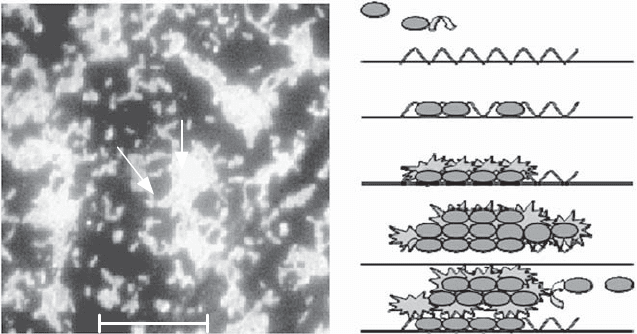
biofilm formation is a dynamic process, comprised of four
main stages (24): migration of cells to the substratum,
adsorption of the cells to the substratum, growth and
metabolic processes within the biofilm, and detachment
of portions of the biofilm (see Figure 1). These steps can be
divided into three phases: initial events, exponential
accumulation and steady state.
Surface Conditioning Film Formation. The conditioning
film is created when organic materials (polysaccharides
and proteins) settle on the surface (11). It can be derived
from the microbes in the vessel or from the bulk fluid.
Adsorption of a conditioning film is relatively quick com-
pared to the other steps. This film has the potential to
alter the physicochemical properties of the substratum
and thus greatly impacts bacterial attachment.
Cell Migration to the Surface. Migration of microorgan-
ism to the substratum is considered the second step in
biofilm formation. This process can be mediated by differ-
ent mechanisms depending on the system under consid-
eration. Thus, transport can be (a) active, facilitated by
flagella (25), or (b) passive, facilitated by Brownian diffu-
sion, convection, or sedimentation. In quiescent systems
(batch culture), sedimentation rates for bacteria are gen-
erally low due to their size and specific gravity (11), and
microbes with a diameter of 1–4 mm
3
have small Brownian
diffusivity. Therefore, motility may be the limiting factor
of transport in such systems. In a laminar flow system,
although motility affects transport, diffusion remains the
controlling factor. In a turbulent flow system, Brownian
diffusion has minute contributions to transport, but forces
such as frictional drag force, eddy diffusion, lift force, and
turbulent bursts are significant.
Factors that Impact Interactions of Bacteria with a Substrate
Microbial adhesion is mediated by specific interactions
between cell surface structures and specific molecular
groups on the substratum. Moreover, the adhesion process
is determined by physicochemical and molecular interac-
tions. It is believed that primary adhesion between bac-
teria and abiotic surfaces is generally determined by
nonspecific (e.g., hydrophobic) interactions, whereas ad-
hesion to living or devitalized tissue is accomplished
through specific molecular (lectin, ligand, or a adhesion)
mechanisms (26).
Physicochemical Interactions. Generally, two types of
physicochemical interactions are used to describe the
adhesion of a microorganism to a planar surface. The
DLVO approach relates to the interaction energies (attrac-
tion and repulsion)—primarily to electrostatic and van der
Waals forces—but chemical forces can operate (27). Typi-
cally, attraction between microbe and surface occurs
either at a long range (5–8 nm), a secondary minimum,
or at a shorter range, the primary minimum. Thus,
adhesion can be reversible (at the secondary minimum)
20μm
EPS
Cells
I.
II.
III.
IV.
V.
Figure 1. Listeria biofilm on the packa-
ging surface and schematic representation
of biofilm formation. Step I: Conditioning
film formation. Step II: Bacteria migration
to the conditioned surface. Step III: The
cells start to produce extracellular polysac-
charides (EPS), which cause an irreversible
attachment. Step IV: Gradually, the biofilm
increases through growth of the irreversibly
attached cells and new ones from the solu-
tion. Step V: Cells near the outer surface
can dislodge from the biofilm and escape to
colonize new microenvironments.
116 BIOFILM DEVELOPMENT ON PACKAGING MATERIALS
or irreversible (toward the primary minimum) (11). In the
DLVO approach, the ionic charge of the medium, the
physicochemistry of both the bacteria and substratum
surface, and the physicochemistry of biosurfactant deter-
mine the extent of adhesion.
Alternatively, in the thermodynamic approach, adhe-
sion is described as the formation of a new interface
between the substratum surface and adhering bacteria
at the expense of (a) the interfaces between bacteria and
the suspending liquid and (b) the substratum–liquid inter-
face (5). Each interface contains a specific amount of
interfacial energy (or surface tension). The extent of
adhesion is determined by the surface properties of all
three phases, the surface tension of adhering particles, of
the substratum and of the medium (28). The more hydro-
philic a substrate, the higher is its surface tension.
Molecular Interactions. Bacterial adherence is also
mediated by molecular mechanisms. Bacteria are able to
adhere to animal cells (29), such as muscle meats through
protein–protein interactions on the surface. These pro-
teins sometimes function as ligands to receptors when the
bacteria invade target cells and/or have specific affinity for
host components (30). The colony-opacity-associated (Opa)
outer-membrane proteins or ligands (often called an a
adhesion) confer intimate bacterial association with mam-
malian cells. Two classes of cellular receptors for Opa
protein receptors have been identified: a adhesio-sulfate
proteoglycan (HSPG) receptors and members of the carci-
noembryonic antigen (CEA) or CD66 family (31). Listeria
monocytogenes surface proteins Internalin A (InlA) and B
(InlB) are involved in the attachment of this bacterium to
host cells (32).
The magnitude of the cell substratum interaction
forces, the chemical heterogeneity and the roughness of
the substratum surface greatly affect the extent of micro-
bial adhesion. As food traverses from the farm to the table,
it comes in contact with fabricating equipments, utensils,
gaskets, conveyor belts, packaging materials, storage con-
tainers, and chopping boards. These surfaces are usually
metallic, plastic, rubber, or wood. Food processing equip-
ments are often made of stainless steel, transport crates of
high-density polyethylene (HPDE), conveyor belts of rub-
ber, chopping boards of wood, and packaging materials of
aluminum. Other storage and packaging-type materials
include polypropylene, PVC, and Teflon. Sometimes the
contact time between foods and surface may be 24–48
hours depending on the processing conditions including
design of equipment cleaning and sanitation techniques.
Substratum Surface Hydrophobicity. The hydrophobicity
of the substratum has substantial effect on bacterial
adhesion. Typically, hydrophilic surfaces such as stainless
steel and glass have a high free surface energy and thus
allow greater bacteria attachment than do hydrophobic
surfaces such as Teflon (25). For instance, a general trend
of decreasing colonization density was observed for Sta-
phylococcus epidermis and Pseudomonas aeruginosa with
an increase in substratum hydrophobicity (33). In the
above-mentioned study, the packaging materials used
were stainless steel, poly(vinyl chloride), polystyrene,
and glass. Likewise, biofilm formation by L. monocyto-
genes LO28 was faster on hydrophilic (stainless steel)
than on hydrophobic polytetrafluoroethylene (PTFE) (34).
Substratum-Surface Roughness/Topography. Many re-
ports have indicated that metal surfaces with a high
degree of roughness serve as a better substrate for bacter-
ial attachment than do smooth ones, since the surface
area of the former is greater (33, 35). Arnold and others
discovered that resistance to bacteria attachment de-
creased in the following order: Electropolished > Sanded >
Blasted > Untreated Stainless Steel. Bower and Daeschel
(1) illustrated that surface topography is extremely im-
portant in biofilm formation and resistance. Still studies
such as that of Barnes et al. (36) claimed that the
difference in bacteria attachment due to difference in
surface topography is minimal.
Substratum Coverage with Organic Material. The layer of
organic substances present on the surface can be favorable
or unfavorable to bacteria adhesion. Barnes et al. (36)
discovered that proteins that adsorbed to a stainless steel
surface inhibited bacterial attachment. The dominating
mechanism was suspected to be competitive inhibition,
since the proteins were able to interact with the hydro-
philic surface. The adhesion process begins, provided that
the conditioning film is favorable to bacterial attachment.
Bulk Nutrient Composition. Generally, bulk fluid condi-
tions influence surface hydrophobicity, adhesion expres-
sions, and other factors that affect adhesiveness (37).
Microbes are usually exposed to a range of nutrients
concentrations from as low as 1 mg/L to 500 g/L, and this
range has an effect on biofilm growth (5). At the highest
nutrient
concentrations, biofilms
can appear to be uniform
with few or no pores. This is common of biofilms associated
with animal and food surfaces. Various reports suggest
that the lower the concentration of nutrients, the greater
the rate of attachment and biofilm development (38–40).
Escherichia coli O157:H7 biofilms developed in minimal
salts medium (MSM) developed faster and had thicker
extracellular matrix, and cells detached much slower
compared to those grown in trypticase soy broth (TSB)
(38).
Temperature. Temperature effect is particularly impor-
tant in the food industry, since food will experience
differentials in temperature (temperature abuse) from
farm to fork. This abuse is a consequence of changes in
cell wall and attachment factors (41). Stopforth et al. (42)
showed that a greater number of Listeria monocytogenes
cells adhered to stainless steel templates at 59 1F and
77 1F compared to 41 1F and 95 1F. Moreover, Stepanovic
et al. (43) suggested that a microaerophilic environment
supports biofilm formation. Presently, there are few con-
clusive reports that support this claim.
Ionic Strength. The atomic ions present in the medium
can indirectly affect attachment of the bacteria to other
substratum. These ions may act as chelator, forming
bridges between protein molecules on the bacteria surface
BIOFILM DEVELOPMENT ON PACKAGING MATERIALS 117