
Yam, Kit L. (ed.). The Wiley encyclopedia of packaging technology
Подождите немного. Документ загружается.

cleaners, and other potentially hazardous materials. Al-
ternatively, we might envisage a shape memory material
acting as a metal rubber band to retain an end or closure
that vents or opens automatically with change in tem-
perature—for example, on microwave heating. As always
however, there is a fine line between ‘‘easy-to-open’’ and
‘‘easy-to-tamper with.’’
ADDING NEW FUNCTIONALITY—SELF-HEATING AND
SELF-COOLING PACKAGING
Self-Heating—Technologies and Applications
The only viable form of heat engine for self-heating
packaging is an exothermic chemical reaction. A number
of options are available with varying degrees of heat
output, but the most reactive are also the most dangerous,
using potentially toxic chemicals and producing undesir-
able gaseous byproducts. The exothermic chemical reac-
tion of choice for consumer packaging is lime reacted with
water because lime is cheap and readily available, and it
generates substantial heat output with environmentally
acceptable byproducts. An alternative reaction is the
hydration of anhydrous calcium chloride, which has the
advantage of no reaction byproducts but generates a lower
heat output.
Beverages, and particularly coffee, have been the most
active application area for self-heating packaging. One of
the most successful self-heating containers was launched
in test markets in the UK in 2001 as a joint venture
between Crown Cork and Seal, Thermotics Development,
and Nestle
´
. The product ‘‘Hot When You Want’’ Nescafe
´
canned coffee heated B200 mL of hot coffee to around
401C above ambient in about 3 minutes. More recently,
there has been a major launch of self-heating gourmet
lattes in the USA, with a range of 10-ounce Wolfgang Puck
gourmet lattes being available through Kroger grocery
stores in 32 states. Based on the lime/water reaction, the
plastic container is portable, fits into a cup holder, and
heats the coffee to around 601C in 6 minutes—and stays
hot for 30 minutes.
In many Mediterranean countries, traditionally a small
quantity of strong espresso coffee is the beverage of choice,
drunk at medium warm temperatures. With these para-
meters, less energetic exothermic reactions can be used.
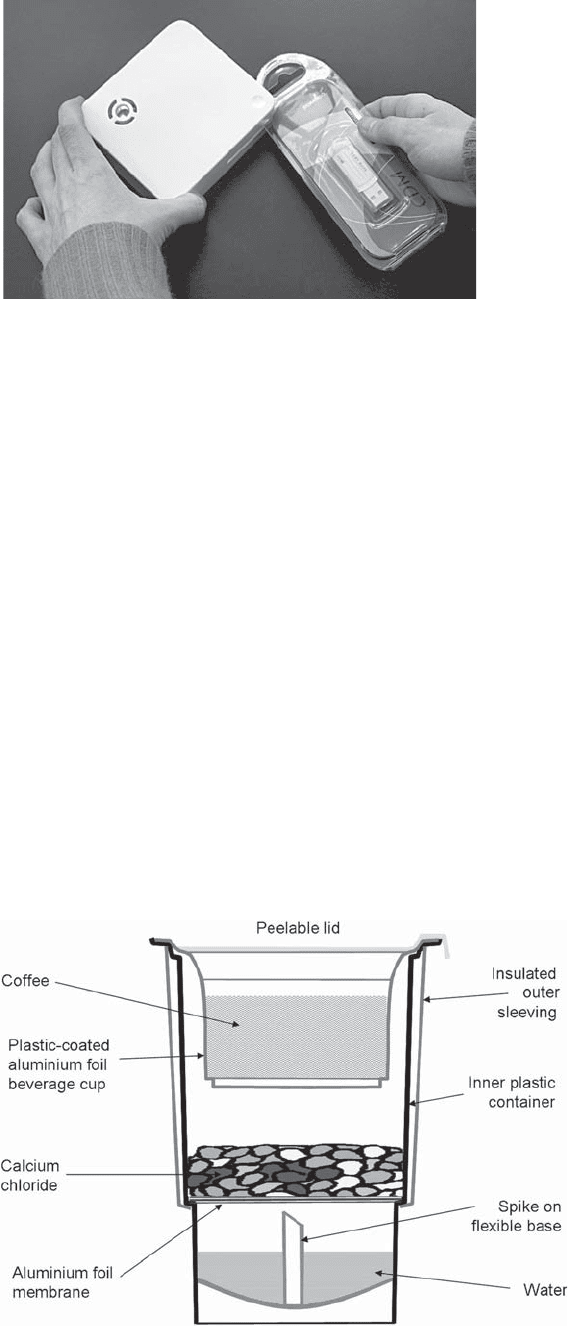
Caldo Caldo, an Italian development, uses the exothermic
reaction between anhydrous calcium chloride and water. A
cross section of the package is shown in Figure 7. When
the substances are mixed, heat swirls around the alumi-
nium cup and is conducted into the beverage. The con-
sumer shakes the container for 40 seconds before peeling
off the lid and a temperature rise of around 231Cis
achieved. Hot drink variants are coffee, cappuccino, cho-
colate, coffee with grappa, and tea with lemon. This
beverage is sold across Europe in sports venues, motorway
rest areas, and many other outlets.
Self-Heating—Other Products
The increasingly convenience-orientated domestic market
requires a means to heat all types of food and beverages,
Figure 6. Electrical debonding at point of sale of a hard-to-open
clamshell package via a hand-held power source. (Reproduced
with permission from Stora Enso.)
Figure 7. Cross section of ‘‘Caldo Caldo’’ self-heating
coffee container. Depressing the flexible plastic base
pierces an aluminium foil membrane allowing the water
and calcium chloride to mix. When shaken, the resulting
exothermic reaction transfers heat via the foil cup to the
beverage.
1128 SMART PACKAGING
including high-viscosity liquids and solid products—that
is, thick soups, snacks including wraps, fajitas, stuffed
pita bread, ready meals, pasta, rice and stews. To date, the
technologies for self-heating have been confined to lime/
water reactions, where heat output is lower but the
reaction is safer. But heating times can be long for solid
food products since heat is transferred from the heating
source to the product solely by conduction.
By ensuring excess water is present with the lime/water
reaction, a new heat transfer process is being developed by
Thermotic Developments—that of direct steam heating (9).
This highly efficient system transfers heat to the product
by injecting steam directly into and through the food.
Steam is a very effective medium for transferring energy,
with 1 g of steam providing 2.2 kJ of energy.
Spin-off technology from the military MRE programs
using highly reactive exothermic reactions based on mag-
nesium oxidation or the reaction between potassium
permanganate and glycerine provides rapid heating even
for solid food meals. This has created a niche but growing
market for self-heating food products for emergency ser-
vices and the outdoors sector.
A number of non-food commercial products are avail-
able that use the lime/water reaction for heating. SC
Johnson’s Raid
s
Fumigator is designed to fumigate a
room or dwelling area. It consists of a metal can contain-
ing insecticide in pellet form in an upper cup and lime
below in a separate container. Supplied with the can is a
separate plastic container that is part-filled with water
and into which the can is placed, activating the reaction.
The room is then evacuated and the heat generated
evaporates the insecticide through a filter in the top of
the can. A self-heating cleansing body wipe, Redi+Wash,
for use in hospitals and by consumers looking for hygiene
on the move, such as campers, travelers, and government
field officers has been developed by U.S.-based Donovan
Industries. After activation, the wipes in packets of five or
eight heat up in 1–2 minutes and then keep warm for a
further 20–30 minutes.
Self-Cooling—Technologies and Applications
Self-cooling is technically more challenging than self-
heating, and current developments are focused on the
two most cost-effective and safe technologies: endothermic
chemical reactions and heat pump technology using water
vapor as the heat transfer fluid.
Endothermic chemical reactions tend to be weak, pro-
ducing cool but not cold products. The sister product of
Caldo Caldo, Freddo Freddo, is a commercial coffee bev-
erage product that employs the endothermic reaction
between sodium thiosulfate pentahydrate and water.
By contrast, water evaporation can be a powerful cool-
ing process, as stepping out of the shower on a cold day
demonstrates. The evaporation of 10 mL of water can
theoretically cool 330 mL of water by 181C. Heat pump
technology has not yet become commercial for single-serve
containers, with high cost and lack of reliability appearing
to be the key factors. But the technology is finding
commercial success in party keg sizes of beer. The German
CS-Metallbau Company has developed the world’s first
self-chilling refillable stainless steel keg using zeolite heat
pump technology. The technology is licensed to Cool-
System Bev. GmbH (10); and it is being used by Germany’s
Tucher Bra
¨
u brewery, as well as other breweries through-
out Europe, Asia, and the United States, for take home-
beer in 5- to 20-L sizes.
Self-Heating and Self-Cooling Smart Packaging—Future
Outlook
For self-heating packaging, technical developments are
expected to continue with the focus being on lime/water
and calcium chloride/water chemical reactions with the
provision of a temperature control feedback system so the
devices create a maximum temperature for the drink
regardless of the ambient temperature. Thermochromic
temperature labels will be incorporated to indicate when a
product is hot. Costs will come down and product quality
will go up, so the future is promising, particularly for
direct steam heating.
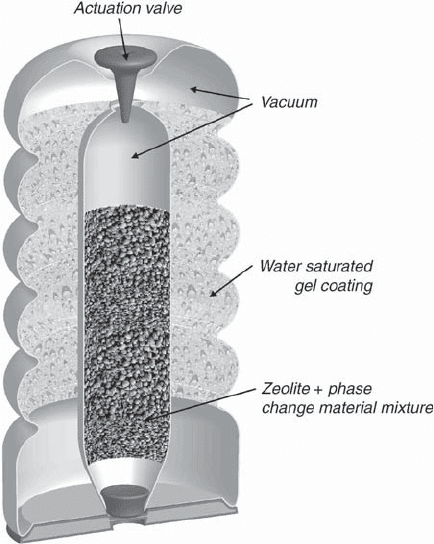
If individual self-cooling beverage cans are to become
commonplace, this will likely require the development of
cost-effective miniaturized ‘‘drop-in’’ modules using heat
pump technology where the heat produced inside the
beverage container can be absorbed by phase change
materials, as in the concept sketch of Figure 8.
MORE EFFECTIVE USE OF PRODUCTS
Food waste is a major problem for the developed world and
one that smart packaging can help reduce. Food
Figure 8. Self-cooling packaging in the future might utilize
drop-in modules that rely on water evaporation/heat pump tech-
nology for their cooling effect.
SMART PACKAGING 1129
degradation kinetics are overwhelmingly determined by
the storage temperature, not by the storage time. Since
the majority of perishable packed food has a ‘‘best before’’
or ‘‘use-by’’ date, indicating storage time and not tempera-
ture, the result is that much perfectly edible and safe-to-
eat food is thrown away by consumers because it has
reached its printed ‘‘use-by’’ date, regardless of actual
condition.
Accurate shelf-life data can be provided to the consu-
mer by smarter food packaging having color change labels
that integrate the passage of time and the various storage
temperature excursions, changing color when a composite
sum of exposure has been reached. Up to now, with
one exception, these time-temperature indicators (TTIs)
have met with significant retailer resistance but are now
close to wider commercialization according to many devel-
opers: Vitsab in Sweden, Avery Dennison in the USA,
OnVu in Europe, Cryolog in France, and TEMPTIME in
France and the USA.
The most successful and longest-running application is
for the Fresh-Check
s
label from TEMPTIME, which has
been in use for at least 15 years by the French super-
market Monoprix, and now can be found on more than 400
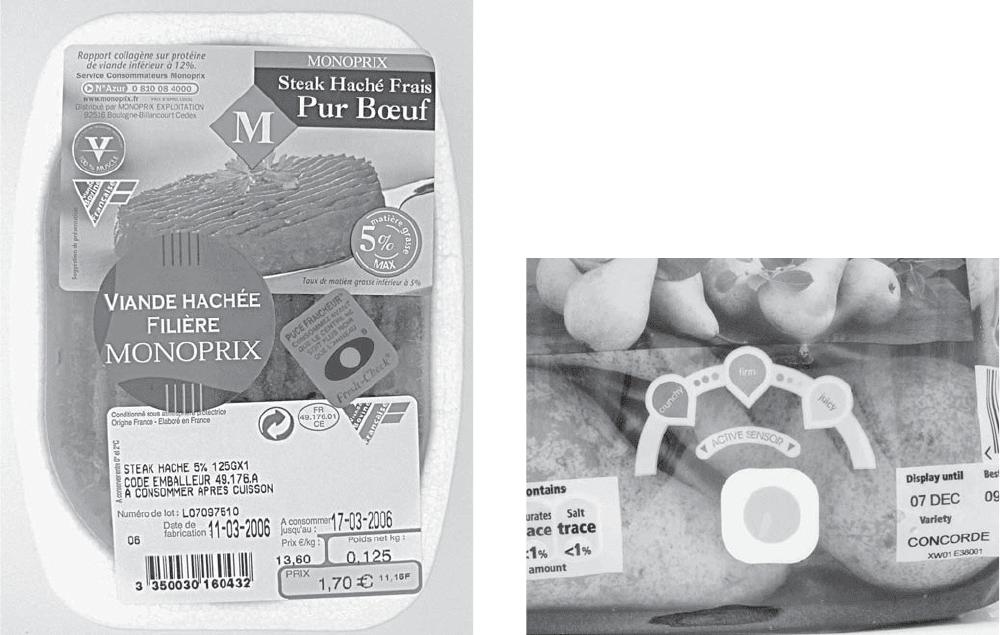
different products. An example on a minced beef patty is
shown in Figure 9. When the central bull’s eye of the ‘‘Puce
Fraı
ˆ
cheur’’ label turns darker than the outer layer, the
product is no longer safe to eat. Details of TTIs and
other freshness color change indicators for foods such as
fish, seafood, and poultry are discussed and reviewed in
reference 1.
Some smart packaging developments have taken in-
spiration from Nature, where there are many color-change
chemical reactions at work associated with food degrada-
tion and ripening that can be borrowed and applied to
consumer packaging. As an example, the ripening of many
fruit is accompanied by the emission of ethylene gas—
easily detected by animals but not by humans, who there-
fore have real difficulty in deciding whether certain types
of fruit are ripe in the absence of a color change. So ripe
bananas are easy to spot, but fruit like winter pears,
avocados, and melons are not.
Using a color change label that is responsive chemically
to ethylene inside the pack creates a smart package that
informs the consumer when pears are ready to eat and at a
certain level of ripeness (Figure 10). Since fruit and
vegetables are a major source of post-consumer food waste
(11), this innovation ought not only to help consumers
enjoy fruit more but also reduce the tendency for consu-
mers to throw away unripe or overripe fruit.
The drive to use smarter packaging to reduce environ-
mental impact by ensuring a more complete utilization of
food products by consumers has been extended to
‘‘hard-to-get-out’’ packaging. High-shouldered containers
and packaging with sharp internal angles are typically
difficult to empty completely, and the last 5–10% of
product is generally discarded with the packaging
as consumers ‘‘give up’’ on getting the last of the
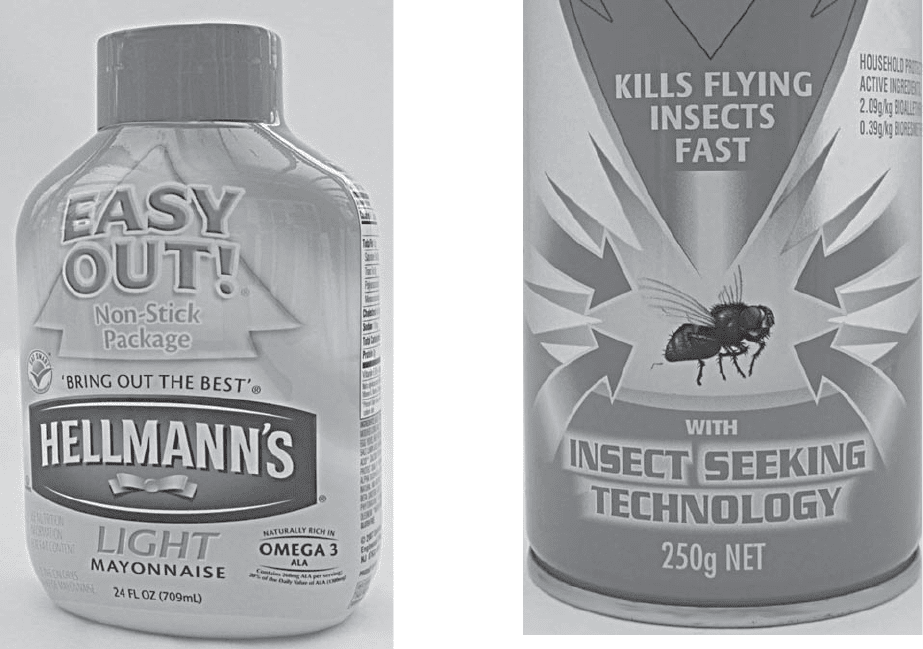
product out. Packaging containing viscous food products
is also difficult to empty completely, and this has
triggered the development of non-stick superhydrophobic
internal surfaces based on the ‘‘Lotus Effect’’ (12),
which allow containers to be more completely evacuated
(Figure 11).
Figure 9. The French supermarket group Monoprix has used
time–temperature indicator (TTI) labels on perishable foods in
their stores for more than 15 years.
Figure 10. A pack of four Concorde pears with active ripeness
indicator. The label inside the pack changes color from dark red to
yellow as the pears ripen.
1130 SMART PACKAGING
Metal aerosol cans are smart packaging innovation
leaders in the household and cleaning market. The
Mortein ‘‘SmartSeekert’’ insecticide aerosol can provides
improved effectiveness over conventional aerosol spray
cans since the spray is electrostatically charged through
a specially engineered nozzle each time the insecticide is
used, improving insect ‘‘kill’’ by electrostatic attraction
(Figure 12). Not only is the product more effective and
lasts longer, but the packaging contributes to reducing the
environmental impact associated with insecticide use
within the home.
PROVIDING CLEARER, MORE EFFECTIVE
COMMUNICATION
Smart packaging offers the opportunity to dramatically
improve the communication aspects of the human/packa-
ging interface. For brands this offers the opportunity to
strengthen the emotion connection with the consumer—
via, for example, story-telling related to the provenance or
history and traditions of the product. But to communicate
more effectively, there needs to be a movement away from
text-based communication toward the greater use of vi-
sual and audio information on packaging. Both at point of
sale and during subsequent use and disposal, there are
opportunities for packaging to inform about the utility and
characteristics of the product, such as
. the product, ingredients, and attributes,
. the way the product works or is best used,
. for pharmaceuticals, when and how to take the
product.
It is expected that these communication packaging inno-
vations will be strongly driven by advances in technologies
such as nanotechnology, biomimetics (learning from
Nature), electroluminescent, and other display technolo-
gies and printed electronics.
Advances in package communication that provide
sound and vision is possible using conventional silicon
device circuitry with LED or electroluminescent (EL)
illumination and sound chip technology driven by button
cell battery power. This exists today but is going to add a
dollar or two to the cost of a package, depending on
complexity, putting it out of bounds for all but high
value products. As an example, sound and EL label
illumination effects, stressing the history and tradition
of rum making in Barbados, can be found on the bottle of
the 10-year old Barbadian rum Coyopa, which retails for
around $50.
Figure 12. Smart packaging in aerosol form. Improved insecti-
cide performance and less environmental impact results from
packaging that electrostatically charges the insecticide particles.
Figure 11. Smarter packaging can contribute to reducing post-
consumer food waste—in this example by ensuring less residual
food is left in the package when it is empty.
SMART PACKAGING 1131
But real communication opportunities need not wait for
the commercialization of cost-effective printed electronics
on packaging, although these will come. Advances in
nonelectronic technologies such as color-change chemis-
try, lenticular graphics, and data matrix bar codes can
today offer a conduit to better story-telling about a brand
product’s attributes, provenance, and how the product can
be used or can provide useful product information in an
easily understandable communication format for the
consumer.
As already discussed, the current ubiquitous printed
date coding system on perishable food is fatally flawed and
there is currently a move toward more accurate time-
temperature colour change labeling. Eventually color-
change chemistry will give way to low-cost printed
electronics on labels, leading to electronic self-adjusting
‘‘use-by’’ dates and displays providing the important
technical breakthrough for smart packaging, leading to a
dramatically improved user interface with food packaging
of the future (13).
Simple communication about the benefits of using a
product can be visually and effectively represented
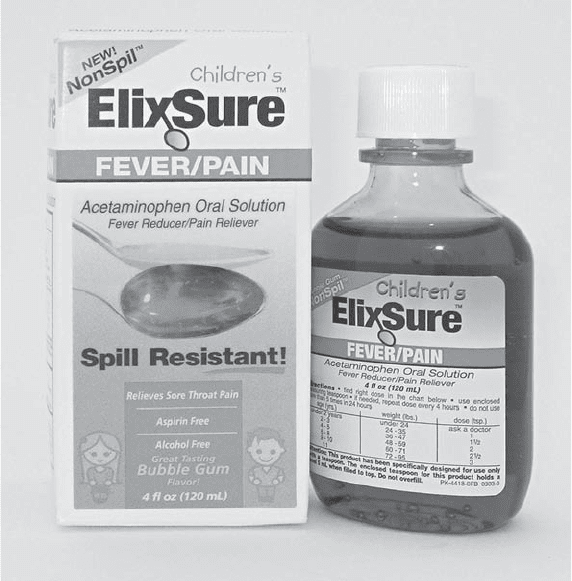
through lenticular graphics. As an example, the no-spill
medication for children sold across the United States
under the ElixSure brand features a lenticular label on
the outer paperboard carton that shows two images of
spoons that flip back and forth, signaling ‘‘spill-proof’’ to
the consumer (Figure 13).
Combining lenticular graphics with conventional sili-
con sound chip technology can augment printed instruc-
tions and improve communication effectiveness about
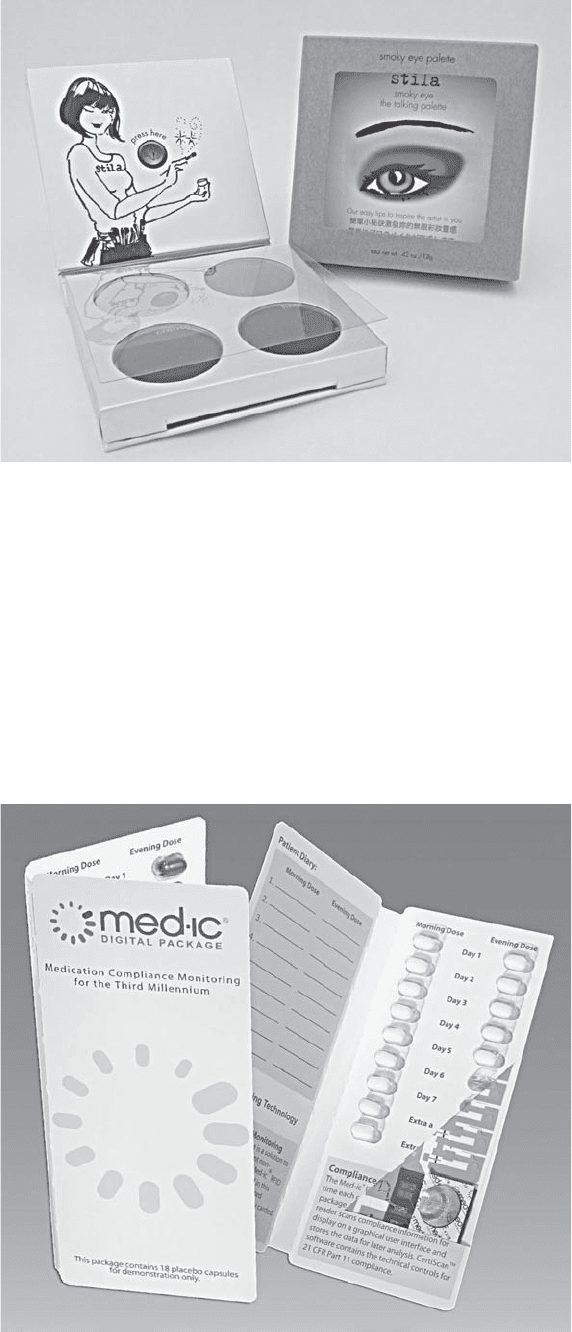
product use in a powerful way. ‘‘Smokey Eye—the Talking
Palette’’ eye makeup from Stila Cosmetics (Figure 14)
comes in a kit that not only visually shows the eye before
and after application by means of a lenticular graphic but
also instructs consumers in a step-by-step audio process at
the press of a button.
Compliance packaging for pharmaceuticals is an act ive
development area for electronic smart packaging, and
several devices are commercial and have recently
been discussed (14). As an example, the Med- ict Smart
Package uses an onboard CPU embedd ed in a blister
package to record each time a pill or capsule is removed.
The RFID tag r ecords the time for later analysis, such as
at repeat prescription time or on a fol low-up visit to a
health center, when the information can be downloaded
through a 13.56-MHz RF wireless reader and displayed
graphically. When used for clinical trials, at the end of
the trial period the patient returns the blister pack-
age and the information is downloaded to a database
(Figure 15 ). A second variant is a smart medication bottle
termed eCAPt. It reminds the patient when the next dose
is due and records the time the patient opens the bottle to
remove the tablet or capsule, without active patient
input.
CLOSING REMARKS
Smart packaging need not use new technologies or be
complex to offer real customer benefits and improved
levels of convenience in today’s crowded marketplace—
considerable scope exists for using today’s technologies
in more imaginative ways. The more extensive use of
Figure 13. Increased ease-of-use and accuracy of dos-
ing is provided by this spill-resistant medicine for
children. The outer packaging communicates the non-
spill characteristics of the formulation by lenticular
graphics.
1132 SMART PACKAGING
lenticular graphics and data matrix bar codes are just two
possibilities. But it is expected that new technologies,
many becoming available for the first time in the next
few years such as nanotechnology, printed electronic dis-
plays, and batteries, will hugely boost the capabilities of
smart packaging.
For some market sectors, such as pharmaceuticals and
healthcare, smart packaging will be as much about improv-
ing the human interface as about providing new function-
ality. The growing demands for information about the
product will force an abandonment of printed text on pack-
aging as the principal means of communication. Packaging
will be capable of sensing, speaking, and displaying, and
hence of warning the consumer of, for example, problem
ingredients. No longer will seniors struggle to open phar-
maceutical packaging or forget to take their medication. All
age groups will benefit from these future packaging ad-
vances, many of which will be electronic in nature.
Consumer benefits will ultimately drive smart packa-
ging developments and must be clearly communicated to
Figure 14. Electronic smart packaging plus lenticular
graphics provides full sound and visual instructions to
consumers with this cosmetic eye make-up palette.
Figure 15. Electronic smart packaging from Informa-
tion Mediary helps and assists patients to be compliant
in their pharmaceutical regimes. [Reproduced with per-
mission from Information Mediary Corp (IMC).]
SMART PACKAGING 1133
the consumer. On-the-go as a way of life seems to show no
signs of abating and in all likelihood consumers will
become even more mobile and time pressured. In this
brave new world, untapped opportunities exist for smart
packaging to offer new and improved levels of benefits and
convenience.
Cost-effective smart materials and systems develop-
ment will perhaps one day realize the truly interactive
package that greets the consumer at supermarket aisles,
plays music, or even flashes the brand logo of the product
in bright lights as an inducement to purchase. Once
purchased and back in the home, the labelling and com-
munication devices on the package will additionally pro-
vide an interaction with smart inventory systems, smart
storage/disposal and smart cooking equipment in the
kitchen—as is happening already, for example, with mi-
crowaveable convenience meals.
Smart packaging can be considered as a natural pro-
gression in package innovation for many fast moving
consumer goods (FMCGs). After all, competition for shelf
space has never been more intense, and the competition
arena is increasingly moving from media to the point-of-
purchase making packaging more important than ever
before.
BIBLIOGRAPHY
1. J. Kerry and P. Butler, eds., Smart Packaging Technologies for
Fast Moving Consumer Goods, John Wiley & Sons, Chiche-
ster, UK, 2008.
2. P. Butler, Consumer Smart Packaging, IDTechEx, Cambridge,
2005.
3. Productscan
s
data. Web information available at http://
www.productscan.com/news/news_mouse04.pdf. Accessed
May 7, 2008.
4. Wikipedia definition. Web information available at http://
en.wikipedia.org/wiki/Wrap_rage. Accessed May 7, 2008.
5. BBC news report. Web information available at http://
news.bbc.co.uk/2/hi/business/3456645.stm. Accessed May 7,
2008.
6. ‘‘Packaging It Can Drive You Nuts—The Most Infuriating
Food and Drink Packaging, as Voted by Readers,’’ Health
Which?, 18–21 (October 2000).
7. Squeezeopent. Web information available at http://www.
squeezeopen.com. Accessed May 7, 2008.
8. ElectReleaset. Web information available at http://www.
eiclabs.com. Accessed May 7, 2008.
9. Steam To Go. Web information available at http://www.
steamtogo.com. Accessed May 7, 2008.
10. CoolKeg. W eb information available at http://www.coolsystem.
de. Accessed May 7, 2008.
11. WRAP Research Report, April 2008. Web information avail-
able at http://www.wrap.org.uk/retail/index.html. Accessed
May 7, 2008.
12. Wikipedia definition. Web information available at http://en.
wikipedia.org/wiki/Lotus_effect. Accessed May 7, 2008.
13. Packaging Materials & Technologies Ltd. Web information
available at http://www.smartpackaging.co.uk/UseByDating
Article.pdf. Accessed May 7, 2008.
14. Reference 2, pp. 148–151.
SMART PACKAGING TECHNOLOGIES FOR
BEVERAGE PRODUCTS
JOSEPH P. K ERRY
Department of Food and
Nutritional Sciences, University
College Cork, Ireland
INTRODUCTION
The beverage industry constitutes one of largest sectors
within the global consumer packaging market and has
been at the forefront in pioneering the development of
novel packaging concepts or through the adoption of new
technologies as they relate to innovative packaging solu-
tions. Today, some of the leading global product brands in
consumer goods are beverages. Beverages are now no
longer seen as merely thirst-quenching products but as
vehicles for delivering functional nutrition that promotes
health and well-being through the incorporation of ‘‘well-
ness’’ components such as vitamins, minerals, phyto-
chemical extracts, pre- and pro-biotics, and so on, into
beverages. Water-based, milk-based, and juice-based bev-
erages, which continue to grow in popularity, are seen as
natural and ideal carriers of such components. Equally,
the development of beverage product lines where flavor,
among other organoleptic properties, need to be created or
controlled is another key area in beverage product devel-
opment. In the future, nanotechnology promises to yield
new solutions to key challenges for the beverage industry,
just as it is likely to impact the food industry. Research
and development currently underway to improve the
beverage product itself includes the development of func-
tional beverages, in-pack nutrient delivery systems, and
methods for optimizing beverage appearance, such as
color, flavor, and consistency (1). Additionally, nanotech-
nology will also be used to affect the beverage pack as
well—For example, by enhancing barrier properties, light-
weighting plastic bottles but improving mechanical
strengths and heat resistances, providing mechanisms to
help packaging to degrade or biodegrade in the environ-
ment, and producing packaging materials that have an
enhanced and associated hygiene status (2).
The use of smart packaging as a novel marketing tool is
another means by which this technology can be effectively
harnessed. For example, the development and use of
fragrances as packaging components in an attempt to
attract the consumers’ attention to high-value food and
beverage products is one such approach (3). Additionally,
as consumers are confronted by a barrage of ever increas-
ing advertising mechanisms, the consequence is that the
traditional use of television, radio, and print advertising
as a means of commercializing products is losing effec-
tiveness; consequently, novel marketing techniques are
developing to explore new advertising mechanisms in an
attempt to get brand and product noticed. One such
approach appears to be targeting as many of the five
senses as possible, all of which are delivered directly
through the product packaging (4). Issues pertaining to
tradition, luxury, and high-end beverage products such as
1134 SMART PACKAGING TECHNOLOGIES FOR BEVERAGE PRODUCTS
reinforcement of consumer appeal, tamper evidence, coun-
terfeiting, and brand protection are also highly topical
areas of interest within the beverage industry.
Many of the issues described above are being addressed
through the use of smart packaging technologies, and
these are discussed subsequently and in greater detail.
GAS-RELEASE PACKAGING
One of the most common and widely adopted forms of
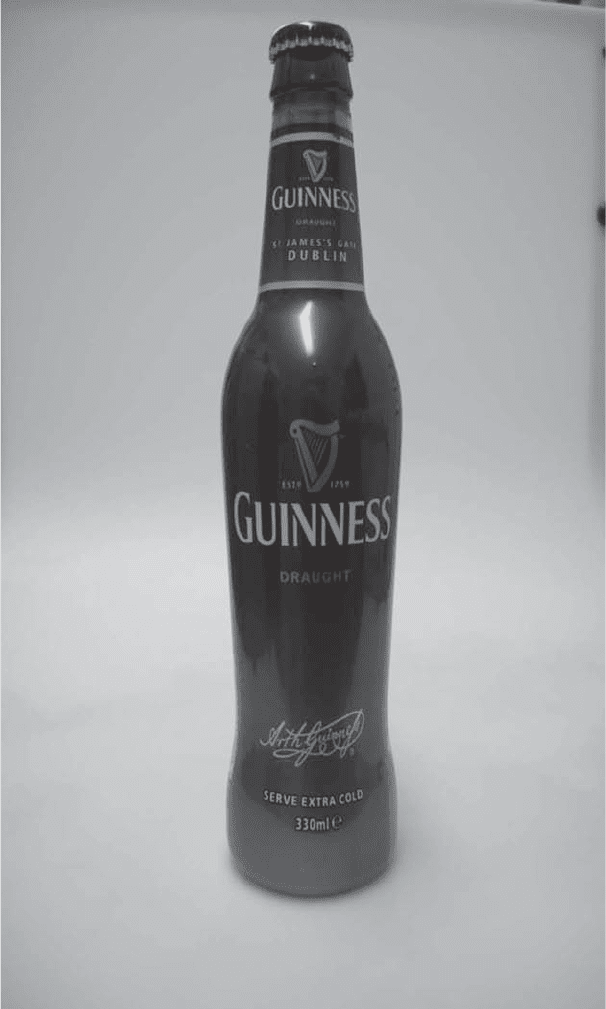
innovative packaging is the gas-releasing ‘‘widget’’ devel-
oped originally for canned and bottled beer products, one
of the best known being Guinness stout (Figure 1). This
technology was developed to provide a draught beer for
the consumer, so that pub-quality beer (having more body,
more effervescence, and a thicker and creamier head)
could be experienced by the consumer in the comfort of
their own home. The widget functions by releasing CO
2
from some of the beer in order to create the head. The
widget that is used in canned beer consists of a hollow
nitrogen-gas-containing plastic sphere which is 3 cm in
diameter and has a tiny hole in it, while that used in
bottled product is cylindrical in shape and approximately
7 cm long with winged appendages to prevent the widget
from exiting through the neck of the bottle. In the case of
Figure 1. Bottled draught Guiness containing
widget technology.
SMART PACKAGING TECHNOLOGIES FOR BEVERAGE PRODUCTS 1135
canned product, the widget sphere is added to the can
before the can is sealed, where it floats on the surface of
the beer with the hole just slightly below the surface (5).
Prior to sealing the can, a small shot of liquid nitrogen is
added to the beer; this evaporates during the rest of the
canning process and pressurizes the can. As pressure
increases in the can, beer is slowly forced into the sphere
through the hole, compressing the nitrogen inside
the sphere. When the can is opened, the pressure in-
side the can immediately drops and the compressed gas
inside the sphere forces beer out through the tiny hole into
the additional surrounding beer. This agitation causes a
chain reaction of bubble formation throughout the beer;
the CO
2
that is dissolved in the beer forms tiny bubbles
that rise to the surface which form the head. The presence
of dissolved nitrogen allows for smaller bubbles to be
formed, which consequently produces the creaminess
associated with the head of the product (5). This result
can be explained because the smaller bubbles in the
product need a higher internal pressure to balance
the greater surface tension which is inversely proportional
to the radius of the bubbles. Achieving this higher pres-
sure is not possible by merely using dissolved carbon
dioxide because the much greater solubility of this gas
compared to nitrogen would create an unacceptably large
head. The result, when the can is then poured out, is a
surging mixture in the glass of very small gas bubbles and
liquid, just as is the case with certain types of draught
beer. Not only does the nitrogen make the beer creamier
and produce a better head, it also protects against oxida-
tion. Consequently, the brewer can permit the beer to be
less carbonated (5). The ‘‘canned draught’’ products have
levels of carbonation similar to those in cask-conditioned
ales, and they have less than half those in some bottled
beers.
Apart from Guinness, other breweries have since come
up with their own widget designs, which were introduced
to draught beer in 1992, lager in 1994, and cider in 1997.
In 2002, the Kenco Ice Cappio coffee drink from Kraft
Foods, which contained a widget, was launched in the
United Kingdom. When the can was opened, the widget
produced a creamy head of froth on the beverage (6). As
has been shown, this technology has proven itself but yet
has enormous potential because it also lends itself to
application in other segments such as mixed milk drinks
and milk shakes, yogurt drinks, fruit juice-based drinks
and smoothies, and coffees. For Kenco Ice Cappio, Ball
Packaging Europe also inserted plastic capsules in 0.25-L
cans. A relatively new cappuccino cocktail is focused on
the Ball Packaging Europe can: ‘‘Cafe Kiss,’’ which is a
cappuccino drink containing vodka, was launched on the
UK market in a 200-mL Slimline can in 2006. A capsule-
style widget inside the can ensures that the typical
cappuccino froth head is produced when the can is opened.
The coffee cocktail can be primarily sourced from British
retail chains Tesco and Spar (7).
Future developments of the widget may incorporate
elements of nanotechnology; for example, the external
surface of the widget could be expected to provide a site
for nucleation, or a liquid or active agent could be en-
capsulated within the widget. The widget could also offer
prolonged bubble release and create other ‘‘theater effects’’
during opening and consumption (2).
FLAVOR RELEASE PACKAGING
Other smart packaging devices may be used to release
flavors and aromas into beverage products at the point of
consumption so as to create or maintain product intensity
and quality. Companies have already incorporated scents
directly into plastic-based containers so that consumers
can smell, for example, the aroma of freshly ground coffee
without opening the product. Newly developed scented
ink, meanwhile, is allowing ads and catalogues to capture
a consumer’s attention with an unsuspecting whiff, using
a technology beyond your father’s scratch-’n-sniff (4).
Fragrances and deodorants for plastics are used in a
variety of applications and are playing a growing role in
marketing food and beverage packaging and in consumer
products for the home (3). Olfactory scientists say that
using scent is smart marketing. Of all the human senses,
smell has the most direct pathway to the emotional center
of the brain (4).
The incorporation of aromas into the polymer material
can be used to attract consumers when the package is
opened, and also to balance any detrimental effects of
aroma loss (8). AddMaster recently developed a chocolate
fragrance for use in polyethylene packaging of chocolate-
flavored milk-based drinks that is intended to create an
‘‘in-store awareness’’ of the product (3). Also, a new aroma
and flavor-releasing technology for packaging is being
tested in consumer trials in bottled water and nutritional
food packaging applications in the United States (9). A
U.S. company, ScentSational Technologies, is behind the
product, which is also known as ScentSational (Figure 2).
This patented flavor and brand-enhancing packaging
incorporates aromatic qualities directly into closures (10).
Pasteurization generally burns off what is known as
top notes, or the aroma notes in beverages traditionally
associated with freshness (10). Additionally, aromas
strongly associated with certain packaged foods and bev-
erages are not statically stable; consequently, they become
altered chemically over time, resulting in the generation
of different and sometimes undesirable odors. The aromas
that ScentSational uses remain stable because the mole-
cules are, essentially, encased in plastic (4). ScentSational
essentially replaces the top notes lost from products
during processing, handling, and storage through the
insertion of food grade flavors that are FDA-approved
and generally recognized as safe (GRAS). These flavors
are mixed with polymers during the injection molding of
closures or during the manufacture of plastic-based liners
and seals for metal closures (10). The plastic used gradu-
ally emits volatiles that are responsible for the specific
aromas produced. It has been reported that these aromas
persist for approximately a month and actively scent
whatever food or liquid product is in close proximity to
the packaging material (4).
ScentSational’s technology is based on the premise that
foods and beverages contained in packaging that smells
better will taste better. The technology works using the
1136 SMART PACKAGING TECHNOLOGIES FOR BEVERAGE PRODUCTS
science of taste. With the exception of sweet, sour, bitter,
salt, and Umami, all other taste is a result of the sense of
smell. When someone drinks a beverage, the liquid creates
vapors inside the mouth that travel up the retro-nasal
canal where it eventually hits the olfactory bulb. It is here
that these flavor vapors are interpreted as taste by the
brain (10).
NutriSystem, a leading marketer of weight manage-
ment products, recommends that users of its products
drink at last eight 8-ounce glasses of water daily to help
flush out toxins produced when body chemistry changes as
weight is lost (11). To make the challenge a little easier,
the company sells a water bottle fitted with a closure
infused with another product also produced by ScentSa-
tional Technologies called CompelAroma
s
. This product
encapsulates substances within the structure of a plastic
package that emits an aroma during heating and after
opening. This gives the water contained in the bottle a
specific taste, even though no flavorants have been added
to the product (11).
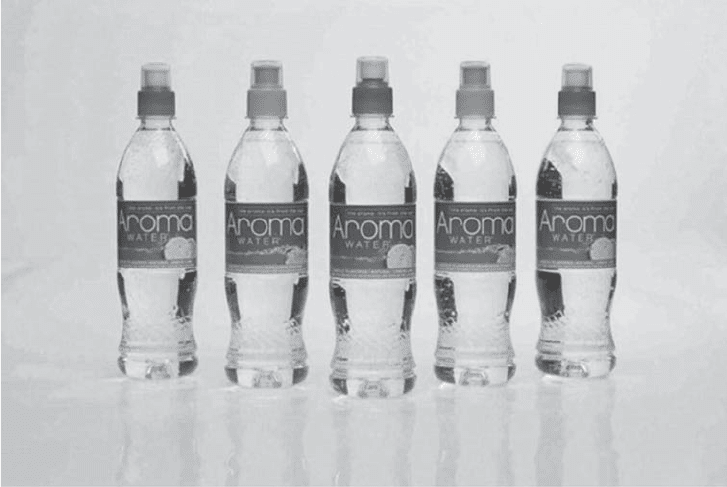
A Pensylvania-based beverage firm, Aroma Water,
LLC, licenses the technology from ScentSational Technol-
ogies to produce Aroma Watert in either a lemon–lime or
mandarin orange scent. Both ‘‘flavors’’ are approved by the
Food and Drug Administration (Figure 2). The aroma of a
particular flavor can affect the sense of taste. For Nutri-
System, CompelAroma
s
is added to the closure of the
water bottle as it is injection molded. The closure emits
an aroma (currently lemon, peach, or berry) that in effect
deceives the taste buds into believing that the water is
flavored, enhancing the consumer’s enjoyment of water
without adding calories, sweeteners, or preservatives (11).
A recent innovation to make milk more popular with
children has been developed by Unistraw Intl. Pty. Ltd.,
Australia. This company has been engaged for the last
seven years in perfecting a milk-flavoring solution that is
mess-free, convenient, wholesome, and tasty (12). The
patented Unistrawt system enables flavor ‘‘beads’’ to be
dissolved in a beverage as the liquid passes through the
straw. The system has three elements; a straw, filters, and
flavor beads. The system’s first component, the straw, is
made from transparent polypropylene (PP), mixed with a
food-grade plasticizer/toughener that prevents the straw
from cracking or splitting. The straw measures approxi-
mately 0.26 in. diameter and is 7.08 in. long. Filters are
heat-welded into both ends of the straw and use a
patented cone shape that allows an optimal flow of liquid
through the straw while keeping the company’s UniBeads
inside (Figure 3). Each straw holds approximately 4 g of
UniBeads, which are 0.08-in.-diameter round beads that
can be dissolved into a beverage to add flavor, vitamins, or
other ingredients. The UniBeads are manufactured at
Unstraw’s facility in New South Wales, using processes
and equipment developed by the company (12). In Aus-
tralia, the straw is sold under the brand name ‘‘Sipahht.’’
These milk-flavoring straws were designed for the 5- to 15-
year-old target market. The original launch flavors of
Chocolate, Banana, Caramel, and Strawberry have al-
ready been joined by Toffee Apple, Cookies & Cream,
and Choc-Mint. Other applications envisioned for the
Unistrawt system include the delivery of vitamins and
other nutrients, nutraceuticals, and bioactive ingredients
or pharmaceuticals into beverages (12). Sipahht fits
perfectly into the global trend toward healthier and con-
venient products that deliver nutritional benefits in a fun
and novel way (13).
Choice-enabled packaging (patent pending) is now
being marketed by IPIFINI Inc., a Boston-based
Figure 2. Aroma Water, LLC, licenses the technology from ScentSational Technologies to produce Aroma Watert. The cap emits an
aroma (lemon-lime or mandarin orange scent) that tricks the taste buds into believing the water is flavored.
SMART PACKAGING TECHNOLOGIES FOR BEVERAGE PRODUCTS 1137