
Yam, Kit L. (ed.). The Wiley encyclopedia of packaging technology
Подождите немного. Документ загружается.

and other fitments on separate converting equipment than
on in-line form/fill/seal equipment. Preformed pouches, to
date, have tended to be more reliable in distribution
performance than in-line-made form/fill/seal pouches. Be-
cause of this reliability factor, most liquid-containing
standup flexible packages to date have used preformed
pouches. Since many different fill/seal machines begin-
ning with preformed pouches are commercially available,
preformed pouches have commonly been used.
STANDUP FLEXIBLE-POUCH MACHINERY
In general, there are two types of machines for producing
standup pouches: preformed pouchmaking machines and
horizontal form/fill/seal machines.
Preformed pouch machines are used by converters to
make standup pouches that are supplied to a packaging
company that will fill the pouch through the open top.
These machines utilize single-wound laminated (nonex-
tensible) rollstock. They make pouches in either (a) two
lanes of production, for pouches smaller than approxi-
mately 7 in. 11 in, or (b) one lane of production, for
pouches larger than 7 in. 11 in. The same pouch
machines can add zipper reclosures and easy-open fea-
tures, or can be used to make conventional three-side-seal
pouches. Some pouch machines use a separate bottom
gusset web and can then easily manufacture in two lanes
(‘‘2-up’’ or two pouches at one time). Other machines use
one web and plow the bottom gusset into the center-folded
material, but are limited to one lane of production.
The advantages of using the preformed pouch are its
superior seal integrity and the ease of adding a reclosure
feature, such as the reclosable pour spout. Preformed
pouch equipment is used more often for packaging liquids
and for small-market-niche products.
Packagers utilize form/fill/seal machinery to fabricate
and fill the standup pouch. Again, single-wound lami-
nated sheeting is used on the machine to form the pouch
and then fill and seal it in-line. This is known as a one-step
operation, while the preformed pouches must be shipped
from the converter to the packager for filling and sealing
in a second operation.
The form/fill/seal (one-step) operation offers economies
to the packager. Even though the speeds of the pouch-
forming operation are typically much slower than those
using preformed pouches, the fact that all operations are
done in-line saves on storage and labor costs. Standup
pouch form/fill/seal machinery is more typically used for
the packaging of large-volume, dry granular products
such as nuts and snacks (see Form/fill, seal horizontal
and vertical).
USE OF STANDUP FLEXIBLE POUCHES WORLDWIDE
The worldwide use of flexible standup pouches, exclusive
of Capri Sun, was about 700–900 million in 1993, with the
largest fraction being in Japan, with the grand total in the
3–3.5 billion range. There was limited but steady growth
during the mid- to late 1990. During recent years, 2005 to
2007, Standup pouches have been growing at a steady
rate.
The introduction of the flat bottom standup pouches
began in late 2005. The flat-bottom pouch can be made as
a relacement for rigid and semirigid packages. The year
2007 has seen the format grow in human and pet food
applications. This format is expected to grow steadily into
the future.
The following is a discussion of the use of standup
flexible pouches throughout the world, broken down by
area.
North America
Package material source reduction was a major factor
behind the development of product packaging in standup
flexible pouches in the United States and Canada.
Although there is really no practical way to recycle the
standup flexible pouch itself, the initial package reduces
material use and results in less material going to the
landfill. Standup flexible pouches offer the potential for up
to 80% package mass reduction for liquid products such as
household laundry products, window cleaners, chemicals,
detergents, fabric softeners, lotions and creams, and
shampoos. Packagers with environmental concerns began
to investigate and test standup flexible pouches that had
been commercialized in Germany in the mid-1980s. Using
structures of polyester film and sometimes nylon film plus
LLDPE and a variety of European packaging equipment,
packages were introduced as environmentally ‘‘friendlier.’’
A popular application was as a refill for high-density
polyethylene (HDPE) bottles.
The first use of a large-size standup flexible pouch in
the United States was for evaporated milk. It was retorted
to achieve ambient temperature shelf stability.
Standup flexible pouches appear to have effected a
more successful entry into the Canadian market for liquid
laundry products under the umbrella of being environ-
mentally more ‘‘friendly.’’ Some of these laundry products
are packaged in the United States. Other products being
marketed in standup flexible pouches in Canada include
hair shampoo/conditioner, motor oil, and liquid household
cleaner.
Europe
Among the products being packaged in standup flexible
pouches in Europe are liquid detergents, fabric softeners,
shampoos, hand creams, windshield-washer fluids, and
latex paint in p5-L sizes. Standup flexible pouches re-
present a rather large usage for liquid packaging in
Europe.
Most
European standup flexible
pouches for liquids are
premade and appear to be three-piece, using 12-mm
(0.00048-in.) PET film/0.004- to 0.006-in. LLDPE for the
two major faces and the softer, stronger nylon film/LLDPE
or PET/LLDPE for the bottom panel. Thus, the flexible
structures for standup flexible pouches are not especially
unique or difficult to fabricate.
1158 STANDUP FLEXIBLE POUCHES
Latin America
In Latin America, standup flexible pouches have been well-
received. One reason is the apparent low cost of flexible
materials versus their semirigid plastic package counter-
parts. The pouches have become established in a number of
food markets, including mayonnaise, mustard, ketchup,
salad dressings, and hot-filled jams and jellies in the fluid
category, as well as for dry (powdered) gelatin desserts,
syrups, toppings, rice, and analogous flowable dry pro-
ducts. In the nonfood category, several companies pack
liquid fabric softeners and detergents in standup flexible
pouches. Capri Sun is also present in the Latin American
market. The number of standup flexible pouches in Latin
America is estimated to be in the 200-million-unit range.
Japan
Almost all are preformed pouches fabricated from polye-
ster film/aluminum foil/cast polypropylene film, with some
in glass-coated polyesters as the barrier, packaged on
several different types of equipment. A few of the alumi-
num foil laminated standup flexible retort pouches are
distributed in the United States.
In Japan, several supply companies developed both
equipment and materials that allowed for a relatively
healthy market niche for liquid food products. The concept
was so well engineered that it could be applied for retort
pouches of low-acid fluid foods and beverages such as milk.
India
Prominent uses include dry rice, motor oil, and related
automotive fluids. Environmental factors once again play
a role in the choice of pouch packaging. Motor oil repre-
sents a significant environmental solid-waste problem,
since the conventional extrusion blow-molded HDPE bot-
tles are not recyclable. Large numbers of semirigid bottles
become part of the municipal solid-waste stream. The
incorporation of motor oil into flexible packages helps
reduce this package mass.
ECONOMIC ISSUES
Historically, the standup flexible pouches have not offered
lower packaging costs, although this has now begun to
change. The actual costs of the standup flexible pouches
with liquid dispensing spouts have been more than double
the cost of extrusion blow-molded plastic bottles with
labels and closures. Another added cost is importing
from Europe, Israel, and even Japan. Thus the expected
cost savings initially did not materialize, and, in fact, they
were negative or at best even. In late 1993, however, a
significant change in the costing situation emerged as
domestic sources for both preformed and form/fill/seal
standup flexible pouches began to develop. In the United
States, the costs have come down considerably and are
now competitive with the costs for more traditional packa-
ging, such as an extrusion blow-molded HDPE bottle. On
the horizon, however, is the ability of plastic bottle blowers
to reduce the wall thicknesses and hence the package
mass and the economics even more—and, of course, their
increasing use of postconsumer scrap plastic for nonfood/
cosmetic contents.
Yet another major problem is that all automatic
standup pouch flexible-packaging equipment is much
slower than bottle-packaging equipment, some down to
25–30 one-liter units per minute. Maximum output speed
for any standup pouch flexible packager is in the range of
120 per minute. Most bottling lines for liquid household
products begin at 100 and go up to 400 bottles per minute,
with some even higher.
Some pouch equipment manufacturers are developing
higher-speed machines, with speeds of X400 per minute.
This new equipment will generate greater attention for
standup flexible pouches for liquid packaging.
Standup flexible pouches have almost zero vertical
compression strength and thus must be totally protected
by higher-cost and higher-package-mass secondary and
tertiary packaging in distribution. Furthermore, standup
flexible pouches are much more difficult to handle than
their bag-in-box equivalents.
Another key to the use of standup flexible pouches is a
lack of equipment to handle and unitize the pouches into
secondary and tertiary packages. Much of the North
American output is actually hand-packed into corrugated
fiberboard cases. On the other hand, equipment for utiliz-
ing flexible pouches is commercially available.
The standup flexible liquid-content pouch market is
relatively small, representing only about 1% of the total of
all flexible pouches.
BIBLIOGRAPHY
General References
A. L. Brody, Rubbright-Brody, Inc., ‘‘The Source Reduction Pros
and Cons of Liquid Stand-up Pouches,’’ paper presented at
Green Packaging ‘94, Washington, DC.
A. L. Brody, Rubbright-Brody, Inc., Worldwide Technology, Mar-
kets and Prospects for Stand-up Flexible Pouches, Packaging
Strategies, Inc., 1994.
‘‘Cleaner Refills Spout a Cap,’’ Packag. Digest (Sept. 1992).
Liquid Pouch Packaging vs. Rigid Blow Molded Containers:
Opportunity or Threat and Environmental Implications
1991–1996, Mastio & Company Pouch Study, 1992.
W. J. Noone, ‘‘Stand-up Flexible Pouches: Has Their Time Come?’’
Packag. Print. Converting (March 1995).
STAPLES
J. R. CHARTERS
Paslode Corporation
INTRODUCTION
In packaging, staples are used to assembly wooden pallets,
skids, and boxes and crates (see Boxes, Wood). In
STAPLES 1159
fastening wood to wood, the relatively heavy shank of a
nail provides greater shear strength, but staples provide
greater holding power because their two legs provide more
wood-to-metal contact surface area. Staples are used as a
replacement for nails in many applications including
furniture, housing, fencing, etc, but the following discus-
sion focuses on packaging applications only.
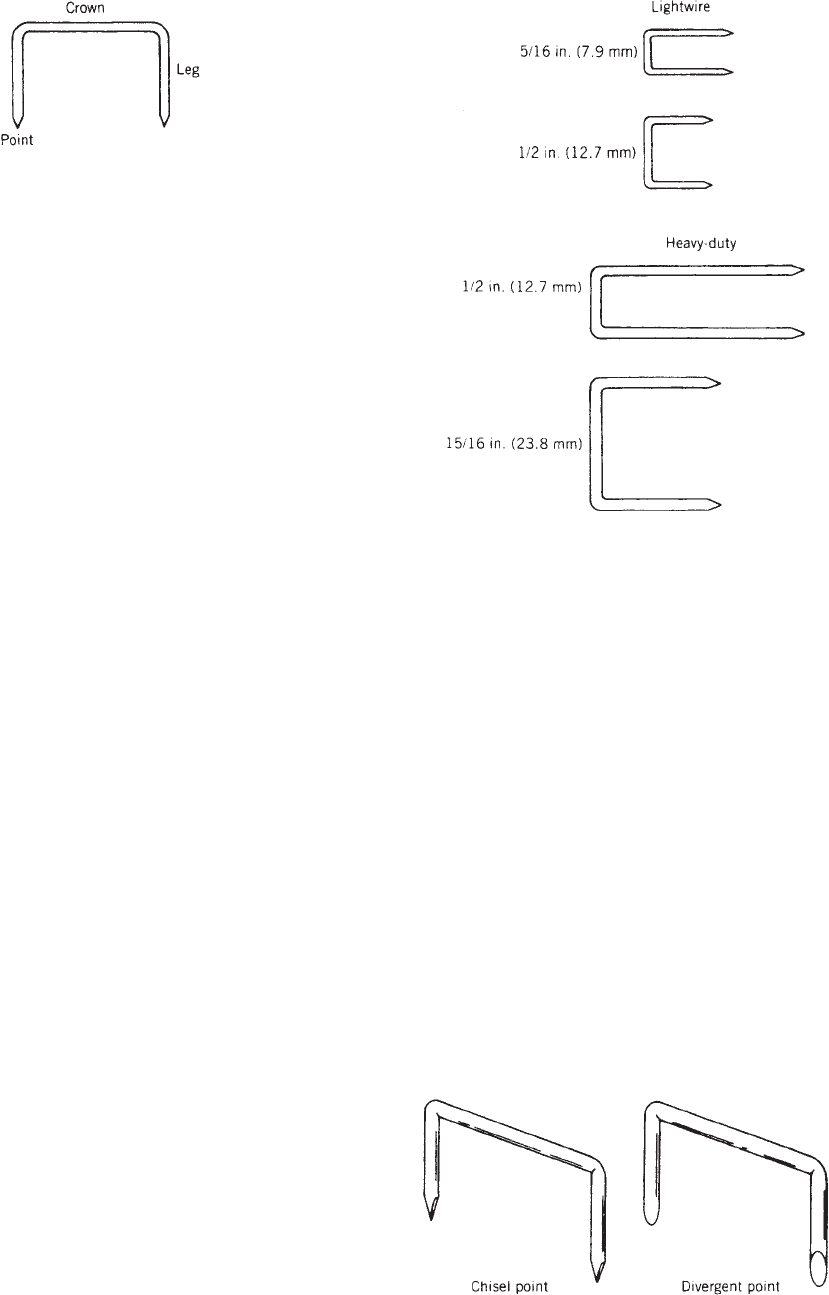
The staple has three basic parts: the crown, two legs,
and two points (see Figure 1). In selecting the proper
staple, four factors must be considered: wire size (gauge),
crown width, leg length, and type of point.
WIRE SIZE
Heavy-duty staples are designated by the gauge (ga) of the
wire prior to manufacturing the staples.
16 ga ¼ 0:062 in: ¼ 1:587 mm
15 ga ¼ 0:072 in: ¼ 1:829 mm
14 ga ¼ 0:080 in: ¼ 2:032 mm
In packaging applications, 16-gauge is the most com-
mon. Heavier-gauge staples are used if a particularly
strong combination of holding power and shear strength
is required, as in the assembling of some heavy-duty skids.
Lightwire staples are designated by the width of the wire
after manufacturing; for example, ‘‘30’’ is equivalent to
0.030 in. (0.762 mm) finished width; ‘‘50’’ is equivalent to
0.050 in. (1.270 mm) finished width. A ‘‘50’’ staple is hea-
vier and more power is required to drive it.
CROWN WIDTH
The widths most common in packaging are shown in
Figure 2.
The staple used most frequently for packaging applica-
tions is the heavy-duty 1/2 -in. (1.3-cm) crown. The wide-
crown 15/16-in. (2.4-cm) heavy-duty staple is used to
prevent pull-through on attachment of porous materi-
als—for example, fastening a corrugated box to a wooden
skid. The wide-crown staple is also used over steel strap-
ping to secure it in place. Lightwire staples are used to
attach identification tags to the outside of wooden boxes.
Plastic liners are attached to boxes with lightwire staples
as well. These are just a few of the numerous applications
for heavy-duty and lightwire staples in packaging.
LEGS
A staple has two legs of equal length. The staple must be
long enough to penetrate the receiving member with
sufficient length to adequately hold two pieces of material
together. The stress of the application must be considered
in order to determine the minimum allowable penetration
of the staple in order to do the job.
POINTS
Staple points are cut at different angles to meet various
application requirements (see Figure 3). A divergent point
causes the staple legs to divert in opposite directions when
it is driven into the wood. This type of point is advanta-
geous when clinching is required. Clinching is the process
of bending the staple points over the opposite side of the
work piece. The staple legs penetrate the wood members
then strike a steel plate diverting the points back into the
wood. The chisel point, which is designed to cut through
the wood without diverging, is the most common in the
industry.
Figure 1. Three basic parts of the staple.
Figure 2. Common crown widths.
Figure 3. Staple points.
1160 STAPLES

BIBLIOGRAPHY
J. R. Charters, ‘‘Staples’’ in M. Bakker, ed., The Wiley Encyclope-
dia of Packaging Technology, 1st edition, John Wiley & Sons,
New York, 1986, pp. 615–616; 2nd ed., R. J. Brody and K. S.
Marsh, eds., 1997, pp. 856–857
General References
Products 1, Paslode Company, Lincolnshire, IL, 1979.
Paslode Products, Paslode Company, Lincolnshire, IL, 1983.
STATIC CONTROL
H. SEAN FREMON
Cole Static Control, Inc., Akron,
Ohio
Since its inception in the packaging industry approxi-
mately 80 years ago, static control has become an integral
part of packaging processing. As machinery speeds have
increased and materials have changed from paper to
plastics and combination laminates and coatings, the
need for static control has rapidly expanded.
As a result, the last 10 years have seen the greatest
increase in the use and development of static control
products to enhance manufacturing processes.
Static is the excess or deficit of electrons on a material.
A regular nonpolar atom has a nucleus with a positive
charge and negatively charged electrons orbiting it. When
one atom comes in close proximity to another, electrons
from the orbit draw or tear away electrons, leaving one
atom with an excess of electrons and the other with a
deficit. This process, called ionization, leaves the atom
with the excess carrying a negative charge, while the one
with the deficit carries a positive charge.
CAUSES OF STATIC
Static in packaging manufacturing is caused by friction,
separation, heat change and improper grounding. Packa-
ging and material handling equipment often incorporate a
combination of these to accomplish its function.
Friction
Static is most commonly caused by friction, the rubbing of
two materials during packaging processing. When a plas-
tic substrate in web form rubs over a steel roller, or when a
pouch is shaped around a forming collar on a vertical form
fill seal machine, for example, the plastic picks up the
negative charge while the steel roller carries the positive
charge. Because metal is such a good conductor, however,
the positive charge is bled off. The charge on the plastic
is not.
Table 1 shows the likely relative polarity a material will
exhibit if it is rubbed with another. The material higher on
the chart will hold a positive charge, while those in the
lower positions will hold the negative charge.
Separation
When material separation occurs, such as the unwinding
of packaging material on a form–fill–seal machine, static
charges are produced at the tangent of the unwind. This
can result in very high charges that attract dust and
contaminants and can cause operator shock hazards. Any-
one who has handled Scotch tape may recognize this
phenomena. As a piece of tape is pulled off its roll and
the tape wraps around itself, it becomes difficult to handle
because static has occurred from the separation.
Heat Change
The change in heat during the thermoforming, injection
and blow molding of packaging products can cause static
charges. As plastic is melted to shape and removed from
its appropriate tooling, it undergoes a cooling process that
can add more static to existing products. As a part cools,
its charge increases and can draw existing dust from the
plant atmosphere. In extreme situations, the dust can
draw to the product surface and adhere to the hot part,
making it nearly impossible to remove later. If the parts
undergo additional manual operations, such as bottle
printing or container sealing, operators are susceptible
to shock (see also Thermoforming).
Improper Grounding
One of the common misconceptions in static control is that
if a machine is grounded, no static can be present. How-
ever, despite grounding efforts from the material to
Table 1. Triboelectric Series
Air Positive charge
Human skin
Rabbit fur
Glass
Human hair
Nylon
Wool
Silk
Aluminum
Paper
Cotton
Steel
Wood
Hard rubber
Nickel, copper
Brass, silver
Gold, platinum
Acetate fiber (rayon)
Polyester
Cling film
Polyethylene
PVC
Silicon
Teflon Negative charge
STATIC CONTROL 1161
ground, there can be blocked passages in the form of
greased bearings, poor metal-to-metal connections and
charges too high to be properly grounded. Because many
packaging products are insulators, partial static reduction
can be attained, but full grounding is impossible.
Results of Untreated Static Electricity
The development of static-related problems are often
inevitable in the manufacturing environment and can
lead to a variety of different problems.
Production Problems and Slow Downs
A static charge generates an electrical field that acts like a
magnet, repelling similar charges and attracting opposite
or neutral charges. This accounts for the attraction be-
tween charged materials and machine frames or rollers
causing machine jams. In many cases, the machine op-
erator will be forced to run at slow speeds to avoid the
problems caused by static.
Dust Attraction
Many products, such as plastic molding materials and
film, develop high static charges on their surfaces. This
highly charged surface will attract airborne dust, some-
times from more than three feet away, and hold it tightly
to the surface. This can lead to high scrap rates. Subse-
quent operations (such as molding, printing, or laminat-
ing) and their end products can be seriously affected by
such difficult-to-remove contamination.
Shocks to Personnel
When handling highly charged material, people receive
unpleasant shocks either directly from material or indir-
ectly. This can become a safety issue if the operator, after
being shocked, recoils into other moving machinery in the
plant.
Fires and Explosions
Static is usually found on nonconductive materials where
high resistivity prevents the movement of the charge.
There are at least two situations where the static charge
an move quickly and be dangerous in a combustible
atmosphere. The first is where a grounded object intensi-
fies the static field until it overcomes the dielectric
strength of the air and allows current to flow in the form
of a spark. The second case is where the charge is on a
floating conductor such as an isolated metal plate. Here
the charge is very mobile and will flash to a proximity
ground at the first opportunity.
Damage and Interference in Electronic Components
Strong static fields and static discharges can cause inter-
ference with electronic equipment. This can cause metal
detectors to malfunction, ink-jet printer boards to burn
out, and weighing equipment to give false readings.
TYPES OF STATIC CONTROL DEVICES
Active/Electrical Ionizers
Active electrical ionizing equipment, one of the most
effective ways of eliminating static charges, is seen in
nearly every large packaging plant that processes plastic
or paper at high speeds. These units create ionization by
forcing high voltage to ground and breaking down air
molecules in between into low levels of ozone. This makes
available millions of free positively and negatively
charged ions and effectively ‘‘feeds’’ away the static charge
by ‘‘matching up’’ ions of opposite charges. Active ionizing
equipment comes in many shapes and sizes, including
alternating current (ac) bars or rods, blowers, nozzles, and
air curtains, steady-state direct current (dc), and pulsed
dc units.
Electrical ionizers are driven by power supplies, which
transform 110 V or 220 V into voltage ranging from 4500 V
to 14,000 V while lowering amperages to a safe level. This
equipment is normally custom manufactured and retrofit
to the machine it serves. If this equipment is not employed
properly, it is useless in packaging applications.
Many bar- or rod-type units are used in web and sheet-
based applications, while air-driven units are used for
static control on asymmetrical parts such as closures, jars,
or thermoformed packages. Most electrical ionizers cannot
be used in hazardous areas.
Static Bars. Static bars are most often used in web-
based applications in the packaging industry. This equip-
ment is necessary on many form–fill–seal, overwrapping,
tamper evident sealing, and stretch wrapping machines.
Bars are normally placed within close proximity to the
web and do not require any air to operate. Most bar-type
ionizers must be within three in. of the substrate as it
passes beneath the bar(s).
Air Ionizers. Air ionizers, driven by small fans, com-
pressed air or large blowers for large parts, are used for
static control on asymmetrical products. In conveying,
unscrambling, filling, denesting, and sorting operations,
air ionizers may be necessary to prevent parts from
sticking together, prevent operator shock, or eliminate
dust attraction.
Nozzles, Guns, and Pinpoint Ionizers. Nozzles are used
in packaging to clean packaging products and to eliminate
static and dust. An example of this is during composite can
cleaning. Ionizing guns are used in more manual environ-
ments where cycle times afford the luxury of cleaning each
unit. Pinpoint ionizers are used in powder filling, for
example, when a small area must be ionized with a small
piece of equipment. Powder filling operations often use
pinpoint ionizers to discharge materials.
Steady-State DC.
Steady-state DC generators allow the
production
of a desired
polarity, positive or negative or
both, which makes them ideal for high-speed webs where
the polarity of the material is known. This allows control
1162 STATIC CONTROL
of static with higher voltage where conventional lower-
voltage AC static control is less effective.
Pulsed DC. Pulsed DC controllers allow adjustment of
positive and negative ions and control of the frequency of
ions, in hertz, that the unit produces. This type of equip-
ment is used in clean room and benchtop applications
where the use of air is not allowed or where large areas
need to be ionized. A ‘‘cloud’’ of ions is produced, making it
ideal for hand packaging of medical devices, for example.
Passive
Passive static control incorporates grounding and conduc-
tive materials. Gold and silver are excellent conductors
but cost-prohibitive. Carbon fiber, stainless steel, and
phosphor bronze are more commonly used passive static
control devices in the packaging industry. However, tinsel
remains most commonly seen because of its low cost and
availability. It is recognized by its similarity to Christmas
garland. Tinsel is usually loosely tied to the frame of a
machine’s ground. Its effectiveness is considered mixed,
but if it reduces static to an acceptable level, it does away
with the need for more expensive electrical ionizers.
Nuclear Ionizers
Nuclear ionizers, radioactive ionizing devices, incorporate
polonium-210, an alpha-emitting isotope. When the alpha
particles collide with an air molecule, it creates thousands
of positive and negative ions without the use of electricity.
This makes nuclear ionizers ideal for explosion-proof
environments where electricity cannot be used and the
possibility of an electrically related spark can exist. Coat-
ing and chemical packaging are examples of plants where
nuclear ionizers must be used for static control. Most
nuclear ionizing units have an active life of approximately
one year, after which they must be returned and refilled.
The Nuclear Regulatory Commission requires yearly
registration of these devices, which must be continually
leased instead of owned. The cost of leasing nuclear static
control devices versus buying electrical ones is much
higher and can make them cost-prohibitive. If a nuclear
unit is damaged, the site can be susceptible to strict clean-
up requirements by the NRC.
Static Generators
Static generators are used to temporarily bond materials
together, generally in web handling processes. Static
generators work the same way as static eliminators,
except that a ground is not present locally. It is placed
on the opposite side of the materials passing between
forcing two substrates to accept the ionization, thereby
pinning them. Static generators operate on DC, allowing
polarity control in packaging operations. Examples of
static generator use in the packaging industry include
air bubble removal, overwrapping, laminating, in-mold
decorating, and heatshrink packaging.
Static control devices, when used properly, can make a
great deal of difference in production efficiency and overall
costs. It is important that you meet face-to-face with your
static eliminator supplier or know your application well
when you are specifying or purchasing to assure the
equipment is necessary and correct for the application
intended. When ionizers results are minimal, it is usually
because equipment is improperly placed or the wrong
equipment is being used.
In the packaging industry, static ‘‘problems’’ are rela-
tive. In one plant, such as a plastic bag converting plant,
charges of 10,000 V may be barely noticed. In another
plant, such as a medical device packager, charges as low as
1000 V may be attracting airborne dust and foreign mat-
ter. It is important to know what actions can be taken to
remove existing problems relating to static and to what
extent they will enhance the packaging manufacturing
and material handling operations.
STRUCTURE/PROPERTY RELATIONSHIPS OF
PACKAGING MATERIALS
KIT L. YAM
Department of Food Science,
Rutgers University, New
Brunswick, New Jersey
The properties of materials are closely related to their
structures. This article provides an introductory under-
standing of the structure/property relationships of packa-
ging materials. Four levels of atomic and molecular
structures are discussed: (a) chemical constituents, what
atoms are composed in the material; (b) chemical bonding,
what forces hold the atoms together to form a molecule; (c)
intermolecular forces, what forces attract molecules to-
gether to form a material; and (d) spatial arrangements,
how molecules are arranged in three-dimensional space.
Although each level has distinct characteristics, the four
levels are closely related, with each level affecting the
sequential levels in determining the observed material
properties.
In a large sense, the first two levels of structures—
chemical constituents and chemical bonding—are respon-
sible for the chemical properties of the materials. Chemical
properties determine the sensitivity of a material to che-
mical changes, which involve breaking chemical bonds to
transform part or all of the original material into new
substances. Examples of chemical changes important to
packaging include oxidation, corrosion of metal containers,
and incineration of packaging wastes. However, the last
two levels of structures—intermolecular forces and spatial
arrangement—are responsible for the physical properties
of materials. Physical properties determine the physical
behavior of a material under conditions, such as heat,
pressure, and concentration gradient, which do not involve
breaking chemical bonds and forming new substances.
Examples of physical properties important to packaging
include gas permeation through package walls, migration
of volatile compounds from package to food, and shock and
vibration during distribution.
STRUCTURE/PROPERTY RELATIONSHIPS OF PACKAGING MATERIALS 1163

CHEMICAL CONSTITUENTS
The first level of structure considers the chemical consti-
tuents, which are the atoms composed in the packaging
material. These atoms determine what type of chemical
bonds can be formed and what chemical properties can be
expected. In general, consumer packages are constructed
of four basic types of materials (plastics, paper, glass, and
metals) with chemical constituents shown in Table 1. It is
important to note that plastics and paper are carbon-
based organic materials, whereas glass and metal are
inorganic materials, because this categorization has pro-
found implications on their properties, sources of raw
material, manufacturing technologies, and economic va-
lue. Like most organic materials, plastics and paper are
inherently lighter, weaker, and more susceptible to che-
mical reactions than inorganic materials such as glass
and metals.
Although most packages are made of single materials,
some packages are made of two or more different materi-
als to provide the necessary functionalities for certain
applications. For example, aseptic cartons for milk and
juices are made of a laminate consisting of 70% paper, 6%
aluminum (Al), and 24% polyethylene (PE). The typical
structure of the laminate is PE/paper/PE/Al/PE, in which
the paper layer provides strength and stiffness, the thin
aluminum foil layer provides gas and light barrier; the
polyethylene layers provide inner and outer protection,
heat sealing, and binding between paper and aluminum.
CHEMICAL BONDING
The second level of structure is chemical bonding that
determines how atoms are bound together to form a
molecule. A chemical bond is formed when the outermost
electrons from two atoms interact with each other to
achieve a lower and more stable energy state. These
interactions involve sometimes the transferring of elec-
trons to form ionic bonds and sometimes the sharing of
electrons to form covalent bonds or metallic bonds, de-
pending on the electronegativities of the atoms (i.e., their
abilities to attract electrons). Ionic, covalent, and metallic
bonds are known as primary bonds, which are character-
ized by strong bond strengths as shown in Table 2.
Some properties of materials generally associated with
the different types of chemical bonding are shown in
Table 3.
Ionic Bonding. An ionic bond is formed when two atoms
come together to transfer one or more electrons between
each other. For example, a sodium atom will transfer an
electron to a chloride atom to yield a Na
+
ion and a Cl
ion:
Na atom Cl atom
Na
+
ion
Cl
−
ion
The electrostatic attraction binding the oppositely
charged ions together is known as the ionic bond.
Formation of an ionic bond occurs between two atoms of
greatly different electronegativities. Typically, one atom is
a metal (such as Li, Na, Al, or Fe) because of its tendency
to donate electrons, and the other atom is a nonmetal
(such as O, F, S, or Cl) because of its tendency to accept
electrons. Ionic materials are strong, hard, brittle, and
resistant to aggressive chemicals, and they also have a
high melting point.
Compared with covalent and metallic bonds, ionic
bonds are found less commonly in packaging materials.
Nevertheless, ionic compounds are found in protective
layers for packaging applications, such as alumina
(Al
2
O
3
) on foil and tin oxide (SnO
x
) on tin plate. Ionic
bonds are also found in ionomers, which are copolymers
that contain both ionic and nonionic repeat units. Shown
below is the chemical structure of Surlyn (DuPont,
Wilmington, DE), which is an ionomer polymer (see
the Inomer article) that contains a small portion of
Table 1. Chemical constituents, chemical bonds, and intermolecular forces in packaging materials
Material Commonly found atoms Chemical bond Intermolecular forces
Plastics Major: C, H C–C backbone, ionic van der Waals forces
Minor: O, N, Cl, etc.
Paper C, H, O Covalent van der Waals forces
Glass Major: Si, O Covalent, ionic Ionic solid
Minor: Na, K, Ca, Al, etc.
Metals Major: Fe, Al Metallic Coulombic forces
Minor: Cr, Sn, etc.
Table 2. Typical bond strengths of chemical bonding and
intermolecular forces
Interaction type
Bond energy
(kJ mol
1
)
Chemical bonding Covalent bonds 200–800
Metallic bonds 100–400
Ionic bonds 40–500
Intermolecular forces Hydrogen bonds 4–40
Dipole–dipole forces 0.15–15
Ion–dipole 5–60
Dispersion forces 0.4–4
1164 STRUCTURE/PROPERTY RELATIONSHIPS OF PACKAGING MATERIALS

methacrylic acid partially substituted with Na in its
carboxyl group:
O
−
Na
+
OC
OH
H
C
H
H
C
H
x
C
H
C
H
y
CH
3
CH
3
OC
C
H
C
H
z
The ionic groups in an ionomer may interact each other
to form a cluster with ionic bonds as shown in Figure 1.
This type of bonding may be considered partly as intra-
molecular bonding and partly as intermolecular interac-
tion. The ionomer is used as sealant between a plastic
layer and a foil in packaging applications where excellent
heat sealability and hot tack are required.
Metallic Bonds. Metallic bonds are found in aluminum
foil, metal containers, and other metal-containing packa-
ging materials. Atoms in metal typically have low electro-
negativities and are willing to share electrons freely, not
only with neighbor atoms but also with all other atoms in
the lattice. For example, Figure 2 shows the formation of
metallic bonding, when aluminum atoms lose their outer
electrons, become positively charged Al
+3
ions, and those
electrons in turn form a ‘‘sea of electrons’’ to surround the
regularly spaced Al
+3
ions. It is important to note that the
electrons in metallic bonds are ‘‘delocalized’’ or free, which
means that they are nondirectional and free to move in all
directions in the lattice, unlike the electrons in covalent
bonds that are bound to specific atoms and locations.
Metallic bonds are largely responsible for the strength,
malleability, and ductility of metals. Malleability is the
ability to be hammered into various shapes; and ductility
is the ability to be drawn out into thin wires, whereas the
shape of the material is changed without cracking or
breaking in both cases. Therefore, a metallic material
such as an aluminum sheet may be rolled into a thin
aluminum foil, or an aluminum disk may be hammered
into cups used for the popular soda cans.
To explain why metallic bonded materials are malle-
able and ductile, Figure 3 shows several layers of metal
ions held closely together.
Although strong, metallic bonds are not bound to
specific metal ions. Hence, forces from hammering or
stretching can cause layers of metal ions to slide over
each another. As the metal ions move, they also attract the
delocalized electrons to their new locations, whereas the
sea of electrons is not broken and still holds the metal ions
together.
Metallic bonds are also responsible for high electrical
and thermal conductivities of metals. The high electrical
conductivity may be explained by the ability of the delo-
calized electrons to flow freely in the lattice of positive
metal ions when a voltage is applied. The high thermal
conductivity may be explained by the ability of metal ions
to absorb heat energy by vibrating faster. Because the
metal ions are closely packed in the lattice, the faster
vibrating ions can collide with their neighboring ions to
transfer the heat energy.
Covalent Bond Model. Covalent bonds are the most
abundant chemical bond found in plastics, paper, and
glass. A covalent bond is formed when two atoms come
together to share their outermost electrons. Typically,
these atoms have high and similar electronegativities,
which means that they have strong affinity to electrons
and are willing to share them with their partner atoms.
These atoms are from nonmetal elements (such as C, O, N,
and Cl) located on the right side of the periodic table. As
an example, shown below are two oxygen atoms sharing
Table 3. Properties associated with chemical bonding
Property Ionic bond materials Covalent bond materials Metallic bond materials
Melting and
boiling points
High melting and boiling points
because of strong attractions
between atoms (ions)
Relatively low thermal
transition temperatures
caused by weak attractive
forces between molecules
High melting and boiling points
caused by attraction of metal ions
with the delocalized electrons
Electrical and
thermal
conductivity
No electric conductivity and poor
thermal conductivity because of the
absence of mobile charged particles
The electron sharing makes
the electrons tightly
bound to atoms, thus no
charge available for
conductivity
High conductivity because of easy
transmission of vibration energy
through the ‘‘electron cloud’’;
metallic luster coming from free
electrons
Mechanical
properties
(hardness and
brittleness)
Generally hard because the ions are
strongly bound to the lattice; also
often brittle because of strong
repulsion between equal charges at
close proximity at the distortion
Generally soft because the
intermolecular bonds are
weak and easily displaced
Dense, hard, and strong with tightly
packed atoms in the lattice;
malleable and ductile as the
distortion is possible without
disrupting the interatomic bond
Ionomer
molecules
Figure 1. Ionic interactions in ionomer molecules.
STRUCTURE/PROPERTY RELATIONSHIPS OF PACKAGING MATERIALS 1165
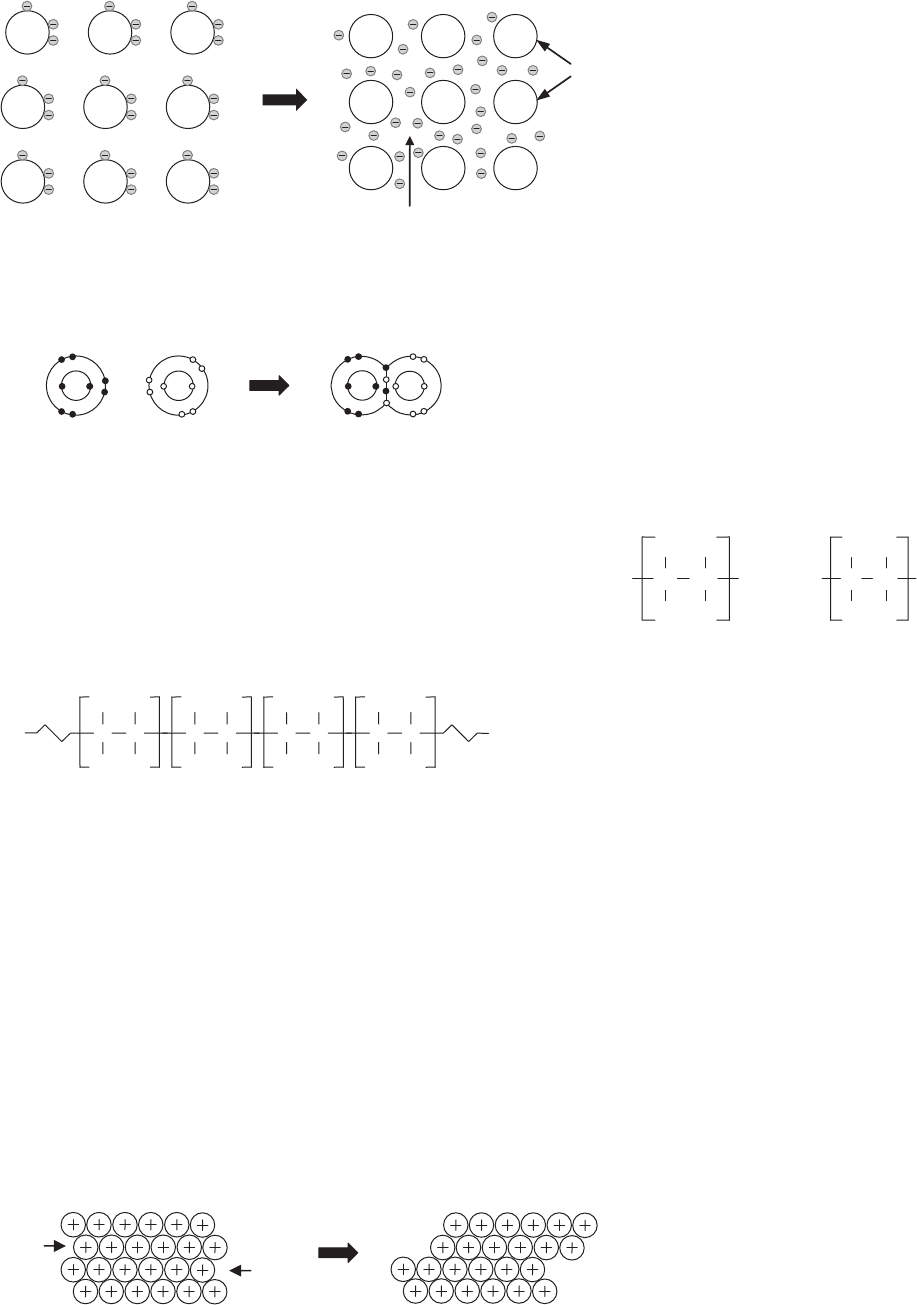
two pairs of outermost electron to form an oxygen mole-
cule joined by a double covalent bond:
Two ox
yg
en atoms One ox
yg
en molecule
Although small molecules such as O
2
and H
2
O are
important to products such as food, the molecules in
packaging materials are much larger and more complex.
For example, polyethylene (PE), which is the most fre-
quently used packaging polymer shown below, is a mole-
cule consisting of thousands of C–C and C–H covalent
bonds:
H
C
H
H
C
H
H
C
H
H
C
H
H
C
H
H
C
H
H
C
H
H
C
H
For a polymer molecule, the degree of polymerization
determines the number of covalent bonds and thus mole-
cular weight, which affects the property and performance
of the material. Although C–C and C–H bonds are the
most common, CQC, CQO, O–H, and other covalent
bonds are also frequently found in plastics and paper.
The most common covalent bond in glass is Si–O.
An important attribute of a covalent bond is bond
polarity, which is determined by the difference in electro-
negativities between the atoms joined by the bond. When
the difference is zero or negligible, the electrons are
shared equally between atoms, and a nonpolar covalent
bond such as C–C is formed. When the difference is small
but significant, the electrons are no longer shared equally
between atoms, and a polar covalent bond such as CQOis
formed. When the difference is large, the electrons are no
longer shared but are transferred from one atom to
another, and an ionic bond is formed.
Bond polarity can greatly affect the polarity of the
molecule and thus the properties of the material. If all
its bonds are nonpolar, the molecule is also nonpolar. If
some of its bonds are polar, the molecule could be polar or
nonpolar, depending on the symmetry of the molecule.
This concept is illustrated by considering the covalent
bonds in two common packaging polymers, polyvinyl
chloride (PVC) and PE:
PVC (
p
olar) PE (non
p
olar)
n
H
C
H
H
C
H
n
H
C
H
Cl
C
H
Because C–H and C–Cl are both polar bonds, PVC is a
polar molecule. But PE is a nonpolar molecule, because its
C-H bonds are arranged symmetrically in such a manner
that the dipoles cancel out, which results in no net dipole.
The more polar the molecule, the stronger are the inter-
molecular forces, and the stronger intermolecular forces
accounts for the reason why PVC has higher mechanical
and barrier properties than PE.
Covalent bonds may be broken when packaging mate-
rials such as plastics and paper are exposed to severe
conditions, such as aggressive chemicals, high tempera-
ture, and high shear. High temperature, for example, is
encountered during heating of food packages in the micro-
wave oven (especially when a heating device known as
susceptor is used in the package) or in the conventional
oven. High temperature and high shear are frequently
encountered during the processing of polymers such as
extruding polymer resins to form plastic films or contain-
ers. A major concern associated with the breakage of
chemical bonds is possible formation of undesirable oligo-
mer compounds, which can migrate from package to food.
Al
+3
Al
+3
Sea of electrons
Positive
metal ions
Al
+3
Al
+3
Al
+3
Al
+3
Al
+3
Al
+3
Al
+3
Al
+3
Al
+3
Al
+3
Al
+3
Al
+3
Al
+3
Al
+3
Al
+3
Al
+3
Figure 2. Formation of metallic bonding.
La
y
ers of ions after slidin
g
La
y
ers of ions before slidin
g
Force
Force
Figure 3. Sliding between layers of metal ions.
1166 STRUCTURE/PROPERTY RELATIONSHIPS OF PACKAGING MATERIALS

Covalent bonds are typically stronger than metallic
and ionic bonds. The amount of energy required to break
a covalent bond between two linked atoms is known as
bond dissociation energy. Some covalent bond energies
relating to packaging materials are shown in Table 4.
It needs to be mentioned that a molecule may have
more than one type of chemical bond. For example,
ionomer is a packaging polymer that consists of mostly
of covalent bonds and a small but significant number of
ionic bonds (Na
+
or Zn
+
ions) to its side chains. Its
covalent-ionic nature provides ionomer with unique prop-
erties (heat seal strength, abrasion resistance, and melt
elasticity) not found in polymers with only covalent bonds.
INTERMOLECULAR FORCES
The third level of structure considers the intermolecular
forces that attract molecules together. Although atoms are
bond together tightly by strong covalent bonds to form a
molecule, a group of molecules are held together loosely by
weak intermolecular forces. Typically covalent bonds are
10–100 times stronger than intermolecular forces. Inter-
molecular forces can be cohesive between like molecules in
surface tension or adhesive between unlike molecules.
Plastics and paper are composed of polymer molecules,
and their physical properties are greatly influenced by the
intermolecular forces between these molecules. When a
PE film is punctured or melted, what are broken are only
the intermolecular forces that hold the PE molecules,
whereas the much stronger covalent bonds holding the C
and H atoms remain unaffected. The weak intermolecular
forces are largely responsible for the low strength and low
melting point of these materials.
However, glass and metal are not composed of a collec-
tion of molecules. A glass or metal material is composed of
a single giant molecule, in which all the atoms are bound
together by primary bonds to form a network. Glass is a
network of Si-O bonds extending throughout the lattice,
and metal is a network of metallic ions held in the sea of
electrons. Hence, cutting a metal container involves
breaking metallic bonds, and shattering a glass bottle
involves breaking covalent bonds. Metal and glass are
inherently stronger and stiffer than plastics and paper,
because metallic bonds and covalent bonds are much
stronger than intermolecular forces.
Intermolecular forces, which are often called van der
Waals forces, correspond to a combination of different
ways of attraction among molecules according to their
dipole moment (dipole–dipole, dipole-induced dipole, and
dispersion forces). Dispersion forces are the weakest
intermolecular force (one hundredth-one thousandth the
strength of a covalent bond), hydrogen bonds are
the strongest intermolecular force (about one-tenth the
strength of a covalent bond): dispersion forcesodipole-
dipole interactionsohydrogen bonds.
Dipole–Dipole Forces. Dipole–dipole forces are intermo-
lecular forces between polar molecules: There are attrac-
tive forces between the positive end of one polar molecule
and the negative end of another polar molecule. They have
a significant effect only when the molecules involved are
close together (touching or almost touching). Dipole–
dipole forces have strengths that range from 0.15 to
15 kJ mol
1
, being much weaker than ionic or covalent
bonds.
Consider the chemical structures of two polar mole-
cules, PVC and ethylene vinyl alcohol copolymer (EVOH):
PVC EVOH
n
H
C
H
Cl
C
H
n
H
C
H
H
C
H
m
H
CC
H
OH
H
For PVC, each C–H bond is polar because carbon is
more electronegative than hydrogen, and the C–Cl bond is
polar because chlorine is more electronegative than either
carbon or hydrogen. Each hydrogen atom will take on a
partial positive charge, and the chlorine atom will take on
a partial negative charge resulting in a net dipole because
the dipoles will not cancel out because of the difference in
electronegativities of carbon, hydrogen, and chlorine. For
EVOH, vinyl alcohol part is polar because the OH group is
more electronegative than hydrogen. When these molecu-
lar chains are in close proximity, dipole–dipole attractions
are formed.
Hydrogen Bonding. This is a special type of dipole–
dipole interaction. It occurs when a hydrogen atom is
covalently bonded to a small highly electronegative atom
such as nitrogen or oxygen. The result is a dipolar
molecule. The hydrogen atom has a partial positive charge
and can interact with another highly electronegative atom
in an adjacent molecule (again N, O, or F). This results in a
stabilizing interaction that binds the two molecules to-
gether. Hydrogen bonds vary in their bond strength from
about 4 to 40 kJ mol
1
being much weaker than typical
covalent bonds, but are stronger than dipole–dipole or
dispersion forces.
Hydrogen bonding is important for some paper and
plastic packaging materials. For example, the high oxygen
barrier of EVOH is largely caused by the formation of
hydrogen bonding between the EVOH molecular chains.
Table 4. The strength of some selected covalent chemical
bonds at 251C
Bond
Bond energy
(kJ mol
1
) Bond
Bond energy
(kJ mol
1
)
C–Cl 338 O–H 463
C–F 565 C–C 348
O–O 146 CQC 612
Si–O 466 C–N 305
C–H 412 C–O 360
N–H 388 CQO 743
STRUCTURE/PROPERTY RELATIONSHIPS OF PACKAGING MATERIALS 1167