
Yam, Kit L. (ed.). The Wiley encyclopedia of packaging technology
Подождите немного. Документ загружается.

CALCULATING MAXIMUM INSTANTANEOUS
DELIVERY RATE
The acronym MIDR (maximum instantaneous delivery
rate) is used interchangeably with IPDR (instantaneous
pump delivery rate). MIDR is the amount of adhesive that
a pump would need to supply if its associated guns were
fired continuously for a specified period of time. Useful
units for measuring MIDR are pounds per hour (lb/h) and
grams per minute (g/min).
To calculate the MIDR for a specific application, follow
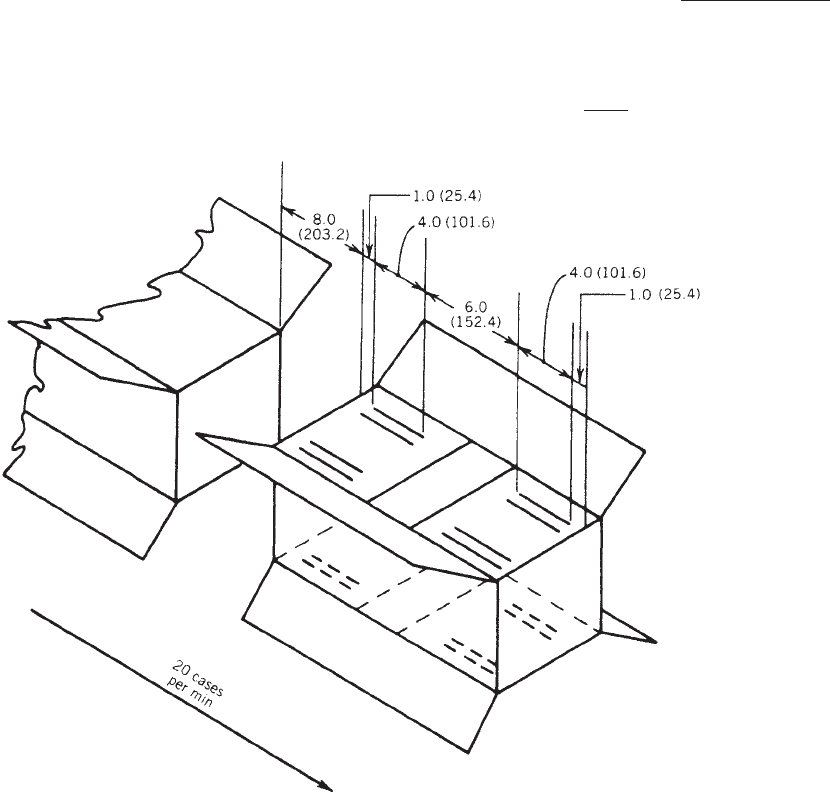
the steps in the example below. Refer to Figure 18 for a
visual description of the physical parameters used in the
calculation.
Given
1. Four beads per flap, top and bottom sealing, for a
total of 16 beads per case.
2. Case length of 16 in. (41 cm).
3. Production rate of 20 cases per min at 100% machine
efficiency.
4. Bead length of 4 in. (10 cm), 1 in. (2.5 cm) from case
end, with a 6-in. (15-cm) gap between beads.
5. Eight-in. (20-cm) gaps between cases.
6. Adhesive ‘‘mileage’’ of 700 lineal ft lbf (949 J).
‘‘Mileage’’ is a function of bead size and the specific
gravity of the adhesive. The 700 lineal ft lbf used above is
based on a 3/32-in. (2.4 mm) half-round bead (standard-
size packaging bead) and melt density of 0.82 g/cm
3
(melt
density of standard packaging adhesive). Adhesives of this
type yield approximately 30 in.
3
/lb (1 cm
3
/g).
Calculation
1. Determine the total bead length in in./h (cm/h) and
convert to ft/h (m/h).
ð20 cases=minÞð4 in:=beadÞð16 beads=caseÞ
ð60 min=hÞ¼76; 800 in:=h ð195; 000 cm=hÞ
ð76; 800 in:=hÞð1 ft=12 in:Þ¼6400 ft =h ð1950 m=hÞ
2. Determine the adhesive consumption rate at 100%
machine efficiency using total bead length per hour
and adhesive mileage:
ð6400 ft=hÞð1 lb=700 ftÞð1 g=1:54 mÞ
¼ 9:14 lb=h ð4:15 kg=hÞ
3.
Determine duty cycle
using length of bead during
machine cycle and machine cycle (length between
case leading edges).
8-in: bead length
24-in: cycle length
¼ 0:333
4. Determine the MIDR using the inverse of the duty
cycle and the adhesive consumption rate from step 2.
1
0:333
ð9:14 lb=hÞ¼27:42 lb=h ð207 g=minÞMIDR
Figure 18. Calculating the MIDR for
a specific application. Dimensions are
given in inches (millimeters in
parentheses).
18 ADHESIVE APPLICATORS

This example demonstrates the difference between the
delivery rate and the adhesive consumption rate. When
the guns are firing, the pump is delivering adhesive at a
rate of 27.42 lb/h. This is the MIDR. Speed reducers are
rated and selected according to the MIDR they can
provide. This figure should not be confused with the
consumption rate, because the consumption rate is an
average measure of consumption that includes the time
when adhesive demand is zero.
Several equations may prove helpful in some
applications:
Bead Length, Line Speed, and Duration
5 bead lengthðin:ÞðcmÞ
line speedðft=minÞðcm=sÞ
¼ durationðsÞ
line speedðft= min Þðcm=sÞdurationðsÞ
5
¼ bead lengthðin:ÞðcmÞ
bead lengthðin:ÞðcmÞ5
durationðsÞ
¼ line speedðft=minÞðcm=sÞ
BIBLIOGRAPHY
‘‘Adhesive Applicators’’ in D. H. Shumaker and C. H. Sholl, The
Wiley Encyclopedia of Packaging Technology, 1st edition, Wiley,
New York P&A Division, Nordson Corporation, 1986, pp. 4–14.
General References
G. L. Schneberger, Adhesives in Manufacturing, Marcel Dekker,
New York, 1983.
‘‘Definitions of Terms Relating to Adhesives and Sealants.’’ Adhes.
Age (May 31, 1983).
I. Kaye, ‘‘Adhesives, Cold, Water-Borne;’’ T. Quinn, ‘‘Adhesives,
Hot Melt;’’ and C. Scholl, ‘‘Adhesives Applicating, Hot Melt’’ in
The Packaging Encyclopedia 1984, Vol. 29, No. 4, Cahners
Publishing, Boston, MA, 1984.
1981 Hot Melt Adhesives and Coatings, Technical Association of the
Pulp and P aper Industry, Norcross, GA, 1981 (Short course notes
presented at the T APPI Conference, San Diego, July 1–3, 1981.)
‘‘Calculating Maximum Instantaneous Delivery Rate,’’ Compo-
nents Catalog, P&A Division, Nordson Corporation, Norcross,
GA, 1984, p. A2.
ADHESIVES
IRVING KAYE
National Starch and Chemical
Company, Murray Hill,
New Jersey
Updated by Staff
INTRODUCTION
The packaging industry represents a significant market
for adhesives materials. Some applications include
coatings, which act as adhesive layers for bonding to other
forms of packaging, such as labels or tapes, or are used in
the actual assembly of a carton, or to prepare a laminate.
Adhesives make up more than 80% of the adhesive and
sealants market. In 2002, the global market was about
16.7 million tons and was expected to rise about 3–4% per
year. In the United States, the market was estimated to be
8.89 million tons in 2004; as a comparison, the market in
1999 was 6.89 million tons (1).
The principal uses of adhesves include: the forming and
sealing of corrugated cases and folding cartons; the form-
ing and sealing of bags; the winding of tubes for cores,
composite cans, and fiber drums; the labeling of bottles,
jars, drums, and cases; the lamination of paper to paper,
paperboard, and foil; and the lamination of plastic films
for flexible packaging. The markets for packaging materi-
als are diverse, mainly concerned with food, beverage,
medical, and heavy-duty industrial applications, each of
which can bring stringent performance requirements and
impose harsh environments under which the adhesive
layer is expected to function.
There is a strong movement to replace solvents and
solvent-based adhesives in both the United States and
Europe, in order to minimize volatile organic emissions.
This has led to a growth in water-based and hot-melt
adhesives at the expense of solvented types. Also, there
has been a strong interest in recyclable adhesives based
on requirements for recycled paper content in the United
States and Europe. There is a desire to develop single
material packaging to facilitate recycling and minimize
sorting. A problem is that adhesive residues left in board
can produce difficulties in the subsequent handling of the
regenerated material. Under consideration is the use of
bioadhesives to assist in the material breakdown (2).
There are many types of packaging adhesives, fre-
quently for the same end-use applications, with the choice
dictated by cost, productivity factors, the particular sub-
strates involved, special end-use requirements, and envir-
onmental considerations (see also Adhesives, extrudable).
To help clarify this complex picture involving many dif-
ferent chemical types, it is useful to classify packaging
adhesives into three physical forms: water-based solutions
and dispersions, solvent-based systems, and solvent-free
100% solids and hot melts.
WATER-BASED SYSTEMS
This is the oldest—and still, by far, the largest-volume—
class of adhesive used in packaging. These adhesives
share the general advantages of ease and safety of hand-
ling, energy efficiency, low cost, and high strength. Water-
based adhesives can be further divided into two cate-
gories, natural and synthetic.
Natural Water-Based Adhesives
The earliest packaging adhesives were based on naturally
derived materials—indeed, almost all were until the
1940s—and they still constitute a large segment of the
market. However, they have seen their gradual replacement
ADHESIVES 19
in many applications. Starch and dextrin have been re-
placed by synthetic poly(vinyl acetate) emulsions. However,
starch-based adhesives are still being investigated (3).
Starch. The largest class of natural adhesives is based
on starch; in the United States, this means corn starch.
Some potato starch is used in Europe primarily because of
economics, since they are heavily subsidized. Adhesives
are produced from raw flour or starch, but more frequently
the starch molecule is broken down into smaller chain
segments by acid hydrolysis. Depending on the conditions
of that reaction, the resulting material can be a fluidity or
thin-boiling starch or a dextrin. These can then be further
compounded with alkaline tackifiers such as borate salts,
sodium silicate, or sodium hydroxide, with added plastici-
zers or fillers.
A principal use of starch adhesives is in the manufac-
ture of corrugated board for shipping cases. The standard
process involves suspending ungelatinized cornstarch in a
thin carrier-starch cook as a vehicle. When the bond line is
subjected to heat and pressure, the cornstarch gelatinizes
almost instantly, forming a bond between the flutes and
the linerboard at very high rates of production. Additives
are usually used to improve adhesion, lower gel tempera-
ture, increase water resistance, and further increase
speed of bond formation.
Other important uses of modified starches and dextrins
are in the sealing of cases and cartons, winding of spiral or
convolute tubes, seaming and forming of bags, and adher-
ing the seams on can labels. Glass bottles are frequently
labeled with a special class of alkaline-treated starch
adhesive called a ‘‘jelly gum.’’ These have the special tacky,
cohesive consistency required on some moderate-speed
bottle labeling equipment. Specially modified starches
based on genetically bred high-amylose strains are also
used as primary ingredients in the remoistening adhesive
on gummed tape used for box sealing.
There are many strong points to recommend starch-
based adhesives. They are regarded as very easy to
handle, clean-machining, easy to clean up, and, above
all, inexpensive. Starch has excellent adhesion to paper;
and, being nonthermoplastic, it has outstanding heat
resistance. Starch also has a green, environmentally
friendly image, being ‘‘natural’’ and based on a renewable
resource. The negatives are the relatively slow rate of
bond formation, the limited adhesion to coatings and
plastics, and poor water resistance.
Protein. Another class of natural adhesives is based on
animal or plant protein. Proteins are highly susceptible to
changes in their structure through changes in pH, the
process of denaturation, and breakdown in molecular
weight to effect solubilization.
Soybeans. Soybeans are important sources of both pro-
teins and trigylceride oils. Proteins for adhesives are
obtained from harvested soybeans by extracting and
pressing out the oils and then heating. Soy in combination
with blood or casein seems to exhibit the most water
resistance. Protein-based adhesives are of interest to the
medical industry; however, blood contamination is an
issue (1). Considerable work is being done in this area.
Stable adhesives from urea-denatured soy flour have been
reported (4).
Animal Glue. This is one of the earliest types of adhe-
sive. It is derived from collagen extracted from animal
skin and bone by alkaline hydrolysis. When used as a
heated colloidal suspension in water, animal glues have an
unusual level of hot tack and long, gummy tack range.
However, because of fluctuating availability and cost,
along with the development of improved synthetics, there
are only two significant uses of animal glue in packaging:
(1) as a preferred ingredient in the remoistening adhesive
on reinforced gummed tape use for box sealing and (2)as
the standard adhesive used in forming rigid setup boxes.
Casein. This is produced by the acidification of skimmed
cow’s milk. The precipitated curds thus produced form the
basis of casein adhesives. There is a lack of suppliers of
casein in the United States. The main sources for casein are
Australia, New Zealand, and Poland, but it is also produced
in Argentina and the Scandinavian countries.
There are two packaging applications where casein is
used in large volume. One is in adhesives for labeling glass
bottles, particularly on newer high-speed labelers where
they outperform starch-based adhesives. They are espe-
cially favored for beer bottles, where casein provides the
resistance to cold-water immersion required by brewers,
together with removability in alkaline wash when the
bottles are returned. The second use is as an ingredient in
adhesives used to laminate aluminum foil to paper. Com-
bined with synthetic elastomers such as polychloroprene
or styrene-butadiene lattices, casein provides a unique
balance of adhesion and heat resistance (5).
Natural Rubber Latex. This is extracted from the rubber
tree, Hevea brasiliensis, and is available in several varia-
tions of concentration and stabilization. One major use in
packaging is as a principal ingredient in adhesives for
laminating polyethylene film to paper, as in the construc-
tion of multiwall bags. Natural rubber latex also finds use
in a variety of self-seal applications, since it is the only
adhesive system that will form bonds only to itself with
pressure. This property is used in self-seal candy wraps
(where it is called cold-seal) and in press-to-seal cases, as
well as on envelopes.
Synthetic Water-Based Adhesives
Synthetic
water-based adhesives
are the most broadly
used class of adhesives in general packaging. Almost all
are resin emulsions, specifically poly(vinyl acetate) emul-
sion, which is a stable suspension of poly(vinyl acetate)
particles in water. These systems usually contain water-
soluble protective colloids such as poly(vinyl alcohol) or 2-
hydroxyethyl cellulose ether and may be further com-
pounded by the addition of plasticizers, fillers, solvents,
defoamers, and preservatives.
These emulsions are supplied in liquid form (the ubi-
quitous ‘‘white glue’’) in a range of consistencies from thin
milky fluids to thick, nonflowing pastes. They are used in a
20 ADHESIVES
broad range of packaging applications, to form, seal, or
label cases, cartons, tubes, bags, and bottles. In most of
these uses they have replaced natural adhesives because
of their greater versatility. They can be compounded to
have a broad range of adhesion not only to paper and glass
but also to most plastics and metals. They can be rendered
very water-insensitive for immersion resistance, or very
water-sensitive to promote ease of cleanup and good
machining. They are the fastest-setting class of water-
based adhesives, facilitating increased production speeds.
They are low in odor, taste, color, and toxicity and have
excellent long-term aging stability. They are tough, with
an excellent balance of heat and cold resistance. The
equipment used to apply them is relatively simple and
inexpensive to purchase and to operate. Finally, they are
economical and reasonably stable in cost.
The utility of these emulsion systems has broadened in
recent years with the greater use of copolymers of vinyl
acetate. Copolymerizing vinyl acetate with ethylene or
acrylic esters in particular has greatly improved the adhe-
sion capabilities of these emulsions, particularly where
adhesion to plastics or high-gloss coatings is required. For
example, crosslinking acrylic–vinyl acetate copolymer emul-
sions have replaced polyurethane solution systems for
laminating plastic films for snack packages. The largest
areas of use for vinyl emulsions, however, are in case and
carton sealing, forming the manufacturers joint on cases
and cartons , and the spiral winding of composite cans.
All acrylic emulsion pressure-sensitive adhesives have to
a significant degree replaced acrylic or rubber solution
products in the manufacture of pressure-sensitive labels.
The development of wa ter-based acrylics eliminates a
source of solvent vapors. The development of pressure-
sensitive adhesives compared to other tapes is convenience
of use. There are no storage problems , and no mixing or
activation is necessary. No waiting is involved. Often the
bond is reversible. Disadvantages are that adhesive
strength is low and they are not suitable for rough surfaces .
Polyurethane dispersions have found acceptance in
medium-performance flexible packaging applications la-
minating plastic films together where some chemical
resistance is required.
The use of other synthetic water-based systems is quite
minor and specialized. Some synthetic rubber dispersions
are used in film adhesives and, in conjunction with casein,
for the lamination of aluminum foil to paper. There is
some use of tackified rubber dispersions as pressure-
sensitive masses on tapes and labels replacing solvent-
based rubber–resin systems.
Sodium silicate was once widely used in many paper
packaging applications, ranging from corrugating to case
sealing, but today the primary use of silicate adhesives is in
tube winding, especially in the convolute winding of large
drums or cores where it produces a high degree of stiffness.
SOLIDS/HOT-MELT ADHESIVES
Hot melts are the fastest-growing important class of
adhesives in packaging. Most of their volume goes into
high-speed large-volume case and carton sealing. Hot
melts can be defined as 100% solids adhesives based on
thermoplastic polymers, which are applied heated in the
molten state and set to form a bond on cooling and
solidification. Their chief attraction is the extremely rapid
rate of bond formation, which can translate into high
production rates on a packaging line.
The backbone of any hot melt is a thermoplastic poly-
mer. Although almost any thermoplastic can be used, and
most have been, the most widely used material by far is the
copolymer of ethylene and vinyl acetate (EVA). These
copolymers have an excellent balance of molten stability,
adhesion, and toughness over a broad temperature range,
as well as compatibility with many modifiers. The EVA
polymers are further compounded with waxes and tackify-
ing resins to convert them into useful adhesives. The
function of the wax is to lower viscosity and control set
speed. Paraffin, microcrystalline, and synthetic waxes are
used, depending on the required speed, flexibility, and heat
resistance. The tackifying resins also function to control
viscosity, as well as wetting and adhesion. These are
usually low-molecular-weight polymers based on aliphatic
or aromatic hydrocarbons, rosins, rosin esters, terpenes,
styrene or phenol derivatives, or any of these in combina-
tion. The formulations always include stabilizers and anti-
oxidants to prevent premature viscosity change and char or
gel formation that could lead to equipment stoppage.
Two variations on traditional EVA hot melts have
recently become commercially significant. First, the re-
cent availability of very low-molecular-weight EVA copo-
lymers has made possible EVA hot melt that can be run at
much lower temperatures, 2501F (1211C), rather than the
traditional 3501F (1771C). This allows for much safer
running conditions as well as energy savings. Second, an
analog of EVA, ethylene-butyl acrylate, has been intro-
duced as the backbone polymer in some packaging hot
melts (6), providing advantages in both adhesion and in
heat and cold resistance. Decrease in the application
temperature has lessened safety concerns associated
with this type of adhesive (1).
Another class of hot melts used in packaging is based
on
lower-molecular-weight polyethylene,
compounded
with natural or synthetic polyterpene tackifiers. These
lack the broader adhesion capabilities of the EVA-based
hot melts as well as their broader temperature resistance
capabilities. However, they are economical and are ade-
quate for many paper bonding constructions, and they find
application in case sealing and bag seaming and sealing.
A third type of hot melt is based on amorphous-poly a-
olefin (APAO) polymers. Originally these were based on
amorphous polypropylene, which was widely available as
the byproduct of the polymerization of isotactic polypropy-
lene plastics. As a byproduct, it was inexpensive, but it
suffered from low strength and was limited to applications
such as lamination of paper to paper to produce water-
resistant wrapping material on two-ply reinforced ship-
ping tape. Improvements in polypropylene polymerization
catalysts have almost eliminated this byproduct, but sev-
eral producers noted the market and began producing on-
purpose APAO polymers, albeit at somewhat higher costs.
Another recent class of hot melt is based on thermo-
plastic elastomers: block copolymers of styrene and
ADHESIVES 21
butadiene or isoprene. These find primary application in
hot-melt pressure-sensitive adhesives for tapes and labels
replacing solvent-borne rubber systems. More recently,
their broad adhesion and low temperature and impact
resistance are finding use such as (a) the attachment of
polyethylene-base cups to polyester soft-drink bottles (7)
and (b) the sealing of film laminated frozen-food cartons.
Pressure-sensitive adhesives from high-molecular-weight
block copolymers having a high diblock copolymer are
suitable for PVC film labels and decals (8).
Even more specialized applications use hot melts based
on polyamides or polyesters when specific chemical- or
heat-resistance requirements have to be met, but their
high cost and relatively poor molten stability have pre-
cluded their widespread use to date.
The most recent and highest-performance hot-melt tech-
nology is moisture curing polyurethane hot melts, but these
have been limited to higher-requirement product assembly
applications and have found few uses in packaging.
All hot melts share the same basic advantages, based
on their mechanism of bond formation by simple cooling
and solidification. They are the fastest-setting class of
adhesive—indeed, preset before both substrates can be
wet is the most frequent cause of poor bonds with hot
melts. Because of the wide range of polymers and modi-
fiers used, they can be formulated to adhere to almost any
surface. With no solvent or vehicle to remove, they are
generally safe and environmentally preferred. They are
excellent at gap filling, since a relatively large mass of
material can ‘‘freeze’’ in place, thus joining poorly mated
surfaces with wide dimensional tolerances.
However, all hot melts share the same weakness, which
is the rapid falloff in strength at elevated temperatures.
They also have a tendency to damage substrates that
cannot withstand their application temperature (1). Prop-
erly formulated hot melts can be suitable for almost all
packaging applications, but they are not appropriate for
very hot-fill or bake-and-serve applications.
SOLVENT-BASED ADHESIVES
Solvent-based adhesives, which are by far the smallest,
and most rapidly declining, of the three classes of adhesive
used in packaging, find use in specialized applications
where water-based or hot-melt systems do not meet the
technical requirements.
Rubber–resin solutions are still used as pressure-sen-
sitive adhesives for labels and tapes. However, factors of
cost, safety, productivity, and, above all, compliance with
clean-air laws have led to a strong movement toward
water-based or soilds/hot-melt alternatives. Such alterna-
tives are available to meet most requirements and most
knowledgeable observers predict an almost total disap-
pearance of rubber–resin solvent-based pressure sensi-
tives for packaging tapes and labels in the near future.
Solvented polyurethane adhesives are widely used in
flexible packaging for the lamination of plastic films.
These multilayer film constructions find application in
bags, pouches, wraps for snack foods, meat and cheese
packs, and boil-in-bag food pouches. They have the ideal
properties of adhesion, toughness, flexibility, clarity, and
resistance to heat required in this area. However, here,
too, alternative systems are being introduced to eliminate
the costs, hazards, and regulatory problems associated
with solvent-based systems. Crosslinking waterborne ac-
rylic polymers have gained acceptance in the large snack
food laminating market for constructions such as potato
chip bags. Polyurethane dispersions and (100% solids)
‘‘warm melt’’ systems are starting to find use in some of
the more demanding food packaging applications.
Solvent-based ethylene–vinyl acetate systems found
use in some heat-seal constructions, such as the thermal
strip on form–fill–seal pouches, or on lidding stock for
plastic food containers such as creamers or jelly packs.
BIBLIOGRAPHY
I. Kaye, ‘‘Adhesives’’ in The Wiley Encyclopedia of Packaging, 2nd
edition, John Wiley & Sons, New York, 1997, pp. 23–25.
Cited Publications
1. E. M. Yorkgitis, ‘‘Adhesives’’ in Kirk–Othmer Encyclopedia of
Chemical Technology, 5th edition, Vol. 1, John Wiley & Sons,
Hoboken, NJ, 2004.
2. R. J. Ashley, ‘‘Packaging Industry’’ in D. E. Packham, ed.,
Handbook of Adhesion, 2nd edition, John Wiley & Sons,
Chichester, UK, 2005.
3. S. Peltonen and H. Mikkonen, U.S. Patent 7,264,666 (to Valtion
tecknillen tutkimuskeskus, Finland), September 4, 2007.
4. J. M. Wescott and M. J. Birkeland, U.S. Patent Application
20080021187, January 24, 2008.
5. W. B. Kinney, U.S. Patent 2,754,240, (to Borden Company),
July 10, 1956.
6. F. Brady and T. Kauffman, U.S. Patent 4,816,306 (to National
Starch and Chemical Company), March 28, 1989.
7. T. Taylor and P. Puletti, U.S. Patent 4,212,10 (to National
Starch and Chemical Company), July 15, 1980.
8. D. J. St. Clair and co-workers, U.S. Patent 7,297,741 (to Kraton
Polymrs U.S. LLC), November 20, 2007.
General References
I. Skeist, ed., Handbook of Adhesives, 3rd edition, Van Nostrand
Reinhold, New York, 1990.
K. Booth, ed., Industrial Packaging Adhesives, CRC Press, Boca
Raton, FL, 1990.
D. E. Packham, ed., Handbook of Adhesion, 2nd edition, John
Wiley & Sons, Chichester, UK, 2005.
ADHESIVES, EXTRUDABLE
STEPHEN R. TANNY
DuPont Polymers,
Wilmington, Delaware
In its broadest definition, extrudable adhesives are poly-
meric resins that can be processed by standard extrusion
22 ADHESIVES, EXTRUDABLE
processes and are useful for bonding together various
substrates. In practice, extrudable adhesives are com-
monly polyolefin materials useful in processes such as
blown and cast film, blow molding, and extrusion coating.
OVERVIEW
The variety of polymeric materials available to both
the industrial user and the consumer and are useful as
adhesives include several materials almost equal to the
number of polymer types themselves (see also Adhesives).
Adhesives are developed from such polymers as poly-
vinyl acetate, polyvinyl alcohol, polyamides, polyesters,
and many others. Adhesives can be applied as solvent
solutions, aqueous dispersions, pastes, spray coatings,
tapes, and thermally activated films. One special subset
of adhesives, called extrudable adhesives, are different in
that, in their application, they are applied in an extrusion
process, in which they are melted, conveyed, and inserted
between the substrates that are to be bonded together.
Although there are many adhesive application methods
that require the melting of a polymeric adhesive, extrud-
able adhesives are distinguished from other adhesive
types used in processes such as powder coating, flame
spraying, and the thermal lamination of adhesive films
and webs. As a second distinction, extrudable adhesives
are also distinguished from hot-melt adhesives that
generally require a resin viscosity unsuitable for tradi-
tional extrusion processes. Thus, extrudable adhesives
are those materials specifically designed to function in
processes such as coextrusion blown and cast film, mono-
layer and coextrusion coating and lamination, coextrusion
cast sheet, coextrusion blow molding, and coextrusion
tubing.
TYPES OF EXTRUDABLE ADHESIVE
Extrudable adhesives are most often polyolefin-based
compositions. The most common use of these polyolefin
extrudable adhesives is as a specific layer in a multilayer
coextrusion. Coextrusion is a technique that allows the
creation of a plastic composite, in a single operation, which
combines the benefits of a number of different materials.
The plastic composite may be, for example, a packaging
film that combines the properties of an oxygen-barrier
resin with a heat-sealable layer on one side and an abuse-
resistant layer on the other side. The purpose of the
extrudable adhesive is to bond the diverse plastic materi-
als in the construction that would not, under ordinary
circumstances, bond with each other. The polyolefin ad-
hesive is designed to bond with similar polyolefins by a
diffusion process. That is, during the extrusion process,
the molten extrudable adhesive resin comes in contact
with the molten polyolefin. Their molecules diffuse to-
gether creating a strong bond between the materials (1).
The polyolefin extrudable adhesive is designed to bond
with other polymeric materials, such as oxygen-barrier
resins like polyamides and ethylene vinyl alcohol, through
a chemical reaction between a functional group on the
adhesive and a functional group on the barrier resin.
Often, the functional group on the extrudable adhesive
can be chosen for bonding to specific materials of interest.
Many types of extrudable adhesive exist. Polyethylene
can be considered to be an extrudable adhesive. Com-
monly, polyethylene is used in extrusion lamination of
paper to aluminum foil. The polyethylene is extruded at
very high temperatures. The melt is oxidized by contact
with air creating polar functionality on the surface of the
melt. This process provides chemical bonding to the
aluminum oxide on the surface of the foil (2). The low
viscosity of the melt and its polar nature allows for good
wetting on the paper and for encapsulation of the indivi-
dual fibers. Co-polymers of ethylene and vinyl acetate also
are useful extrudable adhesives and capable of bonding
polyethylene to polyvinyl chloride. However, the most
sophisticated extrudable adhesives are polyolefins with
either acid or anhydride functionality. Acids and anhy-
drides are particularly reactive and can create strong
bonds to several different materials in extrusion pro-
cesses. Examples of acid-modified polyolefins are the co-
polymers of ethylene with acrylic acid or methacrylic acid.
Variations include the partially neutralized acid co-poly-
mers with metal ions referred to as ionomers or terpoly-
mers of ethylene, an acid and an acrylate such as methyl
acrylate or isobutyl acrylate. Acid-containing extrudable
adhesives are widely used to bond with aluminum foil (3,
4). Examples of anhydride modified polyolefins include
terpolymers of ethylene, maleic anhydride, and acrylates
such as ethyl acrylate or butyl acrylate and the anhydride
grafted polyolefins.
The anhydride grafted polyolefins are created by com-
bining the polyolefin with an anhydride, most commonly
maleic anhydride. The anhydride is added to the poly-
olefin with a free-radical initiator in a solvent or the melt.
This addition allows for the attachment of the highly
reactive anhydride to polyolefins, such as high-density
polyethylene, linear low-density polyethylene, polypropy-
lene, ethylene vinyl acetate copolymers, or ethylene pro-
pylene rubbers. Although the polar functionality of the
anhydride and the polyolefin backbone are the necessary
ingredients for the extrudable adhesive to function, al-
most all commercially available extrudable adhesives are
formulated with other polymers. Formulations of anhy-
dride modified extrudable adhesives will generally contain
two or three basic components. Two-component extrudable
adhesives will contain the anhydride graft blended into a
second, or matrix polyolefin (5). The purpose of the second
polyolefin is to lower the overall cost of the adhesive and to
control the viscosity, modulus, tensile, thermal, and other
properties of the adhesive. The three-component formula-
tion will contain the anhydride graft, the matrix polyole-
fin, and a modifier (6). The purpose of the modifier is to
enhance the peel strength characteristics of the bonded
composite. In most cases, the efficiency of the extrudable
adhesive is judged by peeling the bonded composite apart
in a ‘‘T’’ peel mode. The modifier affects the peel strength
characteristics of the adhesive by dissipating the force at
the interface where the composite is being peeled apart.
The
result of this
process is the necessity for more work to
peel apart the bonded composite (7). These extrudable
ADHESIVES, EXTRUDABLE 23
adhesives also can have other additives, such as antiox-
idants, slip agents, or resin tackifiers.
Although the formulation of an extrudable adhesive is
very important to its utility, many other factors also affect
how well an extrudable adhesive will bond different ma-
terials together. How the extrudable adhesive is processed,
its thickness, and whether the bonded composite is or-
iented, shaped, or exposed to aggressive environmental
conditions can affect the performance of the adhesive (8, 9).
COMMERCIAL OFFERINGS
Many producers of extrudable adhesives around the world
exist. Some of these producers will produce only a few
types of extrudable adhesive. Others have a broader
product line. Some manufacturers market their adhesives
internationally; others only market regionally, to specific
market areas, or for use in specific applications. Manu-
facturers of acid copolymers include Dow Chemical Com-
pany as Primacor and E. I. DuPont de Nemours as Nucrel.
DuPont also manufactures acid terpolymers. Ethylene
terpolymers of anhydride with acrylate are produced by
Atochem under the name Lotader. DuPont manufactures
extrudable adhesives based on anhydride graft technology
under the name Bynel. Quantum Chemical Company also
makes and sells extrudable adhesives under the name
Plexar. Other manufacturers include Mitsui Petrochem-
ical Company with Admer, Morton International with
Tymor, Atochem with Orevac, and DSM with Yparex.
EXTRUDABLE ADHESIVE APPLICATIONS
Extrudable adhesives are used primarily in coextrusion
processes (see Coextrusion). The major market area is food
packaging. Examples include the coextrusion coating of an
oxygen-barrier material, extrudable adhesive, and poly-
olefin onto paperboard to create high-barrier, nonscalping
fruit juice cartons. Oxygen barriers, extrudable adhesives,
and ionomers are coextruded by either cast-film or blown-
film processes to produce packaging films for hot dogs,
bacon, and other processed meats. A third example is the
coextrusion blow molding of polyolefin, extrudable adhe-
sive, and oxygen barrier to produce high-barrier ketchup
bottles. Extrudable adhesives also are used in applications
that do not involve the packaging of foods. Extrudable
adhesives are used to bond high-density polyethylene
to ethylene vinyl alcohol in a coextrusion blow-molding
process to produce automotive gas tanks (see Blow mold-
ing). Extrudable adhesives also are used to bond cross-
linked polyethylene to ethylene vinyl alcohol through a
coextrusion crosshead tubing process to make radiant hot-
water heating pipes.
The selection of the proper extrudable adhesive for any
particular application may be a complex problem. The first
consideration is always the materials that need to be
bonded together. The adhesive must be able to bond with
these materials. When bonding a polyolefin with an oxy-
gen barrier, such as ethylene vinyl alcohol or polyamide,
extrudable adhesives with anhydride functionality are
usually the adhesive of choice. The type of anhydride
modified polyolefin will depend on the polyolefin being
co-extruded with the barrier. For example, if polyamide is
being co-extruded with polyethylene, an anhydride-mod-
ified polyethylene or anhydride modified ethylene vinyl
acetate will be the resin best able to perform in the
application. If polypropylene is coextruded with polya-
mide, then an anhydride modified polypropylene will be
chosen. Second, the adhesive must be processable in the
equipment that the converter intends to use. This may
mean choosing a resin with a relatively lower viscosity for
coating applications and a relatively higher viscosity for
blow-molding applications. If the bonded composite is
going to see a specific environment, such as oil or grease,
then it should be resistant to that product. If the compo-
site will be exposed to either very high or very low
temperatures, then the adhesive must be functional at
those temperatures. Finally, some extrudable adhesive
resins may have to have a specific regulatory compliance
depending on the application for the bonded composite.
Most manufacturers of these extrudable adhesives are
prepared to help the converter select the best adhesive
for their application.
REFERENCES
1. L. Lee, Fundamentals of Adhesion, Plenum Press, New York,
1992.
2. A. Stralin and T. Hjertberg, J. Adhes. Sci. Technol. 7, 1211–
1229 (1993).
3. M. Finlayson and B. Shah, ‘‘The Influence of Surface Acidity
and Basicity on Adhesion of (Ethylene-co-acrylic acid) to
Aluminum’’ in Acid–Base Interactions: Relevance to Adhesion
Science and Technology, VSP BV, Utrecht, 1991, pp. 303–311.
4. G. Hoh, S. Sadik, and J. Gates, ‘‘1989 Polymers’’ in Proc.
Laminations and Coatings Conf., 1989, Tappi, Atlanta, GA,
pp. 361–366.
5. U.S. Patent 4,230,830 (Oct. 28, 1980), S. Tanny and P. Blatz (to
DuPont).
6. U.S. Patent 4,198,327 (April 15, 1980), H. Matsumoto and H.
Niimi (to Mitsui Petrochemical Industries, Ltd.).
7. S. Wu, Polymer Interface and Adhesion, Marcel Dekker, New
York, 1982.
8. B. Morris, Tappi J. 75, 107–110 (1992).
9. B. Morris, Eng. Plast. 6, 96–107 (1993).
AEROSOL CONTAINERS
MONTFORT JOHNSEN
Montfort A. Johnsen &
Associates, Ltd., Danville,
Illinois
The first aerosol cans were heavy steel ‘‘bombs,’’ consisting
of two shells about 0.090 in. (2.3 mm) thick, brazed to-
gether at the lateral centerline. They were known at least
since the early work of Eric A. Rotheim (Oslo, Norway,
24 AEROSOL CONTAINERS
1931) and gained fame during 1943–1945 as insecticides
for U.S. troops fighting in such places as Guadalcanal and
other South Pacific areas. After the war, these products
were made available to the public, but acceptance was
very poor, due to the high initial expense and the aspect of
having to return the emptied unit for refilling. It was
obvious that a lightweight, disposable can was needed.
In 1946–1947, Harry E. Peterson developed such a can
in the laboratories of the Continental Can Corporation in
Chicago. It consisted of a 2.68-in.-diameter solder side
seamed can body, to which were seamed a pair of concave
end sections. The top section, assembled to the body by the
canmaker, carried a small valve, soldered at the center-
line. The can was designed to be filled upside-down with
highly refrigerated (451For431C) aerosol concentrates
and propellants, after which the end was double-seamed
to the body. The final unit stood 4.8 in. tall and had a
capacity of about 12.2 fluid oz (361 mL). In an almost
concurrent but independent development, Earl Graham of
Crown Cork & Seal Company developed a higher-strength
modification of the ‘‘Crowntainer’’ beer can. This was a
two-piece container. The base was double-seamed onto
a drawn steel shell that contained a soldered valve.
The early valves were manufactured by Bridgeport Brass
Company, Continental Can Corporation, and many other
firms. Most were outrageously costly and inefficient.
Slightly later, pioneers such as Robert Alplanalp (Preci-
sion Valve Corp.) and Edward Green, Sr. (Newman-Green,
Inc.) patented more efficient types.
A major innovation occurred about 1951, when Crown
Cork & Seal Company engineers developed the ‘‘1-in.’’
(‘‘25.4-mm’’) hole, along with a corresponding valve cup.
The cup could carry the valve components within the
central pedestal (except for actuator and dip tube), and
it could be crimped (swaged) onto the curl or bead that
surrounded the ‘‘one-inch’’ (‘‘1-in.’’) hole. This secondary
plug-type closure rather quickly displaced the soldered
valve units, the last of which were filled during October
1953. The Continental Can Company developed a can
dome—called a ‘‘cone’’ in the United Kingdom—to provide
the needed ‘‘1-in.’’ hole, while at the same time enlarging
their can somewhat and making it taller.
The budding aerosol industry had to make do with
these two nominal 12-oz cans until 1953, when the 2.12-
in.-diameter can size was developed as a nominal 6-oz
container.
At the insistance of a fast-growing industry, the two can
companies introduced some additional can heights. They
were joined in 1955 by the American Can Company, who
entered the market with their ‘‘Regency’’ line of 2.47-in.-
diameter cans in four heights. The National Can Corpora-
tion followed soon afterward.
The impact extrusion technology for drawing alumi-
num beer and beverage cans was well developed by the
1950s. The Peerless Tube Company produced aerosol units
as early as 1952 and perhaps even earlier. The American
Can Company made a unique two-piece aluminum can
(Mira-Spray and Mira-Flo) in just two 6-oz sizes. Other
very early entrants were Victor Tube, White Metal, and
Hunter-Douglas Corporation (see also Cans, aluminum;
Cans, fabrication).
Glass aerosols were made, first by the Wheaton Glass
Company (Mays Landing, NJ) about 1953 and then by
Ball Brothers and several other firms. The valve was
incorporated into a ferrule by Risdon Manufacturing
Corporation, Emson Research, Inc., and Precision Valve
Corporation, and the ferrule was sealed to the glass finish
by means of clinching—a method then also used to seal
metal caps on beer bottles.
During 1954, Wheaton developed a method for encas-
ing their bottles in a heavy skin of PVC. The plastic
envelope helped the bottle withstand minor falls to hard
surfaces, but if breakage should occur, it contained the
glass shards and kept them from flying outward and
possibly injuring persons nearby. Later on, a bonded film
was developed and made an unofficial industry standard
on glass bottles of W1-oz (30-mL) capacity.
The packaging process also underwent dramatic
changes. Several equipment suppliers are now specialized
in the manufacture of aerosol filling and packaging equip-
ment. As aerosol volume grew, higher speed lines were
needed. Even double-indexing, two-lane-in-line equip-
ment could not produce more than 125 cans/minute.
Reengineering resulted in a production rate of 216 cans/
minute. This rate was important to contract fillers because
it related directly to competitivety and profitability. Today,
very complex rotary machines are available with rated
capacities of 480 cans/minute.
In recent history, the aerosol industry has had to
contend with many obstacles: the ban on the popular
CFC propellants, the global warming potential of various
propellants, and, in 2007, legislation that curtails the use
of volatile organic chemicals (see Propellants, aerosol).
CAN-MAKING TECHNOLOGY
Tinplate
The three-piece tinplate can still command about 82% of
the U.S. aerosol market. This translates to 3.65 109
cans
in 2006.
Tinplate,
in a number of thicknesses of steel and tin, is
routinely delivered to the can-making plant in the form of
large rolls typically 39.4 in. (1 m) wide and 48 in. (1.22 m)
in diameter. A roll may weigh 15,000 lb (6800 kg) and
contain about 4.5 mi (7.25 km) of tinplate, depending on
the thickness. After sending the roll through a straigh-
tener, a slitter cuts it into sheets best suited for making
can bodies with a minimum of waste. At the same time, a
scroll cutter produces strips from which dome and base
section circles can be cut—again with a minimum of waste
(see also Cans, steel).
The body sheets are first lined with epoxy–phenolics or
other materials, baked in huge ovens, and then litho-
graphed. At this point the individual can bodies are cut
apart. A bare metal fringe is allocated for the area to be
welded. The WIMA or other type of bodymaker acts to roll
up the can body and tackweld it every inch or two to hold it
in place with just the right lapover. After this the welding
process produces either a ‘‘standard’’ or ‘‘full’’ (tin-free)
weld line. Weld nuggets (B31 in.
1
) form the basic
AEROSOL CONTAINERS 25

structure. While still extremely hot, the overlap thickness
is reduced by heavy compression to only B1.4 times the
average plate thickness. The cylindrical can body is then
flanged top and bottom for a ‘‘standard’’ or straight-wall
can, or is both necked-in and flanged for the ‘‘necked-in’’
containers. The latter have several advantages and are
increasingly popular.
Meanwhile, can domes and bases are being formed in
multistage presses. They either are used directly or are
‘‘sleeved’’ into long paper tubes for later fabrication. Quite
often, one large plant will make sleeve packs of can ends,
for shipment to satellite locations where the assembly
process is undertaken. The same is true for can bodies,
which can be easily shipped in the flat to other facilities.
The final can is assembled using double seamers that
typically operate at about 350 cans/minute. As a rule, the
finished cans are then tested using a large wheel-like
device that pumps a significant air pressure into each one
and then checks for pressure leakage, if any. Such cans are
automatically shunted aside and scrapped. Finally, the
cans are tiered onto pallets of about 40-in. 44-in. size,
strapped, plastic shrink-wrapped, and warehoused for
delivery to fillers.
A recent innovation in tinplate can manufacturing is
simply known as shaping. It was developed in the 1970s.
The process consists of placing a cylindrical can in a metal
mold and then pressurizing it with about 1 160 psig (80 bars)
of nitrogen (or purified compressed air) to create a can with
the shape of the mol d. This process remained dormant for
20 years, to some extent because the process was expensive.
The method has been improved upon and is now commer -
cialized. Today a relatively large number of aerosol cans are
shaped, especially those made of aluminum. One reason for
shaping relates to the increasing duplication of U.S . product
labels by firms in foreign countries . The use of shaped cans
has corrected the problem for now since forgien can-makers
do not have the technology. As an example, the WD-40
Company has collected 380 cans of foreign-made specialty
lubricants, many of which have patterned their labels and
product claims on WD-40 aerosols, They have now changed
to shaped cans.
Another innovation dating back to the 1970s involves
the development of a compartmentalized tinplate aerosol.
The initial product consisted of a 52-mm 149-mm aerosol
can into which a fluted collapsible polyethylene bag was
inserted before the base section was attached. The tubular
chimney of the bag protruded through the nominal 1-in.
can opening and then it was gently heated and flared
around the can bead. The aeosol filler poured the concen-
trate into the bag, almost filling it but leaving a little space
for the insertion of the valve. After the valve was crimped
into place, isobutane was added through the bottom hole
and into the space between the can and the bag. With the
isobutane exerting a constant squeezing pressure in the
bag of the concentrate, the product would be dispensed
when the valve was actuated regardless of the can posi-
tion. In this fashion the dispenser could extrude such
products as honey, jellies, ointments, and so on. This
process was expensive and languished until S. C. Johnson
& Sons, Inc. developed a unique gelled shave cream
concentrate that contained 2–3% of a weak propellent
blend. When the mixture was dispensed into the hand
and touched with the fingertips, the consumers had the
pleasing experience of generating their own foam. The
company patented their invention and marketed it under
the ‘‘Edge’’ brand. By 2006, the compartmentalized shave
creams captured over 62% of the market despite their
higher price.
Aluminum
Aluminum cans, which constituted about a 18% of the U.S.
market in 2006 (and growing), are made quite differently.
Pure (99.70%) aluminum slugs or pucks are lubricated
with zinc stearate in a tumbler and are then conveyed to
an extruder, where they are formed into a ‘‘cup.’’ The cup
may be drawn and ironed (draw–ironed), in some ad-
vanced operations, to obtain a more uniform wall thick-
ness and lighter structure. After trimming and vigorous
cleaning, the lining and exterior decoration coatings are
applied. The top is then formed in a number of stages (the
number increasing with can diameter) and finally convo-
luted into either an outside or inside curl configuration.
The outside curl is more common. Both have different
advantages. Curl machining is sometimes done to smooth
the curl surface of larger-diameter cans. Finally, they are
strapped into typically 96-pack hexagon shapes and
loaded onto 40-in. 44-in. wood pallets. After strapping
and shrink-wrapping, they are ready for delivery. Table 1
gives some details on aluminum aerosol cans.
Table 1. General Information on Aluminum Aerosol Cans
. Most common diameters: 22, 25,35, 38, 45,50, 55, 59, and 66 mm.
. Largest size is 66 235 mm. Overflow capacity is 709 mL. (Typical use: Saline rinsing solution—sterile.)
. The 22- and 35-mm cans require valves with 20-mm-diameter ferrules.
. Since aluminum cans are nonmagnetic, most production lines have ‘‘puckers’’ and ‘‘de-puckers.’’ The pucks must be ordered for each can
diameter.
. Aluminum cans of 45- to 66-mm diameters must use valve with ‘‘lathe-cut’’ rubber cup gaskets, generally Buna-N. (With over 10% DME,
use butyl or cholorbutyl.)
. The 38 97 mm is (more or less) standard for laboratory samples. (Fills can be 2 oz.)
. Tare weights in a lot of aluminum cans are quite constant as compared to tinplate or steel.
. Aluminum can corrosion can create hydrogen, but very rarely. This overpressurizes the can.
. The passivity range for aluminum is about pH = 4.3 to 8.2 (251C).
26 AEROSOL CONTAINERS
Other
Very small numbers of cans are made by other methods.
The Sexton Can Company produces one-piece steel cans
by an extrusion process. For larger diameters, they ex-
trude a steel shell, and then double-seam a can bottom to
it. The company is able to make very strong cans by this
process, able to withstand pressures up to 650 psig (lb/in.
2
gauge) (45 bars). They are used to pack such higher-
pressure products as HCFC-22 refrigerant, which gener-
ates 302 psig at 1301F (21 bars at 54.41C). A special permit
from the U.S. DOT (Department of Transportation) is
required for such high pressures. As part of the develop-
ment process, Sexton learned how to produce these cans
with a bottom indentation, able to open at about 425 psig
(30 bars) and thus long before heating could cause burst-
ing. The orifice lets the product come out with a fair degree
of control; otherwise, the dispenser might eventually burst
with the brissance and concussive effects of a grenade.
TINPLATE OPTIONS
The electrotinplated steel sheet stock from the tin mill is
available in a modest variety of plate thicknesses and tin
coating weights. The steel for aerosol cans will typically be
B0.007–0.015 in. (0.18–0.38 mm) thick, according to in-
tended use. The thinnest plate is used for bodies of small
(45 to 52-mm)-diameter cans. The bodies of larger cans
(57–76 mm in diameter) will typically be made from 75
to 85-lb ETP, which is a can-making term for stock of
B0.0083–0.0094 in. (0.21–0.24 mm) thick. Tops and bot-
toms require still heavier plate, to prevent premature
buckling (eversion) and subsequent unwrapping of the
top or bottom double seam, leading to a burst event. End
sections of the smaller cans typically use 112-lb ETP, or
plate that is 0.0123 in. (0.31 mm) thick. The largest-dia-
meter aerosol can is a nominal 3.00-in. (76-mm) size and
requires 135-lb ETP, or 0.015-in. (0.38-mm)-thick plate.
Valve cups are almost always made of 95-lb ETP [e.g.,
0.0105-in. (0.266-mm) plate].
Since aluminum is notably softer and more deformable
than steel, these cans are extruded to have thicker metal.
The thickness must be increased as diameters are made
larger. The thinnest part of a typical 52-mm-diameter
aluminum aerosol can will be about 25% up on the body
wall, measuring about 0.017 in. (0.43 mm). The base
of the largest aluminum can (66 mm) may easily get to
0.080 in. (2.0 mm). Aluminum valve cups average 0.016 in.
(0.41 mm) thick.
In the past, tinplate could be ordered with very heavy tin
coatings: up to 1.35 lb of total tin weight per basis box area
of 31,360 in.
2
on each side. This is equivalent to a tin coating
of 15.1 g/m
2
on each side. But today, with economic con-
siderations forcing lower inventories , plus improvements in
the tinplating process, it is rare to see tinplate of greater
than 0.50 lb—that is, 5.6 g/m
2
per side. Some tinplates are
made with the so-called ‘‘kiss of tin’’ (0.05-lb ETP) having a
nominal coating weight of only 0.56 g/m
2
per side. The
thickness then averages only 0.00000303 in. (0.077 mm) per
side. The dark gray color of the steel and F eSn
2
alloy layer
can be easily seen through this ultrathin coating.
With electrotinplating methods it has been possible to
obtain differentially coated tinplates; that is, plate having
coatings of different thickness on each side. For example,
D50/25-lb ETP (more accurately noted as D0.50/0.25-lb
ETP) will carry 0.25 lb of tin on one face and 0.125 lb of tin
on the other (5.6 + 2.8 g/m
2
). This type of plate is generally
used with the heavier tin-coated area turned toward the
aerosol product, to provide corrosion protection.
Linings
Over half of all tinplate aerosol cans and virtually 100% of
all aluminum cans have organic linings. Single linings
are the most common, but double linings and (for a few
tinplate can bodies) even triple linings can be ordered. A
variety of lining materials are used. The most common are
the epoxyphenolics, used for about 70% of tinplate cans
and around 78% of aluminum cans. Other options include
the vinyl organosols, polyamideimide (PAM), and now the
polyimideimide (PIM). The PAM and PIM coatings are
relatively costly and often more difficult to apply, espe-
cially on tinplate. They are extremely resistant to permea-
tion. Finally, there are the pigmented epoxyphenolics and
the vinyls. The latter do not adhere well to metal sub-
strates, and are used as a second or top coating, when
extra performance is needed. They are unaffected by
water, but quickly dissolved by methylene chloride, oxy-
genated solvents, and certain other solvents.
Corrosion inhibitors should be considered whenever
aqueous solutions or dispersions are packed in tinplate.
Typical inhibitors include sodium nitrite, sodium benzo-
ate, and various amines.
Can decorations are a very valuable sales tool. They
must always be the correct color and not affected by body
contouring, consumer use or product spillages. The lining
is often critical as a means of assuring product purity and
dispenser shelf life. Table 2 gives data on the surface
coatings (or linings) process for aluminum aerosol cans.
Size
The can-making industry has strived for uniform dimen-
sions of cans, both from different plants of a given supplier
and between suppliers. This acts to save fillers from
making time-consuming adjustments to crimping and
gassing machines when moving from one lot of cans
to the next. The CSMA (Aerosol Division) Commercial
Standards Committee has now developed about 13 key
dimensions and their tolerances for tinplate cans—both
standard and necked-in—and about 10 more for alumi-
num cans (see Figures 1 and 2).
The smallest tinplate can is 112 214 (45 72 mm)
size, holding 101 mL. Aluminum aerosol cans are known
in sizes down to 13 26 mm and posibly smaller. The 13-
mm size is used for such products as metered dose
inhalants (MDIs), breath fresheners, and pepper sprays
(which attach to key chains). These tiny aerosols require a
13-mm ferrule-type aerosol valve.
The terminolgy used to designate tinplate can sizes
is never used for aluminum aerosol cans, which are
always described in the metric system. For tinplate, the
AEROSOL CONTAINERS 27