
Yam, Kit L. (ed.). The Wiley encyclopedia of packaging technology
Подождите немного. Документ загружается.

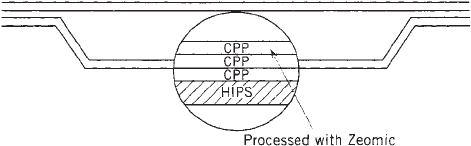
surface layers of the pores. The zeolite is dispersed in, for
instance, a polypropylene or polyethylene 3- to 6-mm-thick
layer and protrudes into the package from this layer as
indicated in Figure 5. Other layers provide package
strength and permeation barrier as required. Liquid in
the food is meant to have access to the zeolite, and it
appears that the mode of action is uptake of silver ion that
dissolves in the aqueous phase (17). The zeolite has been
found to be highly effective against several vegetative
bacteria, especially dispersed in water, saline solution, or
oolong tea. The effect of amino acids in food proteins is the
subject of research (18). Zeomic is approved as a Food
Contact Substance by the U.S. FDA and can be used in any
type of food packaging resin product. The Zeomic product
is distributed outside Japan and in parts of Southeast Asia
by AgION Technologies Ltd. (Wakefield, MA).
Odor Absorption. Since odors can be sensed at very low
levels, there is the opportunity to use packaging materials
to reduce the concentrations of these components in
otherwise acceptable foods (see Aroma barrier testing).
The inclusion of molecular sieves and other agents capable
of adsorbing odorous volatile compounds has been ex-
plored. Packaging technologies capable of removing spe-
cific classes of odorous compounds through chemical
reaction have also been investigated with several patents
in this area relating to elimination of aldehydes having
been granted to Dupont and Cellresin Technologies LLC.
A different approach has been patented by Minato Sangyo
Co. Ltd., based on ascorbic acid and an iron salt dispersed
in the plastic, and is aimed at removing amine or sulfur
compounds from fish in domestic refrigerators.
Thermal Control. Microwavable packages containing
foods with differing reheating requirements can be made
to crisp or brown some components by use of susceptors
and reduce the heating of other components by use of foil
shields. Susceptors normally consist of a vacuum-depos-
ited layer of aluminum, typically with a light transmission
of 50–60%, or a 12-mm-thick film of biaxially oriented PET.
The film is laminated to paper or paperboard by means
of an adhesive. In a microwave field, susceptors have
reached a temperature of 3161C in the absence of food,
or 2231C in pizza packs (19). These temperatures have
caused regulatory authorities to investigate the stability
of all components of susceptor films, particularly the
adhesives. The microwave field strength can be intensified
by specific distributions of foil patches in the dome lids of
microwaveable packs.
Beverage cans can be made either ‘‘self-heating’’ or
‘‘self-cooling’’ by means of chemical reactions in compart-
ments separated from the beverage (20). Sake is heated by
the exothermic reaction of lime with water in aluminum
cans. This process is potentially valuable in the vending
machine market. Cooling is achieved by the endothermic
dissolution of ammonium nitrate and ammonium chloride
with water. Both of these thermal effects are brought
about by shaking and thus are unsuitable for use with
carbonated beverages.
RESEARCH AND DEVELOPMENT
Active packaging materials have been evolving through a
series of innovations dating from the late 1980s, with
many hundreds of primary patent applications having
been filed for both chemical principles and package de-
signs relating to oxygen scavenging alone. Despite con-
siderable industry interest, so far very few of these
innovations have led to commercial products. There is a
substantial amount of innovation in progress, especially in
the area of active plastic-based packaging incorporating
in-polymer chemistry. Methods of activating chemical
systems that are stable during thermal processing are
particularly interesting. The benefits of using active
packaging need to be established clearly, and performance
claims for these technologies need to be supported by
unambiguous, independent research results demonstrat-
ing their effectiveness.
SUMMARY
The emergence of active packaging has required reapprai-
sal of the normal requirement that the package should not
interact with the packaged product. For example, the
introduction of a new EU Regulation (1934/2004) repeal-
ing the earlier relevant EU Directives for food contact
materials (89/109/EEC and 80/590/EEC) attempts to re-
concile the EU’s philosophy that food contact materials
should not give rise to chemical reactions that alter the
initial composition or organoleptic properties of the food,
while recognizing the potential benefits of active packa-
ging technologies to enhance the preservation of packaged
food. The introduction of this new EU Regulation paves
the way for more rapid uptake of these new packaging
materials (21). Active packaging introduced so far repre-
sents substantial fine-tuning in the matching of packaging
properties to the requirements of the product. Accordingly,
it will be seen increasingly in niche markets and in wider
applications in which specific problems are inhibiting the
marketing of the product. Indeed, the specific examples
being introduced are too numerous to describe here, and
the reader is referred to the Bibliography and the Further
Reading sections.
BIBLIOGRAPHY
1. G. L. Robertson, Food Packaging: Principles and Practice,
Taylor & Francis, Boca Raton, FL, 2006, pp. 286–289.
Figure 5. Antimicrobial thermoformed tray containing Zeomic
silver zeolite heat-seal layer. (CPP, cast polypropylene; HIPS;
high-impact polystyrene). (Courtesy of Sinanen Zeomic Co. Ltd.)
8 ACTIVE PACKAGING
2. T. P. Labuza and W. M. Breene, J. Food Proc. Preservat. 13,
1–69 (1989).
3. Y. Abe and Y. Kondoh, ‘‘Oxygen Absorbers’’ in A. L. Brody, ed.,
Controlled/Modified Atmosphere/Vacuum Packaging of
Foods, Food and Nutrition Press, Trumbull, CT, 1989, pp.
149–174.
4. B. V. Chandler and R. L. Johnson, J. Sci. Food Agric. 30,
825–832 (1979).
5. Y. Abe, ‘‘Active Packaging—A Japanese Perspective’’ in Pro-
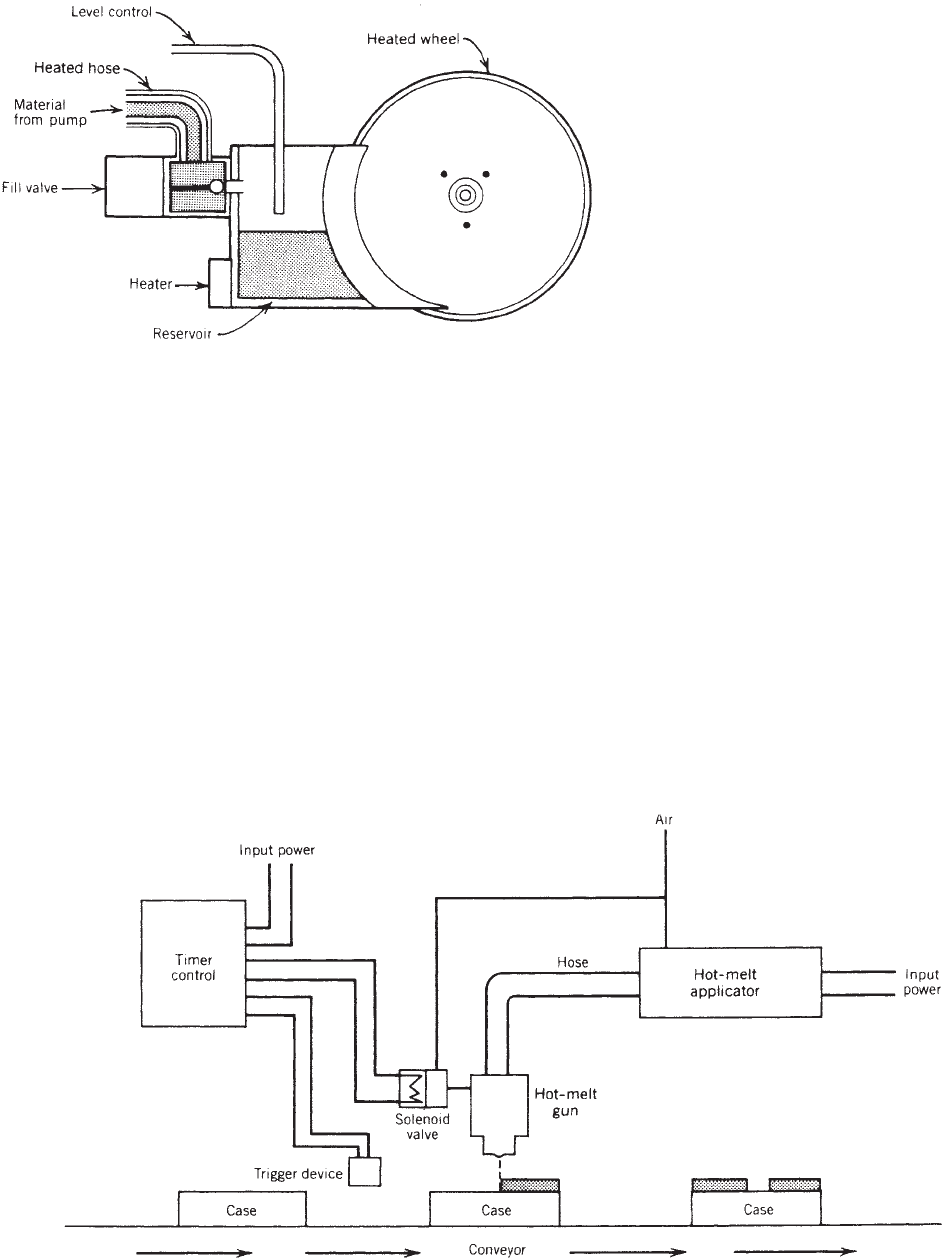
ceedings International Conference Modified on Atmosphere
Packaging, Camden Food and Drink Research Association,
Chipping Camden, U.K., 1990, Part 1.
6. Pira International Ltd., Active & Intelligent Pack News 2(11),
5 (2004).
7. Pira International Ltd., Active & Intelligent Pack News 3(25),
5 (2005).
8. N. Takahashi and K. Yoshie, U.S. Patent No. 5015282, 1991.
9. M. Takuno, U.S. Patent No. 5143773, 1992.
10. M. R. Gibberd and P. J. Symons, International Patent Appli-
cation, WO 05/053955, 2005.
11. M. L. Rooney, ‘‘Overview of Active Packaging’’ in M. L.
Rooney, ed., Active Food Packaging, Blackie Academic and
Professional, Glasgow, UK, 1995, pp. 1–37.
12. F. N. Teumac, The History of Oxygen Scavenger Bottle
Closures in M. L. Rooney, ed., Active Food Packaging, Blackie
Academic and Professional, Glasgow, 1995, pp. 193–202.
13. S. L. Cuppett, ‘‘Edible Coatings as Carriers of Food Additives,
Fungicides and Natural Antagonists’’ in J. M. Krochta, E. A.
Baldwin, and M. Nisperos-Carriedo, eds., Edible Coatings
and Films to Improve Food Quality, Technomic Publishing,
Lancaster, PA, 1994, pp. 123–124.
14. R. D. Joerger, Packag. Technol. Sci. 20, 231–274 (2007).
15. P. Suppakul, J. Miltz, K. Sonneveld, and S. W. Bigger, J. Food
Sci. 68, 408–420 (2003).
16. J. W. Rhim and P. K. Ng, Crit. Rev. Food Sci. Nutr. 47, 411–433
(2007).
17. J. H. Hotchkiss, ‘‘Safety Considerations in Active Packaging’’
in M. L. Rooney, ed., Active Food Packaging, Blackie Aca-
demic and Professional, Glasgow, 1995, pp. 238–255.
18. T. Ishitani, ‘‘Active Packaging for Foods in Japan’’ in P.
Ackermann, M. Ja
¨
gerstad, and T. Ohlsson, eds., Food and
Packaging Materials—Chemical Interactions, Royal Society
of Chemistry, Cambridge, UK, 1995, pp. 177–188.
19. G. L. Robertson, Food Packaging: Principles and Practice,
Taylor & Francis, Boca Raton, FL, 2006, pp. 280–282.
20. G. L. Robertson, Food Packaging: Principles and Practice,
Taylor & Francis, Boca Raton, FL, 2006, pp. 297–298.
21. J. Heckman, Active and Intelligent Packaging—A European
Anomaly, November 2005. http://www.packaginglaw.com/in-
dex_fcn.cfm?id=38&pf=yes(2005) (accessed March 4, 2008).
22. J. P. Smith, H. S. Ramaswamy, and B. K. Simpson, Trends in
Food Sci. Technol. 111–118 (Nov. 1990).
Further Reading
G. L. Robertson, ‘‘Active and Intelligent Packaging,’’ Chapter 14 in
Food Packaging: Principles and Practice, Taylor & Francis,
Boca Raton, FL, 2006, pp. 286–309.
W. D. van Dongen, A. R. de Jong, and M. A. H. Rijk, ‘‘European
Standpoint to Active Packaging—Legislation, Authorization
and Compliance Testing,’’ Chapter 9 in Packaging for Non-
thermal Processing of Food, J. H. Han, ed., Blackwell Publish-
ing Professional, Ames, IA, 2007.
A.
Scully and M.
Horsham, ‘‘Emerging Packaging Technologies
for Enhanced Food Preservation,’’ Food Sci. Technol. 20, 16–19
(2006).
J. H. Han, ed., Innovations in Food Packaging, Elsevier Academic
Press, San Diego, CA, 2005.
C. L. Wilson, ed., Intelligent and Active Packaging for Fruits and
Vegetables, CRC Press, Boca Raton, FL, 2007.
A. L. Brody, E. R. Strupinsky, and L. R. Kline, Active Packaging
for Food Applications, Technomic, Lancaster, PA, 2001.
M. L. Rooney, ed., Active Food Packaging, Blackie Academic and
Professional, Glasgow, 1995.
T. P. Labuza and W. M. Breene, ‘‘Applications of Active Packaging
for Improvement of Shelf-life and Nutritional Quality of Fresh
and Extended Shelf-Life Foods,’’ J. of Food Process. Preserv.,
13, 1–69 (1989).
A. Lo
´
pez-Rubio, E. Almena, P. Hernandez-Mun˜oz, J. M. Lagaro
´
n,
R. Catala
´
, and R. Gavara, ‘‘Overview of Active Polymer-Based
Packaging Technologies for Food Applications,’’ Food Rev. Int.
20(4), 357–387, 2004.
ADHESIVE APPLICATORS
Adhesive applicating equipment used in packaging appli-
cations is available in a vast array of configurations to
provide a specific means of sealing containers. The type of
adhesive equipment chosen is determined by several
factors: the class of adhesive (cold waterborne or hot-
melt), the adhesive applicating unit and pump style that
is most compatible with the adhesive properties, and
production line demands. The variables in the packaging
operation are matched with the available adhesives and
equipment to achieve the desired results.
PACKAGING ADHESIVES
Adhesives used in packaging applications today are pri-
marily cold waterborne or hot-melt adhesives (see the
Adhesives article).
Cold waterborne adhesives can be broadly categorized
into natural or synthetic. Natural adhesives are derived
from protein (animal and casein) and vegetable (starch
and flour) sources. Synthetic-based adhesives (primarily
resin emulsions) have been gradually replacing natural
adhesives in recent years. The liquid ‘‘white glue’’ is
generally composed of protective poly(vinyl alcohol) or 2-
hydroxyethyl cellulose colloids and compounded with
plasticizers, fillers, solvents, or other additives. Also,
new copolymers have been developed and used to upgrade
performance of cold emulsion adhesives in dispensing
characteristics, set time, and stability.
Cold adhesives have good penetration into paper fiber
and are energy efficient, especially when no special speed
of set is required. Hot-melt adhesives are thermoplastic
polymer-based compounds that are solid at room tempera-
ture, liquefy when heated, and return to solid form after
cooling. They are blended from many synthetic materials
to provide specific bonding characteristics. Most hot melts
consist of a base polymer resin for strength, a viscosity
ADHESIVE APPLICATORS 9
control agent such as paraffin, tackifying resins for
greater adhesion, and numerous plasticizers, stabilizers,
antioxidants, fillers, dyes, and/or pigments.
Hot melts are 100% solid; they contain no water or
solvent carrier. This offers several advantages: rapid bond
formation and short set time because heat dissipates
faster than water evaporates, shortened compression
time, and convenient form for handling and long-term
storage. Being a thermoplastic material, hot melts have
limited heat resistance and can lose their cohesiveness at
elevated temperatures.
ADHESIVE APPLICATING EQUIPMENT CLASSIFICATION
Both cold waterborne and hot-melt adhesive application
systems are generally classified as noncirculating or cir-
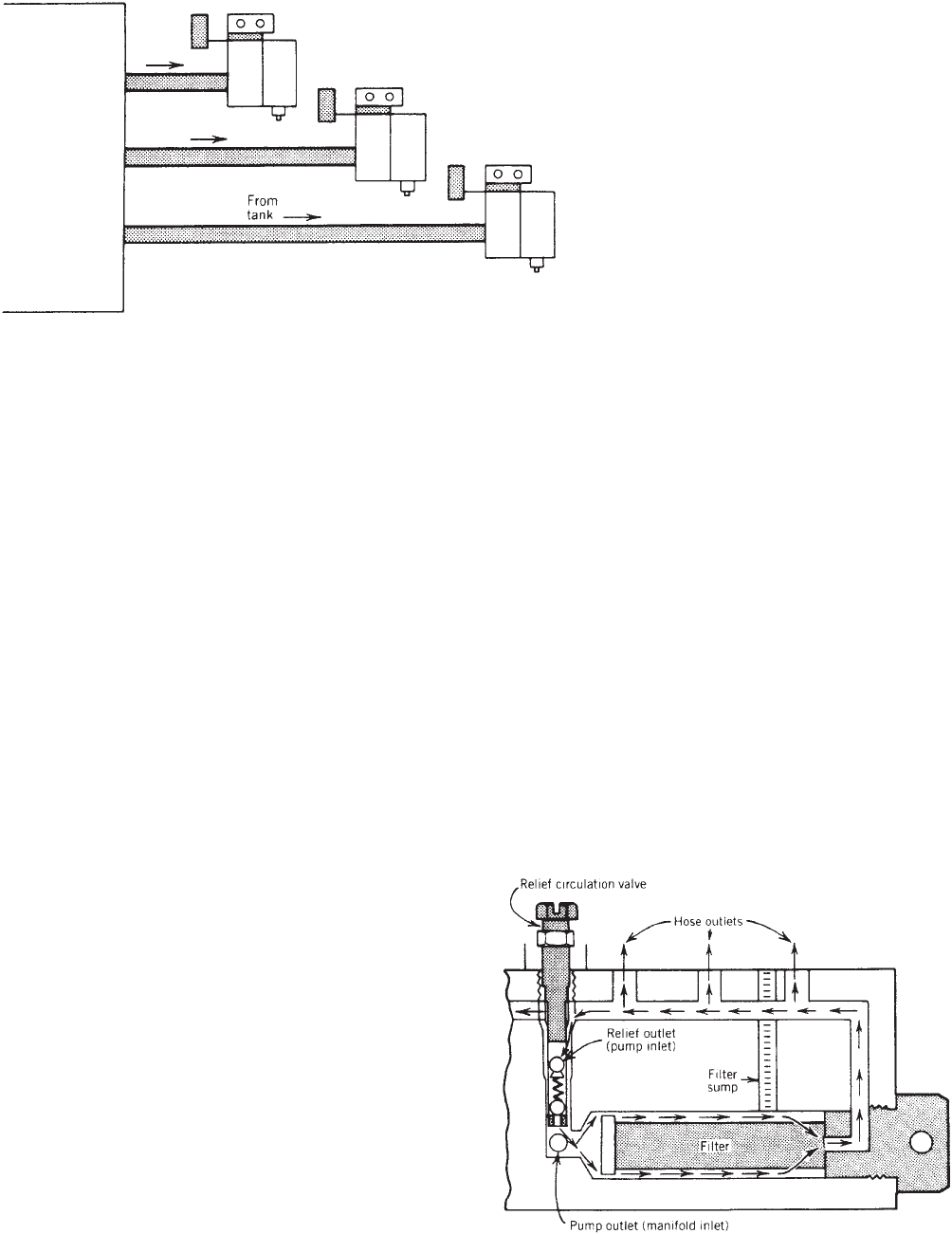
culating. Noncirculating systems are the most common
(see Figure 1). They are identified easily because each gun
in the system is supplied by its own hose. The noncirculat-
ing system is often referred to as a ‘‘dead-end system’’
because the hose dead ends at the gun. An offshoot of the
noncirculating system is the internally circulating hot-
melt system (see Figure 2). Circulation occurs between the
pump and manifold, but from the manifold to the gun it is
the same as a dead-end system.
Circulating systems are used to some extent in applica-
tions that require a standby period, as in a random case
sealing operation, when some setup time is needed. A
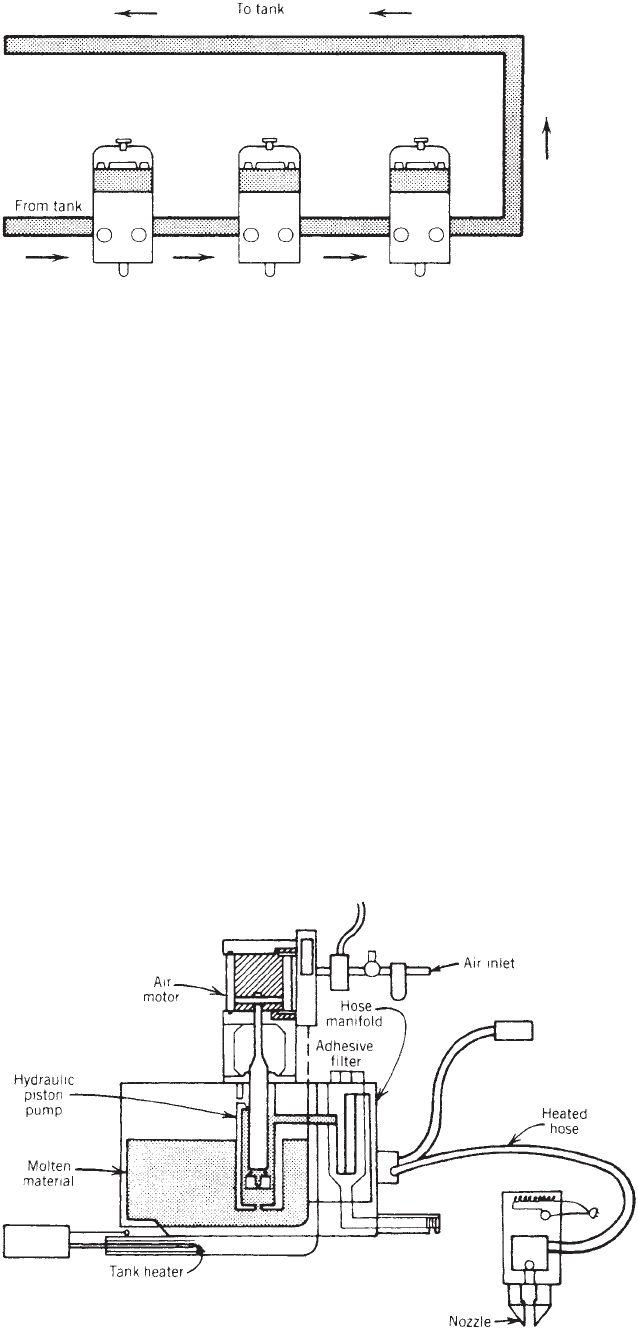
circulating system is identified by the series installation of
the hoses and guns (see Figure 3). In the typical circulat-
ing installation, many automatic extrusion guns are con-
nected in series with the hot-melt hose. Molten material is
siphoned out of the applicator tank and pumped into the
outlet hose to the first gun in the series. The material then
flows from the first gun to the second gun and continues on
until it passes through a circulation valve and back into
the applicator’s tank. The circulation valve permits ad-
justment of the flow of material.
COLD-GLUE SYSTEMS
Most cold-glue systems consist of applicator heads to apply
adhesive either in bead, spray, or droplet patterns; fluid
hoses to carry the adhesive to the applicator head from the
tank; a pressure tank of lightweight stainless steel that
can include a filter, quick-disconnect couplings for air and
glue, a pressure relief valve and an air pressure gauge; and
a timing device to control the adhesive deposition.
The applicator heads are controlled by either an auto-
matic pneumatic valve or a manually operated hand valve.
The bead, ribbon, or spray patterns can be dispensed
using multiple-gun configuration systems with resin or
dextrin cold adhesives. Cold-adhesive droplet guns dis-
pense cold mastic and plastisols, and they come in a wide
variety of configurations for spacing requirements. In
bead and ribbon cold glue extrusion, the tips either
make contact or close contact with the substrate. Spray
valves emit a mistlike pattern without touching the sub-
strate’s surface.
HOT-MELT SYSTEMS
Hot-melt application equipment performs three essential
functions: melting the adhesive, pumping the fluid to the
point of application, and dispensing the adhesive to the
substrate in a desired pattern.
Figure 1. Noncirculating gun installation (parallel)
system.
Figure 2. Internally circulating system.
10 ADHESIVE APPLICATORS
Melting Devices. Tank melters are the most commonly
used melting unit in packaging applications. Best de-
scribed as a simple open heated pot with a lid for loading
adhesive, a significant feature of tank melters is their
ability to accept almost any adhesive form. The tank
melter is considered the most versatile device for accept-
ing hot melts with varying physical properties of adhesion
and cohesion.
In tank melters, the tank size is determined by melt
rate. Once melt rate objectives or specifications are deter-
mined, the tank size is fixed. Larger tanks have greater
melt rates than smaller tanks. Holding capacities range
from 8 lb (3.9 kg) in the smaller units to more than several
hundred pounds (W90 kg) in the larger premelting units
(see Figure 4).
The tanks are made of highly thermal conductive
material, such as aluminum, and they are heated by
either a cast-in heating element or a strip or cartridge-
type heater. The side walls are usually tapered to provide
good heat transfer and to reduce temperature drop.
Adhesive melts first along the wall of the tank as a thin
film. Internal circulation currents from the pumping ac-
tion assist in transferring heat throughout the adhesive
held in the tank. Even when the hot melt is entirely liquid,
there will be temperature differences within the adhesive.
Under operating conditions, adhesive flows along tank
surfaces and absorbs heat at a faster rate than it would
if allowed to remain in a static condition. Even though
adhesive in the center of the tank is cooler, it must flow
toward the outer edges and pick up heat as it flows into the
pumping mechanism.
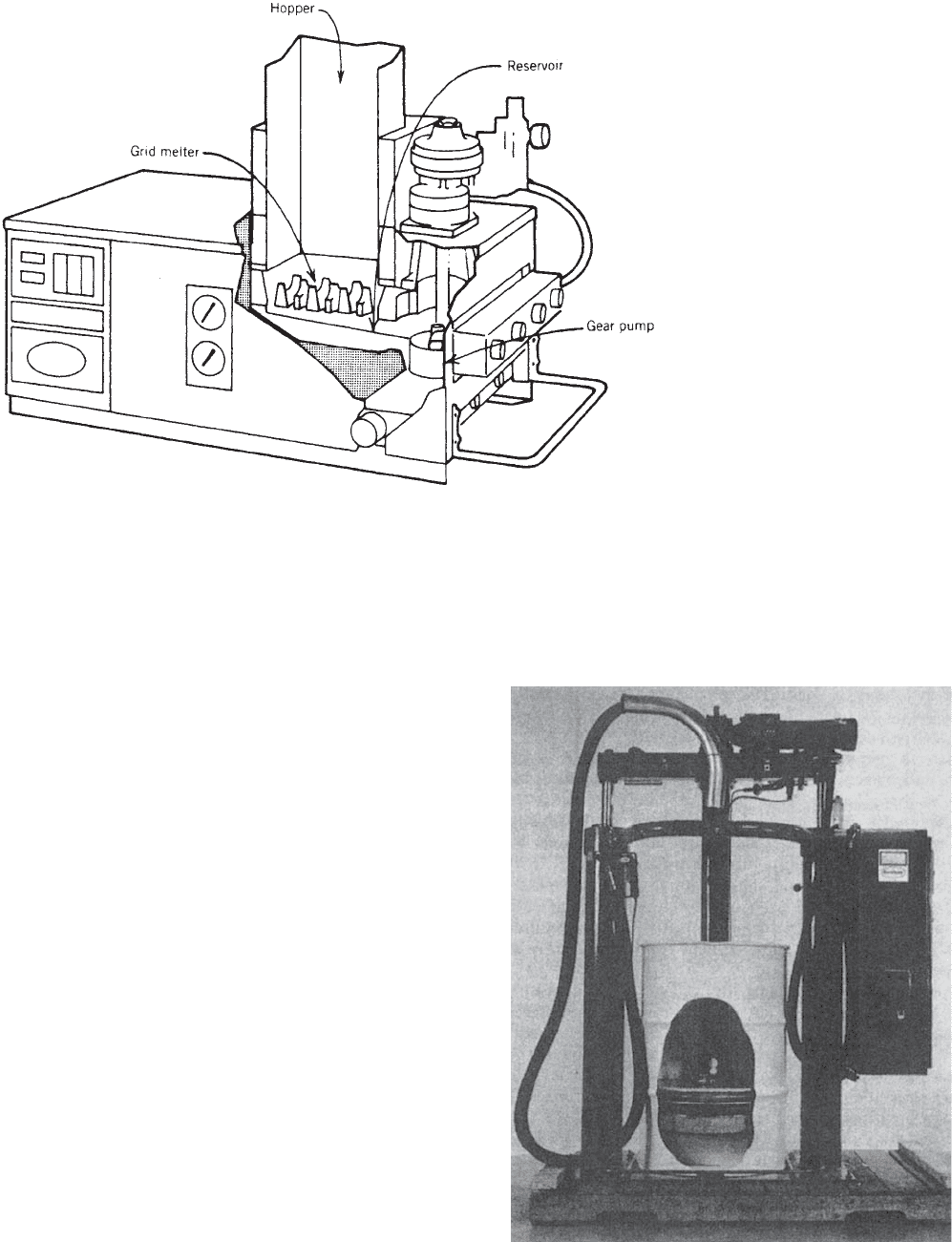
Grid melters are designed with dimensional patterns
resembling vertical cones, egg crates, honeycomb shapes,
and slotted passages arranged in a series of rows. Such an
arrangement creates a larger surface area for heat trans-
fer. The grid melter is mounted above a heated reservoir
and pump inlet (see Figure 5).
The grid melting process is exactly the same as the
tank melting process; however, the film of adhesive flows
along with surfaces and flows through ports in the bottom
of the grid. In this way, the solid adhesive will rest above
the grid and force the molten liquid through the grid. The
grid is designed for deliberate drainage of liquid adhesive
to maintain a thin film adjacent to the heated surfaces.
This thin film provides for a greater temperature differ-
ence than normally found in a tank, and a much larger
heat flow is attainable. The grid melter also achieves a
much greater melt rate for a given size or area of melter. It
can heat higher performance adhesives because it pro-
vides relatively uniform temperature within the melter
Figure 4. Tank-type hot melt unit.
Figure 3. Circulating gun installation (series) system.
ADHESIVE APPLICATORS 11
itself, which also minimizes degradation. These features
are achieved with some sacrifice of versatility because the
adhesives must normally be furnished as pellets or other
more restricted geometries.
Between each row of patterned shapes are passage-
ways that open into a reservoir beneath the melter. The
passageways ensure a constant and unobstructed flow of
molten material to the reservoir below.
The reservoir has a cast-in heating system similar to
that of most tank applicators. The temperature control
can be separate from the grid melter. The floor of the
reservoir is sloped so that molten material is gravity-fed
toward the pump inlet.
Grid melters are available with optional hopper config-
urations. The major difference, other than capacity, is the
ability to keep the material ‘‘cool’’ or ‘‘warm’’ before it
reaches the grid. The cool hopper merely supplies adhe-
sive and the material becomes molten at the grid. The
molten time of the material is shortened before actual
application. The cool hopper works well with hot melts of
relatively high softening and melting points.
Warm hoppers are insulated and attached to the grid so
that heat is radiated from the hopper through the hopper
casting. Materials that are better formulated to melt in a
zone-heating process, such as hot melts with medium to
low melting points, and pressure-sensitive materials work
well with the warm hopper design.
The tank capacities of both tank and grid melting devices
can be extended with premelt tanks . They may be equipped
with their own pumping devices or act on a demand signal
from a level sensor in the applicator tank; however, all
perform like tank units to keep hot melt materials molten at
controlled temperatures. One of the newer premelting
devices is in the bulk melter unit (see Figure 6).
Bulk melting systems are designed to dispense hot-
melt adhesives and other highly viscous thermoplastic
materials in applications requiring a high volume or rapid
delivery of material. Units can be used as direct applica-
tors or as premelters as part of a central feed system.
The material is pumped directly from the drum or pail
in which it is shipped. This provides ease of handling and
lower material costs of bulk containers. In premelting
Figure 5. Grid melter hot melt unit.
Figure 6. Cutaway of drum showing bulk melter system.
12 ADHESIVE APPLICATORS
applications, the bulk melter system preheats the mate-
rial before it is pumped into heated reservoirs. The
material is then pumped from the reservoirs to the
application head on demand.
The electrically heated platen is supported by vertical
pneumatic or hydraulic elevating posts. The platen melts
the hot melt material on demand directly from the con-
tainer and forces it into the pump inlet.
The platen can be a solid one-piece casting, or in the
larger units, several grid or fin sections. It is important
that the platen size match the inside diameter (ID) of the
drum or pail. The platen is protected by one or more seals
to help prevent leakage.
Pressurized melters, or screw extruders, are among the
earliest designs used in hot-melt applicators. Imitating
injection-molding machinery (see the Injection molding
article), early screw-extruder and ram-extrusion handgun
systems had limited success because they were designed
only for continuous extrusion. The closed-system and
screw-extrusion design allows for melting and pumping
of high-viscosity, highly degradable materials.
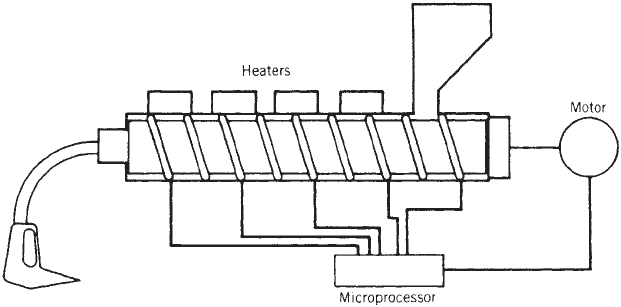
Extruder equipment is now adapted to intermittent
applications; it consists of a hopper feeder, a high-torque
dc-drive system, a heated barrel enclosing a continuous
flight screw, and a manifold area (see the Extrusion;
Extrusion coating article). Heating and drive control
systems can be controlled independently by a micropro-
cessor. Temperatures and pressure are monitored by
digital readouts. Adapted for high-temperature, high-
viscosity, or degradation-sensitive adhesives, the new
technological advances in extruder equipment give
greater potential for adhesive applications such as
drum-lid gasketing, automotive-interior parts, and self-
adhering elastic to diapers (see Figure 7).
Pumping Devices and Transfer Methods. Once the hot-
melt material is molten, it must be transferred from the
tank or reservoir to the dispensing unit. Pumping me-
chanisms are of either piston or gear design.
Piston pumps are air driven to deliver a uniform
pressure throughout the downstroke of the plunger. Dou-
ble-acting piston pumps maintain a more consistent hy-
draulic pressure with their ability to siphon and feed
simultaneously. Piston pumps do not provide complete
pulsation-free output, but they are well suited for fixed-
line speed applications.
Gear pumps are available in several configurations:
spur-gear, gerotor, and two-stage gear pump.
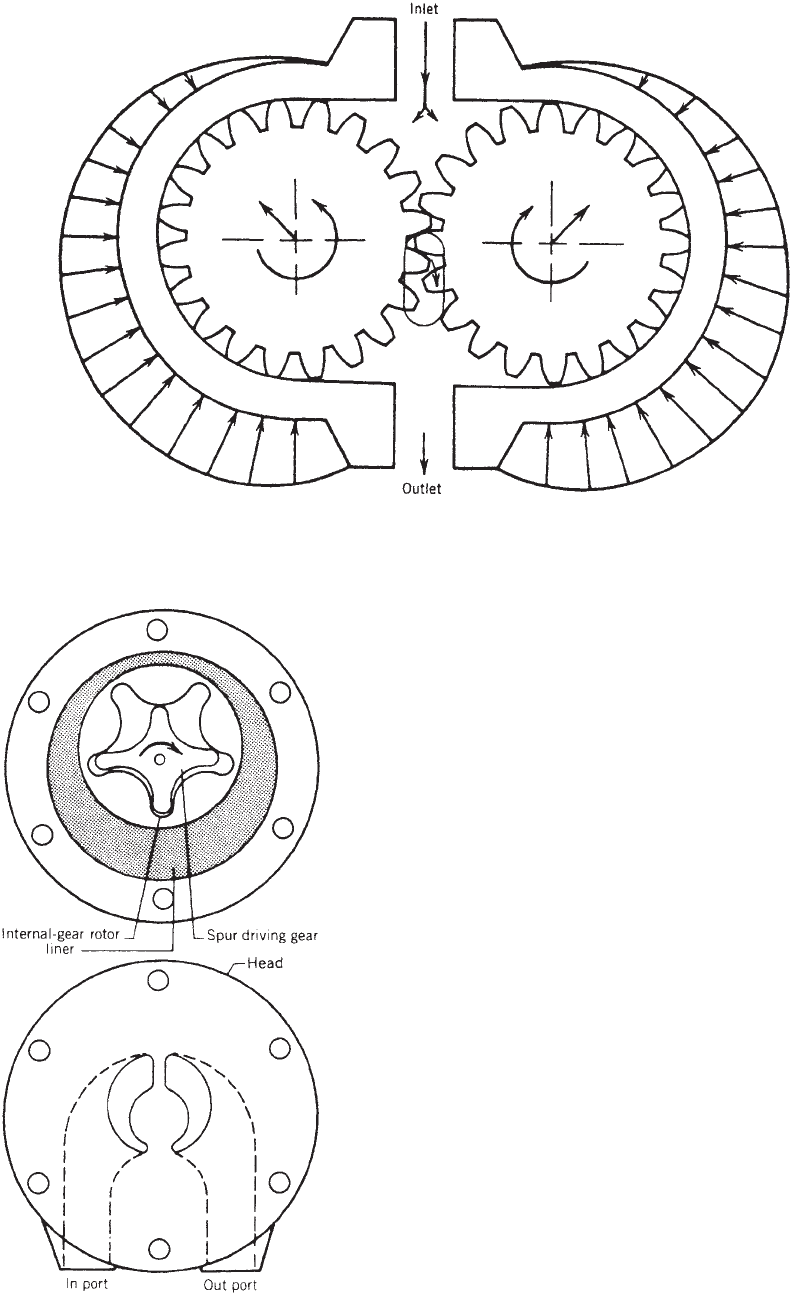
Spur-gear pumps have two counterrotating shafts that
provide a constant suction and feeding by the meshing
action of the gear teeth (see Figure 8). They are becoming
more common because of their versatility in handling a
variety of high viscosity materials and their efficient
performance in high speed packaging.
Gerotor gear pumps have a different arrangement of
gears and larger cavities for the transfer of materials. The
meshing action, which occurs on rotation, creates a series
of expanding and contracting chambers (see Figure 9).
This makes the gerotor pump an excellent pumping device
for high-viscosity hot-melt materials and sealants.
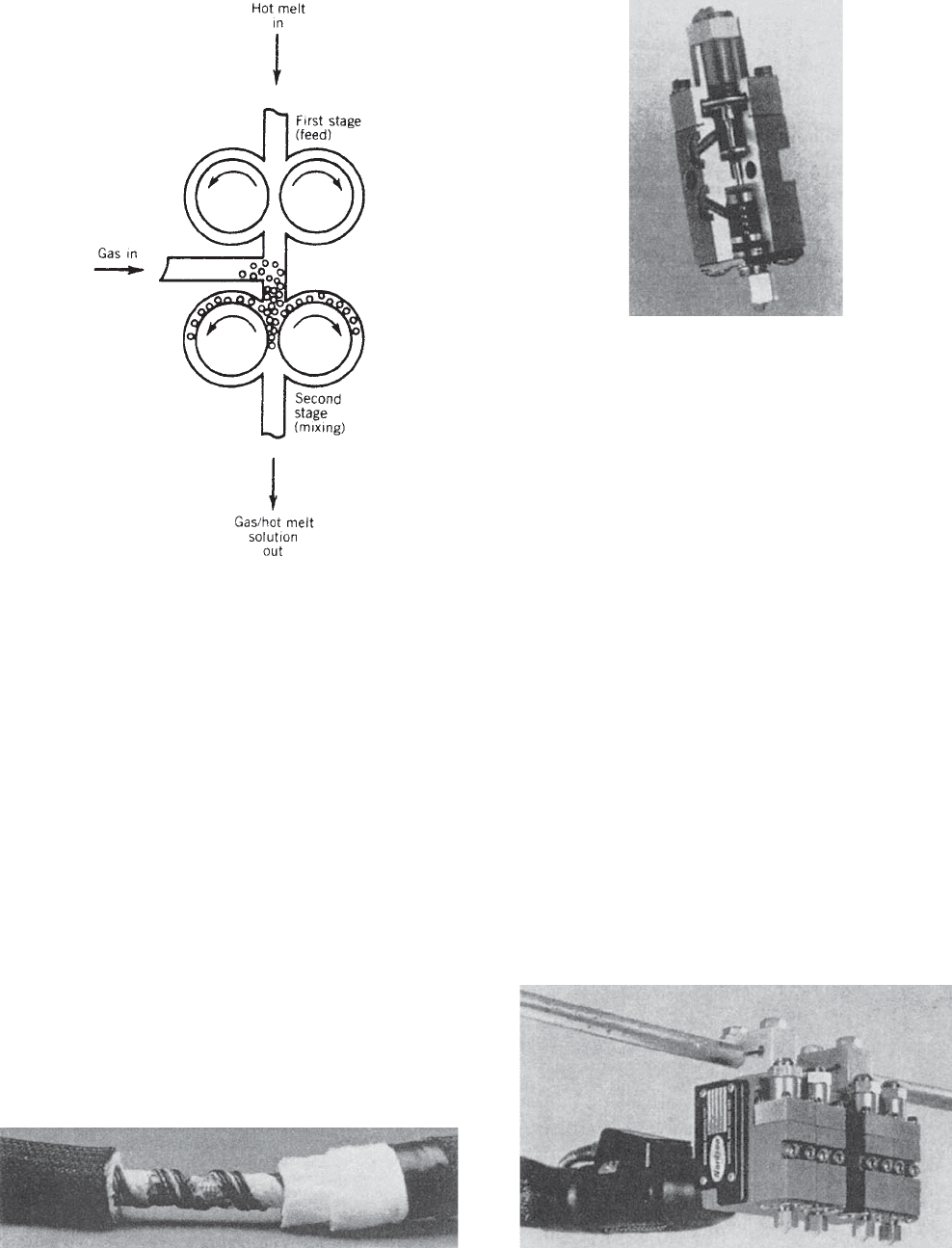
The latest patented two-stage gear pump introduces an
inert gas in a metered amount into the hot melt. When the
adhesive is dispensed and exposes the fluid to atmospheric
pressure, the gas comes out in solution, which foams the
adhesive much like a carbonated beverage (see Figure 10).
All types of gear pumps provide constant pressure
because of the continuous rotating elements. They can
be driven by air motor, constant speed electric motors,
variable-speed drives, or by a direct power takeoff from
the parent machine. PTO and SCR drives allow the pump
to be keyed to the speed of the parent machine. As the line
speed varies, the amount of adhesive extruded onto each
segment of substrate remains constant.
Variations and modifications to the pumping devices
incorporate improvements to their transfer efficiency and
performance. Multiple-pump arrangements are also of-
fered in hot-melt systems to meet specific application
requirements.
The transfer action of the pumping device moves the
hot-melt material into the manifold area. There, the
adhesive is filtered and distributed to the hose or hoses.
In the manifold, there is a factory-set, unadjustable relief
valve, which protects the system from overpressurization.
The adhesive then passes through a filter to remove
contaminants and is directed through the circulation
valve. The circulation valve controls the hydraulic pres-
sure in the system. The material circulates to the hose
outlets and out the hose to the dispensing devices.
Figure 7. Screw extruder.
ADHESIVE APPLICATORS 13
For hot-melt systems that require a fluid link between
the melting-pump station and the point of application,
hot-melt hoses provide a pipeline for transferring the
adhesive. Some methods of dispensing (e.g., wheel-type
applicators) do not use hoses and will be discussed later.
To withstand operating hydraulic pressures up to
1600 psi (lb/in.
2
) (11.3 MPa), hot-melt hoses are con-
structed of aircraft-quality materials. They are flexible,
electrically heated, and insulated, and they come in
various lengths to accommodate particular installation
requirements.
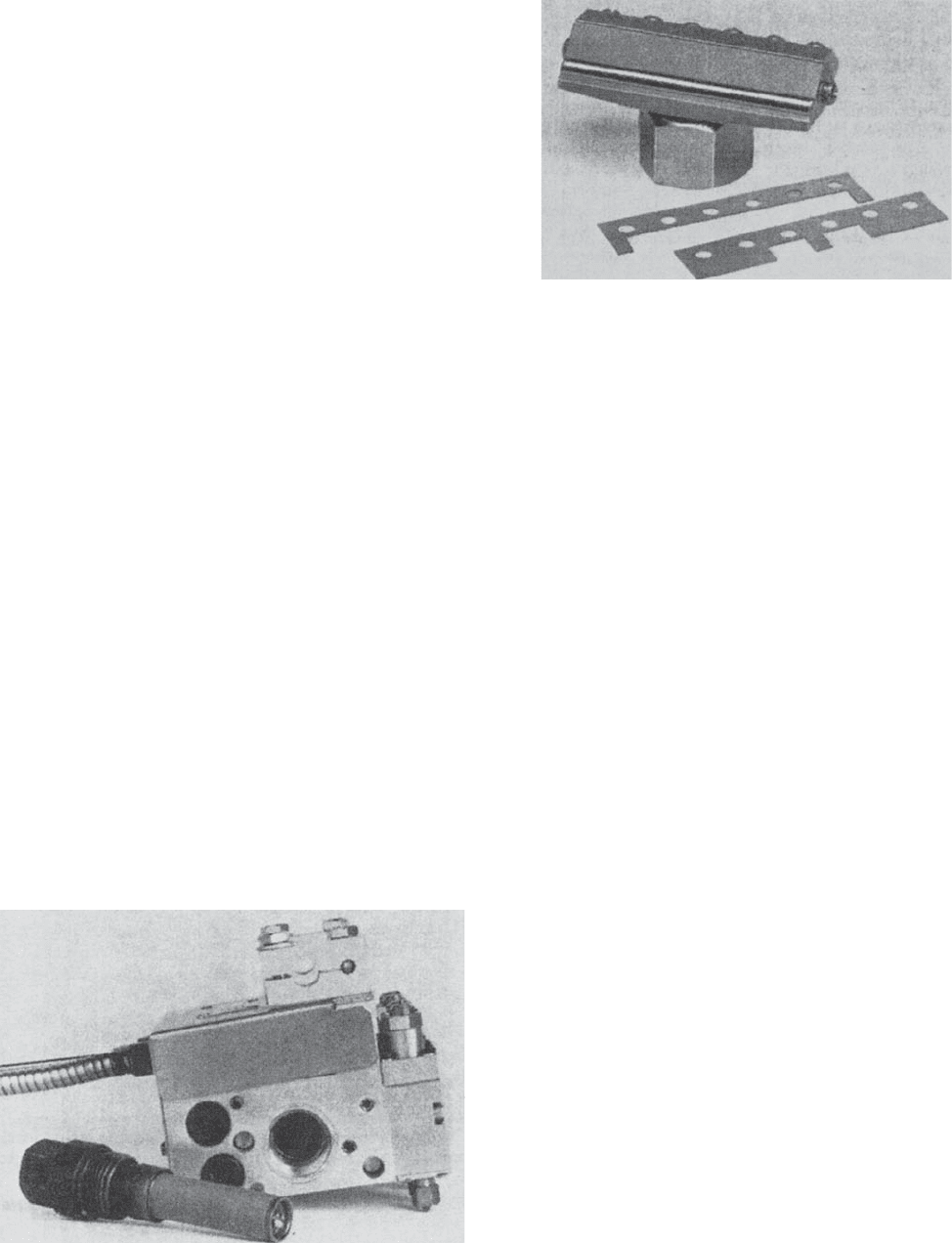
Hot-melt hoses are generally constructed of a Teflon
innertube that is surrounded by a stainless steel wire
braid for pressure resistance (see Figure 11). Noncirculat-
ing hoses maintain temperature with a heating element
spirally wrapped around the wire braid throughout the
length of the hose. Circulating hoses sometimes use only
the wire braid to maintain heat. Wrapped layers of
materials such as polyester felt, fiberglass, and vinyl
tape provide insulation. For abrasion resistance, the en-
tire hose is covered with a nylon braid.
The hose temperature can be independently controlled
and is monitored inside the hose by a sensing bulb,
thermistor, or resistance temperature detector.
Dispensing Devices. There are several methods of de-
positing adhesive onto a substrate once the material is in a
molten state. The applicating devices can be categorized
as follows:
1. Extrusion guns or heads (automatic and manual).
2. Web-extrusion guns.
3. Wheel and roll dispensers.
Figure 8. Spur gear pump.
Figure 9. Gerotor gear pump.
14 ADHESIVE APPLICATORS
Extrusion guns are used on most packaging lines. This
extrusion method entails applying beads of hot melt from
and nozzle. The gun is usually fed from the melting unit
through the hose or directly from the unit itself.
Most high-speed applications use automatic guns that
are triggered by timing devices or controllers on line with
the parent machinery to place the adhesive on a moving
substrate.
Automatic guns are actuated by pressure that forces a
piston or plunger upward, lifting the attached ball or
needle off the matched seat. Molten adhesive can then
pass through the nozzle as long as the ball or needle is
lifted off its seat by the applied pressure. The entire
assembly can be enclosed in a cartridge insert or extrusion
module (see Figure 12). Either style, when fitted into or on
the gun body, allows for multiple extrusion points from
one gun head. Modular automatic guns with up to 48
extrusion modules are possible (see Figure 13).
The pressure to actuate automatic guns is either
electropneumatic by means of a solenoid or electromag-
netic with a solenoid coil electrically signaled.
Gun temperatures can be controlled thermostatically
with cartridge heaters to a maximum of 4501F (2301C). A
maximum operating speed of 3500 cycles per minute
(58.3 Hz) is possible.
Handgun extrusion is based on the same principles but
with manual rather than automatic triggering. A mechan-
ical linkage operated by the gun trigger pulls the packing
cartridge ball from its seated position to allow the adhe-
sive to flow through the nozzle.
The extrusion nozzle used on the head or gun is the
final control of the adhesive deposited and is used to
regulate the bead size. It is designed for varying flow
rates that are determined by the nozzle’s orifice diameter
and length. Classified as low-pressure–large-orifice or
high-pressure–small-orifice nozzles, they provide different
types of beads. Low-pressure–large-orifice nozzles are
specified for continuous bead applications with the large
orifice helping to limit nozzle clogging.
High-pressure–small-orifice nozzles are better adapted
to applications that require clean cutoff and rapid gun
cycling. Drooling and spitting must be controlled for
applications such as stitching.
Figure 10. Foaming process of two-stage gear pump.
Figure 11. Cutaway of hot-melt hose.
Figure 12. Cutaway of extrusion module.
Figure 13. Automatic gun with four modules.
ADHESIVE APPLICATORS 15
Patterns can be varied even more by selection of multi-
ple-orifice designs, right-angle nozzles for differences in
positioning, and spray nozzles for a coated coverage.
Heated in-line filters can be installed between the hose
and gun to provide final filtering before adhesive deposi-
tion. Independent temperature control helps keep the
temperature constant. However, more options are avail-
able to provide optimum control by combining a heat
exchanger and filter integrally with the gun (see Figure
14). These specialized guns can precisely elevate the
temperature of the adhesive material and can hold adhe-
sive temperature within 721F(71.11C) of the set point.
This allows the rest of the system to be run at lower
temperatures, which thereby minimizes degradation of
the material. The filter assembly incorporated into the
service block catches contaminants not trapped by the hot-
melt system filter.
Efforts to prevent nozzle clogging and drool have
resulted in a zero-cavity gun that replaces the traditional
ball-and-set seat assembly with a tapered needle and
precision-matched nozzle seat. In traditional guns, the
ball-and-seat assembly interrupts adhesive flow some
distance from the nozzle, allowing the adhesive left in
the nozzle to drool from the tip and char to lodge in the
nozzle orifice. With the zero-cavity gun, no separate nozzle
is needed. A microadjust feature adjusts the needle for
precise flow control. When the needle closes into the
nozzle seat, any char is dislodged. In addition, with no
nozzle cavity area the cutoff is clean and precise.
Web-extrusion guns have adapted extrusion dispensing
technology to deposit a film of hot melt on a moving
substrate. Better known as slot nozzles or coating heads,
they are well suited to continuous or intermittent applica-
tions. Mounted on an extrusion gun, a heated or non-
heated slot nozzle extrudes an adhesive film of varying
widths, patterns, and thickness. Pattern blades can be cut
to desired patterns. Film thickness is adjustable by using
different thickness blades, by stacking of blades in the slot
nozzle, or by varying the adhesive supply pressure (see
Figure 15).
Web extrusion is well suited to coating applications
such as labeling, tape/label, envelopes, business forms,
and web lamination as in nonwovens.
For temperature-sensitive adhesives in continuous web
extrusion, the slot nozzle is used with a heat-exchanger
device to minimize temperature exposure of the material.
Wheel and roll dispensers are the predecessors of
present coating extrusion. Wheels or rolls are mounted
in a reservoir of molten adhesive. The wheels or rolls are
finely machined and may be etched, drilled, or engraved
with desired patterns for specific pattern transfer. As the
wheel rotates in the reservoir, it picks up the hot melt and
transfers it to the moving substrate by direct contact (see
Figure 16). The reservoir may be the primary melting unit
or fed by an outside melting device.
Roll coaters involve a series of unwinding and rewind-
ing units for paper coating, converting, and laminating,
plus wide-web applications for tape and label applications.
Timing and Controlling Devices. Automatic applications
require installation of one or more devices to control the
placement of adhesives on the moving substrate. Such
devices normally include a sensor or trigger to detect the
presence of the substrate in the gluing station, and a timer
or pattern control to measure the predetermined intervals
between beads of adhesive or the substrate and to activate
extrusion guns at the proper moments (see Figure 17).
The sensor may be operated mechanically (as with a
limit switch activated by the substrate or a cam on the
packaging machine) or optically (as with photo eyes or
proximity switches).
Timers or pattern controls may be used at constant line
speeds to time delay extrusion intervals or produce
stitched beads. When the line speed varies, pattern con-
trols equipped with line speed encoder or tachometer must
be used to compensate for changes in line speed so that
bead lengths remain the same. Such devices are highly
reliable but are more complex and correspondingly more
expensive than duration controls. They can usually con-
trol bead placement accurately at line speeds up to 1000 ft/
min (5.1 m/s).
Some pattern controls can also be equipped with devices
that electronically vary air pressure to the hot-melt
Figure 14. Heat exchanger gun.
Figure 15. Two-inch slot nozzle with pattern blades.
16 ADHESIVE APPLICATORS
applicator to control adhesive output, which maintains
constant bead volume as well as placement at varying
line speeds. Other accessories can be obtained to count the
number of packages that have been glued, check for
missing beads, and allow the same device to control guns
or different lines. Advanced controls are often modular in
construction, user oriented, and include self-diagnostic
features.
System Selection. Choosing the correct system to pro-
duce the results desired on the packaging line is not
difficult once the variables are identified. Some primary
variables to consider in specifying equipment for a hot-melt
system include rate of consumption, rate of deposition,
adhesive registration, and control. Trained factory repre-
sentatives for adhesive applicating equipment can identify
and recommend the best system to fit those variables.
The melting device selected must be capable of hand-
ling the pounds-per-hour demand of the packaging opera-
tion. The unit must also have sufficient holding capacity to
prevent the need for frequent refilling of the adhesive tank
or hopper.
Adhesive consumption is affected by line speed, bead
size, and pattern. The adhesive consumption rate and
maximum instantaneous delivery rate of the pump must
be matched to the application requirements (see below).
The pattern to be deposited will determine the dispen-
sing device. Also, the pattern size and registration of the
adhesive deposit must be matched with the cycling cap-
abilities of that device.
The system must fit neatly into the entire operation
with spacing considerations for mounting unit, gun, and
hoses; location to point of application; and accessibility for
maintenance.
Figure 16. Wheel-type applicator.
Figure 17. Timer application process. The timer control sequence is activated when the trigger device senses the leading edge of the case.
The timing sequence controls preset adjustable delay and duration gun actuations.
ADHESIVE APPLICATORS 17