
Ambaum M., Thermal Physics of the Atmosphere
Подождите немного. Документ загружается.

126 CH 7 CLOUD DROPS
0 102030405060708090100
T (ºC)
58
60
62
64
66
68
70
72
74
76
γ (mNm
−1
)
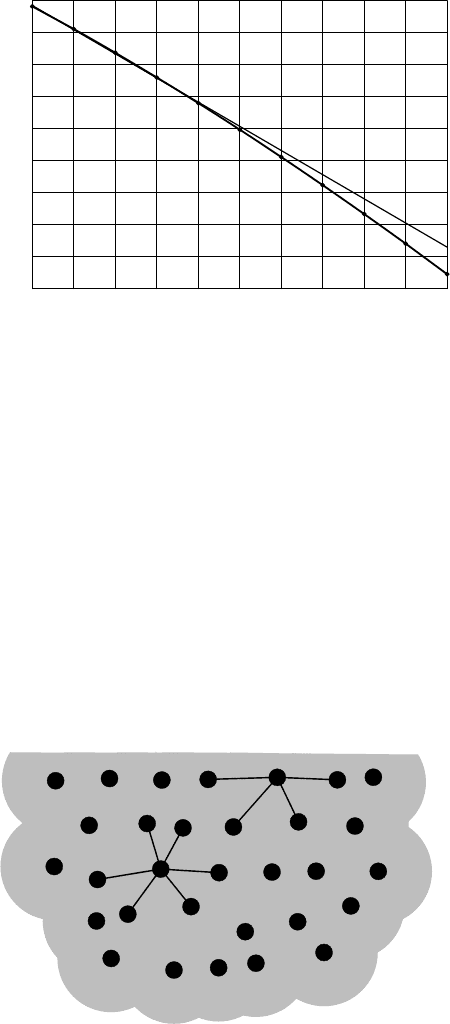
FIGURE 7.1 Points: measured surface tension for water as a function of tempera-
ture. Thin line: surface tension from linear fit of Eq. 7.3. Data from Vargaftik, N.B. et al.
(1983) J. Phys. Chem. Ref. Data 12 817–820.
Surface tension reduces with increasing temperature but the reduction is
small. The linear approximation
= (75.7 − 0.151 T(
◦
C)) × 10
−3
Nm
−1
(7.3)
is accurate to within one part per thousand in the range of 0
◦
C <T<40
◦
C,
see Figure 7.1. For many practical purposes we take to be constant.
The origin of surface tension is the relatively strong attractive force be-
tween molecules in a liquid; it takes energy to separate the molecules of a
liquid. In Figure 7.2 it can be seen that molecules at the surface of the liquid
have fewer neighbours than molecules in the bulk of the liquid. In order to
reside at the surface the molecule must separate from some of its surrounding
FIGURE 7.2 The molecules in the bulk of the liquid are attracted by more neighbours than
molecules at the surface and therefore have a lower potential energy. The total potential
energy of the liquid is minimized when the surface area is minimum for a given bulk
volume. The increase of potential energy with surface area manifests itself as surface
tension.

7.1 HOMOGENEOUS NUCLEATION: THE KELVIN EFFECT 127
molecules. This separation costs energy and the total energy involved will be
proportional to the number of molecules that reside at the surface, which is
again proportional to the surface area of the liquid. This explains that any
increase of surface area will correspond to a proportional increase in energy,
as in Eq. 7.1.
On increasing the temperature of the liquid it becomes easier to sever the
link between the liquid molecules because the kinetic energy of the molecules
helps to overcome the energy barrier between the bound and separated
states. This means that at higher temperatures the excess energy to enable
a molecule to reside at the surface becomes lower. As a result, the surface
tension decreases with increasing temperature, as is indeed seen in Eq. 7.3.
We will now repeat the derivation of the Clausius–Clapeyron equation for
a liquid that has a spherical surface. Any evaporation from such a surface
would decrease the surface area and thus release energy. The internal energy
budget for a liquid drop is therefore modified to
dU
l
= T dS
l
− p dV
l
+ dA. (7.4)
Transforming this to a Gibbs function budget we find
dG
l
=−S
l
dT + V
l
dp + dA. (7.5)
This modified Gibbs function budget forms the basis of a modified Clausius–
Clapeyron equation. A flat surface is of course also under surface tension, but
any evaporation from a flat surface does not change its surface area, so does
not contribute to the Gibbs function budget. This is why in the derivation
of the Clausius–Clapeyron equation in Chapter 5 the surface tension did not
play a role.
For a spherical liquid drop, the area change ıA is related to a mass transfer
ıM from the liquid to the vapour phase (so a positive ıM corresponds to a
reduction in droplet volume V)as
ıA =
dA
dV
ıV =−
dA
dV
v
l
ıM =−
2v
l
r
ıM, (7.6)
with v
l
the specific volume of the liquid phase and r the radius of the droplet.
Here we take it that for a spherical droplet V =(4/3)r
3
and A =4r
2
and
write dA/dV =(dA/dr)/(dV/dr). Following on from Eq. 5.3, the change of
the Gibbs function ıG at fixed temperature and pressure now becomes
ıG = M
l
(−s
l
ıT + v
l
ıe) + M
v
(−s
v
ıT + v
v
ıe)
+ (g
v
− g
l
− 2v
l
/r) ıM. (7.7)
Because by construction ıG = 0, ıT = 0, and ıe = 0, we find that
g
v
= g
l
+ 2v
l
/r. (7.8)

128 CH 7 CLOUD DROPS
This equation can be used to calculate the change in the vapour pressure for
a given temperature due to surface tension. At a fixed temperature we find
∂g
v
∂p
T
ıe =
∂g
l
∂p
T
ıe + 2v
l
ı(1/r). (7.9)
Using (∂g/∂p)
T
= v and assuming v
l
v
v
we find
v
v
ıe = 2v
l
ı(1/r). (7.10)
We can next use the ideal gas law to write v
v
= R
v
T/e and arrive at
R
v
T ıe/e = 2v
l
ı(1/r) (7.11)
At fixed temperature T and assuming v
l
, and R
v
are not functions of the
radius, this can be integrated between the case of a flat surface with radius
r →∞and a curved surface of radius r. The vapour pressure e then varies be-
tween its flat surface value e
s
(∞), as determined by the Clausius–Clapeyron
equation, and its curved surface value e
s
(r), which we are trying to calcu-
late. The integral becomes
R
v
T ln
e
s
(r)
e
s
(∞)
=
2v
l
r
. (7.12)
This is written in terms of a saturation ratio S
K
as
I S
K
=
e
s
(r)
e
s
(∞)
= exp
2v
l
R
v
Tr
. (7.13)
The curvature effect increases the saturated vapour pressure compared to its
flat surface value, that is, S
K
> 1. This effect is called the Thomson effect or the
Kelvin effect. A physical picture for the Kelvin effect is that for a drop under
surface tension it is easier to evaporate water because the associated reduction
of droplet radius releases surface energy. The effective energy barrier for
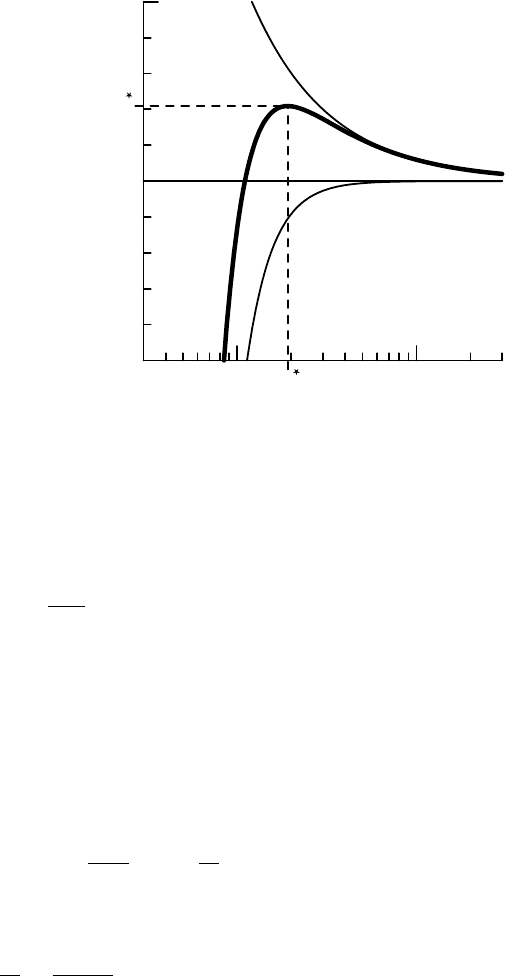
evaporation has therefore reduced. Figure 7.3 shows a plot of the saturation
ratio as a function of droplet radius.
The relative humidity and the saturation ratio can be compared. For ex-
ample, if
RH >S
K
(7.14)
the drop is in a supersaturated environment and vapour will condense on it;
the drop will grow. A flat surface has a saturation ratio of 1 and therefore the
vapour will condense on it when the relative humidity is above 100%. Curved
drops have higher saturation ratios and therefore need a higher relative hu-
midity (above 100%) to grow.
7.1 HOMOGENEOUS NUCLEATION: THE KELVIN EFFECT 129
1.00.1
r
99
100
101
S
radius (µm)
saturation ratio (%)
Kelvin effect
Raoult effect
FIGURE 7.3 Saturation ratio as a function of droplet radius (‘K
¨
ohler curve’, thick line) for
a droplet at 0
◦
C and with 10
−16
g of NaCl solute. The K
¨
ohler curve is the product of the
Kelvin effect and the Raoult effect (thin lines).
The Kelvin effect is small for large droplet radii. It becomes very large for
radii r smaller than the Kelvin radius r
K
with
r
K
=
2v
l
R
v
T
. (7.15)
For water drops at typical atmospheric temperatures, r
K
≈ 1.2nm, about 10
times the size of a water molecule. A drop of water of size r
K
would therefore
contain several thousand water molecules; this is getting close to the regime
where equilibrium thermodynamics becomes less applicable and we need to
use molecular dynamics calculations. However, in the atmosphere, typical
saturation ratios are only slightly larger than 1. For such saturation ratios we
can write
S
K
≈ 1 +
2v
l
R
v
Tr
= 1 +
r
K
r
. (7.16)
This can be rearranged to
r
r
K
=
1
S
K
− 1
. (7.17)
So for a droplet with a radius 100 times larger than the Kelvin radius, the
Kelvin effect corresponds to a supersaturation of 1% (S
K
= 1.01). At such a
droplet radius (≈ 0.12 m) the drop contains enough molecules to be accu-
rately described by macroscopic physics.

130 CH 7 CLOUD DROPS
We can rewrite the right-hand side of Eq. 7.9 as
∂g
l
∂p
T
ıe + 2v
l
ı(1/r) =
∂g
l
∂p
T
ı(e + 2/r). (7.18)
So the surface tension term in Eq. 7.8 can be incorporated in the Gibbs func-
tion for the drop as
g
l
(e, T) + 2v
l
/r = g
l
(e
,T), (7.19)
with
e
= e + 2/r. (7.20)
In other words, the surface tension increases the pressure inside the drop by
2/r, something that should come as no surprise. So according to Eq. 7.8,
the specific Gibbs functions for the two phases have to be the same as long
as the pressure inside the drop is augmented by the capillary pressure
I p
= 2/r (7.21)
compared to the external vapour pressure.
With the interpretation of pressure as a volumetric energy density, see
Section 2.2, the Kelvin effect can be interpreted as a Boltzmann factor corre-
sponding to the excess energy per droplet molecule due to the surface tension,
exp
2v
l
R
v
Tr
= exp
−
E
k
B
T
, (7.22)
with the excess energy per molecule written in terms of capillary pressure,
E =−p
V/N, (7.23)
and with N the number of molecules in the drop and V its volume. So
the capillary pressure provides a reduced energy barrier between the liq-
uid and the vapour. This interpretation in terms of the Boltzmann factor
emphasizes the statistical nature of the vapour–liquid equilibrium at a fixed
temperature.
So can water molecules clump together to form water droplets when the
relative humidity is large enough? Such a process is called homogeneous nucle-
ation. Initial clusters of water molecules may form by chance but their radius
is quite a bit smaller than 1 nm. This means that the Kelvin effect is important
and in practice would correspond to saturation ratios S
K
= 4 or larger. For
growth to occur we would need a relative humity in excess of 400% or so, see
Eq. 7.14. This never happens in the atmosphere. Homogeneous nucleation
cannot be the source of cloud droplets in the atmosphere. Somehow, we need
to counteract the Kelvin effect.

7.2 HETEROGENEOUS NUCLEATION: THE RAOULT EFFECT 131
7.2 HETEROGENEOUS NUCLEATION: THE RAOULT EFFECT
The atmosphere contains particles that can serve as condensation nuclei for
drops. Many of these particles can partially dissolve in the water they attract. It
turns out that the dissolved nucleus in the water reduces the saturation vapour
pressure enough to counteract the Kelvin effect.
Suppose the water drop contains number concentrations c
i
of solute i; that
is, c
i
of the molecules in the droplet are made up of the solute i. Raoult’s law
now states that the saturated vapour pressure is the sum of the individual
saturated vapour pressures of the constituents in the liquid weighted with
their number concentrations. A derivation of Raoult’s law requires introduc-
tion of so-called chemical potentials, the generalized forces that correspond to
changes in composition of a substance. This is set out in detail in Chapter 8.
An informal justification is as follows. Suppose c is the number concentra-
tion of all solute molecules. Then 1 − c is the number concentration of water
molecules. That means that according to Raoult’s law the saturated vapour
pressure e
s
(c) for a water with solute concentration c is
e
s
(c) = (1 − c) e
s
(0), (7.24)
with e
s
(0) the saturated vapour pressure for pure water (with the Kelvin
effect included for spherical droplets). From a microscopic point of view this
equation makes sense. According to the equipartition theorem, the kinetic
energy will be equally distributed amongst all the molecules, because they
are at the same temperature. This means that at some temperature the water
molecules have the same chance of escaping the solution. It is assumed that
the solute does not change the energy barrier for escaping the solution; this is,
implicitly, one of the assumptions in deriving Raoult’s law: the assumption of
an ideal solution. However, the number of water molecules per unit number
of molecules has reduced by a factor 1 − c, thus reducing the evaporation
rate, and therefore the saturation vapour pressure of the water by the same
factor.
We can rewrite Eq. 7.24 in a more explicit form. Write the total number
of molecules N
t
as N
t
= N
l
+ N
s
with N
l
the number of molecules of liquid
water, the solvent, and N
s
the number of solute molecules. We then find
that
1 − c =
N
t
− N
s
N
t
=
N
l
N
l
+ N
s
=
1
1 + N
s
/N
l
. (7.25)
The fraction N
s
/N
l
can be expressed as
N
s
N
l
= i
M
s
l
V
l
s
, (7.26)
with M
s
the total mass of the solute in the drop, V the volume of the drop,
being nearly equal to the volume of all the water molecules, and
l
and
s
the

132 CH 7 CLOUD DROPS
molar weights of the water and solute molecules, respectively. The factor i is
the Van’t Hoff factor, which takes into account the dissociation of the solute
molecules. For example, in solution common salt NaCl will dissociate into
two ions, Na
+
and Cl
−
. The Van ’t Hoff factor i is typically equal to 2 for
many of the relevant solutes.
This expression can be substituted in Eq. 7.24 to find for the saturation
ratio due to the Raoult effect
S
R
=
e
s
(M
s
)
e
s
(0)
=
1
1 + i
3M
s
l
4r
3
l
s
, (7.27)
where we have now written V = (4/3)r
3
for spherical drops of radius
r. Figure 7.3 shows a plot of the saturation ratio as a function of droplet
radius.
7.3 K
¨
OHLER THEORY
Combining the Kelvin and Raoult effects, we get an expression for the ratio
of the saturated vapour pressure over a flat surface of pure water, as derived
in Section 5.1, to the saturated vapour pressure of a solution in a spherical
droplet of radius r at temperature T. This saturation ratio is:
I S = S
K
S
R
=
exp (a/rT)
1 + b/r
3
(7.28)
with, for water drops in air,
a =
2v
l
R
v
≈ 3.3 × 10
−7
Km, (7.29a)
b =
3v
l
l
4
iM
s
s
≈ 4.3 × 10
−6
(iM
s
/
s
)m
3
. (7.29b)
A plot of S as a function of radius is called a K
¨
ohler curve. Figure 7.3 shows
an example of a K
¨
ohler curve highlighting the Kelvin and Raoult effects. The
K
¨
ohler curve defines at what relative humidity the droplet would be in equi-
librium with the environment.
The maximum of the K
¨
ohler curve plays an important role for droplet
growth. The radius at the maximum is called the activation radius, denoted
r
, and the value of the supersaturation at the activation radius is called the
activation saturation ratio or critical saturation ratio, denoted S
.
The values of r
and S
follow from setting dS/dr = 0 in the K
¨
ohler
equation. An exact calculation requires finding the root of a cubic polyno-
mial. However, from the above graph it can be seen that both the Kelvin and
Raoult effects are typically quite small around the activation radius (of or-
der one percent). This suggests that we can use a Taylor expansion for both

7.3 K
¨
OHLER THEORY 133
effects and find an approximate result. To do this, define a non-dimensional
radius x as
r = x
bT
a
, (7.30)
and a non-dimensional parameter as
=
(a/T)
3
b
. (7.31)
We can write the K
¨
ohler curve equation, Eq. 7.28, as
S(x) =
exp (/x)
1 + /x
3
. (7.32)
For typical atmospheric values of the parameters a, b, and T it can be verified
that is quite small. Now assuming that x is not much bigger or much smaller
than 1 – to be verified in hindsight – we can use a Taylor expansion for S in
small ,
S(x) = 1 +
x
−
x
3
+ O (
2
). (7.33)
We thus have
dS
dx
=−
x
2
+ 3
x
4
+ O (
2
). (7.34)
Setting this to zero gives the non-dimensional activation radius x
,
x
=
√
3 + O (), (7.35)
which is indeed not much larger than 1, validating the Taylor expansion.
38
The corresponding critical saturation ratio is
S
= 1 +
2
3
√
3
. (7.36)
38
A full solution of dS/dx = 0 without approximation leads to
x
= 2 cos
1
3
cos
−1
−
2
.
The difference between this exact expression for x
and the approximated expression is
small; it can be shown that x
=
√
3 − /6 + O (
2
).
134 CH 7 CLOUD DROPS
1.00.1
99
100
101
radius (µm)
saturation ratio (%)
0.1
0.3
1
3
10
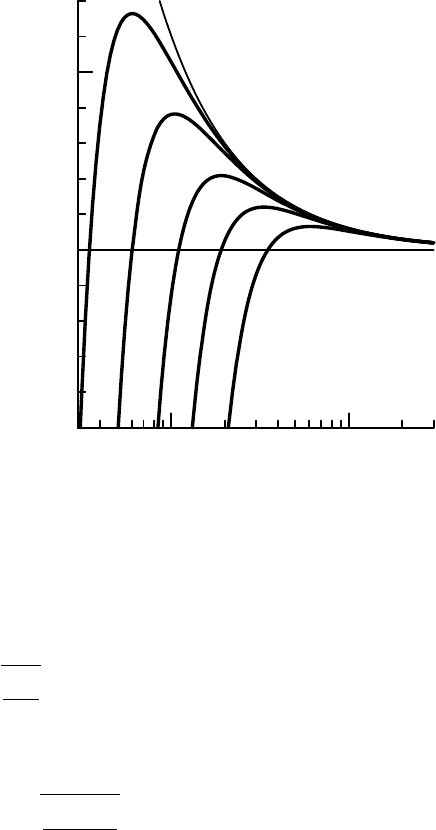
FIGURE 7.4 K
¨
ohler curves for different amounts of NaCl solute (in 10
−16
g). In the limit
of vanishing solute amount, the K
¨
ohler curve approaches that of the Kelvin effect (thin
line).
So the non-dimensional parameter is a measure of the critical super-
saturation.
Substituting the definitions of x and , we find the activation radius r
I r
=
3bT
a
, (7.37)
and the critical saturation ratio S
I S
= 1 +
4(a/T)
3
27b
. (7.38)
The critical supersaturation, defined as S
− 1, decreases when b increases,
which is to say when the amount of solute increases in the droplet. At the
same time the activation radius r
increases. Figure 7.4 shows various K
¨
ohler
curves for different amounts of solute, illustrating the dependencies of r
and S
on the solute amount. Note that the activation radius is always very
small. For any drops larger than about 1m both the Kelvin and Raoult effects
can be ignored.
The K
¨
ohler curve contains a lot of information about initial cloud droplet
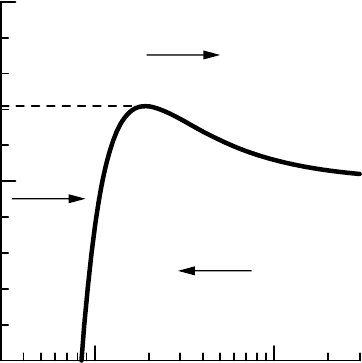
growth. Consider Figure 7.5, where the K
¨
ohler curve and the level of the
critical saturation ratio divides the figure into three different areas, labelled
A, H, and N.
7.3 K
¨
OHLER THEORY 135
1.00.1
99
100
101
radius (µm)
relative humidity (%)
H
A
N
FIGURE 7.5 Three distinct regions, A, H, and N, in the (r, RH) space, as defined by the
K
¨
ohler curve.
Now suppose the nucleus has attracted some water and forms a small
droplet of a particular radius r. Further suppose this droplet is moved into
air of a particular relative humidity RH. This initial droplet then finds itself
at the point (r, RH) in the figure and will be in one of the labelled areas.
Suppose the initial droplet was somewhere in area H. In this area the
droplet is in an environment with a higher saturation ratio than the equi-
librium saturation ratio for the droplet, as given by the K
¨
ohler curve. This
means that the droplet is in a supersaturated environment and water vapour
will start to condense onto the drop. The drop will grow; the point (r, RH)
in the figure will move to the right, as indicated by the arrow. This growth
will continue until the point hits the K
¨
ohler curve, where RH = S; here the
droplet is in equilibrium with its environment and will remain steady. Such
droplets are called haze.
Suppose the initial droplet was somewhere in area N. In this area the
droplet is in an environment with lower relative humidity than the equi-
librium saturation ratio for the droplet. The droplet will therefore start to
evaporate and reduce in radius. The point (r, RH) for the droplet will move
to the left in the figure until it hits the K
¨
ohler curve, where the drop is again
in equilibrium, RH = S. The droplet has again become haze. To find initial
droplets in area N requires the existence of relatively large drops in subsat-
urated air, which is possible when turbulence is present or when raindrops
fall in subsaturated air.
Haze droplets on the boundary between areas H and N, given by the K
¨
ohler
curve below the activation radius, are stable: if for some reason a haze droplet
were to move away from the boundary the tendency would be for the droplet
to be pushed back to the boundary. Haze is a stable state for droplets. For