
Ambaum M., Thermal Physics of the Atmosphere
Подождите немного. Документ загружается.

Useful data
Universal constants:
Boltzmann constant k
B
= 1.381 × 10
−23
JK
−1
.
Avogadro number N
A
= 6.022 × 10
23
Universal gas constant R
= 8.314 J mol
−1
K
−1
Planck constant h = 6.626 × 10
−34
Js
Speed of light c = 2.998 × 10
8
ms
−1
Stefan–Boltzmann constant = 5.670 × 10
−8
Wm
−2
K
−4
Permittivity of vacuum
0
= 8.854 × 10
−12
Fm
−1
Elementary charge e = 1.602 × 10
−19
C
Dry air properties:
effective molar mass
d
= 29.0 g mol
−1
specific gas constant R, R
d
= 287 J kg
−1
K
−1
specific heat at constant pressure c
p
,c
pd
= 1004 J kg
−1
K
−1
Water properties (temperature dependent properties determined at 0
◦
C):
molar mass
v
= 18.015 g mol
−1
specific gas constant R
v
= 461.5Jkg
−1
K
−1
specific heat at constant pressure (vapour) c
pv
= 1859 J kg
−1
K
−1
specific heat at constant pressure (liquid) c
pl
= 4218 J kg
−1
K
−1
specific heat at constant pressure (solid) c
pl
= 2050 J kg
−1
K
−1
enthalpy of vaporization L = 2.501 × 10
6
Jkg
−1
enthalpy of fusion L
f
= 0.334 × 10
6
Jkg
−1
enthalpy of sublimation L + L
f
= 2.835 × 10
6
Jkg
−1
surface tension = 75.6 × 10
−3
Nm
−1
Other useful data:
Standard pressure = 101325 Pa
Standard temperature = 15
◦
C = 288.15 K
Acceleration of gravity (Earth surface) g
0
= 9.81 m s
−2
Earth: mean radius R
E
= 6.371 × 10
6
m
Earth: mean orbital radius r
E
= 149.5 × 10
9
m
Earth: orbital eccentricity e = 0.0167
Sun: radius R
S
= 696 × 10
6
m

1
Ideal gases
In this chapter we introduce the concept of an ideal gas, a gas of non-
interacting molecules. An ideal gas is an accurate model of dilute gases such
as the atmosphere.
We further introduce the notion of macroscopic variables, amongst them
such familiar ones as temperature or pressure. These macroscopic variables
must be related to some property of the microscopic state of the molecules that
make up the substance. For example, for the systems we consider here, tem-
perature is related to the mean kinetic energy of the molecules. The linking of
the macroscopic and microscopic worlds is the subject of statistical mechan-
ics. In this chapter we give an elementary application of it to ideal gases.
1.1 THERMODYNAMIC VARIABLES
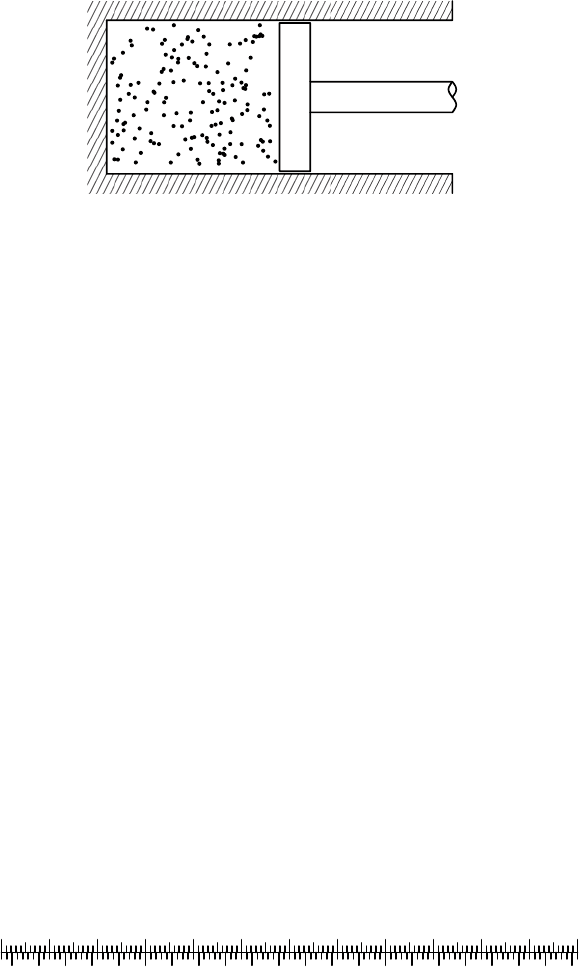
Consider a volume of gas. A useful mental picture is that of a gas in a closed
cylinder with a piston, similar to the driving cylinder of a steam engine, see
Figure 1.1. In this way we can control certain properties of the gas, such as its
volume or temperature, and perform experiments on it. Such experiments are
normally thought experiments, although in principle they can be performed
in the laboratory.
At the macroscopic level, the gas has some familiar properties:
r
volume V (units: m
3
)
r
mass M (units: kg)
r
density = M/V (units: kg m
−3
)
r
temperature T (units: K, Kelvin)
r
pressure p (units: Pa = Nm
−2
, Pascal).
The gas is made up of molecules with individual mass M
1
, so the total mass
of gas is
M = NM
1
, (1.1)
1
Thermal Physics of the Atmosphere Maarten H. P. Ambaum
© 2010 John Wiley & Sons, Ltd. ISBN: 978-0-470-74515-1
2 CH 1 IDEAL GASES
FIGURE 1.1 Gas in a cylinder with piston.
with N the number of molecules. The number of molecules N is often ex-
pressed as a multiple of the Avogadro number N
A
,
N
A
= 6.022 × 10
23
. (1.2)
The Avogadro number is defined as the number of molecules in 12 g of
carbon-12. The number of molecules is then defined as a multiple n of N
A
N = nN
A
, (1.3)
where n is the number of moles. With this definition of the mol, the mass of
the gas can be written as
M = n (1.4)
with = N
A
M
1
the molar mass. So the molar mass of carbon-12 is by defi-
nition precisely 12 g mol
−1
.
The temperature can be defined as ‘that property which can be measured
with a thermometer’. This definition sounds circular but it can be shown to
be a perfectly valid definition. The SI unit
3
for temperature is the Kelvin
(K). Temperature is often denoted in degrees Celsius,
◦
C with T(
◦
C) =
T(K) −273.15, or in degrees Fahrenheit,
◦
F with T(
◦
F) = 1.8 T(
◦
C) +32, see
Figure 1.2. Temperature can never be lower than 0 K, or absolute zero; the
temperature in Kelvin is also called the absolute temperature.
–70
–60
–50
–40
–30
–20
–10
0
10
20
30
40
50
–90
–80
–70
–60
–50
–40
–30
–20
–10
0
10
20
30
40
50
60
70
80
90
100
110
120
ºC
ºF
FIGURE 1.2 Nomogram for Celsius–Fahrenheit conversion.
3
SI stands for Syst
`
eme International d’Unit
´
es, the internationally agreed system of units
for physical quantities.
1.1 THERMODYNAMIC VARIABLES 3
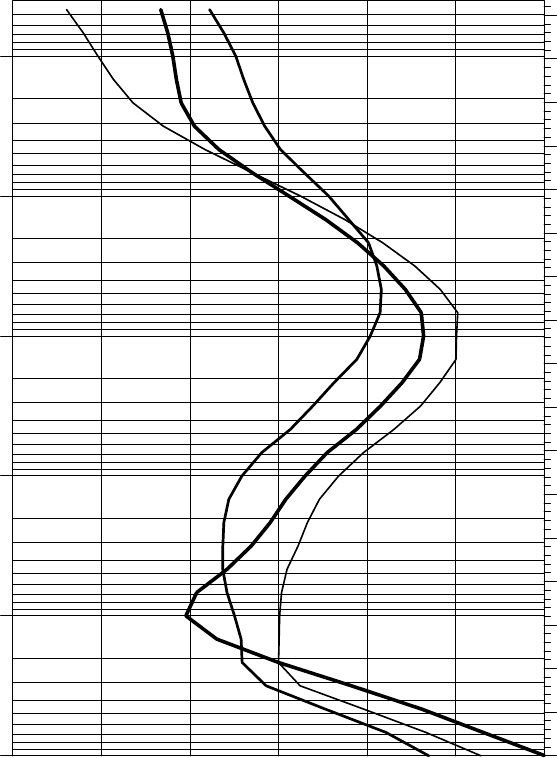
Figure 1.3 illustrates the typical mean temperatures encountered through
the depth of the Earth’s atmosphere. This figure uses the logarithm of pressure
as a vertical coordinate because this is approximately proportional to the
geometric height in the atmosphere.
Pressure is the force a gas exerts on its bounding walls per unit area. This
does not mean that gas only has a pressure defined at the bounding walls:
the internal pressure of a gas can in principle be measured by inserting some
probe and measuring the force per unit area on the probe. There are several
units of pressure in use, each with its specific area of application. The SI unit
for pressure is the Pascal (Pa) which is equivalent to one Newton per square
metre. In atmospheric applications we normally use the hectoPascal (hPa;
by definition, 1 hPa = 100 Pa) or millibar (mbar; with 1 mbar = 1 hPa).
Pressure and temperature do not correspond to a property of individual
molecules. They are bulk properties that can only be defined as a statistical
property of a large number of molecules. This will be discussed in the next
section.
There are several other macroscopic variables that can be used to describe
the state of a simple gas; these are known as thermodynamic variables.Ifwe
know all the relevant thermodynamic variables, we know the full thermody-
namic state of the gas. All these variables are interrelated and it turns out
that for a simple substance (a substance with a fixed composition, such as
dry air) we only need two thermodynamic variables to describe the whole
thermodynamic state.
4
For more complex systems we need more variables. For example, in a
mixture of varying composition we need to know the concentrations of the
constituents. Moist air is such a mixture. The number of water molecules in
the air is highly variable and these variations need to be taken into account.
For sea water, on the other hand, we need to know the salinity – the quantity
of dissolved salts – because it has important consequences for the density.
Finally, for cloud drops we need to know the surface area as well as the
amount of dissolved solute, both of which have profound consequences for
the thermodynamics of the drops.
Thermodynamic variables are either:
r
extensive, proportional to the mass of the system
r
intensive, independent of the mass of the system.
Volume and mass are extensive variables, temperature and density are inten-
sive variables. For most variables it is obvious whether they are extensive or
intensive.
4
The number N of thermodynamic variables required to define the state of any system
is given by the Gibbs’ phase rule,
N = 2 + C − P,
with C the number of independent constituents and P the number of coexisting phases
(gas, liquid, solid) in the system.
4 CH 1 IDEAL GASES
1000
100
10
1
0.1
0.01
p (hPa)
0
5
10
15
20
25
30
35
40
45
50
55
60
65
70
75
80
85
Z
T (ºC)
(km)
025−25−50−75−100−125
FIGURE 1.3 Temperature, in
◦
C, as a function of height. Tropical annual mean (thick
line), extratropical winter mean (medium line) and extratropical summer mean (thin
line). The tropics here correspond to the latitudes between the tropics of Cancer and
Capricorn; the extratropics correspond to the latitudes beyond 45
◦
in either hemisphere
at the corresponding season. Based on data from Randel, W. et al. (2004) Journal of
Climate 17, 986–1003.
Going up in altitude, the temperature first decreases (troposphere), increases (strato-
sphere), and then decreases (mesosphere). The mesosphere ends at about 90 km altitude,
above which the temperature starts to increase again (thermosphere). These atmospheric
layers are separated by the tropopause, stratopause, and mesopause, respectively. The
temperature increase in the stratosphere is due to the photo-dissociation of ozone, which

1.1 THERMODYNAMIC VARIABLES 5
Extensive variables can be divided by the mass of the system to become
intensive; such new variables are then called specific variables. Specific and
extensive variables are usually denoted by the same letter, but with the spe-
cific variable written in lower case and its extensive equivalent in upper. For
example, the volume V of a system divided by the mass M of the system
becomes the specific volume v with v = V/M. Note that
v = 1/, (1.5)
where is the density. Later we will come across other extensive variables.
For example, the entropy S of a system is an extensive variable, so we can
define s = S/M as the specific entropy. Although temperature T is an intensive
variable it is normally denoted by an upper case letter, a convention we adopt
here as well.
We have ignored internal variations in the volume of gas or material un-
der consideration. For example, we assume there is no internal macroscopic
motion of the gas, which would be associated with pressure variations and
internal kinetic energy. Clearly this is not the case for the atmosphere as a
whole. The pressure and density vary enormously through the atmosphere,
usually most dramatically in the vertical: at 10 km height the pressure is
about a quarter of its surface value. Indeed, such variations are the source of
all atmospheric motion.
We assume that we can define the intensive thermodynamic variables lo-
cally and that they have their usual equilibrium thermodynamic relations. We
then say that the gas is in local thermodynamic equilibrium. Local thermody-
namic equilibrium is valid if there is a large separation between the spatial
and temporal scales of macroscopic variations and those of microscopic vari-
ations. The spatial scale of macroscopic variations needs to be much larger
than the mean free path of molecules, the mean distance a molecule travels
between collisions with other molecules. The temporal scale of macroscopic
variations needs to be much larger than the mean time between molecular
collisions. Near the Earth’s surface the mean free path in the atmosphere is
FIGURE 1.3 (continued) absorbs the solar energy in the UV part of the spectrum
(wavelengths shorter than about 320 nm). Indeed, the ozone itself is formed by photo-
dissociation of molecular oxygen, which occurs at wavelengths shorter than 240 nm. The
maximum ozone concentration (‘the ozone-layer’) is at about 25 km altitude.
It is of note that the temperature in the troposphere is at its maximum in the tropics,
while in the stratosphere it is at a maximum in the summer hemisphere and a minimum
in the winter hemisphere. This latitudinal temperature gradient is reversed in the meso-
sphere. Note also that the tropopause is coldest and highest in the tropics.
The thermosphere (outside this plot) is heated by absorption of UV radiation and sub-
sequent ionization of the molecular constituents, thus forming the ionosphere. At these
altitudes the density is so low that energy does not get thermalized effectively and local
thermodynamic equilibrium is not fully attained. The thermosphere gives way to space in
the exosphere.

6 CH 1 IDEAL GASES
about 0.1
m (about 30 times the average molecular distance) with typical
molecular velocities of several hundreds of metres per second, so local ther-
modynamic equilibrium is satisfied. It turns out that above about 100 km
height, local thermodynamic equilibrium breaks down.
A small volume of gas in the atmosphere, for which the internal motion can
be ignored and which has well-defined density, temperature, and so on, is
called an air parcel. Because an air parcel is, by definition, in local thermody-
namic equilibrium, its thermodynamic variables satisfy all the relationships
that are found in equilibrium systems. At the level of an air parcel we need
not worry about non-equilibrium effects.
1.2 MICROSCOPIC VIEWPOINT
From the microscopic viewpoint, temperature is defined as the average kinetic
energy of the molecules,
I
3
2
k
B
T =
1
2
M
1
U
2
+
1
2
M
1
V
2
+
1
2
M
1
W
2
, (1.6)
with (U , V , W ) the three-dimensional vector velocity of the molecule. The
brackets ... denote the average, a time average for a single molecule, the
average over all molecules, or the average over an ensemble of gases in
the same macroscopic state. A key assumption of statistical mechanics is that
all these averages lead to the same result. The constant k
B
is the Boltzmann
constant,
k
B
= 1.381 × 10
−23
JK
−1
. (1.7)
In statistical physics as well as macroscopic thermodynamics, energy is the
fundamental quantity. Temperature is a derived quantity which has been
given its own units because it is measured with a thermometer. The Boltz-
mann constant is merely a proportionality constant between energy and ab-
solute temperature. The fundamental point is that statistical mechanics can
be formulated such that the microscopic definition of temperature in terms of
the mean kinetic energy of the molecules corresponds to the thermodynamic
definition of temperature.
The factor 3/2 in the microscopic definition of temperature reflects a classic
result in the mechanics of systems with many components, namely that each
degree of freedom contains, on average, the same energy. A degree of freedom
is an independent variable in which the system can vary. A single molecule
carries three translational degrees of freedom: motion in the x, y, and
z-directions. There can also be internal degrees of freedom corresponding
to rotations and vibrations of the molecule. The equipartition theorem states
that each accessible degree of freedom
5
carries on average the same energy,
5
Not all available degrees are necessarily accessible. Quantization of energy levels im-
plies that there is a minimum energy required to excite any degree of freedom.
1.2 MICROSCOPIC VIEWPOINT 7
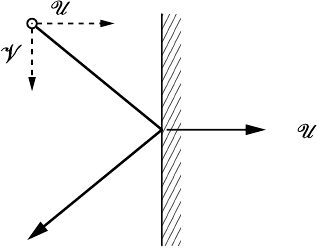
2M
FIGURE 1.4 Transfer of momentum by a molecule colliding with the wall. The total
momentum transfer is twice the momentum in the x-direction of the molecule.
and this energy equals k
B
T/2. Adding the average kinetic energies in the three
spatial directions then gives the result of Eq. 1.6.
Pressure is the result of many collisions of individual molecules against the
walls of a vessel or a probe. If a molecule approaches the wall with a veloc-
ity U and elastically collides with the wall, then the molecule’s momentum
in the direction of the wall changes by 2M
1
U , from M
1
U to −M
1
U . This
momentum is transferred to the wall. By Newton’s laws, the amount of mo-
mentum transferred per unit time is the force on the wall, see Figure 1.4.
For an interior point we can define the local pressure as the momentum flux
density through some imaginary surface in the interior of the fluid.
So how many molecules collide with the wall? Let the number density
of molecules, that is the number of molecules per unit volume, be denoted
with
˜
n. We can now write the number density of molecules with x-velocities
between U and U + dU as
˜
n
U
, which is related to the total number density
˜
n by
˜
n =
˜
n
U
dU . (1.8)
Over a time ıt, those molecules with positive velocity between U and U +dU
that are located within a distance U ıt of the wall will collide with the wall.
Therefore, the number of such molecules that have collided with the wall
will be
˜
n
U
U ıt A, with A the area of the wall. To get the momentum transfer
per unit time, simply multiply this number by the momentum transfer per
molecule, 2M
1
U , and divide by the time taken, ıt. This is the force F
U
exerted
on the wall by molecules with positive velocities between U and U + dU ,
F
U
= 2
˜
n
U
M
1
U
2
A. (1.9)
To find the total pressure we need to divide by A and integrate the force over
all positive velocities, that is to say those U > 0, because molecules with
negative velocities will not collide with the wall and thus will not contribute
8 CH 1 IDEAL GASES
to the pressure,
p =
U >0
2
˜
n
U
M
1
U
2
dU . (1.10)
By symmetry, there will be an equal number of molecules with positive and
negative U . We can therefore integrate over all velocities U , positive and
negative, and divide the result by two. The expression for the pressure then
becomes
p =
˜
n M
1
U
2
, (1.11)
with
˜
n the total number density. The equipartition theorem states that
M
1
U
2
=k
B
T so that the pressure satisfies
I pV = Nk
B
T, (1.12)
where we have substituted
˜
n = N/V. This is the ideal gas law.
By writing the total number of molecules N as nN
A
, the ideal gas law can
be written
pV = nR
T, (1.13)
where R
is called the universal gas constant,
R
= N
A
k
B
= 8.314 J mol
−1
K
−1
. (1.14)
Before the microscopic definitions of temperature and pressure were known,
it was already hypothesized by Avogadro (and later confirmed to be true)
that the constant R
is the same for all types of gases.
Another form of the ideal gas law follows by dividing by the mass M = n
of the gas to find
I pv = RT, or p = RT, (1.15)
where R is the so-called specific gas constant,
R = R
/. (1.16)
This is the form of the ideal gas law that is normally used in atmospheric
science. Confusingly, the convention is to use a capital R for the specific
gas constant even though it is a specific quantity. Note also that in most
general physics literature the letter R stands for the universal gas constant; it
should be clear from the context which is meant. This is one of those instances
where the convention used in atmospheric science literature is not particularly
helpful. Furthermore, the ideal gas law in the form of Eq. 1.13 is more general
and more useful.
1.2 MICROSCOPIC VIEWPOINT 9
p
pV
VTT000
isotherm
low T
high T
isochore
high V
low V
isobar
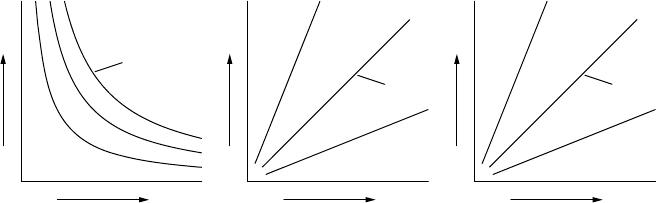
high p
low p
FIGURE 1.5 The left panel illustrates Boyle’s law and the middle panel Gay-Lussac’s law.
The right panel illustrates that, for an ideal gas at fixed pressure, the volume of a gas is
proportional to its temperature; this is sometimes known as Charles’s law.
The ideal gas law encompasses:
r
Boyle’s law: at constant temperature, the product of pressure and vol-
ume is constant
r
Gay-Lussac’s law: at constant volume, the pressure of a gas is propor-
tional to its temperature.
Figure 1.5 illustrates these laws in diagrams. These laws were originally de-
termined experimentally. They are only strictly valid for ideal gases.
In deriving the ideal gas law, we have not considered subtleties such as in-
elastic collisions, where energy transfer between the gas and the wall occurs,
or the consideration that the wall is not a mathematical flat plane but made
up of molecules. These complications do not alter the basic result.
We have also not considered interactions between the molecules and inter-
actions at a distance between the molecules and the wall. This does make a dif-
ference and it defines the difference between real gases and ideal gases. Ideal
gases are made up of non-interacting molecules, vanishingly small molecules
that are unaware of the presence of any other molecules.
We assume that molecules in an ideal gas do not interact with each other
and also that the molecules are in thermal equilibrium. Strictly speaking these
assumptions are inconsistent, as a gas can only achieve thermal equilibrium
through many collisions between the molecules. The colliding molecules dis-
tribute the energy amongst all the accessible degrees of freedom and thus
achieve equipartition. This process of energy distribution is called thermal-
ization. A gas is in local thermodynamic equilibrium if all the available energy
is thermalized. If collisions are rare, energy cannot be thermalized effectively
and the gas cannot achieve local thermodynamic equilibrium. This occurs at
high altitudes in the atmosphere (higher than, say, 100 km) where the energy
input from radiation is not thermalized due to the low number of collisions.
The ideal gas law is an example of an equation of state. Real gases are
not ideal and will therefore have a different relationship between pressure,
density and temperature. For example, the equation of state for real gases is