
Ambaum M., Thermal Physics of the Atmosphere
Подождите немного. Документ загружается.

94 CH 5 WATER IN THE ATMOSPHERE
5.1 THE CLAUSIUS–CLAPEYRON EQUATION
Consider a closed cylinder with a liquid and its vapour, but nothing else, co-
existing.
29
All the time some of the liquid molecules will evaporate to vapour,
while some of the vapour molecules will condense to liquid. This situation
will equilibrate: when excess molecules are leaving the fluid to go into the
vapour, the pressure of the vapour will increase and consequently the number
of molecules moving back into the liquid will increase, reducing the excess
pressure until equilibrium is restored.
For systems in equilibrium, where the liquid and the vapour phases coexist,
the specific Gibbs functions g
l
and g
v
for the liquid and vapour phases have
to be the same. An informal argument for this was given in Section 3.6. The
equality of the specific Gibbs functions in turn determines how the vapour
pressure changes with temperature, as described by the Clausius–Clapeyron
equation. Now we give a more complete argument why the specific Gibbs
functions for the liquid and the vapour have to be the same when they coexist.
Consider a cylinder with a piston, which is filled with a liquid and its vapour
and held under a constant temperature T and pressure e (the pressure of a
vapour is denoted by the symbol e to distinguish it from the total pressure p
of air). Because the system is held at constant pressure and temperature, the
Gibbs function for the whole system
G = U − TS + eV (5.1)
has a constant value as it is a function of temperature and pressure only, see
Section 3.1. But the total Gibbs function has contributions from both the
liquid and the vapour,
G = M
l
g
l
+ M
v
g
v
, (5.2)
with M
l
and M
v
the masses of the liquid and vapour and g
l
and g
v
the specific
Gibbs functions for the liquid and the vapour phases. If now, by some fluc-
tuation, some amount ıM of liquid evaporates to the vapour, the total Gibbs
function changes by
ıG = M
l
ıg
l
+ M
v
ıg
v
+ (g
v
− g
l
) ıM
= M
l
(− s
l
ıT + v
l
ıe) + M
v
(− s
v
ıT + v
v
ıe) + (g
v
− g
l
) ıM. (5.3)
Because the total Gibbs function is kept constant, its first order variation has
to vanish, ıG = 0. The pressure and the temperature are prescribed, so we
29
This requires the cylinder to be below the critical temperature, the temperature above
which the gas and liquid phases become indistinguishable and no phase separation can
occur no matter how high the pressure is. The critical temperature for water is 647 K.
5.1 THE CLAUSIUS–CLAPEYRON EQUATION 95
have ıe = 0 and ıT = 0. It then follows that
I g
v
= g
l
. (5.4)
The specific Gibbs functions for the liquid and vapour phases are the same if
they coexist in the cylinder.
At first sight it appears that the equality of g
v
and g
l
depends on the fact that
the system was in a cylinder at constant temperature and pressure. This is
not the case. Suppose we had fixed the piston and the system was at constant
temperature T and constant volume V. In that case the total free energy
F = U − TS (5.5)
would have to stay constant. Using the same arguments as above (with F =
M
l
f
l
+ M
v
f
v
) it then follows that
ıF = M
l
ıf
l
+ M
v
ıf
v
+ (f
v
− f
l
) ıM
= M
l
(− s
l
ıT − eıv
l
) + M
v
(− s
v
ıT − eıv
v
) + (f
v
− f
l
) ıM. (5.6)
Now we have to take into account that, although the total volume V is kept
constant, the specific volumes v
l
and v
v
can change when there is a mass
transfer ıM from the liquid to the vapour phase. We have
M
l
ıv
l
= ıV
l
− v
l
ıM
l
,M
v
ıv
v
= ıV
v
− v
v
ıM
v
. (5.7)
Substituting this in Eq. 5.6 we find
ıF =−(M
l
s
l
+ M
v
s
v
)ıT − e (ıV
l
+ ıV
v
) + (f
v
+ ev
v
− f
l
− ev
l
)ıM
=−(M
l
s
l
+ M
v
s
v
)ıT − eıV + (g
v
− g
l
)ıM, (5.8)
where we have used the fact that g = f + ev. Because the free energy is kept
constant, its first order variation has to vanish, ıF = 0. the temperature and
volume are prescribed so we have ıV = 0 and ıT = 0. It again follows that
g
v
= g
l
, that is, the specific Gibbs functions for the two phases have to be the
same if they coexist.
It turns out we can choose any set of constraints and still find that the spe-
cific Gibbs functions for both phases have to be the same, see Problem 5.1. The
Gibbs function is the only thermodynamic potential that depends on two in-
tensive variables: pressure and temperature. This is the ultimate reason why
for coexisting phases their specific Gibbs functions, rather than any of the
other thermodynamic potentials, are the same.
Having established that when the phases coexist their specific Gibbs func-
tions have to be the same, we will now change the temperature T of the
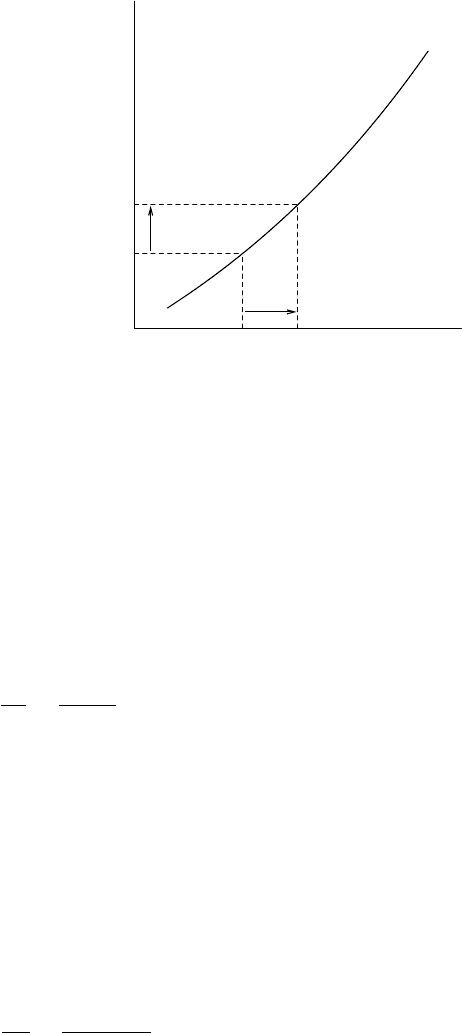
96 CH 5 WATER IN THE ATMOSPHERE
T
e
dT
de
g
v
= g
l
liquid
vapour
FIGURE 5.1 Derivation of the Clausius–Clapeyron equation: the coexistence curve g
v
= g
l
determines how much the vapour pressure needs to change (de) when the temperature is
changed (dT).
cylinder by dT. This temperature change will lead to a change in vapour
pressure e by de, see Figure 5.1. On changing e and T we have for the specific
Gibbs functions
dg
l
= v
l
de − s
l
dT, dg
v
= v
v
de − s
v
dT. (5.9)
Because for the coexisting phases the specific Gibbs functions g
l
and g
v
are
equal, we must have dg
l
= dg
v
. From this follows
de
dT
=
s
v
− s
l
v
v
− v
l
. (5.10)
The entropy difference between the liquid and the vapour is related to the
heat required to evaporate a certain amount ıM of liquid into the vapour
phase. This is most easily formalized by noting that at equilibrium
g
v
= g
l
by Eq. 5.4,
h
v
− Ts
v
= h
l
− Ts
l
by Eq. 3.12,
L = T (s
v
− s
l
) by Eq. 3.58. (5.11)
Substituting this in Eq. 5.10, we find the Clausius–Clapeyron equation,
I
de
s
dT
=
L
T(v
v
− v
l
)
. (5.12)
This equation describes how the pressure of the vapour changes when the
temperature changes; the subscript s has been added to emphasize that the

5.2 CALCULATION OF SATURATED VAPOUR PRESSURE 97
vapour is saturated, that is, the vapour is in equilibrium with the coexisting
liquid. (If no liquid is available, the vapour pressure is not determined by the
Clausius–Clapeyron equation but by the equation of state for the vapour.)
Because v
v
>v
l
and L>0, we find that the saturated vapour pressure is an
increasing function of temperature; at higher temperatures more molecules
can escape the attractive potential in the liquid.
5.2 CALCULATION OF SATURATED VAPOUR PRESSURE
The Clausius–Clapeyron equation needs to be integrated to find the vapour
pressure at a certain temperature. To do this, assume that the vapour is an
ideal gas, so we have e
s
v
v
= R
v
T, with R
v
the specific gas constant for the
vapour (in the case of water vapour R
v
= 461.5Jkg
−1
K
−1
). Further assume
that v
v
v
l
, which is true away from the critical temperature. The Clausius–
Clapeyron equation then becomes
I
de
s
dT
=
Le
s
R
v
T
2
. (5.13)
Further assuming that L is constant (this is not a very good assumption, see
below) this integrates to
e
s
= e
s0
exp
L
R
v
1
T
0
−
1
T
, (5.14)
with e
s0
the saturated vapour pressure at temperature T
0
. Because the specific
latent heat, L, reduces with temperature this integration is only valid for small
temperature differences.
It can be seen that the saturated vapour pressure is a strongly increas-
ing function of temperature. This aspect is independent of the presence
of any other gases alongside the vapour. By Dalton’s law, the total pres-
sure of a mixture is the sum of the partial pressures of the constituents;
the partial pressure of vapour above a liquid surface is determined by the
Clausius–Clapeyron equation, independent of any other gases present. This
clarifies the common misconception that ‘warm air holds more water’; the
air does not ‘hold’ the water, and its presence does not change the vapour
pressure.
If the vapour pressure is the same as the atmospheric pressure, the liquid
has reached its boiling point. Above the boiling point, the vapour cannot co-
exist with the liquid as its equilibrium vapour pressure is higher than the pre-
scribed pressure in the system. From the Clausius–Clapeyron equation it then
follows that the boiling point of a liquid reduces if the environmental pressure
reduces, see Problem 5.5. The boiling point of water is set at 100
◦
C because
at that temperature the vapour pressure is equal to the standard atmospheric
pressure of 1013.25 hPa.

98 CH 5 WATER IN THE ATMOSPHERE
In Section 3.6 we derived that the specific latent heat of evaporation can
be approximated as
L = L
0
− (c
pl
− c
pv
)(T − T
0
), (5.15)
with L
0
the latent heat of evaporation at some reference temperature T
0
. With
this approximation for the specific latent heat of evaporation as a function of
temperature we can now rewrite the Clausius–Clapeyron equation, Eq. 5.13,
as
de
s
e
s
=
L
0
+ (c
pl
− c
pv
) T
0
R
v
dT
T
2
−
c
pl
− c
pv
R
v
dT
T
. (5.16)
This integrates to
e
s
= e
s0
exp
L
0
R
v
1
T
0
−
1
T
T
0
T
˛
exp
˛
1 −
T
0
T
, (5.17)
with ˛ = (c
pl
− c
pv
)/R
v
. At T
0
= 25
◦
C we have L
0
= 2.444 × 10
6
Jkg
−1
,
c
pv
= 1865.1Jkg
−1
K
−1
, and c
pl
= 4179.9Jkg
−1
K
−1
. Using these values, the
accuracy of Eq. 5.17 is better than 1 part in two thousand when 0
◦
C <T<
40
◦
C and better than 1.5 parts in a hundred when 0
◦
C <T<100
◦
C; an
impressive result as the saturated vapour pressure varies by more than two
orders of magnitude over this temperature range.
30
For realistically varying L and without ignoring v
l
there are several empiri-
cal formulae which give values of the saturated vapour pressure as a function
of temperature. A particularly simple empirical formula is Tetens’ formula,
e
s
(hPa) = 6.112 exp
17.67 T(
◦
C)
T(
◦
C) + 243.5
, (5.18)
with T(
◦
C) the temperature in degrees celsius.
31
This formula has an accuracy
level similar to the analytical expression, Eq. 5.17.
Such formulae can also be produced for the saturated vapour pressure
over ice. The argument leading to the Clausius–Clapeyron equation can also
be applied to the balance between sublimation and deposition of vapour
over ice. Equation 5.14 with L
ice
= 2.826 × 10
6
Jkg
−1
gives the vapour
pressure over ice accurate to two parts in a hundred down to temperatures
of –50
◦
C. Again, accurate empirical formulae exist to calculate the saturated
vapour pressure over ice.
30
In these equations, the enthalpy of vaporization L always occurs in the fraction L/R
v
with R
v
the specific gas constant for the vapour. It is often more convenient to rewrite this
fraction as L/R
v
= /R
with the molar enthalpy of vaporization and R
the universal
gas constant.
31
This version of Tetens’ formula was published in Bolton, D. (1980) Mon. Wea. Rev.
108, 1046–1053.
5.2 CALCULATION OF SATURATED VAPOUR PRESSURE 99
403020100–10–20–30–40 T (ºC)
0.1
1
10
100
e
s
(hPa)
0.3
0.2
0.1
0
e
s
(hPa)
water
ice
water−ice
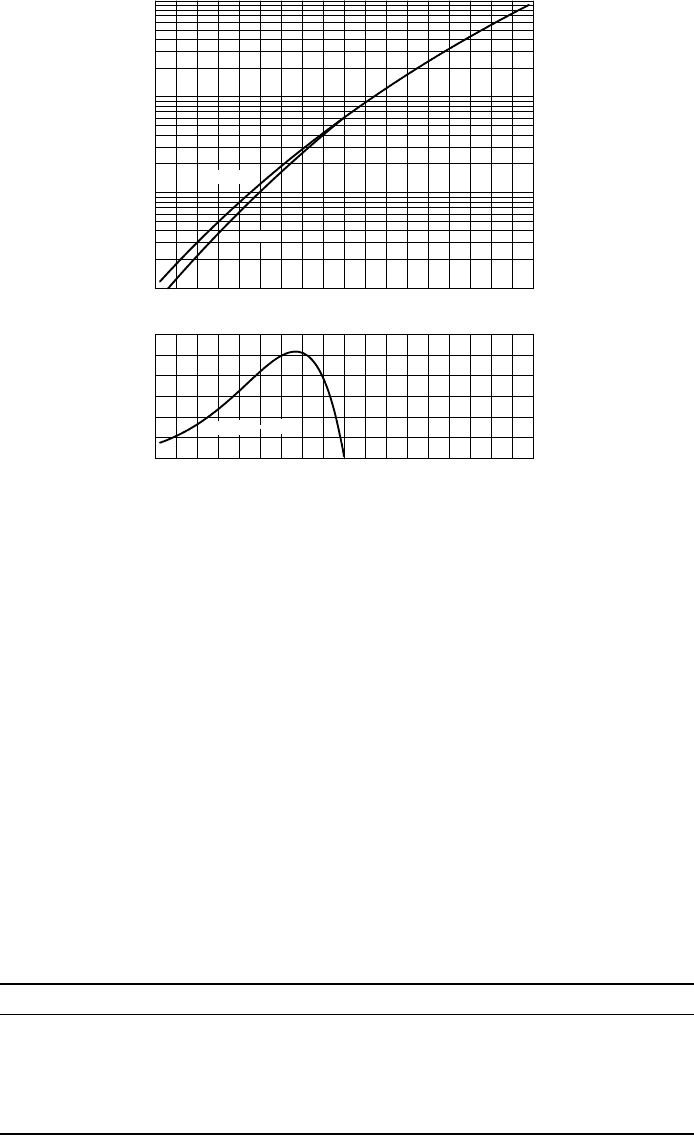
FIGURE 5.2 Saturation vapour pressure e
s
over water and over ice as a function of tem-
perature (top), and the difference between the vapour pressures over water and over ice
(bottom).
Figure 5.2 shows a graph of the saturated vapour pressures over water and
ice, and their difference. The vapour pressure over ice is not defined above
the melting point. However, the vapour pressure over water is defined below
the freezing point because of the existence of supercooled water at those
temperatures.
The vapour pressure increases approximately linearly in this logarithmic
graph: a temperature difference of 10
◦
C corresponds roughly to a doubling
of the saturated vapour pressure. So a temperature increase from 30
◦
Cto
31
◦
C has much greater consequences for the saturated vapour pressure than
an increase from 5
◦
Cto6
◦
C, see also Table 5.1.
The saturated vapour pressure over ice is smaller than that over water,
because it is easier for a molecule to escape water than to escape ice: the
TABLE 5.1 Values of the saturated vapour pressure over water (in hPa) as a function of
temperature (sum of the row index and the column index, in
◦
C). Data from Haar, L.
et al. (1984) NBS/NRC Steam Tables. Hemisphere Publishing, New York.
00 10 20 30
0 6.113 12.28 23.39 42.46
2 7.061 14.03 26.45 47.58
4 8.136 15.99 29.85 53.23
6 9.354 18.19 33.63 59.45
8 10.73 20.64 37.82 66.30

100 CH 5 WATER IN THE ATMOSPHERE
latent heat of evaporation over supercooled water is lower than the latent heat
of sublimation over ice. This has important consequences in cloud physics:
if supercooled water drops and ice crystals are present at the same time in
a cloud then the ice crystals will grow at the expense of the supercooled
drops. This is called the Bergeron–Findeisen process.
5.3 HUMIDITY VARIABLES
In atmospheric physics several different variables are used to describe the
amount of water vapour in the air. These tend to be used in different contexts
and here we put the most commonly encountered variables together.
The first variable is the concentration by mass of water vapour, usually
called the specific humidity q,
I q =
v
d
+
v
, (5.19)
with
v
and
d
the local densities of the vapour and the dry air respectively. It
was introduced in section 1.3 to define the virtual temperature. The specific
humidity is dimensionless but it is often given ‘units’ of kg kg
−1
or, because
there is usually much less water vapour than dry air, units of g kg
−1
. A related
quantity is the mass mixing ratio r
v
,
I r
v
=
v
d
. (5.20)
The mass mixing ratio is also dimensionless but is often given units of kg kg
−1
or g kg
−1
. From their definitions it follows that the two variables can be trans-
formed by
r
v
=
q
1 − q
and q =
r
v
1 + r
v
. (5.21)
Because generally q 1 we find that r
v
≈ q (or more precisely: r = q +q
2
+
q
3
+ q
4
+ ...). In the Earth’s atmosphere the two are the same to within one
part in a hundred.
From the ideal gas law, p = RT, we can relate the partial densities
v
and
d
to the partial pressures of the water vapour e and the dry air p −e, with p
the total pressure. It then follows that
q =
e
(
d
/
v
)(p − e) + e
,r
v
=
e
(
d
/
v
)(p − e)
, (5.22)
with
d
and
v
the effective molar masses of dry air and water respectively,
so
d
/
v
= R
v
/R
d
= 1.61. (5.23)

5.3 HUMIDITY VARIABLES 101
The relative humidity (RH) is defined as the ratio of the actual vapour pres-
sure e to the saturated vapour pressure vapour e
s
at the given temperature,
I RH =
e
e
s
(T)
. (5.24)
The relative humidity is dimensionless but it is most commonly expressed as
a percentage. Because e
s
increases with temperature, the relative humidity at
constant specific humidity will decrease at increasing temperature. Relative
humidity indicates how far we are away from saturation. For example, just
above the sea surface the relative humidity is usually very close to 100% while
the specific humidity varies strongly with temperature.
Another commonly used humidity variable is the dewpoint temperature. It
is defined as follows:
Dewpoint temperature T
d
is that temperature to which moist air has to
be cooled isobarically to achieve saturation.
Following Eq. 5.22, the vapour pressure also remains constant in such a pro-
cess, because r
v
remains the same. In equations, the dewpoint temperature
T
d
is defined implicitly by
I e
s
(T
d
) = e, (5.25)
that is, the vapour pressure equals the saturated vapour pressure at the dew-
point temperature. The relative humidity can now be expressed as
RH = e
s
(T
d
)/e
s
(T). (5.26)
The difference between the actual temperature and the dewpoint tempera-
ture, T −T
d
, is called the dewpoint depression. Air at low relative humidity has
a large dewpoint depression; air at 100% relative humidity has a dewpoint
depression of 0
◦
C.
The definition of dewpoint temperature suggests a way to measure the
humidity in air: cool it isobarically until saturation – the saturated vapour
pressure at that temperature is the actual vapour pressure. This is the principle
behind accurate measurements of humidity. However, it does require a fairly
complex apparatus such as, for example, a chilled mirror hygrometer which
works by cooling a mirror until condensation is optically detected.
A simpler way is to put water at the same temperature in contact with
the air parcel and to cool the air parcel isobarically by evaporating the water
into the parcel. Doing so will change the actual water vapour content of
the parcel but this can be taken into account. It forms the basis of a classic
humidity measurement using the so-called wet-bulb temperature. It is defined
as follows:
Wet-bulb temperature T
w
is that temperature to which air can be cooled
isobarically by evaporating water into it.

102 CH 5 WATER IN THE ATMOSPHERE
At T
w
the air is saturated. If it were not we could evaporate more water into it
and cool the parcel further. Because in the process the specific humidity of the
parcel has increased, the wet-bulb temperature is higher than the dewpoint
temperature.
Here we present a quick calculation to indicate how the wet-bulb tem-
perature relates to the vapour mixing ratio; a more accurate calculation is
presented in the next section. To evaporate a unit mass of water we need
energy L, the latent heat of evaporation. Let us assume that this energy is
provided by the internal energy of the dry air, which forms the bulk of an
air parcel. Further assume the dry air is an ideal gas. Because the process is
isobaric we have
L dM
v
=−c
p
M
d
dT, (5.27)
with M
v
the mass of the vapour in the parcel and M
d
the mass of the dry air in
the parcel. Divide this equation by M
d
to get an equation in terms of vapour
mixing ratio r
v
,
L dr
v
=−c
p
dT. (5.28)
Further assuming L and c
p
to be constant, this equation can be integrated
from the initial, dry-bulb temperature T to the final, wet-bulb temperature
T
w
, when the air is saturated. This gives the so-called psychrometric equation,
I r
v
− r
vs
(T
w
) =−
c
p
L
(T − T
w
), (5.29)
with the additional subscript s indicating saturated values of the vapour mix-
ing ratio. The difference T − T
w
is called the wet-bulb depression. The factor
c
p
/L is called the psychrometric constant.
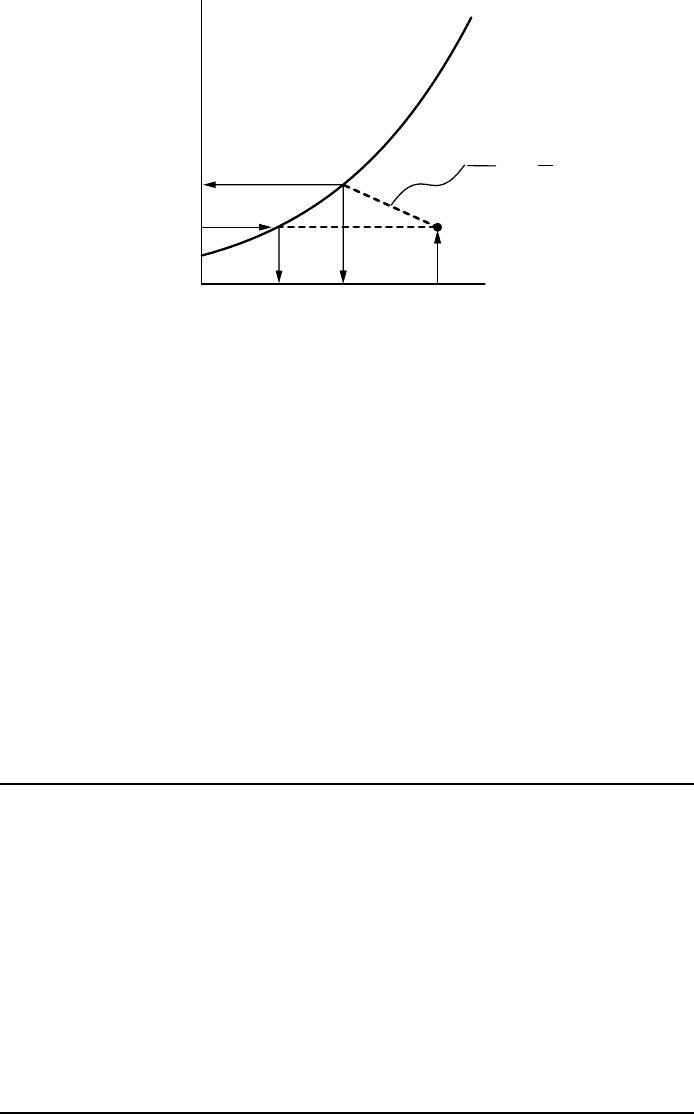
Figure 5.3 illustrates the construction of the wet-bulb temperature on a
graph of vapour mixing ratio versus temperature. It also illustrates the con-
struction of the dewpoint temperature.
Dewpoint temperature is usually measured with a whirling psychrometer
(or sling psychrometer). A whirling psychrometer has two thermometers, one
of which has a wet wick (piece of fabric) around its bulb. The thermometers
are whirled round so as to ventilate air through the wet wick. The air in the
wick cools down and saturates, and the temperature of the air in the wick now
equals the wet-bulb temperature. The difference between the temperatures of
the two thermometers is the wet-bulb depression. The psychrometric equation
is then solved to find the mixing ratio from the wet-bulb depression and the
temperature. There are tables, charts, slide rules, or computer programs to
solve the psychrometric equation; Table 5.2 and Figure 5.4 are examples. If
T
w
< 0
◦
C there is a chance the wet bulb might freeze, so these tables and
charts have limited validity in that regime although they typically continue
5.3 HUMIDITY VARIABLES 103
r
v
r
vs
(T
w
)
T
d
T
w
T
r
vs
dr
v
dT
=−
c
p
L
mixing ratio
temperature
FIGURE 5.3 Construction of dewpoint temperature T
d
and wet-bulb temperature T
w
. The
dewpoint temperature is found by cooling a parcel at fixed vapour mixing ratio r
v
until
saturation is achieved, r
v
= r
vs
(T
d
). The wet-bulb temperature is found by cooling the
parcel by evaporating water into it until saturation is achieved. In this process the vapour
mixing ratio changes according to dr
v
/dT =−c
p
/L; for constant c
p
/L we can infer from the
geometry in the figure below that (T −T
w
)(c
p
/L) = r
vs
(T
w
)−r
v
, which is the psychrometric
equation.
working down to T
w
≈−2
◦
C. For below freezing T
w
we need to use an ice-bulb
thermometer.
Modern radiosondes use a capacitor with a porous dielectric material in-
side. The capacitance changes according to the amount of vapour the dielec-
tric absorbs. An electric circuit is then used to determine the capacitance and
from this any humidity variable can be determined. Other instruments rely
TABLE 5.2 Psychrometric table giving the relative humidity (in %) at 1000 hPa as a function
of dry-bulb temperature and wet-bulb depression, based on the psychrometric equation,
Eq. 5.41.
T − T
w
(
◦
C)
0.511.522.533.54568101214
0 91 82 74 65 57 49 40 32 16 1
2 92 84 76 68 61 53 46 38 24 10
4 93 85 78 71 64 57 50 43 30 17 RH (%)
6 93 86 80 73 67 60 54 48 36 24 1
8 94 87 81 75 69 63 57 52 40 30 9
10 94 88 83 77 71 66 60 55 45 35 15
12 94 89 84 78 73 68 63 58 48 39 21 4
15 95 90 85 80 76 71 66 62 53 44 28 13
18 95 91 86 82 77 73 69 65 57 49 34 20 7
22 96 92 87 84 80 76 72 68 61 54 41 28 17 6
26 96 92 89 85 81 78 74 71 64 58 46 35 24 14
32 97 93 90 87 83 80 77 74 68 63 52 42 33 24
T (
◦
C)