
Ambaum M., Thermal Physics of the Atmosphere
Подождите немного. Документ загружается.

6.3 FINITE AMPLITUDE INSTABILITIES 115
in terms of its usual dry potential temperature. We can therefore define the
pseudo-equivalent potential temperature as follows:
The pseudo-equivalent potential temperature is the potential temperature
a parcel would have if lifted pseudo-adiabatically to great heights.
The pseudo-equivalent potential temperature of a lifted parcel is lower than
the equivalent potential temperature because the liquid water lost in the
pseudo-adiabatic ascent carries internal energy away from the parcel.
It is important to remember that the pseudo-equivalent potential temper-
ature is again just a convenient label of a pseudo-adiabat; it is not a true
potential temperature of a saturated parcel. A more commonly used label for
a pseudo-adiabat is the temperature where the pseudo-adiabat reaches the
reference pressure. This temperature is called the wet-bulb potential tempera-
ture,
w
.
35
Of all the potential temperature-like variables used in meteorology,
the wet-bulb potential temperature is perhaps the one that is closest to the
original general definition of potential temperature, in Eq. 3.78. It is not
quite a true potential temperature because the process used to define it is
pseudo-adiabatic.
This definition of the pseudo-equivalent potential temperature and wet-
bulb potential temperature is also used for unsaturated parcels: if the parcel
is initially unsaturated, the lifting parcel will conserve its potential tempera-
ture. When the parcel has cooled down enough it will become saturated. The
level at which this happens is called the lifting condensation level (LCL). Be-
yond the LCL the pseudo-equivalent potential temperature will be conserved.
6.3 FINITE AMPLITUDE INSTABILITIES
In Section 4.4 the stability of a dry atmosphere was discussed as the result of
the vertical gradient of specific entropy. For positive ds/dz the atmosphere
is stable for infinitesimal parcel displacements, for negative ds/dz the atmo-
sphere is unstable, and for ds/dz = 0 the atmosphere is neutrally stable. In-
sofar as the air can remain saturated, this is still the case for saturated air, as
long as the entropy is calculated from Eq. 6.12.
When an air parcel is displaced over a finite distance (rather than an in-
finitesimal distance) new effects can occur. The linearizations of Section 4.4
are not valid anymore and we need to reconsider the buoyancy of a parcel,
now assuming finite displacements.
Suppose we have a stable profile of subsaturated air, with the specific en-
tropy increasing with height. If we lift the parcel beyond the lifting conden-
sation level, latent heat will be released. This latent heat release will increase
the temperature above that expected from the dry adiabatic lapse rate; al-
though the parcel total entropy remains the same, the entropy released by
35
For accurate expressions for the wet-bulb potential temperature see Bolton, D. (1980)
Mon. Wea. Rev. 108, 1046–1053.
116 CH 6 VERTICAL STRUCTURE OF THE MOIST ATMOSPHERE
condensation is used to increase the temperature of the parcel. It is now pos-
sible to lift the parcel so far that its temperature will become higher than
that of the environment and the parcel becomes positively buoyant. Strictly
speaking, the specific volume of the parcel has to become larger than that
of the environment, see Eqs. 4.35 and 4.36. The level at which the parcel
becomes positively buoyant is called the level of free convection (LFC).
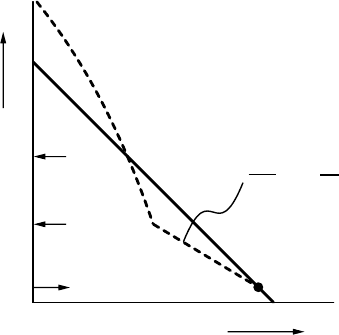
The situation sketched above is called conditional instability. The insta-
bility is conditional on saturation after a finite displacement of the parcel. A
conditionally unstable atmosphere is stable for infinitesimal displacements;
it has a real buoyancy frequency. The mechanism of conditional instability is
sketched in Figure 6.3.
From inspection of Figure 6.3 we find that conditional instability cannot
occur if the environmental temperature lapse rate is everywhere lower than
the moist adiabatic lapse rate. In this case the parcel can nowhere cross the
environmental profile. A formal way of stating this is that stability is ensured
if for the profile d
e
/dz>0, where
e
is the saturated equivalent potential
temperature, the equivalent potential temperature if we assume the parcel is
saturated. If there are layers in the profile where the temperature lapse rate is
larger than the moist adiabatic lapse rate, the potential (in-)stability depends
on the whole profile and which parcel is being lifted. A careful analysis of the
full profile is then needed.
The final type of instability is called potential instability or, confusingly,
convective instability. This type of instability is due to the lifting of a whole
layer of air rather than a single parcel. This typically happens when air flows
z
T
dep
LCL
LFC
dT
dz
=−
g
c
p
FIGURE 6.3 Illustration of conditional instability. On lifting the parcel from its departure
point (dep) it will follow the dry adiabatic lapse rate (dashed straight line) and become
negatively buoyant, that is, colder than the environment (solid line). Beyond the lifting
condensation level the parcel will follow a moist adiabat (dashed curved line). It is now
possible that the parcel will reach the same temperature as the environment. Beyond this
level, the level of free convection (LFC), the parcel is positively buoyant.
6.4 VERTICAL STRUCTURE IN THERMODYNAMIC DIAGRAMS 117
over a hill. Suppose the layer was initially stable; that is, the potential tem-
perature (or specific entropy) increases with height in the layer. If there is
no humidity in the air, then the layer will always be stable because the po-
tential temperature is conserved on lifting and a positive gradient cannot
change into a negative gradient. But now suppose that the lowest part of the
layer is more humid than the upper part. When lifting the layer, the lower
part can condense sooner and start following a moist adiabat, that is, cool
at a lower rate than the dry adiabatic lapse rate. We may then encounter a
situation where the lower part of the layer gets a higher dry potential temper-
ature than the upper part and the layer becomes unstable. This is potential
instability.
The easiest way to diagnose potential instability is to consider the equiva-
lent potential temperature. As stated before, this is the potential temperature
of a parcel when it is lifted to great heights such that all the water vapour has
condensed out (strictly speaking, this defines the pseudo-equivalent potential
temperature). Suppose the layer is initially subsatured and stable, d/dz>0,
while the vapour content in the lower part of the layer is much higher than
in the upper part such that d
e
/dz<0. This means that if we lift the layer
to great heights, the potential temperature will decrease with height in the
layer, d/dz<0. So at some point in the lifting process the layer must have
become unstable.
6.4 VERTICAL STRUCTURE IN THERMODYNAMIC DIAGRAMS
Here we will take a graphical approach to the analysis of vertical structure,
to complement the formal approach in the previous sections. We will use
a tephigram, to illustrate this. A tephigram is a Ts diagram which has been
adjusted for meteorological use. Appendix C discusses the precise structure of
a tephigram as well as the relationship between tephigrams and skewT–logp
diagrams, the other commonly used thermodynamic diagram. The analysis
below works essentially the same for either of these diagrams.
First we will consider the meaning of a single sounding data point as plotted
on a tephigram. A radiosonde produces measurements of temperature T,
dewpoint temperature T
d
, and pressure p. We can plot those measurements
on the tephigram. First we plot a single measurement of T, T
d
, and p.Wecan
then use the tephigram to deduce several other variables.
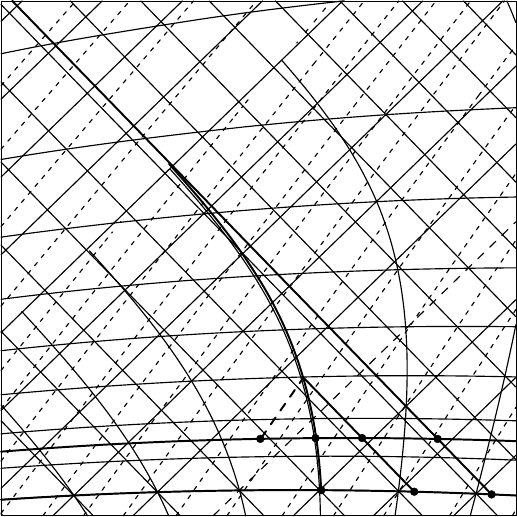
On the tephigram in Figure 6.4 we have marked such a single measure-
ment: the sonde measured at 850 hPa a temperature T = 8.6
◦
C and dewpoint
temperature T
d
=−4
◦
C.
The potential temperature is found by following the dry adiabat ( con-
stant) to 1000 hPa and we can read off that = 22
◦
C. The value of the
potential temperature can be read off anywhere along the dry adiabat, as the
dry adiabat is labelled by its potential temperature.
The dewpoint temperature gives the water vapour mixing ratio. Remember
that e
s
(T
d
) = e so if the air parcel at p = 850 hPa and T = 8.6
◦
C were cooled
118 CH 6 VERTICAL STRUCTURE OF THE MOIST ATMOSPHERE
T
θ
T
w
θ
w
T
d
θ
e
T
e
LCL
1000
500
200
p (hPa)
–10
0
10
20
30
T (ºC)
2.5
4
6.5
10
r
vs
(gkg
−1
)
FIGURE 6.4 Normand’s construction. Given the pressure p, temperature T, and dewpoint
temperature T
d
, we can derive the wet-bulb temperature T
w
, wet-bulb potential tempera-
ture
w
, potential temperature , the pseudo-equivalent potential temperature
e
, and the
equivalent temperature T
e
. The lifting condensation level is also found.
isobarically, it would reach saturation at T
d
=−4
◦
C. On the tephigram we
can read off that the saturated mixing ratio at T =−4
◦
C and p = 850 hPa
is about 3.5gkg
−1
. So this is the vapour mixing ratio of the air parcel: r
v
=
3.5gkg
−1
.
The saturated vapour mixing ratio at T = 8.6
◦
C and p = 850 hPa is read
off as about 8.5gkg
−1
. This means that the relative humidity of the air parcel
is 3.5/8.5 × 100% ≈ 40%.
If we lift the air parcel, then it follows the dry adiabat upward. It will
cool down until its mixing ratio of 3.5gkg
−1
becomes the saturated mix-
ing ratio. This happens at the vertex labelled lifting condensation level in
Figure 6.4, the lifting condensation level. We can read off that the lifting
condensation level for this air parcel is about 700 hPa. So the lifting con-
densation level is found where the dry adiabat crosses the isoline of the air
parcel’s mixing ratio.
If we lift the parcel further it will now follow the moist adiabat, or the
pseudo-adiabat, depending on what happens to the liquid water after con-
densation. Note that the tephigram has pseudo-adiabats labelled, and we will
always assume pseudo-adiabatic processes. Lifting it further until all moisture
6.4 VERTICAL STRUCTURE IN THERMODYNAMIC DIAGRAMS 119
is condensed out, the parcel will reach the potential temperature, defined
as its pseudo-equivalent potential temperature
e
. It can be read off to be
about 32
◦
C.
The temperature the parcel would have if all its water vapour were con-
densed out isobarically is called the equivalent, or pseudo-equivalent tem-
perature T
e
. It is therefore also the temperature a parcel would have at the
same pressure level if its potential temperature were equal to
e
.
It is of interest to locate the wet-bulb temperature on the tephigram. Re-
member that the wet-bulb temperature is defined as that temperature to
which an air parcel can be cooled isobarically by evaporating water into it. We
can get the wet-bulb temperature in an equivalent but more roundabout way:
first lift the parcel adiabatically up to the lifting condensation level. The par-
cel is now saturated. Then lower the parcel back to its original pressure level
while at the same time evaporating water into it to keep it saturated. This
process occurs pseudo-adiabatically because the energy used for evaporation
is extracted from the internal energy of the parcel, like in a wet-bulb ther-
mometer. At the end of this process the parcel will have its original pressure,
it will be saturated, and it will have cooled by evaporating water into the
parcel. We must conclude that at the end of this process the parcel will be at
its wet-bulb temperature T
w
.
The process can be easily followed on the tephigram: follow the dry adiabat
up to its lifting condensation level. Then lower the parcel along the pseudo-
adiabat (the parcel is saturated in this process) until its original pressure is
achieved. The point on the tephigram is labelled T
w
. In our present case we
can read it off as about T
w
= 3
◦
C.
Following the pseudo-adiabat further down to 1000 hPa, we can read off
the wet-bulb potential temperature,
w
. Wet-bulb potential temperature is
simply a label for a pseudo-adiabat, just as potential temperature is a label
for a dry adiabat. On the tephigram we can read off that
w
= 10
◦
C. Pseudo-
equivalent potential temperature is also a label for a moist adiabat. Note that
these two labels have different values for any chosen moist adiabat; in our
case
w
= 10
◦
C and
e
= 32
◦
C. These two labels refer to the same moist
adiabat.
The construction above is called Normand’s construction:
The dry adiabat through point (p, T), the isoline of r
vs
through point
(p, T
d
), and the pseudo-adiabat through point (p, T
w
) meet in one point
at the lifting condenstation level.
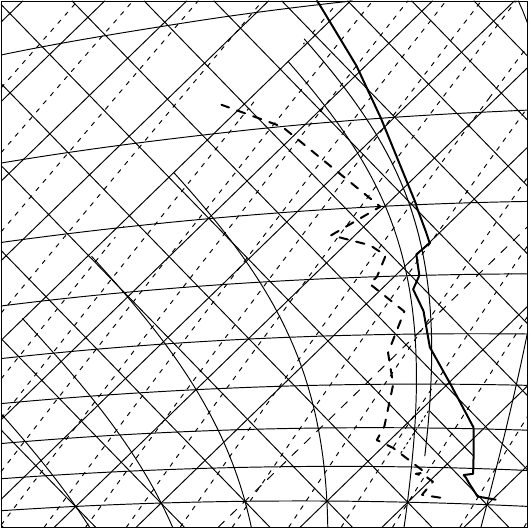
Let us now continue and plot a full profile on the tephigram. The solid line
in Figure 6.5 represents the temperature T of the sounding, the dashed line
represents the dewpoint temperature T
d
. The Normand construction for the
parcel at 870 hPa is also drawn in. We can perform Normand’s construction
at every point on this sounding to get any of the moisture variables at any
level, but we can also view the more general structure of the profile. For
example:
120 CH 6 VERTICAL STRUCTURE OF THE MOIST ATMOSPHERE
1000
500
200
p (hPa)
–10
0
10
20
30
T (ºC)
2.5
4
6.5
10
r
vs
(gkg
−1
)
LCL
LFC
LNB
FIGURE 6.5 Sounding data plotted on a tephigram, including Normand’s construction for
the parcel at 870 hPa.
r
Near the surface, below 980 hPa, the atmosphere is unstable (d/dz<
0) in a thin layer, probably because of cold air flowing over a warm
surface.
r
Below 920 hPa the atmosphere is well mixed and near-neutral, close to
a dry adiabatic lapse.
r
On top of the boundary layer is a stable and shallow inversion with a
strong increase in temperature with height.
r
The layer between about 900 and 800 hPa is potentially unstable as its
equivalent potential temperature decreases with height (
e
(900 hPa) ≈
70
◦
C and
e
(800 hPa) ≈ 60
◦
C) although the layer would have to be
lifted very high for it to become unstable. There are further potentially
unstable layers, such as above 400 hPa.
r
In the mid-troposphere (500–600 hPa) the air becomes more humid
(smaller dewpoint depressions) with nearly moist adiabatic lapse rates,
probably indicative of clouds.

6.5 CONVECTIVE AVAILABLE POTENTIAL ENERGY 121
r
At 460 hPa there is another strong inversion most likely due to radiative
cooling at the top of the cloud.
r
The air becomes dry in the upper troposphere.
r
The tropopause is higher than 200 hPa.
It is a bit of an art to tease out all the information out of any sounding. Usually
more additional information is required to uniquely pin down all the features
visible in a profile on a tephigram.
Let us now consider in more detail the air parcel at 870 hPa. From
Normand’s construction we can see that its lifting condensation level is at
about 780 hPa. Above this level the parcel will be saturated and will follow
the pseudo-adiabat (
e
= 68
◦
C). We can also see that initally the parcel will
be colder than its environment, as deduced from the profile, and the parcel
is therefore negatively buoyant.
If we lift the parcel further up, to about 630 hPa, we see that it reaches
the same temperature as the environment; it will be neutrally buoyant. If we
were to lift the parcel further it would be warmer than its environment and
would therefore be positively buoyant and would start to rise by itself. Cearly,
this parcel is conditionally unstable. The level where the parcel moves from
negatively buoyant to positively buoyant is called the level of free convection,
labelled LFC on the tephigram. The parcel under consideration has a level of
free convection of 630 hPa.
The parcel would continue to rise by itself until it became cooler than the
environment again. For our particular parcel this happens at about 460 hPa, at
the inversion above the cloud. We call this level the level of neutral buoyancy,
labelled LNB in the tephigram. So our parcel has a level of neutral buoyancy
of 460 hPa. If the parcel were made to convect by lifting it, it would stop
convecting above 460 hPa.
We have to keep in mind that such analyses mainly give potential idealized
scenarios. Whether a parcel would really be lifted in the way described above
depends on many factors; it is in fact a highly unlikely scenario.
6.5 CONVECTIVE AVAILABLE POTENTIAL ENERGY
When a parcel is lifted above its level of free convection it experiences a
specific (i.e. per unit mass) upward buoyancy force of
f = g
T
p
− T
e
T
e
, (6.19)
as in Eq. 4.36; we make the ideal gas assumption here.
36
T
p
is the vir-
tual temperature of the parcel (the pseudo-adiabat drawn in on Figure 6.5)
36
In these arguments we use virtual temperature, but note that the tephigram only shows
temperatures.

122 CH 6 VERTICAL STRUCTURE OF THE MOIST ATMOSPHERE
and T
e
the environmental virtual temperature (the sounding profile in Fig-
ure 6.5). Between the LFC and LNB we see that T
p
>T
e
so that f>0, positive
buoyancy. Moving the parcel upward by an amount dz would then release
a specific energy of f dz. The height differential dz is by the hydrostatic re-
lationship related to a pressure differential dp by dp =−
e
gdz, with
e
the
density in the environment. We can now calculate the total specific energy
released when the parcel moves between the LFC and the LNB. We call this
released energy the convective available potential energy (CAPE). So we find:
CAPE =
LNB
LFC
f dz =−
LNB
LFC
g
T
p
− T
e
T
e
dp
e
g
, (6.20)
or
I CAPE =−R
LNB
LFC
(T
p
− T
e
)
dp
p
. (6.21)
The convective available potential energy has units of J kg
−1
;itisaspecific
energy.
CAPE corresponds to the area between the environmental profile and the
parcel profile: we should not be surprised at this because a tephigram is
a proper thermodynamic diagram where area corresponds to energy. The
differential of enthalpy,
dh = T ds + v dp (6.22)
for an ideal gas (dh = c
p
dT and pv = RT) can be rewritten as:
T ds = c
p
dT − RT dp/p. (6.23)
From this equation we see that the area on a tephigram, which is the integral
over a closed loop of T ds, can be written as the sum of two integrals. The
integral of the term c
p
dT vanishes as it is a simple differential. The integral
of the term RT dp/p can be written as Eq. 6.21.
A rough estimate of the CAPE for our parcel can be found by using the
following estimates: T
p
− T
e
≈ 1.5
◦
C, p ≈ 550 hPa, p ≈ 170 hPa. So we
find that CAPE ≈ 130Jkg
−1
.
Before the parcel reaches its LFC, it has to be lifted against its negative
buoyancy. This will cost energy. The total energy required to lift the parcel
from its starting level to the level of free convection is called the convective
inhibition (CIN). Following the analogous calculations as above we readily
find that:
I CIN =−R
LFC
p
start
(T
e
− T
p
)
dp
p
. (6.24)
6.5 CONVECTIVE AVAILABLE POTENTIAL ENERGY 123
CIN has the same units as CAPE. It is again the area between the environ-
mental and parcel profiles but now below the LFC.
A rough estimate of the CIN for our parcel can be found by using the
following estimates: T
e
− T
p
≈ 2.5
◦
C, p ≈ 750 hPa, p ≈ 250 hPa. So we
find that CIN ≈ 240Jkg
−1
.
Often CIN is included in the calculation of CAPE. So in this definition CAPE
becomes the positive area between the LFC and LNB, minus the CIN. With this
definition it is possible to have a negative CAPE. Indeed, our parcel starting
from 870 hPa has a greater negative area (about 240 J kg
−1
) than positive
area (about 130 J kg
−1
). So it would cost energy to get the parcel up from
870 hPa to its level of neutral buoyancy.
The specific energy released between the LFC and the LNB, as given by
Eq. 6.21, can be translated into specific kinetic energy, W
2
/2 with W the
parcel speed; this speed is assumed to be upward as the buoyancy force
points upward. For our parcel, starting at 870 hPa, this would lead to a speed
of about 16 m s
−1
. This is quite a severe overestimate of the parcel speed at
the level of neutral buoyancy. The two main causes of the overestimate are
(i) the parcel always mixes partially with its environment, which reduces the
temperature contrast and therefore its buoyancy, and (ii) the rising air parcel
has to move the environmental air out of the way and thus use part of its
buoyant energy to impart kinetic energy onto the environment; it acquires an
added mass. These caveats were also pointed out in the context of the Brunt–
V
¨
ais
¨
al
¨
a frequency, Section 4.4. We should also ask ourselves whether the
CAPE can be fully transformed into kinetic energy. In more complete theories,
CAPE is linked to the thermodynamic efficiency of convective motion.
37
So CAPE is not obviously related to parcel kinetic energy at the level of
neutral buoyancy. High values of CAPE, or CAPE − CIN, also turn out to be
fairly poor predictors of convection. Nonetheless, CAPE is used as a measure
of how stable or unstable a particular profile is. Indeed, the onset of thun-
derstorms is usually associated with a strong increase of CAPE ahead of the
storm with values of CAPE easily over 1000 J kg
−1
. Furthermore, high values
of CAPE are indicative of vigorous convection if the convection occurs. High
CAPE is a necessary, but not a sufficient, condition for the onset of convection.
37
See Renno, N. O. & Ingersoll, A. P.(1996) J. Atmos. Sci. 53, 572–585.

7
Cloud drops
In this chapter we introduce the thermodynamics of drops. Droplet nucle-
ation is described by modifications of the Clausius–Clapeyron equation due
to surface tension. These modifications also provide the framework for under-
standing droplet nucleation due to electric charge. We also introduce some
of the processes involved in droplet growth.
7.1 HOMOGENEOUS NUCLEATION: THE KELVIN EFFECT
Naively, we would expect vapour to start to condense and thus form cloud
droplets if the relative humidity is above 100%. However, we have to be care-
ful: the saturation vapour pressure as calculated from the Clausius–Clapeyron
equation is only valid for flat water surfaces. Cloud droplets have strongly
curved surfaces and as a consequence the surface tension needs to be incor-
porated in the free energy budgets leading to the Clausius–Clapeyron equa-
tion. The surface tension effect is named after William Thomson, Lord Kelvin,
who made many seminal contributions to thermodynamics and physics in
general.
Any liquid–gas interface experiences a surface tension: the surface tries to
contract like an elastic membrane. Therefore, increasing the surface area of
such an interface requires work energy. The amount of work required dW
is proportional to the increment in surface area dA with the proportionality
constant called surface tension, ,
I dW = dA. (7.1)
The unit of surface tension is J m
−2
or, equivalently, N m
−1
. It is the surface
tension that makes droplets (and bubbles) spherical. The surface tension tries
to minimize the surface area of a drop for the volume of the drop given. The
shape that has minimum surface area for a given volume is a sphere.
A typical value for the surface tension of a water–air interface is
= 75 × 10
−3
Nm
−1
. (7.2)
125
Thermal Physics of the Atmosphere Maarten H. P. Ambaum
© 2010 John Wiley & Sons, Ltd. ISBN: 978-0-470-74515-1