
Ambaum M., Thermal Physics of the Atmosphere
Подождите немного. Документ загружается.

136 CH 7 CLOUD DROPS
larger condensation nuclei the steady radius of haze droplets can be up to
several hundreds of nanometres, and therefore become visible.
Suppose the initial droplet was somewhere in area A. When considering
cloud droplet growth from initial condensation nuclei we start at very small
radii. So typically, droplets in area A have to be in an environment with a
relative humidity higher than the critical saturation ratio S
. The droplet is in
a supersaturated environment and will start to grow. But now the growing
droplet cannot hit the K
¨
ohler curve at any point; it will continue to grow
indefinitely and will eventually become a cloud drop. Droplets in region A
are said to be activated.
For droplets to become activated and grow into cloud drops the environ-
mental supersaturation has to be larger than the critical supersaturation. Typ-
ical critical supersaturations are less than a couple of percent. This is the rea-
son why in the atmosphere the relative humidity will never exceed 100% by
very much. With any temporary increase in relative humidity, haze droplets
would activate and form clouds. These growing cloud droplets would reduce
the vapour content of the air until a relative humidity of 100% was achieved
and droplets could no longer use up water vapour.
So at relative humidities below 100% any condensation nuclei will form
stable haze. Suppose that this air is forced to lift by some external process;
this will expand and cool down the air, thus increasing the relative humid-
ity. Because of the stability of the haze part of the K
¨
ohler curve, the haze
droplets move up on the K
¨
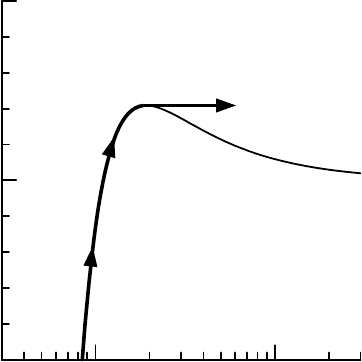
ohler curve and get a larger radius.
39
This process
1.00.1
99
100
101
radius (µm)
relative humidity (%)
FIGURE 7.6 Growth of a haze drop in an updraft.
39
The K
¨
ohler curve itself is a weak function of temperature. However, this does not
change the main argument here.

7.4 CHARGE-ENHANCED NUCLEATION 137
continues until the air reaches critical supersaturation; the haze droplets will
then have grown to the activation radius. Any further adiabatic cooling will
activate the droplet and make it grow into cloud drops, and thus remove
water vapour so as to keep the relative humidity down. Figure 7.6 shows this
process on the K
¨
ohler curve.
7.4 CHARGE-ENHANCED NUCLEATION
Droplets are often charged. There can be many sources of this charge, typically
charge separation by the differential motion of drops of different sizes, or the
always-present electric current between ionosphere and the Earth’s surface,
which can charge up individual droplets at cloud boundaries. A net charge
corresponds to an electrostatic energy on the drop which modifies the Gibbs
free energy budget and therefore the saturated vapour pressure around the
drop.
A spherically symmetric charge distribution has an electrostatic potential
V
e
at radius r of
V
e
=
Q
4r
, (7.39)
with Q the charge and the electric permittivity; for all practical purposes
we can use
0
, the permittivity of the vacuum.
40
Increasing the charge by
an amount dQ requires work dW against the electrostatic potential of dW =
V
e
dQ (see also Section 2.1). So to charge up a sphere from no charge to a
total charge Q requires a total electrostatic energy W of
W =
Q
2
8r
. (7.40)
For a given charge, a change in the radius of the drop would change the elec-
trostatic energy. That means that on evaporating a mass ıM from a charged
drop, its electrostatic energy will change. Analogous to Eq. 7.7, the Gibbs
function budget is modified to
ıG = (g
v
− g
l
) ıM −
Q
2
8r
2
ır. (7.41)
We have ignored any effects of solute or surface tension here in order to isolate
the specific effects of the charge and we have omitted the terms proportional
to ıe and ıT as these are zero by construction. As before, ır is related to ıM
40
The relevant inverse permittivity is 1/ = 1/
air
−1/
water
but the permittivity of water
is about 80 times larger than that of air, which in turn is very similar to that of the vacuum,
0
.

138 CH 7 CLOUD DROPS
by
ır =
ıV
A
=−
v
l
4r
2
ıM, (7.42)
with V the volume of the sphere, A its area and v
l
the specific volume of
the liquid phase (remember that positive ıM corresponds to a reduction in
droplet volume). For the variations in the total Gibbs function to vanish, we
therefore have
g
v
(e, T) = g
l
(e, T) −
Q
2
v
l
32
2
r
4
. (7.43)
At infinite radius the charge effect vanishes and the vapour pressure is the
same as the flat surface value from the Clausius–Clapeyron equation. We can
now perform the same integration over radius as was performed following
Eq. 7.8. The result is a new charge-induced saturation ratio S
Q
,
I S
R
=
e
s
(Q)
e
s
(0)
= exp
−
Q
2
v
l
32
2
R
v
Tr
4
, (7.44)
where have returned to the usual notation of e
s
for saturated vapour pressure
and with e
s
(0) the saturated vapour pressure for an uncharged drop. We see
that the charge of the drop decreases the vapour pressure around the drop
by an exponential factor, S
R
<1. This effect is called the Rayleigh effect. The
physical picture is that on a charged drop it is more difficult to evaporate water
because the associated reduction of droplet radius requires extra electrostatic
energy.
Analogous to Eq. 7.19, the electrostatic term can be absorbed in the pres-
sure dependency of the Gibbs function,
g
l
(e, T) −
Q
2
v
l
32
2
r
4
= g
l
(e
,T), (7.45)
with
e
= e −
Q
2
32
2
r
4
. (7.46)
In other words, the effective pressure inside the drop is decreased by the
charge. This decrease of pressure inside a drop should, again, come as no
surprise: the repulsive electrostatic charges try to expand the drop. The pres-
sure drop due to the charge is p
Q
, with
p
Q
=
Q
2
32
2
r
4
. (7.47)

7.4 CHARGE-ENHANCED NUCLEATION 139
The charge effect can be interpreted as a Boltzmann factor analogous to
Eq. 7.22,
exp
−
Q
2
v
l
32
2
R
v
Tr
4
= exp
−
E
k
B
T
, (7.48)
with the excess energy per molecule written in terms of the pressure drop p
Q
due to the charge,
E =
p
Q
V
N
, (7.49)
with N the number of molecules in the drop and V its volume.
The charge helps to form droplets by counteracting the Kelvin effect. It is
of interest to see when the two effects exactly compensate. Using Eqs. 7.13
and 7.44 we find compensation when S
K
S
R
= 1 or equivalently when
p
= p
Q
. (7.50)
For a given charge Q this compensation will occur at a critical radius r
R
, the
so-called Rayleigh radius, with
I r
3
R
=
Q
2
64
2
. (7.51)
Rayleigh showed that for droplets with a radius smaller than r
R
the repul-
sive electrostatic force becomes so strong that the droplets disintegrate ex-
plosively;
41
thermodynamically this can be interpreted as the destabilizing
charge pressure overcoming the stabilizing capillary pressure.
With the definition of the Rayleigh radius r
R
and the Kelvin radius r
K
we
can rewrite the combined Rayleigh and Kelvin effect to the saturation ratio S
as
S = S
K
S
R
= exp
r
K
r
1 −
r
3
R
r
3
. (7.52)
From this equation it becomes clear that the charge effect is only important
when the droplet radius is close to the Rayleigh radius. Only for droplets
smaller than the Rayleigh radius, the charge effect dominates the Kelvin effect
and saturation can occur at relative humidities below 100%.
So what is a typical value for the Rayleigh radius? For a unit charge e (an
electron has charge −e), we can put in standard values for a water droplet
41
For a derivation of the onset of Rayleigh explosions, see Peters, J. M. H. (1980) Eur.
J. Phys. 1, 143–146.
140 CH 7 CLOUD DROPS
101
r
0
100
200
300
400
S
radius (nm)
saturation ratio (%)
Kelvin effect
Rayleigh effect
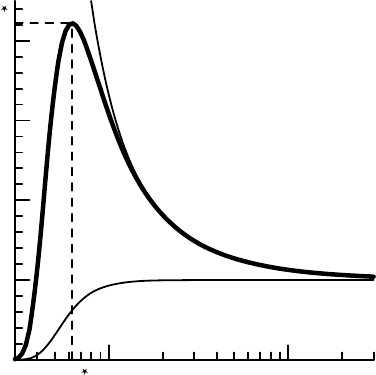
FIGURE 7.7 Saturation ratio as a function of charged droplet radius for a clean droplet at
0
◦
C with one unit charge.
to find r
R
≈ 0.4 nm. Very tiny indeed; in fact this is so small that quantum
effects become important.
Like the K
¨
ohler curve, the saturation ratio for a charged drop has a maxi-
mum. Figure 7.7 shows the saturation ratio for a droplet of pure water with
a unit charge as a function of radius. It is straightforward to show that this
maximum occurs at a critical radius of r
= 4
1/3
r
R
, about 0.6 nm for a unit
charge droplet. Substituting this radius back in the equation for the saturation
ratio, we find a critical saturation ratio of about S
= 4.
For droplets with such high saturation ratios to grow we need relative hu-
midities in excess of RH = 400%;
42
this does not occur in nature. We are
forced to conclude that in the atmosphere single charge ions cannot serve as
condensation nuclei. This is of importance in the present discussion on influ-
ence of cosmic rays on climate. Cosmic rays generally produce single charge
ions in the atmosphere and it has been argued that these may form cloud
condensation nuclei. It is clear from the argument above that this is impos-
sible. In order for cosmic rays to influence cloud formation other processes
such as ion clustering or charge accumulation have to occur.
Supersaturations of 400% are fairly easy to achieve in the laboratory. By
expanding a vessel which has water and its vapour in it we can achieve very
high supersaturations: on adiabatic expansion the pressure as well as the
42
There is an asymmetry between positively charged ions and negatively charged ions:
positively charged ions require a relative humidity of about 600%; this is presumably due
to the geometry of water molecules. See Wilson, C. T. R. (1899) Proc. Roy. Soc. London
65, 289–290.
7.5 DROPLET GROWTH 141
temperature will drop. By the Clausius–Clapeyron equation the saturation
vapour pressure will also drop and it is found to drop more than the pressure
itself. This means that vapour that was originally saturated will become su-
persaturated. In Problem 7.2 this situation is examined and it is shown that
an expansion by a factor of about 1.3 is enough to reach a supersaturation of
400%.
This supersaturation in the laboratory is the basis of the Wilson cloud cham-
ber. Wilson used a closed chamber with saturated vapour and by expansion
made the vapour supersaturated. Any condensation nuclei would rapidly sat-
urate and grow into drops. Wilson allowed these drops to settle out. This
was repeated until no condensation nuclei were present anymore. Wilson
then found that there were still cloud traces in his chamber. Further exper-
imentation with X-ray sources made him realize that these traces were due
to charged particles in the cloud chamber, the residual traces being due to
natural radioactivity and cosmic rays. The cloud chamber is used as a detec-
tor in particle physics. Wilson received the Nobel prize for physics in 1927
‘for his method of making the paths of electrically charged particles visible
by condensation of vapour.’
7.5 DROPLET GROWTH
If a cloud droplet is activated it is out of equilibrium: the environment is
supersaturated with respect to the droplet and the droplet will grow by con-
densation of vapour onto the droplet. However, this process is limited by the
speed with which the condensed vapour is replenished by new vapour from
the environment. If there is no such replenishment, the immediate vicinity of
the drop will run out of vapour and will become subsaturated. Consequently,
the drop would stop growing.
The process that replenishes the vapour is a diffusive flux of water
vapour. To a good approximation, this diffusive flux is proportional to the
gradient in water vapour density (Fick’s law). So the vapour flux F
v
is
F
v
=−D ∇
v
, (7.53)
where
v
is the mass density of the vapour and the constant of proportionality
D is called the diffusion coefficient. The direction of the flux is opposite to
the gradient of the vapour density: mass flows from high densities to low
densities. If a drop is activated, vapour molecules will condense on the drop
thus reducing the vapour density in the immediate vicinity of the drop. This
sets up a gradient in vapour density between the immediate vicinity of the
drop and the far field. This will lead to a diffusive flux of water vapour towards
the drop.
The value of the diffusion coefficient varies with the species being dif-
fused (approximately with the square root of the mass) and it increases with

142 CH 7 CLOUD DROPS
temperature. For diffusion of water vapour at 5
◦
C we have
D = 22 × 10
−6
m
2
s
−1
, (7.54)
with an increase of about 0.15 × 10
−6
m
2
s
−1
per 1
◦
C temperature increase.
The origin of the vapour flux is the random motion of the vapour molecules.
If there is a density gradient there will be fewer molecules moving from the
low density to the high density region than the other way around simply
because the low density region has fewer molecules to move to the high
density region than the other way around. This discrepancy results in a net
motion of molecules from the high density area to the low density area. It is
also clear that the discrepancy is proportional to the difference in molecule
densities between the high and the low density regions.
Assuming the situation is spherically symmetric, all variables will be func-
tions of the radial coordinate r and of time t. We now make the assumption
that away from the drop the density field is constant in time (but not neces-
sarily constant in space). The vapour flux F
v
is according to Fick’s law
F
v
=−D
d
v
dr
ˆ
r, (7.55)
with
ˆ
r the unit vector in the radial direction. The total mass flux F
m
into a
shell of radius r then is
F
m
=−4r
2
F
v
·
ˆ
r = 4Dr
2
d
v
dr
. (7.56)
Note the sign here: if the vapour density increases away from the drop there
will be a positive mass flux towards the drop.
F
m
is the total vapour mass entering any spherical shell, so it is also the
total vapour mass entering the droplet. So the mass growth dM
d
/dt of the
droplet is
dM
d
dt
= F
m
. (7.57)
The drop grows by condensing the vapour onto its surface. This condensation
releases latent heat, which will heat up the drop. In a steady state situation
this heat will be conducted away by a total heat flux F
q
equal to
F
q
=−L
dM
d
dt
=−LF
m
, (7.58)
with L the latent heat of condensation and F
q
the total inward heat flux
through a spherical shell. Note that as the drop grows (F
m
positive) the heat
flux is directed outward (F
q
negative). According to Fourier’s law, the heat
7.5 DROPLET GROWTH 143
r
0
r
1
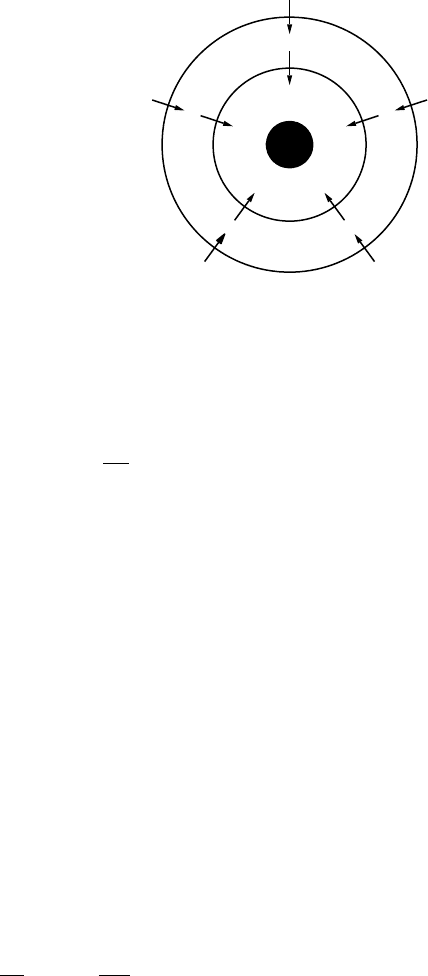
FIGURE 7.8 Flux of vapour through spherical shells towards a drop. In a steady state the
flux through all spherical shells has to be equal.
flux is proportional to the gradient of the temperature. Therefore total inward
heat flux is, analogous to Eq. 7.56,
F
q
= 4Kr
2
dT
dr
, (7.59)
with K the heat conduction coefficient. The thermal conductivity of air in-
creases with increasing temperature. A typical value of K at 10
◦
Cis
K = 25 × 10
−3
Wm
−1
K
−1
. (7.60)
Between −5
◦
C and 25
◦
C, K varies only by about 4%.
In a steady state, the total mass flux into a spherical shell is independent of
the radius of the shell. Consider the volume between an outer shell of radius
r
1
and an inner one of radius r
0
, see Figure 7.8. For a steady state the total
vapour mass flux into this volume needs to be the same as the total flux out
of this volume. Because this is true for any pair of radii, we have
F
m
= constant. (7.61)
We can combine this constraint with Fick’s law to find a simple expression
for the mass flux. First, rewrite Eq. 7.56 as
F
m
r
2
= 4D
d
v
dr
. (7.62)
Integrating this expression between the droplet radius r = r
d
and the far field
r =∞we find
F
m
/r
d
= 4D (
v
−
v,d
), (7.63)

144 CH 7 CLOUD DROPS
where we have written
v
for the vapour density in the far field (that is, the
vapour density of the air not too close to the drop) and
v,d
the vapour density
at the drop surface.
The analogous argument holds for a steady heat flux: the total energy
between radii r
0
and r
1
needs to remain constant, so the heat entering the
volume must be the same as the heat exiting the volume. This can only be
true if F
q
is not a function of the radius. This then leads to
F
q
/r
d
= 4K (T − T
d
), (7.64)
with T the air temperature in the far field and T
d
the temperature at the
drop surface. Substituting these expressions in the steady state condition of
Eq. 7.58 we find
T − T
d
=−
LD
K
(
v
−
v,d
). (7.65)
The temperature difference and the vapour density difference are propor-
tional. For large heat conductivity K, the temperature difference will be small;
the latent heat can be efficiently transported away from the drop. For small
heat conductivity, the latent heat will accumulate on the drop and larger
temperature gradients are required to transport the heat away. The precise
meaning of ‘large’ or ‘small’ will become clear later on.
To calculate the droplet growth we need to know the difference between
the vapour density at the drop surface and the vapour density of the air. We
assume that vapour near the drop is saturated. Using the ideal gas law we
thus have
v,d
=
vs
(T
d
) =
e
s
(T
d
)
R
v
T
d
. (7.66)
We have suppressed the radius dependence of the saturated vapour pressure
so this argument is only accurate for drops substantially larger than the ac-
tivation radius. It is fairly straightforward to include this radius dependence
but this would just make the equations more convoluted without providing
any further insight.
Let us for the moment assume the drop temperature T
d
is the same as the
air temperature T. We then have
v,d
=
vs
(T) =
e
s
(T)
R
v
T
. (7.67)
Using the relative humidity, the vapour density in the far field can be written
in terms of the saturated vapour density,
v
= RH
vs
(T). (7.68)

7.5 DROPLET GROWTH 145
With these expressions the total mass flux F
m
in Eq. 7.63 becomes
F
m
= 4Dr
d
vs
(RH − 1), (7.69)
where
vs
is evaluated at temperature T. In other words, the droplet growth
is due to supersaturation: if the relative humidity is larger than 100% (pos-
itive supersaturation) the drop will grow; if it is smaller than 100% the
drop will shrink. So for relative humidities below 100% the above equa-
tion can be used to calculate how quickly a droplet evaporates. Note also
that the growing droplets extract water vapour from the air and thus re-
duce its relative humidity; droplet growth by condensation is a self-limiting
process.
In the above derivation we took T
d
= T. As the droplet is heated up by
condensation this assumption is not valid. However, assuming that T
d
and
T are not too far apart we can linearize the saturated vapour pressure in
Eq. 7.66 around temperature T,
v,d
=
vs
(T
d
) =
vs
(T) +
d
vs
dT
(T
d
− T). (7.70)
Using the Clausius–Clapeyron equation in the form of Eq. 5.13 we have
d
vs
dT
=
L
R
v
T
− 1
vs
T
. (7.71)
We therefore find
v,d
=
vs
1 +
L
R
v
T
− 1
T
d
− T
T
. (7.72)
The temperature difference between the drop and the far field can be ex-
pressed as a vapour density difference by Eq. 7.65. We now get for the vapour
density difference
v
−
v,d
=
vs
RH − 1 −
v
−
v,d
K
, (7.73)
where we introduced a conduction density scale
K
=
KT
LD
L
R
v
T
− 1
−1
. (7.74)
This equation can be rearranged to find the vapour density difference
v
−
v,d
in terms of the saturated vapour density
vs
. A particularly compact way to
write the ensuing expression is
v
−
v,d
=
r
(RH − 1), (7.75)