
Ambaum M., Thermal Physics of the Atmosphere
Подождите немного. Документ загружается.

9.1 THERMAL RADIATION AND KIRCHHOFF’S LAW 167
spectrum into bands with a constant average absorptivity. Such models are
called wide-band models.
In Section 9.9 we will show that the black body emission per unit wave-
length and per unit area B
(T), equals
I B
(T) =
2hc
2
5
1
exp
hc
k
B
T
− 1
(9.6)
with h Planck’s constant,
h = 6.626 × 10
−34
Js, (9.7)
c the speed of light, and k
B
the Boltzmann constant. The above expression
for the black body emission is called Planck’s law and it played a pivotal role
in the early development of quantum mechanics.
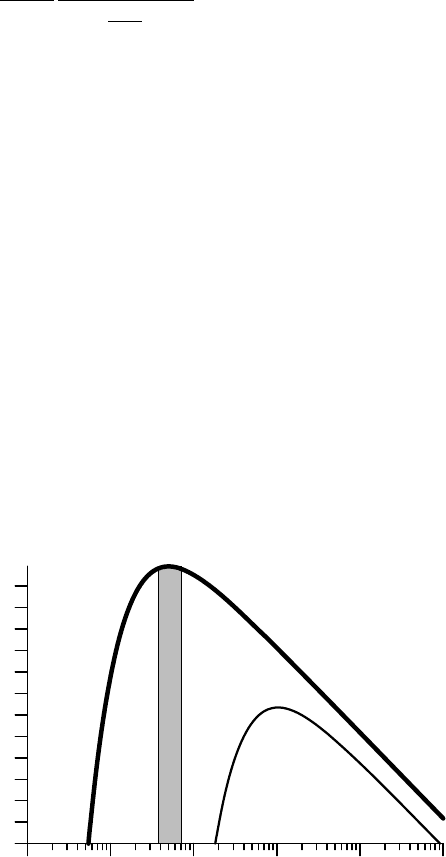
Black body radiation is a strong function of temperature. The graph in
Figure 9.1 shows, on a logarithmic scale, the black body emission as a function
of wavelength for two different temperatures: 5780 K, the temperature of the
Sun’s surface, and 280 K, a typical temperature at the Earth’s surface. Not only
is the total emission (the integral under the Planck curve) much greater for
the higher temperature, its peak is also at shorter wavelengths.
The peak for the solar temperature is in the visible spectrum. This is to be
expected on evolutionary grounds: any life form would develop ‘eyes’ that
could see the radiation that the local star predominantly produced, which
then by definition is ‘visible’. Additionally, the atmosphere is nearly transpar-
ent at these wavelengths so all this radiation reaches the Earth’s surface.
ultraviolet
visible
near infrared
thermal infrared
far infrared
wavelength
10 nm 100 nm 1 µm10µm 100 µm1mm
emission (W m
− 2
m
− 1
)
10
3
10
6
10
9
10
12
FIGURE 9.1 Black body emission as a function of wavelength for two different temper-
atures, 5780 K, the temperature of the Sun’s surface (thick curve), and 280 K, a typical
temperature at the Earth’s surface (thin curve).

168 CH 9 THERMAL RADIATION
The fact that the Sun emits nearly equally at visible wavelengths would
make it white in colour. Because the atmosphere preferentially scatters
blue light, the Sun looks yellow when viewed from the Earth’s surface. For
temperatures typical for the Earth’s surface and the atmosphere, the emis-
sion is mainly in the thermal infrared, a property that is used in infrared
thermometers.
9.2 THE STEFAN–BOLTZMANN AND WIEN DISPLACEMENT
LAWS
The Stefan–Boltzmann law expresses how much total radiative energy flux
a black body emits; the Wien displacement law expresses at what wave-
length the black body has its maximum emission. These laws can be derived
from thermodynamic arguments as well as from the Planck law. The former
method is covered in section 9.8. Here we discuss how both laws follow from
the Planck law.
The Planck law can be integrated over all wavelengths to get the total
emission B of a black body,
B =
B
d =
∞
0
2hc
2
5
1
exp
hc
k
B
T
− 1
d. (9.8)
It is convenient to introduce the thermal wavelength ,
I = hc/k
B
T. (9.9)
We can now non-dimensionalize the wavelength with the thermal wavelength
by defining the variable
= /. (9.10)
In terms of this non-dimensional wavelength, the total black body emission
can be written
B =
2k
4
B
T
4
h
3
c
2
∞
0
1/
5
exp (1/) − 1
d. (9.11)
The integral is a fixed number and it can be shown that it equals
4
/15. We
now find the Stefan–Boltzmann law,
I B = T
4
, (9.12)
with
=
2
5
k
4
B
15h
3
c
2
= 5.670 × 10
−8
Wm
−2
K
−4
(9.13)

9.2 THE STEFAN–BOLTZMANN AND WIEN DISPLACEMENT LAWS 169
the Stefan–Boltzmann constant. The Stefan–Boltzmann law states that the
total radiative energy per unit area emitted by a black body increases with
the fourth power of its temperature. The units of B are W m
−2
.
The Planck curve shows a maximum at a certain wavelength that can be
determined from dB
/d = 0. It is again easiest to non-dimensionalize the
problem and find the non-dimensional wavelength for which dB
/d = 0.
After some algebra, we find that at the maximum has to satisfy
(5 − 1/) e
1/
= 5. (9.14)
This is a trancedental equation which can be solved numerically and its solu-
tion is 1/
m
= 4.96511423 ... So the Planck function B
(T) has a maximum
when =
m
;
47
that is, for a wavelength
m
of
m
=
m
hc
k
B
T
, (9.15)
which can be written as
I
m
= b/T, (9.16)
with
b = 2.898 × 10
−3
mK. (9.17)
Equation 9.16 is called Wien’s displacement law and the constant b is called
the displacement constant. So the higher the temperature, the shorter the
wavelength at which the maximum emission occurs.
For the surface of the Sun at T = 5780 K we find
m
= 500 nm, well inside
the visible spectrum (from about 400 nm to about 700 nm, see Figure 9.1). In
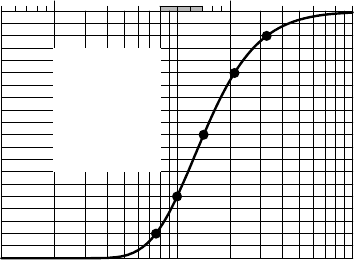
fact, about 40% of the solar radiative output is in the visible spectrum – see
also Problem 9.2 and Figure 9.2. For T = 280 K we find
m
= 10 m, well
in the thermal infrared. Thermography is based on this principle: an object
at different temperatures emits predominantly at different wavelengths and
has therefore a different ‘colour’ in the infrared.
In an atmospheric context, radiation around the thermal infrared is often
called long-wave radiation and radiation around the visible spectrum and
shorter wavelengths is often called short-wave radiation.
47
The Planck law can also be expressed in frequency instead of wavelength. The max-
imum emission in the frequency spectrum corresponds to 1/
m
= 2.821439 ... which is
the solution to (3 − 1/) e
1/
= 3.
170 CH 9 THERMAL RADIATION
0
0.1
0.2
0.3
0.4
0.5
0.6
0.7
0.8
0.9
1
0.1 1 10
100nm
1000nm
percentiles
10% 0.758
25% 1.000
50% 1.417
75% 2.122
90% 3.236
λ/Λ
λ (T = 5780 K )
FIGURE 9.2 Cumulative fraction of black body emission as a function of wavelength ,
expressed in thermal wavelengths (bottom axis) and in nanometres for a radiation tem-
perature of 5780 K (top axis; the grey bar corresponds to the visible part of the spectrum).
9.3 GLOBAL ENERGY BUDGET AND THE GREENHOUSE EFFECT
The Sun’s radius is about R
S
= 6.96 × 10
8
m and its surface temperature
is about T
S
= 5780K. The Sun can be approximately treated as a black
body. From Stefan’s law we can then find the total radiative energy out-
put of the Sun. When this radiation has reached the Earth’s orbit (average
orbital radius r
E
= 149.5 × 10
9
m) this energy is used to irradiate a much
larger area, 4r
2
E
instead of 4R
2
S
. So the radiative energy flux per unit area
S
0
at the distance of the Earth can be found from
4r
2
E
S
0
= 4R
2
S
T
4
S
. (9.18)
The flux S
0
is called the solar constant, or the total solar irradiance, and it has
a value of about
I S
0
= 1366 W m
−2
. (9.19)
The solar constant is not really constant. There is a small variation, typically
less than 1W m
−2
, due to the change of the solar output over an 11-year solar
cycle, as well as variations on cosmological time scales.
The solar constant is defined as the amount of solar radiation received
outside the Earth’s atmosphere at the Earth’s mean distance from the Sun. The
Earth’s orbit is slightly eccentric, which leads to a variation of solar irra-
diance from 1412 W m
−2
in early January to 1321 W m
−2
in early July, see
Problem 9.1.
The solar radiation reaching the Earth will irradiate the Earth disk of size
R
2
E
with R
E
= 6.371 × 10
6
m the mean radius of the Earth. However, the
9.3 GLOBAL ENERGY BUDGET AND THE GREENHOUSE EFFECT 171
total surface of the Earth is 4R
2
E
. That means that the average radiation per
unit area on Earth, the so-called average insolation,isS
0
/4 = 342Wm
−2
.
Because the total energy content of the Earth system is constant on long
time scales, the Sun’s heat input is compensated by the Earth’s heat output;
therefore Earth will have to export, on average, S
0
/4 = 342Wm
−2
. About
30% of this export is accounted for by reflection of the incoming short-wave
radiation from the clouds and from the Earth’s surface. The fraction ˛ of
insolation that is reflected is called the albedo; the Earth system has an average
albedo of ˛ = 0.3. The radiation that is not reflected back to space, about
239Wm
−2
on average, is exported as long-wave radiation. Using Stefan’s
law, this radiative export can be expressed as the effective temperature of a
black body with the same energy output. This effective temperature is called
the radiation temperature or bolometric temperature, T
b
. For the Earth we find
a radiation temperature of T
b
= 255 K.
The radiation temperature is lower than the observed average surface tem-
perature on Earth, T
E
, of about 288 K. This high surface temperature is due
to the greenhouse effect produced by the atmosphere. The total greenhouse
effect on Earth is about 288 K −255 K = 33 K. Physically, the atmosphere can
be viewed as a long-wave blanket over the Earth. The top of the atmosphere
will have to radiate at a temperature of 255 K. To emit at this temperature,
the Earth’s surface beneath the blanket has to be warmer. This is the green-
house effect. If the blanket insulates better, the Earth’s surface has to become
hotter to enable the same radiation temperature at the top of the atmosphere.
In its simplest possible setting, the greenhouse effect can be understood
by assuming that the atmosphere is relatively transparent in the short-wave
spectrum (
SW
≈ 0) and opaque in the long-wave spectrum (
LW
≈ 1). The
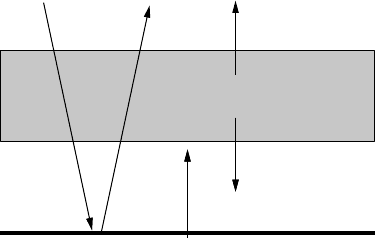
schematic in Figure 9.3 shows how the radiation is transmitted in such a
system, where we assume the atmosphere to consist of a single, cloud-free
slab of uniform temperature T
A
. In equilibrium, the energy fluxes into and
T
E
T
A
σ T
4
E
σ T
4
A
σ T
4
A
S
0
/ 4 αS
0
/ 4
FIGURE 9.3 Paths of radiative fluxes in a system made of a single, cloud-free slab atmo-
sphere at temperature T
A
, with unit emissivity in the long-wave and zero emissivity in the
short-wave part of the spectrum. The insolation is S
0
/4. The planetary short-wave albedo
˛ is here provided by the Earth’s surface alone.

172 CH 9 THERMAL RADIATION
out of the components of the system must balance. The energy budget can
be evaluated for the space surrounding the Earth system at the top of the
atmosphere (TOA), in the atmosphere itself (ATM), and at the Earth’s surface
(SFC). This leads to the following three budget equations:
energy output = energy input
TOA: S
0
/4 = ˛S
0
/4 + T
4
A
(9.20a)
ATM: 2T
4
A
= T
4
E
(9.20b)
SFC: T
4
E
= T
4
A
+ (1 − ˛) S
0
/4. (9.20c)
The factor of two in the atmospheric budget corresponds to the fact that the
atmosphere radiates to the Earth as well as to space.
In this energy budget, we have three equations with two unknowns but
the three budgets are dependent; we can substitute Eq. 9.20b into Eq. 9.20c
to find Eq. 9.20a. So effectively we have two equations with two unknowns,
T
E
and T
A
, which have as solution
T
A
=
(1 − ˛) S
0
4
1/4
and T
E
= 2
1/4
T
A
. (9.21)
Putting in numbers, we find T
A
= 255 K; indeed, it has to be the same as the
previously calculated radiation temperature, T
b
, because the atmosphere in
this model radiates as a black body to space. For the Earth’s surface tempera-
ture we find T
E
= 303 K, rather higher than the 255 K calculated without an
atmosphere. This value is also higher than observed (about 288 K) because
the atmosphere is not completely opaque to long-wave radiation and because
there are other heat exchange processes between the Earth’s surface and the
atmosphere.
It is enlightening to work out several budget scenarios based on simple slab
models. One obvious extension of the above model would be to allow for a
finite long-wave emissivity,
LW
, and for a latent and sensible heat transfer,
H, between the Earth’s surface and the atmosphere. The budget equations for
this modified system are
TOA: S
0
/4 = ˛S
0
/4 +
LW
T
4
A
+ (1 −
LW
) T
4
E
(9.22a)
ATM: 2
LW
T
4
A
=
LW
T
4
E
+ H (9.22b)
SFC: T
4
E
+ H =
LW
T
4
A
+ (1 − ˛) S
0
/4. (9.22c)
Here it is taken that an atmospheric long-wave emissivity of
LW
corresponds
to a long-wave transmissivity of 1−
LW
. As before, only two of these equations
are independent. The solution for T
E
is
(1 −
LW
/2)T
4
E
= (1 − ˛) S
0
/4 − H/2. (9.23)

9.3 GLOBAL ENERGY BUDGET AND THE GREENHOUSE EFFECT 173
From this equation we can see that the Earth’s surface temperature increases
with increasing
LW
, the greenhouse effect, and with decreasing H.
The greenhouse effect is due to a mix of several greenhouse gases in the
atmosphere, gases that absorb strongly in the long-wave part of the spectrum.
The most dominant greenhouse gases are H
2
O and CO
2
. It is important to
note that we cannot simply add contributions of each individual gas to find the
total long-wave absorption. Most greenhouse gases absorb strongly in certain
wavelength bands and when bands of two different gases overlap, the total
absorption is less than the sum of the individual absorptions. For this reason
it is impossible to uniquely define the contribution of each greenhouse gas to
the total. Nonetheless, the water vapour contribution to the total long-wave
absorption is about four times larger than the CO
2
contribution.
Increases in these greenhouse gases make the atmosphere more opaque
to long-wave radiation (they will increase
LW
) and will increase the surface
temperature, as in Eq. 9.23. This is called the enhanced greenhouse effect. It
requires detailed radiative calculations to quantitatively determine the effect
of adding a certain amount of CO
2
to the atmosphere. One of the key diffi-
culties comes in estimating the size of the so-called water vapour feedback.If
CO
2
in the atmosphere increases, the temperature will go up. This will en-
hance saturation vapour pressure in the atmosphere and its water vapour
content. This will then further increase the opacity of the atmosphere.
We can devise a simple model for the water vapour feedback mechanism
based on Eq. 9.23. Assuming the latent and sensible heat fluxes remain the
same, we can estimate the change in temperature in terms of the change in
long-wave emissivity. We find for small variations in
LW
4
dT
E
T
E
=
d
LW
2 −
LW
. (9.24)
We now linearize our radiation code so as to express variations in the long-
wave emissivity in terms of changes in CO
2
concentration and changes in
water vapour concentration. The latter is written as proportional to the satu-
rated vapour pressure at temperature T
E
– this assumes that the mean relative
humidity does not change, something which is generally confirmed by general
circulation models. So we have
d
LW
= P dCO
2
+ Q de
s
(T
E
), (9.25)
with P and Q some constants that follow from linearizing the total radiation
effects. With the Clausius–Clapeyron equation the change in saturated water
vapour pressure can be written in terms of the change in surface tempera-
ture. Substitution in Eq. 9.24 gives
(8 − 4
LW
)
dT
E
T
E
= P dCO
2
+ Q
e
s
L
R
v
T
E
dT
E
T
E
. (9.26)

174 CH 9 THERMAL RADIATION
Rearranging gives
dT
E
dCO
2
=
PT
E
8 − 4
LW
1 +
x
1 − x
, (9.27)
with
x =
Qe
s
L
R
v
T
E
(8 − 4
LW
)
. (9.28)
If the radiative effect of increased water vapour is ignored we have Q =
0,x = 0. So the first term on the right-hand side of Eq. 9.27 represents
the direct effect of the CO
2
forcing. The second term on the right-hand side
represents the water vapour feedback. It is positive and can easily be larger
than the direct effect. Note that the linearization constants P and Q depend
on the presence of CO
2
, water vapour and all the other greenhouse gases in
the atmosphere, so the direct effect of CO
2
depends on the presence of water
vapour.
The water vapour feedback becomes infinite when x → 1. This is what
is called the runaway greenhouse effect. This is a possibility in our model:
remember that the saturated vapour pressure increases strongly with tem-
perature. In a runaway state, the surface temperature shoots up until all the
water vapour on the planet has evaporated. The present one-layer model is
much too simple to accurately estimate the limits of the runaway greenhouse
effect. From more comprehensive models it is believed that the Earth cannot
get to a runaway state by pumping CO
2
into the atmosphere.
Although didactically enlightening, these simple slab models are ultimately
insufficient to accurately describe the energy balance of the atmosphere and
to predict useful values for surface or atmospheric temperatures. To achieve
any level of accuracy for the radiative part of the description we need to move
to comprehensive radiative transfer models. We need to relax the assumption
of horizontal homogeneity. We also need to take into account the true emis-
sivity structure of the atmosphere. This structure is complex and depends on
molecular absorption spectra and density profiles of absorbers, such as water
vapour or ozone, in the atmosphere. This is crucial to understanding the true
effect of radiation on the atmosphere and key to understanding the climate
change response to changed greenhouse gases. These subjects are covered in
texts that are specifically devoted to atmospheric radiation.
Furthermore, these slab models do not generally provide adequate de-
scriptions of the many additional complexities in the atmospheric energy
budget. For example, the sensible and latent heat fluxes are not set by any
of the variables in the models. We can devise parameterizations. We could
for example take the flux from the Earth’s surface to the atmosphere to be
proportional to their temperature difference. These types of parameteriza-
tions, so-called bulk aerodynamic parameterizations, are widely used in gen-
eral circulation models, although the constants of proportionality are usually
complex functions of atmospheric parameters, such as vertical wind shear,
9.4 HORIZONTAL VARIATIONS 175
that are not included in simple slab models. More complex parameterizations
may be found in radiative–convective equilibrium models. Here the latent and
sensible heat fluxes are estimated based on approximations of convective
activity in the atmosphere.
Additionally, the Earth system contains many feedback mechanisms. The
water vapour feedback, discussed above, is only one of them. Particularly, the
albedo is a complex function of the state of the atmosphere. For example, in
a warmer world, we generally expect less ice cover of the poles and therefore
a reduced albedo in the polar regions. This will lead to enhanced absorption
of solar radiation leading to further warming. This is called the ice–albedo
feedback; it is a positive feedback. This is again a very simplified picture of the
ice–albedo feedback: it is not obvious to what extent a warmer world would
actually have less ice, because the polar ice cover is a complex function of
the ocean currents and atmospheric circulation patterns, both of which will
change in a warmer world. Changing cloud cover provides another feedback
mechanism for which we do not even know for sure whether it is on average
positive or negative. Clouds account for about three-quarters of the albedo
of planet Earth
48
and at the same time provide additional long-wave heating
of the Earth’s surface. It is one of the great challenges of climate science to
determine how these competing effects will change in a changing climate.
9.4 HORIZONTAL VARIATIONS
In the previous section we examined simple slab models for the global energy
budget by taking global mean values of all relevant parameters, such as in-
solation and albedo. The actual value of insolation is a function of latitude,
season, and time of day. At any time, the insolation S equals
S = S
0
(r
E
/r
E
(t))
2
cos , (9.29)
with r
E
(t) the distance from the Earth to the Sun as a function of time, r
E
the average distance from the Earth to the Sun, and the zenith angle, that is,
the angle between the rays of the Sun and the local vertical. The cos factor
accounts for the projection of the incident rays onto the surface.
With this equation, the insolation averaged over a day can be calculated as a
function of latitude and season; this requires standard astronomical equations
for the declination of the Sun (the angle between the rays of the Sun and the
plane of the Earth’s equator) and the distance between the Earth and the Sun
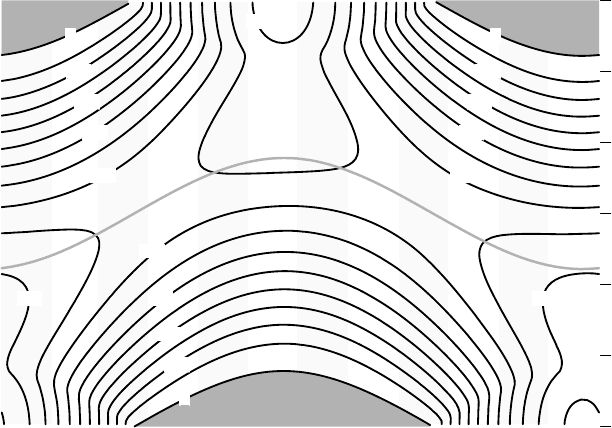
as a function of day number. Figure 9.4 shows the result of this calculation.
It can be seen that the insolation vanishes in the polar nights. The maximum
insolation is achieved at the poles in the summer hemispheres. This is due to
the fact that, although the solar zenith angle increases when going poleward,
the length of the day also increases in the summer hemisphere. In the winter
hemisphere there is a strong insolation contrast between the equator and the
48
See Trenberth, K. E., Fasullo, J. T. and Kiehl, J. (2009) Bull. Am. Meteor. Soc. 90,
311–324.
176 CH 9 THERMAL RADIATION
60S
30S
EQ
30N
60N
NP
SP
SAJJMAMFJ
DNOSAJJMAMFJ
DNO
0
100
200
300
400
500
0
100
200
300
400
500
0
100
200
300
400
500
FIGURE 9.4 Insolation for current astronomical conditions averaged over a day as a func-
tion of season and latitude. The contour interval is 50 W m
−2
. The shaded areas have
vanishing insolation. The grey line indicates the declination of the Sun as a function of
season.
pole; in the summer hemisphere there is a much weaker, indeed reversed,
insolation contrast.
The short-wave albedo is the fraction of incoming short-wave radiation
that is reflected. It is also a strong function of local conditions such as cloud
cover, cloud type, surface type, solar zenith angle. The average short-wave
albedo for Earth is ˛ ≈ 0.3. Figure 9.5 shows the average albedo of the Earth
as a function of geographical location for the year 1986. It is determined
from satellite measurements of the outgoing radiation. As can be seen in the
figure, the albedo increases strongly from the tropics (˛ ≈ 0.2) to the poles
(˛ ≈ 0.6). This is partly due to the increased average zenith angle going
towards the poles, and partly due to the presence of snow and ice at high
latitudes. The regions of lowest albedo correspond to relatively clear regions
over the tropics.
The combined effect of the varying solar insolation and the increased
albedo towards the higher latitudes implies that the absorbed solar radiation
at the Earth’s surface is larger at the equator (about 300 W m
−2
on average)
than at the poles (about 100 W m
−2
on average), see Figure 9.5; the largest
contrast is achieved in the winter hemisphere. This contrast in absorbed
radiation sets up a temperature gradient from pole to equator and a subse-
quent build-up of potential energy. The build-up of potential energy makes
the atmosphere unstable and this results in poleward transport of heat. The
oceans are driven by varying heat inputs and the atmospheric winds. They