
Baker K.R. Optimization Modeling with Spreadsheets
Подождите немного. Документ загружается.

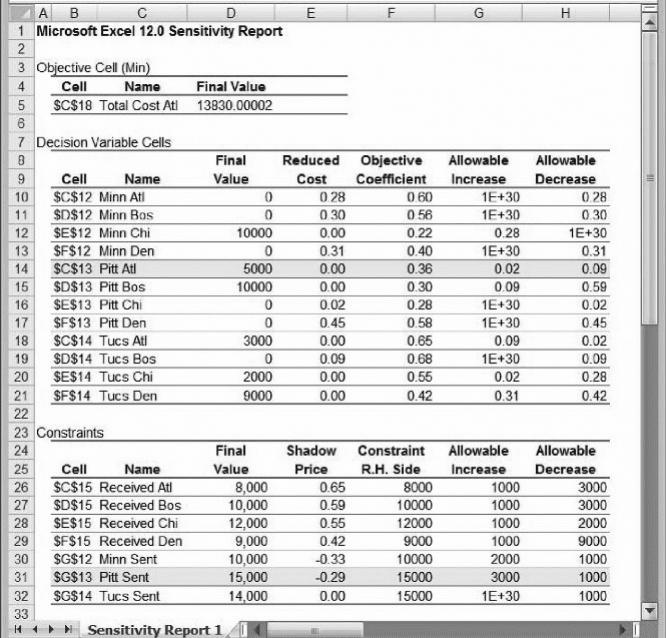
second section, the report reproduces the values of the decision variables in the opti-
mal solution (under Final Value) and the values of the coefficients in the objective
function (under Objective Coefficient). The Allowable Increase and Allowable
Decrease columns show how much we could change any one of the objective function
coefficients without altering the optimal decision variables. For example, the objective
function coefficient for the PA route is $0.36 in the base case, as shown in the first
highlighted row of the Sensitivity Report in Figure 4.15. This unit cost could rise
to $0.38 without having an impact on the optimal shipping schedule. (This limit is
indicated by the allowable increase of 0.02.) In addition, the original value could
drop to $0.27 without having an impact on the optimal shipping schedule. (This
limit is indicated by the allowable decrease of 0.09.) These increases and decreases
from the base case are consistent with the parameter analysis shown in Figure 4.5.
It might be helpful to think about the Sensitivity Report as an “insensitivity
report,” because it mainly provides information about changes for which some
aspect of the base-case solution does not change. Here, for example, the base-case
Figure 4.15. Sensitivity Report for Example 3.1.
136 Chapter 4 Sensitivity Analysis in Linear Programs
decisions are insensitive to changes in the PA unit cost between $0.27 and $0.38. In
this interval, the base-case schedule remains optimal. Of course, the optimal total
cost will vary with the PA unit cost, because some 5000 units are shipped along the
PA route in the optimal schedule. For example, if the unit cost dropped by $0.04,
the optimal schedule would remain unchanged, but the optimal total cost would
drop by 5000($0.04) ¼ $200.
The Sensitivity Report is more precise but less flexible than the Parameter
Analysis Report. For example, Figure 4.4 provides us with the allowable increase
and decrease, but to a precision of only 0.05. We need to search on a smaller grid,
as in Figure 4.5, to refine our precision; but even in this more detailed report, we
can determine the allowable increase and decrease to a precision of only 0.01. By con-
trast, the Sensitivity Report provides the values exactly. On the other hand, the
Sensitivity Report tells us virtually nothing about what would happen if the PA unit
cost rose above $0.38, whereas the Parameter Analysis Report can provide a good
deal of information.
The entries in the Reduced Cost column of the Sensitivity Report may initially be
displayed as a set of zeros for all variables.
2
However, if we display the entries to two
decimal places, we see some nonzero values. For decision variables that are not at their
upper or lower bounds (and here, the only bound for a variable is zero), the reduced
cost is zero. So, for the variable PA, which is positive in the optimal shipping schedule,
the report shows a reduced cost of zero.
The reduced cost is nonzero if the corresponding decision variable lies at its
bound. In this example, that condition means that the route is not used in the optimal
schedule. For the MA route, the reduced cost is $0.28. The interpretation of this value
is as follows. Evidently, the unit cost of the MA route is unattractive at its base-case
value of $0.60, and we might wonder how much more attractive that unit cost
would have to become for the MA route to appear in the optimal solution. The
answer is given by the reduced cost: The unit cost would have to drop by more than
$0.28 before there would be an incentive to ship along the MA route. However, we
already knew that much, from the Allowable Decrease for the MA variable. As this
example shows, the Reduced Cost provides information that can be obtained else-
where, and we need not rely on it.
In the third section, the Sensitivity Report provides the values of the constraint
left-hand sides (under Final Value) and the right-hand-side constants (under
Constraint RH Side), along with the shadow price for each constraint. Here again, it
may be necessary to re-format the column of shadow prices. From the earlier sensi-
tivity analysis for this example, we expect to see a shadow price of $0.29 for
Pittsburgh capacity. The Sensitivity Report shows this value as a negative price
because it follows a convention of quoting the shadow price as the increase in the
objective function induced by a unit increase in the right-hand side constant. An
2
The format of these cells corresponds to the format of the corresponding decision cell in the original model.
Thus, depending on how the model was originally formatted, the figures in this report can be misleading,
especially when zeros appear.
4.3. The Sensitivity Report and the Transportation Example 137
increase in the Pittsburgh capacity would allow the optimal total cost to drop, so the
shadow price is negative.
The Allowable Increase and Allowable Decrease columns show how much we
could change any one of the constraint constants without altering the shadow price.
In the case of Pittsburgh capacity (15,000 in the base case), the information in the
highlighted row of the report’s bottom section indicates that the capacity could increase
by 3000 or decrease by 1000 (i.e., it could vary between 14,000 and 18,000) without
affecting the shadow price of $0.29. Again, this is an “insensitivity” result, and it is
consistent with the information in the Parameter Analysis Report of Figure 4.6.
Recall from our earlier discussions, however, that the optimal values of some decision
variables change with any increase or decrease in the Pittsburgh capacity.
The Sensitivity Report does not offer information about what occurs outside of
the allowable increase and allowable decrease. It is also completely based on one-
at-a-time analysis. That is, the presumption is that only one parameter at a time is
subject to change. No facility exists in the Sensitivity Report to explore the effects
of varying two parameters simultaneously, as in the case of the two-way parameter
analysis shown in Figure 4.14.
The sensitivity analysis for right-hand-side constants is omitted for constraints
that involve a simple lower or upper bound. That is, if the form of the constraint is
Variable Ceiling or Variable Floor, then the Sensitivity Report does not include
the constraint. On the other hand, if the same information is incorporated into the
model using the standard SUMPRODUCT constraint form (as in the case of the allo-
cation model) or using the SUM constraint form (as in the case of the transportation
model) then the Sensitivity Report treats the constraint in its usual fashion and pro-
vides ranging analysis.
4.4. THE SENSITIVITY REPORT AND THE
ALLOCATION EXAMPLE
As another illustration of the Sensitivity Report, suppose we ask for it after solving
Example 2.1, the allocation problem discussed earlier. (Refer to Figure 4.7, but
with the original profit coefficient of 16 restored to cell B8.) The Sensitivity Report
is shown in Figure 4.16. In the first section, the report shows the optimal value of
the objective function (total profit) of $4,880. In the second section, the Sensitivity
Report reproduces the optimal solution and tabulates the Allowable Increase and
Allowable Decrease for each objective function coefficient. If we ask how much the
contribution of chairs ($16 in the base case) could vary without altering the optimal
product mix, we can tell from the first Allowable Increase that the contribution
could rise by up to $5 or drop by any amount without altering the optimal mix.
Thus, a price increase of more than $5 would provide an inducement to include
chairs in the product mix. This conclusion could also be drawn from the parameter
analysis in Figure 4.7.
Suppose instead that we ask a similar question about desks: How much could the
profit contribution for desks ($20 in the base case) change, without altering the
138
Chapter 4 Sensitivity Analysis in Linear Programs
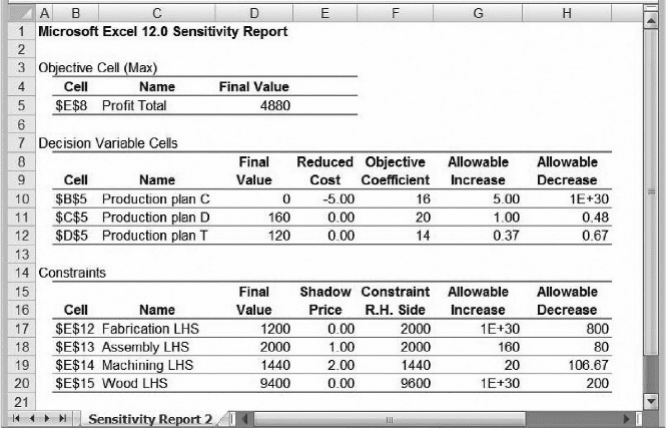
optimal solution? From the Sensitivity Report, in the row for desks, we see that the
allowable range is from $19.52 to $21.00 (from an Allowable Decrease of about
$0.48 to an Allowable Increase of $1.00). Within this interval, the unit profit on
desks does not trigger a change in the optimal mix; the best mix remains 160 desks,
120 tables, and no chairs. However, any change outside this range should be examined
by re-running the model. Also, if the profit on desks were to increase by $0.75, which
lies within the Allowable Increase, the optimal value of the objective function would
necessarily change because the 160 desks in the optimal mix would account for a profit
increase of 160($0.75) ¼ $120.
The example involving the profit on desks reinforces the point that the Sensitivity
Report cannot “see” beyond the Allowable Increase and Allowable Decrease. The
Sensitivity Report tells us nothing about what happens when the profit contribution
for desks rises above $21, whereas that information would be available to us from
the Parameter Analysis Report, provided we specify a suitable range for the input
parameter. Nevertheless, the Sensitivity Report covers all of the decision variables
in one report. If we’re primarily interested in the allowable increases and decreases
around the base case—that is, if we’re looking for “insensitivity” information—
then the Sensitivity Report is the tool of choice. Had we used the Parameter
Analysis Report, we could not have produced information on all three coefficients
simultaneously.
In the third section, the Sensitivity Report provides the shadow price for each con-
straint and the range over which it holds. The Allowable Increase and Allowable
Decrease columns show how much we could change any one of the constraint con-
stants without altering any of the shadow prices. For example, we should recognize
Figure 4.16. Sensitivity Report for Example 2.1.
4.4. The Sensitivity Report and the Allocation Example 139

the shadow price on Machining time of $2.00 (from Figure 4.11). However, from the
Sensitivity Report, we also know now that this $2.00 value holds up to a capacity
of 1460 hours (an allowable increase of 20). Beyond that, there would be a change
in the shadow price for machining hours. In fact, there would be a change in the
optimal product mix. Once again, we cannot anticipate from Sensitivity Report
exactly what that change might look like, whereas the Parameter Analysis Report
(Figure 4.11) shows that the expanded machining capacity will make it desirable to
add chairs to the product mix.
Thus, the Parameter Analysis Report and the Sensitivity Report provide different
capabilities. A comparison of the two approaches is summarized in Table 4.1.
Generally, the Parameter Analysis Report is more flexible, whereas the Sensitivity
Report is more precise. Although each is suitable for answering particular questions
that arise in sensitivity analyses, it would be reasonable to draw on both capabilities
to build a comprehensive understanding of the model’s solution. One word of warning
must be added. The Sensitivity Report can sometimes be confusing if the model itself
does not follow a disciplined layout. As described in Chapter 2, we advocate a stan-
dardized approach to building linear programming models on spreadsheets. Solver
does permit more flexibility in layout and calculation than our guidelines allow, but
some users find the Sensitivity Report confusing when running nonstandard model
layouts. This problem is less likely to arise with the Parameter Analysis Report.
4.5. DEGENERACY AND ALTERNATIVE OPTIMA
Viewed from the perspective of the Sensitivity Report, each linear programming
solution carries with it an allowable range for the objective function coefficients
Table 4.1. Comparison of the Parameter Analysis and Sensitivity Reports
Parameter Analysis Report Sensitivity Report
Differences
Describes user-determined region Describes “insensitivity” region
Can “see” beyond insensitivity region Limited to “insensitivity” region
Contains standard and tailored content Contains standard content
Table grid may need refinements Allowable increase/decrease are precise
User may require several reports Information is provided simultaneously
Two-at-a-time analysis is available One-at-a-time analysis only
Any parameter on the worksheet Objective coefficients and constraint constants
Similarities
Report is a new worksheet Report is a new worksheet
Column names may need revision Tabulated names may need revision
Entries in report table may need
reformatting
Entries in report table may need reformatting
140 Chapter 4 Sensitivity Analysis in Linear Programs
and RHS constants. Within this range, some aspect of the optimal solution remains
stable—decision variables in the case of varying objective function coefficients and
shadow prices in the case of varying RHS constants. At the end of such a range,
the stability no longer persists, and some change sets in. In this section, we examine
the endpoints of these ranges as special cases.
First, let’s consider the allowable range for a constraint constant. For a particular
constraint, there is a corresponding range in which the shadow price holds. At the end
of that range, the shadow price is in transition, changing to a different value. At a point
of transition, a different shadow price holds in each direction. This condition is
referred to as a degenerate solution.
Consider our transportation example and its sensitivity report in Figure 4.15.
Suppose we are again interested in the analysis of Pittsburgh capacity, originally at
15,000. From the ranging analysis of Figure 4.15, we find that the shadow price of
$0.29 holds for capacities of 14,000 to 18,000. At a capacity of 18,000, the shadow
price is in transition. We can see from Figure 4.6 that the shadow price is $0.29
below a capacity of 18,000 and $0.27 for capacities above it. Just at 18,000, it
would be correct to say that there are two shadow prices, provided that we also explain
that the 29-cent shadow price holds for capacity levels below 18,000, and a 27-cent
shadow price holds for capacity levels above 18,000. When we take capacity to be
exactly 18,000, however, Solver can display only one of these shadow prices. The
Sensitivity Report could show the shadow price either as $0.29 but with an allowable
increase of zero, or as $0.27 but with an allowable decrease of zero, depending on how
the model is expressed on the worksheet.
To recognize a degenerate solution, we look for an entry of zero among the allow-
able increases and decreases reported in the Constraints section of the Sensitivity
Report. This value indicates that a shadow price is at a point of transition. If none
of these entries is zero, then the solution is said to be a nondegenerate solution,
which means that no shadow price lies at a point of transition in the optimal solution.
The significance of degeneracy is a warning: It alerts us to be cautious when using
shadow prices to help evaluate the economic consequences of altering a constraint
constant. We must be mindful that, in a degenerate solution, the shadow price holds
in only one direction. If we want to know the value of the shadow price just beyond
the point of transition, we can change the corresponding right-hand side by a small
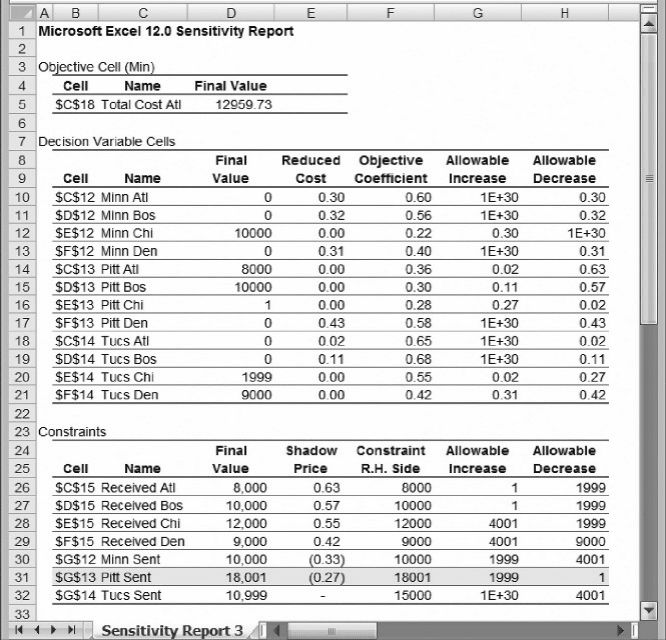
amount and then re-run Solver. In our example, we could set Pittsburgh capacity
equal to 18,001 and re-optimize. The resulting Sensitivity Report reveals a 27-cent
shadow price for the Pittsburgh capacity constraint, along with an Allowable
Decrease of one, as shown in the highlighted row of Figure 4.17.
For a complementary result, suppose we have a problem that leads to a nonde-
generate solution, and we consider ranging analysis for objective function coefficients.
For any particular coefficient, there is a corresponding range in which the optimal
values of the decision variables remain unchanged. At the end of that range, more
than one optimal solution exists. This condition is referred to as alternative optima,
or sometimes multiple optima.
As an example, consider our original transportation model, as displayed in
Figure 4.1. From the ranging analysis of Figure 4.15, we see that the unit cost of the
4.5. Degeneracy and Alternative Optima 141
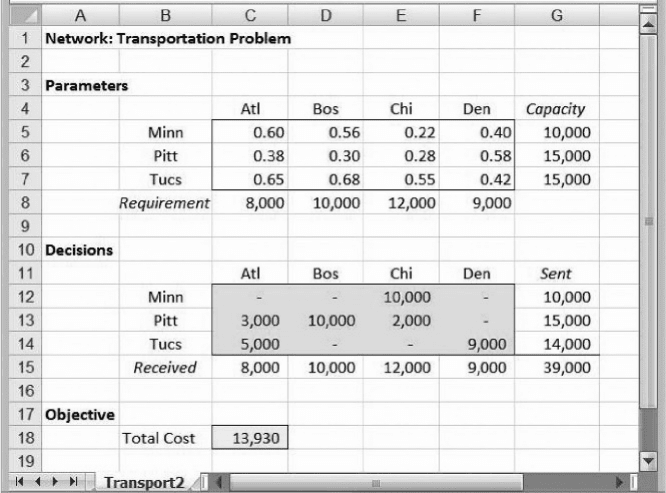
PA route can vary from $0.27 to $0.38 without a change in the optimal schedule. At the
38-cent limit of this range, more than one optimal solution exists. To find this solution,
we change the unit cost on the PA route to 0.38 and re-run Solver. We find that the
optimal total cost is $13,930, as shown in Figure 4.18. In this solution, the shipments
from Pittsburgh are 3000 to Atlanta, 10,000 to Boston and 2000 to Chicago, with cor-
responding adjustments to the Tucson shipments. However, we can verify that the
original optimal schedule generates this same total cost. In other words, we have
found two different schedules that achieve optimal costs. (In fact, it is possible to show
that any weighted average of the two schedules is also optimal; thus, the number of
distinct optimal schedules is actually infinite.) Solver is able to display only one of
these solutions, depending on how the model is constructed on the spreadsheet.
To recognize the existence of multiple optima, we look for an entry of zero
among the allowable increases and decreases reported in the Decision Variable
Cells section of the Sensitivity Report. If there are no zeros, then the optimal solution
is a unique optimum, and no alternative optima exist. (Strictly speaking, this is true
Figure 4.17. Sensitivity Report for the near-degenerate case.
142 Chapter 4 Sensitivity Analysis in Linear Programs
only for nondegenerate solutions; when the solution is degenerate, these zeros are
not necessarily indicators of multiple optima.) Otherwise, the optimal solution
displayed on the spreadsheet is one of many alternatives that all achieve the same
objective function value. The significance of multiple optima is an opportunity:
Knowing that there are alternative ways of reaching the optimal value of the objective
function, we might have secondary preferences that we could use as “tiebreakers” in
this situation. However, Solver does not have the capability of displaying multiple
optima, and it is not always obvious how to generate them on the spreadsheet. In
our example, we can at least “trick” Solver into displaying the original optimal
schedule for the case of a 38-cent unit cost on the PA route. If we change the unit
cost on the PA route to 0.37999 and re-run Solver, we obtain the output we desire.
Here, we exploit the fact that this made-up value remains inside the limits of the orig-
inal ranging analysis (as given in Figure 4.15), but it effectively behaves like the
desired parameter of 0.38.
In summary, the Sensitivity Report examines the objective function coefficients
and the RHS constants separately in two tables. Taking each parameter independently,
and permitting it to vary, the report provides information on its allowable range—the
range of values for which the solution remains stable in some way. At the end of these
ranges, indicated by the values of the Allowable Increase and Allowable Decrease,
special circumstances apply. Box 4.1 summarizes the various conditions that can
occur when we start with an optimal solution that is unique and nondegenerate.
Figure 4.18. Solution with multiple optima.
4.5. Degeneracy and Alternative Optima 143

4.6. PATTERNS IN LINEAR PROGRAMMING
SOLUTIONS
We often hear that the real take-away from a linear programming model is insight,
rather than the actual numbers in the answer, but where exactly do we find that insight?
This section describes one form of insight, which comes from interpreting the quali-
tative pattern in the solution. Stated another way, the optimal solution tells a “story”
about a pattern of economic priorities, and it’s the recognition of those priorities
that provides useful insight. When we know the pattern, we can explain the solution
more convincingly than when we simply transcribe Solver’s output. When we
know the pattern, we can also anticipate answers to some what-if questions without
having to modify the spreadsheet and re-run Solver. In short, the pattern provides a
level of understanding that enhances decision making. Therefore, after we optimize
a linear programming model, we should always try to describe the qualitative pattern
in the optimal solution.
BOX 4.1
Summary of Ranging in Sensitivity Analysis
Allowable ranges for objective function coefficients
In the range from Allowable Increase to Allowable Decrease
†
the values of the decision variables remain the same
†
the binding constraints remain binding.
At the boundary of the range
†
multiple optima occur
†
the decision variables are in transition.
Inside the range (but not on its boundary)
†
the optimal set of decision variables is unique.
Allowable ranges for right-hand-side constants
In the range from Allowable Increase to Allowable Decrease
†
the shadow prices remain the same
†
the zero-valued decision variables remain zero.
At the boundary of the range
†
degeneracy occurs
†
the shadow price is in transition.
Inside the range (but not on its boundary)
†
the shadow prices are unique.
144 Chapter 4 Sensitivity Analysis in Linear Programs
Spotting a pattern involves making observations about both variables and con-
straints. In the optimal solution, we should ask ourselves, which constraints are bind-
ing and which are not? Which variables are positive and which are zero? A structural
scheme describing the pattern is simply a qualitative statement about binding con-
straints and positive variables. However, to make that scheme useful, we translate it
into a computational scheme for the pattern, which ultimately allows us to calculate
the precise values of the decision variables in terms of the model’s parameters. This
computational scheme often allows us to reconstruct the solution in a sequential,
step-by-step fashion. To the untrained observer, the computational scheme seems to
calculate the quantitative solution directly, without Solver’s help. In fact, we are pro-
viding only a retrospective interpretation of the solution, and we need to know that sol-
ution before we can construct the interpretation. Nevertheless, we are not merely
reflecting information in Solver’s output; we are looking for an economic imperative
at the heart of the situation depicted in the model. When we can find that pattern and
communicate it, then we have gained some insight.
The examples in each of the subsections illustrate how to describe a pattern with-
out using numbers. The discussion also introduces two tests that determine whether
the pattern has been identified. We’ll see how knowledge of the pattern enables us
to anticipate the ranges over which shadow prices hold. We’ll also see how to antici-
pate the ranges over which reduced costs hold. In effect, this material amounts to an
explanation of information in the Sensitivity Report, although we can go beyond
the report. Ultimately, the ability to recognize patterns allows us to appreciate and
interpret solutions to linear programs in a comprehensive fashion, but it is a rather
different skill than using the Sensitivity Report. The identification of patterns
allows us to look beyond the specific quantitative data of a problem and find a general
way of thinking about the solution. Unfortunately, there is no recipe for finding
patterns—just some guidelines. The lack of a recipe can make the process challenging,
even for people who can build linear programming models quite easily. Therefore, our
discussion proceeds with a set of examples, each of which illustrates different aspects
of working with patterns.
4.6.1. The Transportation Model
Let’s return to the transportation example of Figure 4.1. The first thing to notice is that
we need to use only six of the available routes in order to optimize costs. As Solver’s
solution reveals, the best routes to use are MC, PA, PB, TA, TC, and TD. Stated another
way, the solution tells us that we can ignore the other decision variables.
The solution also tells us that all the demand constraints are binding. This
makes intuitive sense because unit costs are positive on all routes, and so there is
no incentive to ship more than demand to any destination. A consequence of meeting
all demands exactly is that at least one of the supply capacities must be underutilized
in the optimal solution because there is a total demand of 39,000 units compared to a
total capacity of 40,000. In general, there is no way to anticipate how many sources
will be fully utilized and how many will be underutilized, so one useful part of
the optimal pattern is the identification of critical sources—those that are fully utilized.
4.6. Patterns in Linear Programming Solutions 145