
Baker K.R. Optimization Modeling with Spreadsheets
Подождите немного. Документ загружается.

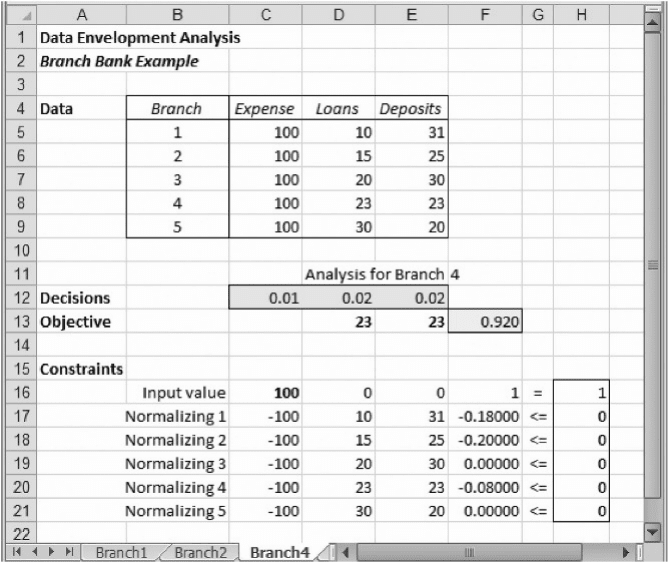
zero. This means that the normalizing constraint is binding for Branches 1 and 3.
In other words, Branches 1 and 3 have efficiencies of 100 percent, even at the most
favorable weights (0.003125, 0.03125) for Branch 2.
We could construct similar spreadsheet models for the analyses of Branches 3, 4,
and 5 following the same format. However, much of the content on those worksheets
would be identical, so a more efficient approach makes sense. In Figure 5.5, we show a
single spreadsheet model that handles the analysis for all five branches. As before, the
array in rows 4– 9 contains the problem data. Cell F11 contains the branch number for
the DMU under analysis. Based on this choice, two adjustments occur in the linear
programming model. First, the outputs for the branch being analyzed must be selected
for use in the objective function, in cells D13:E13. Second, the inputs for the branch
being analyzed must be selected for use in the EQ constraint, in cell C16. These selec-
tions are highlighted in bold in Figure 5.5. The INDEX function uses the branch
number in cell F11 to draw the objective function coefficients from the data array
and reproduce them in cells D13:E13. It also draws the input value from the data
array and reproduces it in cell C16. The three cells in bold format change when a differ-
ent selection appears in cell F11.
Figure 5.5. Model for any branch in Example 5.2.
186 Chapter 5 Linear Programming: Data Envelopment Analysis

We want to solve the model in Figure 5.5 several times, once for each DMU.
To do so, we vary the contents of cell F11 from 1 to 5. Since each solution requires
a reuse of the worksheet, we save the essential results in some other place before
switching to a new DMU. In particular, we save the weights and the value of the objec-
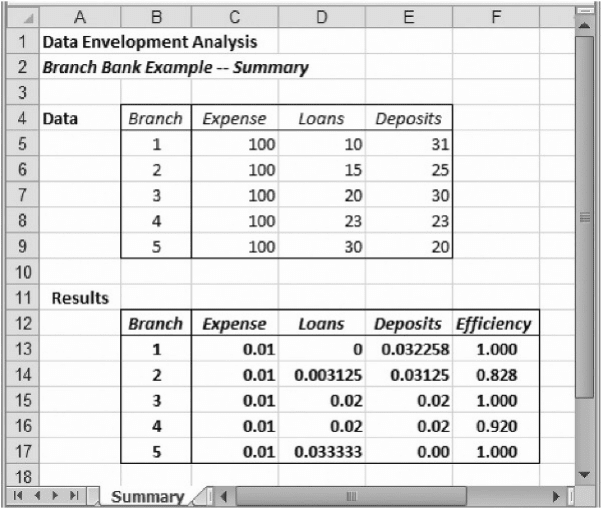
tive function. Figure 5.6 shows a worksheet containing a summary of the five optim-
izations for the five-branch example (one from each choice of cell F11 in Figure 5.5).
The original data are reproduced in rows 4–9, and the optimal decision variables and
efficiencies appear in rows 12–17. This summary can be generated automatically with
the parameter analysis capability described in Chapter 4.
As we can see in Figure 5.6, there are three efficient branches in our example:
Branches 1, 3, and 5. Branches 2 and 4 are inefficient, with efficiencies of 82.8 percent
and 92 percent, respectively. The numerical results agree with the graphical model.
Thus, we have developed a spreadsheet prototype that implements the DEA approach.
Later, we build on this set of results and use the spreadsheet model to compute
additional information pertinent to the analysis.
Before proceeding, it is important to note that Example 5.2 remains somewhat
specialized. It has only one input dimension, and all the DMUs have identical input
levels. The example has only two output dimensions, but by taking the inputs to be
identical and by taking the outputs as two dimensional, we can depict the solution
graphically, as in Figures 5.1 and 5.2. As mentioned earlier, if the inputs were different
for all the DMUs, we would not have been able to convey the analysis graphically.
However, the spreadsheet model, in the same form as Figures 5.5 and 5.6, accommo-
dates the more general problem without difficulty.
BOX 5.1
Excel Mini-Lesson: The INDEX Function
The INDEX function in Excel finds a value in a rectangular array according to the row
number and column number of its location. The basic form of the function, as we use it
for DEA models, is the following:
INDEX(Array,Row,Column)
†
Array references a rectangular array.
†
Row specifies a row number in the array.
†
Column specifies a column number in the array.
In the example of Figure 5.5, suppose Array ¼ C5:E9, Row ¼ F11, and Column ¼ 2.
When cell F11 contains the number 4, the function
INDEX(C5:E9,F11,2) would
find the element in the fourth row and second column of the array in cells C5:E9. In this
case, the function returns the Loans output value for Branch 4, or 23. This calculation
would be suitable for cell D13.
When we work with a one-column array, we can omit the Column argument in the
INDEX function. Thus, in the worksheet, we can also use the function
INDEX(D$5:D$9,$F$11) for cell D13 and then copy that formula into cell E13.
5.3. A Spreadsheet Model for DEA
187
5.4. INDEXING
Quantitative measures of performance are not always absolute figures. Often, it is more
meaningful and more convenient to measure performance in relative terms. To create
indexed data, we assign the best value on a single input or output dimension an index
of 100, and other values are assigned the ratio of their value to the best value. In effect,
all performance values are expressed in percentages, relative to the best performance
observed.
The use of indexed data does not present difficulties for DEA. In fact, the DEA
calculations are, perhaps, more intuitive when based on indexed data because the
result tends to be optimal weights of approximately the same order of magnitude,
which may not be the case without indexing.
To illustrate how indexing works, we return to Example 5.2. When we scan the
loan values for the various branches, the highest output in the comparison comes
from Branch 5, with an output of 30. If we treat a level of 30 as the base, we can express
the loan values for each of the other branches as a percentage of Branch 5 output.
Table 5.1 summarizes the scaled values that result, for both loans and deposits.
Suppose we perform the linear programming analysis using the indexed values
instead of the original, raw data. How does the analysis change? Figure 5.7, which
Figure 5.6. Summary of the analysis for Example 5.2.
188 Chapter 5 Linear Programming: Data Envelopment Analysis
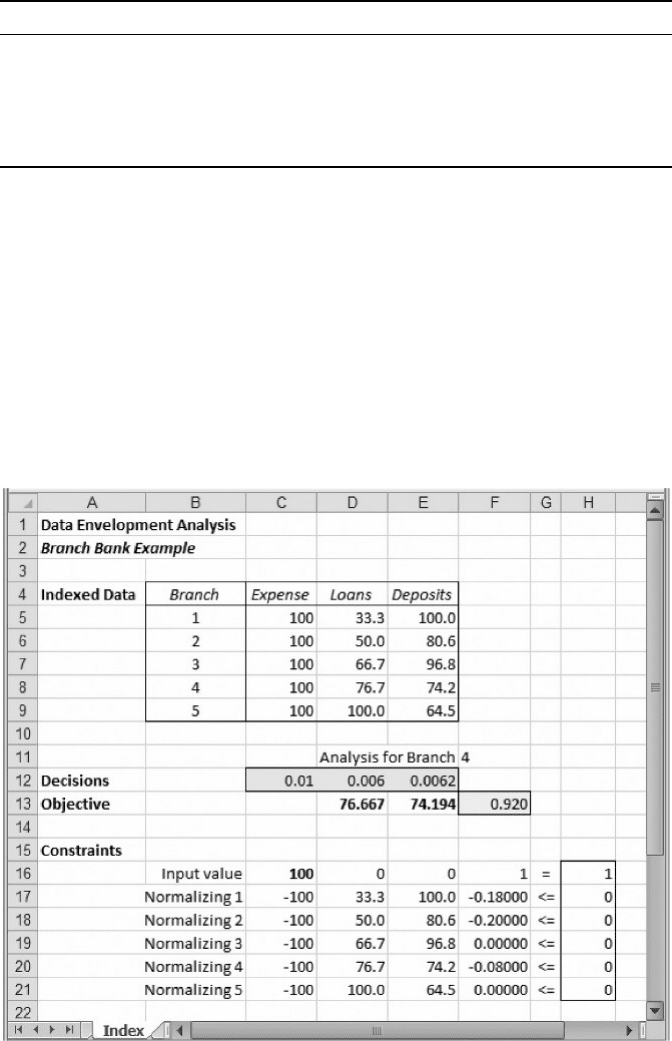
shows the analysis of Branch 4 using indexed values, conveys the main point. The
value of the objective function remains unchanged (at 92 percent in this case), even
though the values of the decision variables are different from those in the original
model (compare Figure 5.5). This example shows that the efficiency calculation is
robust in the sense that it depends only on the relative magnitudes of the output
levels, and these can be scaled for convenience without altering the efficiency
values produced by the analysis.
Within each of the output dimensions being evaluated, only relative values matter,
so it is always possible to use raw data even when the dimensions are quite different. In
Example 5.2, the sizes of loans and deposits are of roughly the same magnitude—tens
Table 5.1. Scaled Values from Example 5.2
DMU Loans Index Deposits Index
Branch 1 10 33.3 31 100.0
Branch 2 15 50.0 25 80.6
Branch 3 20 66.7 30 96.8
Branch 4 23 76.7 23 74.2
Branch 5 30 100.0 20 64.5
Figure 5.7. Analysis of Branch 4 in Example 5.2, with indexing.
5.4. Indexing 189

of millions of dollars. Suppose we had used another dimension of performance, cal-
culated as the nondefault rate on commercial and residential mortgages. For this
measure, the given data might be proportions no larger than one, but it will not be a
problem to mix such data with numbers in the tens of millions, because it is only rela-
tive levels, within a performance dimension, that really matter in DEA. As a result, we
do not have to worry about scaling the data. Nevertheless, it is sometimes advan-
tageous to use indexing because it leads to some comparability in the weights selected
by the optimization model.
5.5. FINDING REFERENCE SETS AND HCUs
We identify an efficient DMU by solving the linear program and finding a value of
1 for the objective function. By contrast, an optimal value less than 1 signifies that
the DMU is inefficient. The first main result in DEA is classifying the various
DMUs as either efficient or inefficient. For the efficient DMUs, there may not be
much more to say. As we shall see later, advanced variations of the analysis can dis-
criminate among the efficient DMUs. Initially, however, these are not analyzed
further. Instead, attention focuses on the inefficient DMUs. If we solve a version of
the linear program and discover that a DMU is inefficient, the analysis proceeds by
identifying the corresponding reference set and describing the associated HCU. In
order to carry out this part of the analysis, we can draw on the shadow price infor-
mation in the Sensitivity Report.
To illustrate how the analysis proceeds, we move next to an example with multiple
inputs and multiple outputs. The simplest such case would be a two-input, two-output
structure, as in the example of evaluating a chain of nursing homes.
EXAMPLE 5.3
Hope Valley Health Care Association
The Hope Valley Health Care Association owns and operates six nursing homes in adjoining
states. An evaluation of their efficiency has been undertaken, using two inputs and two outputs.
The inputs are staffing labor (measured in average hours per day) and the cost of supplies
(in thousands of dollars per day). The outputs are the number of patient-days reimbursed
by third-party sources and the number of patient-days reimbursed privately. A summary of
performance data is shown in the table below.
Staff hours Supplies Reimbursed Privately paid
DMU per day per day patient days patient days
Facility 1 150 0.2 14,000 3500
Facility 2 400 0.7 14,000 21,000
Facility 3 320 1.2 42,000 10,500
Facility 4 520 2.0 28,000 42,000
Facility 5 350 1.2 19,000 25,000
Facility 6 320 0.7 14,000 15,000
B
190 Chapter 5 Linear Programming: Data Envelopment Analysis

A spreadsheet model for the analysis of the six DMUs is shown in Figure 5.8, which
displays the specific analysis for Facility 5. In a full set of six optimization runs for this
model, we find that the first four units are all efficient, while Facilities 5 and 6 are inef-
ficient. The efficiencies are summarized in cells G6:G11.
Next, we illustrate the further analysis of Facility 5. The first step is to re-run
Solver for Facility 5 and obtain the Sensitivity Report, which is shown with some
reformatting in Figure 5.9. The information we need can be found in the
Constraints section of the Sensitivity Report, in the rows corresponding to the normal-
izing constraints of the original model, which have right-hand-side constants of zero.
The specific values we seek are the shadow prices corresponding to the six normaliz-
ing constraints, as highlighted in Figure 5.9.
To proceed, we copy the shadow prices for the normalizing constraints and paste
them into column J of the spreadsheet, so that they match up with the corresponding
constraint rows, as shown in Figure 5.8. The next step is to identify which shadow
prices are positive; the DMUs corresponding to those make up the reference set. In
Figure 5.8, we can observe that the shadow prices are positive in normalizing con-
straints corresponding to Facilities 1, 2, and 4. This means that Facilities 1, 2, and 4
form the reference set for Facility 5. The results are summarized as follows.
Shadow Reference
DMU price set
Facility 1 0.2000 Yes
Facility 2 0.0805 Yes
Facility 3 0.0000
Facility 4 0.5383 Yes
Facility 5 0.0000
Facility 6 0.0000
Having identified the reference set for Facility 5, we next construct a HCU. In
cells C26:F26 we lay out a row resembling the original row of data for Facility 5.
The entry in cell C26 is calculated as the SUMPRODUCT of the shadow prices
and the six values of the first input (staff hours) from the array of input data. This cal-
culation yields the value 342.125, as shown below. This number represents the staff
hours of the HCU.
Staff hours Shadow
DMU per day price
Facility 1 150 0.2000
Facility 2 400 0.0805
Facility 3 320 0.0000
Facility 4 520 0.5383
Facility 5 350 0.0000
Facility 6 320 0.0000 SUMPRODUCT ¼ 342.125
5.5. Finding Reference Sets and HCUs
191
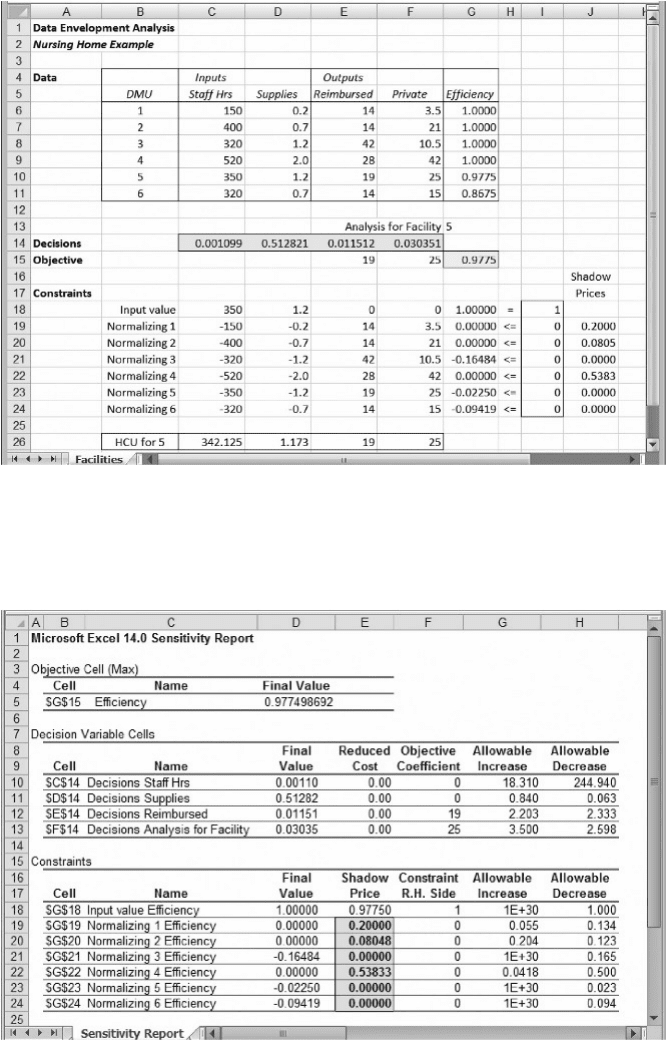
Figure 5.8. Analysis for Facility 5 in Example 5.3.
Figure 5.9. Sensitivity report for Facility 5 in Example 5.3.
192 Chapter 5 Linear Programming: Data Envelopment Analysis

The specific formula in cell C26 is ¼ SUMPRODUCT($J$19:$J$24,C6:C11).
Next, this calculation is copied to cells D26:F26, using absolute addresses for the
shadow prices in column J, as shown in Figure 5.8. The resulting numbers provide
the description of an HCU for Facility 5.
0:2000 (Facility 1 Data) ¼ 0:2000 (150 0:20 14 3:5)
0:0805 (Facility 2 Data) ¼ 0:0805 (400 0:70 14 21:0)
0:5383 (Facility 4 Data) ¼ 0:5383 (520 2:00 28 42:0)
HCU Data ¼ (342 1:17 19 25:0)
In particular, the outputs of the comparison unit, which are (19, 25), match the outputs
of Facility 5 precisely. However, the inputs (342.125, 1.173) are slightly smaller than
the inputs of Facility 5. In other words, the comparison unit achieves the same outputs
as Facility 5, but with lower input levels. By its construction, the comparison unit has
inputs and outputs that are weighted averages of those for the facilities in the reference
set. Thus, a weighted combination of Facilities 1, 2, and 4 provides a target for Facility
5 to emulate.
The analysis of Example 5.3 shows how the shadow prices can be used as weight-
ing factors to construct the HCU. In general, the comparison unit has outputs that are at
least as large as the outputs of the inefficient unit being analyzed and inputs that are no
larger than the inputs of the unit being analyzed. In this case, the actual inputs for
Facility 5 are staff hours of 350 and a supply level of 1.2. The analysis suggests
that efficient performance, as exemplified by Facilities 1, 2, and 4, would allow
Facility 5 to produce the same outputs with inputs of only 342.125 staff hours and
a supplies level of 1.173.
How could Facility 5 achieve these efficiencies? DEA does not tell us. It merely
suggests that Facilities 1, 2, and 4 would be reasonable benchmarking targets for
Facility 5. Then, by studying differences in technology, procedures, and management,
Facility 5 might be able to identify and implement changes that could lead it to
improved performance.
In Example 5.3, Facilities 1–4 are all efficient, but only Facilities 1, 2, and 4 form
the reference set for Facility 5. An exploration of the analysis for Facility 6 leads to a
similar conclusion: Its reference set also consists of Facilities 1, 2, and 4. Although
Facility 3 is efficient, it does not appear in any reference sets. Evidently, it is not a
facility that Facility 5 or 6 should try to emulate. We might guess that this is the
case because its output mix is quite different.
5.6. ASSUMPTIONS AND LIMITATIONS OF DEA
Although we have relied on the term “efficient,” it would be more appropriate to use
the term relatively efficient—that is, the productivity of a DMU is evaluated relative to
the other units in the set being analyzed. DEA identifies what we might call “best prac-
tice” within a given population. However, that does not necessarily mean that the
5.6. Assumptions and Limitations of DEA 193
efficient units compete well with DMUs outside the population. Thus, we have to resist
the temptation to make inferences beyond the population under study.
As mentioned earlier, DEA works well when there is some ambiguity about the
relative value of outputs. No a priori price or other judgment about the relative value
of the outputs is needed. Because prices are not given, it should not be obvious
what output mix would be best. (This applies to inputs as well.) DEA performs its
evaluation by assuming weights that are as favorable as possible to the DMU being
evaluated. However, DEA may not be very useful in a situation where a distinct hier-
archy of strategic goals exists, especially if one goal strongly influences performance.
Some applications of DEA have run into complaints that the output measures may
be influenced by factors that managers cannot control. In response, variations of the
DEA model have been developed that can accommodate uncontrollable factors.
Such a factor can be added by simply including it in the model; there is no need to
specify any of its structural relationships or parameters. Thus, a factor that is neither
an economic resource nor a product, but is instead an attribute of the environment,
can easily be included. An example might be the convenience of a location for a
branch bank, which could be treated as an input.
One of the technical criticisms often raised about DEA relates to the use of com-
pletely arbitrary weights. In particular, the basic DEA model allows weights of zero on
any of the outputs. (Refer to Figure 5.3 as an illustration.) A zero-valued weight in the
optimal solution means that the corresponding input or output has been discarded in
the evaluation. In other words, it is possible for the analysis to completely avoid a
dimension on which the DMU happens to be relatively unproductive. This may
sound unfair, especially since the inputs and outputs are usually selected for their stra-
tegic importance, but it is consistent with the goal of finding weights that place the
DMU in the best possible light. In response, some analysts suggest imposing a
lower bound on each of the weights, ensuring that each output dimension receives
at least some weight in the overall evaluation. Choosing a suitable lower bound is dif-
ficult, however, because of the flexibility available in scaling performance data.
(Recall the discussion of indexed values earlier.) A more uniform approach is to
impose a lower bound on the product of performance measure and weight. For any
input dimension, the product of input value and weight is sometimes called the virtual
input on that dimension. Similarly, for any output dimension, the product of output
value and weight is sometimes called the virtual output. The virtual outputs are the
components of the efficiency measure, and we can easily require that each component
account for at least some minimal portion of the efficiency, such as 10 percent. In the
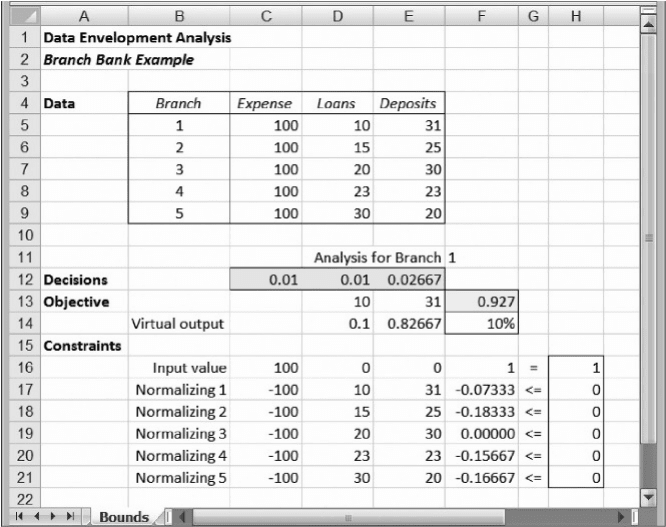
analysis of Branch 1 (see Figure 5.10), we can compute the virtual outputs for each
performance dimension in cells D14 and E14. Then, we add constraints forcing
these values to be at least 10 percent (as specified in cell F14). With these lower
bounds added, it is not possible to place all the weight on just one dimension. As
shown in Figure 5.10, the imposition of a 10 percent lower bound for the contribution
from each dimension reduces the efficiency rating for Branch 1 to 92.7 percent
when the model is optimized. As the example illustrates, when we impose additional
requirements, we may turn efficient DMUs into inefficient ones.
A related criticism is that the weight may be positive but still quite small on
an output dimension that is known to be strategically important. In this situation, it
194
Chapter 5 Linear Programming: Data Envelopment Analysis
is possible to add a constraint to the model that will force the virtual output of one
important measure to be greater than the virtual output other measures. These kinds
of additional constraints may improve the logic, but they sacrifice transparency in
the model.
Another technical criticism relates to the fact that a DEA evaluation often pro-
duces a number of efficient DMUs, and it would be satisfying to have a tie-breaking
mechanism for distinguishing among the efficient units. One way to break ties is to
omit the normalizing constraint for the kth DMU when it is the subject of evaluation.
When we do so, we tend to get some efficiencies above 1.0, and we are much less
likely to get ties in the performance metric. Another response is more complicated
but perhaps more equitable. The evaluation of the kth DMU produces a set of optimal
weights that are, presumably, as favorable as possible to unit k. Suppose we call these
“price set k.” When we evaluate DMU k, we compute the value of its outputs under
each of the price sets (price set 1, price set 2, etc.). Then we average the output
values obtained under the various price sets and rank the DMUs based on their average
values over all price sets. The average value on which the DMUs are ranked is called
the cross-efficiency. This method makes ties less likely but involves more
computation.
Although we started with a small one-input/one-output example and then moved
on to larger examples, it does not follow that a DEA model should be built with as
many inputs and outputs as possible. In fact, there is a good reason to limit the
Figure 5.10. Analysis of Branch 1 with lower bounds.
5.6. Assumptions and Limitations of DEA 195