
Baker K.R. Optimization Modeling with Spreadsheets
Подождите немного. Документ загружается.

of Farmer’s commensurately decreased. People’s Bank provided retail services to a basically
middle class clientele.
Assessing Branch Productivity
Although it is clearly necessary to have some measure of branch performance, there is consider-
able disagreement in the industry about what should be measured and how to measure it. Several
different measurement and reporting techniques are currently used by different banks to evaluate
branches. Ann decided to compare the formal branch performance evaluation systems that peer
banks use to see whether one would fit at NNB.
Measuring productivity is often a simple matter for many individual jobs, but can become
complex for branches with multiple goals. For example, if teller A handles 200 transactions per
day whereas teller B handles 250 transactions, teller B is more productive, other things equal.
However, if those tellers handle different types of transactions, then the raw data given is no
longer sufficient, and the transactions must be weighted according to standard times. If teller
A’s 200 transactions were judged to require 8 standard hours whereas teller B’s 250 transactions
required only 7.5 standard hours, then teller A would be considered more productive.
Evaluating branch productivity is more complicated than evaluating individual tellers.
There are multiple strategic directives, such as customer satisfaction, profitability, growth of
the customer base, and so on, that are all measured differently and cannot easily be combined
into a single measure. But even when profitability is the only goal, there are often multiple
measures that should be consulted.
For example, assume that profit is derived from only loans and deposits. Due to a lack of
match-funding
2
the net interest earned on the loan and deposit portfolios can vary widely. In
some years, loans are highly profitable whereas deposits are marginally so, in other years the
reverse is true. If measured on profit alone, branches that are very good at generating checking
accounts may be viewed as excellent branches one year and poor performers the next—even if
they are performing at a sustained level of excellence in generating deposits. Consequently,
gross profit may not always be an appropriate performance measure. Because of these difficul-
ties and others, branch effectiveness can be difficult to assess.
Branch Managers Revolt
The problem of evaluating branches was brought to the forefront by a cabal of the former
People’s Bank managers. It was already known that they had lower ranking than other
branch managers, but they had believed that this was due to the merger process and that salaries
were relatively equal. When they inadvertently discovered the wide gaps in salaries between
branch managers (see Exhibit 5.1) they were furious. They demanded that Ann bring their
titles and salaries up to the level of the other managers.
Clay Whybark, President of NNB, was against any pay increases. He believed that the
former People’s branches were not producing as well as the others and that their managers
should be paid accordingly. Realizing that his “feel” was not going to be good enough to placate
his branch managers, he instructed Ann to come up with an objective method of determining
how well the branches were doing.
2
“Match funding” refers to how a bank funds its loans and deposits of different maturities. As a simplified
example, for a bank to loan money for a 30-year mortgage, it can get the money for the loan from the
overnight federal funds market or a long-term deposit account. If it funds a long-term loan of 10 percent from
a long-term deposit of 5 percent, the loan is match funded and is guaranteed to be profitable. If it funds the
long-term loan from the short-term overnight market, there is a danger that the overnight rates may rise
substantially over the course of the loan, making the loan unprofitable.
206 Chapter 5 Linear Programming: Data Envelopment Analysis

Measuring Branches: Available Techniques
Ann narrowed the choice of alternatives to three commonly used techniques, branch profitabil-
ity, branch ranking and branch goals, and one emerging technique that has been used only
recently: data envelopment analysis.
†
Branch Profitability. Many banks evaluate branches by fashioning financial statements
for each branch. Interest and fee income from accounts is credit to the branch where the
accounts originated. This income is netted against interest costs and non-interest
expenses to determine a profitability level (see Exhibit 5.2).
†
Ranking Reports. An alternative is to evaluate branches according to performance in
specific areas separately, rather than using a single profitability number.
†
Goal Reports. Pre-set goals are negotiated with each branch manager in a variety of
areas. Performance evaluation is based on the percentage of goal attained. The categories
used for goal reporting would be similar to those used in ranking reports.
†
Data Envelopment Analysis (DEA). Formally, DEA is a linear programming technique
for measuring the relative efficiency of facilities where each facility has more than one
desired output or needed input. In practical terms, DEA is a measurement tool for
businesses that have many different sites performing similar tasks, when a single overall
measure, such as profit or ROI, is not sufficient. DEA combines numerous relevant out-
puts and inputs into a single number that represents productivity, or “efficiency.”
The DEA Study
Ann decided to use DEA to evaluate the NNB branch system. She initially used four outputs and
three inputs (Exhibit 5.3). The outputs chosen were branch profit, a deposit transaction index, a
new account index and an existing account index. Later, at the specific request of the Farmer’s
branch manager, Ann also included agricultural loan balances as an output.
Branch profitability was obtained from standard accounting reports. From these reports,
Ann calculated the average monthly profit for the last three years and used that figure directly.
Each of the other measures was a composite of several items. The transaction index multiplied
the number of transactions handled at a branch by the standard time required to perform the
EXHIBIT 5.1 Branch Manager Salaries
Branch Branch manager Branch manager
Original bank number title salary
NNB 1 Vice President (V.P.) $48,000
NNB 2 Vice President $52,500
NNB 3 Senior V.P. $65,000
Belle Meade 4 Vice President $50,000
Belle Meade 5 Senior V.P. $60,000
Belle Meade 6 Vice President $46,000
Farmer’s 7 Vice President $52,000
People’s 8 Assistant V.P. $38,000
People’s 9 Assistant V.P. $36,000
People’s 10 Assistant V.P. $34,000
Case: Branch Performance at Nashville National Bank
207

transaction. For example, handling a routine deposit takes 20 seconds, but writing a cashier’s
check takes 3 minutes. The branch with the largest amount of standard time was given an
index value of 100 and the other branches were indexed accordingly.
Similar procedures were used for new and existing accounts. A certificate of deposit for
$10,000 at 5.5 percent interest is far less profitable than a regular savings account with a
$10,000 balance at 3.0 percent. Consequently, indices using approximate profitability ratings
were used to weight new and existing account activity.
For inputs, Ann used the average monthly personnel and total branch expenses over the
past three years. Also, some locations were clearly better than others and branches located in
EXHIBIT 5.2 Sample Branch Profitability Statement ($000)
Interest income from loans
384.2
Federal funds sold
300.0
Total interest income 384.2
Interest expense from deposits
(185.5)
Federal funds purchased
0(23.0)
Total interest expense (208.5)
Provision for credit losses (26.5)
Net interest income after
Provision for credit losses 149.2
Noninterest income
Deposit account fees 22.2
Loan fees
12.1
Total noninterest income 32.3
Noninterest expense
Salaries (35.0)
Benefits (7.4)
Occupancy (4.1)
Other expense
(18.2)
Total noninterest expense (64.7)
Net income before support expenses 116.8
Specific support expense
(32.6)
Net income before general expense 84.2
General support expense
(22.4)
Net income 61.8
Income/expense from loan and deposit accounts initially opened by branch.
If more deposits are taken in than loans given out, the excess is sold on the Federal Funds (FF) market. If
excessive loans are granted, the money is borrowed from the FF market.
Expenses of central administration directly related to branch activity.
Expenses of central administration not directly related to any specific branch (e.g., president’s salary).
208 Chapter 5 Linear Programming: Data Envelopment Analysis

EXHIBIT 5.3 Raw Data for the Analysis
Outputs Inputs
Deposit New Account Ag
Personnel Total Location Branch trans. account balance loan
Branch expense expense index profit index index index bal.
1 39 80 9 95 65 100 90 0
2 37 82 9 70 68 78 77 0
3 41 92 8 108 75 80 100 0
4 42 88 9 63 68 69 73 0
5 54 99 10 115 77 85 98 0
6378410857269900
7 45 92 7 12 17 12 34 25
8 65 125 7 45 93 40 52 0
9 73 109 8 39 94 45 58 0
10 79 118 9 50 100 38 65 0
209

prime spots would reasonably be expected to perform better, so a “location desirability” estimate
was included as an input.
According to Ann’s calculations, nearly every branch was perfectly efficient and of the
three that had less than 100 percent efficiency, the lowest efficiency was 92 percent (see
Exhibit 5.4 for a summary). The inescapable conclusion was that the former People’s branch
managers were right—they were underpaid.
When Ann presented her method and conclusions at the next Executive Operating
Committee meeting, she was met with a less than enthusiastic response. When she finished, a
stony silence ensued and Ann noticed that Clay was starting down at the desk with his head
in his hands.
Aleda Roth, Senior Vice President and head of the check-processing center, was the first to
speak. “This is garbage. Clay, give me three days and I’ll give you something you can use.”
When Ann began to protest, Clay interrupted, “Wait a minute, Ann. Let’s hear what Aleda
has to say.”
EXHIBIT 5.4 Branch Efficiencies and Output Factor Weightings
Branch Efficiency
Existing
Agricultural
Branch
profit
Transaction
index
New
account
account loans
index index
1 1.00 0.00 0.00 1.00 0.00 0.00
2 1.00 0.00 0.76 0.24 0.00 0.00
3 1.00 1.00 0.00 0.00 0.00 0.00
4 0.92 0.00 0.84 0.08 0.00 0.00
5 0.98 0.98 0.00 0.00 0.00 0.00
6 1.00 0.23 0.77 0.00 0.00 0.00
7 1.00 0.00 0.00 0.00 0.00 1.00
8 1.00 0.00 1.00 0.00 0.00 0.00
9 1.00 0.00 1.00 0.00 0.00 0.00
10 0.99 0.03 0.95 0.00 0.00 0.00
210 Chapter 5 Linear Programming: Data Envelopment Analysis

Chapter 6
Integer Programming:
Binary Choice Models
An integer programming model is a linear program with the requirement that some or
all of the decision variables must be integers. In principle, we could distinguish
between linear and nonlinear programs with integer variables, but the latter are extre-
mely difficult and generally beyond the capability of Solver. We focus on the role of
integer variables in what would otherwise be linear programming models. Thus far,
we have not paid much explicit attention to whether the decision variables take on inte-
ger values. In Chapter 3, we pointed out that in special network models, integer sol-
utions are guaranteed. In other cases, we often encountered integer solutions without
explicitly requiring integers, so there seemed to be no need to discuss integrality. In
still other cases, we seemed to be content with fractional solutions, especially when
the decision variables were scaled. In this chapter, the role of integer values takes
center stage.
This chapter first describes how Solver handles integer programs. Next, we
explore the basic capital budgeting model as a way of introducing binary variables
and developing some intuition for the effects of integer requirements on decision vari-
ables. Then, in the remainder of the chapter, we look at models characterized by binary
choice. In these optimization models, all decisions are of a yes/no variety. Other uses
of binary variables are covered in the next chapter.
Before we discuss how to handle the integer requirement using Solver, we return
briefly to the subject of integers in linear programs. Recall that one of the three con-
ditions of linearity is divisibility—that is, the fact that fractional values make sense for
decision variables. Consider Example 2.1, the allocation model for chairs, desks, and
tables. As it turned out, the optimal solution contained no chairs, 160 desks, and 120
tables, so that the decisions happened to all be integers. Suppose instead that the
problem had been posed with only 1800 assembly hours available, rather than the
2000 of the base case. Then the optimal product mix would have been 13.33 chairs,
220 desks, and no tables. Is the fractional number of chairs meaningfu l?
At first glance, it may seem to make no sense to talk about one-third of a chair in
the product mix. Certainly, if we were interested in the tactical implications of the
Optimization Modeling with Spreadsheets, Second Edition. Kenneth R. Baker
# 2011 John Wiley & Sons, Inc. Published 2011 by John Wiley & Sons, Inc.
211
solution, it would not make sense for us to produce one-third of a chair to help meet
demand (or to count on the profit that the fractional chair would generate). However,
there are two interpretations of the fraction that do make sense. For one, we should be
willing to round off. That is, we might interpret the optimal solution as 13 chairs and
220 desks. This solution would use less capacity than the optimal solution but would
clearly be feasible. Another possibility might be to round up the number of chairs to
14, leaving desks at 220. Although this rounded-up solution violates the precise state-
ment of capacity, the violation is on the order of one tenth of a percent in the case of
assembly capacity and half a percent in the case of machining capacity. Since we are
unlikely to “know” the given information in this problem to a precision of one part in a
thousand, we may well accept the rounded-up product mix as an implementable
solution.
A second interpretation is also possible. We might want to think of the model as
representing a routine weekly planning model that specifies conditions in a typical or
average week. In that context, when we encounter a figure like 13.33 in the optimal
mix, we could interpret it as a long-run average. That is, the fractional value prescribes
a three-week cycle with 13 chairs in weeks 1 and 2, and 14 chairs in week 3. Thus,
rounded-off values and planning averages provide us with two interpretations that
might allow us to tolerate fractional answers to linear programs when fractions seem
impractical in literal terms. In addition, we might be primarily interested in under-
standing the economic priorities in the optimal sol ution (as discussed in Chapter 4),
and the details of the decision variables might be of secondary importance. Since
linear programming models are usually guides to decisions, rather than fully auto-
mated substitutes for decision makers, we might well be satisfied with noninteger sol-
utions to most of our linear programs. Still, there are some cases where only integers
will suffice. In those cases, the requirement of integer values is crucial, and it influ-
ences how we use Solver.
Broadly speaking, there are perhaps three types of integer programming models.
The first type is essentially a linear program but with an inflexible requirement th at
some or all of the variables must be integer. For example, a decision variable might
correspond to the number of times in a production schedule that a piece of equipment
is shut down for a maintenance check. In this instance, a value such as 2.59 will not
suffice; we must have an integer. For this purpose, we designate some variable in the
model as an integer variable.
The second type is a model in which some of the key decisions are of the yes/no
variety. For example, a decision variable might correspond to whether or not we pur-
chase a parcel of land. In this instance, we model our decision with a variable that is
allowed to be only zero or one. We refer to such a decision as a binary choice, because
there are only two alternatives, and we use binary variables to represent the decision.
Binary variables are integer variables that are limited to the values zero or one. In this
chapter, we mainly focus on models involving binary choice .
The third type is a model that contains certain relationships that we might not
normally think of as linear. For example, suppose that we are contemplating a plant
expansion in which we may add a new manufacturing line to the factory. If we proceed
with the expansion, then we can produce a particular component internally. If we don’t
212
Chapter 6 Integer Programming: Binary Choice Models

expand, then we will have to buy the component from an external vendor. In other
words, our make/buy alternatives are contingent on the decision to expand. Such a
contingency is an example of a logical or qualitative constraint, but we can capture
it in a model if we use binary variables to represent the decision to expand and the
decision to produce components in house. Other kinds of qualitative constraints can
often be represented using binary variables, and in the next chapter we focus on
models involving logical constraints.
6.1. USING SOLVER WITH INTEGER REQUIREMENTS
To illustrate how to use Solver for integer programming, let’s conside r the staffing
problem faced by a call center. Daily requirements for staff are usually developed
from studies of congestion in the service system. Then an optimization model helps
determine how large a staff is needed to cover the staffing requirements.
EXAMPLE 6.1
Callum Communications
Callum Communications runs a small call center that operates seven days a week. Callum
requires a specified minimum number of employees to be at work each day, to provide the
necessary level of customer service. Under union regulations, employees at the call center
must all work full-time schedules, which means five consecutive workdays and two days off
per week. Furthermore, employees whose regular schedules include a weekend day receive a
pay premium. Specifically, employees who work five weekdays are paid $400 per week.
Employees who work one of the weekend days are paid $440, and employees who work both
of the weekend days are paid $470. The minimum daily requirements for workers are described
in the following table.
Day Sun Mon Tue Wed Thu Fri Sat
Requirement 16 18 18 17 13 8 5
Callum’s management wishes to minimize the cost of salaries paid to the workforce while meet-
ing the staffing requirements. B
At the call center, seven different work shifts are possible under union rules.
Each shift starts a five-day work period on a particular day. For example, suppose we
use SU to represent the number of employees who start work on Sunday, MO for the
number who start work on Monday, and so on. The se variables can make sense only if
their values are integers. The constraints require that the number of employees
assigned to work a given day must be at least as large as the daily minimum. For
example, the number working on Thursday (SU + MO + TU + WE + TH) must be
greater than or equal to 13, and a similar constraint applies for each of the other
days of the week. In addition, the total salary cost for a week plays the role of the
6.1. Using Solver with Integer Requirements 213
objective function. The algebraic model, shown below, is a variation on the staff-sche-
duling model introduced in Chapter 2.
Minimize z = 440SU + 400MO + 440TU + 470WE + 470TH + 470FR + 470SA
subject to
SU +WE +TH +FR +SA ≥ 16
SU +MO +TH +FR +SA ≥ 18
SU +MO +TU +FR +SA ≥ 18
SU +MO +TU +WE +SA ≥ 17
SU +MO +TU +WE +TH ≥ 13
+MO +TU +WE +TH +FR ≥ 8
+TU +WE +TH +FR +SA ≥ 5
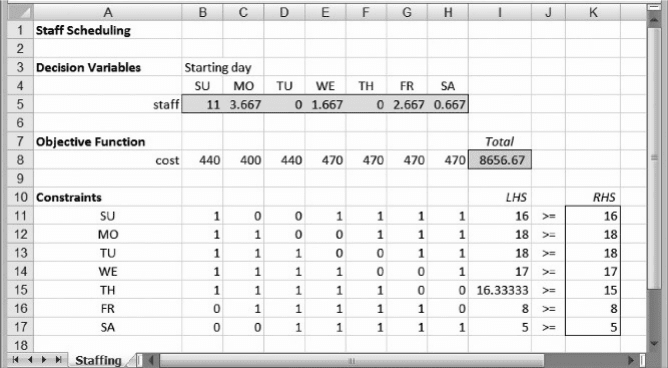
Figure 6.1 shows the complete spreadsheet model. It is also a variation of the
spreadsheet model for staff scheduling introduced in Chapter 2. When we treat this
model as a linear programming problem, the model specification is as follows.
Objective: I8 (minimize)
Variables: B5:H5
Constraints: I11:I17 ≥ K11:K17
As shown in Figure 6.1, Solver produces a solution containing some fractions (e.g.,
3.667 employees starting on Monday) and a total cost of $8656.67.
Figure 6.1. Spreadsheet model for Example 6.1.
214 Chapter 6 Integer Programming: Binary Choice Models
The application of Solver to integer programming models, once they are formu-
lated, is relatively straightforward. Solver treats the requirement that a variable must
be integer as an additional constraint. Along with the familiar constraint types ≤,
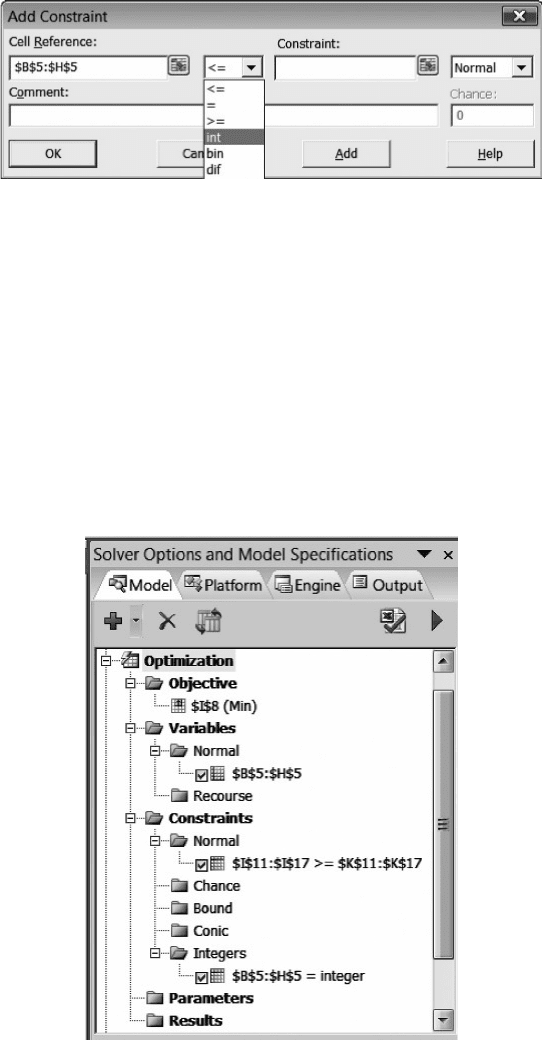
≥, and ¼ , the drop-down menu in the Add Constraint window also permits int and
bin. The int constraint designates a variable to be integer valued, while the bin con-
straint designates a variable to be either 0 or 1 (binary valued). To produce an integer
solution in Example 6.1, we add a constraint that designates the decision variables to
be integers, as shown in Figure 6.2. The specification of the model in the task pane is
shown in Figure 6.3, where we can see the explicit designation of integer variables.
Figure 6.2. Declaring integer variables in Example 6.1.
Figure 6.3. Model specification for Example 6.1.
6.1. Using Solver with Integer Requirements 215