
Baker K.R. Optimization Modeling with Spreadsheets
Подождите немного. Документ загружается.

Once we build the model and designate particular variables as integer or binary,
the next step is to examine the options in the Integer group of the Engine tab on the task
pane. The key option is the Integer Tolerance option, which should normally be set to
zero. At some other setting, such as 0.05, Solver is guaranteed to find a solution that is
no worse than 5 percent away from the optimum, as measured by the objective func-
tion. Clearly, we would prefer to find the very best solution, and this calls for an Integer
Tolerance parameter of zero. However, in some large models, a tight Integer Tolerance
level may require the solution procedure to take a great deal of time. Therefore, we
sometimes keep the level at 0.05 while we are debugging a large model, and we
leave it at that level if we find that solution times are prohibitively lo ng otherwise.
If Solver can locate a solution at the 0.05 level in a reasonable amount of time, we
can experiment further by lowering the parameter toward zero.
With the integer variables designated and the Integer Tolerance option set, Solver
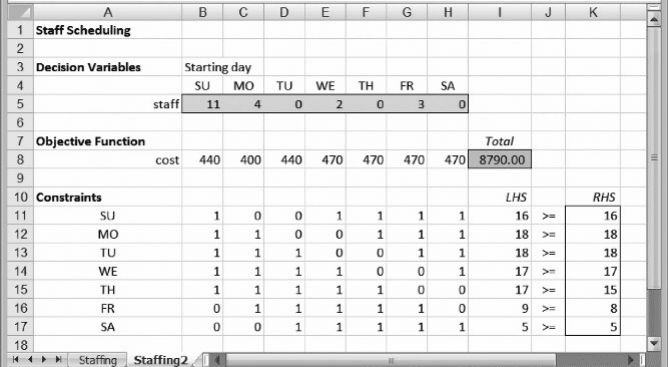
produces an optimal solution, shown in Figure 6.4, with a total cost of $8790. On the
surface, at least, there is no intuitive reason why we would have anticipated this result
based on the solution to the linear program. It is not, for example, a rounded-off ver-
sion of the optimal solution. Thus, by using the integer programming capability in
Solver, Callum can meet its staffing requirements with minimum salary cost.
As suggested by this example, integer programming models look just like linear
programming models, except for the fact that certain variables are constrained to be
integer valued. The differences occur within Solver, not in the spreadsheet model.
Moreover, finding a solution with Solver simply requires the user to take two
additional steps beyond the typical procedure for solving linear programs—that is,
designating integer variables and setting the Integer Tolerance parameter. When the
only role of integers in a model is to avoid fractional values in what otherwise
would be a normal linear program, then the formulation principles we covered in
Figure 6.4. Optimal integer solution to Example 6.1.
216 Chapter 6 Integer Programming: Binary Choice Models

Chapters 2 and 3, along with the int constraint, are likely to suffice. That was the case
in Example 6.1.
In some cases, such as the call center model, all of the variables are constrained to
be integers. This type of model is sometimes called a pure integer program. In other
cases, certain variables may be integers, but others are allowed to be noninteger. A
model containing both kinds of variables is called a mixed integer program. Using
Solver, the only difference between these two cases is the set of variables designated
by the int constraint.
At the level of building models for use with Solver, integer programming may
seem to be a minor technical extension of what we can already do with linear program-
ming. However, as we explore the formulation of integer programs using binary vari-
ables in this chapter and the next, a very different picture emerges. The opportunity to
use binary variables provides access to a class of models that is actually very different
from linear programming.
The solution algorithm within Solver for handling integer programs is generically
known as a branch and bound procedure. At the end of this chapter, we take a look at
how such a procedure works.
6.2. THE CAPITAL BUDGETING PROBLEM
A binary variable, which takes on the values 0 or 1, can represent a yes/no decision—
that is, a decision that represents a choice between taking an action and not taking it.
We sometimes think in terms of discrete projects, where the decision to undertake the
project is represented by the value 1 and the decision to forego the project is
represented by the value 0. A classical example arises in conjunction with the capital
budgeting problem, as illustrated by the Newton Corporation.
EXAMPLE 6.2
The Newton Corporation
Division A of the Newton Corporation has been allocated $40 million for capital projects this
year. Managers in Division A have examined various possibilities and have proposed five pro-
jects for the capital budgeting committee to consider. The projects cover a variety of activities
and functional areas, and there is just one of each type. The projects are listed below.
P1 Renovate the production facility for greater efficiency.
P2 License a new technology for use in production.
P3 Expand advertising by naming a stadium.
P4 Purchase land and construct a new headquarters building.
P5 Introduce a new product to complement the current line.
Each project has an estimated net present value (NPV), and each requires a capital expenditure,
which must come out of the budget for capital projects. The following table summarizes the pos-
sibilities, as they have been provided to the committee, with all figures in millions of dollars.
6.2. The Capital Budgeting Problem
217
Project P1 P2 P3 P4 P5
NPV 2.0 3.6 3.2 1.6 2.8
Expenditure 12 24 20 8 16
The committee would like to maximize the total NPV from projects selected, subject to a $40-
million limit on capital expenditures. This $40-million constraint makes it impossible to under-
take all five projects; a subset of the five must be selected. B
The problem facing the Newton Corporation can be posed as an allocation
model with one constraint, as shown below with objective function and constraint
scaled to represent millions of dollars.
Maximize z = 2.0P1 +3.6P2 +3.2P3 +1.6P4 +2.8P5
subject to
12P1 +24P2 +20P3 +8P4 +16P5 ≤ 40
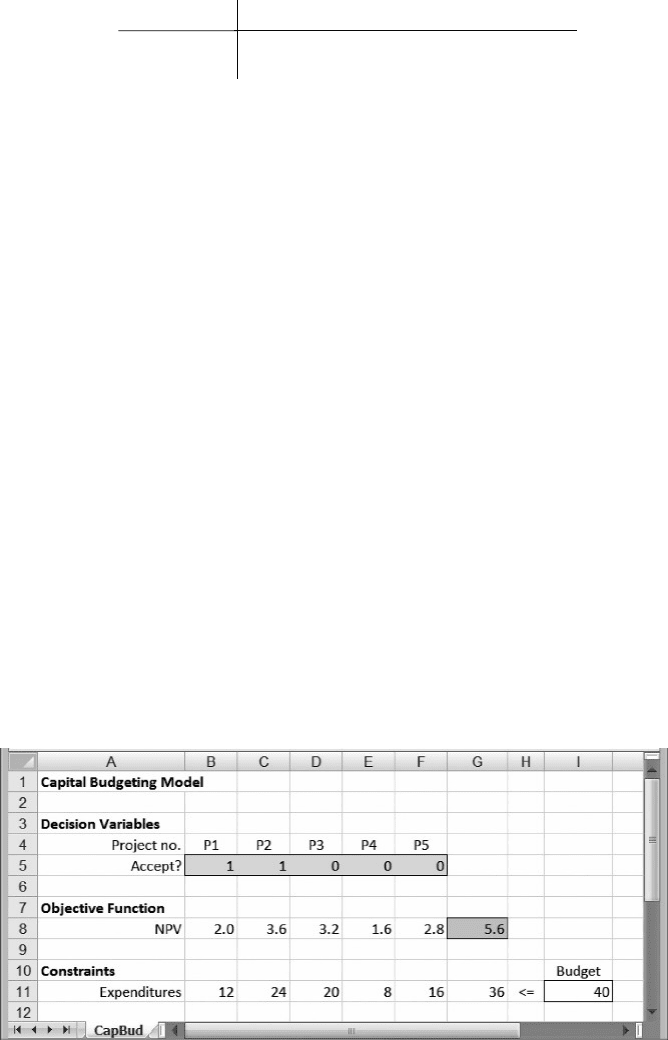
A spreadsheet model for this problem is shown in Figure 6.5. (A feasible, but
suboptimal set of choices is displayed.) If we treat the model as if it were a simple
linear program, we can specify the problem as follows.
Objective: G8 (maximize)
Variables: B5:F5
Constraints: G11 ≤ I11
In the discussion that follows, we elaborate on the development and interpretation of the
integer programming model as it is derived from the linear programming model. Our
purpose is to develop some intuition for binary variables in optimization models,
and we won’t elaborate in the same way for the other modes we introduce later.
Figure 6.5. Linear program for Example 6.2.
218 Chapter 6 Integer Programming: Binary Choice Models
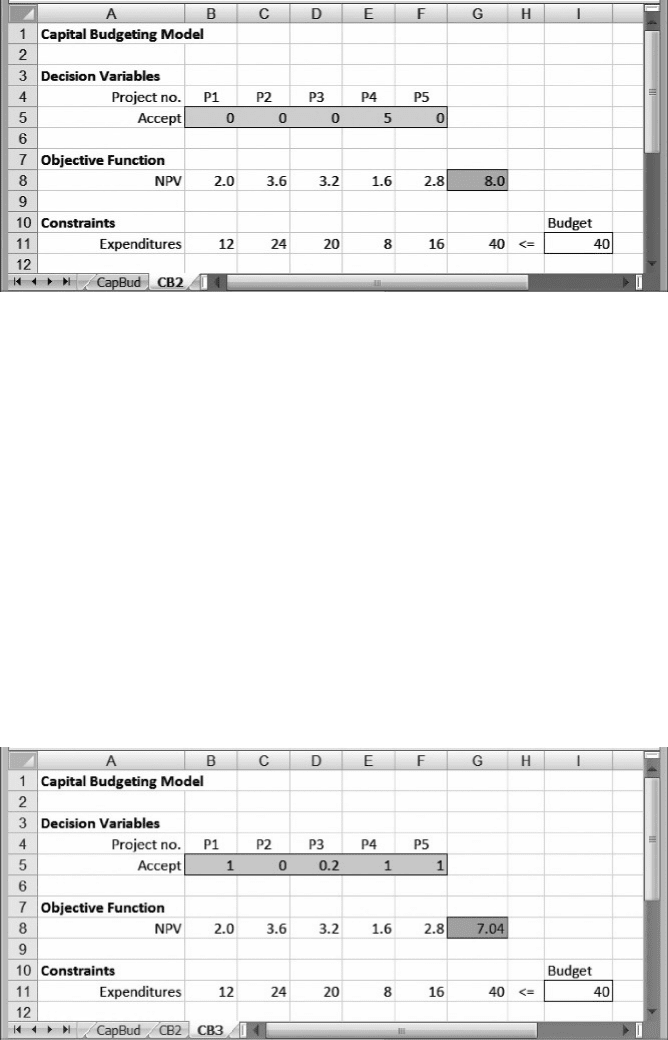
The optimal NPV in the linear program for Example 6.2 appears to be $8 million,
as shown in Figure 6.6, but the solution would require the selection of project P4 five
times. However, none of the projects can be implemented more than once. In particu-
lar, it is not possible to buy the same parcel of land and build new headquarters five
times; obviously, that activity can be done only once.
To prevent any project from being implemented several times, we can require
each of the variables to be no greater than 1. If we optimize the model as a linear
program, imposing an upper bound of 1 on each of the variables, the maximum
NPV comes to just over $7 million, as shown in Figure 6.7, but the optimal mix of
projects is P1, P4, P5, and one-fifth of P3. However, none of the projects can be
done in a fractional amount. In the case of P3, we cannot pay for a fraction of a stadium
name; the project is indivisible and must be either accepted or rejected in its entirety.
No part-way adoption of any of the projects is possible. Therefore, we must use binary
variables, as all-or-nothing variables, to represent choices.
Figure 6.6. Optimal solution to the linear program for Example 6.2.
Figure 6.7. Optimal solution to the linear program for Example 6.2 with ceilings of 1.
6.2. The Capital Budgeting Problem 219
Having seen why a purely linear programming approach is unsuitable for the
situation at the Newton Corporation, we add the constraint that each variable is
binary. The model specification is as follows.
Objective: G8 (maximize)
Variables: B5:F5
Constraints: G11 ≤ I11
B5:F5 ¼ binary
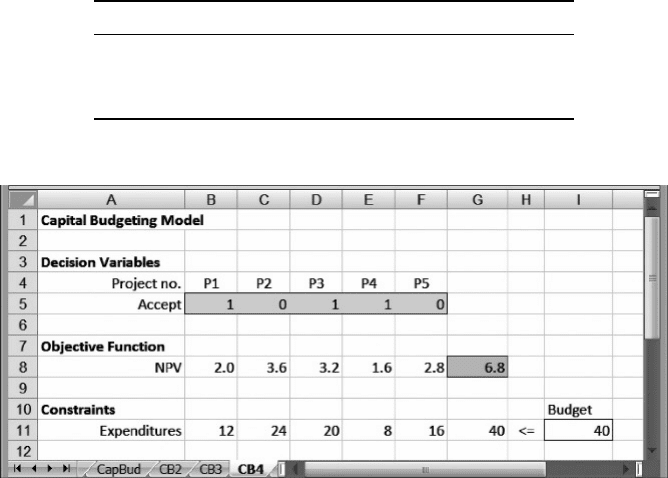
The optimal solution achieves a NPV of $6.8 million, achieved by accepting
projects P1, P3, and P4, as shown in Figure 6.8. This figure represents the largest
value that can be achieved with the five candidate projects from the allocation of a
$40 million budget.
The capital budgeting model captures a well known allocation problem, in which
each candidate project is either included in the solution once or not at all. Finding sol-
utions can be difficult because of the “lumpy” nature of the projects as they consume
resources in the budget constraint. Let’s take a closer look at the nature of our solution.
In a problem with one constraint on expenditures, the intuitive approach would be
to rank the projects by the ratio of value achieved to capital expenditure required, or in
this case, the ratio of NPV to capital expense. If we calculate those ratios, we obtain the
following numbers.
Project P4 P5 P1 P3 P2
NPV 1.6 2.8 2.0 3.2 3.6
Expense 8 16 12 20 24
Ratio 0.200 0.175 0.167 0.160 0.150
Figure 6.8. Optimal integer solution for Example 6.2.
220 Chapter 6 Integer Programming: Binary Choice Models

In the table, we have ordered the projects with the highest ratio on the left. Therefore,
using ratios to represent priorities, the intuitive rule would suggest adopting projects
P4, then P5, and then continuing in order until the budget is consumed. If we followed
that logic, we would adopt P4 and P5, but their expenditures of $36 million would
leave no room in the budget for other projects, and the total NPV would be
$4.4 million. However, by judiciously departing from the priority ordering, we can
reject P5 and instead adopt P1 and P3, thus achieving a full use of the capital
budget and a NPV of $6.8 million. The lumpiness of capital expenses means that
we can’t adopt fractional projects and follow our intuitive sense of priorities.
Instead, we have to account for the implications of each combination of expenditures
in terms of the budget remaining when we examine which combinations of projects
make sense. The number of combinations is large enough that it becomes tedious to
write down all the possibilities. In large problems, that tas k would be prohibitively
time consuming, yet an integer programming model can provide us with optimal sol-
utions readily.
The capital budgeting model illustrates decisions that are of the yes/no variety.
In fact, all variables in the capital budgeting model are of this type. In other integer
programming models, some of the variables might correspond to yes/no decisions
(and thus to binary variables), while other variables resemble the familiar types of
decisions that we have seen in other linear programming models.
6.3. SET COVERING
The covering model is one of the basic linear programming model types. As intro-
duced in Chapter 2, the model contains covering decisions corresponding to variables
that are assumed to be divisible. However, when the decisions are of the yes/no var-
iety, we have a binary-choice version of the covering model known as the set-covering
problem. To describe how this model m ight arise, consider the situation at the
Metropolis Police Department.
EXAMPLE 6.3
Metropolis Police Department
The police department in the city of Metropolis, has divided the city into 15 patrol sectors so
patrol cars can respond quickly to service calls. Until recently, the streets have been patrolled
overnight by 15 patrol cars, one in each sector. However, severe budget cuts have forced the
city to eliminate some patrols. The chief of police has mandated that each sector should be
covered by at least one unit located within the sector or in an adjacent sector.
The simplified map (Figure 6.9) depicts the 15 patrol sectors in the city. Any pair of sectors
that share a boundary are considered to be adjacent. (Sectors 4 and 5 are adjacent, but not Sectors
3 and 5.) In addition, Sectors 7 and 14 are not accessible from each other because their boundary
is the site of the Goose Pond Dam, while Sectors 9 and 13 are not mutually accessible due to the
terrain of Moose Mountain, which is located at their boundary.
Having analyzed the map, the chief wants to know what number of patrol units will be
required to provide service to the city’s 15 sectors. B
6.3. Set Covering
221
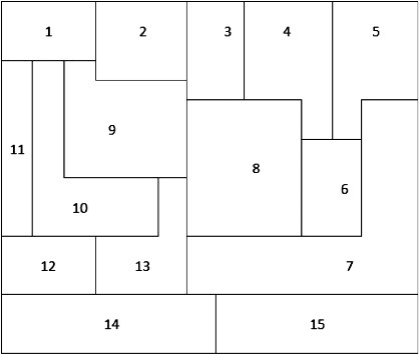
Although the map is the basic source of data for this problem, we can use it to
create an adjacency array for modeling purposes. This array is shown in Figure 6.10.
In the figure, the numbered rows and columns correspond to the various sectors. An
entry of 1 appears in row i and column j if sectors i and j are adjacent. (Each sector
is considered adjacent to itself.)
A model for minimizing the required number of patrols can be constructed around
the adjacency array by defining binary variables as follows.
y
j
= 1 if a patrol is assigned to sector j
y
j
= 0 otherwise
Then the objective function—the total number of patrols—can be expressed as
the sum of the y
j
values. In the model of Figure 6.11, this sum is represented as the
SUMPRODUCT of the decision row and a row containing all 1s. To formulate con-
straints, suppose we focus on row i in the array, which corresponds to sector i. The
SUMPRODUCT of this row and the decisions yields the number of patrols that can
service county i. In the problem, we require coverage from at least one patrol for
every row. In words, our model takes the following form.
Minimize z = the number of patrols
subject to
Patrols servicing sector i ≥ 1, ( for all i = 1, 2, ...,15)
In algebraic terms, we can let a
ij
represent the adjacency data in the array of
Figure 6.10. That is, a
ij
¼ 1 if sectors i and j are adjacent and a
ij
¼ 0 if not. Then
Figure 6.9. Sector map for Example 6.3.
222 Chapter 6 Integer Programming: Binary Choice Models

we can write
Minimize z =
y
j
subject to
j
a
ij
y
j
≥ 1, ( for all sectors i = 1, 2, ...,15)
In the spreadsheet of Figure 6.11, we have positioned the constraint information
immediately to the right of the data array because the rows of the array give rise to con-
straints. We then specify the model as follows.
Objective: R7 (minimize)
Variables: C5:Q5
Constraints: R11:R25 ≥ T11:T25
C5:Q5 ¼ binary
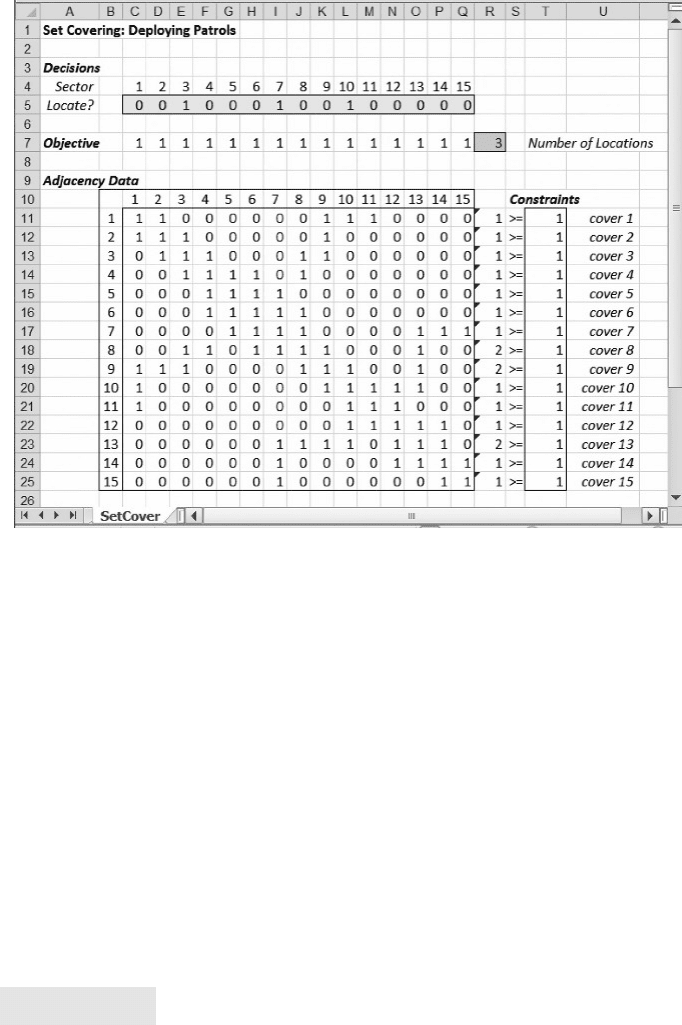
Figure 6.11 shows the optimal solution, obtained with the linear solver and an Integer
Tolerance of 0, which calls for assigning patrols to Sectors 3, 7, and 10. By using an
integer programming model, the police department can provide service to Metropolis
while minimizing the number of patrols needed.
The generic set covering problem involves the selection of objects to meet given
coverage requirements, where selection is a matter of binary choice. Each column in
the constraints of the model (refer to Figure 6.11 as an example) corresponds to an
object and the coverage it provides. When the coverage is expressed with 0s and 1s
(the constraint coefficients in a column), we can think of the 1s as defining a coverage
123456789101112131415
1 11000000
1
110000
2 11100000
1
000000
3 01110001
1
000000
4 00111101
0
000000
5 00011110
0
000000
6 00011111
0
000000
7 00001111
0
000111
8 00110111
1
000100
9 11100001
1
100100
1010000000
1
111100
1110000000
0
111000
1200000000
0
111110
1300000011
1
101110
1400000010
0
001111
15000000100 0 0 0 0 1 1
Figure 6.10. Adjacency array for Example 6.3.
6.3. Set Covering 223
set (i.e., the set of rows in which 1s appear). Thus, the selection of objects is equivalent
to the selection of sets, and the problem is to choose the minimum number of sets
and still provide the required coverage. This interpretation gives rise to the name
set-covering problem.
6.4. SET PACKING
As we saw in the previous section, the covering model of linear programming leads to
an analog in binary-choice programming. In a similar fashion, the allocation model of
linear program leads to another analog. This model contains allocation constraints
rather than covering constraints; otherwise, it resembles the set-covering model. To
describe how this model might arise, consider the expansion problem faced by the
Happy Landings Motel Company.
EXAMPLE 6.4
Happy Landings Motels
The Happy Landings Motel has been a successful one-of-a-kind business in its original location.
Its new owner has decided to replicate the motel at several locations and form a small chain.
More expansion will follow if this first phase is a success. The new owner has identified nine
Figure 6.11. Optimal solution for Example 6.3.
224 Chapter 6 Integer Programming: Binary Choice Models
potential locations where a motel might be located. However, some of these locations are within
30 miles of each other, and the owner prefers to separate motels in the chain by at least 30 miles
to avoid cannibalizing demand. The following information about location conflicts has been
obtained from a map.
Potential
site
Potential sites
within 30 miles
12
21,5,7
3 5,6,8,9
46,7
5 2,3,6,8
6 3,4,5,7
72,4,6
83,5
93
The new owner wants to build motels on as many sites as possible, while adhering to the 30-mile
requirement. B
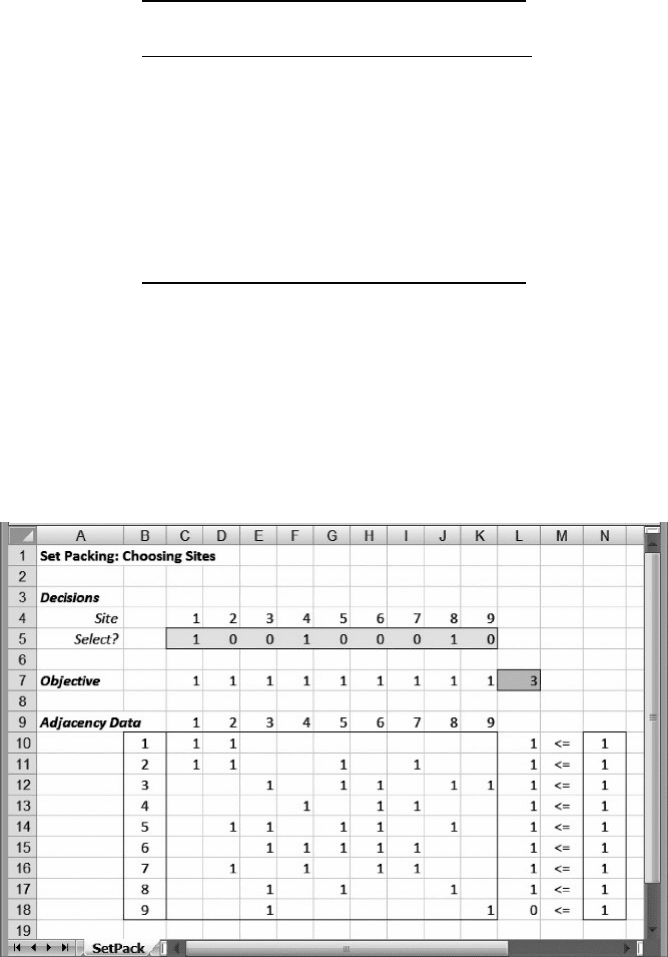
Again, the raw data for this problem comes from a map, organized according
to the list given in Example 6.4. For modeling purposes, it’s convenient to convert this
information into a conflict array. This array is shown in Figure 6.12, as part of the ulti-
mate model. In the figure, the numbered rows and columns correspond to the various
Figure 6.12. Optimal solution for Example 6.4.
6.4. Set Packing 225