
Baker K.R. Optimization Modeling with Spreadsheets
Подождите немного. Документ загружается.

motel sites. An entry of 1 appears in row i and column j if sites i and j are within 30
miles of each other.
A model for maximizing the number of nonconflicting motel sites can be con-
structed around the conflict array by defining binary variables
y
j
= 1 if a motel is assigned to site j
y
j
= 0 otherwise
Then the objective function—the total number of motels—can be expressed as the
sum of the y
j
values. In the model of Figure 6.12, this sum is represented as the
SUMPRODUCT of the decision row and a row containing all 1s. To formulate con-
straints, suppose we focus on row i in the array, which corresponds to site i. The
SUMPRODUCT of this row and the decisions yields the number of assigned sites
(possibly including site i itself) that conflict with site i. In the problem, we require
the number of conflicts to be at most 1, for any site. In words, our model takes the
following form.
Maximize z = the number of sites
subject to
Sites in conflict with i ≤ 1, ( for all i = 1, 2, ...,9)
In algebraic terms, we can let a
ij
represent the conflict data in the array of
Figure 6.12. That is, a
ij
¼ 1 if sites i and j are within 30 miles and a
ij
¼ 0 if not.
Then we can write
Maximize z =
y
j
subject to
j
a
ij
y
j
≤ 1, ( for all sites i = 1, 2, ...,9)
In the spreadsheet of Figure 6.12, we specify the model as follows.
Objective: L7 (maximize)
Variables: C5:K5
Constraints: L10:L18 ≤ N10:N18
C5:K5 ¼ binary
Figure 6.12 shows the optimal solution, obtained with the linear solver and an Integer
Tolerance of 0, which calls for choosing sites 1, 4, and 8. By using an integer program-
ming model, the new owner can open as many new motels as the 30-mile limit allows.
The generic version of this problem involves the selection of objects that avoid
given conflict possibilities, with selection represented by binary choice. Each
column in the constraints of the model (refer to Figure 6.12 as an example) corre-
sponds to an object and the conflicts it generates. When the conflicts are expressed
with 0s and 1s (the constraint coefficients in a column), we can think of the 1s as
226
Chapter 6 Integer Programming: Binary Choice Models

defining a conflict set (i.e., the set of rows in which 1s appear.) Thus, the selection of
objects is equivalent to the selection of sets, and the problem is to “pack in” the maxi-
mum number of sets without creating conflicts. This interpretation gives rise to the
name set-packing problem.
6.5. SET PARTITIONING
As another example of a binary choice model, we consider a matching problem. The
term “matching” refers to identifying pairs—that is, associating one object in a popu-
lation with exactly one other object. This structure differs from the assignment pro-
blem of Chapter 3, which calls for matching an object in one population, such as
products, to an object in another population, such as factories. Consider the exam-
scheduling problem as it arises at Oxbridge College.
EXAMPLE 6.5
Oxbridge College
Oxbridge College faces the problem of devising an exam schedule at the end of every term. By
tradition, the exam period lasts four days, and exams are scheduled in the morning of each day.
In other words, there are four available exam periods. To create an exam schedule, the college
registrar assigns courses to exam days according to the course meeting time. Thus, all courses
that meet Monday at 9am are assigned the same exam day. Eight distinct meeting times occur
in the college calendar, and the registrar wants to assign two to each of the four exam days.
However, when two times are assigned to the same exam day, some students may have a
time conflict because they are enrolled in courses that meet at those two times. Special arrange-
ments must then be made for such students. The registrar’s office has an information system that
can determine, for any pair of class times, how many students are taking courses at both times.
With this information, the registrar would like to devise an exam schedule that makes the
number of exam conflicts as small as possible because that minimizes the number of cases in
which special arrangements have to be made. For the current term, the conflict numbers are
displayed in the following table.
Time T2 T3 T4 T5 T6 T7 T8
T1 20 15 18 14 16 11 8
T2 26 32 29 19 14 18
T3 40 32 29 26 20
T4 35 31 23 26
T5 31 26 27
T6 27 31
T7 26
B
It’s not necessary to fill in the entire array because of symmetry: the number
of conflicts between Ti and Tj is the same as the number of conflicts between Tj and Ti.
6.5. Set Partitioning 227
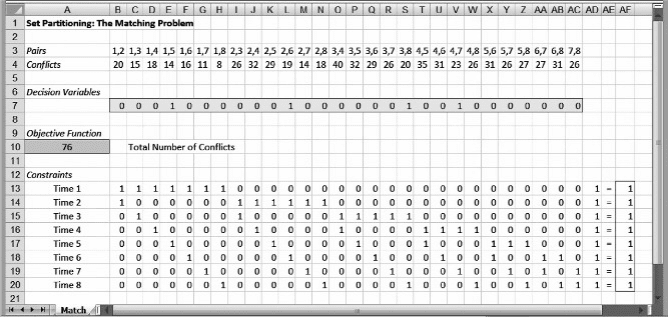
Although it is convenient to present the data in a half-array, it can also be presented in a
horizontal layout, as in the standard linear programming format. (See rows 3 and 4 of
Figure 6.13.)
The essential decision in this problem is a binary choice for matching. The binary
decision variables x
ij
are defined as follows.
x
ij
= 1 if class time Ti and class time Tj are assigned to the same exam day.
x
ij
= 0 otherwise
Because symmetry allows us to work with just half the conflict array, we need to define
the x
ij
variables only for i , j, which comes to 28 pairs. Then we can write the objec-
tive function as a SUMPRODUCT in the form
c
ij
x
ij
,wherec
ij
represents the number
of conflicts occurring when Ti and Tj are assigned to the same exam day, and where
the sum is taken over all 28 potential assignments. Because the quantity c
ij
contributes
to this sum only when x
ij
¼ 1, the objective function measures the total number of con-
flicts in the exam schedule. Constraints are needed to make sure that each class time is
assigned exactly one match. The algebraic model takes the following form.
Minimize z = 20x
12
+ 15x
13
+ 18x
14
+ ··· +26x
78
subject to
x
12
+ x
13
+ x
14
+ x
15
+ x
16
+ x
17
+ x
18
= 1
x
12
+ x
23
+ x
24
+ x
25
+ x
26
+ x
27
+ x
28
= 1
x
13
+ x
23
+ x
34
+ x
35
+ x
36
+ x
37
+ x
38
= 1
x
14
+ x
24
+ x
34
+ x
45
+ x
46
+ x
47
+ x
48
= 1
x
15
+ x
25
+ x
35
+ x
45
+ x
56
+ x
57
+ x
58
= 1
x
16
+ x
26
+ x
36
+ x
46
+ x
56
+ x
67
+ x
68
= 1
x
17
+ x
27
+ x
37
+ x
47
+ x
57
+ x
67
+ x
78
= 1
x
18
+ x
28
+ x
38
+ x
48
+ x
58
+ x
68
+ x
78
= 1
Figure 6.13. Spreadsheet model for Example 6.5.
228 Chapter 6 Integer Programming: Binary Choice Models
Figure 6.13 shows the spreadsheet model. The layout follows the standard linear
programming layout introduced in Chapter 2. By transforming the layout of the con-
flict data from the original half-array into one long row in Figure 6.13, we facilitate the
standard layout.
The model specification is the following.
Objective: A10 (minimize)
Variables: B7:AC7
Constraints: AD13:AD20 ¼ 1
B7:AC7 ¼ binary
After entering this information, we set Integer Tolerance to 0 and run the linear solver.
The minimal number of conflicts is 76, as shown in the figure, and the optimal pairings
are Time 1 with Time 5, Time 2 with Time 6, Time 3 with Time 8, and Time 4 with
Time 7. By using an integer programming model, Oxbridge can thus limit the number
of exam conflicts to the minimum possible level.
The binary-choice model in Figure 6.13 resembles the set covering model and the
set packing model, except for the constraint type. Again, we can think of columns as
sets, and in this case, the 1s in each column identify the pair of objects in the corre-
sponding match. The problem involves choosing a full match—that is, a collection
of pairs such that each object appears exactly once in the collection. The “exactly
once” requirement means that the sets selected must partition the population of objects
into mutually exclusive and exhaustive subsets. For that reason, this problem type is
often called a set-partitioning problem.
In Example 6.5, the number of class times is exactly equal to twice the number of
exam days. More generally, the number of class times could be slightly less than twice
the number of exam days, and a similar model could be used. For example, if there
were six class times rather than eight, then only two pairings would be needed, and
two of the class times would be unpaired. To accommodate this condition, we
could state the model constraints as LT inequalities and add a constraint to ensure
that at least two pairings took place.
Although Example 6.5 occurs in the setting of scheduling exams, the same kind
of matching model can be used to schedule class meetings (or training courses, or
conference sessions, etc.) when there are at most two items per time period. Several
additional conditions may apply as well, but the basic structure of such problems
often corresponds to the matching problem.
6.6. PLAYOFF SCHEDULING
An application area for integer programming that has received increasing attention
lately is the scheduling of sports teams in professional leagues. Although basic guide-
lines exist for the creation of a “balanced” schedule, a good deal of flexibility remains,
and several specific considerations come into play in determining an “optimal” sche-
dule. As an example, a relatively new league in Latin America has just begun to exam-
ine the possibility of optimized scheduling.
6.6. Playoff Scheduling 229

EXAMPLE 6.6
The Latin American Soccer Association
Soccer is a popular spectator sport in Latin America, and as the year draws to a close, attention is
focused on the Latin American Soccer Association (LASA), which administers the annual
league competition. LASA also pays attention to trends in attendance, income from television
contracts, and the interactions between soccer games and the broader national culture. One of its
activities is drawing up a schedule for the season-ending playoff series.
The LASA league consists of 12 teams which compete against each other during a 24-week
regular season. Then, after a one-week break, the playoffs begin. Six teams—three from each
division—qualify for the playoffs based on their regular season performance. In the playoffs,
each team must play each of the other qualifying teams. After those games have been played,
the teams with the best record in each division meet in the championship game.
The playoff games are played on Saturdays, and each team plays every week. Several sche-
dules can be constructed that allow the playoffs to be completed in five weeks, but the LASA
Executive Board has determined that some schedules are preferable to others. In particular,
they have noticed that attendance is relatively greater when two teams of the same division
play each other (reflecting intradivision rivalries) and when games are relatively later in the
schedule (reflecting the importance of the later games in determining the ultimate division
winners). The Board has concluded that total attendance will be maximized if intra-division
games are played as late as possible in the schedule. B
When we examine the LASA problem closely, we can identify two basic
constraints: (1) each team must play every other team, and (2) each team plays exactly
one game each week. As a consequence, the schedule must require at least five weeks.
When we turn to the objective, we observe that each team plays two intradivision
rivals. Therefore, at best, the intradivision rivalries can be placed in the last two
weeks of the schedule. Normally, it is not too difficult to devise a five-week schedule
containing the 15 required games, even with pencil and paper. However, it may not be
so easy to determine whether all intradivision rivalries can be placed in the last two (or
even three) weeks. That’s where an integer programming model can be useful.
To build the model, we rely on a binary-choice variable.
x
jkt
= 1 if teams j and k meet in week t of the schedule
0 otherwise
We need to define these x
jkt
variables for the 15 distinct pairs of teams corresponding
to j , k, as well as for each of the five weeks. This specification gives us a total of
75 binary variables. Then it is straightforward to write the constraints of the problem.
For the one-game-per-week constraint, we write
6
k=j
x
jkt
= 1 for each team j and week t (6.1)
For the play-everyone-else constraint, we write
6
t=1
x
jkt
= 1 for each pair of teams ( j, k)(6.2)
230
Chapter 6 Integer Programming: Binary Choice Models
The model contains 30 constraints of type (6.1) and 15 constraints of type (6.2), for a
total of 45 constraints.
For the objective function, let’s assume we wish to maximize the following
expression.
Maximize z =
5
t=1
6
k=j
c
jkt
x
jkt
This expression represents a sum containing 75 terms. In selecting the coefficients c
jkt
,
we first need a mechanism that favors intradivision games over the other games. An
easy way is to associate a zero coefficient with each pairing of teams from different
divisions. Then, for the intradivision games, we need a mechanism that favors later
weeks over earlier weeks. For this purpose, we could associate a positive objective
function coefficient equal to the week number for each variable. Thus, we define
the following coefficients
c
jkt
= t if intradivision teams j and k meet in week t of the schedule
0 otherwise
Perhaps the notion of “later week” deserves a closer look. In our assignment of coeffi-
cient values, we would permit the model to place two intradivision games in week 4
(making a contribution of 8 to the objective) rather than placing one intradivision game
in week 5 (making a contribution of just 5). However, if we do not find that trade-off
desirable, we could use an alternative scheme.
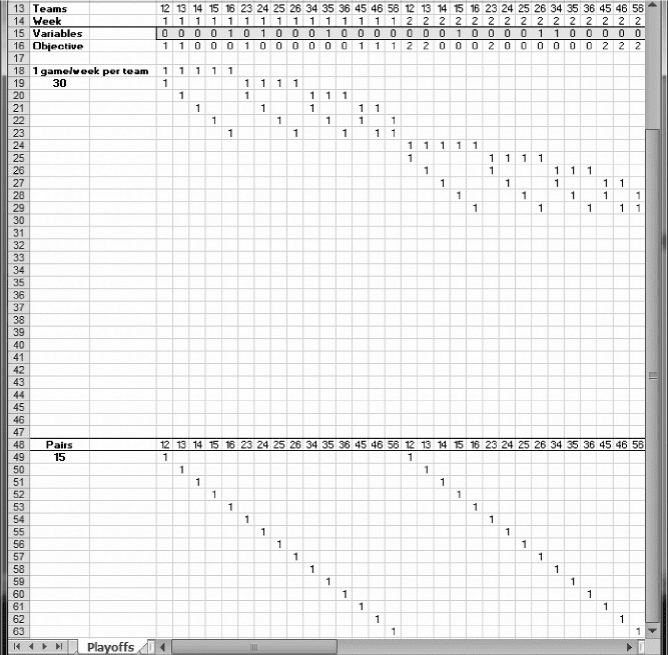
The spreadsheet model for the LASA problem is not difficult to build, but we
must keep its size in mind: 45 constraints and 75 variables. For reasons of readability,
Figure 6.14 shows just the upper left portion of the model. The variables appear in row
15, with rows 13 and 14 containing labels for the variables. Specifically, the pair ( j, k)
appears in row 13 and the week t appears in row 14. The first set of constraints, corre-
sponding to (6.1) appears in rows 18–47, and the second set, corresponding to (6.2)
appears in rows 49–63. Row 48 reproduces the team pair in row 13 for easier
reference.
Figure 6.15 shows the entire model. All the constraints are equations with right-
hand-side constants equal to 1, so this model takes the form of a set-partitioning pro-
blem. The sets of constraints corresponding to (6.1) and (6.2) each have distinctive,
repeating clusters of nonzero coefficients, which become visible when we zoom out
and display the entire model in one window. By examining the model at this zoom
level, we can scan the layout for possible typos or omissions.
The model specification is the following
Objective: BZ16 (maximize)
Variables: C15:BY15
Constraints: BZ18:BZ47 ¼ 1
BZ49:BZ63 ¼ 1
C15:BY15 ¼ binary
6.6. Playoff Scheduling
231
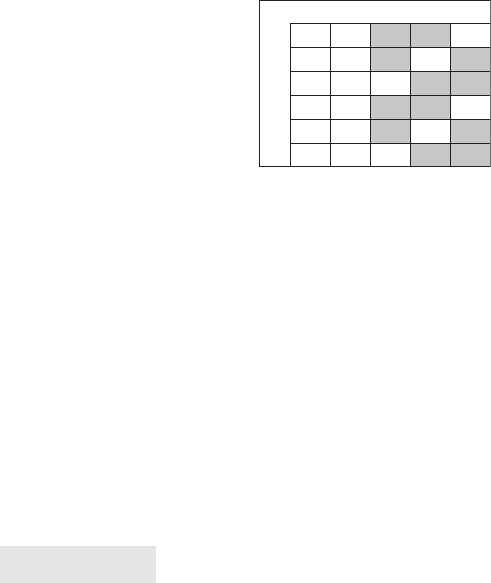
A solution appears in both Figures 6.14 and 6.15, but the entire schedule is more use-
fully displayed in a table such as in Table 6.1, with shading to designate intradivision
games.
In the optimal schedule, all intradivision games are played in weeks 3 – 5.
Although six intradivision games must be played, they cannot all fit into the final
two weeks of the schedule.
The LASA scenario leads to a simple version of the playoff scheduling problem.
In actual practice, administrative bodies are concerned about several other features of
a schedule. For example, it’s common to keep track of home and away games and
to restrict a schedule so that no team plays more than two consecutive games at
home. In other settings, governing boards keep track of especially “strong” teams
and require that no team be scheduled to play two strong teams in successive
weeks. Finally, in many countries, soccer games compete with cultural events, so lea-
gues often prohibit games on dates corresponding to local festivals, bicycle races, or
Figure 6.14. Portion of the spreadsheet model for Example 6.6.
232 Chapter 6 Integer Programming: Binary Choice Models
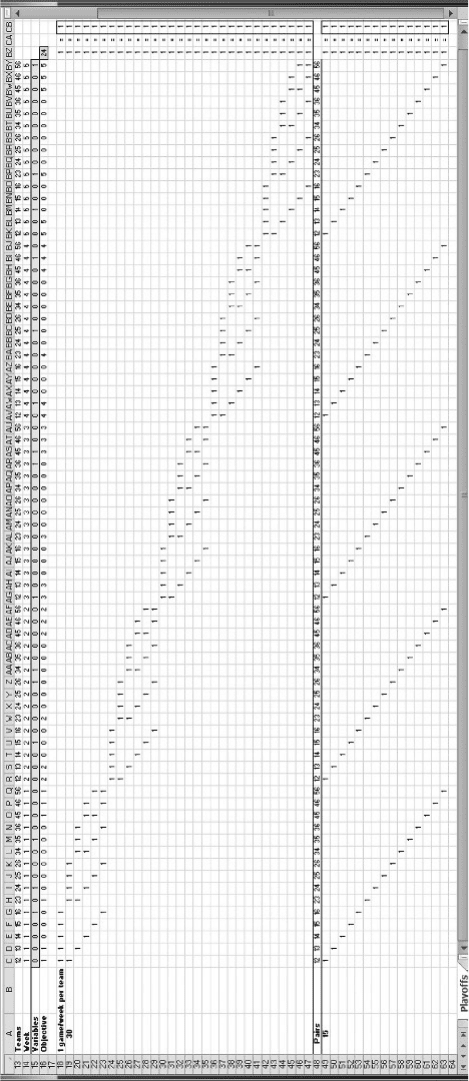
Figure 6.15. Spreadsheet model for Example 6.6.
233
religious celebrations. Considerations such as these can be accommodated with integer
programming models, but sometimes the scheduling models grow quite large.
6.7. SOLVING A LARGE-SCALE SET PARTITIONING
PROBLEM
In this section, we examine a very large type of binary choice problem. It is considered
large because it contains a large number of variables, not to mention a large number of
feasible possibilities. Although the size of the problem outstrips the normal capabili-
ties of Solver, the set partitioning model provides us with an alternative approach to
finding a solution. The scenario at Courier Express gives rise to such a problem.
EXAMPLE 6.7
Courier Express
Courier Express serves 12 locations in its region with delivery service from a central transpor-
tation hub. Each day, trucks are sent out to several locations, where they deliver and collect
packages. Then the trucks return to the hub, where the pickups are sorted and sent on, and
where incoming packages are sorted and loaded on trucks in preparation for the next day’s
work. Each truck leaves the hub, visits some locations, and then returns to headquarters. The
dispatching problem is to route the trucks so that some truck visits each location. Distances
between locations are known. Courier Express wants to find a dispatching plan that achieves
the minimum total distance traveled by its trucks each day. B
The distance data for Example 6.7 can be displayed in an array, as shown in
Figure 6.16. In this array, the element appearing in row i and column j is d
ij
, the dis-
tance from location i to location j. Location 1 corresponds to the depot, and locations
2–13 correspond to the pickup and delivery points.
To analyze this problem, we first assume that Courier Express deploys four trucks
and that each truck travels to three locations before returning to the depot. For each
truck, we want to assign a set of locations and a sequence for those locations. We
refer to this assignment as a segment. Each s egment has a total distance, dictated
by the sequence in which the truck visits the locations and returns to the depot. A
full solution is made up of four segments, one for each truck. For a group of four seg-
ments to be feasible, each location must be visited exactly once.
Table 6.1. Playoff Schedule for LASA
Week
12345
1 16 15 12 13 14
2 24 26 21 25 23
Team 3 35 34 36 31 32
4 42 43 45 46 41
5 53 51 54 52 56
6 61 62 63 64 65
234 Chapter 6 Integer Programming: Binary Choice Models
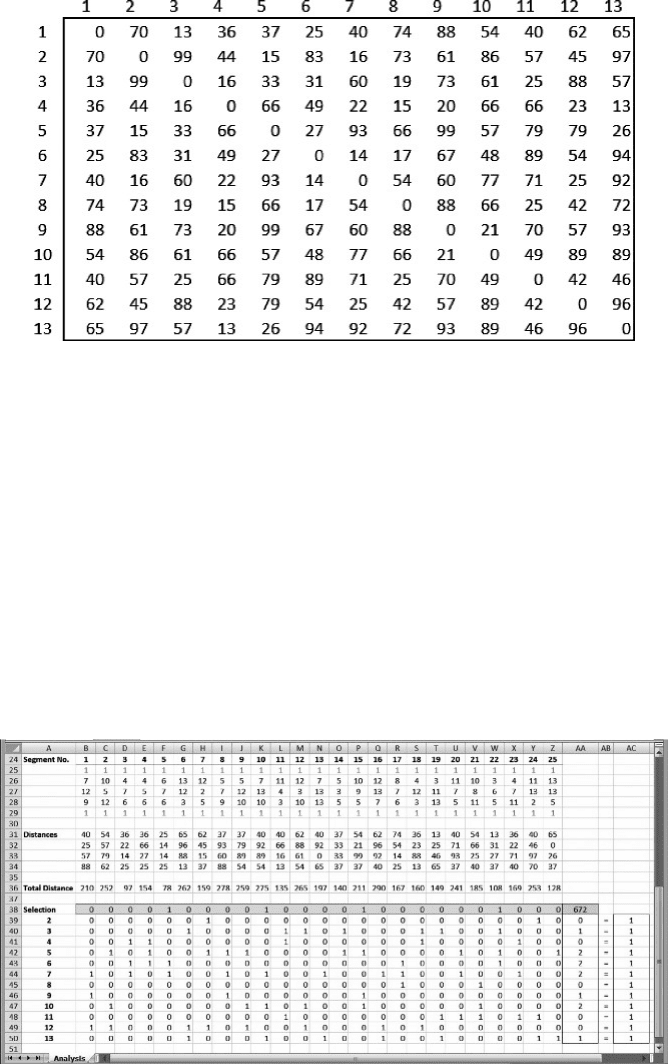
Figure 6.17 displays a model for this situation. Columns B–Z correspond to 25
segments. In column B, for example, the truck travels from the depot (city 1) to
cities 7, 12, and 9 in order, and then returns to the depot. This route is specified in
rows 25–29. Based on that route, the pairwise distances between locations are
recorded in rows 31 – 34 and their total appears in row 36. These 25 segments have
been selected randomly.
The remainder of Figure 6.17 shows a set partitioning model in which binary-
choice variables indicate whether a segment should be selected. The objective
function is the SUMPRODUCT of the binary variables and the total distances
in row 36. The constraints in the model require that each location must be selected
exactly once. Thus, the model attempts to find the best feasible combination of
Figure 6.16. Distance data for Example 6.7.
Figure 6.17. Set partitioning model for Example 6.7.
6.7. Solving a Large-Scale Set Partitioning Problem 235