
Battarbee R.W., Binney H.A. (Eds.) Natural Climate Variability and Global Warming: A Holocene Perspective
Подождите немного. Документ загружается.


..
190
|
Dirk Verschuren and Dan J. Charman
..
water-resource availability at the landscape scale that has often determined the
success or failure of societies in the past (Weiss and Bradley 2001), and will do so in
the future (IPCC 2007). A first step in providing this answer can be made through
syntheses of paleohydrologic data at the continental scale, in an attempt to recon-
struct large-scale spatial patterns of variability at decadal to centennial time-scales.
In this contribution we aim to (i) review initial attempts to integrate proxy records
of Holocene continental paleohydrology across regions; and (ii) juxtapose high-
and low-latitude patterns of hydrologic change through time. Geographically,
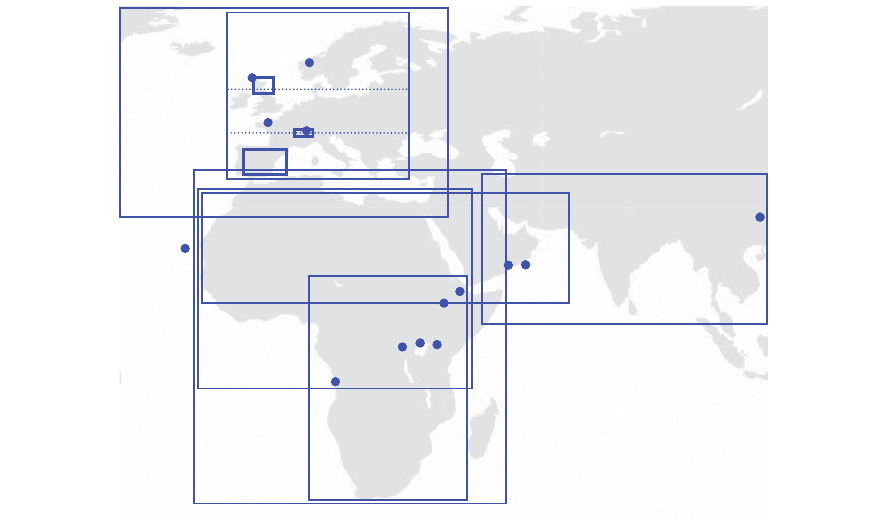
we focus on the PAGES–PANASH Europe–Africa transect (Bradley et al. 1995),
which includes continental regions of Europe, adjacent Eurasia, and Africa
bounded on the west by the Atlantic Ocean and extending east into monsoonal
Asia (Figure 8.1).
Challenges to proxy data integration
Integration of paleohydrologic data across sites
Most traditional hydrologic climate-proxy indicators tend to reflect “effective
moisture availability”, rather than rainfall, with poorly constrained temperature
effects on evaporation. Rainfall variation is also spatially more heterogeneous and
temporally more pronounced than temperature variation, because the atmo-
spheric circulation patterns ultimately determining rainfall location and intensity
depend on ocean currents, pressure contrasts between oceans and adjacent land
masses, and local land topography. To draw a coherent picture of latitudinal link-
ages and the associated climate dynamics for rainfall variability during past millen-
nia thus requires appropriate geographic coverage of well-dated, high-quality
hydrologic proxy records. This in turn presents two other challenges: (i) what is the
proper spatial scale to integrate paleodata, when the main aim of such integration
is to capture and highlight characteristic regional climate patterns for comparison
with those of other regions?; (ii) how to compare climate-proxy time series
between two or more regions where the selected proxy indicators are influenced to
a different degree by temperature and precipitation variations?
High-quality paleodata are often generated from natural climate archives that
are common in certain regions but have limited distribution or poor archival qual-
ity in other regions. Consequently, meeting the second challenge (if not also the
first, cf. Moberg et al. 2005) requires integration of climate-proxy time series across
archives that have a different resolution and chronologic control. As with multi-
proxy studies on a single archive, comparison of proxy records between archives
from within the same region can provide unique insight into the seasonal charac-
teristics of past climate change and into how well we understand individual proxies
as indicators of climate change. It also provides an independent test of the quality
of natural climate archives as recorders of climate change in a manner that any
number of proxy indicators from the same archive can not.
9781405159050_4_008.qxd 6/3/08 3:58 PM Page 190
Latitudinal linkages in moisture-balance variation
|
191
..
Calibration of paleohydrologic proxy indicators in space and time
Any exercise in paleodata integration across sites and archives necessarily assumes
that the relative magnitude of reconstructed proxy climate signals has been cali-
brated locally. This is accomplished either by time series regression against instru-
mental climate data (e.g. precipitation) or derived measures of hydrologic change
(e.g. effective moisture, Palmer drought index) or through a spatial transfer func-
tion relating variation in the proxy indicator to modern geographic variation in the
climate variable. Time-series calibration (as is customary in dendroclimatology) is
..
B
A
D
C
F
G
2
1
3
4
5
6
7
8
9
01
11
21
31
41
51
71
61
E
Figure 8.1 Western Eurasia and Africa with main study
sites and regions discussed in the text: lakes in the Jura,
French pre-Alps and Swiss Plateau (1: Magny 2004); Uamh
an Tartair Cave, Scotland (2: Proctor et al. 2002); northern
Britain peatlands (3: Charman et al. 2006); Great Aletsch
Glacier, Switzerland (4: Holzhauser et al. 2005); Bjørnbreen
Glacier, Norway (5: Matthews et al. 2005); fluvial
chronology of Spain (6: Thorndycraft and Benito 2006);
oak tree-rings, western France (7: Masson-Delmotte et al.
2005); Dongge Cave, China (8: Wang et al. 2005); Qunf
Cave, Oman (9: Fleitmann et al. 2003); marine sediments,
western Arabian Sea (10: Gupta et al. 2003); Lakes Abhé and
Ziway-Shala, Ethiopia (11 and 12: references in Gasse
2000); marine sediments, eastern tropical Atlantic Ocean
(13: de Menocal et al. 2000); Lake Edward, DR
Congo/Uganda (14: Russell and Johnson 2005b);
agricultural drought index, coastal Angola (15: Miller
1982); Pilkington Bay, Lake Victoria (16: Stager et al. 2005);
Lake Naivasha, Kenya (17: Verschuren et al. 2000).
Continental-scale syntheses of Holocene and/or historical
paleohydrology are available for Europe (A: Yu and
Harrison 1995; B: Pauling et al. 2006), the arid–sub-arid
belt of North Africa and the Arabian Peninsula (C:
Hoelzmann et al. 2004), north and intertropical Africa
(D: Street and Grove 1976), the entire African continent (E:
Gasse 2000), sub-Saharan Africa (F: Verschuren 2004) and
the Indian and East Asian monsoon domains (G: Fleitmann
et al. 2007a).
9781405159050_4_008.qxd 6/3/08 3:58 PM Page 191
..
192
|
Dirk Verschuren and Dan J. Charman
..
generally considered superior to the spatial approach (customary in palynology
or paleoecology of aquatic biota). This is not necessarily the case, however, when
instrumental weather data from the immediate vicinity of the proxy record are
lacking, or of insufficient length to capture local climate variability at the time-
scale of interest and to confirm the stationarity (constancy through time) of
indicator response to this variability (Jones et al. 1998). Lack of suitably long
precipitation records can sometimes be overcome by a regional climate field
reconstruction, i.e. a multi-variate statistical calibration of proxy data against
spatial networks of instrumental data (e.g. Zhang et al. 2004). Climate field recon-
struction must evidently start from the assumption that relationships between a
proxy indicator and synoptic climate patterns have been stationary through time
(Jones and Mann 2004). Time-series calibration of nonannually resolved climate-
proxy records (e.g. Laird et al. 1996) often optimize the correlation by shifting or
tuning the time axis of the record, thus making it difficult to identify possible lags
in system response to climate change. This tuning can either be avoided or justified
through system modeling of the relationship between a particular proxy indicator,
the archive concerned, and climate. Although time-series calibration on nonan-
nual proxies is imperfect, such methodologic compromises made for the purpose
of climate-proxy calibration are evidently preferable to having no direct test of the
exact meaning of climate-proxy signals at that particular site. Unfortunately, in
many available high-resolution records of hydrologic change, proxy signals have
not been directly calibrated, and the stationarity of signal response is unknown.
Reconstruction must be based instead on a plausible mechanistic scenario of
system response to climate at the time-scale of interest, inspired sometimes by
modern relationships at seasonal time-scales that do not necessarily apply over
decadal and centennial scales.
Chronologic issues
A further obstacle to integration of paleohydrologic data and to resolving their
association with climate-forcing functions is the limited age control on recon-
structed climate anomalies in nonannually resolved records dated with radioiso-
topes (e.g.
14
C,
210
Pb, U/Th). Although this issue is not confined to paleohydrologic
records, it is of particular importance here because large-scale hydrologic change is
thought to have occurred rapidly during certain periods. It also hampers attempts
to link presumed low-frequency change (e.g. regional water-table fluctuation) to
high-frequency change (e.g. flooding) recorded in different archives. Evidently,
more effort should be directed to optimize age control on any record containing
significant climate anomalies. Particularly for recent millennia, chronologic pre-
cision can sometimes gain significant improvement through wiggle-matching of
multiple closely spaced radiocarbon ages to the dendrochronologic radiocarbon
calibration curve (Blaauw et al. 2003), an approach used with success for hydro-
logic reconstructions extracted from European peat deposits (e.g. Mauquoy et al.
2004). When age control is inadequate, researchers are tempted to draw separate
9781405159050_4_008.qxd 6/3/08 3:58 PM Page 192

Latitudinal linkages in moisture-balance variation
|
193
..
climate events at different sites into one illusory regional-scale event (Baillie 1991,
Oldfield 2001). Explicit statistical analysis of the age uncertainties in proxy records
can stimulate progress towards more rigorous integration of paleoclimate data
(Blaauw et al. 2006).
Regional integration of proxy records
North-west Europe
Some of the earliest records of past moisture-balance change come from north-
west Europe, where pioneering work on Holocene climate reconstruction was car-
ried out. Best known is undoubtedly the Blytt–Sernander division of post-glacial
time based on peat stratigraphic changes (Blytt, 1876; Sernander 1908; Birks, this
volume), which introduced terms such as “Boreal” to represent a relatively cool,
dry period in the early Holocene, and “Atlantic” to represent the subsequent
warmer, wetter mid-Holocene. These terms are still used today but can be mislead-
ing when taken too literally, even within north-west Europe. Peat stratigraphy
remains one of the key sources of Holocene moisture-balance data within this
region, together with lake-level records and an increasingly diverse range of other
climate archives such as alpine glaciers, speleothems, and tree rings. Establishing a
broad regional picture of the main periods of hydrologic variability by integrating
paleodata produced by these various archives faces two key problems, already
hinted at above, related to a process-based understanding of interpreting natural
climate archives and the climate-proxy indicators they contain. Despite broad
conceptual understanding that the diverse proxy indicators all relate to moisture
balance, their records may represent variation in distinctly different hydrologic
variables and thus may not be directly comparable. In the case of peat records
of past surface wetness, summer moisture deficit is the key determinant of proxy
variations, but depending on location this may be forced primarily by precipita-
tion in oceanic regions, such as the British Isles, or by an increasing influence of
summer temperature in continental Europe (Charman et al. 2004; Charman
2007). Lake levels are usually interpreted as being a function of net annual mois-
ture balance (precipitation minus evaporation, P − E) but with substantial vari-
ation in the relative importance of precipitation and seasonal effects of temperature
on evapotranspiration (Digerfeldt et al. 1997). The mass balance of mountain
glaciers (and thus their records of advance and retreat) tends to respond to climate
change in particularly individualistic fashion depending on location, size, and
direction of exposure. Significant inertia and delay in the response of large glaciers
to climate change may generate different histories of high-frequency advance and
retreat among glaciers within a single mountain range. On a regional scale, glaciers
in the Alps appear to respond mostly to variations in winter temperature and sum-
mer precipitation (Holzhauser et al. 2005), whereas maritime glaciers in western
Norway are regarded as primarily responding to variation in winter precipitation
..
9781405159050_4_008.qxd 6/3/08 3:58 PM Page 193
..
194
|
Dirk Verschuren and Dan J. Charman
..
(Matthews et al. 2005). Vincent et al. (2005) point out possible nonstationarity in
the parameters controlling glacier mass balance in the Alps, with influence of sum-
mer temperature apparently having grown during the 20th century, whereas in the
past, winter precipitation had greater influence.
Lake-level changes
Comprehensive datasets of Holocene lake-level change exist from two main areas
in north-west Europe: Sweden (Digerfeldt 1988, 1997) and the French pre-Alps
(Magny 2004). The Swedish records were combined with other geographically
more dispersed records into the European Lake Level database (Yu and Harrison
1995), which now includes a total of 96 north-temperate to boreal sites (46–75°N)
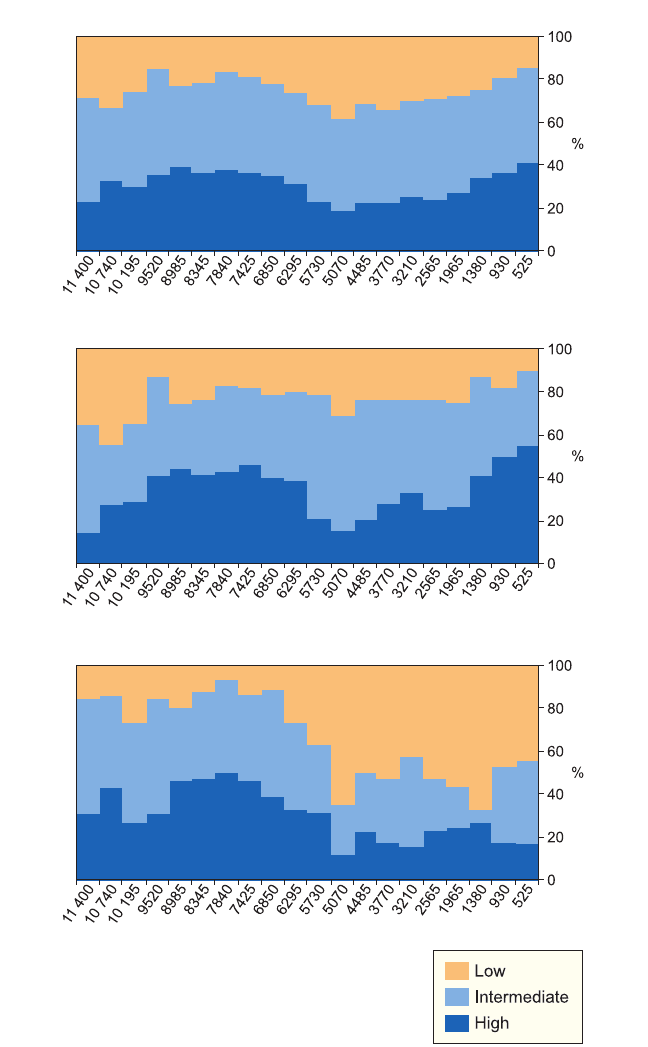
and 22 south-temperate sites (37–46°N). These data provide an excellent overview
of millennial-scale patterns in lake-level status (categorized as high, intermediate
or low: Figure 8.2a) across the European continent and along broad latitudinal and
longitudinal gradients. Limits to chronologic control on many records necessi-
tated temporal integration over 500 radiocarbon year intervals, precluding analysis
of century-scale events. Taking Europe as a whole, the data show generally wet
conditions from ca. 9520 to 6295 years BP, followed by declining lake levels culmin-
ating in drought ca. 5070–4485 years BP, and gradually increasing wetness during
recent millennia to reach a present-day mean lake status comparable to that of the
early Holocene. All ages given as calendar years BP or ad, or calibrated
14
C years for
radiocarbon chronologies (denoted cal. years BP) unless stated otherwise. A broad
latitudinal analysis (Figure 8.2b and c) indicates that the major patterns were con-
tinental in scale, except that a greater fraction of south-temperate lakes (roughly,
south of the Alps) already stood high at the onset of the Holocene. Dryness at the
start of the Holocene was mostly concentrated in a broad band across southern
Britain, southern Scandinavia, and into the eastern Baltic, consistent with the
effects of a glacial anticyclone over the lingering Scandinavian Ice Sheet (Yu and
Harrison 1995). Inference of increased wetness during recent millennia, and
particularly in the past 1500 years, mostly derives from Scandinavian and boreal
lakes (north of 55°N). South-temperate lakes record an increasing proportion of
lakes with low status between 2565 and 930 years BP, and hint at greater wetness
only in the past 1000 years. Major variability in the fraction of lakes with interme-
diate rather than low or high status complicates distillation of broad temporal
trends in effective moisture from these data.
Using time series of similar lake-level scores based on detailed stratigraphic
studies and drowned tree-stump dating at 26 lakes in the Jura Mountains and
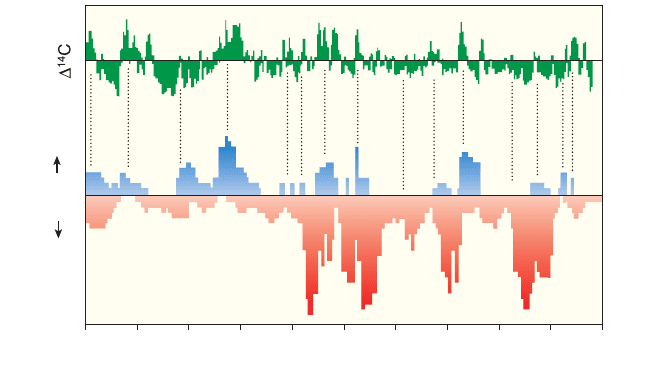
French pre-Alps (45–47°N, 5–9°E), Magny (2004) produced the most compre-
hensive and rigorous dataset of lake-level change for any area in Europe with
century-scale resolution. His regional compilation for the Holocene (Figure 8.3)
broadly agrees with the European lake-level database compilation for lakes south
of 46°N (Figure 8.2c), in particular their relative highstand from the onset of the
Holocene, and evidence for major episodes of increased wetness at 9550–9150,
8300–8050, and 7550–7250 years BP. The transition to generally lower mid- and late
9781405159050_4_008.qxd 6/3/08 3:58 PM Page 194
Latitudinal linkages in moisture-balance variation
|
195
....
(a) All European lakes
(b) North of 55°N
(c) South of 46°N
Age (cal. years BP)
Age (cal. years BP)
Age (cal. years BP)
Figure 8.2 Lake-level status
of European lakes at 500-
14
C-
year intervals through the
Holocene, for (a) the
complete European Lake
Level Database (ELLDB) of
118 lakes, and for sub-sets of
(b) lakes north of 55°N and
(c) lakes south of 46°N.
Original radiocarbon age
categories have been
converted to calibrated (cal.)
years using the nearest age
equivalent in the INCAL04
dataset (Reimer et al. 2004).
Labels reflect the start of each
period, i.e. “525” is the period
from 525 calibrated years BP
to present. (Based on Yu and
Harrison 1995.)
9781405159050_4_008.qxd 6/3/08 3:58 PM Page 195
..
196
|
Dirk Verschuren and Dan J. Charman
..
Holocene levels appears to have occurred at the same time in the higher-resolution
record from west-central Europe as that evident in the European-wide compila-
tion, ca. 5800 years BP and 5700 years BP respectively. The higher-resolution
record of Magny (2004), however, is punctuated by marked reversions to high-
stands at 5650–5200 and 4850–4800 years BP almost as significant as those
recorded in the early Holocene. Of particular note in the late Holocene is the high
lake-level phase at 2700–2400 years BP, and episodes of relative wetness (less
severe drought) at 4300–3900, 3500–3200, 2000–1800, 1400–1200, 900–700, and
after 400 years BP.
Glacier mass balance variations
There are a sizable number of individual records of glacier fluctuation in the cen-
tral European Alps, mostly based on dating of moraines and trees buried during ice
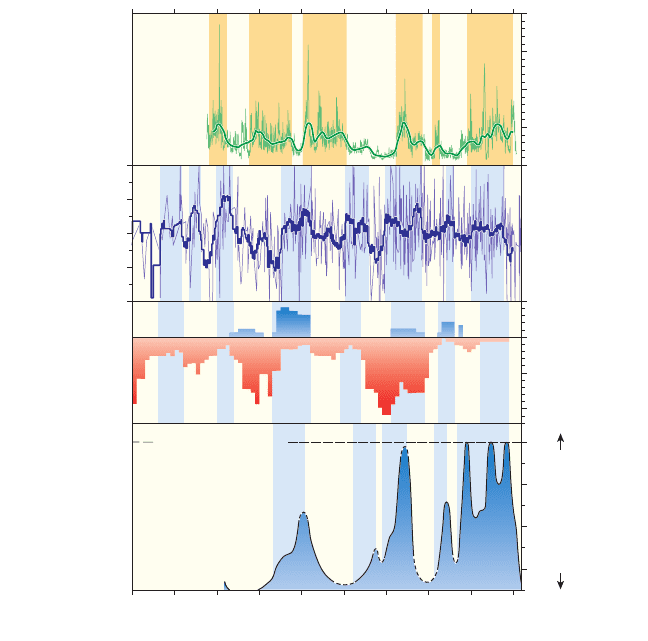
advance. Here we highlight the late Holocene record from Great Aletsch Glacier in
Switzerland (Holzhauser 1997; Holzhauser et al. 2005; Figure 8.4d). Periods of
pronounced glacier advance occurred at 2800–2450, 1500–1250, 850–750, and
650–50 years BP; and phases of pronounced retreat at 2450–1900, 1250–850, and
550–350 years BP. In northern Norway, the full Holocene record of Bj
´
ørnbreen
and other glaciers shows mountain ice to have been absent between 9700 and 5700
years BP, except for short-lived glacier advances at 8300–7900 and 7800–7600 years
BP. Mid- to late Holocene glacier expansion (neoglaciation) started at 5700 years
BP and culminated in periods of maximum glacier extent during 5700–3900,
3600–1600, 1300–800, and 600–100 years BP, albeit with some variation in timing
between sites (Matthews et al. 2000). The Bj
´
ørnbreen record of glacier mass balance
is based on the dated lithostratigraphy of alpine stream-bank mires episodically
flooded by glacier meltwater, using a model that describes the associated overbank
deposition of suspended glaciofluvial sediments. In the context of this chapter the
Bj
´
ørnbreen record is notable because modeling of variation in snow accumulation
10 000
Lake
level
HighLow
8000 6000
Calibrated years BP
4000 2000 0
Figure 8.3 Summed lake-
level scores for 26 lakes in the
Jura, French pre-Alps, and on
the Swiss Plateau, at 50-year
intervals through the
Holocene compared with the
record of atmospheric Δ
14
C as
proxy for solar activity.
(Magny 2004. Copyright
Elsevier 2004.)
9781405159050_4_008.qxd 6/3/08 3:58 PM Page 196
Latitudinal linkages in moisture-balance variation
|
197
..
with pollen-inferred summer temperatures allowed Matthews et al. (2005) to
reconstruct Holocene variations in local equilibrium-line altitude (corrected for
post-glacial isostatic uplift) and winter precipitation in maritime northern Europe
(Figure 8.5). Winter precipitation appears to have ranged between 40 and 160 per-
cent of the modern value, with late Holocene maxima at 2900–2600 and 1200–800
years BP, and pronounced minima at 4000–3600 and 800–600 years BP.
Speleothem records
Speleothem-based proxy indicators (oxygen and carbon isotopes, fluorescence,
annual band thickness) similarly record a variety of climate variables, depending
on local cave setting and the above-ground climate regime. Oxygen-isotope signals
in some speleothems accurately reflect isotopic variability in past rainfall, but the
relationship with temperature and rainfall varies geographically (Fairchild et al.
2006). Here we contrast two studies exploiting the potential of speleothems as
recorders of hydrologic change. Through direct calibration against instrumental
climate data, Proctor et al. (2000) found that the ratio of regional mean annual
..
(a)
(b)
(c)
(d)
4500 4000 3500 3000 2500 2000 1500 1000 500 0
200
150
100
50
0
–10
0
10
20
0
Maximum extension
1
2
3
2
1
0
Water table
(SD units)
Band width (μm)
Lake level scores
Retreat / advance
(km)
–1
–2
A
g
e (years BP)
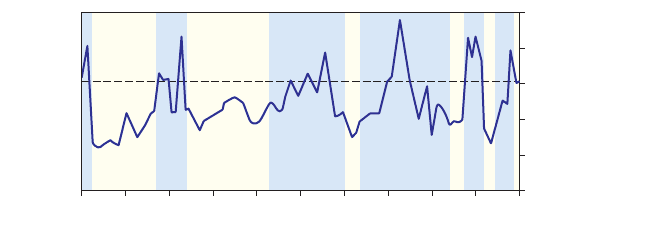
Figure 8.4 Selected annually
resolved to century-scale
hydrologic records for
temperate Europe covering
the past 3400 to 4500 years.
Blue shaded bars highlight
periods of high inferred
moisture availability in each
record. (a) Mean annual band
thickness and 100-yr running
average in three speleothems
from Northwest Scotland
(from Proctor et al. (2002)
but with time in years before
ad 1950, not years before
ad 2000 as published).
Orange bars highlight periods
of drier conditions. (b) Mean
standardized peatland surface
wetness and 100-yr running
average at 12 sites from four
regions in northern Britain
(from Charman et al. 2006).
(c) Summed lake-level scores
inferred from sediment
stratigraphy and drowned tree
stumps at 26 lakes in the Jura
Mountains, French pre-Alps,
and on the Swiss Plateau.
(Magny 2004. Copyright
Elsevier 2004.) (d) Mass-
balance fluctuation (advance
and retreat) of the Great
Aletsch glacier, Switzerland,
based on dating of moraines
and fossil trees exposed from
beneath retreating ice
(modified from Holzhauser
et al. (2005) with permission
from Sage publications).
9781405159050_4_008.qxd 6/3/08 3:58 PM Page 197
..
198
|
Dirk Verschuren and Dan J. Charman
..
temperature to mean annual rainfall explained > 60 percent of the variation in
annual band thickness of a stalagmite from northern Scotland. In a 100-year run-
ning average record, drier phases are indicated around 3500, c. 3100–2600,
c. 2500–2000, c. 1350–1100, c. 950, and c. 555–0 years BP. (Proctor et al. 2002;
Figure 8.4a). Niggemann et al. (2003) interpreted speleothem δ
18
O in west-central
Germany as primarily reflecting winter precipitation. From this they inferred peri-
ods of enhanced precipitation ca. 4800, 3500, 2700, and 2400 years BP (after 1500
years BP the record is less robust).
Peatland surface wetness changes
Changes in the surface wetness of peatlands are recorded by a number of biologic
proxy indicators (plant macrofossils, testate amoebae) and by the degree of peat
decay (humification). Testate amoebae permit quantitative inference of water-
table depth, when supported by a calibration dataset that describes (typically using
weighted-averaging techniques) species distribution in relation to a hydrologic
gradient at the local to regional scale. This approach has the advantage that local
water balance is reconstructed directly. Inference of climate variables (tempera-
ture, precipitation) from these reconstructions, however, depends on calibrating
local water balance variations in relation to climate (e.g. Charman et al. 2004). This
approach contrasts with some other biologic paleoclimate proxies (e.g. pollen,
chironomids) where proxies are calibrated directly with the climatic variables, and
often over larger geographic scales.
Peat records from those regions across continental Europe where peatlands are
present are growing in number, but most records currently available are from the
UK. Here we focus on the record from northern Britain, where there is a geograph-
ically dense set of records that can be summarized as an average regional series
(Charman et al. 2006) or by the clustering of “wet shifts” (Barber and Charman
2003). Figure 8.4b shows the averaged series created by identifying correlative
events in sets of detrended, normalized local peat surface-wetness records from
each of four latitudinal regions (northern Scotland, central Scotland, the
England–Scotland border region, and northern England). Individual site radio-
metric chronologies were tuned within chronologic errors and using independ-
ent age markers (tephra horizons, pollen markers, spheroidal carbonaceous
Modern
10 000 8000 6000
Calibrated years BP
4000 2000 0
0
500
1000
Precipitation (mm)
1500
2000
2500
Figure 8.5 Holocene winter
precipitation record for
coastal northern Norway
reconstructed by combining
the record of glacier advance
and retreat at Bj
´
ø
rnbreen
together with a regional
pollen-based summer-
temperature reconstruction
in a snow-accumulation
model. (Mattews et al. 2005.
Copyright Elsevier 2005.)
9781405159050_4_008.qxd 6/3/08 3:58 PM Page 198
Latitudinal linkages in moisture-balance variation
|
199
..
particles), so that a “stacked” or averaged record could be derived. This method
assumes that significant differences in century-scale climate change are unlikely to
have occurred within a region, but are allowed between regions. Although such
apparent interregional differences in the late Holocene sequence of wet and dry
events may be real and significant (Langdon and Barber 2005), the integrated
surface-wetness record for the whole of northern Britain (54–58°N, 5–0°W;
Figure 8.4b) appears to provide a useful basis for comparisons with late Holocene
hydrologic records with similar time resolution from continental Europe.
According to this record, pronounced shifts to wetter conditions occurred at 3600,
2760, and 1600 years BP, and somewhat less pronounced events at 4200, 3800,
2000, 1260, 860, 550, and 260 years BP.
Is there a coherent pattern of moisture-balance variability
between archives?
British peat surface-wetness records and central European lake-level data show
coherent hydrologic changes at the sub-millennial time-scale during the late
Holocene (Figure 8.4b and c). Coincidence is evident between markedly wet
episodes in both regions at 2750–2350 and 750–650 years BP, and the pronounced
dry episode at 3300–2750 years BP. Other wet events recorded in British peat are
reflected in the central European lake-level record as episodes of less pronounced
drought: 4150–3900, 3500–3300, 2000–1700, and 500–100 years BP. The most
significant discrepancy involves the period 1500–1100 years BP, when inferred
drought during 1700–1500 years BP switched to increased surface wetness in
Britain but persisted with mostly (but not exclusively: Figure 8.4c) low lake levels
in central Europe and only a modest return to higher lake levels. Some of the cited
changes also appear in the European Lake Level database (Figure 8.2). For exam-
ple, in the continent-wide lake-level compilation, but particularly in lakes south of
46°N (Figure 8.2c), greater moisture is evident from 3770 years BP, with a further
increase by 2565 years BP. Central European drought from 1750 to 1000 years BP,
ending in a rapid return to wetter conditions, is also evident in the low-resolution
dataset as a peak and then reduction of the fraction of lakes south of 46°N that
experienced low status (1380–930 years BP). Strong overall correspondence
between the British peat and the west-central European lake-level records of water
balance suggests a predominance of regionally coherent trends in effective mois-
ture. A possible explanation is that both peat surface wetness and lake level are
controlled mostly not by the total annual moisture balance but by the duration and
intensity of a seasonal P − E deficit (i.e., the extended summer period): much of the
excess precipitation during periods of positive P − E balance is lost as run-off from
peatlands or increased (sub-) surface outflow from lakes.
The main periods of glacier mass balance in the Alps also show broad correspon-
dence with the lake-level and peat surface-wetness data. In particular the advances
at 2750–2450 and 1550–1250 years BP and during the LIA at 650–50 years BP are
synchronous with wet periods inferred from the British peat record, or slightly
precede them in the case of the 900–750 years BP advance. Most of these glacier
..
9781405159050_4_008.qxd 6/3/08 3:58 PM Page 199