
Battarbee R.W., Binney H.A. (Eds.) Natural Climate Variability and Global Warming: A Holocene Perspective
Подождите немного. Документ загружается.

..
200
|
Dirk Verschuren and Dan J. Charman
..
fluctuations also show strong correspondence with lake-level variation in the
adjacent Jura, the French pre-Alps, and on the Swiss plateau (Holzhauser et al.
2005). One possible link between these different archives is summer precipitation
and temperature; high precipitation and low temperatures during summer
months would increase glacier mass balance, similar to the way they increase
available moisture for lakes and peatlands. One notable discrepancy between the
regional glacier and lake-level records is the apparent coincidence of major glacier
advance at ca. 1450–1250 years BP, with summer drought inferred from a pre-
dominance of low lake-level indicators at that time and only minor increases
in higher lake-level indicators during the latter part of this phase (Figure 8.4c
and d). This is the same period when a discrepancy exists between lake and peat
records (cf. above), suggesting a more muted signal in the lake-level records than
the other proxies.
It becomes more difficult to argue convincingly about potential climate links
between records that are understood to reflect mostly summer (or extended sum-
mer) conditions and those reflecting winter climate or an annual mean. Niggeman
et al. (2003) suggest that δ
18
O variation in their German speleothem is mostly a
function of winter conditions; cold, dry winters result in low summer water supply
to the cave and more enriched δ
18
O in drip waters. Proctor et al. (2000) find annual
band thickness in their Scottish speleothem to correlate strongly with the ratio of
annual T over P. In this region, however, where winter rainfall exceeds summer
rainfall, the annual signal may be determined more by winter than summer condi-
tions. We should therefore not necessarily expect to see strong correspondence
between “annual” proxy indicators in the European speleothem records and
“summer” proxy indicators in the peat and lake records. The most obvious com-
parison to make is between a 100-year running mean of the Scottish speleothem
band-thickness record and the peat record from northern Britain. The relationship
between these records is not consistent through time (Figure 8.4a and b). In gen-
eral, the records are in phase between 3500 and 1700 years BP but antiphase after
this period. Also instructive is a comparison between the Scottish speleothem
record and the late Holocene record of glacier mass balance in maritime Norway
(Figure 8.5), which is similarly understood to mostly reflect winter precipitation.
Correspondence between episodes of greater inferred wetness in both regions is
not immediately evident, however. The only two periods of significant Norwegian
glacier retreat during the past 4000 years (1600–1300 and 800–600 years BP)
correspond with broad minima (i.e. wet condition in speleothem band thickness
(1700–1400 and 800–600 years BP).
In summary, periods of greater moisture excess in north-west Europe over the
past 4000 years (Figure 8.4) are consistently recorded in three types of proxy record
(peat surface wetness, lake levels, Alpine glaciers) that are principally a function of
warm season water balance. Strong correspondence between them suggests that
changes in summer P − E were coherent throughout temperate Europe at least from
the Alps to the north of Scotland (46–58°N). Judging from the available records
with proxies responding more probably to annual and/or winter precipitation,
it seems likely that warm-season wetness was associated with decreased winter
9781405159050_4_008.qxd 6/3/08 3:58 PM Page 200
Latitudinal linkages in moisture-balance variation
|
201
..
precipitation since c. 1700 years BP (correspondence between Scottish speleo-
them and north Britain peat records). This is supported by the centenial-scale
correlation between wet summers and drier or unchanged winters during the Little
Ice Age in north-west Europe (e.g. Figure 8.6; Lamb, 1985).
Considering that different climatic variables control glacier mass balance in
the Alps and Norway it is not surprising that glacier mass balance records
from these two regions show only limited convergence. Glacier advance appears
to have taken place in both regions around 2800–2600 years ago and during the
Little Ice Age (LIA), although the timing of maximum glacier extent is variable and
the Alpine records reflect a sequence of higher-frequency changes. Glacier expan-
sion in Norway may result from enhanced winter zonal circulation, which in
recent centuries is related to a strongly positive North Atlantic Oscillation (NAO)
(Wanner et al. 2001). Summer precipitation variability, however, shows no or
only very weak association with the NAO, and the warmer winters in central
Europe associated with a positive NAO would be expected to have caused glacier
recession in the Alps. This implies that synoptic weather patterns during recent
centuries are not necessarily a good guide to longer-term climate variability:
wetter LIA winters in Norway must have been accompanied by cooler and wetter
summers in the Alps. To generate this combination of wetter summers and wetter
winters, zonal circulation must not only have been intensified in winter, but also
must have shifted southward with persistence of the moisture-bearing Westerlies
into the late spring and early autumn. Wet summers can also be generated
by higher convective rainfall, but this is associated with higher rather than lower
temperatures.
Precipitation changes over the past 500 years from
annually resolved proxy records
Until recently, annually resolved records of European precipitation were restricted
to instrumental records (very sparse before ad 1800) and a few long documentary
time series (Brázdil et al. 2005), both of which are exceptionally rich data sources
even in a global context. Now a number of studies have extended the time frame of
annually resolved precipitation reconstructions to the past 400–500 years. Pauling
et al. (2006) combine instrumental time series with precipitation indices based on
documentary evidence and natural proxy data (tree rings, corals, ice cores, and
a speleothem) to provide Europe-wide (30°W to 40°E/30° to 71°N) reconstruc-
tions of season-specific precipitation from ad 1500. Although estimated error is
evidently higher in the earlier portions of the reconstruction, correlation of this
Europe-wide dataset with independent tree-ring datasets (Brázdil et al. 2002;
Wilson et al. 2005) for two regions in central Europe is good. Reminiscent of the
conclusion reached by Vincent et al. (2005), one notable finding of this study is the
occurrence of major nonstationarities in long-term regional precipitation patterns
across Europe. Another notable finding is the considerable difference in long-term
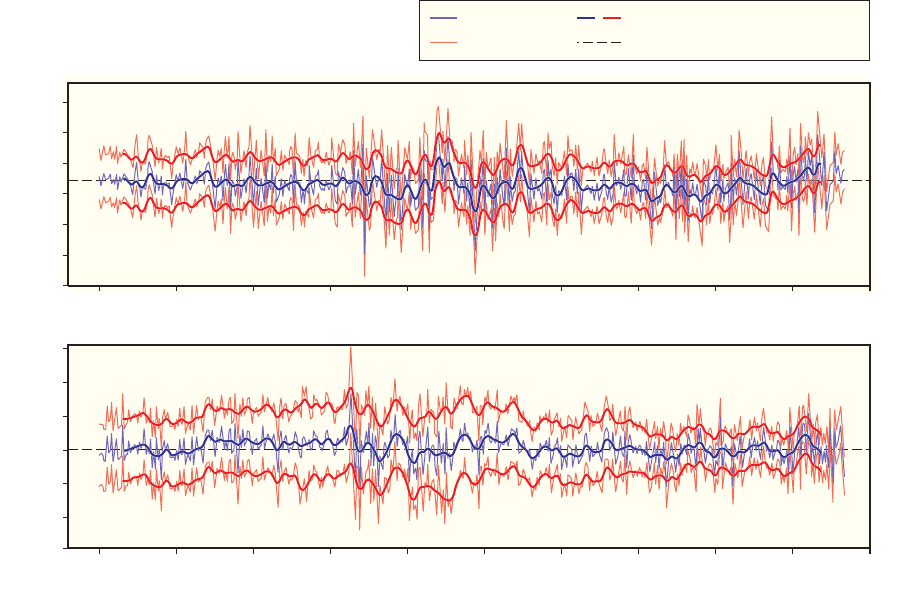
(multi-decadal) precipitation trends among seasons. Winter (DJF) precipitation
(Figure 8.6a) displays pronounced decade-scale fluctuations in the 18th century
..
9781405159050_4_008.qxd 6/3/08 3:58 PM Page 201
..
202
|
Dirk Verschuren and Dan J. Charman
..
before assuming a declining trend in the 19th century and a mostly rising trend
since ca. ad 1895. Fluctuation in spring, summer (Figure 8.6b), and autumn pre-
cipitation is greatest in either the second half of the 17th century or the 18th cen-
tury, followed by muted variation and no pronounced trends in the 19th and 20th
centuries. These distinct long-term trends in seasonal precipitation patterns sup-
port our contention that a thorough understanding of any seasonal bias in proxy
data is essential for a meaningful comparison of multi-proxy and multi-archive
records at millennial and century time-scales.
Comparison of the central-European lake-level compilation (Magny 2004)
with the annually resolved precipitation record of Pauling et al. (2006) is not pos-
sible because of the large difference in time resolution, but peat surface-wetness
records can potentially provide decade-scale resolution (Hendon and Charman
2004). A superficial visual comparison between the annually resolved European
summer precipitation time series and the peat-based water-table compilation
(a)
(b)
20001950190018501800175017001650160015501500
100
120
140
160
Precipitation (mm)
180
200
220
200019501900185018001750
Year AD
17001650160015501500
100
120
140
160
Precipitation (mm)
180
200
220
30-year Gaussian filter
1900–83 mean of reconstruction
/Precipitation
±2 sigma
Winter (DJF)
Summer (JJA)
Figure 8.6 Spatially averaged time series and uncertainty
range of Europe-wide (30°W–40°E/30–71°N) seasonal
precipitation, based on instrumental time series,
precipitation indices from documentary evidence, and
annually resolved proxy data (tree rings, corals, ice cores,
and a speleothem): (a) winter (DJF) and (b) summer (JJA).
(From Pauling et al. (2006) with kind permission from
Springer Science and Business Media.)
9781405159050_4_008.qxd 6/3/08 3:58 PM Page 202
Latitudinal linkages in moisture-balance variation
|
203
..
from northern Britain (Figure 8.4b) suggests matching dry periods in the late 17th
and early 18th centuries. Increasing summer precipitation in the course of the 16th
century appears to post-date a late 15th century (ca. ad 1480) rise in peatland water
tables, but in fact can be synchronous within dating errors on the peat record.
Extending annually resolved precipitation records further back in time, combined
with a move towards peat-based reconstructions with decadal or better resolution,
provides an opportunity to establish multi-proxy reconstructions for region-
specific European precipitation over longer time periods with greater confidence.
Relations between flood records and long-term hydrologic change
A topic of growing concern in the context of future climate change is the extent
to which short-lived extreme events are related to longer-term, low-frequency
climate variability. Multi-archive integration of paleohydrologic proxy data pro-
vides an opportunity to improve our understanding of the relationship between
extreme hydrologic events (extreme drought, flooding) and long-term trends in
moisture balance. As discussed above, our ability to identify coherent patterns of
century-scale hydrologic variability with any confidence is still plagued by the
problems of incomplete spatial coverage, proxy- and archive-specific responses to
climate variables, and chronologic limitations. Likewise, available long-term
records of extreme hydrologic events are not always good quality and may be
lacking from those regions where the low-frequency changes are best constrained.
The large, quality-checked databases of past fluvial activity now being assembled
are providing the first regionally integrated records of changing flood frequency
over centennial to millennial time-scales. Methods are now also being developed
to infer episodes of extreme drought from tree-ring records. Such developments
allow tentative speculation on the links between these inventories of extreme
events and variation in “average” moisture-balance conditions at least over the late
Holocene (Macklin et al. 2006).
The principal integrated datasets on past fluvial activity come from Britain,
Spain, and Poland (Macklin and Lewin 2003; Macklin et al. 2005, 2006; Johnstone
et al. 2006; Thorndycraft and Benito 2006). Attempts to relate phases of increased
flood frequency observed in these records to longer-term hydrologic change have
met with mixed success, although links have been made to the integrated Holocene
lake-level record for west-central Europe and millennial-scale North Atlantic cli-
mate variability as reflected in the record of ice-rafted debris (Macklin et al. 2005,
2006; Thorndycraft and Benito 2006). Problems of interpretation relate to the type
of event recorded in various fluvial depositional environments (alluvial overbank
and channel gravels, flood-basin facies, slackwater flood deposits), the possibility
that enhanced fluvial activity is due to (continuous or interrupted) human impact
on the landscape, and more generally the problematic dating of individual fluvial
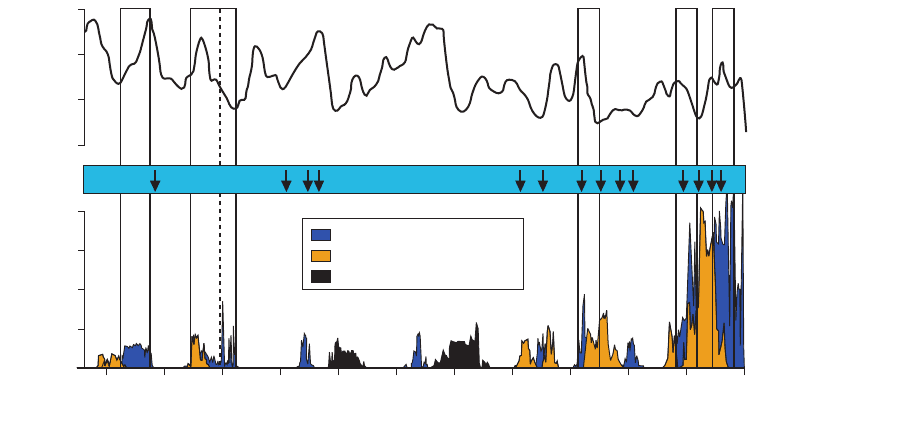
events. Focus on the late Holocene portions of the records from Spain (Figure 8.7),
Poland, and Britain suggests that Europe-wide flooding episodes centered on 3500,
2750, 2550, 1900, 1300, 870, 660, and 570 years BP (approximate ages; Macklin
et al. 2006) tend to correspond to phases of increased moisture balance revealed in
..
9781405159050_4_008.qxd 6/3/08 3:58 PM Page 203
..
204
|
Dirk Verschuren and Dan J. Charman
..
low-frequency proxy records (Figure 8.4b). This supports the idea that flooding is
linked to (multi-) decadal shifts in summer water balance. In the case of Britain
these changes may have been caused by semi-permanent southward shifts in
westerly circulation, which increased summer precipitation, groundwater levels,
and soil moisture. This would increase catchment susceptibility to flooding from
extreme rainfall events, even if these events were no more frequent during these
periods with cooler, wetter summers.
In an ingenious application of dendroclimatology, Masson-Delmotte et al.
(2005) used the stable-isotope composition of tree-ring cellulose to reconstruct
drought frequency and precipitation seasonality over the past 400 years in western
France (Brittany: 48°N, 2°W). Using multiple linear regression the authors derived
a relationship of oak latewood δ
18
O, δ
13
C (corrected for progressive atmospheric
13
C depletion due to fossil-fuel emissions) and ring width to water stress, i.e. the
ratio of actual evapotranspiration to potential evapotranspiration calibrated
over the reference period 1951–1996 (Raffalli-Delerce et al. 2003). At the decadal
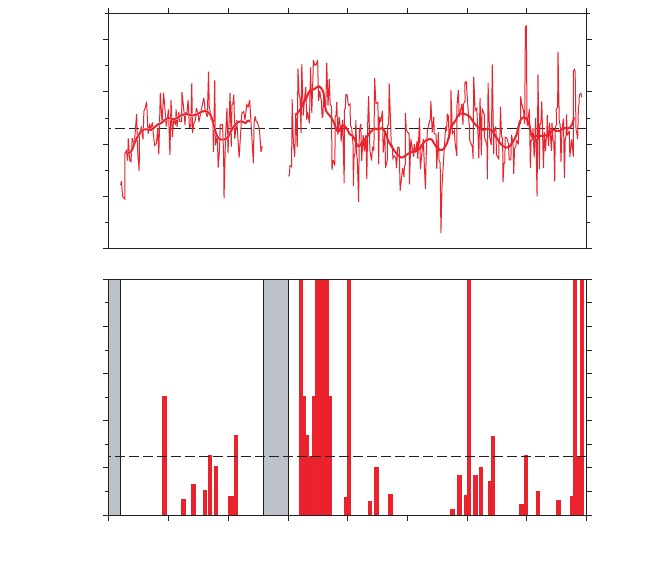
time-scale, the resulting 400-year water-stress reconstruction (Figure 8.8a) shows
significant (inverse) correlation with historical wine-harvest dates, a regional
proxy indicator for dry and warm summer conditions. Combined with instru-
mental rainfall records, the data suggest a widespread change in the seasonality
of western European precipitation during the early 19th century towards drier
winters and wetter summers. The authors also produced a drought recurrence
record based on the frequency of years with water stress values exceeding one
15
1 2a 2b 345
10
5
0
0
0.02
11 000 10 000 9000 8000 7000 6000
Alluvial deposits
Slackwater flood deposits
Floodbasin facies
Calibrated years BP
}
}
5000 4000 3000 2000 1000 0
0.04
Probability per year Percent of drift ice
lithic indicators
UK fluvial activity
FE: Extreme
flood episodes
Figure 8.7 Holocene fluvial chronology of Spain in
relation to the North Atlantic drift-ice record (Bond et al.
2001). (From Thorndycraft and Benito (2006). Copyright
Elsevier (2006).)
9781405159050_4_008.qxd 6/3/08 3:58 PM Page 204
Latitudinal linkages in moisture-balance variation
|
205
..
standard deviation above the 1951–1996 mean (Figure 8.8b). The most notable
climate anomalies in this record are the high drought recurrence in the late
20th century, exceeded only by a period of persistent extreme summer drought
ca. 1765–1780.
Tropical Africa, extending into monsoonal Asia
Millennial-scale moisture-balance variation through the Holocene
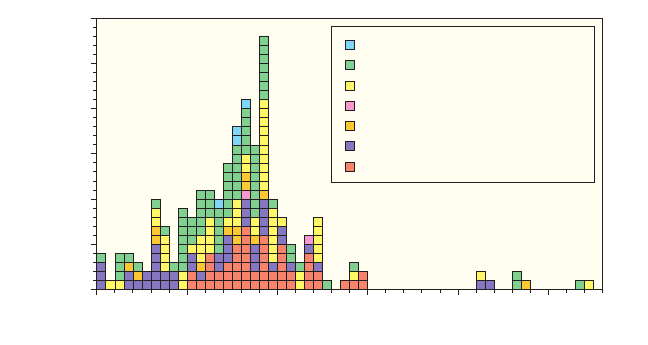
Street and Grove (1976; Figure 8.9) compiled the first millennial-scale lake-status
dataset for tropical Africa comparable to the European Lake Level database;
Kutzbach and Street-Perrott (1985) expanded this dataset to tropical lakes world-
wide. Many contributing lake-level chronologies have since been modified to
correct for lake carbon reservoir ages and the reworking of plant macrofossils in
the beach and lowstand deposits where they were found. This aggregate data-set,
however, still succeeds in illustrating the two drastic dry-to-humid transitions in
northern and equatorial Africa around 15 ± 0.5 and 11.5–10.8 ka (ca. 12 700 and
10 000–9500
14
C years BP, respectively on Figure 8.9). The dry-to-humid transi-
tion at ca. 15 ka represents the start of the so-called African Humid Period
..
(b)
(a)
0
0.2
0.4
Drought recurrence index
Water stress index α
0.6
0.8
1.0
0.8
0.7
0.6
0.5
0.4
20001950190018501800
Year AD
175017001650
1600
Figure 8.8 (a) Summer
water stress (ratio of actual to
potential evapotranspiration)
in western France since ad
1600, reconstructed using oak
tree-ring width and isotopic
composition calibrated
against the reference period
1951–1996. (b) Recurrence
of extreme summer drought
(> 1 SD above the mean of
1951–1996) calculated from
the water stress record. The
long-term mean drought
recurrence is once every four
years (index value 0.25);
shaded bars indicate gaps in
isotopic data. (From Masson-
Delmotte et al. (2005) with
kind permission from
Springer Science and Business
Media.)
9781405159050_4_008.qxd 6/3/08 3:58 PM Page 205
..
206
|
Dirk Verschuren and Dan J. Charman
..
(deMenocal et al. 2000), when fairly abrupt intensification of the northern
Summer Monsoon (e.g. Williams et al. 2006) ended a continent-wide drought
linked to Heinrich event 1 (Stager et al. 2002; Lamb et al. 2007a). Most proxy data
agree that tropical Africa was also dry during the Last Glacial Maximum (LGM;
ca. 21–18 ka) and the Younger Dryas episode (YD; ca. 12.8–11.5 ka) (Gasse 2000;
Barker and Gasse 2003; but see Garcin et al. 2006). Paleoclimate research over the
past two decades, mostly based on lake-sediment records scattered across north-
ern and eastern Africa, has elucidated the broad latitudinal patterns of Holocene
moisture-balance variation across the African continent (Gasse 2000). Through-
out northern (sub-) tropical and equatorial Africa these provide strong support
for precessional insolation forcing to have been the dominant driver of Atlantic
and Indian Ocean monsoon dynamics and moisture advection at this time-
scale, through its control on the mean latitudinal position of the Intertropical
Convergence Zone (ITCZ; Haug et al. 2001). To what extent (sub-) tropical south-
ern Africa experienced the predicted anti-phased patterns of Holocene hydrologic
change has only partly been resolved (Barker et al. 2004; Scott and Lee-Thorp
2004). Many southern lakes recorded a dry LGM followed by wet conditions
between ca. 15 (17) and ca. 13 ka, indicating that immediately prior to the
Holocene glacial boundary conditions dominated over low-latitude insolation
forcing (Barker and Gasse 2003). These same lakes (e.g. Lake Rukwa at 8°S, Lake
Malawi at 12°S) show decreasing water levels during or immediately after the YD
and into the early Holocene (Gasse et al. 2002; Thevenon et al. 2002), reflecting a
less favorable regional moisture balance, due at least partly to northward displace-
ment of the meteorologic Equator. They also record a return of modestly wetter
conditions over the past 3000–5000 years, opposite to the pronounced drying
trend experienced by the Northern Hemisphere tropics during the middle and late
Holocene (Gasse 2000). Early Holocene establishment and persistence of wood-
land vegetation tolerant to a prolonged dry season in south-eastern tropical Africa
Frequency
30
25
20
15
10
5
0
0 5000 10 000 15 000
14
C year BP
20 000 25 000
Jebel Aulia, Sudan
Ethiopia and T.F.A.I.
East Africa
Hoggar
Mauritanian sebkhas
Chad, MegaChad, Niger oases
Tibesti, basins fed by Tibesti runoff
Figure 8.9 Frequency of
stratigraphic evidence for
intermediate or high lake
status in seven regions of
(sub-) tropical north and
equatorial Africa since 30 000
14
C years BP, highlighting the
early Holocene Humid
Period. (From Street and
Grove (1976). Reprinted by
permission from Macmillan
Publishers Ltd: Nature.)
9781405159050_4_008.qxd 6/3/08 3:58 PM Page 206
Latitudinal linkages in moisture-balance variation
|
207
..
suggested to Garcin et al. (2007a) that resumption of the African monsoon at the
YD–Holocene transition must have been accompanied by greater latitudinal
amplitude of seasonal ITCZ migration over eastern Africa.
Century-scale moisture-balance variation during the
early to middle Holocene
A current major issue in African paleoclimate research is the regional expression
of sub-Milankovitch climate variability. Speleothem records of Indian and Asian
monsoon intensity (Neff et al. 2001; Fleitmann et al. 2003; Wang et al. 2005)
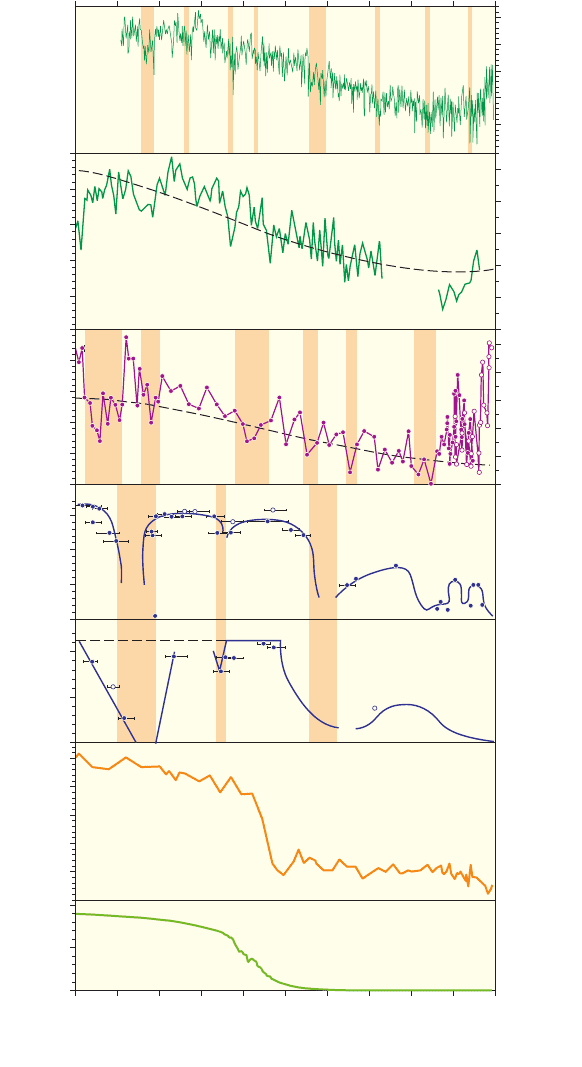
suggest Holocene hydrologic change in the Northern Hemisphere sub-tropics to
have been a rather smooth adjustment to the gradual southward migration of
mean annual ITCZ position in response to the orbitally induced latitudinal shift in
summer solar insolation (Figure 8.10a–c). For example the Dongge Cave record
from sub-tropical China (Wang et al. 2005; Figure 8.10a) closely tracks summer
insolation at 30°N, except for eight relatively modest century-scale events inferred
to reflect episodes of weakened monsoon activity, and minor additional modula-
tion by multi-decadal solar-activity changes. Six of these weak monsoon events
coincide, within dating error, with the Northern Hemisphere cold episodes first
recorded as episodes of peak ice-rafted debris abundance in marine sediments
(Bond et al. 2001). A high-resolution marine sediment record from the Arabian
Sea (Gupta et al. 2003) also mainly recorded the long-term trend of decreasing
Indian monsoon intensity, however, with somewhat stronger signatures of
inferred weak monsoon episodes superimposed on it (Figure 8.10d).
The above-mentioned proxy records of predominantly gradual monsoon
weakening during the Holocene contrast with many lake-level records of hydro-
logic variability in eastern Africa and south Asia, which are punctuated by abrupt
century-scale dry spells with a magnitude rivaling that of the main Holocene
drying trend (Gasse and van Campo 1994; Figure 8.10f and g). The two best-
documented drought episodes, at ca. 8400–8000 and 4200–4000 years BP (Gasse
2000), broadly match the timing of the two most pronounced weak monsoon
episodes in the Dongge Cave speleothem record, and thus can be considered coin-
cident with Bond events 5 and 3 (Mayewski et al. 2004). The 4200–4000 years
BP drought similarly had widespread impact, having been linked to the demise
of ancient cultures from Egypt (the Old Kingdom: deMenocal 2001) over
Mesopotamia (the Akkadian Empire: Weiss 2000) and India (Indus valley civiliza-
tion: Staubwasser et al. 2003) to China (Wu and Liu 2004).
Lake-status data from the Sahara, the Arabian Desert, and adjacent sub-arid
regions (Hoelzmann et al. 2004) suggest that across these regions the early
Holocene wet period ended in a succession of two pronounced dry spells at
6700–5500 and 4000–3600 years BP. Even more extreme, the marine sediment
record of eolian deposition in the sub-tropical North Atlantic Ocean adjacent to
the West African Sahara suggests that it ended abruptly in a single episode of rapid
..
9781405159050_4_008.qxd 6/3/08 3:58 PM Page 207
..
208
|
Dirk Verschuren and Dan J. Charman
..
(a)
(b–c)
(f)
Lake Abhé
Lake Ziway
Shala
(g)
(h)
(i)
0
0.5
1
60
50
55
45
40
0
0
50
100
150
5
10
15
20
25
30
–9.0
–8.5
–8.0
–7.5
G. Bulloides (%)
δ
18
O (‰ VPDB)
δ
18
O (‰ VPDB)
Insolation 30°N
JJA
(
Wm
–2
)
Insolation (Wm
–2
)
–7.0
500
490
480
470
460
560
540
520
500
480
460
–0.5
–1.0
–1.5
–2.0
–2.5
50
100
0200040006000
Years BP
800010 000
432105
(d–e)
??
9781405159050_4_008.qxd 6/3/08 3:58 PM Page 208
Latitudinal linkages in moisture-balance variation
|
209
..
aridification ca. 5500 BP (deMenocal et al. 2000; Figure 8.10h). An important
question is whether these disparate records of Holocene moisture-balance change
truly reflect large-scale regional differences in climate history, or are a function of
proxy- and archive-specific factors. For example, the otherwise widespread hyper-
arid spell at 8400–8000 years BP has so far not been recorded at lake sites in the
eastern Sahara desert, presumably because of the buffering effect of fully recharged
regional aquifers at that time (Hoelzmann et al. 2004). Model simulations of
mid-Holocene aridification of the Sahara (Claussen et al. 1999) suggest that the
nonlinear climate response to gradual insolation forcing observed in the marine
dust record results from vegetation–atmosphere feedbacks, namely the albedo
effect of changing vegetation on monsoonal rainfall penetrating the continent
(Figure 8.10i; see also Renssen et al. (2006) and Claussen, this volume). Notably
in this study the exact timing of Sahara aridification (5800–5300 years BP in vari-
ous model runs) depended on prescribed values for North Atlantic sea-surface
temperature (SST) and sea-ice cover, which through a vegetation–snow–albedo
feedback on boreal vegetation affected the meridional temperature gradient and
hence Northern Hemisphere summer monsoon intensity.
Exactly when aridification culminated in the (near-) complete loss of vegetation
cover at the local scale would have depended both on the absolute rainfall amount
and on the rate of lowering of the regional groundwater table, possibly generating
a simultaneous threshold response over large areas. Conversely, the hydrologic
..
Figure 8.10 (Opposite) Selected high-resolution moisture-balance records for sub-
tropical monsoon regions in Africa and Asia covering the Holocene. Shaded bars are weak
monsoon events in (a) and (d), and arid episodes in (f) and (g); insolation is the hatched
line in (c) and (e). (a) Asian monsoon strength inferred from stalagmite δ
18
O in Dongge
Cave (sub-tropical China), with indication of weak monsoon events coeval with North
Atlantic cold events (numbered). (From Wang et al. (2005). Reprinted with permission
from AAAS.). (b) Indian monsoon strength inferred from stalagmite δ
18
O in southern
Oman compared with (c) summer (JJA) insolation at 30°N (from Fleitmann et al. (2003).
Reprinted with permission from AAAS), with insolation curve based on Berger and Loutre
(1991). (d) Indian monsoon strength inferred from Globigerina bulloides abundance in
sediments from an upwelling zone in the Arabian Sea compared with (e) July insolation at
65°N (from Gupta et al. 2003 – reprinted by permission from Macmillan Publishers Ltd:
Nature), with insolation curve based on Berger (1978). (f and g) Rainfall in north-east
Africa inferred from the surface elevations of Lakes Abhé and Ziway Shala, Ethiopia. (From
Gasse (2000). Copyright Elsevier (2000).) (h) Terrigenous input in marine sediments from
the eastern tropical Atlantic Ocean. (From deMenocal et al. (2000). Copyright Elsevier
(2000).) (i) Fractional vegetation cover in the Sahara desert simulated using a CLIMBER-2
coupled atmosphere–ocean–vegetation model of intermediate complexity (From Claussen
et al. (1999). Copyright [1999] American Geophysical Union. Reproduced by permission
of American Geophysical Union.)
9781405159050_4_008.qxd 6/3/08 3:58 PM Page 209