
Bernatz R. Fourier Series and Numerical Methods for Partial Differential Equations
Подождите немного. Документ загружается.

142 HEAT TRANSFER IN 2D AND 3D
The orthonormality of the eigenfunctions X
n
(x) and Y
m
(y) gives
rC pd
X
n
(x)Ym(y)Xr(x)Ys(y)dydx = { J
if n φ r or m ^ s
if n = r and m = s
(6.17)
Therefore, if coefficients .A
nm
exist such that Equation (6.16) is true, then
pc pd
A
nm
= I X
n
(x)Ym{y)f(x,y)dydx (6.18)
Jo Jo
6.1.1 Example: Homogeneous IBVP
The solution procedure outlined in the Section 6.1 is used to solve the following
homogeneous IBVP,in two dimensions:
( u
t
(x,y,t) = k[u
xx
(x,y,t) +u
yy
{x,y,t)]
u(x,y,0) = f(x,y)
IBVP<
(PDE)
(IC)
u
y
(x, 0, t) = 0 0 < x < c (BC1)
u\c, y,t) = 0 0 < y < d (BC2)
u\x, d,t) = 0 0<x<c (BC3)
I w(0,2/,i) = 0 0<y<d (BC4)
(6.19)
Note the temperature is held at the constant value of zero at all boundaries except
that for y = 0, where the boundary is insulated. The problem is said to have
mixed boundary conditions because two types of boundary conditions (Dirichlet and
Neumann in this case) are specified.
The Dirichlet-Dirichlet boundary conditions on the function X mean the eigen-
values are
, 2
a„
and the eigenfunctions are
(T)'
Xn(x)
n = 1,2,3,...
- sin a
n
x
The Neumann-Dirichlet boundary conditions for the Sturm-Liouville problem in
Y result in eigenvalues of
2 i'(2m
—
1)π
/r =
with associated eigenfunctions
2d
m
—
1,2,3,...
Ym(y) = \ -cosß
m
y
V
a
SEMIHOMOGENEOUS 2D IBVP 143
Suppose the initial temperature distribution is given by
il 0.8 < x < 1.2 and 0.3 < y < 0.7
ffay) = \ " " "
t 0 otherwise
If k = 0.1, c = 2 and d = 1 the temperature u(x, y, t) is given by
u(x,y,t) =
Σ Σ
A
™™
(ψ)
c
-((
2
- - D^)e-°
01
[
(¥)
^"^l*
n—1 ra=l
where
Aim = / / /(a:,
2/)
sin ( —— j y/2 sin((2m - l)ny)dydx
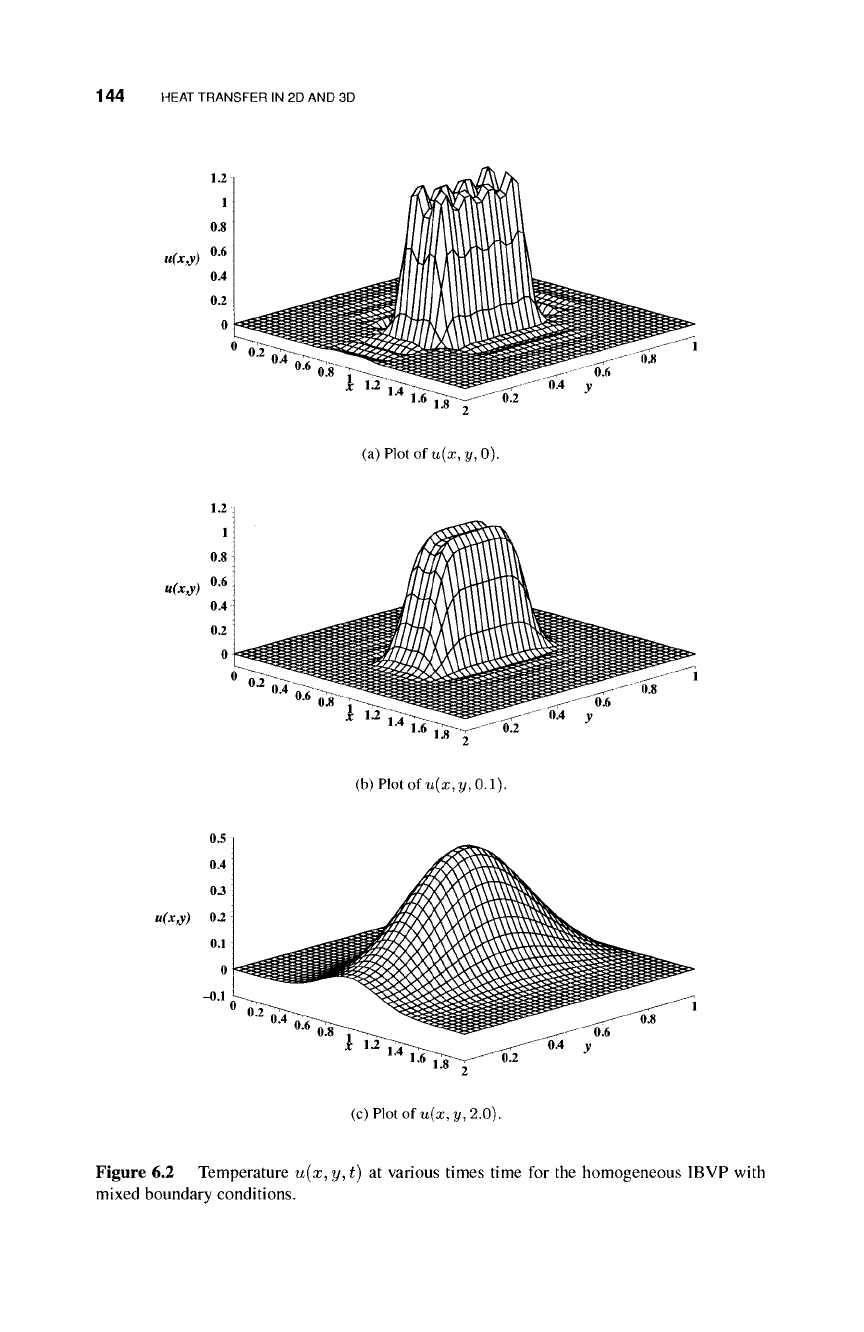
The temperature u(x,y,t) for various times £ is plotted in Figure 6.2. The
graph of u(x, y, 0) is shown in Figure 6.2(a), which shows how the double Fourier
series matches the discontinuous initial temperature f(x,y) distribution within the
rectangular region. The Fourier representation in this example is constructed with m
and n = 20. It has some difficulty at the "edges" of the nonzero section of /(x, y).
The temperature distribution appears much smoother for time t — 0.1, as shown in
Figure 6.2(b). The temperature is fixed at zero at three of the four boundaries, and
insulated where y = 0, so as time increases, the overall temperature of the material
will decrease to zero at all locations, including the insulated boundary. However, the
temperature at the points on this boundary remains positive as indicated in Figure
6.2(c). Note that the vertical scale (the temperature) is less in Figure 6.2(c) so that
the Neumann condition may be more clearly seen.
6.2 SEMIHOMOGENEOUS 2D IBVP
A general semihomogeneous 2D IBVP is outlined in IBVP (6.20). The nonhomoge-
neous nature of the IBVP is contained in the PDE where the internal heat source or
sink function q(x, y, i) is included.
ut = k [u
xx
+ u
yy
] + q(x, y, t) (PDE)
U(X,Î/,0) = /(X,Î/) (IC)
aiu(x,0,t)+a
2
u
x
(x,0,t) = 0 0<x<c (BC1)
(
6
·
20
)
IBVP<
hu(c,y,t) + b
2
u
x
(c,y,t) =0 0 < y < d (BC2)
c\u{x,d,
t) + C2U
x
(x, d, t) = 0 0<x<c (BC3)
diu(0,í/,í) +d
2
Mx(0,y,i) = 0 0 < y < d (BC4)
The method for solving the semihomogeneous IBVP in 2D is like that for the ID
case where variation of parameter methods were used. For the 2D, case we begin by
assuming a solution of the form
OO OO
u(x, y, t) = Σ Σ A
n
m{t)X
n
{x)Ym{y)e-
k(al+ß
^
)t
(6.21)
n=0 m=0
144 HEAT TRANSFER IN 2D AND 3D
u(x,y)
1.2 i
lj
0.8 \
0.6
0.4
0.2
0.6
0.4 y
(a)Plotofu(rr,y,0).
u(x,y)
(b) Plot ofu(x,y, 0.1).
(c) Plot ofu(x,y, 2.0).
Figure 6.2 Temperature w(x, y, í) at various times time for the homogeneous IBVP with
mixed boundary conditions.
SEMIHOMOGENEOUS 2D IBVP
145
where the double Fourier coefficients A
nrn
(t) are time-dependent parameters to be
determined. As in the ID case, the actual form of u(x,y,t) used in the solution
process is
oo
oo
u(x,tf,
t)
= Σ Σ
B
nrn
{t)X
n
{x)Y
m
(y) (6.22)
n=0 ra=0
where
The heat source or sink term q(x, y, t) will be represented by the double Fourier
series
oo
oo
q(x, y, t) = Σ Σ
Qnm(t)Xn(x)Ym(y)
(6.23)
n=0 m=0
where
Qnm(t)
= /
q(x,y,t)X
n
(x)Y
m
(y)dydx (6.24)
Jo
Jo
Substituting the expression for u{x, y, t) in Equation (6.22) and the expression for
q(x, y, t) in Equation (6.23) into the PDE of IBVP (6.20) gives
oo
oo oo oo
£
£
B'
nm
(t)X
n
(x)Y
m
(y)
=
ΣΣ-1;[αΙ+
ß
2
m
]
B
nm
(t)X
n
(x)Y
m
(y)
n=0 m=0
oo
oo
+
Σ Σ
Qnm(t)Xn(x)Ym(y) (6.25)
n=0m=0 n=0m=0
oo
oo
n=0 m=0
v2
V (~\
α«Λ
V"f„\
—
—fß
where the facts that X'¿(x)
=
-ο%Χ
η
(χ) and
Y^(y) =
-ßm
Y
m(y) are used to
write the derivatives of
X
and
Y
in terms of
X
and
Y,
respectively.
Assuming equality in the double series expressions implies equality of the corre-
sponding individual terms implies
B'
nm
(t)
+ k
[a
2
n
+ ßl]
B
nm
(t)
=
Q
nm
(t)
(6.26)
for each nra-term,
n =
0,1,2,... and m
=
0,1,2, Equation (6.26) is
a
first-
order, linear, nonhomogeneous differential equation for each nm-pair. The solution
to a given nm-equation is found through the use of an integrating factor
so that
B
nm
(t)
= e-
fe
K+Ä)'
f
Qnro(T)e
*(<*+/£)T
dT
+
Cmne
-k(
a
'
n+
fi'
m
)t
(62Ί)
Jo
Using the initial condition
B
nm
(0)
=
A
nm
(0)e-
k
^+^°
—
A
=
Γ /
/(^,2/)^n(^)^m(2/)d^x (6.28)
JO
JO
146 HEAT TRANSFER IN 2D AND 3D
it follows that
re pd
C
n
m=
/ f(x,y)X
n
(x)Ym(y)dydx
Jo Jo
so that the formula for B
nm
(t) is
B
nm
(t)
= e-
k
^
+
^y\fQ
nm
{r)e
k
^
+
^>dr
VJo
+ f(x,y)Xn(x)Ym(y)dydx\
Jo Jo
(6.29)
where
rC pd
if
Jo Jo
Qnm{t)= / q(x
1
y,t)X
n
(x)Y
m
(y)dydx
IBVP<
This solution procedure is used in the following example of
an
internal heat source
and sink.
6.2.1 Example: Internal Source or Sink
The following semihomogeneous IBVP is solved in this section. The problem domain
is the unit square given by [0,1] x [0,1] = {(x, y)\0 < x < 1 and 0 < y < 1}. The
thermal diffusivity k
—
0.01
u
t
= 0.01 [u
xx
+
Uyy)
+ q(x, y, t) (PDE)
u(x,y,0)=0 (IC)
w(x,0,í)
=
0 0<x<c
(BC1)
(6.30)
Mx(l,2/,t)
=
0
0<y<d (BC2)
u{x,
1,
i)
=
0
0<x<c (BC3)
i¿(0,2/,t)
=
0
0<y <d (BC4)
The initial temperature distribution is zero for all (x, y). The internal source or sink
function is defined as
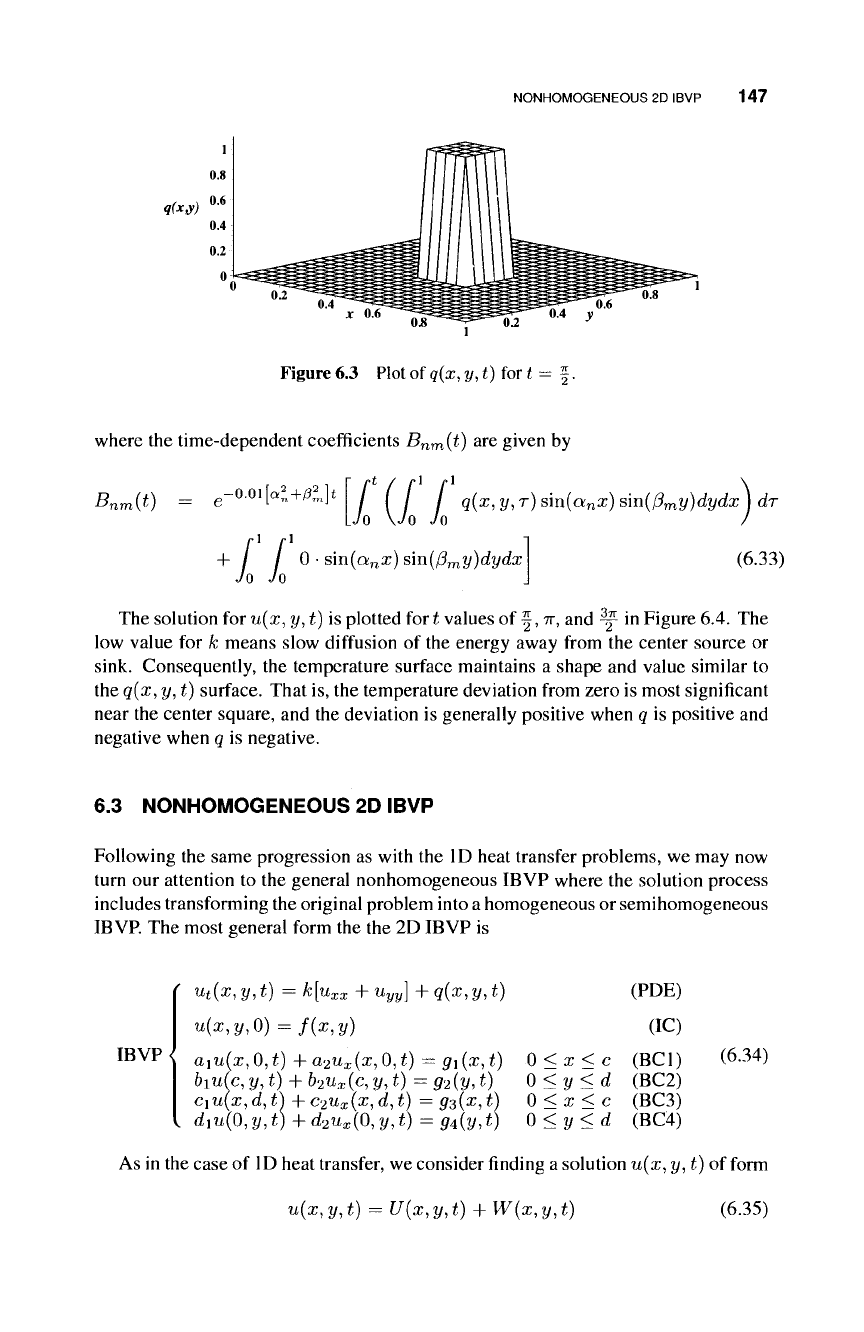
f sint 0.4 < x < 0.6 and 0.4 < y < 0.6
q(x,V,t) = {
n
^ " . " - - (6.31)
t 0 otherwise
so that the center square region, 0.2 units on a side, fluctuates between a source of
one unit and a sink of one unit. Figure 6.3 shows a plot of q for t = | when the
source is at its maximum of one. Although the plot of q in Figure 6.3 suggests the
q surface is continuous, the surface has discontinuities on the boundary of the center
square.
The boundary conditions BC2 and BC4 result in eigenvalues a
n
= ^
n
~ ^ and
eigenfunctions X
n
(x) = sina
n
x for n — 1,2,3,... . Boundary conditions BC1
and BC3 give eigenvalues of
/3
m
= πιπ and eigenfunctions Y
m
(x) — smß
m
y for
m = 1,2,3,... . Consequently, the double series solution for u(x,
?/,
t) is given as
oo oo
u(x,
2/,
i) = 5Z Σ
B
nm(t) sin(a
m
x) sin(ß
m
y) (6.32)
NONHOMOGENEOUS 2D IBVP 147
q(*,y)
Figure 6.3 Plot of q(x, y, t) for t = f.
where the time-dependent coefficients B
nm
(t) are given by
¿W¿) = e-
001
^^ [| (j j q(x,y,T)8m(a
n
x)sm(ß
m
y)dydx
>
\dT
+ / / 0 · sin(a;
n
x) sm(ß
m
y)dydx
Jo
Jo
(6.33)
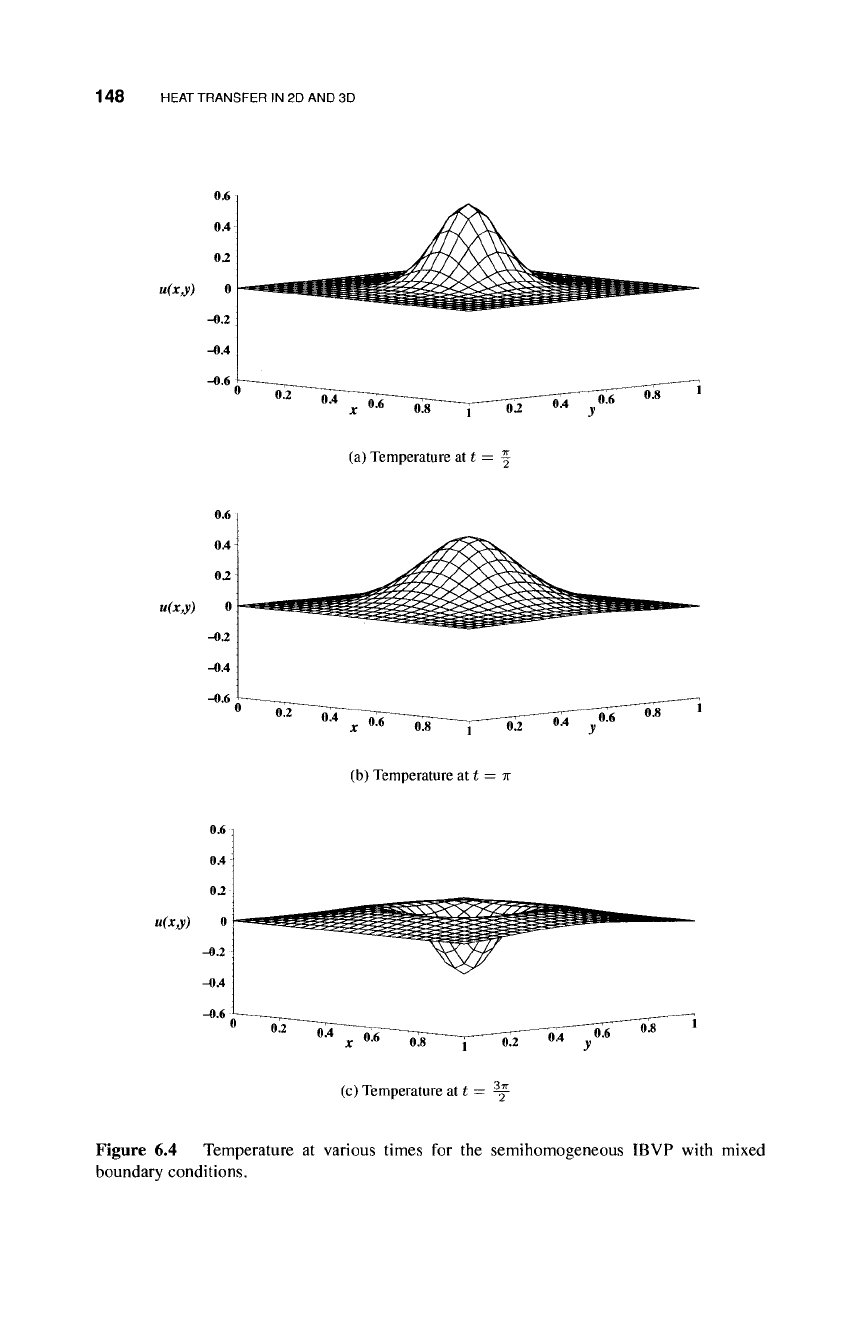
The solution for u(x, y, t) is plotted for t values of Ç, π, and ^y in Figure 6.4. The
low value for
A;
means slow diffusion of the energy away from the center source or
sink. Consequently, the temperature surface maintains a shape and value similar to
the q(x, y, t) surface. That is, the temperature deviation from zero is most significant
near the center square, and the deviation is generally positive when q is positive and
negative when q is negative.
6.3 NONHOMOGENEOUS 2D IBVP
Following the same progression as with the ID heat transfer problems, we may now
turn our attention to the general nonhomogeneous IBVP where the solution process
includes transforming the original problem into
a
homogeneous or semihomogeneous
IBVP.
The most general form the the 2D IBVP is
ut(x, y, t) = k[u
xx
+
Uyy)
+ q(x, y, t) (PDE)
U(X,Î/,0) = /(X,Î/) (IC)
a
1
u(x,0,t)+a
2
u
x
(x,0,t) = g
1
(x,t) 0<x<c (BC1)
(
6
·
34
)
biu(c, y, t) 4- b
2
u
x
(c, y, t) = g
2
{y, t) 0 < y < d (BC2)
c\u(x,d,
t) 4- C2U
x
(x,d, t)
—
gs(x,t) 0<x<c (BC3)
d
1
u{0,y,t)+d
2
u
x
(0,y,t)=g
4
(y,t) 0<y<d (BC4)
As in the case of ID heat transfer, we consider finding a solution u(x, y, t) of form
IBVP^
u(x, y, t) = U(x, y, t) + W(x, y, t)
(6.35)
148 HEAT TRANSFER IN 2D AND 3D
(a) Temperature at t = Ç
(b) Temperature at t
—
π
(c) Temperature at t -
Figure 6.4 Temperature at various times for the semihomogeneous IBVP with mixed
boundary conditions.
NONHOMOGENEOUS 2D IBVP 149
where U will be determined by separation of variables and Fourier series methods on a
semihomogeneous IBVP, and W satisfies the nonhomogeneous boundary conditions
of IBVP (6.34). Another condition placed on W will become evident as the details
unfold below.
We begin by substituting the expression for u(x, y, t) in Equation (6.35) into the
PDE of the IBVP (6.34).
U
t
(x, y, t) + W
t
(x, y,t) = k [V
2
U(x, y, t) + V
2
W(x, y, t)] + q(x, y, t) (6.36)
where
V = 1
dx
2
dy
2
Rearranging Equation (6.37) gives
U
t
(x,y,
t) = kV
2
U(x, y, t) + kV
2
W{x, y, t) + q(x, y, t) - W
t
(x, y, t) (6.37)
If we require
V
2
W(x,y,t)
= 0 (6.38)
then Equation (6.37) simplifies to
U
t
(x, y, t) = kV
2
U(x,y, t) + q(x,y, t) - W
t
(x, y, t) (6.39)
which will represent the nonhomogeneous PDE of a semihomogeneous IBVP for U.
Because the IBVP for U must have homogeneous boundary conditions, it follows
that any nonhomogeneous BCs of the original IBVP (6.34) must be satisfied by the
W function. Assuming such a W exists, the following semihomogeneous IBVP
defines the function U
U
t
= kV
2
U + q(x,y,t)-W
t
(x,y,t)
t/(x,y,0) = /(x,y)-W(a;,y,0)
IBVP<
(PDE)
(IC)
aiU(x, 0, t) + a
2
U
x
(x, 0, t) = 0 0<x<c (BC1)
hU(c,y,t) + b
2
U
x
(c,y,t) =0 0 < y < d (BC2)
cit7(x, d, t) + c
2
U
x
(x, d, i) = 0 0<x<c (BC3)
dit/(0,
y, ¿) + d
2
t/
x
(0, y, t) = 0 0<y<d (BC4)
(6.40)
Knowing that we can solve the IBVP (6.40) for U, the next task is determining
the function W that satisfies Equation (6.38) and the nonhomogeneous boundary
conditions of
the
original IBVP (6.34). To make this process simpler, we will assume
for the time being that the boundary functions g\ through
g±
are not time dependent.
This would imply that
W = W(x,y)
and the problem that defines
VF
is a BVP only. That is, we are looking for a function
W(x,y),
suchthat
BVP<
V
2
W(x,y)=0
a
1
W{x,0) + a
2
W
x
(x,0)
b
1
W(c,y) + b
2
W
x
(c,y)
ciW(x, d) 4- c
2
W
x
(x, d
diW(0,y)+d
2
Ws(0,y:
0i W
92\y)
9s(x)
94{y)
0<x<c
0<y <d
0 <x<c
0< y <d
(PDE)
(BC1)
(BC2)
(BC3)
(BC4)
(6.41)
150 HEAT TRANSFER IN 2D AND 3D
The PDE in the BVP is the Laplace equation in W. Eventually, we will consider
a BVP similar to (6.41), except the PDE will be the non-homogeneous Poisson
equation
V
2
W(x,y)
= f(x,y)
Section 6.4 will focus on methods for solving various BVPs.
6.4 2D BVP: LAPLACE AND POISSON EQUATIONS
Laplace and Poisson BVPs arise in many circumstances in physics, chemistry, and
engineering. We saw in Section 6.3 that a Laplace BVP results in our method for
solving general 2D nonhomogeneous IBVPs.
6.4.1 Dirichlet Problems
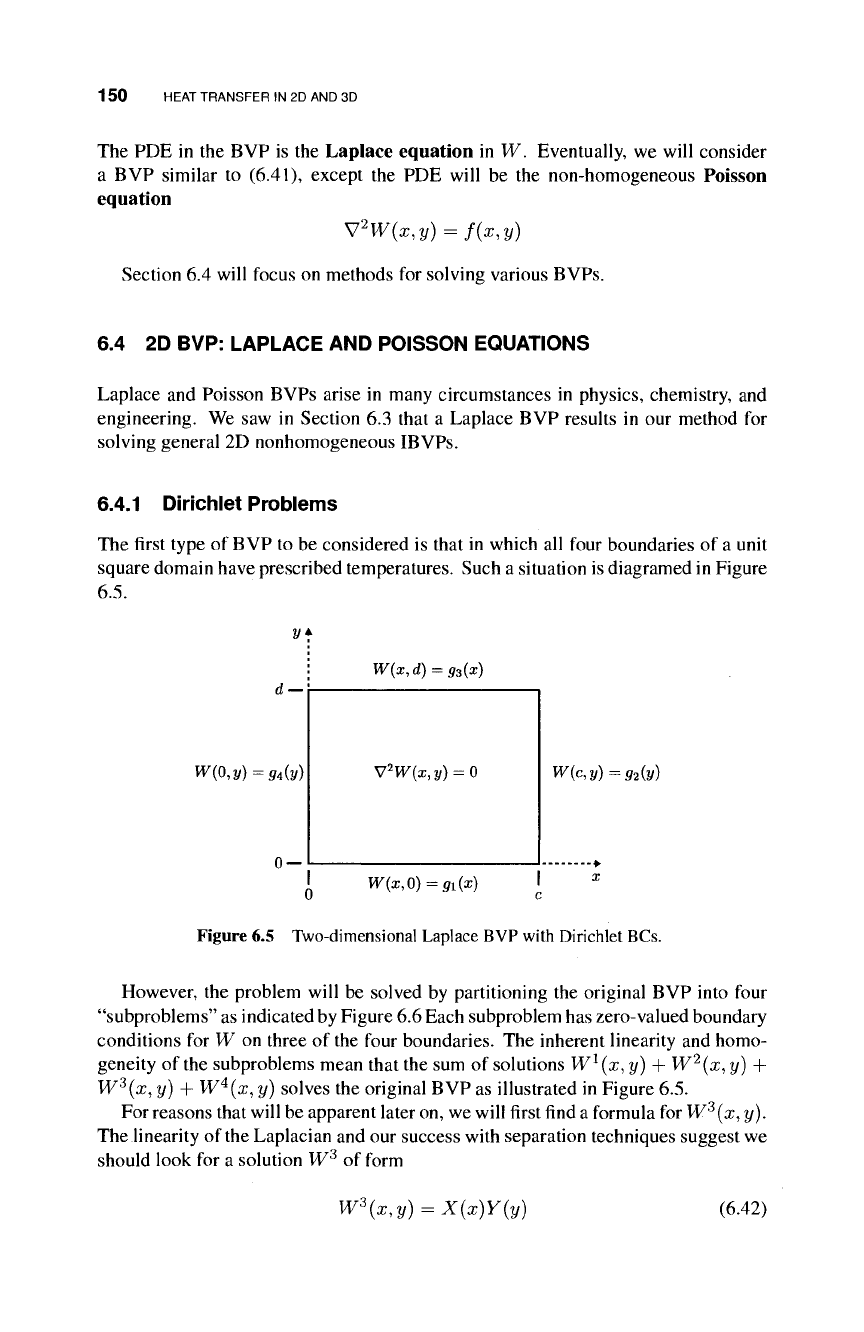
The first type of BVP to be considered is that in which all four boundaries of a unit
square domain have prescribed temperatures. Such a situation is diagramed in Figure
6.5.
v*
w(p,v)
= 9A(y)
W(x,d)=g
3
(x)
V
2
W(x,y)=0
W(x,0) =
gi
(x)
W{c,y) =g
2
(y)
Figure 6.5 Two-dimensional Laplace BVP with Dirichlet BCs.
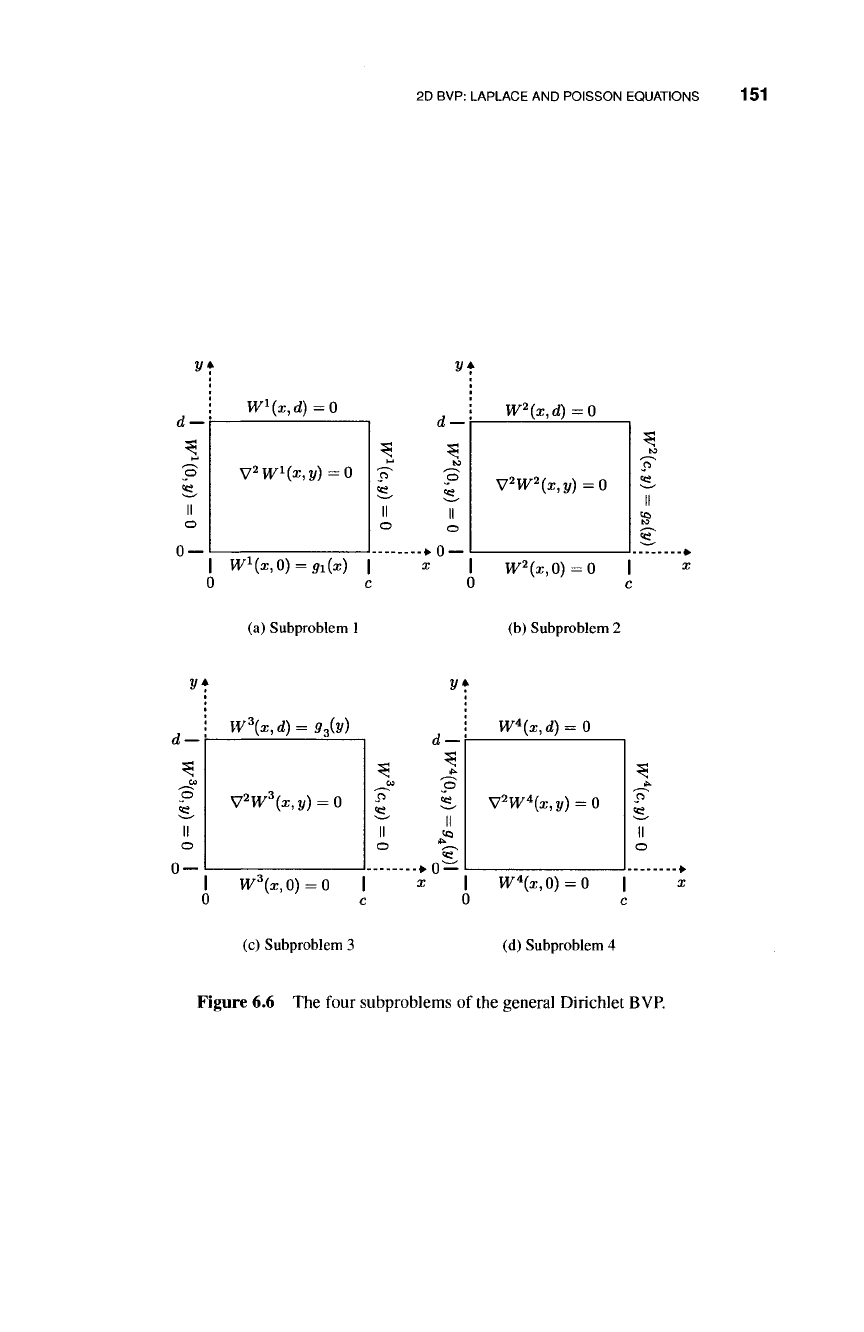
However, the problem will be solved by partitioning the original BVP into four
"subproblems" as indicated by Figure 6.6 Each subproblem has zero-valued boundary
conditions for W on three of the four boundaries. The inherent linearity and homo-
geneity of the subproblems mean that the sum of solutions W
1
(x^ y) + W
2
(x, y) +
W
3
(x, y) 4- W
4
(x, y) solves the original BVP as illustrated in Figure 6.5.
For reasons that will be apparent later on, we will first find a formula for W
3
(x, y).
The linearity of
the
Laplacian and our success with separation techniques suggest we
should look for a solution W
3
of form
W
3
(x,y)=X(x)Y(y)
(6.42)
2D BVP: LAPLACE AND POISSON EQUATIONS 151
(a) Subproblem 1 (b) Subproblem 2
2/f
V*
W
3
(x,d)
= g
3
(y)
W
4
(x,d)
= 0
CD
II
o
V
2
W
3
(x,y)
= 0
W
3
(x,0)
= 0
-♦►0
x
l
—
O
^L
II
<0
*s-~v
«Cf
V
2
W\x,y)
= 0
W
4
{x,0)
= 0
3
*».
II
o
(c) Subproblem 3 (d) Subproblem 4
Figure 6.6 The four subproblems of the general Dirichlet BVP.