
Bernatz R. Fourier Series and Numerical Methods for Partial Differential Equations
Подождите немного. Документ загружается.

122 HEAT TRANSFER IN 1D
for which a solution for A(t) and B(t) is guaranteed if the determinant
α2&ι
—
a\b\c
—
a\b2
is not zero. Because the IBVP in question pertains to ID heat transfer, we know that
for many applications a\ = hi,
ct2
=
—«1,
i>i = h^ and 62 = «2» and each of these
constants are non-negative. The determinant is then given by
—/i2^i — h\h2C
—
/11K2
which is zero if both h\ and /12 are zero. This is the case when flux is prescribed at
both boundaries. See Exercise 5.5 for a possible way to overcome this shortcoming.
We will assume that A(t) and B(t) can be determined. What is left to do is solve
the semihomogeneous IBVP for U(x, t) outlined as
IBVP<
U
t
= kU
xx
(x,t)+q*(x,t), 0<x<c (PDE)
U(x,0) = f*(x) (IC)
(5>28)
oi£/(0,
t) + a
2
U
x
(0, t) = 0 (BC1)
61
t/(c, t) + 6
2
C/
X
(c, i) = 0 (BC2)
where q*(x,t) = q(x, t) - A'(t)x- B'(t) and/*(x) = u(x,0)-A(0)x-B(0). The
semihomogeneous IBVP (5.28) is solved using the variation of parameter methods
described in Section 5.2 to determine a series solution for U(x,t). This solution
is used to express the solution u(x,t) to the original IBVP (5.24). Section 5.3.1
provides an example of this solution technique.
5.3.1 Example: Nonhomogeneous Boundary Condition
The example presented in this section pertains to an infinite slab with faces at x = 0
and x = c. The face at x = 0 is insulated, while the temperature T
s
of the
surroundings is maintained at x = c. The resulting IBVP for this situation is
IBVP
<
^'
} = xy
~
X) K
^> (5.29)
Ut
—
ku
xx
(x,t), 0 < x < c
u(x,0)
—
x(l
—
x)
u
x
(0,i}=0
hu(c,t) 4- Ku
x
(c,t)
—
hT
s
(PDE)
(IC)
(BC1)
(BC2)
The positive constant k is the thermal diffusivity, h is the heat exchange coefficient,
and K is a positive constant representing the conductivity of the material. Here,
q(x, t) = 0 and f(x) = x(l - x) in IBVP (5.24).
Using the methods outlined in Section 5.3, we assume a solution u(x, t) of form
u(x, t) = U{x, t) + xA(t) + B(t)
Substituting for u(x,t) in IBVP (5.29) results in the homogeneous IBVP for U as
shown below.
NONHOMOGENEOUS BOUNDARY CONDITIONS 123
U
t
=
kU
xx
(x,
t), 0 < x < c (PDE)
IBVP ^
U
^
x
' °)
=
^
1
~
χ
) ~
Ts (IC)
(5.30)
U
x
(0,t)=0
(BC1)
/i£7(c,
t) + nU
x
(C,
£)
= 0 (BC2)
and the determination of A(t) and B(t) with
A(t) = 0 and B(t) = T
s
Consequently, the functions q*(x, t) and /*(x,
£)
are
g*(x,¿) = ^(χ,ί)-^
/
(ί)-
β/
(*) =0-χ·0-0 = 0
and
f*(x)
= x(l -x)- A(0) - B(0) =
x(l-x)-0-T
8
Because q(x, t) is identically zero and neither A nor B are dependent on t, q* in this
case is zero so that the PDE in the transformed IBVP is homogeneous. Consequently,
the form of U(x, t) is
oo
U(x,t) = ^2a
n
X
n
(x)T
n
(t)
n=0
where a
n
has no t dependence as in the nonhomogeneous case.
In search of our
X
n
(x),
the following Strum-Liouville for X results.
X"{x)
+ XX (x) = 0 X'(0) = 0 -X(c) + X\c) = 0
The eigenvalues and eigenfunctions for
this
Sturm-Liouville case were determined
in Exercise 3.I.e. They are given below:
v2.
V
Λ.Λ- /
2h
¡
K
hc/κ + sin
2
a
n
c
λ
η
= α
η
; Χ
η
{χ) = Λ
Τ
— —^^ cosa
n
x
h/κ,
tana
n
c= n
—
1,2,3,...
The ODE for T is
T\t) + k\
n
T(t) = 0 with λ
η
= α
2
(5.31)
Consequently, the solutions of Equation (5.31) are constant multiples of
T
n
(t) = e-**'*
Combining the results for X and T give the form of C/
n
(x,
¿).
That is,
2/i 2
U
n
(x,t)
= \l-—— costtnxe"^* n = 1,2,3,..,
l/
he + sin a;
n
c
124 HEAT TRANSFER IN 1D
Applying the Generalized Linearity principle, we know the function U(x,t),
defined as the series
U(x,t) = ^2,a
n
U
n
{x,t)
n=l
satisfies the homogeneous PDE and BCs of IBVP (5.30).
What remains of the solution process is to determine a
n
so that U(x,t) satisfies
the nonhomogeneous initial condition of IBVP (5.30). That is, find a
n
such that
2h/n
;
4-
sin
The orthonormal nature of the eigenfunctions assure us that when
U(x,0) = y^
A
-— —~ cosa
n
x = x(l
-x)-T
s
j^
y hcjK 4- sin a
n
c
a
n
= / \ T—, —Ö cosa
n
x I (x(l - x) -
T
s
)dx
(5.32)
Jo
V
y
hc/K,
4-
sin a
n
c I
the series converges to the value
f(x+) - T
s
+ f(x-) - T
s
2
for all x in (0,
c).
(Refer to Section 2.13.)
The solution to the original IBVP (5.29) is obtained by adding the term T
s
to the
result for U(x,t). That is,
u(x,t) =
U{x,t)+T
8
(5.33)
cos(a
n
x)e-^
i
+ T
s
(5.34)
2h
/
K
_^. »\„-<*u
v
hc/κ -f- sin a
n
c
n=l V
where a
n
is given by Equation (5.32) and a
n
satisfies
h
tana
n
c = —
In order to visualize the solution, values will be provided for the constants in this
example. Let c
=
2, k = 0.01, κ = 0.1, and T
s
= 4. Calculation of u(x, t) is made
for two values of h to demonstrate the effect of the heat exchange coefficient of the
time-evolution of u. The first computation is made for h = 0.1. The temperature
surface u(x, t) is shown in Figure 5.3 for 0 < x < 2 and 0 < t < 100. The parabolic
shape of the initial temperature distribution is evident for t
—
0. As t increases, the
left-hand boundary temperature (at x — 2) increases to the limiting temperature of
T
s
= 4. The rate at which this temperature increases is controlled, in part, by the heat
exchange coefficient h. In this case, the temperature u{2,100) is « 2.5. When the
same calculation is done, but for h = 0.01, the left-hand boundary temperature at t
= 100 has reached an approximate value of 1.0, as evident in Figure 5.4.
NONHOMOGENEOUS BOUNDARY CONDITIONS 125
1 1.5 2
Figure 5.3 Plot of
the
material temperature u(x, t) for h
=
0.1.
u(xj)
Figure 5.4 Plot of
the
material temperature u(x, t) for h - 0.01.
5.3.2 Example: Time-Dependent Boundary Condition
In this section, we consider an example wherein the boundary condition on the left
face of our infinite slab is time-dependent. The details of the IB VP are
IBVP<
( u
t
= ku
xx
(x,t), 0<#<c (PDE)
u(x, 0) = 0 (IC)
(5.35)
M0,t)=0 (BC1)
[ hu{c, t) +
KU
X
(C,
t) = h(sint + 1) (BC2)
The IB VP (5.35) specifies there
is
no internal source of heat and the initial temperature
distribution is zero for all x. The face at x
=
0 of the infinitely long slab is insulated,
126 HEAT TRANSFER IN
1D
while Newton's law
of
heat transfer governs the boundary condition
at
x
—
c,
where
the temperature
of
the surrounding environment
is
given
by
sin
t + 1.
A solution
of
the form
u(x, t) = U(x, t) + A(t)x
4-
B(t) is
sought. The semiho-
mogeneous IBVP
for U
results through
the
determination
of A(t) and B(t) by the
system
A(t)
= 0
h(A(t)c
+ B(t)) + KA(t) =
ft(sini
+ l)
that gives
B(t) =
sint
+ 1 and A(t) = 0.
With
A(t) and B(t)
determined,
the
functions q*(x,
t)
and
f*(x, t) are
q*(x,t) =0-Ä(t)x-B'(t)
=
-cost
and
f*(x,t)
= 0- A(0)x - B(0) = -1
so that the semihomogeneous IBVP
is
{
Ut
=
kU
xx
(x,
t) -
cosi,
0 < x < c (PDE)
tf(s,0) =
-l (IC)
(536)
E/*(0,í)=0
(BC1)
hU(c, t) + KU
X
(C, t) = 0 (BC2)
From Section 5.2, we know
the
solution
for U(x, t) is
oo
U{x,t)
= Y^B
n
(t)X
n
{x)
where
X
n
(x)
are the
appropriate eigenfunctions determined
by
the boundary condi-
tions
of
IBVP (5.36),
and
the time-dependent coefficients
B
n
(t)
are given
by
B
n
(t)
=
e-
ka
'
t
\j
Q
n
(T)e
ka
^dT
+ J°
f*(x)X
n
(x)dx
where
Qn(t)=
[
q*(x,t)X
n
(x)dx
Jo
/o
The boundary conditions
of
IBVP (5.36) give orthonormal eigenfunctions
X
n
{x)
= \
——.
r~9
cosa
n
x
y he/ κ
+
sin
a
n
c
with eigenvalues
λ
η
given
by
A
n
= a
n
and
tan
a
n
c =
Oin
NONHOMOGENEOUS BOUNDARY CONDITIONS 127
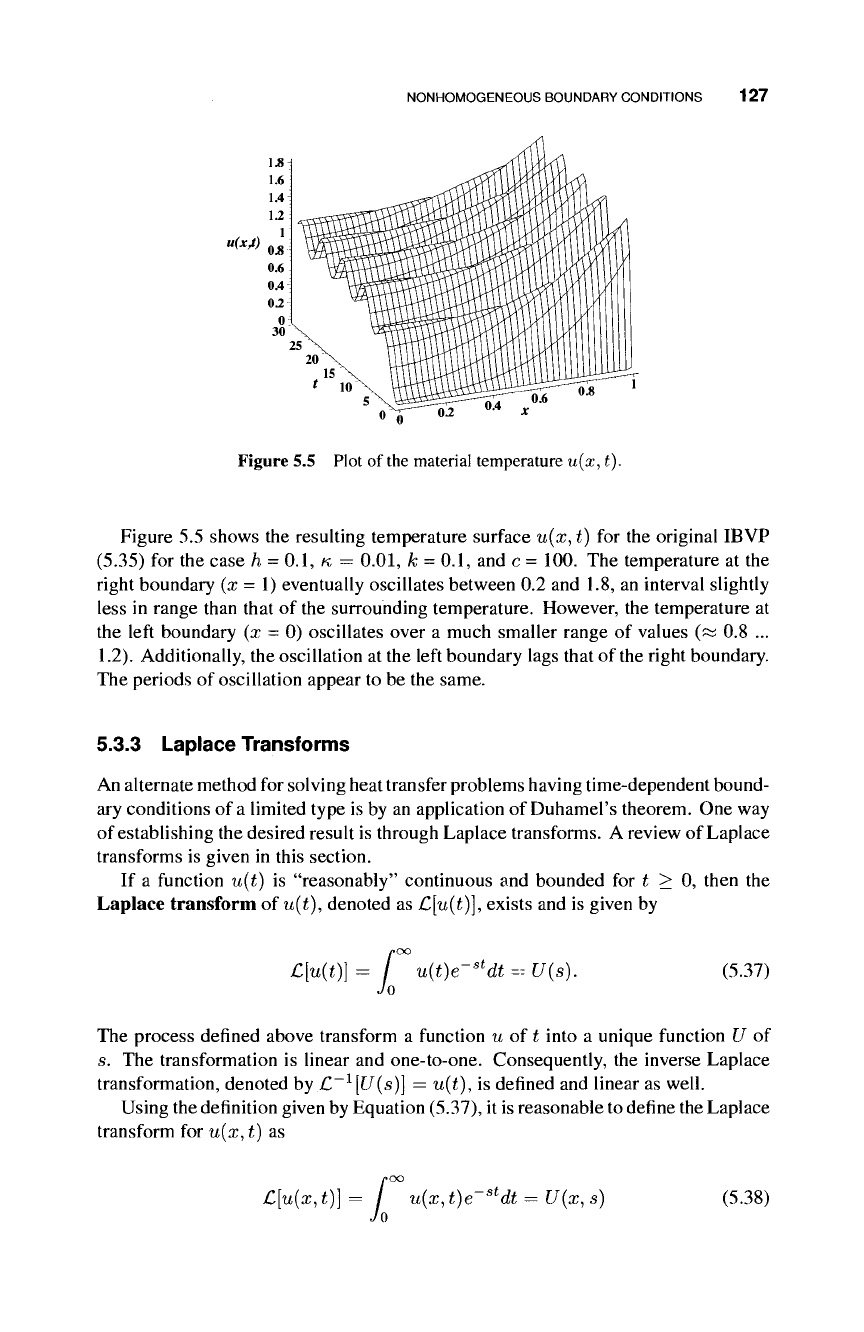
Figure 5.5 Plot of
the
material temperature u(x, t).
Figure 5.5 shows the resulting temperature surface u(x, t) for the original IBVP
(5.35) for the case h = 0.1, κ = 0.01,
fe
= 0.1, and c
=
100. The temperature at the
right boundary (x = 1) eventually oscillates between 0.2 and 1.8, an interval slightly
less in range than that of the surrounding temperature. However, the temperature at
the left boundary (x = 0) oscillates over a much smaller range of values (w 0.8 ...
1.2). Additionally, the oscillation at the left boundary lags that of the right boundary.
The periods of oscillation appear to be the same.
5.3.3 Laplace Transforms
An alternate method for solving heat transfer problems having time-dependent bound-
ary conditions of
a
limited type is by an application of Duhamel's theorem. One way
of establishing the desired result is through Laplace transforms. A review of Laplace
transforms is given in this section.
If a function u(t) is "reasonably" continuous and bounded for t > 0, then the
Laplace transform of u(t), denoted as C[u(t)}, exists and is given by
/»OO
C[u(t)] = / u(t)e~
st
dt
==
U(s). (5.37)
Jo
The process defined above transform a function u of t into a unique function U of
s.
The transformation is linear and one-to-one. Consequently, the inverse Laplace
transformation, denoted by
C~
1
[U(s)]
—
u(t), is defined and linear as well.
Using the definition given by Equation (5.37), it is reasonable to define the Laplace
transform for i¿(x, t) as
/»OO
C[u(x,t)] = / u(x,t)e-
st
dt = U(x,s) (5.38)
Jo
128 HEAT TRANSFER IN 1D
The method of integration by parts can be used to show (see Exercise 5.10)
/»OO
C[u
t
(x,
t)}
= / u
t
(x, t)e~
st
dt = sU(x, s) - u(x, 0) (5.39)
Jo
Additionally,
—C[u{x,t)) = — / u{x,t)e~
st
dt
= / u
x
(x,t)e~
st
dt
Jo
= C[u
x
(x,t)]
=
U
x
(x,s)
(5.40)
provided the order of partial differentiation and integration may be interchanged.
Once the result in Equation (5.40) is established, it follows that
C[u
xx
(x, t)] =
U
xx
(x,
s) (5.41)
The convolution of two functions / and g is defined as
(f*9)(t)= [ f(r)g(t-r)dr (5.42)
Jo
provided the integral exists for t > 0. It can be shown that
I f(r)9(t - T)dr = I fit- r)g(r) (5.43)
JO JO
so that (/ * g)(t) = (g *
f)(t).
An additional property of convolutions is
C[(f * g)(t)} = C[f(t)}C[g(t)} (5.44)
Using the invertibility of the Laplace transform, it follows that
C-
l
[C[f{t)]C[g(t)}] = C-\C[U*g){t)\]
=
(/**)(*)
= / f(r)g(t - r)dt (5.45)
Jo
5.3.4 Duhamel's Theorem
Duhamel's theorem for IBVP (5.46) is developed in this section.
( u
t
= ku
xx
0 < x < c (PDE)
u(x, 0) = 0 (IC)
IBVP<
u(0,t)=0 (BC1)
{ u(c,t)=g(t) (BC2)
(5.46)
NONHOMOGENEOUS BOUNDARY CONDITIONS
129
The time-dependent function
g(t) in
BC2
is
assumed
to be
continuous
and
differ-
entiable
for t > 0.
The process begins
by
finding
the
solution
to the
simpler IBVP
(5.47)
vt
=
kv
xx
0 < x < c (PDE)
IBVP<
v(x,0)
= 0
v(cA)
= 1
(IC)
(BC1)
(BC2)
using Laplace transformation techniques. The PDE
is
transformed first.
vt
=
kv
xx
=4>
C[v
t
]
=
C[ku
xx
\
=> sV-v(x,0)
= kV
xx
=^>
sV - kV
xx
= 0
k
(5.47)
(5.48)
The Laplace transform process
in
this case changes the original PDE into
a
second-
order ordinary differential equation
in the
new variable
V.
The general solution
to
the equation given
in
Equation (5.48)
is
V(x, s)
= Ae^
x
+
Be~^
x
(5-49)
The coefficients
A and B may be
determined using boundary conditions resulting
from
the
Laplace transformation
of
the boundary conditions given
in
IBVP (5.47).
A table giving Laplace transformations
of
basics functions
is
beneficial
for
this
objective. The transforms
are
v(0,t)
=0
C[v(0,t)}
=
C[0]
V(0,s)=0
(5.50)
and
v(l,t)
= l
C[v(l,t)]=C[l]
V(c,s)
= -
S
Applying the transformed BC given
in
Equation (5.50) results
in
(5.51)
V(a:,
s) =
Csinh
( χ/
—x
(5.52)
Applying
the
transformed
BC
given
in
Equation (5.51) allows
a
value
for C to be
determined
V(x,
s) = .
i
]
,__.
N
sinh
(JT_X)
(5.53)
ssinh
F)
130 HEAT TRANSFER IN 1D
The last step in our solution process in to find the inverse transform of the expression
for V(x, s) given in Equation (5.53). For sake of reference, let v(x, t) be such that
v{x,t) = £
_1
1
5sinh
(vl
c
)
sinh
(5.54)
The solution process for IBVP (5.46) follows that for the IBVP (5.47) up to the
point of determining the coefficient C shown in Equation (5.52). In the present case,
the coefficient C must be such that the Laplace transformed BC2 be satisfied as
x = c. That is, it must be
(5.55)
Csmh(
x
l-x)=C[g(t)]=G(s)
Here, the solution for u(x,t) may be expressed as
G(s)
i(x,t)
sinh
(\/f
c
)
^
k
= C
G(s)s—-
sinh
5sinh(yfc)
= C-
1
[G(s)sV(x,s)]
= C~
l
[G(s)(sV(x, s) - v(x, 0))]
= C-^GWVtfas))
= (g*v
t
)(t)
= / g(j)v
r
{x,t - r)dr (5.56)
Jo
Using integration by parts, the expression found in Equation (5.56) is equivalent to
u(x,t)= / g
T
(T)v(x,t-r)dT-g(t)v(x
1
0)+g(0)v(x,t) (5.57)
Jo
Finally, using the convolution property given in Equation (5.43) and the fact that
v(x, 0) = 0, the result is the solution for u(x, t) given by Duhamel's theorem.
u(x,t)= I g
T
(t-T)v(x,t)dr + g(0)v(x,t) (5.58)
Jo
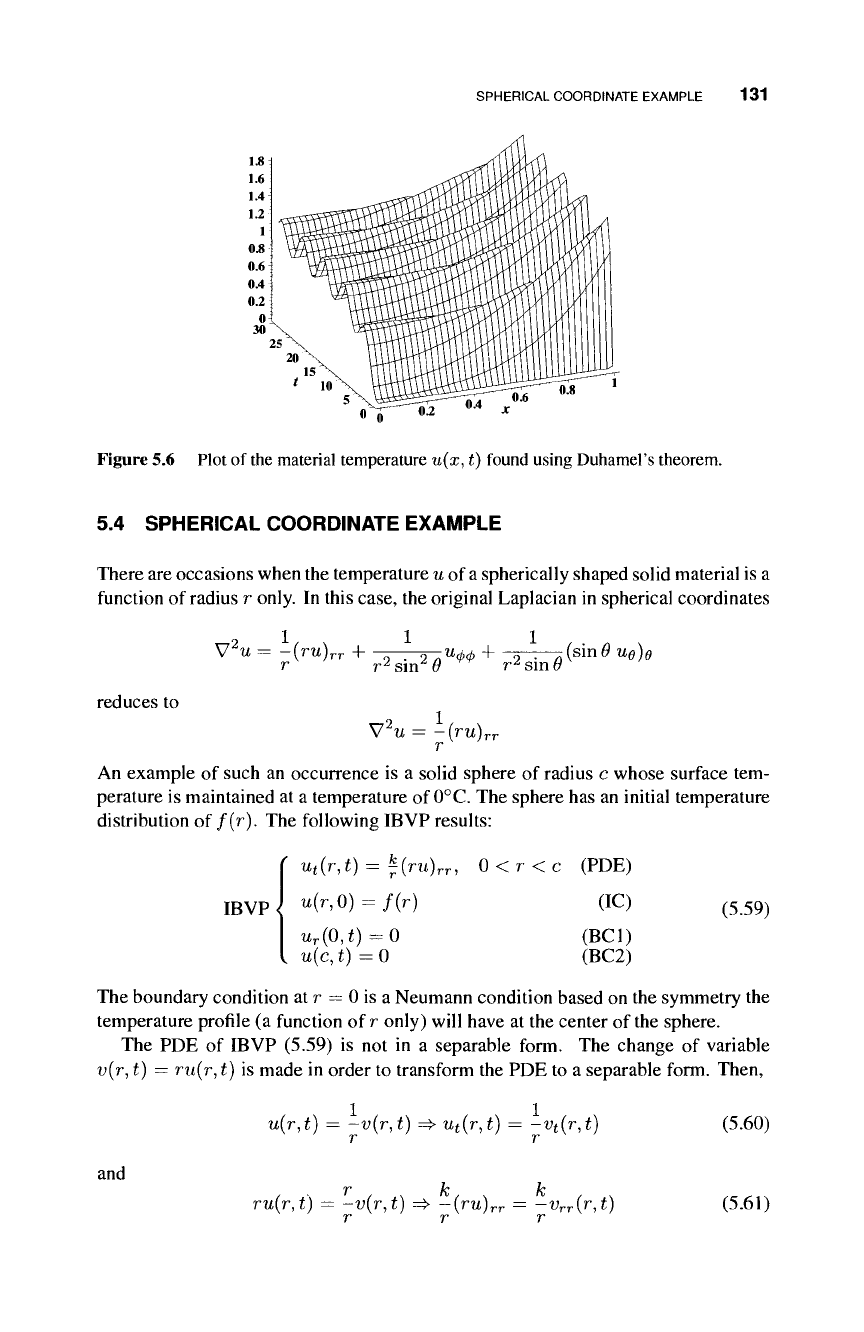
Duhamel's theorem formulation was used to solve the IBVP (5.35) from Section
5.3.2. Figure 5.6 shows the temperature "surface" plotted for t from 0 to 30. The
result is almost identical to that shown in Figure 5.5, where the temperature surface
was constructed using methods outlined in Section 5.3.2.
SPHERICAL COORDINATE EXAMPLE
131
Figure 5.6 Plot of
the
material temperature u(x, t) found using Duhamel's theorem.
5.4 SPHERICAL COORDINATE EXAMPLE
There are occasions when the temperature
u
of
a
spherically shaped solid material is a
function of radius
r
only. In this case, the original Laplacian in spherical coordinates
τ-72
1/ x 1
V U = -{rU)rr +
9
. 2η
η
ΦΦ + ~2
1
r^ sin
c
r(sin0
u
e
)e
reduces
to
V
u
—
-(ru)
r
r
An example
of
such
an
occurrence
is a
solid sphere
of
radius
c
whose surface tem-
perature is maintained at
a
temperature of
0°C.
The sphere has an initial temperature
distribution
of f(r).
The following IBVP results:
IBVP<
\
u
t
(r, t) =
£(ru)
rr
,
0 < r < c (PDE)
u(r,0)
= /(r) (IC)
(5.59)
u
r
(Q,t)
= 0
u(c,t)
=0
(BC1)
(BC2)
The boundary condition at
r = 0
is a Neumann condition based on the symmetry the
temperature profile
(a
function
of r
only) will have at the center
of
the sphere.
The
PDE of
IBVP (5.59)
is not in a
separable form.
The
change
of
variable
v(r,
t) = ru(r, t) is
made
in
order to transform the PDE to
a
separable form. Then,
u(r,t)
=
-v(r,t)
=>
u
t
(r,t)
=
-v
t
(r,t)
r
r
and
ru(r,t)
=
-v(r,t)
=>
-{ru)
r
r
r
k
v
rr
(r,t)
(5.60)
(5.61)