
Bernatz R. Fourier Series and Numerical Methods for Partial Differential Equations
Подождите немного. Документ загружается.


This Page Intentionally Left Blank
CHAPTER 5
HEAT TRANSFER IN 1D
The techniques of separation of variables and Fourier series are used to solve a
variety of ID heat transfer problems in this chapter. The homogeneous IBVP is
solved initially. Then the method of variation of parameters is used to solve IBVPs
for the case of a nonhomogeneous PDE with homogeneous boundary conditions.
This type of IBVP is referred to as the semihomogeneous problem. Once this
solution procedure is in place, the general nonhomogeneous problem, where one
or both boundary conditions is nonhomogeneous, is solved by transforming the
nonhomogeneous IBVP to a semihomogeneous problem.
5.1 HOMOGENEOUS IBVP
The development of a solution process for a general ID IBVP begins by considering
the simpler homogeneous version of an IBVP. The general form of the problem is
Fourier Series and Numerical Methods for Partial Differential Equations, 113
First Edition. By Richard Bernatz
Copyright © 2010 John Wiley & Sons, Inc.
114 HEAT TRANSFER IN 1D
outlined as
IBVP<
u
t
= ku
xx
(x,t), 0 < x < c (PDE)
u(x
?
0) = /(x)
aiu(0, t) + a2U
x
(0, t)
b\u(c,t)
+ b2U
x
(c,t) -
=
0
0
(IC)
(BC1)
(BC2)
(5.1)
The PDE and both BCs are homogeneous. In the case of the BCs, a\ or
Ü2
must
nonzero in
BC1,
and b\ or
62
must be nonzero in
BC2.
The IB VP define by Equations
(5.1) is stated generally so that it includes the possibility of any of
the
three boundary
condition types at either of the boundary locations. The case of insulated ends
(Neumann-type conditions at both x = 0 and x
—
c) is solved next example.
5.1.1 Example: Insulated Ends
Recall the initial example of the method of separation of variables presented in
Section 1.8 was for the ID heat transfer problem with Dirichlet boundary conditions
(boundary conditions of the first type). The first example in this chapter is for the
case of insulated boundaries at x = 0 and x = c (Neumann boundary conditions or
boundary conditions of the third type).
Consider the IBVP
IBVP<
Ut
—
ku
xx
\x,t),
u(x,0) = f(x)
Ό,ί)
= 0
c,t) =0
0 < x < c (PDE)
(IC)
(BC1)
(BC2)
(5.2)
corresponding to heat transfer in an infinite slab bounded by the planes x = 0 and
x = c or a thin metal rod lying parallel to the x-axis with ends at x = 0 and x — c.
The boundary conditions specified above imply the slab and rod are insulated at
x = 0 and x
—
c. The objective is to find a formula for u(x,t) that satisfies the IBVP.
Using the method of separation of variables, the solution for u(x, t) is assumed to
be of the form u(x, t)
—
X(x)T(t). Substituting for u and its derivatives in the PDE
of IBVP 5.2 gives
X(x)T'(t) = kX"{x)T{t)
Dividing both sides of this equation by X(x)T(t) results in
T'(t) _ X"{x)
kT(t) ~ X(x)
Because the left-hand side of the last equation is a function of t while the right-hand
side is a function of x, it follows that both sides of the equation may be, at most, a
constant. Let — λ be the separation constant. Then, the equation given above may be
separated into two ODEs:
X"{x)
+ XX(x) = 0 (5.3)
T'{t) + XkT(t) = 0
(5.4)
HOMOGENEOUS IBVP 115
The boundary conditions of IBVP 5.2 applied to the assumed form of u(x, t) gives
u
x
(0,t) = 0 => X'(0)T(t) =0=> X'(0) = 0
and
u
x
(c,t) = 0 => X'(c)T(t) = 0 => X'(c) = 0
The requirements of X'(0) = X'(c) = 0 are made to ensure a nontrivial solution for
T(£).
That is, we do not want to specify T(t) = 0 in either case.
Combining Equation (5.3) with the boundary conditions on X gives
X"{x)
+ XX (x) = 0 (5.5)
X'(0)
= 0 X'(c) = 0 (5.6)
which is the Regular Sturm-Liouville example presented in Section
3.4.1.
The
resulting eigenvalues for this problem are λ
η
= (ηπ)
2
for n = 0,1,2,... with
corresponding eigenfunctions X(0) = 1 and X
n
(x) = cos (
I
^), n
—
1,2,3,....
Now that the eigenvalues have been determined through the Regular Sturm-
Liouville problem, the ODE for T given by (5.4) becomes
T'{t) + k(nw)
2
T{t) = 0 (5.7)
for n = 0,1,2,... . For n
=
0, Equation (5.7) becomes T'(t) = 0 so that the general
solution is a constant multiple of To(t) = 1. For n = 1,2,3,..., the resulting
first-order, linear, homogeneous ODE given by Equation 5.7 has a general solution
that is a constant multiple of the function
T
n
(t) =
e
-
fc(mr)2t
Combining the solutions for X and T results in solutions for u(x, t) of the form
uo(x,t) = X
0
(x)T
0
(t) = 1
and
η
η
(χ, t) = Xn(x)T
n
(t) = cos(nnt)e-
k{n7r)H
, n = 1,2, 3,...
Applying the generalized principle of superposition, we know the expression
oo
u{x,t) = ^ + Y
j
a
n
cos(nnx)e-
k(n
^
2t
is a function that satisfies the homogeneous PDE and both homogeneous boundary
conditions of Equation (5.2).
The solution process will be complete once the nonhomogeneous initial condition
is satisfied. To that end, we require
oo
u(x, 0) = f(x) =» ^ + Σ
On
cos(nnx)e-
kin7r)2
° = f{x)
2
n=l
OO
=> -y + 5Z «n οο8(ηπχ) = /(x)
2
n=l
116 HEAT TRANSFER IN 1D
Given that function f(x) is piecewise smooth and defined in such a way that
,
(I)
„ ΛΞζ1±1ίΞ±)
for all x in
(0,1
),
it follows from Theorem 2.7 that the cosine series
oo
V 2_\
a
n cos(n7rx) (5.8)
2
n=l
with
a
n
—
2 / f(x)cos(nnx)dx n
—
0,1,2,... (5.9)
Jo
will converge to f(x) for all x in (0,1). Refer to the summary comments in Section
2.13 for support of this convergence claim.
5.2 SEMIHOMOGENEOUS PDE
Suppose an infinite slab with faces at x
—
and x = c has an internal heat source given
by q(x, t). The general ID IBVP in this case is given as
IBVP<
u
t
= ku
xx
(x,t) 4-
q(x,t),
0<x<c (PDE)
u(x,0)=/(x) (IC)
(5AQ)
a
1
u{0,t)+a
2
u
x
(0,t) = 0 (BCl)
t biu(c,t) + b
2
u
x
(c,t) = 0 (BC2)
so the PDE in this application is nonhomogeneous. Both prescribed boundary con-
ditions for the IBVP (5.10) are homogeneous. From now on, we will refer to such an
IBVP as semihomogeneous.
We know for the homogeneous case (q(x, t)
—
0) the solution will have the form
u{x,t) = Y^A
n
X
n
{x)e-
ko
^
n=0
where a
n
and X
n
(x) are, respectively, the eigenvalues and orthonormal eigenfunc-
tions for the associated Sturm-Liouville problem determined by the values of a±,
(22,
&i, and
&2·
The eigenfunctions will be sine or cosine functions for any scenario
because of the homogeneous boundary conditions. In some instances, the index n
may begin at
"1"
instead of
"0."
The coefficients A
n
are determine in the usual way
using the initial condition f{x). That is,
A
n
=
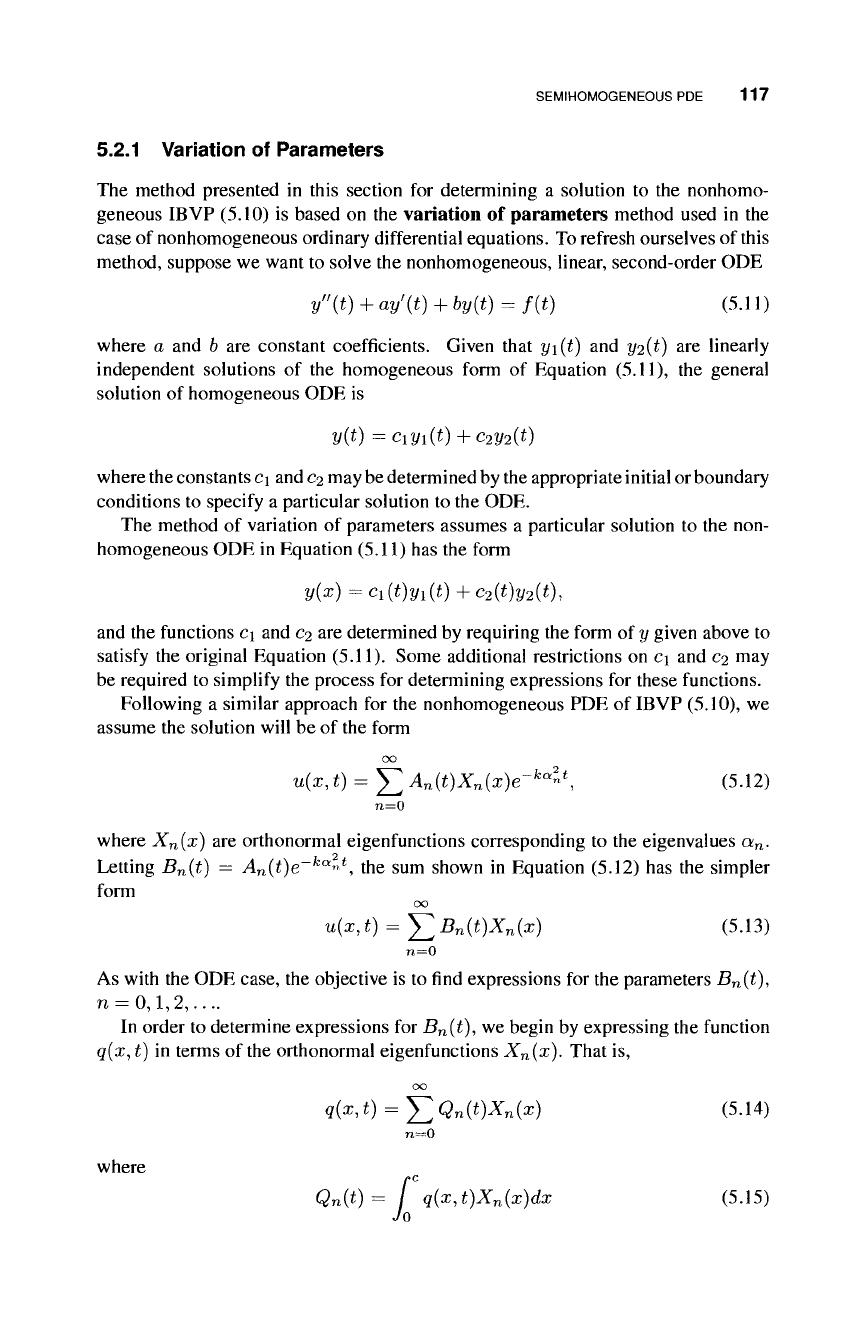
f{x)X
n
(x)dx
Jo
SEMIHOMOGENEOUS PDE 117
5.2.1 Variation of Parameters
The method presented in this section for determining a solution to the nonhomo-
geneous IBVP (5.10) is based on the variation of parameters method used in the
case of nonhomogeneous ordinary differential equations.
To
refresh ourselves of this
method, suppose we want to solve the nonhomogeneous, linear, second-order ODE
y"(t)+ay
f
(t)
+ by(t) = f(t) (5.11)
where a and b are constant coefficients. Given that yi(t) and y
2
{t) are linearly
independent solutions of the homogeneous form of Equation (5.11), the general
solution of homogeneous ODE is
y(t) = ciyi(t) +
c
2
y
2
(t)
where the constants c\ and c
2
may be determined
by
the appropriate initial or boundary
conditions to specify a particular solution to the ODE.
The method of variation of parameters assumes a particular solution to the non-
homogeneous ODE in Equation (5.11) has the form
y(x)=c
1
(t)yi(t)+c
2
(t)y
2
(t)
1
and the functions c\ and c
2
are determined by requiring the form of y given above to
satisfy the original Equation (5.11). Some additional restrictions on c\ and c
2
may
be required to simplify the process for determining expressions for these functions.
Following a similar approach for the nonhomogeneous PDE of IBVP (5.10), we
assume the solution will be of the form
OO
u(x,t) = J2A
n
(t)X
n
(x)e-
ka
^, (5.12)
where X
n
(x) are orthonormal eigenfunctions corresponding to the eigenvalues a
n
.
Letting B
n
(t) = A
n
{t)e~
koi
^
t
, the sum shown in Equation (5.12) has the simpler
form
00
u(x,t) =
Y^B
n
(t)X
n
(x)
(5.13)
n=0
As with the ODE case, the objective is to find expressions for the parameters
B
n
(t),
n = 0,l,2,....
In order to determine expressions for
B
n
{t),
we begin by expressing the function
q(x, t) in terms of the orthonormal eigenfunctions X
n
{x)· That is,
00
q(x,t) =
Y^Q
n
(t)X
n
(x)
(5.14)
71=0
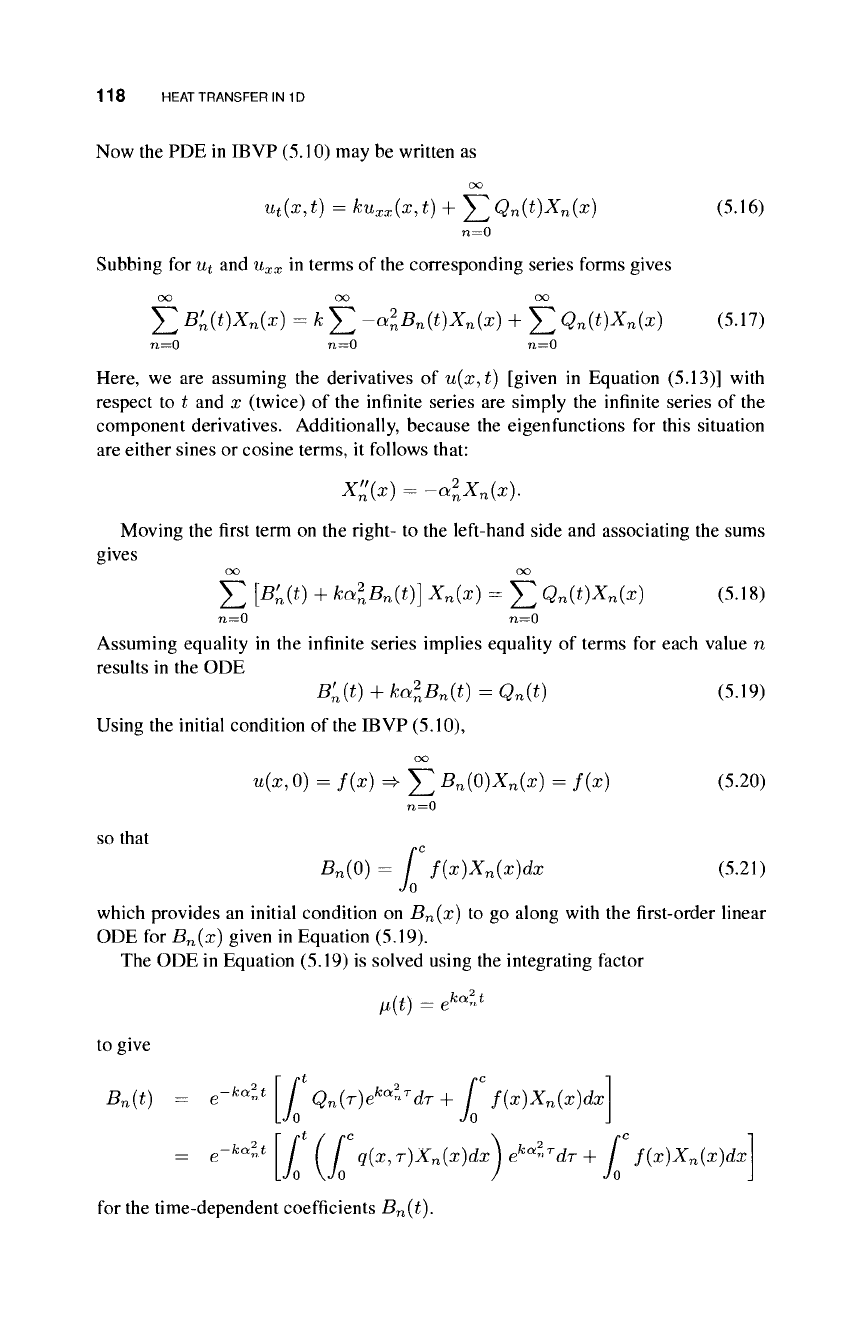
where
Qn(t)= [ q(x,t)X
n
(x)dx (5.15)
Jo
118 HEAT TRANSFER IN 1D
Now the PDE in IBVP (5.10) may be written as
oo
u
t
(x,t) = ku
xx
(x,t) -\-^2Q
n
(t)X
n
(x) (5.16)
n=0
Subbing for u
t
and u
xx
in terms of the corresponding series forms gives
oo oo oo
Σ B'
n
(t)X
n
(x) = kJ2 -a
2
n
B
n
(t)X
n
(x) + Σ Qn(t)X
n
(x) (5.17)
n=0 n=0 n=0
Here, we are assuming the derivatives of u(x,t) [given in Equation (5.13)] with
respect to t and x (twice) of the infinite series are simply the infinite series of the
component derivatives. Additionally, because the eigenfunctions for this situation
are either sines or cosine terms, it follows that:
X;'(x) = -a
2
n
X
n
(x).
Moving the first term on the right- to the left-hand side and associating the sums
gives
oo oo
Σ [K(t)
+ ka
2
n
B
n
(t)]
X
n
{x) = Σ Q
n
(t)X
n
(x)
(5.18)
n=0 n=0
Assuming equality in the infinite series implies equality of terms for each value n
results in the ODE
B'
n
(t)
+ ka
2
n
B
n
(t) = Q
n
(t) (5.19)
Using the initial condition of the IBVP (5.10),
u(x,0) = f(x) => ¿ B
n
(Q)X
n
(x) = f(x)
n=0
so that
Bn(0) = Í f(x)X
n
(x)dx
Jo
(5.20)
(5.21)
which provides an initial condition on B
n
(x) to go along with the first-order linear
ODE for B
n
(x) given in Equation (5.19).
The ODE in Equation (5.19) is solved using the integrating factor
μ{ί) = e
katt
to give
B
n
(t)
-kalt
I Qn(r)e
k
^
T
dT+ Γ f(x)X
n
(x)á
Jo Jo
j (Γ q(x,r)X
n
(x)dx) e
ka
"
T
dr + Γ f(x)X
n
(x)dx
for the time-dependent coefficients
B
n
(t).
-katt
SEMIHOMOGENEOUS PDE 119
5.2.2 Example: Semihomogeneous IBVP
Consider the IBVP given below.
u
t
= 0.1u
xx
(x, t) -f q{x, t), 0 < x < 1
u(x,0) = x(l
—
x)
IBVP<
0,i
1,*'
0
0
(PDE)
(IC)
(BC1)
(BC2)
(5.22)
The boundary conditions indicate the infinite slab has insulated faces at x — 0 and
x = 1. The initial temperature distribution is f(x) =
x(l—x).
In terms of the internal
heat generation term, suppose q(x, t) is given by
the
product
#[0.45,0.55]
(#)e
_t
, where
#[0.45,0.55] (
x
)
il
0.45 < x < 0.55
otherwise
(5.23)
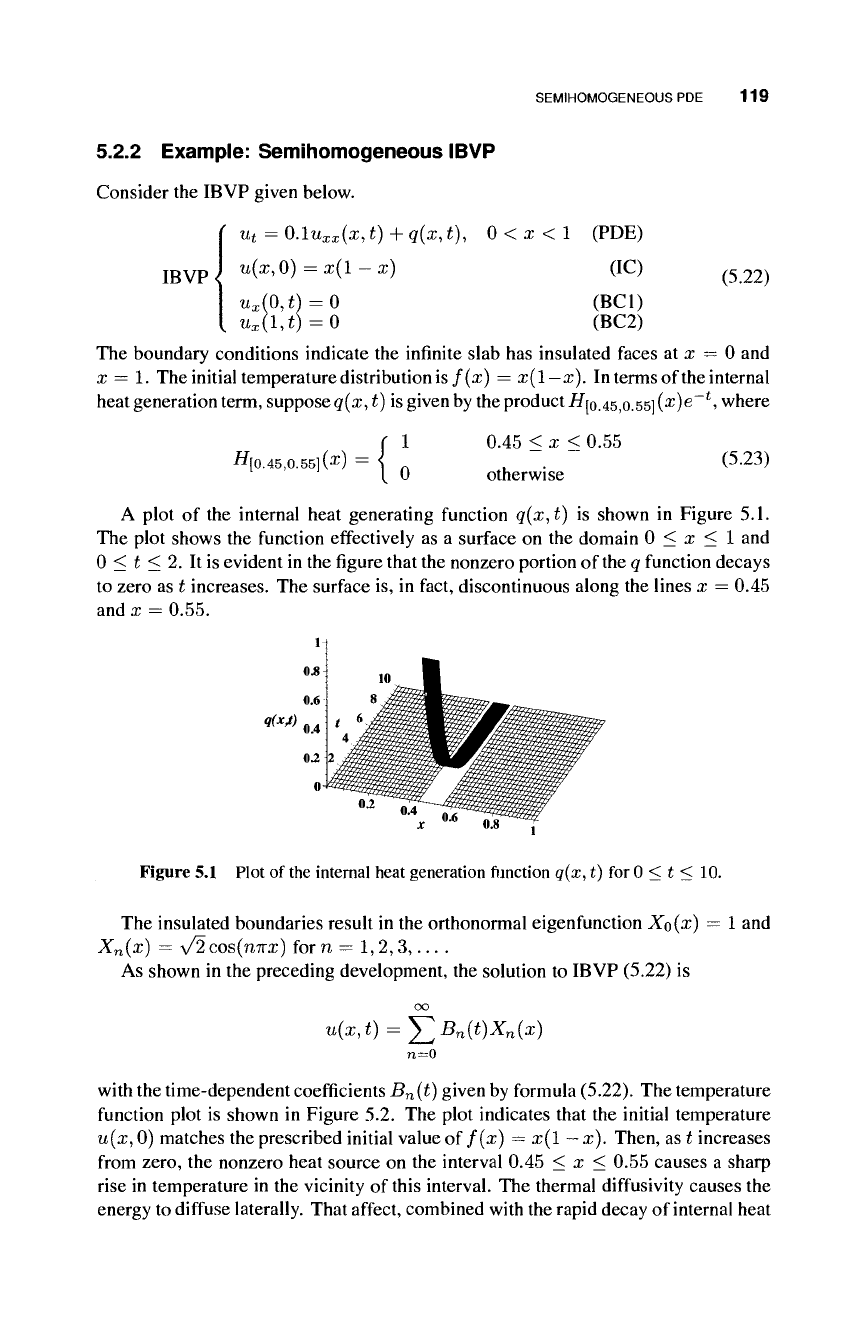
A plot of the internal heat generating function q(x,t) is shown in Figure 5.1.
The plot shows the function effectively as a surface on the domain 0 < x < 1 and
0 < t < 2. It is evident in the figure that the nonzero portion of
the
q function decays
to zero as t increases. The surface is, in fact, discontinuous along the lines x
—
0.45
and x = 0.55.
qM)
Figure 5.1 Plot of
the
internal heat generation function q(x,t) for 0 < t < 10.
The insulated boundaries result in the orthonormal eigenfunction XQ{X) — 1 and
Xn(%) =
Λ/2
cos(nnx) for n = 1,2,3,... .
As shown in the preceding development, the solution to IBVP (5.22) is
L{x,t) = Y^B
n
{t)X
n
{x)
n=0
with the time-dependent coefficients B
n
(t) given by formula
(5.22).
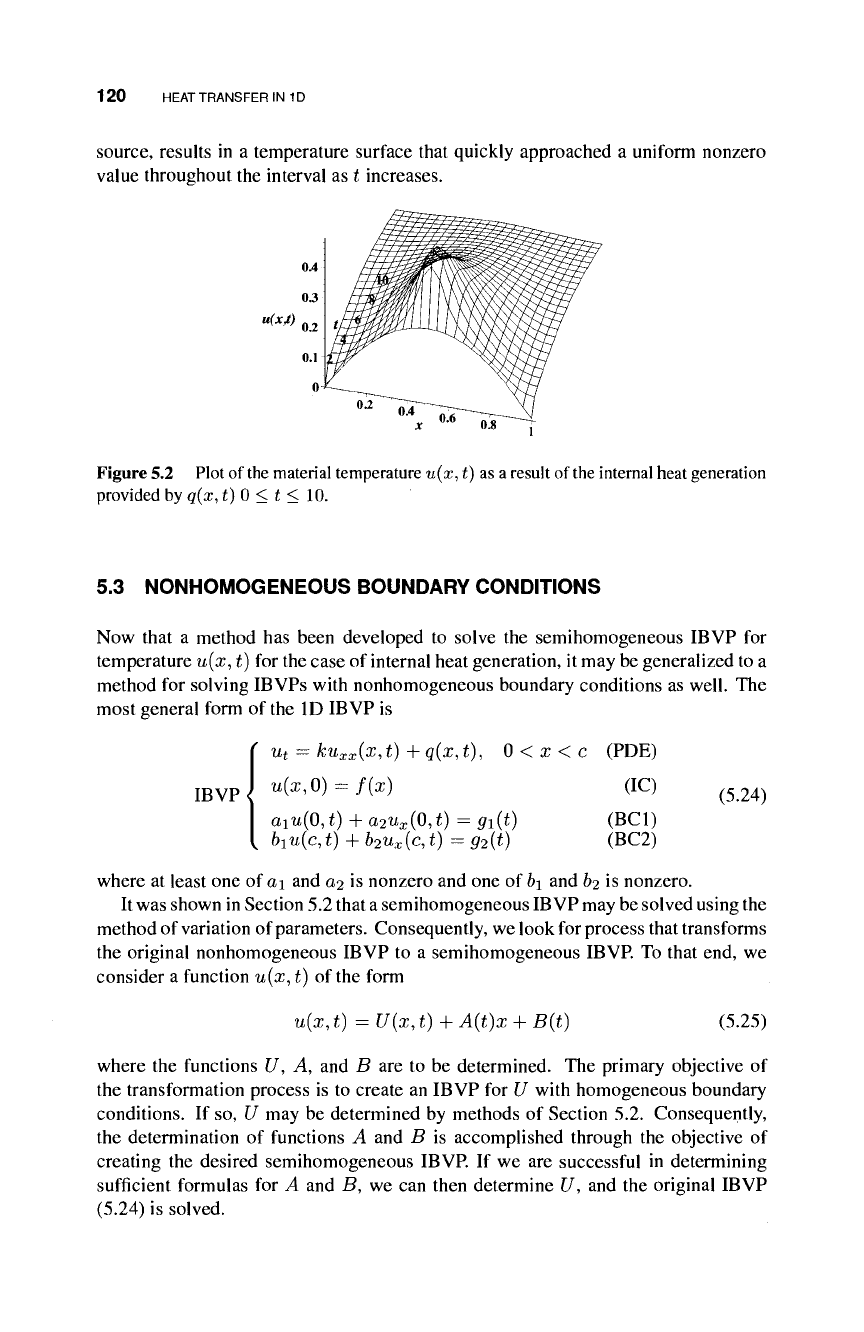
The temperature
function plot is shown in Figure 5.2. The plot indicates that the initial temperature
u(x, 0) matches the prescribed initial value of f(x) = x(l
—
x). Then, as t increases
from zero, the nonzero heat source on the interval 0.45 < x < 0.55 causes a sharp
rise in temperature in the vicinity of this interval. The thermal diffusivity causes the
energy to diffuse laterally. That affect, combined with the rapid decay of internal heat
120 HEAT TRANSFER IN 1D
source, results in a temperature surface that quickly approached a uniform nonzero
value throughout the interval as t increases.
u(x¿)
Figure 5.2 Plot of the material temperature u(x, t) as
a
result of
the
internal heat generation
provided by q(x, t) 0 < t < 10.
5.3 NONHOMOGENEOUS BOUNDARY CONDITIONS
Now that a method has been developed to solve the semihomogeneous IBVP for
temperature i¿(x, t) for the case of internal heat generation, it may be generalized to a
method for solving IBVPs with nonhomogeneous boundary conditions as well. The
most general form of the ID IBVP is
IBVP<
u
t
—
ku
xx
{x, t) 4- q(x, t), 0 < x < c (PDE)
u(x,0)=f(x) (IC)
aitt(0,
t) 4- a
2
u
x
(0, t) = gi(t)
&iu(c, t) 4- b
2
u
x
(c, t) = g
2
(t)
(5.24)
(BC1)
(BC2)
where at least one of a\ and a
2
is nonzero and one of b\ and b
2
is nonzero.
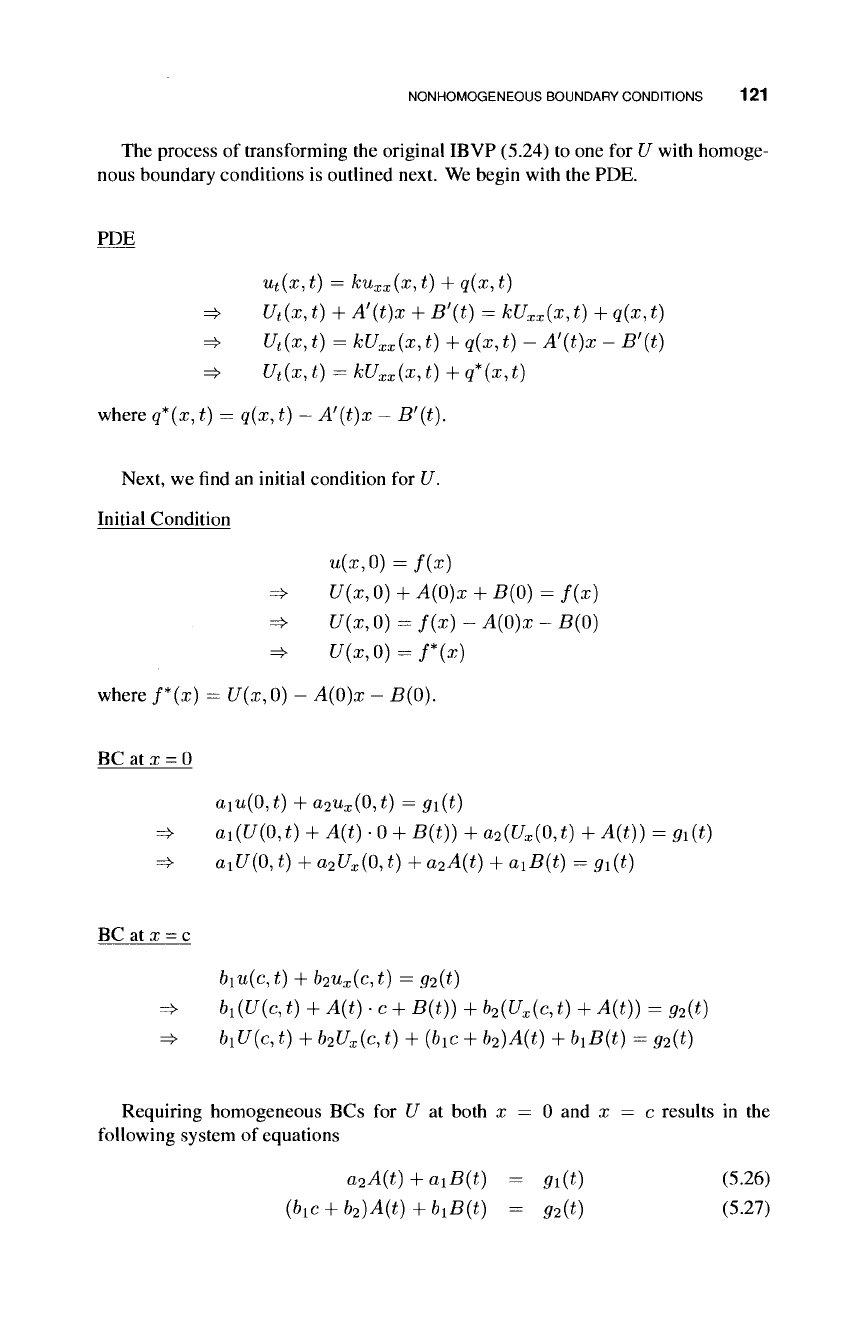
It was shown in Section 5.2 that
a
semihomogeneous IBVP may be solved using the
method of variation of parameters. Consequently, we look for process that transforms
the original nonhomogeneous IBVP to a semihomogeneous IBVP. To that end, we
consider a function u(x, t) of the form
u(x, t) = U(x, t) + A(t)x 4- B(t)
(5.25)
where the functions U, A, and B are to be determined. The primary objective of
the transformation process is to create an IBVP for U with homogeneous boundary
conditions. If so, U may be determined by methods of Section 5.2. Consequently,
the determination of functions A and B is accomplished through the objective of
creating the desired semihomogeneous IBVP. If we are successful in determining
sufficient formulas for A and B, we can then determine U, and the original IBVP
(5.24) is solved.
NONHOMOGENEOUS BOUNDARY CONDITIONS 121
The process of transforming the original IBVP (5.24) to one for U with homoge-
nous boundary conditions is outlined next. We begin with the PDE.
PDE
Ut{x, t) = ku
xx
(x, t) 4- q{x, t)
U
t
(x, t) 4- A\t)x + B'{t) = kU
xx
(x, t) + q{x, t)
U
t
(x, t) = kU
xx
(x, t) 4- q(x, t) - A
f
(t)x - B'(t)
U
t
{x,t)
= kU
xx
(x,t) +q*(x,t)
where q*{x,t) = q{x,t) - A'(t)x -
B'(t).
Next, we find an initial condition for U.
Initial Condition
u(x,0)=f(x)
=$> U(x, 0) + A(0)x 4- J3(0) = f(x)
=> U{x, 0) = f(x) - A(0)x - B(0)
=* U(x,0) = f*(x)
where /*(x) - U(x,0) - A(0)x - B(0).
BC at x = 0
aiw(0,i) + a
2
w
x
(0,i) = #i(¿)
ai(C/(0,f) 4- A(i) · 0 4- B(t)) + a
2
(^(0,t) 4- A(f)) = ^i(t)
aiî/(0,
¿) 4- a
2
U
x
(0, t) + α
2
Α(ί) 4- a
x
B{t) = g
x
(t)
BC at x
=
c
biu(c,t) 4- b
2
u
x
(c,t) =
02 (¿)
=» 6i(C/(c,t) + A(t) .c + B(í)) + 62(üx(c,í) + A(í)) = <?
2
(¿)
=> ^[/(c, t) 4- fcC^c, t) 4- (he 4- 6
2
)A(t) 4- 6iB(i) = g
2
(t)
Requiring homogeneous BCs for U at both x = 0 and x = c results in the
following system of equations
a
2
A(t) + aiB(t) = #i(t) (5.26)
(6
lC
+ 6
2
),4(t)4-&i£(¿) = g
2
(t) (5.27)