
Bernatz R. Fourier Series and Numerical Methods for Partial Differential Equations
Подождите немного. Документ загружается.

162 HEAT TRANSFER IN 2D AND 3D
2/f
W
y
(x,l)
= 0
-W
x
(0,î/) = 4(l-y)-2
V
2
W(x,y)
= 0
W
y
(x,0)
= 0
W
x
(2,y)=0
(a) Subproblem 1
2/f
W
y
(ar,l)
= -1
-W*(0,y) = 2
V
2
W{x,y)
= 0
W
x
(2,y)
= 0
¿ -Τν
ν
(χ,0) = 0
2
(b) Subproblem 2
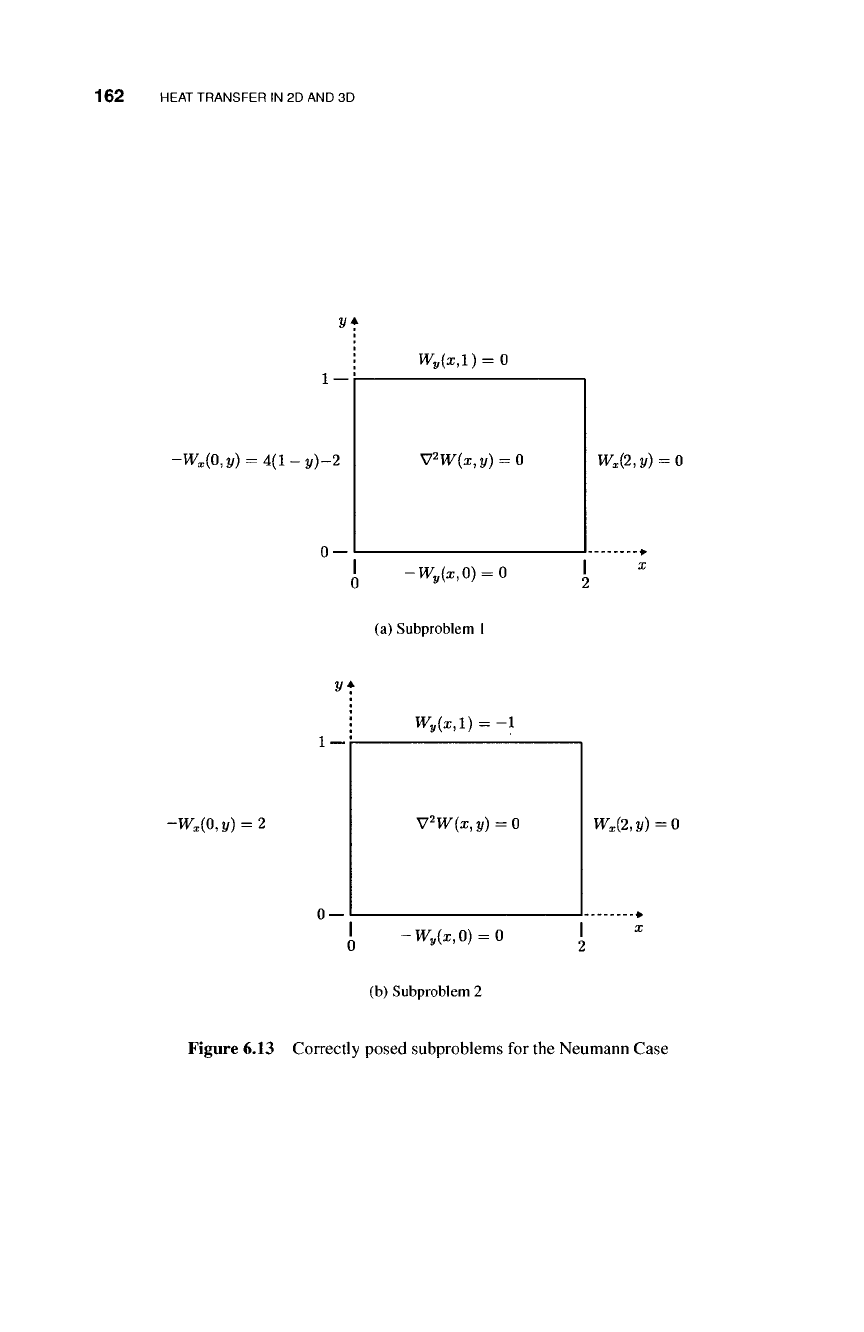
Figure 6.13 Correctly posed subproblems for the Neumann Case
2D
BVP:
LAPLACE AND POISSON EQUATIONS 163
W
3
(x,0)=0
WÎ{xA)
2C
E =
2C
C =
0 + E =
=
0
1 = -1
1
~2
0
The result of satisfying the BCs is
W\x,y)=
l
-x
2
-
l
-y
2
2x
(6.95)
(6.96)
so that, as in the case of the first subproblem, we are able to determine a formula for
W
3
(x, y) up to a constant. In this case, as in the previous case, we will let F = 0.
Combining the formulas for W
3
(x, y) and W
4
(x, y) gives the nonunique solution
11 °°
W(x, y) — -x
2
y
2
—
2x + 2_.
a
n cos(nny) cosh(n7r(l
—
x)) (6.97)
n=l
with coefficients a
n
given by Equation (6.93).
0.5 1
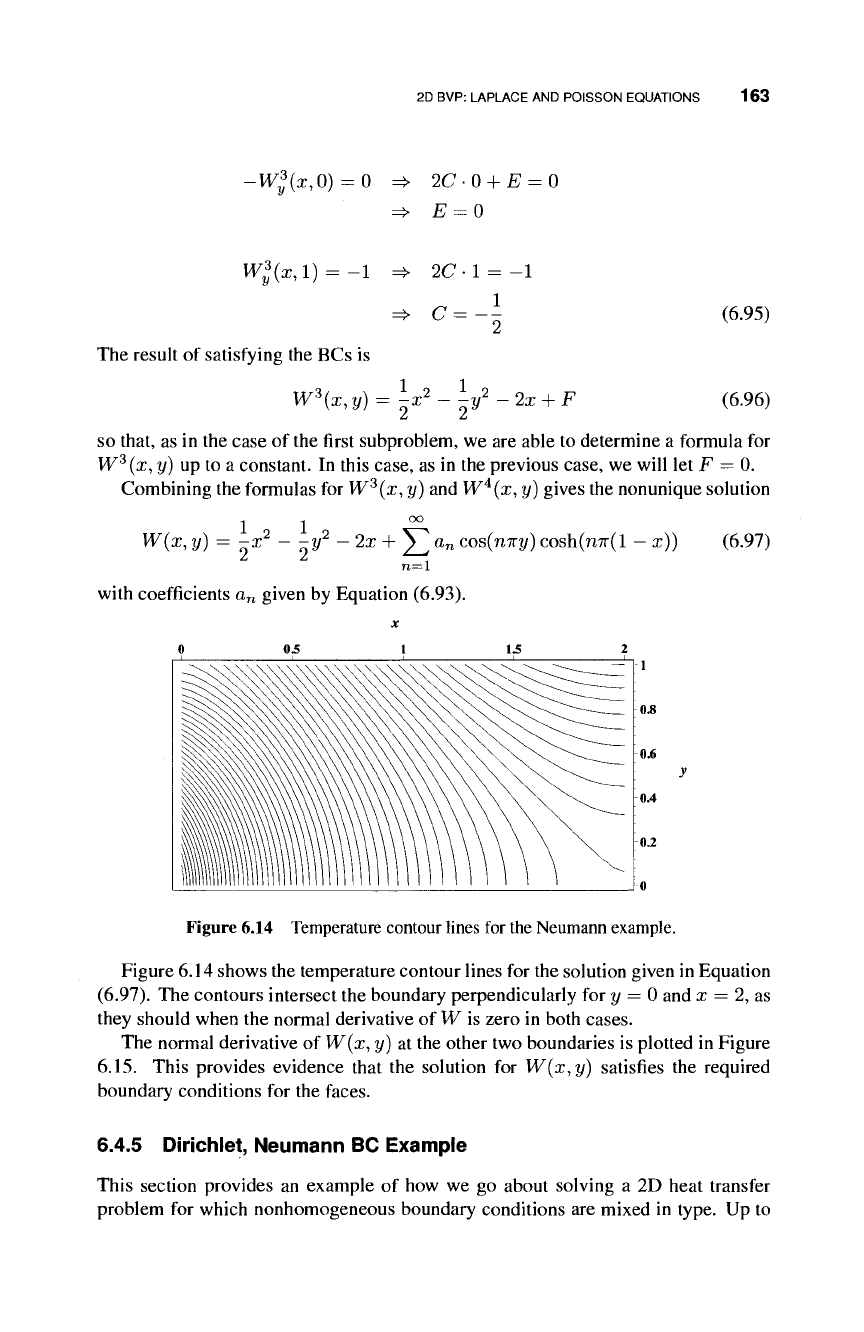
Figure 6.14 Temperature contour lines for the Neumann example.
Figure 6.14 shows the temperature contour lines for the solution given in Equation
(6.97).
The contours intersect the boundary perpendicularly for y
—
0 and x
—
2, as
they should when the normal derivative of W is zero in both cases.
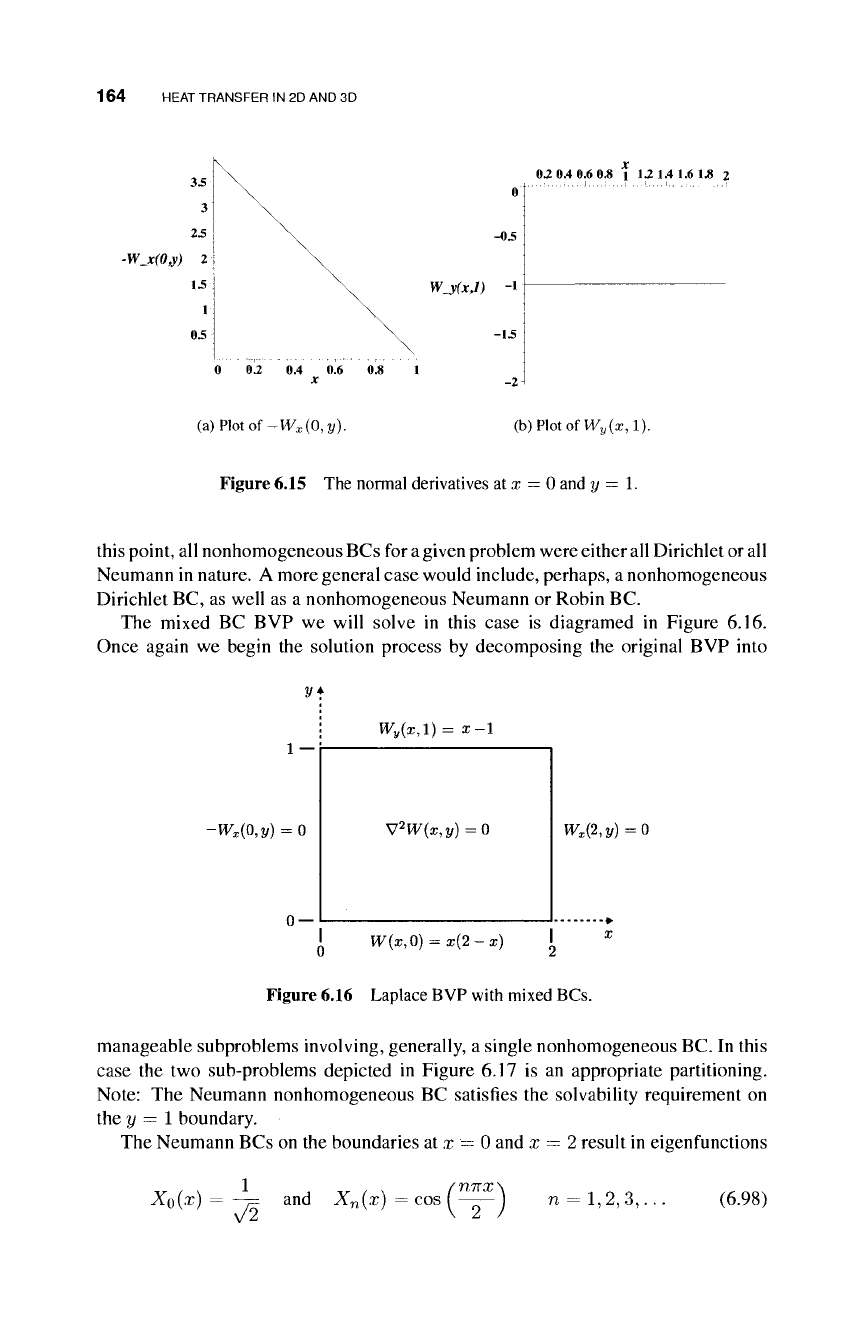
The normal derivative of W(x, y) at the other two boundaries is plotted in Figure
6.15.
This provides evidence that the solution for W(x,y) satisfies the required
boundary conditions for the faces.
6.4.5 Dirichlet, Neumann BC Example
This section provides an example of how we go about solving a 2D heat transfer
problem for which nonhomogeneous boundary conditions are mixed in type. Up to
164 HEAT TRANSFER IN 2D AND 3D
02 0.4 0.6 0.8 l 12 1.4 1.6 1.8 2
W_y(xJ)
-1
-15
(a)
Plot of-W*(0,0).
(b)PIotofW
y
(x,l).
Figure 6.15 The normal derivatives at x = 0 and y = 1.
this point, all nonhomogeneous BCs for
a
given problem were either all Dirichlet or all
Neumann in nature. A more general case would include, perhaps, a nonhomogeneous
Dirichlet BC, as well as a nonhomogeneous Neumann or Robin BC.
The mixed BC BVP we will solve in this case is diagramed in Figure 6.16.
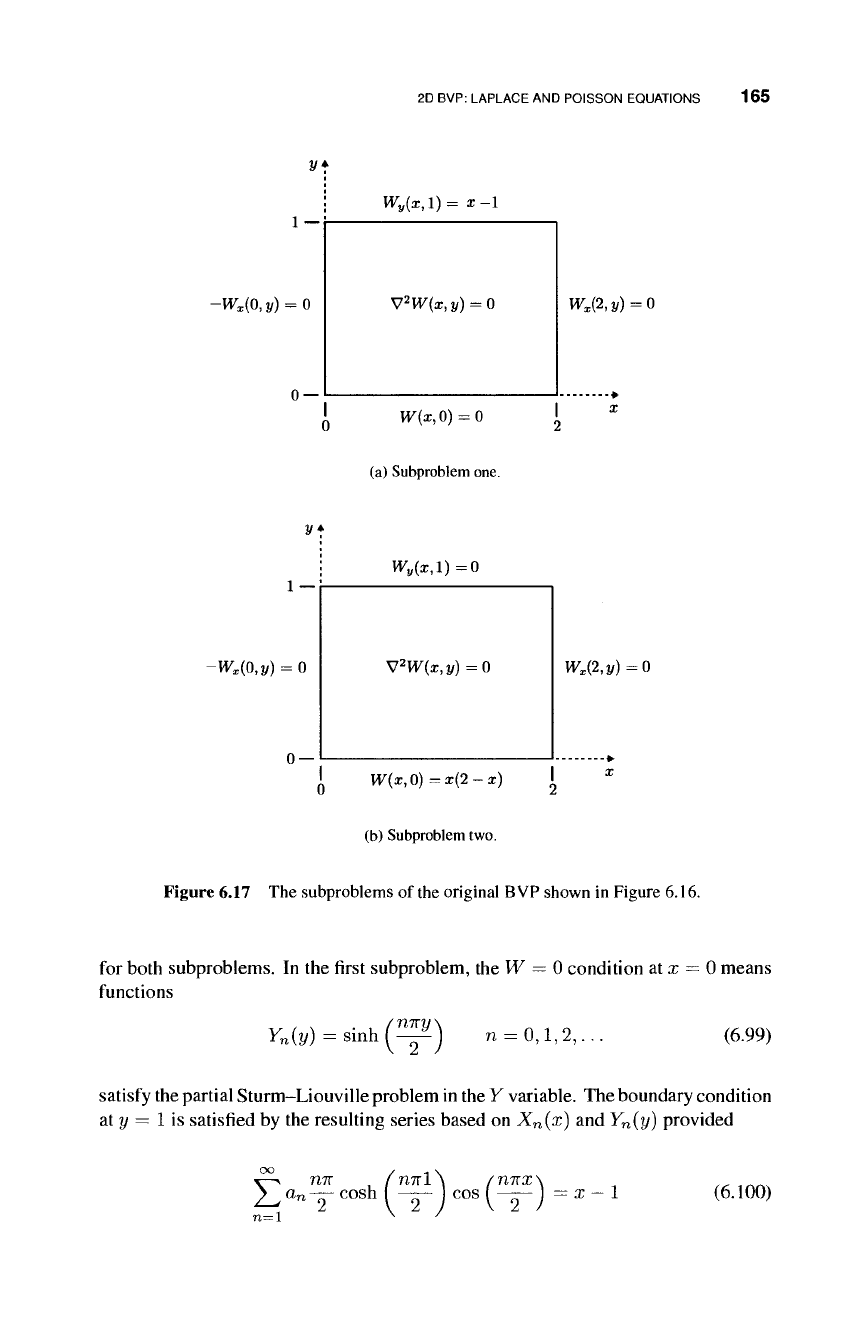
Once again we begin the solution process by decomposing the original BVP into
-W
x
{0,y)
= 0
0-
W
y
(x,l)=
x-1
V
2
W(x,y)
= 0
W
x
(2,y)=0
W(x,0) = x(2-x)
Figure 6.16 Laplace BVP with mixed BCs.
manageable subproblems involving, generally, a single nonhomogeneous BC. In this
case the two sub-problems depicted in Figure 6.17 is an appropriate partitioning.
Note: The Neumann nonhomogeneous BC satisfies the solvability requirement on
the y = 1 boundary.
The Neumann BCs on the boundaries at x
—
0 and x = 2 result in eigenfunctions
Χ
θ(
χ
) = -/=
and
X
n(x) = COS (^2~)
n =
1,2,3,...
(6.98)
2D BVP: LAPLACE AND POISSON EQUATIONS 165
</*
-W
x
(0,y) = 0
W
y
(x,l)=
x-1
V
2
W(x,y)
= 0
W
x
(2,y)=0
0
W(x,0) = 0
2
(a) Subproblem one.
2/f
-W
x
(0,y) = 0
W
y
(x,l)=0
V
2
W{x,y)=0 W
x
(2,y)=0
0
W(x,0)=x(2-x)
2
(b) Subproblem two.
Figure 6.17 The subproblems of the original BVP shown in Figure 6.16.
for both subproblems. In the first subproblem, the W
—
0 condition at x = 0 means
functions
Y
n
(y) = sinh (^p) n = 0,1,2,...
(6.99)
satisfy the partial Sturm-Liouville problem in the Y variable. The boundary condition
at y = 1 is satisfied by the resulting series based on X
n
(x) and Y
n
(y) provided
Σ
ηπ
Λ
/ηπΐλ
/ηπχ\
α
η
— cosh I — Icos [-γ-) =x-l
n=l ^ '
(6.100)
166 HEAT TRANSFER IN 2D AND 3D
which is the case if
2 f /
Τ17ΓΧ
\
a
"
=
n
7
rcosh(^)y
0
(*-1)οοβ(—)ώ (6.101)
Therefore, the solution VF
1
(x, y) for the first sub-problem is
oo
W\x,υ)
=
Σα
η
cos
(ψ)
sinh
(ψ) , (6.102)
n=l
The Y
n
(y) functions that solve the partial Sturm-Liouville problem for the second
subproblem are
Y
n
(y) = cosh
f
n7r(1
~^l
n = 0,1,2,... (6.103)
because of the homogeneous Neumann condition at y = 1. The solution for the
second subproblem is
W\
X
,y)
= f>„ cos (^) cosh (^ί^) (6.104)
n=0
where the coefficient a
n
are
ou =
^í4f)í
i(2
"
i)cos
^)
(6
'
l05)
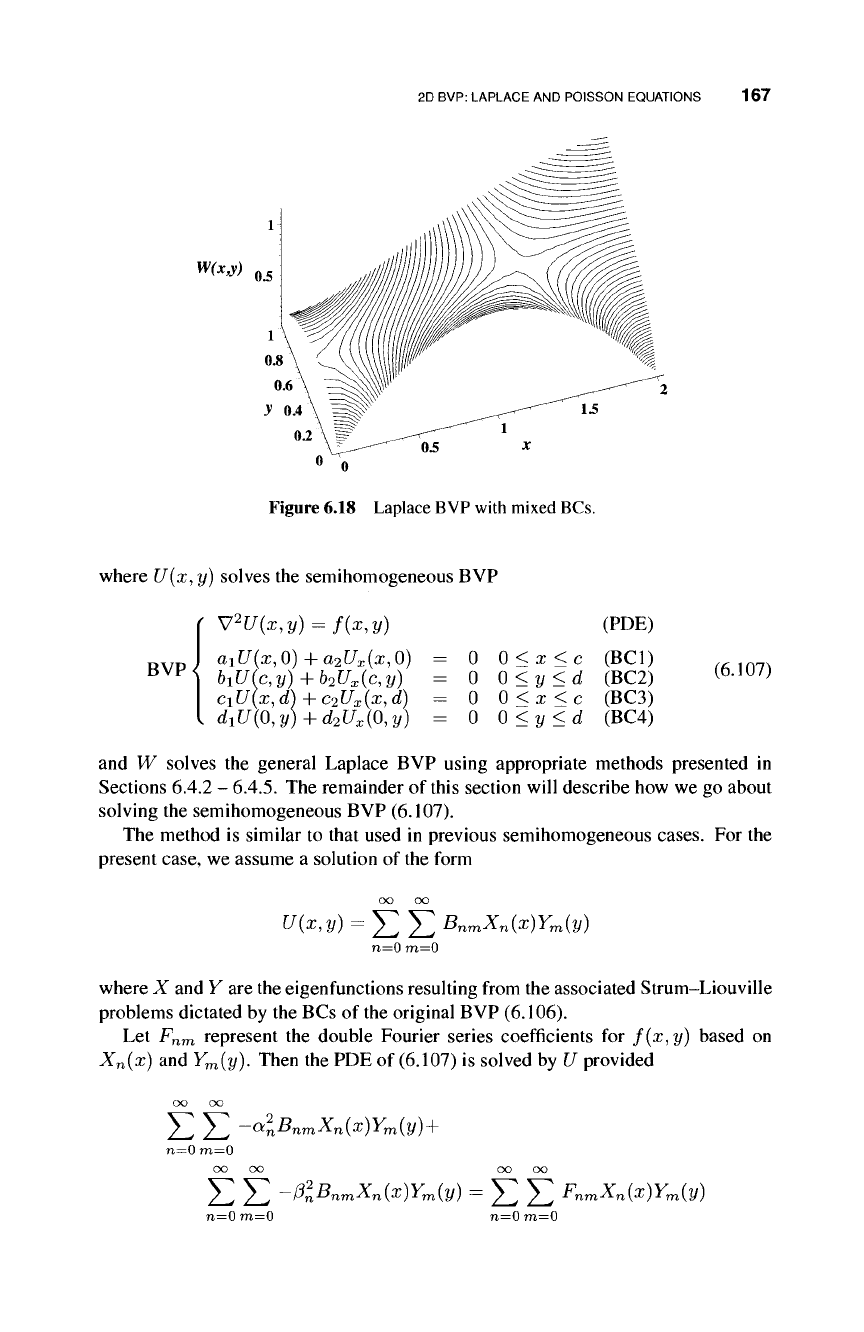
Figure 6.18 depicts the temperature surface W(x,y) with isothermal contours.
One can see from the plot that the temperature profile on the y
—
0 boundary matches
the prescribed parabolic profile of x(2
—
x). The contours intersect the boundaries
at x = 0 and x = 2 perpendicularly as expected due to the insolated nature on this
faces.
6.4.6 Poisson Problems
The general 2D Poisson BVP in Cartesian coordinates is given by
( \7
2
S(x,y) = f(x,y) (PDE)
a
1
S(x,0)+a
2
S
x
(x,0) =
9l
(x) 0<x<c (BC1)
b
1
S(c,y)+b
2
S
x
(c,y) = M 0<y<d (BC2)
(
6J06
)
ci5(x, d) + c
2
S
x
(x,d) = g
3
(x) 0 < x < c (BC3)
1^5(0,^
+ ^^(0^) = g¿y) 0<y<d (BC4)
BVP^
The general BVP (6.106) is solved by letting
S{x,y) = U{x,y) + W{x,y)
2D BVP: LAPLACE AND POISSON EQUATIONS 167
W(xjr)
Figure 6.18 Laplace BVP with mixed BCs.
where U(x,y) solves the semihomogeneous BVP
BVP<
V
2
U(x,y)
= f(x,y)
aiU(x,0) +a
2
U
x
(x,0)
biU(c,y) + b
2
U
x
(c,y)
c\U{x, d) + C2Ü
x
(x, d
d
1
U(0,y)+d
2
U
x
(0,y
0 0 <x<c
0 0<y<d
0 0 <x<c
0 0 <y<d
(PDE)
(BC1)
(BC2)
(BC3)
(BC4)
(6.107)
and W solves the general Laplace BVP using appropriate methods presented in
Sections 6.4.2 - 6.4.5. The remainder of this section will describe how we go about
solving the semihomogeneous BVP (6.107).
The method is similar to that used in previous semihomogeneous cases. For the
present case, we assume a solution of the form
oo oo
U(x,y) = 2^2_^ B
nrn
X
n
(x)Y
m
(y)
n=0 m=0
where X and Y are the eigenfunctions resulting from the associated Strum-Liouville
problems dictated by the BCs of the original BVP (6.106).
Let
F
nrn
represent the double Fourier series coefficients for f(x,y) based on
X
n
(x)
and Y
m
(y). Then the PDE of (6.107) is solved by U provided
]T ]T -a
2
n
B
nrn
X
n
(x)Y
rn
(y)+
oo oo oo oo
Σ Σ -ßlB
nm
X
n
{x)Y
m
{y) = Σ Σ F
n
mXn{x)Ym{y)
n=0 m=0
oo oo
n=0 m=0 n=0 m=0
168 HEAT TRANSFER IN 2D AND 3D
which means
Bn
a
2
+ 0
2
n = 1,2,3,... andm = 1,2,3,...
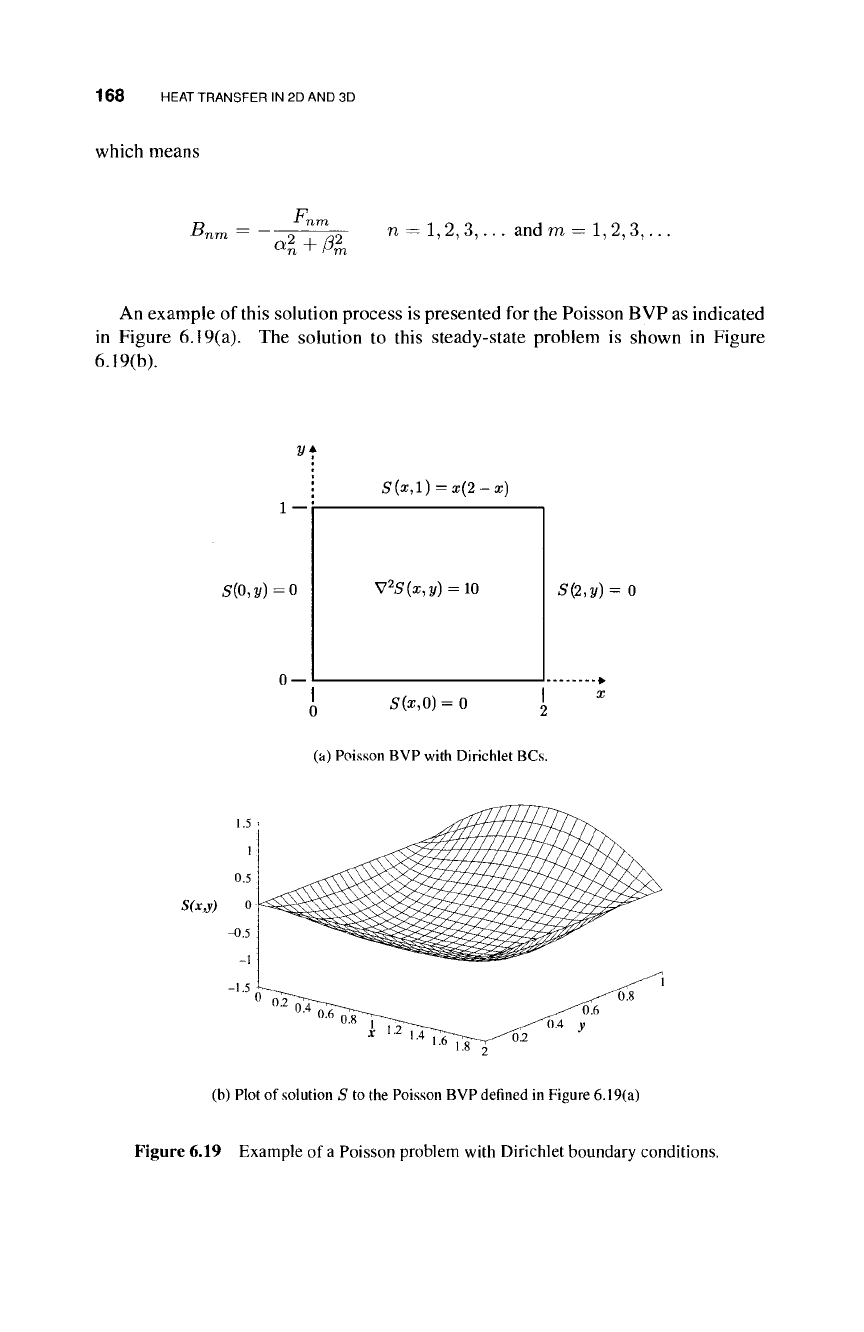
An example of this solution process is presented for the Poisson B VP as indicated
in Figure 6.19(a). The solution to this steady-state problem is shown in Figure
6.19(b).
2/f
5(0,2/) =0
S{x,l) =x{2-x)
V
2
S(x,y)
=10
S(2,y)= 0
0
5(x,0)=0
2
(a) Poisson BVP with Dirichlet BCs.
(b) Plot of solution S to the Poisson BVP defined in Figure 6.19(a)
Figure 6.19 Example of a Poisson problem with Dirichlet boundary conditions.
NONHOMOGENEOUS 2D EXAMPLE 169
6.5 NONHOMOGENEOUS 2D EXAMPLE
The details for solving the nonhomogeneous 2D IBVP 6.108 are provided in this
section.
ut = 0.1 [u
xx
+ u
yy
] (PDE)
u{x, y, 0) =
#[0.4,0.6] x [o.4,o.6]
(x, y) (IC)
w
y
(x, 0,t) = 0 0 < x < 1 (BC1) (6.108)
u(l,y,t) = 4y(l-y) 0<y<l (BC2)
w
î/
(x,l,i) = l/2-x 0<χ<1 (BC3)
I u(0, y, i) = 0 0 < y < 1 (BC4)
The solution u is assumed to be of
the
form u(x, y, t) — U(x, y, t) + W(x, y), where
W solves
IBVP<
W
xx
(x,y)
+
W
yy
(x,y)
= 0 (PDE)
BVP
Wy(X,0,t) = 0
W(l,y,t)=4y(l-
W
y
(x,l,t)
= l/2-
W(0,y,t)=0
-y)
- X
0 <x < 1
0 < 2/ < 1
0<£< 1
0<t/ < 1
(BC1)
(BC2)
(BC3)
(BC4)
(6.109)
the Laplace BVP 6.109 that includes the nonhomogeneous BCs given in IBVP 6.108,
and U solves the IBVP 6.110 with homogeneous forms of the nonhomogeneous BCs
of 6.108
IBVP<
t/
t
=0.1[l/
a
.
x
+ ü
yi/
]
U(x,y,0) =
#[o.4,o.6] x [0.4,0.6]
(x,y) - W(x,y)
U
y
(x,0,t)
=0
C/(l,j/,t) = 0
U
y
(x,l,t)=0
t/(0,y,i) = 0
(PDE)
(IC)
(6.110)
0 < x < 1 (BC1)
0 < y < 1 (BC2)
0 < x < 1 (BC3)
0 < y < 1 (BC4)
The solution for VF is determined by the methods outlined in Section 6.4.5.
Two subproblems, one each for the nonhomogeneous BCs, must be solved. The
eigenfunctions in this case are X
n
(x) — sin(a
n
x), with a
n
= ηπ (n =
1,2,3,...),
and Y
0
(y) = 1 for β
0
= 0, Y
m
(y) = cos(ß
m
y), for ß
m
= πιπ (m =
1,2,3,...).
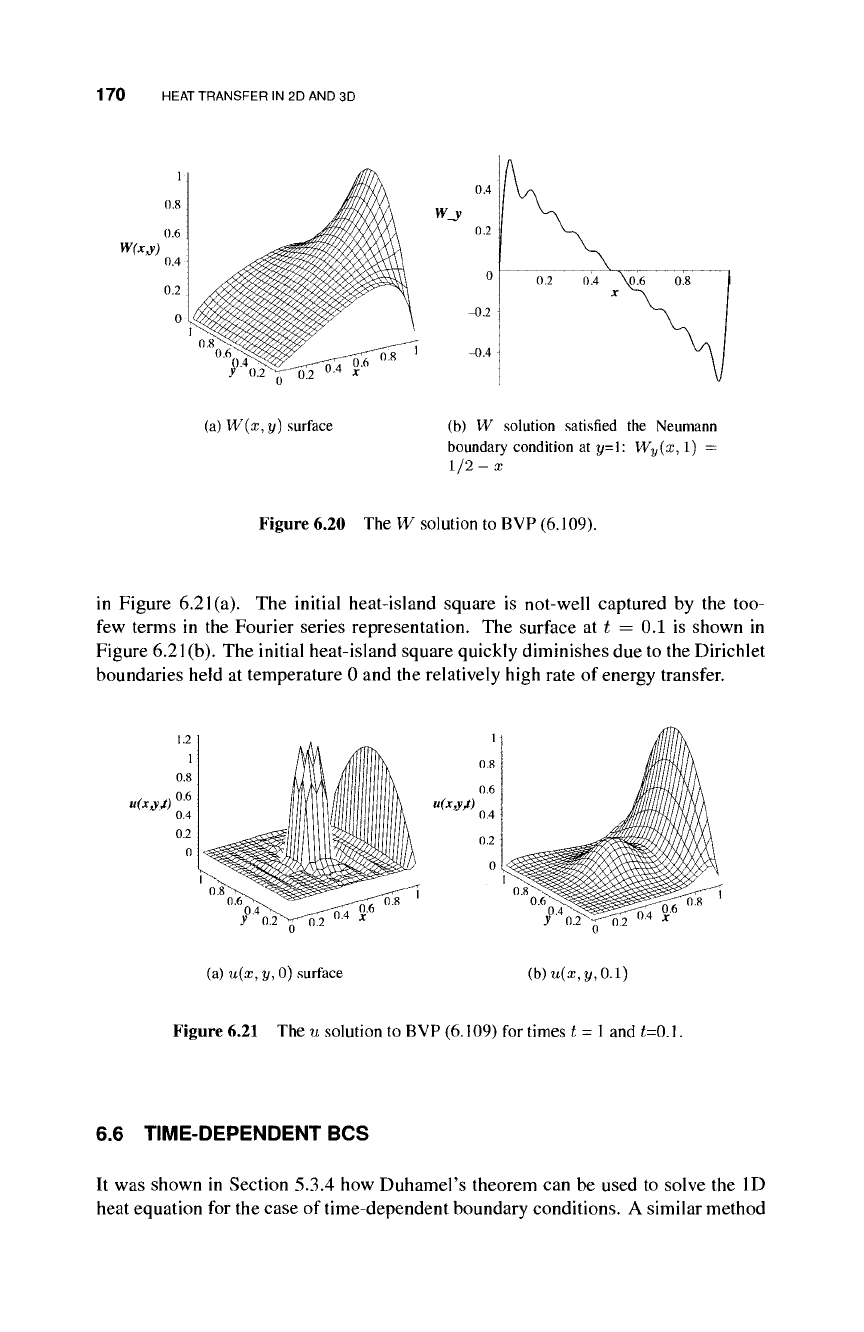
The W(x, y) surface found using these methods is shown in Figure 6.20(a), and the
resulting boundary condition fit in Figure 6.20(b). Twenty terms of X
n
and 20 terms
of Y
m
, for a total of 400 terms, were included in the double-Fourier series solution
for W(x, y). This explains the rather wavy result for W
y
(x, 1). The number of terms
used to construct W(x,y) is kept small because double-Fourier formula must be used
in the calculation of Fourier coefficients for the initial condition for in the solution of
IBVP (6.110).
Once the solution U(x,y,t) is found for IBVP (6.110), it is combined with
W(x,y) to give formula for u{x,y,t). The initial temperature surface is shown
170 HEAT TRANSFER IN 2D AND 3D
W(x,y)
(b) W solution satisfied the Neumann
boundary condition at y=\: W
y
(x, 1) =
1/2-a;
Figure 6.20 The W solution to BVP (6.109).
in Figure 6.21(a). The initial heat-island square is not-well captured by the too-
few terms in the Fourier series representation. The surface at t = 0.1 is shown in
Figure 6.21(b). The initial heat-island square quickly diminishes due to the Dirichlet
boundaries held at temperature 0 and the relatively high rate of energy transfer.
u(xyjt) u(x,yjt)
y 0.2>j^0.2
(á)u(x,y, 0) surface (b)u(x,y,0.1)
Figure 6.21 The u solution to BVP (6.109) for times t = 1 and
£=0.1.
6.6 TIME-DEPENDENT BCS
It was shown in Section 5.3.4 how Duhamel's theorem can be used to solve the ID
heat equation for the case of time-dependent boundary conditions. A similar method
TIME-DEPENDENT BCS 171
is described in this section for the 2D case. The method will be developed for the
IBVP
(6.
Ill), and may be adapted to other IBVPs with time-dependent BCs on other
boundaries, as well as Neumann- or Robin-based time-dependent BCs.
IBVP<
( u
t
(x,y,t) = kV
2
u-\-q(x,y,t)
u{x,y,0) = f(x,y)
u(x,0,t)
—
0
uh,y,t) = g(t)
u(x, l,i) =0
I tfc(0,2/,i) =0
(PDE)
(IC)
0 < x < 1 (BC1)
0 < y < 1 (BC2)
0 < x < 1 (BC3)
0 < y < 1 (BC4)
(6.111)
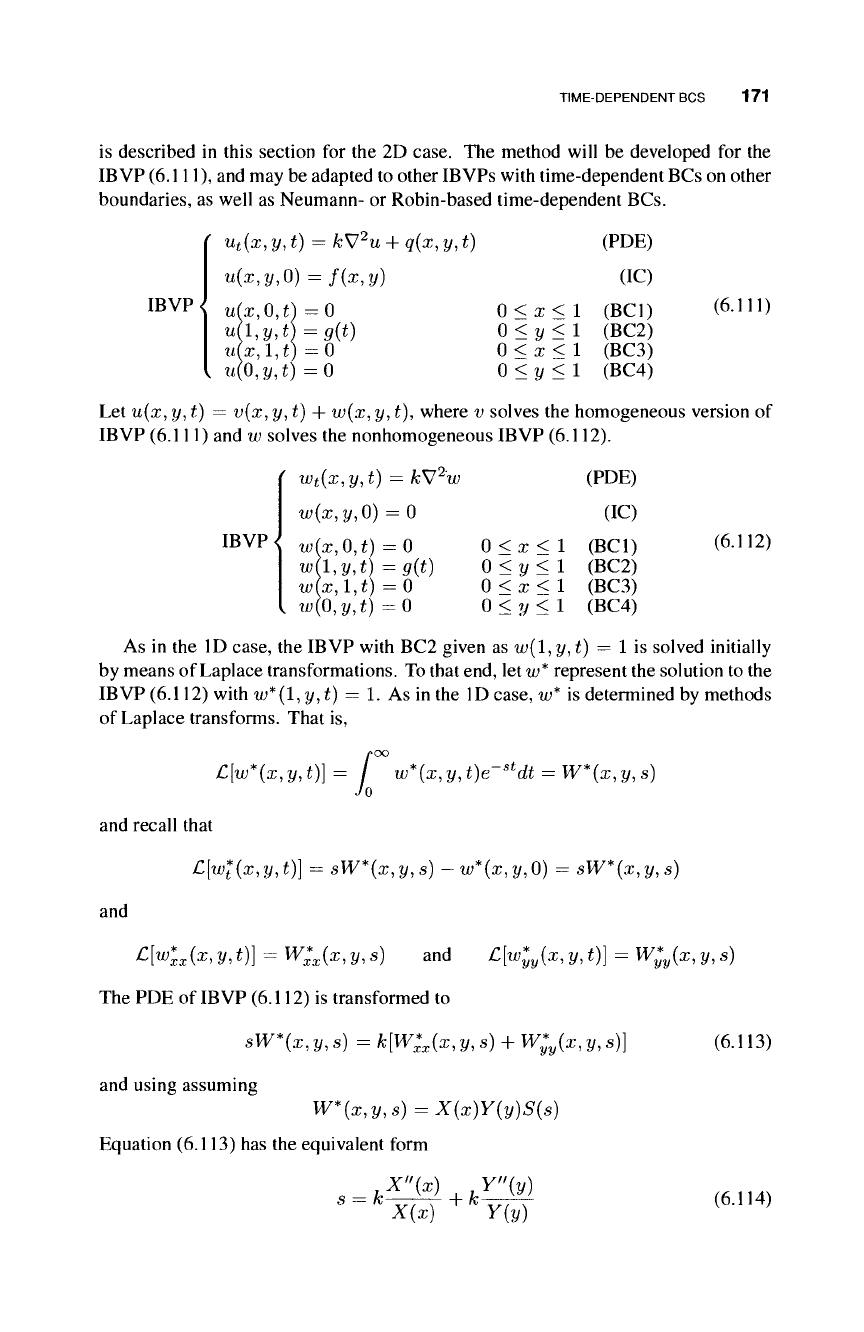
Let u{x, y, t) — v(x, y, t) + w(x, y, f), where v solves the homogeneous version of
IBVP (6.111) and w solves the nonhomogeneous IBVP (6.112).
IBVP<
( w
t
(x,y,t) — kV
2
w
w(x,y,0) =0
w(x,0,t) = 0
wh,y,t) =g(t)
w(x, l,f) = 0
I w{0,y,t) = 0
(PDE)
(IC)
0<x<l (BC1)
0 < y < 1 (BC2)
0 < x < 1 (BC3)
0 < y < 1 (BC4)
(6.112)
As in the ID case, the IBVP with BC2 given as w(l, y, t) — 1 is solved initially
by means of Laplace transformations. To that end, let
w*
represent the solution to the
IBVP (6.112) with w*(l,y,t) — 1. As in the ID case, w* is determined by methods
of Laplace transforms. That is,
/»OO
C[w*{x,y,t)]= / w*(x,y,t)e-
8t
dt =
W*(x,y,s)
Jo
and recall that
C[wl(x,y,t)\
= sW*(x,y,s) -w*(x,y,0) = sW*(x,y,s)
and
¿Κ^ι/,ί)]
=
w
xx(
x
,yi
s
)
and
£[u>lyfay,t)] =
w*
y
(x,
y
,s)
The PDE of IBVP (6.112) is transformed to
sW*(x,y,s) = k[W;
x
(x,y,s) +
W;
y
(x,y,s)]
(6.113)
and using assuming
W*(x,y,s)
= X(x)Y(y)S(s)
Equation (6.113) has the equivalent form
X(x) Y(y)