
Bernatz R. Fourier Series and Numerical Methods for Partial Differential Equations
Подождите немного. Документ загружается.

132 HEAT TRANSFER IN 1D
so the PDE in v is
1 k
-v
t
(r, t) = -v
rr
(r, t)
=>
v
t
(r, t) = kv
rr
(r, t) (5.62)
r r
The IC under the change of variable becomes
-v(r, t) = /(r) => v(r, t) = rf(r) (5.63)
r
The boundary condition at r = 0 for v is determined by first finding a formula for
u
r
(x,t) in terms of f
r
(r, t).
9 1 rv
r
- υ
—-ü(r,t) = 2
/ N i/ i , , rv
r
— v ,„ ^
A
.
w
r(r,t) = is^M) = ^— (5.64)
Consequently, for u
r
(0,£) = 0, it must follow that v(0,t) = 0. The boundary
condition for r
—
c becomes
u(c, t) = 0
=>
-v(c, t) = 0 => v(c, t) = 0 (5.65)
c
The Sturm-Liouville problem that results from separation of variables on the PDE
and BCs for v(r, t) is
Ä"(r) +
XR
(
r
) = 0 Ä(0) = 0 and Ä(c) - 0 (5.66)
so the eigenvalues and eigenfunctions are
/
2 ηπ
-sin(a
n
r) a
n
= —, n = 1,2,3,... (5.67)
c c
and the general solution for v(r,
£)
is
oo
t
;(r,i) = X;6„J?
n
(r)e-
to
"
t
(5.68)
n=l
The coefficients b
n
are determined by matching the initial condition
rf(r),
so that
b
n
= Γ rf(r)R
n
(r)dr (5.69)
Jo
The last step is transforming the solution given in Equation (5.69) to one for u(r, t),
which gives
1
oo
u(r, t) = - Σ b
n
Rn(r)e-
ka
'
t
(5.70)
n=l
Figure 5.7 shows the temperature result for 0 < t < 10 for a sphere of radius
2,
thermal diffusivity A: = 0.1, and an initial temperature distribution given by
f(r) = r(2
—
r). Observe that the temperature at r = 0 increases from the initial
value of zero for t from zero until t « 2. Thereafter, the temperature decreases in an
exponential fashion for all r.
EXERCISES 133
u(rjt)
Figure 5.7 Temperature of
the
sphere of
radius
2 over for 0 < t < 10.
EXERCISES
In the exercises that follow, as in other locations in the text, the function H^
a
^ (x)
a < x < b
0 otherwise
is defined as:
H
[a,b](
X
)
il
5.1 Suppose that in the separation process in the solution to IBVP (5.2), the sepa-
ration process resulted in the equation
T'(t)
=
X»{x)
T(t) X(x)
As in the example, set each side equal to — λ, and show that the same eigenfunctions
result as before. (The purpose of
this
exercise is to demonstrate either setup gives the
same result for eigenfunctions. However, one setup results in simpler manipulations.)
5.2 Solve the following homogeneous IBVPs by constructing a 20-term approxi-
mating series for u{x,t). In each case, (i) specify the appropriate eigenvalues and
orthonormal eigenfunctions, (ii) clearly identify the integral formula for any Fourier
series coefficients that need to be determined, (iii) provide a 3D plot of the solution
u(x, t) Gver an appropriate domain, (iv) give the value of u(c/2,1).
a)
IBVP<
u
t
=
0.05u
xx
,
u(x,0) = 1
—
x
0<x< 1
u(0,t
(PDE)
(IC)
(BC1)
(BC2)
(5.71)
b)
IBVP<
u
t
=
0.1u
xx
,
U{X,0) =
#[0.8,1.2]
0*0
u(0,t) =0
u(2,t) =0
0 <x < 2
(PDE)
(IC)
(BC1)
(BC2)
(5.72)
134 HEAT TRANSFER IN 1D
C)
IBVP<
( ut=
0.1u
xx
,
0 < x < 2 (PDE)
U(X,0)=F
[0
.8,1.2](X) (IQ
(5.73)
u(0,t) = 0
u
x
(2,t)
= 0
(BC1)
(BC2)
d)
IBVP
ut =
0.1u
xx
,
0 < x < 2 (PDE)
u(x
y
0) = 2i7
[0
.4,0.6] (x) + #[1.4,1.6] (IC)
u(0,£) = 0
0.2u(2,t)+0.3u
x
(2,i) =0
(5.74)
(BC1)
(BC2)
5.3 Solve the following semihomogeneous IBVPs by constructing a 20-term ap-
proximating series for
u(x,t).
In each case, (i) specify the appropriate eigenvalues
and orthonormal eigenfunctions, (ii) clearly identify the integral formula for any
Fourier series coefficients that need to be determined, (iii) provide a 3D plot of the
solution u(x, t) over an appropriate domain, (iv) give the value of u(c/2,1).
a)
[ Ut
—
§.\u
xx
+ siri7nr, 0 < x < 1 (PDE)
u(x, 0) = 0 (IC)
IBVP< (5.75)
u{l,t) =0
(BC1)
(BC2)
b)
IBVP
u
t
—
0.1u
xx
4- cos7nr, 0 < x < 1 (PDE)
lfc(x,0) =
#[0.4,0.6]
0*0
(IC)
(5.76)
u
x
(0,t)
=0
u
x
{l,t)=0
(BC1)
(BC2)
c)
[ u
t
=0.1u
xx
+ e-*#
[0
.
4
,o.6], 0<x<l (PDE)
IBVP i
u
(
x
i ^)
= s
^
n πχ
ÖQ
(5.77)
u
x
(0,£) = 0
I u(l,t) = 0
(BC1)
(BC2)
d)
( ut = (Un** + x(2 - x)e~%, 0 < x < 2 (PDE)
IBVP ¿
u
(
x
> °) = ° (
IC
)
(5.78)
u
x
(0,f) = 0
I
0.2u(2,t)
+ 0Mu
x
(2,t) =0
(BC1)
(BC2)
EXERCISES 135
e)
IBVP<
ut = 0.1
u(x,0) =
w(0,t) =
0.2u(l,i
^Xj
~T~
β
= X
■2Íf
[0
0
) + 0,01u
x
(l,/
4,0.6]
7
) = 0
o<
x<l
(PDE)
(IC)
(BC1)
(BC2)
(5.79)
5.4 Solve the following nonhomogeneous IB VPs using methods outlined in Section
5.3,
where the substitution u(x, t) — U(x, t) + A(t)x + B(t) is employed. Construct
an approximating 20-term series for U(x,t). In each case, (i) specify formulas
for the nonhomogeneous term g* of the PDE for U(x,t), the initial condition /*
of the semihomogeneous IBVP in U(x, t), and formulas for A(t) and B(t), (ii) the
appropriate eigenvalues and eigenfunctions, and (iii) provide a 3D plot of
the
solution
u(x, t) over an appropriate domain, and (iv) give the value ofu(c/2,1).
a)
IBVP<
b)
IBVP<
c)
IBVP<
[ u
t
=
0.1u
xx
+ e 2 sin7T£,
J i¿(#,0) = 1
( u(l,t) = cosí
f u
t
= 0Au
xx
+ e"*^/f[0.4,0.6]
J
1 u(x,0) = 0
u(0,i) = l
I 0.2w(l,i) +
0.4^(1,t)
= 2
r ^ =0Au
xx
+x(l + t)-
2
,
)
M(X,0)
= x — x
2
u(0,i) = l
l ^(Ι,^ίίΗί)-
1
0 <x < 1
0 <x < 1
0 <x < 1
(PDE)
(IC)
(BC1)
(BC2)
(PDE)
(IC)
(BC1)
(BC2)
(PDE)
(IC)
(BC1)
(BC2)
(5.80)
(5.81)
(5.82)
d)
( u
t
=0.lu
xx
+x(l + t)-
2
, 0<x<l (PDE)
IBVP<
u(x, 0) = x
—
x
2
«x(0,t) = l
«(1,ί) = ί(1+*)
_1
(IC)
(BCD
(BC2)
(5.83)
5.5 In Section 5.3, it was pointed out that if Neumann conditions are prescribed
at both endpoints in the ID heat transfer case, the determination of A(t) and B(t)
136 HEAT TRANSFER IN 1D
such that u(x, t) = [/(#, t) + A{t)x -f -B(i) solves the nonhomogeneous may not be
possible. For the IB VPs given below, use a function of the form
u{x, t) = U(x, t) 4- A(t)x
2
+ B(t)x
in an effort to transform the nonhomogeneous IBVP to a semihomogeneous IBVP. If
possible, solve the original IBVP. In each case, (i) specify formulas for the nonhomo-
geneous term
q*
of the PDE for U(x, t), the initial condition /* of the semihomoge-
neous IBVP in U(x, t), and formulas for A(t) and B(t), (ii) specify the appropriate
eigenvalues and orthonormal eigenfunctions, (iii) provide a clear integral formula for
any Fourier series coefficients that need to be determined, and (iv) create a 3D plot
of the temperature u(x, t) over an appropriate domain.
a)
' ut = (Un** 0 < x < 1 (PDE)
IBVP<
u(x,0) = 2x
(IC)
(5.84)
b)
IBVP¿
u
x
(0,t)
= -2 (BCl)
K
u
x
(l,t)=A (BC2)
' u
t
=
0.05u
xx
,
0 < x < 1 (PDE)
U(Z,0) = #[0.5,1] (Z) (IC)
*(0,*) = 1 (BCl)
*(!,«) = e~* (BC2)
(5.85)
5.6 Suppose a sphere of radius 4 is submerged in a fluid of temperature 20°C and
the initial temperature of the sphere is f(r) = 10/(1 + r) °C. Take the boundary
condition at r = 4 to be Dirichlet, u(4) = 20. Use the methods outlined in Section
5.4 to determine the temperature of the sphere as a function of r and t. Generate a
plot of the temperature over the interval 0 < r < 2 for 0 < t < 10. Use κ
—
0.1.
5.7 A solid sphere of radius c
is
surrounded by a
fluid
kept at
a
constant temperature
of 40°C. Applying Newton's law of cooling and Fourier's law of heat transfer, the
boundary condition at r = c is
hu(c, t) + KU
r
(c, t) = hT
s
where n is the thermal conductivity of the material and h is the surface conductance.
Suppose a sphere of radius 2 is submerged in a fluid of temperature 40 °C and the
initial temperature of the sphere is 10°C. Use the methods outlined in Section 5.4
to determine the temperature of the sphere as a function of r and t. Generate a plot
of the temperature over the interval 0<r<2for0<¿<10. Let κ — 0.1 and
Λ
= 0.1.
5.8 In Exercise 4.13, the PDE for ID heat transfer was derived for the case of
surface heat transfer along the later length of
a
slender wire. It is the PDE associated
EXERCISES 137
with the IBVP shown below. Find the solution u(x, t) and use technology to plot
u(x, t) for 0 < x < c and 0 < t < 5.
IBVP<
( Uf=0.1u
xx
+ b[l-u(x,t)], 0<x<l (PDE)
u(x,0)
=-H
[0m5tl]
(x)
(IC)
(5.86)
u
x
(0,t)
= l
I
u
x
(l,t)
=e *
(BC1)
(BC2)
5.9 Show that the formula for u(x, t) of Equation (5.56) found by Duhamel's
theorem reduces to the solution v(x, t) of IBVP (5.47) in the event g(r) = 1.
5.10 Provide the details showing how integration by parts is used to establish the
result given in Equation (5.39).
5.11 For the given IBVP, (i) find a solution using Duhamel's theorem as formu-
lated by Equation (5.58), (ii) demonstrate your solution satisfies the time-dependent
boundary condition by generating a plot of the solution at the appropriate boundary
over a suitable time interval, and (iii) calculate u(c/2,1).
a)
b)
c)
d)
IBVP<
IBVP<
IBVP
ut =
0.1^
x
,
w(x,0) = 0
u(0,t) = 0
w(l,i) =
e
-t
sin£
ut = Ο.ΟΙη^,
u(x,0) =0
u(0,t) = 0
u(l,t) =ί(1+ί)"
u
t
= 0.01i¿
xx
,
u(x,0) =0
u(0,t) =0
u(l,t) = t(l + *)-
0<x < 1
(PDE)
(IC)
(BC1)
(BC2)
0 < x < 1 (PDE)
(IC)
(BC1)
(BC2)
0 < x < 1 (PDE)
(IC)
(BCD
(BC2)
IBVP<
u
t
= 0Au
xx
,
u(x,0) =0
u(0,t) = sini
uh,t) =0
0 < x < 1 (PDE)
(IC)
(BCD
(BC2)
(5.87)
(5.88)
(5.89)
(5.90)
138 HEAT TRANSFER IN 1D
e)
IBVP<
f u
t
= OAu
xx
, 0 < x < 1 (PDE)
u{x, 0) = 0 (IC)
f)
IBVP<
tx*(0,i) = 0
[ u(l,t) = sint
( u
t
=
0.05u
xx
,
u(x,0) = 1
u(0,t) =0
I 0.1u
T
(l,í) + 0.2u(l,£) = 0.2sin(7rt)
(BCl)
(BC2)
0 < x < 1 (PDE)
(IC)
(BCl)
(BC2)
g)
IBVP<
( u
t
= O.luss, 0 < x < 1 (PDE)
u(x, 0) = 0 (IC)
u(0,t) = sin¿
[ u(l,t) = cotí
(BCl)
(BC2)
(5.91)
(5.92)
(5.93)
CHAPTER 6
HEAT TRANSFER IN 2D AND 3D
In this chapter, our attention is focused on methods for solving heat transfer problems
in the event temperature is a function of two spacial dimensions. The development
process is very similar to that for the ID case. We begin by considering the homo-
geneous IBVP, then the semihomogeneous problem (a nonhomogeneous PDE and
homogeneous boundary conditions), and then the case for IBVPs with nonhomoge-
neous boundary conditions.
6.1 HOMOGENEOUS 2D IBVP
We consider the case of the homogeneous 2D heat equation with homogeneous
boundary conditions as indicated in the IBVP below.
IBVP<
ut(x, y,t)=k [u
xx
(x, y, t) +
u
yy
(x,
y, t)}
u(x,y,0) = f(x,y)
a\u{x, 0, t) +
<i2U
x
(x,
0,£) = 0 0 < x < c
biu(c, y, t) +
b
2
u
x
(c,y,
t) = 0 0 < y < d
c\u{x, d, t) + C2U
x
(x,
<i,
t) = 0 0 < x < c
dmiO, y, t) + d
2
M
x
(0, y,t)=0 0<y<d
Fourier Series and Numerical Methods for Partial Differential Equations,
First Edition. By Richard Bernatz
Copyright © 2010 John Wiley & Sons, Inc.
(PDE)
(IC)
(BC1) (
6
·!)
(BC2)
(BC3)
(BC4)
139
140 HEAT TRANSFER IN 2D AND 3D
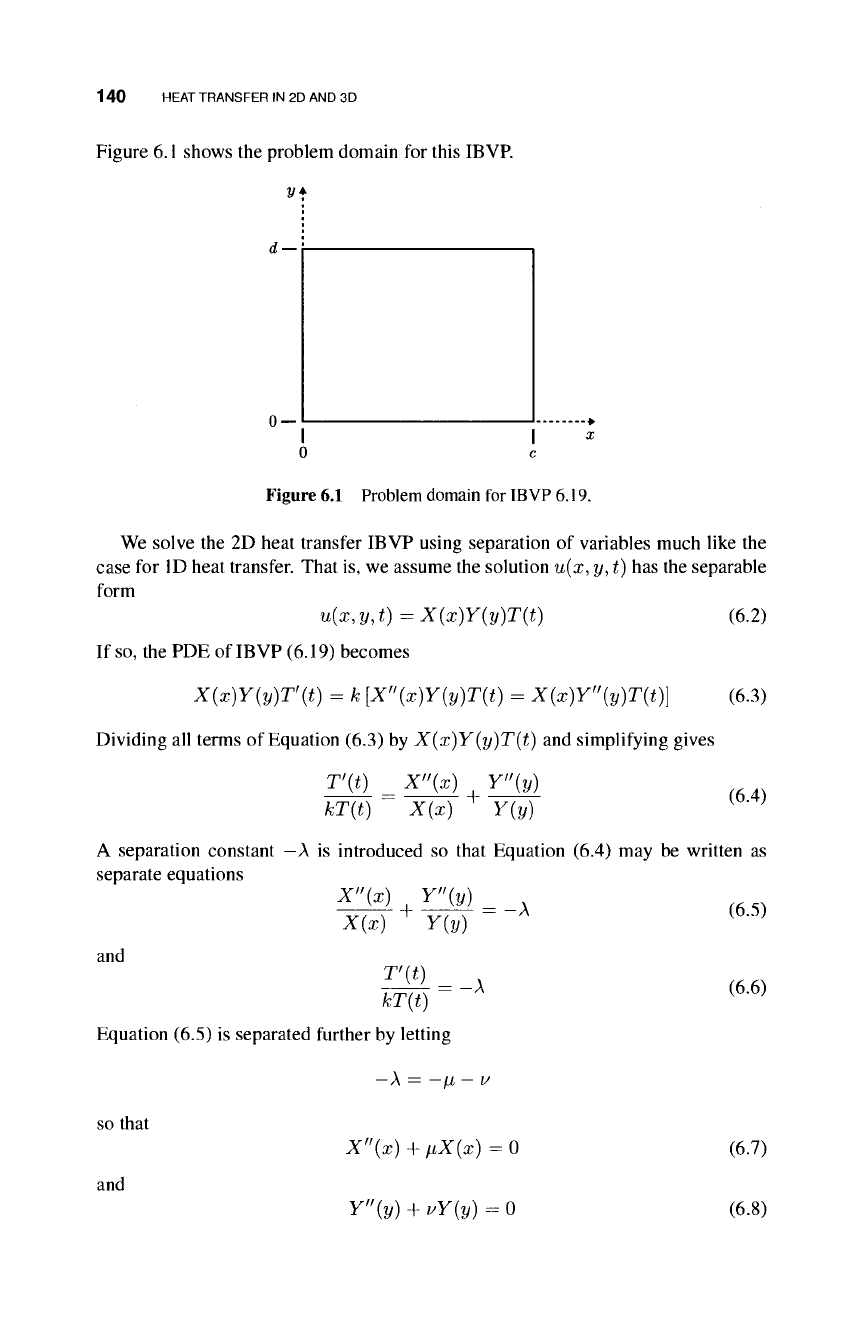
Figure 6.1 shows the problem domain for this IBVP.
2/f
Figure
6.1
Problem domain for IBVP 6.19.
We solve the 2D heat transfer IBVP using separation of variables much like the
case for ID heat transfer. That is, we assume the solution u(x,y,t) has the separable
form
u(x,y,t)=X(x)Y(y)T(t) (6.2)
If
so,
the PDE of IBVP (6.19) becomes
X(x)Y(y)T'(t) = k [X"{x)Y{y)T{t) = X(x)Y"(y)T(t)\ (6.3)
Dividing all terms of Equation (6.3) by X(x)Y(y)T(t) and simplifying gives
T'(t) _ X"(x) Y"(y)
kT(t) X(x)
+
Y(y)
(6.4)
A separation constant — λ is introduced so that Equation (6.4) may be written as
separate equations
x"(x)
+
r^)
=
_
A
and
X(x) Y(y)
T'{t)
kT(t)
Equation (6.5) is separated further by letting
-λ
λ
(6.5)
(6.6)
so that
and
μ
—
v
X"{x)
+ μΧ{χ) = 0
Y" (y) + vY{y) = 0
(6.7)
(6.8)
HOMOGENEOUS 2D IBVP 141
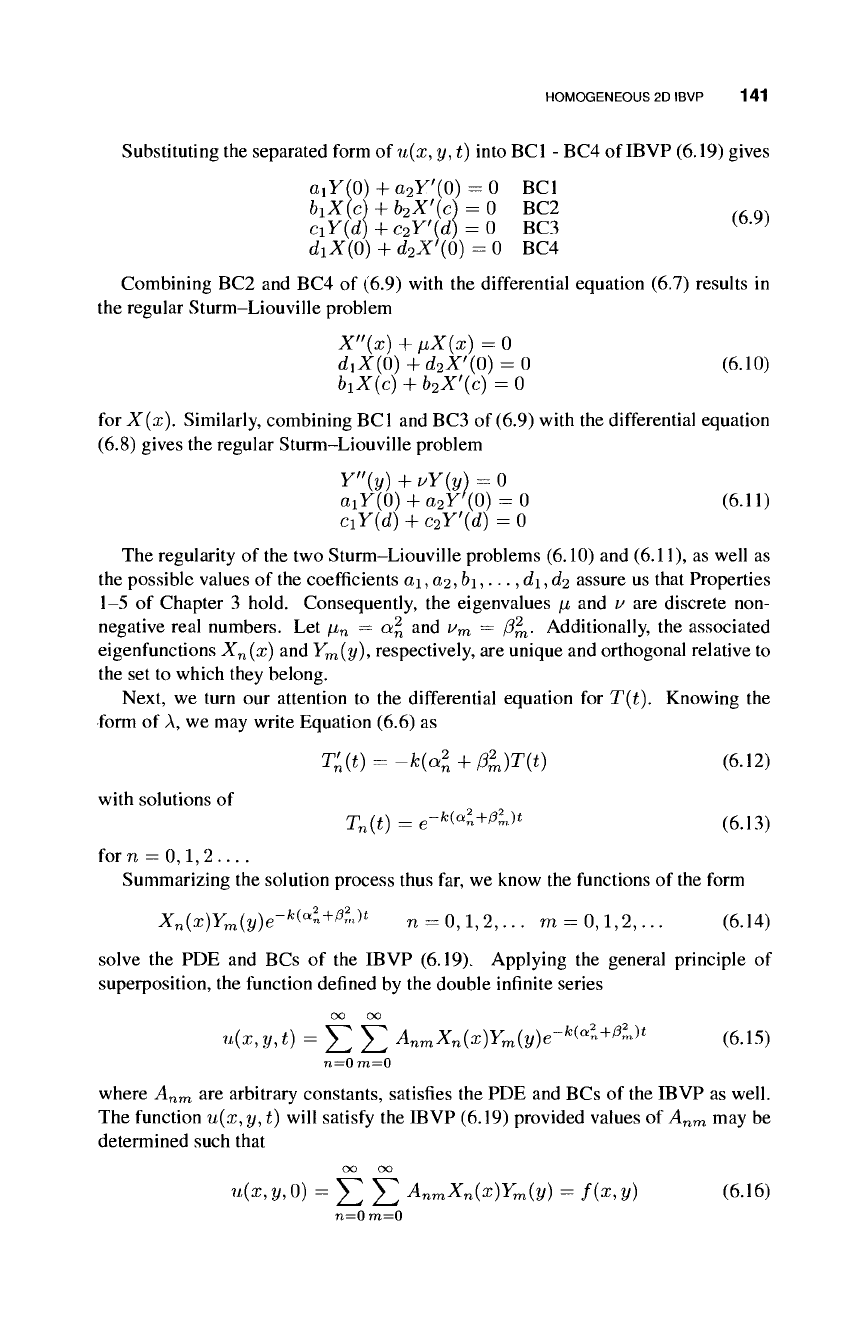
Substituting the separated form of u(x, y, t) into BCl - BC4 of IBVP (6.19) gives
ajFfO) + a
2
Y'(0) = 0 BCl
b
1
X(c) + b
2
X'(c)=0 BC2
rfi
~
Cl
Y(d) + c
2
Y'(d) = 0 BC3 ^'
diX(O) + d
2
X'(0) = 0 BC4
Combining BC2 and BC4 of (6.9) with the differential equation (6.7) results in
the regular Sturm-Liouville problem
X"{x)
+ μΧ(χ) = 0
d
1
X(0) + d
2
X'(0) = 0 (6.10)
6iX(c) + b
2
X'(c) = 0
for X(x). Similarly, combining BCl and BC3 of (6.9) with the differential equation
(6.8) gives the regular Sturm-Liouville problem
y
,,
(
2
/) + i/y(y) = o
a{Y(0) + a
2
Y
/
(0) = 0 (6.11)
ciY(d) + c
2
F'(d) - 0
The regularity of the two Sturm-Liouville problems (6.10) and (6.11), as well as
the possible values of the coefficients ai, a
2
, &i,..., di, d
2
assure us that Properties
1-5 of Chapter 3 hold. Consequently, the eigenvalues μ and ^ are discrete non-
negative real numbers. Let μ
η
— α^ and Vm — β^- Additionally, the associated
eigenfunctions X
n
(x) and Y
m
(y), respectively, are unique and orthogonal relative to
the set to which they belong.
Next, we turn our attention to the differential equation for T(t). Knowing the
form of λ, we may write Equation (6.6) as
T'
n
{t)
= -k{a
2
n
+ß
2
m
)T{t) (6.12)
with solutions of
T
n
(í) = e-
/c(a
'
+/3
-
)í
(6.13)
forn = 0,1,2... .
Summarizing the solution process thus far, we know the functions of the form
Xn^YMe-^+tf^
n = 0,1,2,... m = 0,1,2,... (6.14)
solve the PDE and BCs of the IBVP (6.19). Applying the general principle of
superposition, the function defined by the double infinite series
oo oo
u(x,
j/,*)
= Σ Σ A
nm
X
n
(x)Ym(y)e-
k{a
-
+ß
-
)t
(6.15)
n=0
ra=0
where A
nm
are arbitrary constants, satisfies the PDE and BCs of the IBVP as well.
The function u(x, y, t) will satisfy the IBVP (6.19) provided values of
A
nrn
may be
determined such that
oo oo
u(x, y^) = J2^2 A
nm
X
n
(x)Y
m
(y) = /(x, y) (6.16)
n=0 m=0