
Bernatz R. Fourier Series and Numerical Methods for Partial Differential Equations
Подождите немного. Документ загружается.

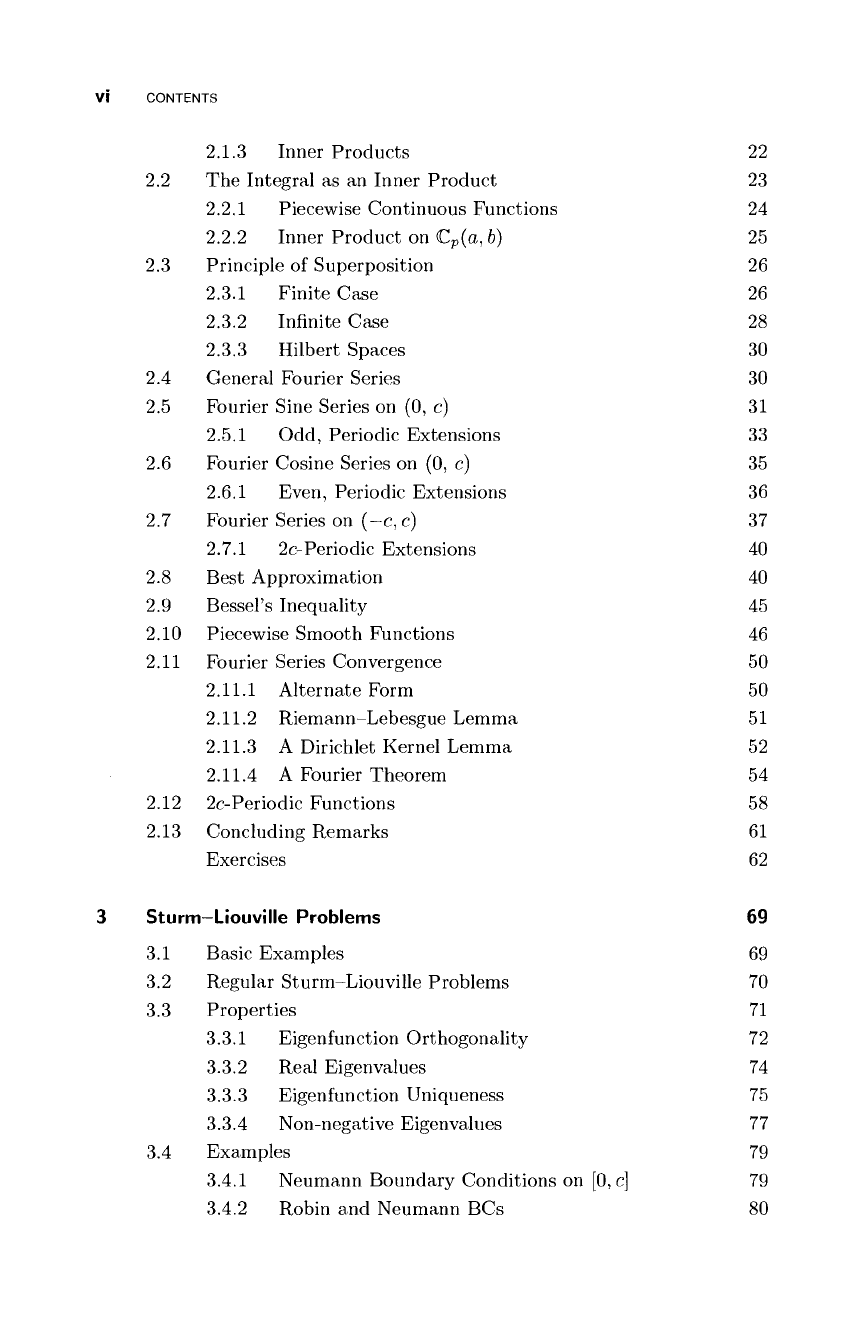
CONTENTS
2.1.3 Inner Products
2.2 The Integral as an Inner Product
2.2.1 Piecewise Continuous Functions
2.2.2 Inner Product on C
p
(a, 6)
2.3 Principle of Superposition
2.3.1 Finite Case
2.3.2 Infinite Case
2.3.3 Hubert Spaces
2.4 General Fourier Series
2.5 Fourier Sine Series on (0, c)
2.5.1 Odd, Periodic Extensions
2.6 Fourier Cosine Series on (0, c)
2.6.1 Even, Periodic Extensions
2.7 Fourier Series on
(—c,c)
2.7.1 2c-Periodic Extensions
2.8 Best Approximation
2.9 Bessel's Inequality
2.10 Piecewise Smooth Functions
2.11 Fourier Series Convergence
2.11.1 Alternate Form
2.11.2 Riemann-Lebesgue Lemma
2.11.3 A Dirichlet Kernel Lemma
2.11.4 A Fourier Theorem
2.12 2c-Periodic Functions
2.13 Concluding Remarks
Exercises
Sturm-Liouville Problems
3.1 Basic Examples
3.2 Regular Sturm-Liouville Problems
3.3 Properties
3.3.1 Eigenfunction Orthogonality
3.3.2 Real Eigenvalues
3.3.3 Eigenfunction Uniqueness
3.3.4 Non-negative Eigenvalues
3.4 Examples
3.4.1 Neumann Boundary Conditions
3.4.2 Robin and Neumann BCs
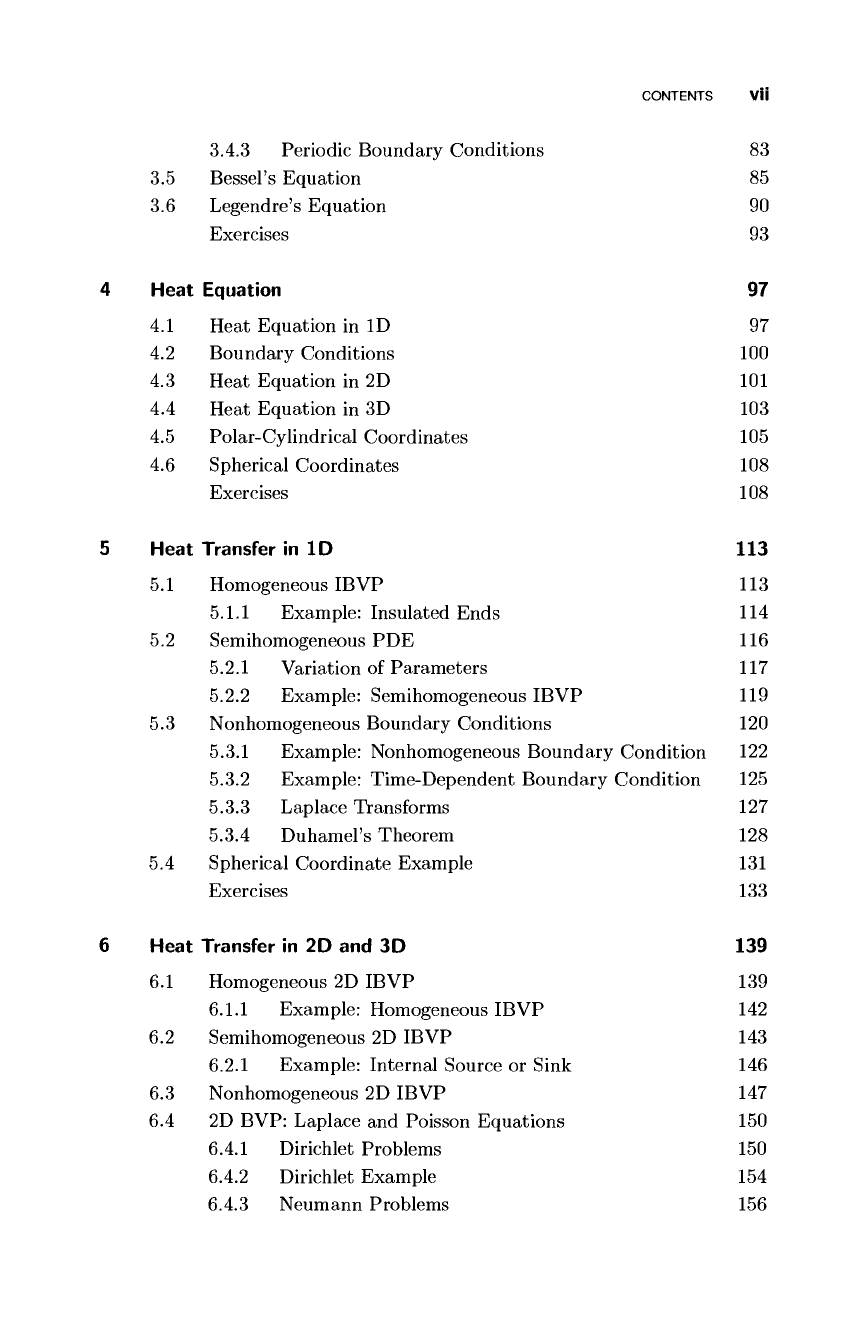
CONTENTS VII
3.4.3 Periodic Boundary Conditions 83
3.5 Bessel's Equation 85
3.6 Legendre's Equation 90
Exercises 93
Heat Equation 97
4.1 Heat Equation in ID 97
4.2 Boundary Conditions 100
4.3 Heat Equation in 2D 101
4.4 Heat Equation in 3D 103
4.5 Polar-Cylindrical Coordinates 105
4.6 Spherical Coordinates 108
Exercises 108
Heat Transfer ¡n ID 113
5.1 Homogeneous IBVP 113
5.1.1 Example: Insulated Ends 114
5.2 Semihomogeneous PDE 116
5.2.1 Variation of Parameters 117
5.2.2 Example: Semihomogeneous IBVP 119
5.3 Nonhomogeneous Boundary Conditions 120
5.3.1 Example: Nonhomogeneous Boundary Condition 122
5.3.2 Example: Time-Dependent Boundary Condition 125
5.3.3 Laplace Transforms 127
5.3.4 Duhamel's Theorem 128
5.4 Spherical Coordinate Example 131
Exercises 133
Heat Transfer in 2D and 3D 139
6.1 Homogeneous 2D IBVP 139
6.1.1 Example: Homogeneous IBVP 142
6.2 Semihomogeneous 2D IBVP 143
6.2.1 Example: Internal Source or Sink 146
6.3 Nonhomogeneous 2D IBVP 147
6.4 2D BVP: Laplace and Poisson Equations 150
6.4.1 Dirichlet Problems 150
6.4.2 Dirichlet Example 154
6.4.3 Neumann Problems 156
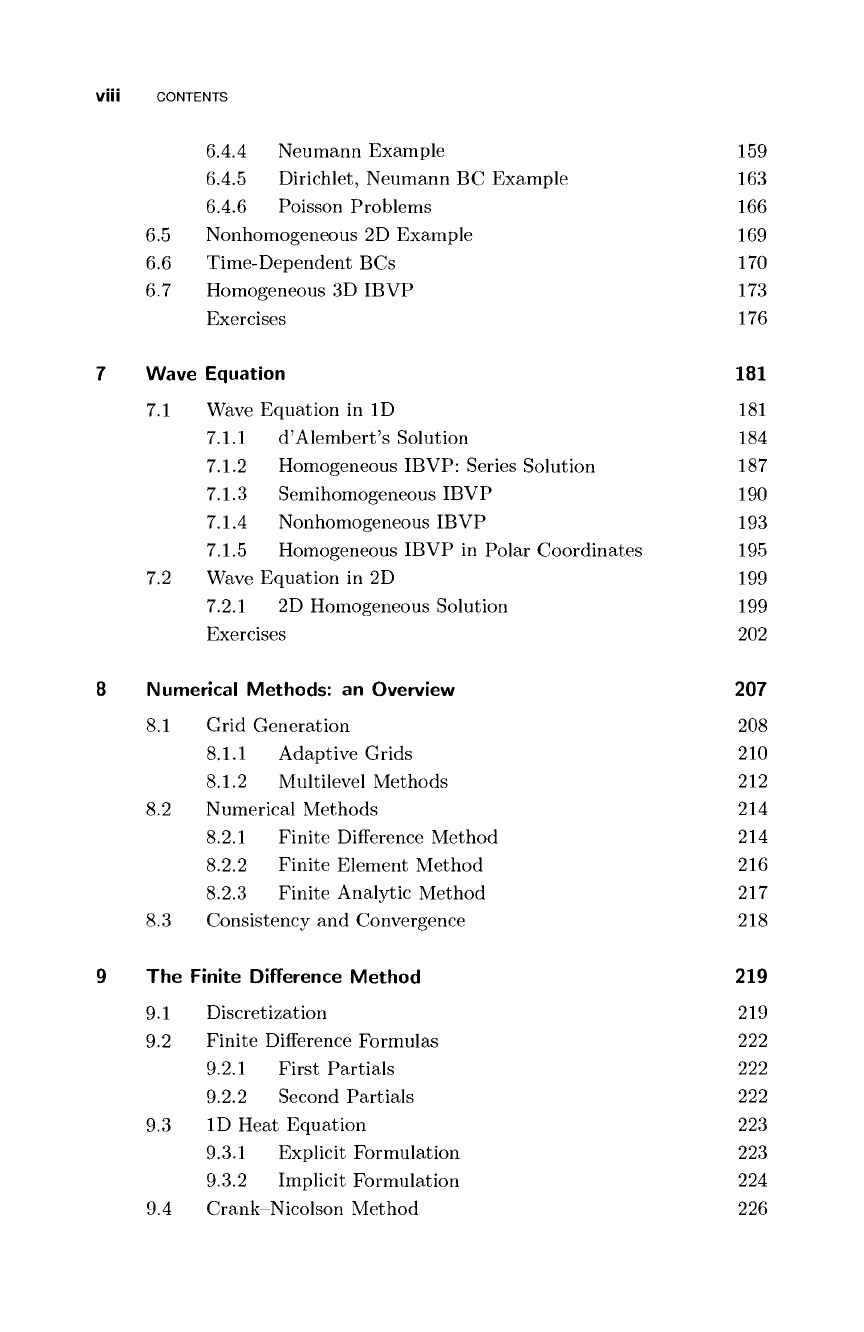
VIH CONTENTS
6.4.4 Neumann Example 159
6.4.5 Dirichlet, Neumann BC Example 163
6.4.6 Poisson Problems 166
6.5 Nonhomogeneous 2D Example 169
6.6 Time-Dependent BCs 170
6.7 Homogeneous 3D IBVP 173
Exercises 176
Wave Equation 181
7.1 Wave Equation in ID 181
7.1.1 d'Alembert's Solution 184
7.1.2 Homogeneous IBVP: Series Solution 187
7.1.3 Semihomogeneous IBVP 190
7.1.4 Nonhomogeneous IBVP 193
7.1.5 Homogeneous IBVP in Polar Coordinates 195
7.2 Wave Equation in 2D 199
7.2.1 2D Homogeneous Solution 199
Exercises 202
Numerical Methods: an Overview 207
8.1 Grid Generation 208
8.1.1 Adaptive Grids 210
8.1.2 Multilevel Methods 212
8.2 Numerical Methods 214
8.2.1 Finite Difference Method 214
8.2.2 Finite Element Method 216
8.2.3 Finite Analytic Method 217
8.3 Consistency and Convergence 218
The Finite Difference Method 219
9.1 Discretization 219
9.2 Finite Difference Formulas 222
9.2.1 First Partíais 222
9.2.2 Second Partíais 222
9.3 ID Heat Equation 223
9.3.1 Explicit Formulation 223
9.3.2 Implicit Formulation 224
9.4 Crank-Nicolson Method 226
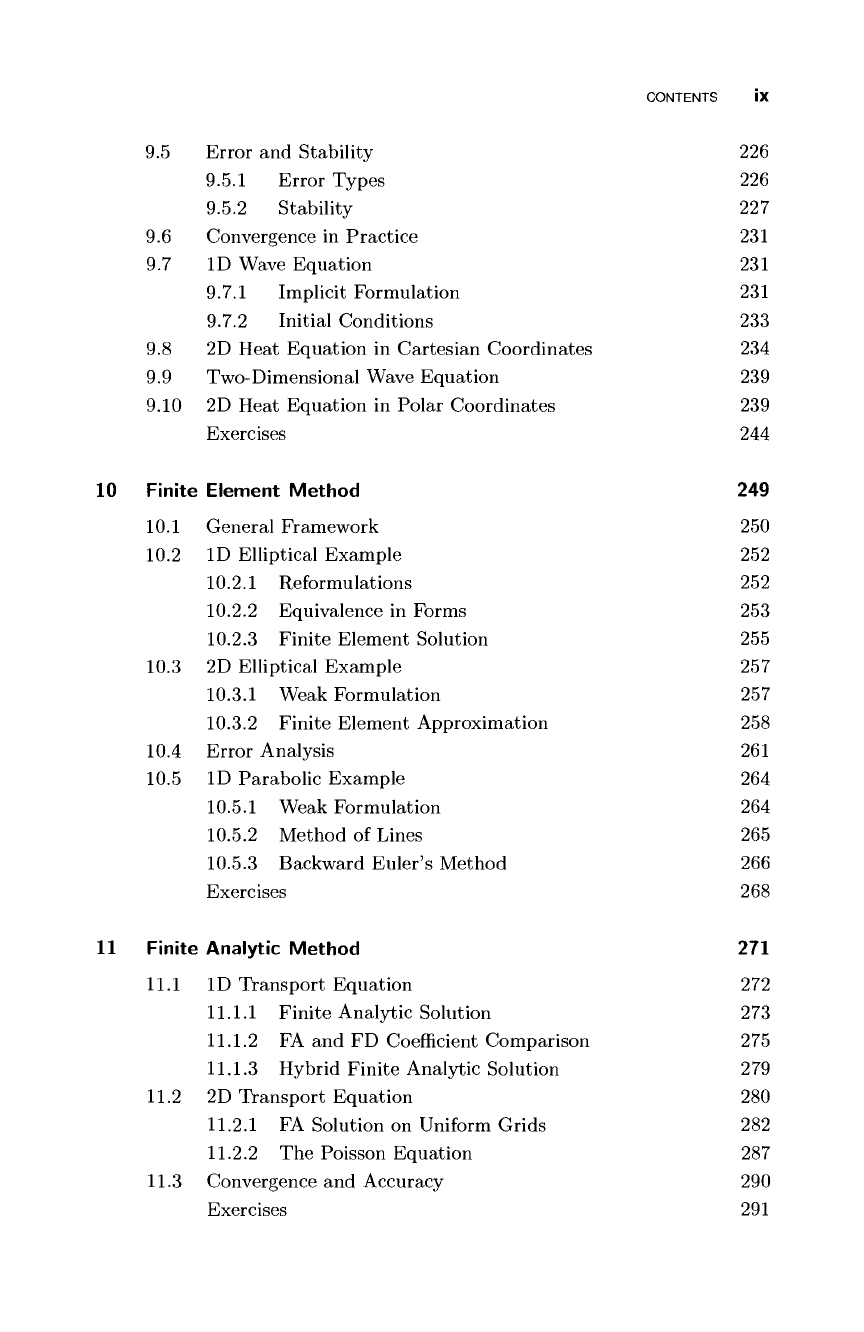
CONTENTS IX
9.5
9.6
9.7
9.8
9.9
9.10
Error and Stability
9.5.1 Error Types
9.5.2 Stability
Convergence in Practice
ID Wave Equation
9.7.1 Implicit Formulation
9.7.2 Initial Conditions
2D Heat Equation in Cartesian Coordinates
Two-Dimensional Wave Equation
2D Heat Equation in Polar Coordinates
Exercises
226
226
227
231
231
231
233
234
239
239
244
Finite Element Method 249
10.1 General Framework 250
10.2 ID Elliptical Example 252
10.2.1 Reformulations 252
10.2.2 Equivalence in Forms 253
10.2.3 Finite Element Solution 255
10.3 2D Elliptical Example 257
10.3.1 Weak Formulation 257
10.3.2 Finite Element Approximation 258
10.4 Error Analysis 261
10.5 ID Parabolic Example 264
10.5.1 Weak Formulation 264
10.5.2 Method of Lines 265
10.5.3 Backward Euler's Method 266
Exercises 268
Finite Analytic Method 271
11.1 ID Transport Equation 272
11.1.1 Finite Analytic Solution 273
11.1.2 FA and FD Coefficient Comparison 275
11.1.3 Hybrid Finite Analytic Solution 279
11.2 2D Transport Equation 280
11.2.1 FA Solution on Uniform Grids 282
11.2.2 The Poisson Equation 287
11.3 Convergence and Accuracy 290
Exercises 291
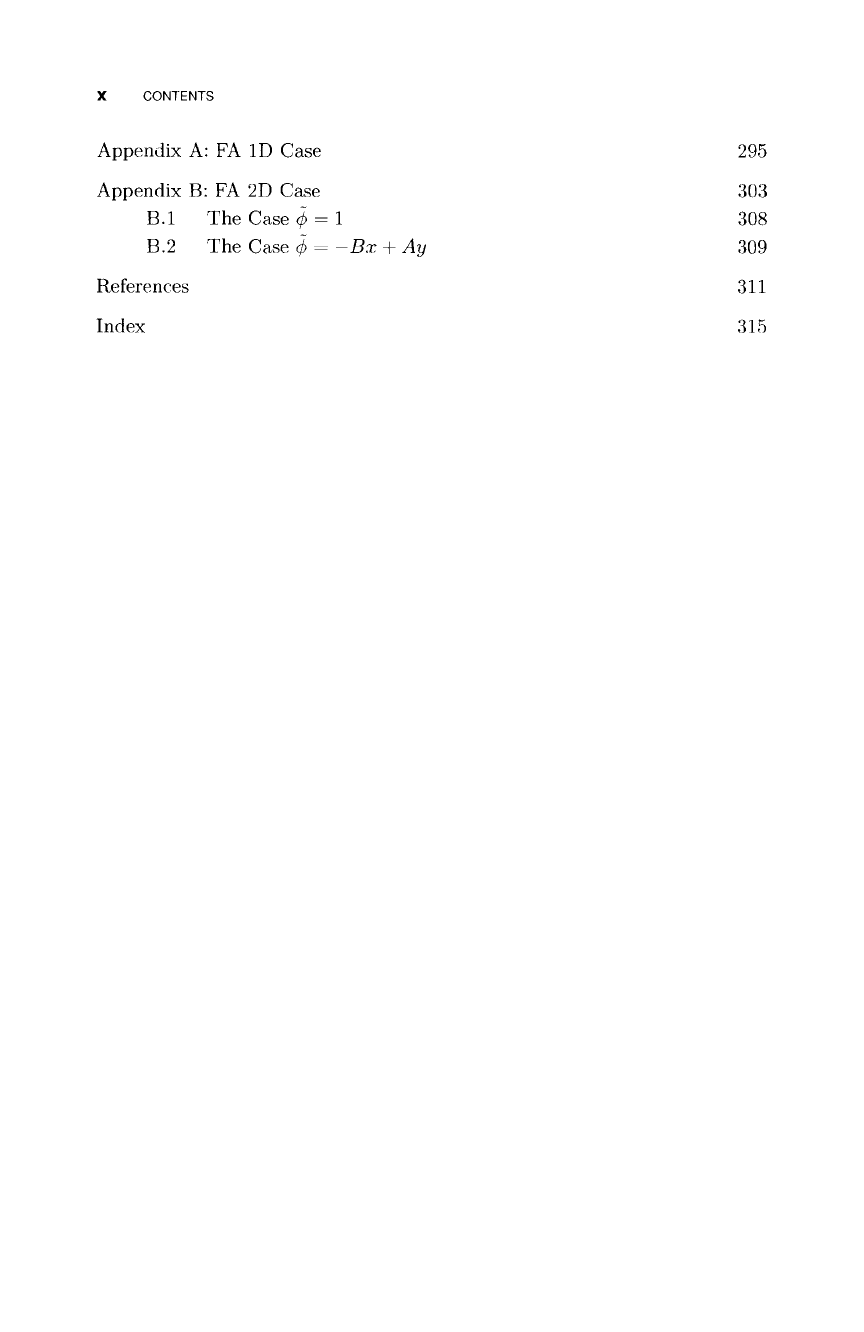
X CONTENTS
Appendix A: FA ID Case 295
Appendix B: FA 2D Case 303
B.l The Case φ = \ 308
B.2 The Case φ = -Bx + Ay 309
References 311
Index
315
PREFACE
The importance of partial differential equations in modeling phenomena in engi-
neering and the physical, natural, and social sciences is known by many students and
practitioners in these fields. I came to know this in my studies of atmospheric science.
A dependent variable, such as air temperature, is generally a function of two or more
independent variables (time and three spatial coordinates). Our desire to understand
and predict the state of natural systems, such as our atmosphere, frequently begins
with equations involving rates of change (partial derivatives) of these quantities with
respect to the independent variables. Once these equations have evolved from the
conceptual models of such systems, the next challenge is "solving" these partial
differential equations in qualitative and quantitative ways.
This book on solution techniques for partial differential equations has evolved over
the last six years and several offerings of
an
introductory course on partial differential
equations at Luther College. Students enter the course with a background typical of
most junior- or senior-level mathematics or physical science majors including two
to three calculus courses, an introductory linear algebra course, and a one-semester
course in ordinary differential equations. With this common foundation, the book
intends to strengthen and extend the reader's knowledge and appreciation of the power
of linear spaces and linear transformations for purposes of understanding and solving
a wide range of equations including many important partial differential equations.
The notions of infinite dimensional vector spaces, scalar product, and norm lead to,
XI
XÜ PREFACE
perhaps, the reader's initial introduction to Hubert spaces through the theoretical
development of Fourier series and properties of convergence. These somewhat
abstract foundations are important aspects of developing an undergraduate's more
general problem solving skill.
Most "real-world" partial differential equations, because of their nonlinear nature,
do not lend themselves to solution techniques of separation of variables, orthogonal
eigenfunction bases, and Fourier series solutions. Consequently, three different nu-
merical solution techniques are introduced in the final third of
the
book. The versatile
finite difference method is introduced first because of its relative understandable and
easy implementation. The finite element method is a popular method used by many
sanctioners in a variety of fields. Yet, it has a formidable theoretical foundation
including concepts of infinite-dimensional function spaces and finite-dimensional
subspaces. The third method for numerical solutions is the finite analytic method
wherein separation of variables Fourier series methods are applied to locally lin-
earized versions of the original partial differential equation.
Admittedly, I do not cover all of this material in a one-semester course. Usually,
Chapters
1
-
5
are covered, and then topics are chosen from Chapters 6 and
7.
Chapter
9 on finite differences is covered, and then either an introduction to finite elements
or the finite analytic method completes the semester.
Because Maple© is our campus computer algebra system of choice, a "library"
of Maple work sheets has been developed over the years. They are useful for solving
many of the exercises ranging from one-dimensional problems using Fourier se-
ries to multidimensional problems using the various numerical techniques. The
work sheets are available for users of the book through the textbook web site:
http://faculty.luther.edu/ bernatzr/PDE Text/index.html
RICHARD BERNATZ
Decorah, Iowa
January 29, 2010
ACKNOWLEDGMENTS
I am grateful for all the bright and enthusiastic students at Luther College who have
plowed their way through the partial differential equations course and the primitive
versions of this manuscript. I thank them for their patience while working with an
evolving text, as well as their suggestions for improving the work. In particular, the
careful reading of the text and the additional exercises developed by Aaron Peterson
were especially helpful. I want to thank Christian Anderson for giving me the
thought that it may be worth making this manuscript available to a wider audience.
In addition, I appreciate the guidance provided by the staff at John Wiley. I thank
Susanne Steitz-Filler, in particular, for the assistance she provided to make the goal
of publishing this manuscript a reality.
R.A.B.
XIII

This Page Intentionally Left Blank
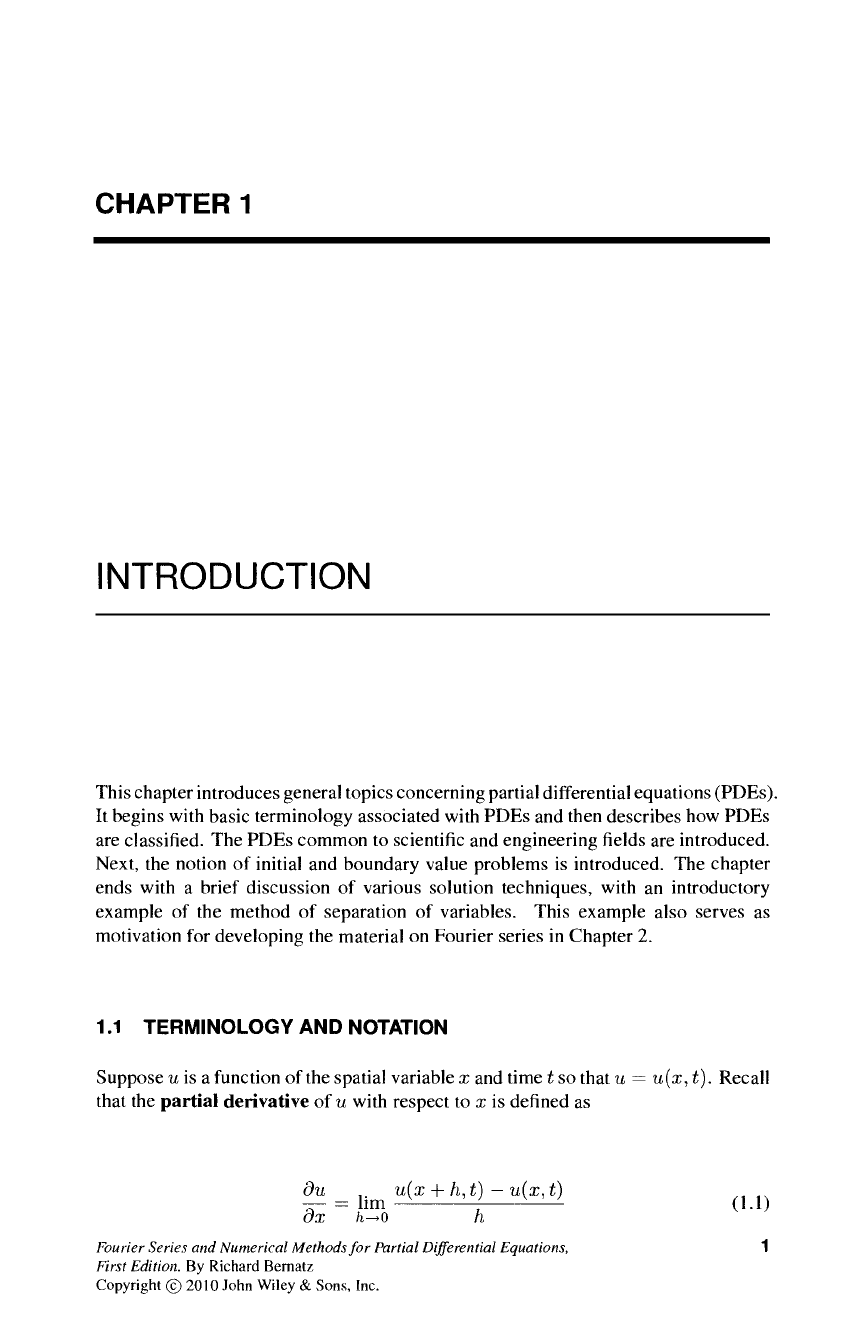
CHAPTER 1
INTRODUCTION
This chapter introduces general topics concerning partial differential equations (PDEs).
It begins with basic terminology associated with PDEs and then describes how PDEs
are classified. The PDEs common to scientific and engineering fields are introduced.
Next, the notion of initial and boundary value problems is introduced. The chapter
ends with a brief discussion of various solution techniques, with an introductory
example of the method of separation of variables. This example also serves as
motivation for developing the material on Fourier series in Chapter 2.
1.1 TERMINOLOGY AND NOTATION
Suppose u is a function of
the
spatial variable x and time t so that u = u(x, t). Recall
that the partial derivative of u with respect to x is defined as
du u(x + h,t)— u{x,t)
ίΛ 1Χ
— = lim 1 (1.1)
OX h-^0 h
Fourier Series and Numerical Methods for Partial Differential Equations, 1
First Edition. By Richard Bernatz
Copyright © 2010 John Wiley & Sons, Inc.