
Bernatz R. Fourier Series and Numerical Methods for Partial Differential Equations
Подождите немного. Документ загружается.

192
WAVE EQUATION
The solution formulation will be complete once expressions for A
n
(0) and B
n
(0)
are determined. We know the general solution for y(x, t) is given by Equation (7.40).
Matching the initial displacement f\ (x) when t = 0 gives
]T (A
n
(0) cos(ca
n
0) + B
n
(0) sin(ca
n
0)) X
n
(x) = f
x
(x)
oo
^^^„(0)X
n
(x) = h{x)
n=0
n=0
^A
n
(0) = Í
f
1
(x)X
n
(x)dx
Jo
Next, the initial velocity f%(x) is matched for t
—
0 to give
oo
^2(A
n
(0)cos{ca
n
0) + B
n
(0)sm(ca
n
0)yX
n
{x) = f
2
(x)
n=0
=>
J2ca
n
B
n
(0)X
n
(x) = f
2
(x)
n=0
^B
n
(0) = —[
f
2
(x)X
n
(x)dx
ca
n
Jo
Formulas for A
n
(t) and B
n
(t) given in (7.48) and (7.49) are valid for all n > 1.
The case for zero as an eigenvalue (λ = 0) must be treated separately because the
general solution to the ODE given by Equation (7.45) is given by linear combinations
of the solutions C\ — 1 and C
2
= t. In the event of a zero eigenvalue, the formulas
for Ao(t) and B
0
(t) are
A
0
(t)
= A)(0) + / -rFo(r) dr (7.50)
Jo
B
o
(t)=B
o
(0)+ Í F
0
(r)dr (7.51)
Jo
with
pL pL
A)(0)=/
f
1
{x)X
0
(x)dx
ana B
o
(0) =
f
2
(x)X
0
(x)dx
(7.52)
Jo Jo
7.1.3.1
Semihomogeneous Example The solution for the following semi-
homogeneous problem is presented in this section. Referring to the general semi-
homogeneous IBVP (7.38), suppose
F(x, t) = if
[4.5,5.5]
0*0
(x - 4.5)(5.5 - x) sin(i)
and both f\ and f
2
are identically zero. Plots of F(x,t) and the series solution for
y(x,t) for various times t are given in Figure 7.5. The displacement at the center of
the string follows the forcing function F(x, t) with some lag time.
WAVE EQUATION IN 1D 193
(a)
t
=
2.0
(b)
t
=
5.0
(c)
t
=
6.0
Figure 7.5 Plots of y (solid) and F (dotted) versus t for various t.
7.1.4 Nonhomogeneous IBVP
The general nonhomogeneous ID wave problem is shown in IBVP (7.53). Our
approach for solving this general IBVP, like that for the nonhomogeneous
f
y
tt
(x,t)
=
c
2
y
xx
{x,t)
+ F(x,t) (PDE)
0 < x < L, t>0
IBVP
y(x,0) = f
1
(x)
yt(x,0) = /
2
(x)
(ICI)
(IC2)
(7.53)
194
WAVE EQUATION
ID heat equation, is to assume a solution of the form
y(x, t) = y
(x,
t) + S(x, ¿) (7.54)
where S(x,t) satisfies the nonhomogeneous BCs of the IBVP. If so, the function
Y(x,t) is left to solve a semihomogeneous wave problem. Such a solution may be
determined using methods of Section 7.1.3.
A suitable form of 5(x, t) in many instances is
S(x,t) = A(t) + B(t)x (7.55)
where A(t) and B(t) are determined by satisfying BC1 and BC2. Assuming this
may accomplished, we identify the resulting semihomogeneous problem that Y(x,t)
must solve.
Substituting for y and its derivatives in the PDE of IBVP (7.53), we have
Ytt{x, t) + A"{t) + B"{t)x = c
2
Y
xx
(x, t) + F(x, y) (7.56)
which leads to the PDE
Ytt(x,t) = c
2
Y
xx
(x,t) + F*(x,y) (7.57)
where
F*(x, y) = F(x, y) - A"{t) - B"{t)x (7.58)
Next, we substitute the proposed form for y(x,t) in the initial conditions prescribed
in IBVP (7.53) to determine the initial conditions required of Y(x,t). For initial
condition
(IC1 ),
we have
y(x,0) + A(0) + B(0)x = h(x) => y(x,0) = f¡(x) (7.59)
where
/í(x) - h(x) - ^(0) - B(0)x (7.60)
For initial condition (IC2), we have
y
t
(x,0) 4- ^(0) + B'(0)x = f
2
(x)
=>
Yt(x,0) = r
2
{x) (7.61)
where
/
2
*(*) =
Λ(Χ)
- ^'(0) - B'(0)x (7.62)
A simple nonhomogeneous example is solved in Section
7.1.4.1.
7.1.4.1 Nonhomogeneous Example The simple nonhomogeneous problem
prescribed in IBVP (7.63) is solved in this section. The stretched string in this
example
(
y
tt
(x,t)
= 2y
xx
(x,t) (PDE)
| 0 < x < 10, t > 0
!/(x,0)=0 (ICI)
î/t(x,0)=0 (IC2)
i
7
·
63
)
y(0,t) = ^siní (BCl)
I 2/(10,*) =0 (BC2)
IBVP<
WAVE EQUATION IN 1D 195
has no initial displacement nor initial velocity. Note the PDE of IBVP (7.63) is ho-
mogeneous as well as boundary condition (BC2). The latter translates to a stationary
right end point for the string. However, boundary condition (BCl) implies the left
end of the string oscillates on the ?/-axis between
— ^
and |.
Requiring S(x, t) = A(t) 4- B(t)x to satisfy both boundary conditions gives
A(t) = -sini and B(t) = -——— sint
Once A(t) and B(t) have been determined, formulas for F*(x, t), fl(x), and /! (#)
can be found. In this case,
F*(x,t) = -sint
—
x sini
v
'
)
2 2-10
fi(x) = -isinO + x—^sin0 = 0
1 1 1 x
fo(x) = --cosO -\-x——— cosO =
—
- 4- —
J2K )
2 2-10 2 20
The homogeneous Dirichlet BCs of the resulting semihomogeneous IBVP for
Y(x,t) require eigenfunctions and eigenvalues
/
2 77/7Γ
— sin(a
n
x) a
n
= —, n = 1,2,3, ...
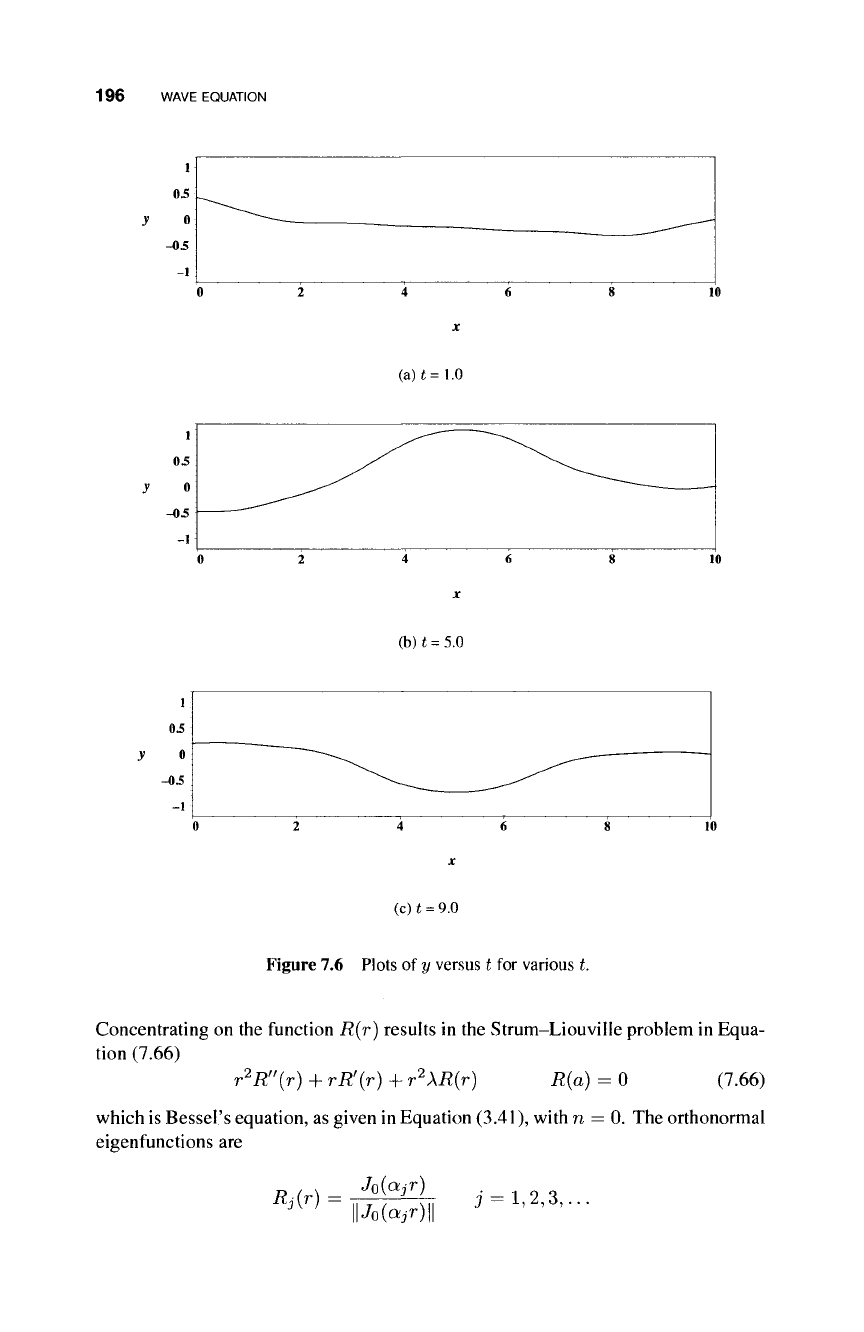
Figure 7.6 shows the string's displacement for various times t. The left end of the
string at x
=
0 oscillates, as prescribed, between the values of
—
\ and \ as the right
end point remains stationary.
7.1.5 Homogeneous IBVP in Polar Coordinates
The solution process for homogeneous ID initial boundary value problem in polar
coordinates is presented in this section. The specifics of the problem are shown in
IBVP (7.64).
ztt(r, t) = c
2
(z
rr
(r, t) + \z
r
(r, t)) (PDE)
0 < r < a, t > 0
IBVP<
*(r,0) = /i(r) (ICI)
(J M)
*t(r,0) = /
2
(r) (IC2)
(/
'
ö4)
z(a,t)=0 (BCl)
|y(r,f)|<oo (BC2)
The initial displacement is given by /i(r) and the initial velocity by f
2
{r) of the
surface. The boundary condition at r = a is homogeneous and Dirichlet.
A separated solution of the form z(r, t) = R(r)T(t) is sought. Subbing for z in
the PDE, simplifying, and introducing the separation constant λ gives
Ht) fi^fr) l^(r)
c
2
T{t) R(r)
+
r R(r)
(
'
196
WAVE EQUATION
(a)t=1.0
(b) t = 5.0
(c) t = 9.0
Figure 7.6 Plots of y versus t for various t.
Concentrating on the function R(r) results in the Strum-Liouville problem in Equa-
tion (7.66)
r
2
R"{r)
+ rR'(r) +
r
2
XR(r)
R(a) = 0 (7.66)
which is Bessel's equation, as given in Equation (3.41), with n = 0. The orthonormal
eigenfunctions are
Rj(r)
||
Jo(ajr)
|
3 =
1,2,3,...
WAVE EQUATION IN 1D 197
where the eigenvalues aj are the zeros of the Bessel function Jo(ar).
Now that the eigenvalues are known from the R equation, the differential equation
for T found from Equation (7.65) is
T"(t) + c
2
a]T{t) = 0 (7.67)
with general solution
T(t) = Aj cos(cajt) + Bj sin(ca¿í) (7.68)
Combining the results for R and T gives the Fourier solution for z(r,t) shown in
Equation (7.69).
OO
z
(
r
i ¿) = Σ(
Α
ΐ
cos
(
ca
j
t
) +
B
j sm(cajt))Rj(r) (7.69)
3 = 1
The coefficients Aj and Bj are determined using the initial displacement fi(r) and
velocity
./^(r),
respectively. Because we want
oo
z
(
r
, 0) = Y^(
A
j cos(coyO) + Sj sinicttjO))^-^) = /i(r) (7.70)
it follows that ^4j are such that
oo
fi(r) =
Y^AjRj(r)
and
/»a
A,- - / rh{r)Rj(r)dr
Jo
The case for initial velocity is
oo
zt(r,0) = /J(
—ca
jAj sin(cajO) +
COLJBJ
cos(cajO))Rj(r) = fe(r)
3 = 1
which requires
B
i = ^7 Í
r
f2(r)Rj(r)dr
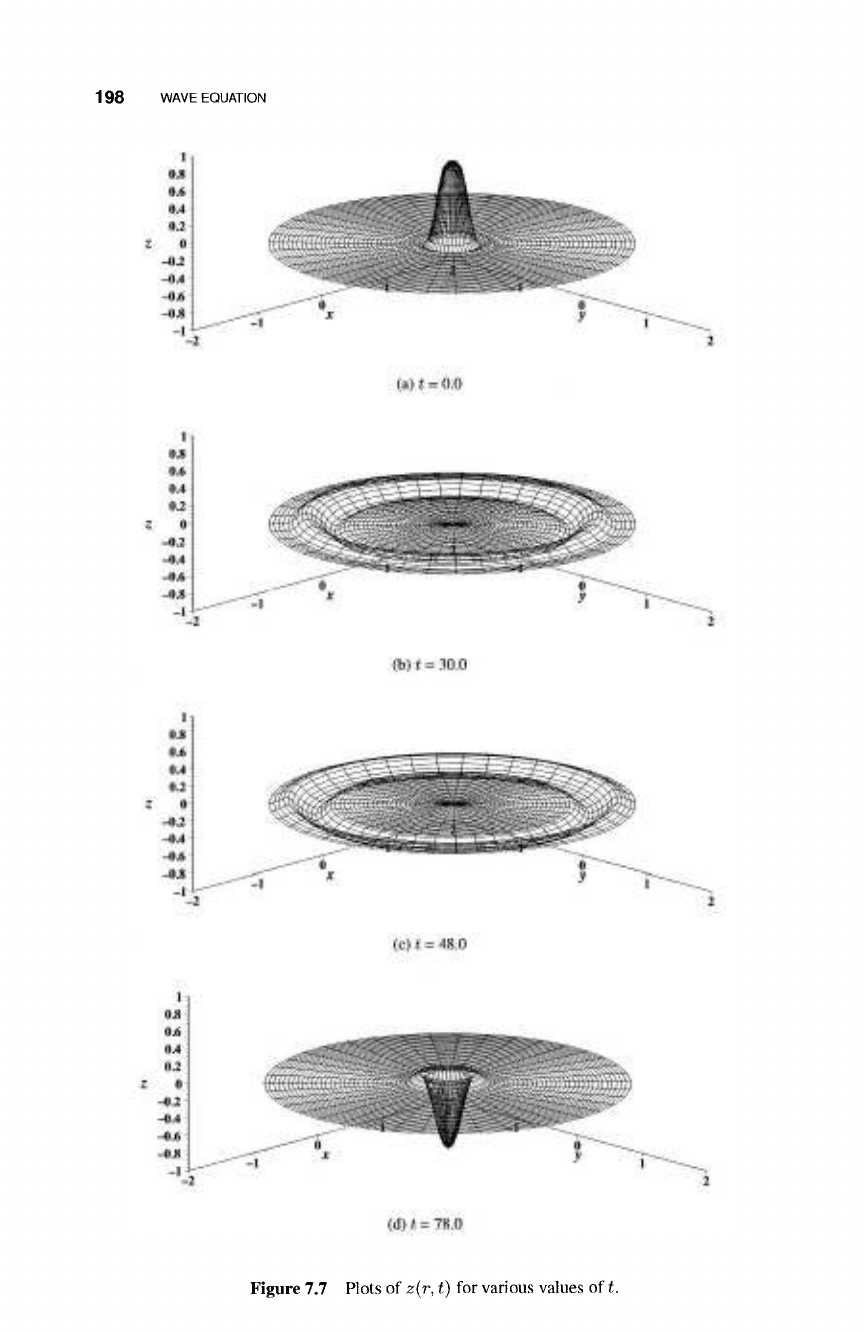
Figure 7.7 gives the z surface at various times for the homogenous IBVP
(7.64).
In
this case, radius a — 2, speed c = 0.05, initial displacement /i(r) = 1
—
(r/0.25)
2
for 0 < r < 0.25 and /i(r) = 0 for 0.25 < r < 2. The initial velocity /
2
(r) = 0.
The initial "witch hat" surface is well represented by the Fourier series solution
constructed from the Bessel functions. The displacement spreads outward to the
boundary at r = 2 where it is reflected and inverted as it begins its progression back
to the center. At t = 78, the surface is almost the mirror image, through the z = 0
plane, of the initial displacement.
198
WAVE EQUATION
Figure 7.7 Plots of z(r, t) for various values of t.
WAVE EQUATION IN 2D 199
7.2 WAVE EQUATION IN 2D
The wave equation in two spatial dimensions is shown in Equation (7.71). The
derivation is left
as
an
exercise.
The dependent variable z represents the displacement,
at a given location (x, y) and time ¿, of a surface from some reference level taken to
correspond to z = 0.
z
tt
(x,
y, t) = c
2
[z
xx
(x, y, t) + z
yy
(x, y, t)] + F(x, y, t)
(7.71)
A well-posed IBVP for z on a finite rectangular domain {(x, y)\0 < x < L and 0 <
y < M} for t > 0 require boundary conditions for z at x = 0, x = L, ?/ = 0, and
2/
= M, as well as initial conditions for z and z
t
. The general form of an IBVP for a
two-dimensional elastic membrane is outlined in IBVP (7.72).
( ztt(x, y, t) = c
2
V
2
z{x, y, t) + F(x, y, t)
0<x<L, 0<y<M, t>0
IBVP<
z(x,y,0)
=
^t(^2/,0)
/i(^y)
aiZy(x,0,t) + biz(x,0,t) = gi(x,t)
a
2
z
x
(L, y, i) + &2^(^,
2/,
0 =
P2Í2/,
*)
azZy(x, M, i) +
6
3
z(x,
M, i) = 03
(x,
i)
α
4
^χ
(0,
y, í) + 6
4
2;(0,
j/,
t) = ^
4
(y, t)
(PDE)
(ICI)
(IC2)
(BC1)
(BC2)
(BC3)
(BC4)
(7.72)
The solution procedure for the 2D elastic wave is like that for the other IBVPs we
have already considered. We begin with the homogenous case for which the methods
of separation of variables and Fourier series provide a solution.
7.2.1 2D Homogeneous Solution
The homogeneous form of IBVP (7.72) results when F and gi{i = 1..4) are all
identically zero. We assume a solution of the form
z(x,y,t) = X(x)Y(y)T(t)
and when it is substituted into the homogeneous form of Equation (7.71), the equation
T"(t) X"(x) , Y"(y)
<?T{t) X(x)
+
Y(y)
-A
(7.73)
results after division by X(x)Y(y)T(t). As before, the separation constant —λ is
introduced. To allow for the separation of functions X and Y, the constant λ is
written as μ + v. The three ODEs shown in Equations (7.74) - (7.76) result.
Χ"(χ)+μΧ(χ) = 0
Y"{y) + uY{y) = 0
T"(t) + c
2
(ß + v)T(t) = 0
(7.74)
(7.75)
(7.76)
200
WAVE EQUATION
When Equation (7.74) is combined with BCs (BC2) and (BC4), a regular Sturm-
Liouville problem results for which properties
1
- 5 of Chapter 3 hold. The same is
true for Equation (7.75) in combination with BCs (BC1), and (BC3). Consequently,
we will let
X(a
n
x) and μ
η
—
c?
n
n = 0,1,2,... (7.77)
represent the eigenfunctions and eigenvalues, respectively, for X. Similarly,
Y(ß
n
x) and v
n
= ß
2
n
n
0,1,2,...
(7.78)
will represent the eigenf unctions and eigenvalues, respectively, for Y.
With solutions for X and Y determined, the ODE in Equation (7.76) is considered
next. Both μ and v are non-negative. Both are zero only if bi(i — 1..4) are zero.
For most applications, one or both of μ or v is positive, so the general solution to
Equation (7.76) is
T
nm
(t)
= Acos{c^/al+ßlt) + Bsm(cy/a
2
n
+ßlt)
Combining the results for the three separated ODEs gives
oo oo
z(x,y,t) = ΣΣ(
Α
(7.79)
cos(cy/al + ßlfj
B
nm
sm{c^/al + ß^tj X
n
{a
n
x)Y
m
{ß
m
y)
n=0 m=0
+
(7.80)
IBVP<
7.2.1.1
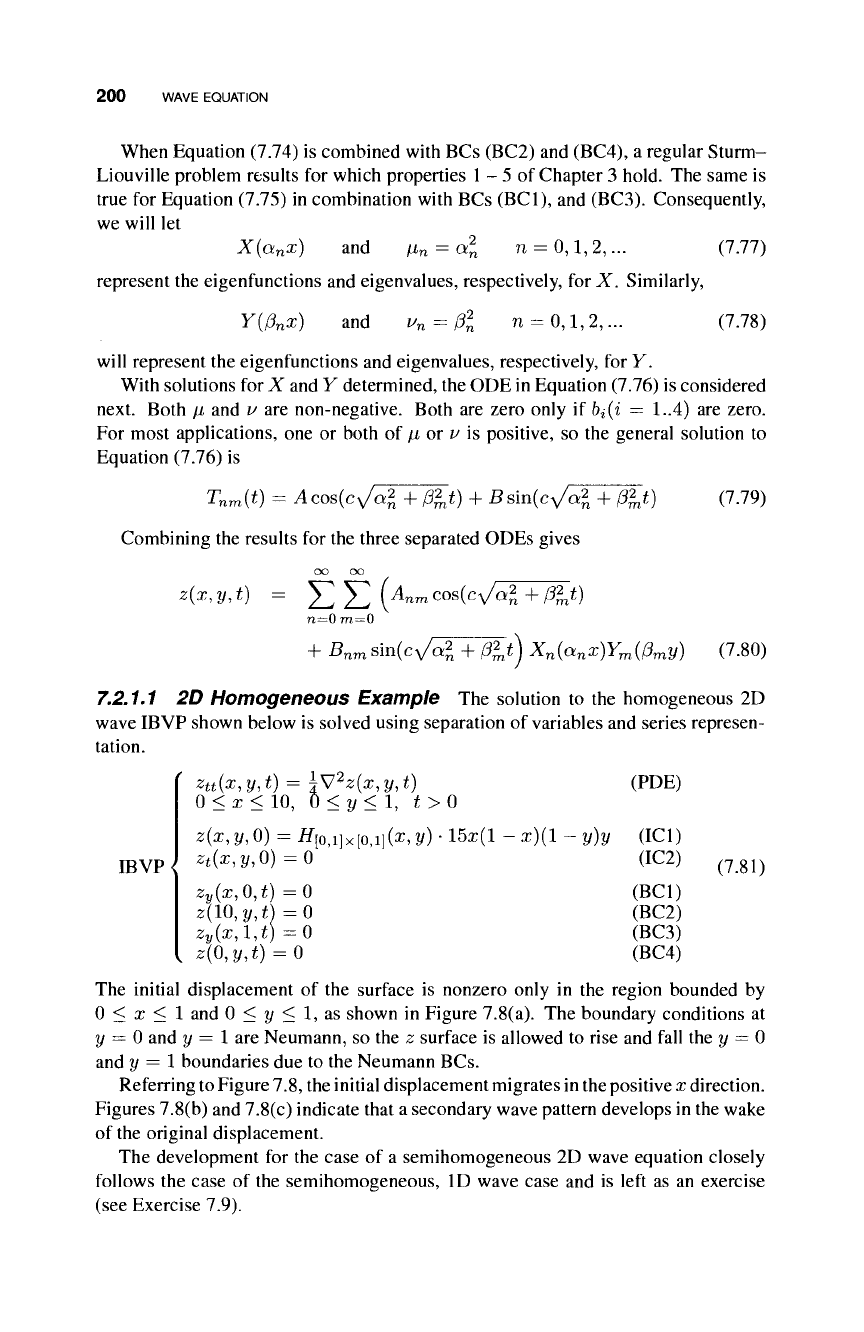
2D Homogeneous Example The solution to the homogeneous 2D
wave IBVP shown below is solved using separation of variables and series represen-
tation.
z
tt
(x,y,t) = {V?z(x,y,t) (PDE)
0<x<10, 0 < y < 1, ¿>0
z(x,y,0) = i/[o,i]x[o,i]fo2/) · 15x(l -x)(l - y)y (ICI)
zt(x,y,0) = 0 (IC2)
(7e81)
z
y
(x,0,t)=0 (BCl)
¿(10,2/,i) = 0 (BC2)
Zy(x,l,t)=0 (BC3)
z(0,y,t) = 0 (BC4)
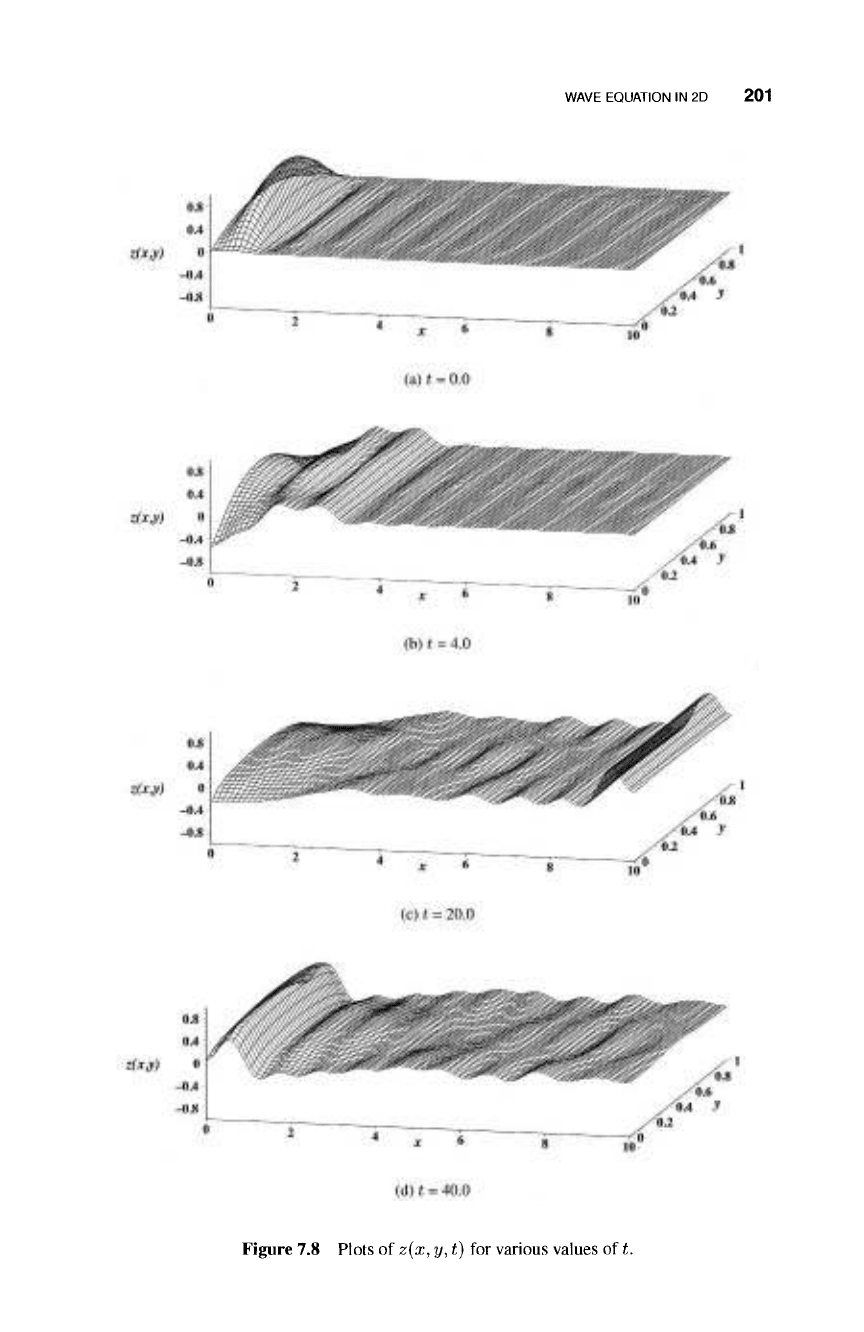
The initial displacement of the surface is nonzero only in the region bounded by
0 < x < 1 and 0 < y < 1, as shown in Figure 7.8(a). The boundary conditions at
y = 0 and y = 1 are Neumann, so the z surface is allowed to rise and fall the y = 0
and y
—
I boundaries due to the Neumann BCs.
Referring
to
Figure
7.8,
the initial displacement migrates in the positive x direction.
Figures
7.8(b)
and
7.8(c)
indicate that a secondary wave pattern develops in the wake
of the original displacement.
The development for the case of a semihomogeneous 2D wave equation closely
follows the case of the semihomogeneous, ID wave case and is left as an exercise
(see Exercise 7.9).
WAVE EQUATION IN 2D 201
Figure 7.8 Plots of z(x, y, t) for various values of t.