
Bernatz R. Fourier Series and Numerical Methods for Partial Differential Equations
Подождите немного. Документ загружается.

182
WAVE EQUATION
T sino-
T sin (99
.7:
x + Ax
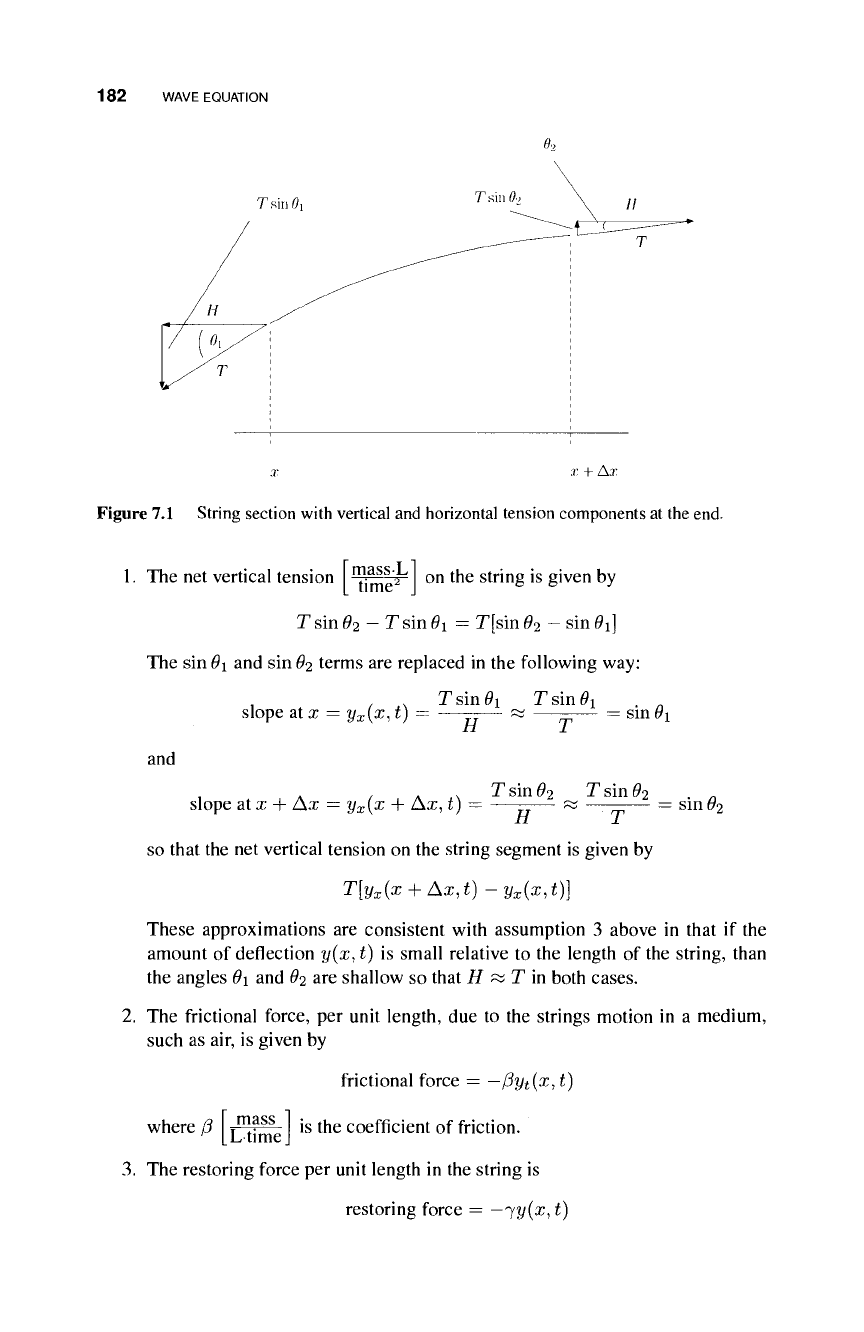
Figure
7.1
String section with vertical and horizontal tension components at the end.
1.
The net vertical tension
m
^
S
2 on the string is given by
T sin Θ
2
-Τ sin θ
1
= T[sin 0
2
- sin
θ
λ
]
The sin θ\ and sin
#2
terms are replaced in the following way:
Tsintfx Tsinfl! .
slope at x = y
x
{x, t) = ——— « —-— = sin θι
and
x T sin 0
2
Tsin0
2
.
Λ
slope at x + Δχ = y
x
(x + Δχ, ί) = ——— « , — = sin 0
2
ΧΊ
Τ
so that the net vertical tension on the string segment is given by
T[y
x
(x + Δχ, t) - y
x
(x,
t)]
consistent with assumption 3 above in that if the
ount of deflection y(x, t) is small relative to the length of the string, than
angles θ\ and
Θ2
are shallow so that H w T in both cases.
unit length, due to the strings motion in a medium,
2.
The frictional force, per
such as air, is given by
where β
mass
is
frictional force = —ßy
t
(x,t)
the coefficient of friction.
LL-timej
3.
The restoring force per unit length in the string is
restoring force = —jy(x,t)
WAVE EQUATION IN 1D 183
where 7
mass
is the restoring coefficient. Notice that the minus sign
LL
time
2
_
means the force acts in a direction opposite the deflection of the string. That
is,
if the deflection of the string segment is positive (above the x-axis), the
restoring force is in the negative y direction. If the string segment is deflected
below the x-axis, where y is negative, the restoring force would have a positive
sign, which implies the direction of the force is in the positive y direction.
4.
Any external force, such as that due to gravity, is given by F(x, t). The force
F must be prescribed on a unit length basis.
Using Newton's second law we have
Axpy
tt
(x, t) = T[y
x
(x + Δχ, t) - y
x
(x, t)] - Axßy
t
(x, t)
-Axjy(x,t) + AxF(x,t) (7.1)
where p is the uniform mass density
mass
of the string. Dividing both sides of
Equation (7.1) by Axp, and taking the limit as Ax goes to zero gives
y
u
{x,
t) = —y
xx
(x, t) - ßy
t
(x, t) - -yy{x, t) + F(x, t) (7.2)
P
The parameters ß, 7, and F in Equation (7.2) should be divided by p. Instead of show-
ing this, or using different symbols to represent the new-dimensioned coefficients,
the unit on these terms are now [time
-1
], [time
-2
], and [L ·
time
-2
],
respectively.
The units on the factor
—
are
[
L
2
time
-2
],
the same as velocity squared. Therefore,
we will let c
2
=
—,
where c may be interpreted as an intrinsic velocity of the wave.
The greater the horizontal tension T, the greater the speed, the greater the density p
of the string, the lesser the speed of the wave. The equation shown in (7.3)
yu(x,t)
c
2
y
xx
(x, t) - ßyt(x, t) - jy(x, t) 4- F(x, t)
(7.3)
is known as the telephone equation. In the absence of friction and a restoring force,
Equation (7.3) becomes the nonhomogeneous wave equation in one spatial dimension
yu(x,t)
c
2
y
xx
(x,t) + F(x,t)
(7.4)
Because Equation (7.4) includes the second derivative of y with respect to time t,
an initial condition on y and y' are required for a particular solution. In the case of
finite spatial domains, two boundary conditions on y are required due to the second
partial oïy with respect to x as well. The general form of
the
nonhomogeneous IBVP
for a ID wave equation is
IBVP
yu(x,t)
0 < x < L,
C Vxx
(x,t) + F(x,t)
t >0
l/(x,0)
= /!(x)
y
t
(x,0)
= h{x)
aw(0,t) + a
2
y
x
(0,t) = gi(t)
hy(L,
t) + b
2
y
x
(L, t) = g
2
(t)
(PDE)
(ICI)
(IC2)
(BC1)
(BC2)
(7.5)
184
WAVE EQUATION
Note the form of the BCs in IBVP (7.5) is identical to that for the one-dimensional
heat equation in Chapter 5.
7.1.1 d'Alembert's Solution
Before investigating series solution methods for IBVP (7.5), d'Alembert's solution
to a variation on IBVP (7.53) is presented in this section. The specific problem to be
solved is
(
y
tt
(x,t)
= c
2
y
xx
{x,t) (PDE)
IVP
-00 < X < 00, t > 0 ,η ,ν
y(x,0) = f(x) (ICI)
I 2/t(x,0)=0 (IC2)
The situation presented in IVP
(7.6)
pertains to an "infinitely long" string so specifying
conditions on y at finite boundary locations is not possible.
The solution process begins by making a change of variables
u
—
x
4-
ct and v
—
x
—
ct (7.7)
Expressions for ytt{x, t) and
y
xx
(x,
t) in terms of the new variables are required. To
that end,
dy
dt
dy du dy dv
du dt dv dt
dy dy
du dv
(7.8)
dy
Using the result in Equation (7.8), but replacing y with — gives
at \dt)
= c
du~ \dt) ~
c
dv~ \dt)
(7,9)
dy
Substituting for — from Equation (7.8) results in
at
— (^λ = c— (c— - c—^ - c— (a— - a—
dt \dt J du \ du dv J dv \ du dv
= c
2
d2
y
c
2
d2
y
c
2
d2
y ,
c
2
d2
y
du
2
dudv dvdu-\- dv
2
\du
2
dudv dv
2
J
An expression for y
xx
in terms of the new variables u and v is found in a similar
way.
dy dy du dy dv
dx du dx dv dx
= 7Γ + 7Γ
(7
·
Π)
ou dv
WAVE EQUATION IN 1D 185
dy
Using the result in Equation (7.11), but replacing y with
——
gives
dx\dx) du\dxjdv\dxj
dy
Substituting for
——
from Equation (7.11) results in
ox
dx
2
du \du dvJ dv \du dv
d
2
y d
2
y d
2
y d
2
y
du
2
dudv dvdu dv
2
_ (d
2
y d
2
y d
2
y\
\du
2
dudv dv
2
J
Now, substitute these expressions for y
tt
and y
xx
into the PDE of Problem (7.6) to
get the PDE in the new variables u and v. That is,
c
2
{y
U
u - ^Vuv + Vvv) = c
2
(y
uu
+ 2y
uv
+ y
vv
) (7.14)
and after some simple manipulation, Equation (7.14) reduces to
y
uv
=0
(7.15)
The general solution to Equation (7.15) is determined in the following way.
Vuv = 0 => y
u
= φ'(μ) (7.16)
and
y
u
= φ\η) => y(u,v) = φ(υ) + ψ(υ) (7.17)
Back substituting for u and v results in
y(x,t) = φ(χ + et) + φ{χ - et) (7.18)
The two initial conditions will be used to determine the particular solution. First,
y(x, 0) = f(x) => φ(χ) + φ{χ) = f(x) (7.19)
Next,
y
t
(x,
0) = 0 =» οφ'{χ) - οψ{χ) = 0
=» φ'{χ) = ψ'{χ)
=Φ ^0*0 = 0(χ) 4- C, or (7.20)
=» 0(x)=^(x)-C (7.21)
186
WAVE EQUATION
Now, Equations (7.19) and (7.20) imply
φ(χ) + φ(χ) + C = f{x) 2ψ(χ) = f{x) - C
Φ{Χ)
= \f{x) - f
and, more generally,
(ß(x + ct) = ^f(x + ct)--
(7.22)
(7.23)
Similarly, Equations (7.19) and (7.21) imply
ψ{χ)-0 + ψ{χ)=ί(χ) => 2i/>(x)=f(x) + C
and, more generally,
Ψ(χ -<*)
= \f(x -
<*)
+
§
(7.24)
(7.25)
Substituting for φ and ψ in Equation (7.18) using Equations (7.23) and (7.25) gives
the final formula for y(x, t).
y(x,t) = -[f(x + ct)+f(x-ct)]
(7.26)
This solution is valid for a rather special case of the wave equation. The initial
conditions specify a wave form given by f(x), with no initial change vertical "veloc-
ity". As such, the wave form f(x) travels, with speed c in the positive and negative
x directions along the infinite string.
7.1.1.1
Example d'Alembert's solution for the ID wave equation problem
shown below
( ytt(x,t) =
y
xx
(x,t)
(PDE)
—oo < x < oo, t > 0
10
IBVP
y(X,0)=
l+x2
I y
t
(x,0) = 0
(ici)
(IC2)
is
y{x,t)
10
-f
10
2 |_l + (x + t)
2
1+ (£-£)
(7.27)
(7.28)
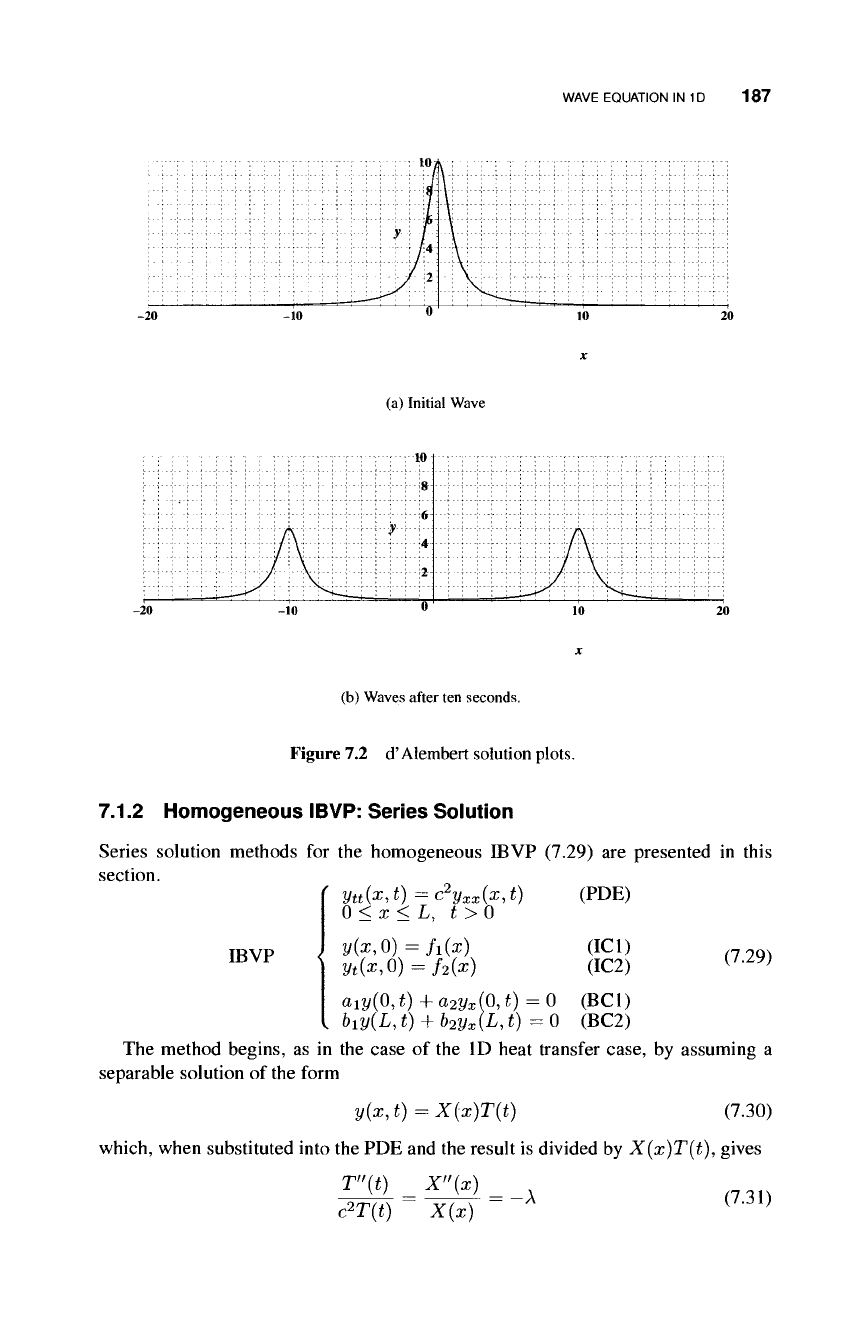
The wave velocity in this example is c = 1. Plots for the solution are shown in Figure
7.2. The initial wave for t
—
0 is shown in 7.2(a). The right- and left-traveling waves
are shown for t = 10 s in Figure 7.2(b). Each traveling wave has a peak displaced
10 units from the origin because of the wave speed of
1
unit per second.
WAVE EQUATION IN 1D 187
(a) Initial Wave
(b) Waves after ten seconds.
Figure 7.2 d'Alembert solution plots.
7.1.2 Homogeneous IBVP: Series Solution
Series solution methods for the homogeneous IBVP (7.29) are presented in this
section.
(
y
tt
(x,t)
= c
2
y
xx
(x,t) (PDE)
0 < x < L, t>0
IBVP
y(x,0) = fi(x)
yt(x,0) =/2O)
(ICI)
(IC2)
(7.29)
ai2/(0,t)+O22/x(0,í) = 0 (BCl)
I
b
iy
{L,t)
+ b
2
y
x
{L,t)=0 (BC2)
The method begins, as in the case of the ID heat transfer case, by assuming a
separable solution of the form
y(x,t) = X(x)T(t) (7.30)
which, when substituted into the PDE and the result is divided by X(x)T(t), gives
T"{t) X"{x)
c
2
T(t) X(x)
= -\
(7.31)
188
WAVE EQUATION
The BCs in the IBVP will determine the eigenvalues λ and eigenfunctions X of
the Sturm-Liouville problem that results for X. The typical values for ai,
Ü2,
b\ and
62 result in real, non-negative, and discrete eigenvalues λ
η
=
o?
n
and sine or cosine
functions for the associated eigenfunctions
X
n
{x).
Once the eigenvalues have been determined by the Sturm-Louisville problem for
X, the ODE for T is considered.
T"{t) + c
2
a
2
n
T(t) = 0
The general solution to Equation (7.32) is
T
n
(t) = A
n
cos(ca
n
t) + B
n
sm(ca
n
t)
(7.32)
(7.33)
where the coefficients A
n
and B
n
are determined by matching the initial conditions
on
y(x,t).
It will become evident coefficients A
n
are determined so that the initial
displacement is satisfied by y(x, 0), and the B
n
coefficients are determined through
the satisfaction of the initial velocity by
y
t
(x,0).
These methods are illustrated in
the following example.
7.1.2.1
Series Solution Example Series solution techniques are used to solve
the following homogeneous IBVP
f lti%
IBVP
< 10, t > 0
y(x,0) = H
[4i6]
(x)(A-x)(x-
y
t
{x,0)
= 0
y(o,t) = o
y(io,f) = o
6)
(PDE)
(ICI)
(IC2)
(BC1)
(BC2)
(7.34)
that describes the case of a string stretched between fixed ends at x equal 0 and x
equal 2. The initial velocity of the string is zero. The initial displacement of the
string from its natural position is given in ICI. Note the intrinsic wave speed c is y/2
in this example.
The boundary conditions result in eigenfunctions of X
n
(x) — J\ sin (^ψ-) with
eigenvalues α
η
= ^, n —
1,2,3,...
. With the general solution of the ODE for T
known, the formula for y(x, t) in Equation (7.35) satisfies all but the initial conditions
of the IBVP.
y(x,t)
Σ
n=l
B
n
cos
y/2nnt
+ A
n
sin
\f2nixt
sin
/ηπχ\
(7.35)
The zero velocity initial condition removes the sine terms from the general solution
for T(t) so that T
n
(t) = cos
(^ψΐ^
m
Consequently, the solution to IBVP (7.34) is
71=1 \
fV2nni
(ψ)
(7.36)
WAVE EQUATION IN 1D 189
where
B
n
f
2
/ ^χ · /ηπχ\ _
/ y(x,0)sm ( ——
J
ax
V 2
-)
(7.37)
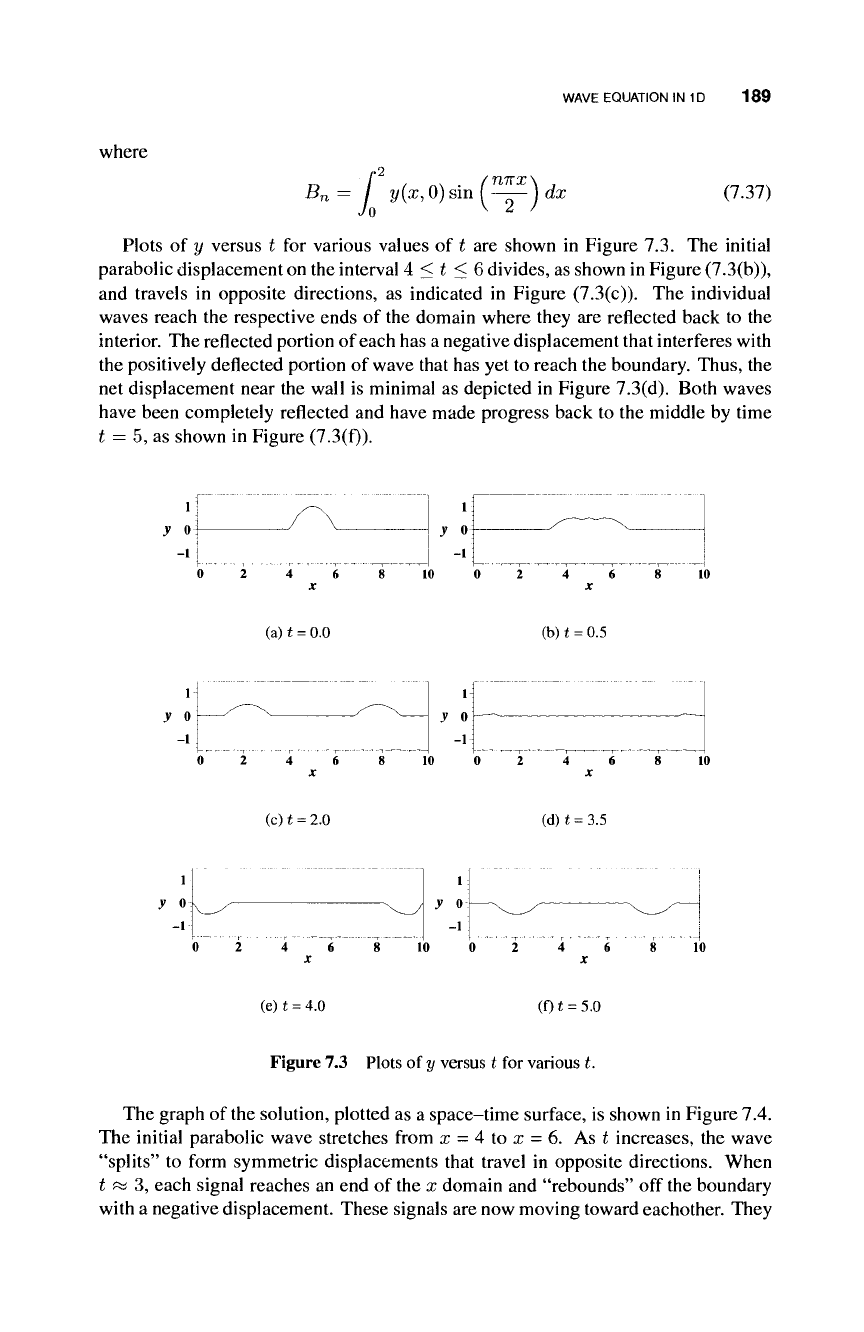
Plots of |/ versus t for various values of t are shown in Figure 7.3. The initial
parabolic displacement on the interval 4 < t < 6 divides, as shown in Figure (7.3(b)),
and travels in opposite directions, as indicated in Figure (7.3(c)). The individual
waves reach the respective ends of the domain where they are reflected back to the
interior. The reflected portion of each has a negative displacement that interferes with
the positively deflected portion of wave that has yet to reach the boundary. Thus, the
net displacement near the wall is minimal as depicted in Figure 7.3(d). Both waves
have been completely reflected and have made progress back to the middle by time
t = 5, as shown in Figure (7.3(f))·
i
y
o
-i
1-
y
oj
10
8 10
(a)
t
=
0.0
(b)
t
=
0.5
1
y
o
-i
y
o
-i
10
2 4 6
X
8 10
(c)
t
=
2.0
(d)
t
=
3.5
1-
y
o-j
-M
4 6
X
1
y
o
-1
10
4 6
x
10
(e)
t
=
4.0
(f) t
=
5.0
Figure 7.3 Plots of y versus t for various t.
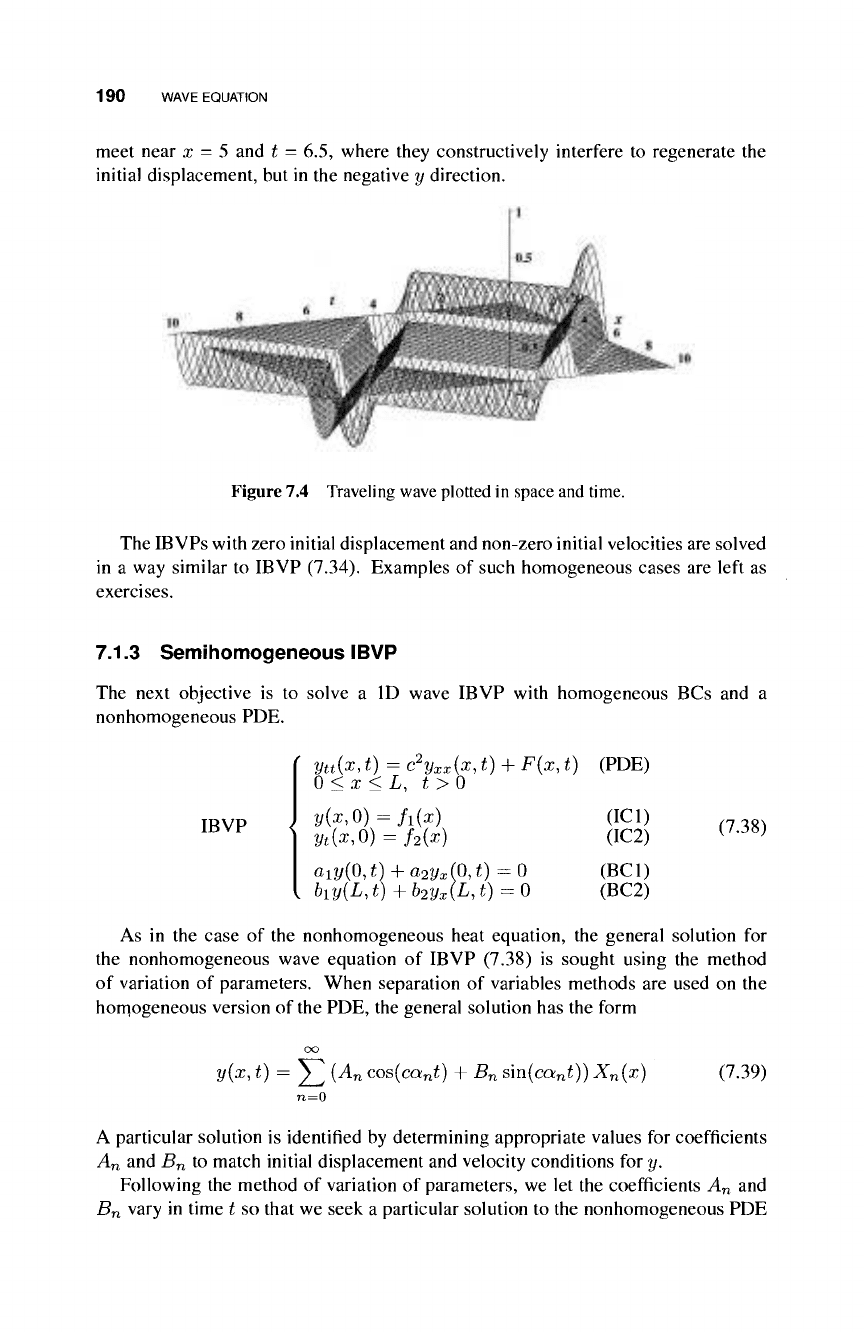
The graph of the solution, plotted as a space-time surface, is shown in Figure 7.4.
The initial parabolic wave stretches from x = 4 to x = 6. As t increases, the wave
"splits"
to form symmetric displacements that travel in opposite directions. When
t œ 3, each signal reaches an end of the x domain and "rebounds" off the boundary
with a negative displacement. These signals are now moving toward eachother. They
190
WAVE EQUATION
meet near x = 5 and t = 6.5, where they constructively interfere to regenerate the
initial displacement, but in the negative y direction.
Figure 7.4 Traveling wave plotted in space and time.
The IB VPs with zero initial displacement and non-zero initial velocities are solved
in a way similar to IBVP (7.34). Examples of such homogeneous cases are left as
exercises.
7.1.3 Semihomogeneous IBVP
The next objective is to solve a ID wave IBVP with homogeneous BCs and a
nonhomogeneous PDE.
y
tt
(x,
t) = c
2
y
xx
{x, t) + F(x, t) (PDE)
0 < x < L, t > 0
y(x,0) = fi(x) (ICI)
2/t(x,0) = /
2
(x) (IC2)
a
iy
(0,t)+a
2
y
x
(0,t)=0 (BC1)
b
iy
(L,t)+b2y
x
(L,t) = 0 (BC2)
IBVP (7.38)
As in the case of the nonhomogeneous heat equation, the general solution for
the nonhomogeneous wave equation of IBVP (7.38) is sought using the method
of variation of parameters. When separation of variables methods are used on the
homogeneous version of the PDE, the general solution has the form
oo
y(x, t) = ^2 (
A
n cos(ca
n
t) + B
n
sm(ca
n
t)) X
n
(x) (7.39)
A particular solution is identified by determining appropriate values for coefficients
A
n
and B
n
to match initial displacement and velocity conditions for y.
Following the method of variation of parameters, we let the coefficients A
n
and
B
n
vary in time t so that we seek a particular solution to the nonhomogeneous PDE
WAVE EQUATION IN 1D 191
of the form
oo
y(x, i) = ]T (A
n
(t) cos(ca
n
t) + B
n
(t) sin(ca
n
t)) X
n
(x) (7.40)
n=0
For notational convenience, we let
C
n
{t) = A
n
(t) cos(ca
n
t) + B
n
{t) sin(ca
n
t) (7.41)
so that
oo
y(x,t) = Y
i
C
n
(t)X
n
(x)
(7.42)
In order to find our series solution, we represent F(x,t) by
OO -£
F(x,t) = VF
n
(t)I
n
(a:), where F
n
(t) = / F{x,t)X
n
(x)dx (7.43)
n=0 ■><>
Substituting for y
tt
, y
xx
, and F(x, t) in the PDE of IBVP (7.38) with appropriate
series representations gives
oo oo oo
^ C';{t)X
n
{x) = Σ -c
2
a^C
n
(í)X
n
(í) + £ F
n
(í)X„(x) (7.44)
n=0 n=0 n=0
Assuming, once again, that equality in the full series implies equality for each index
value n, the following ODE in C
n
(t) results.
C;
,
(í)+c
2
a2c
n
(t)=F
n
(í) (7.45)
We know that cos(ca
n
t) and sin(ca
n
t) are linearly independent solutions of
the homogeneous form of Equation (7.45). Therefore, we may apply the result of
Exercise 1.10 to provide formulas for the derivatives of parameters A
n
(t) and
B
n
(t).
Therefore, we have
=
-sm(cat)F(t)
nV J
W(cos(ca
n
t),sm(ca
n
t))
„/
(
.
=
cos(ca
n
t)F
n
(t)
nK }
W(cos(ca
n
t),sm(ca
n
t))
K
*
}
Where W(cos(ca
n
t), sin(ca
n
t))
—
ca
n
istheWronskianof cos(ca
n
t) andsin(ca
n
i).
Applying the Fundamental theorem of Calculus to both Equations (7.46) and (7.47)
gives
A
n
(t)
= MO) + f "
Sin(Ca
"
T)F
"
(T)
dr (7.48)
B
n
(t)
= B
n
(0) + f
COS(ca
"
T)F
"
(T)
dr (7.49)